Respondeu · mesma resposta final de outras 9 IAs
levou 15 s
Como pensou
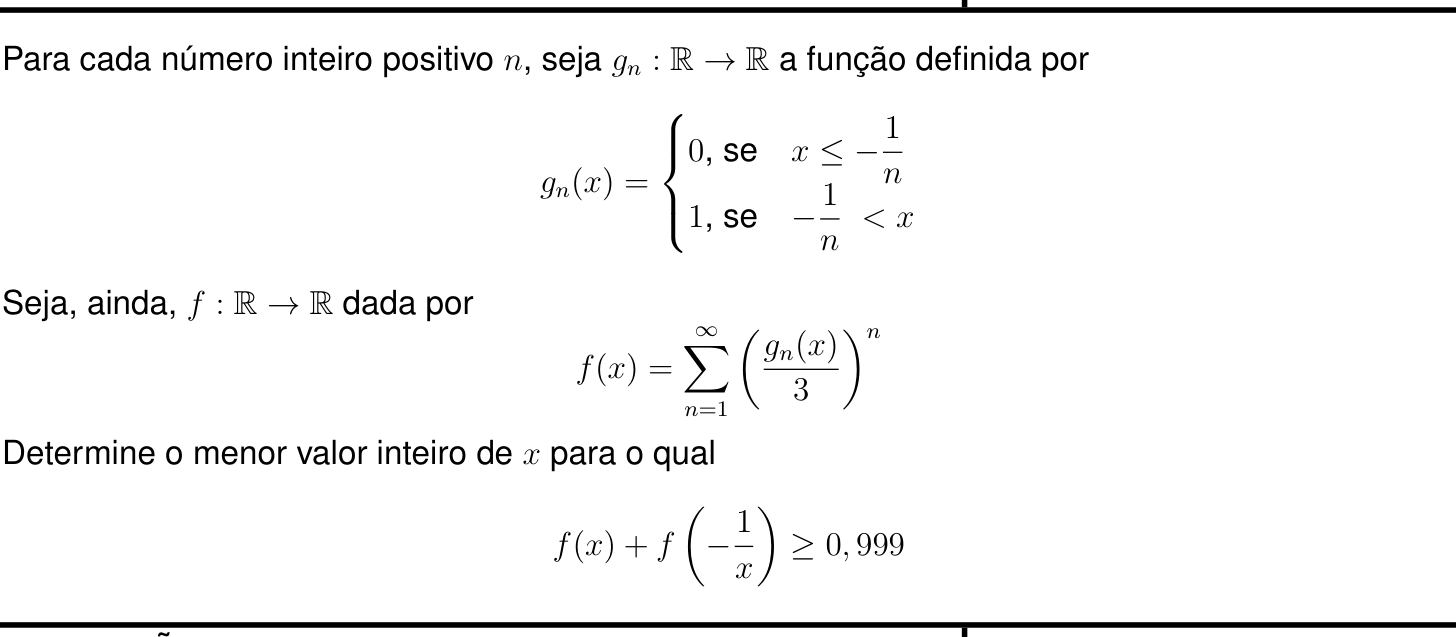
Como g_n(t)\in\{0,1\}, cada parcela de f(t) vale 0 ou 3^{-n}. Em particular, para t\geq 0, temos g_n(t)=1 para todo n, de modo que
f(t)=\sum_{n=1}^{\infty}\frac1{3^n}
=\frac{1/3}{1-1/3}=\frac12.
Se x é inteiro negativo, então x\leq-1, logo g_n(x)=0 para todo n e f(x)=0. Como -1/x>0,
f(x)+f\left(-\frac1x\right)=0+\frac12<0{,}999.
Além disso, x=0 não é permitido. Portanto, basta considerar os inteiros positivos.
Para x>0, temos f(x)=1/2 e
g_n\left(-\frac1x\right)=1
\iff -\frac1n<-\frac1x
\iff n<x.
Assim, como x é inteiro,
f\left(-\frac1x\right)
=\sum_{n=1}^{x-1}\frac1{3^n}
=\frac12\left(1-\frac1{3^{x-1}}\right),
com soma nula quando x=1. A desigualdade pedida equivale, então, a
1-\frac1{2\cdot3^{x-1}}\geq\frac{999}{1000}
\iff 3^{x-1}\geq500.
Como
3^5=243<500<729=3^6,
o menor expoente inteiro possível é x-1=6, isto é, x=7.
Resposta final: 7.
Respondeu · mesma resposta final de outras 9 IAs
levou 15 s
Como pensou
Como g_n(t) assume apenas os valores 0 e 1, temos
\left(\frac{g_n(t)}{3}\right)^n=\frac{g_n(t)}{3^n}.
Assim, para t\ge 0, todos os termos têm g_n(t)=1, de modo que
f(t)=\sum_{n=1}^{\infty}\frac1{3^n}=\frac12.
Já para t\le -1, todos os termos são nulos e f(t)=0.
Se x é inteiro negativo, então x\le-1 e -1/x>0. Logo,
f(x)+f\left(-\frac1x\right)=0+\frac12<0{,}999.
Além disso, x=0 não está no domínio da expressão. Portanto, devemos considerar apenas os inteiros x\ge1.
Para esses valores,
g_n\left(-\frac1x\right)=1
\iff -\frac1n<-\frac1x
\iff n<x.
Consequentemente,
f\left(-\frac1x\right)
=\sum_{n=1}^{x-1}\frac1{3^n}
=\frac12\left(1-\frac1{3^{x-1}}\right),
sendo a soma nula quando x=1. Como f(x)=1/2, a desigualdade equivale a
1-\frac1{2\cdot3^{x-1}}\ge\frac{999}{1000}
\iff 3^{x-1}\ge500.
Por fim,
3^5=243<500<729=3^6.
Logo, o menor expoente inteiro possível é x-1=6, isto é, x=7.
Resposta final: 7.
Respondeu · mesma resposta final de outras 9 IAs
levou 13 s
Como pensou
**Analyzing integer conditions**
I need to solve the equation involving g_n(x). For x less than or equal to -1/n, g_n(x) is zero; otherwise, it's one. I’m trying to determine the least integer x such that f(x) + f(-1/x) is greater than or equal to 0.999, where x is a nonzero integer.
For non-positive integers, f(-m) equals zero. However, for positive integers, I see that as I examine the results, f will converge around 0.5, so I need to reach a sum of at least 0.999.**Determining smallest x**
I calculated 3^5 equals 243 and 3^6 equals 729. From that, it follows that k must be at least 7. I initially considered if x could be negative, but I found that for negative integers, f(-m) equals zero, and for 1/m, it equals 1/2. Since x=0 is undefined, that excludes it as an option. Ultimately, the smallest viable x is indeed 7. I need to keep in mind how f behaves with positive and negative arguments.
Para t\ge 0, temos g_n(t)=1 para todo n, logo
f(t)=\sum_{n=1}^{\infty}\frac1{3^n}=\frac12.
Se t=-a<0, então g_n(t)=1 exatamente quando
-a>-\frac1n \quad\Longleftrightarrow\quad n<\frac1a.
Para um inteiro positivo k, portanto,
f\left(-\frac1k\right)=\sum_{n=1}^{k-1}\frac1{3^n}
=\frac12\left(1-\frac1{3^{k-1}}\right),
e assim
f(k)+f\left(-\frac1k\right)
=1-\frac1{2\cdot 3^{k-1}}.
A condição dada equivale a
\frac1{2\cdot 3^{k-1}}\le \frac1{1000}
\quad\Longleftrightarrow\quad
3^{k-1}\ge 500.
Como 3^5=243<500<729=3^6, o menor inteiro positivo que satisfaz a condição é k=7.
Se x=-k, com k\ge1, então f(-k)=0 e f(1/k)=1/2, de modo que a soma vale 1/2, insuficiente. Além disso, x=0 não está no domínio da expressão por causa de -1/x.
Resposta final: 7
Respondeu · mesma resposta final de outras 9 IAs
levou 19 s
Como pensou
For x ≥ 0, every term in the sum equals 1, giving a geometric series summing to 1/2. For x < 0, I need to figure out which n satisfy the condition, which depends on comparing n to 1/(-x).
Working through f(x)+f(-1/x) ≥ 0.999 for integer x: positive x gives 1 - (1/2)·3^{-(x-1)}, requiring 3^{x-1} ≥ 500, so x ≥ 7, while negative x always gives only 1/2, which fails. So the smallest valid integer is x=7, and checking confirms 3^6=729 satisfies the bound.
Cálculo de f(x)
Temos g_n(x)=1 \iff x>-\dfrac1n, e g_n(x)=0 caso contrário. Como 0^n=0 e (1/3)^n para os termos com g_n=1:
-
Se x\ge 0: x>-\frac1n para todo n, logo
f(x)=\sum_{n=1}^{\infty}\left(\frac13\right)^n=\frac{1/3}{1-1/3}=\frac12.
-
Se x<0: g_n(x)=1 \iff x>-\frac1n \iff n<-\frac1x. Seja N o número de inteiros positivos n com n<-\frac1x. Então
f(x)=\sum_{n=1}^{N}\left(\frac13\right)^n=\frac12\left(1-\frac1{3^N}\right).
(Se N=0, f(x)=0.)
Análise da desigualdade (note que x\neq 0)
Caso x inteiro negativo (x\le -1): então -\frac1x=\frac1{|x|}\le 1, e não existe n\ge 1 com n<\frac1{|x|}; logo f(x)=0. Já -\frac1x>0, logo f(-\frac1x)=\frac12. A soma vale \frac12<0{,}999. Não serve.
Caso x inteiro positivo: f(x)=\frac12. Para -\frac1x<0: g_n(-\frac1x)=1 \iff n<x, ou seja N=x-1:
f\!\left(-\frac1x\right)=\frac12\left(1-\frac1{3^{x-1}}\right).
Assim
f(x)+f\!\left(-\frac1x\right)=1-\frac{1}{2\cdot 3^{x-1}}\ \ge\ 0{,}999 \iff \frac{1}{2\cdot 3^{x-1}}\le 0{,}001 \iff 3^{x-1}\ge 500.
Como 3^5=243<500 e 3^6=729\ge 500, precisamos de x-1\ge 6, isto é, x\ge 7.
Verificação: para x=7, a soma é 1-\frac1{1458}\approx 0{,}99931\ge 0{,}999; para x=6, é 1-\frac1{486}\approx 0{,}99794<0{,}999.
Resposta final: 7
Respondeu · mesma resposta final de outras 9 IAs
levou 15 s
Como pensou
I'm checking the condition g_n(x)=1: for x≥0 all terms are 1 giving f=1/2, while for x<0 only terms with n less than -1/x contribute, so I need to sum that partial geometric series.
For positive integers x, f(x)=1/2 and f(-1/x) requires x-1 terms, giving total 1-(1/2)3^-(x-1); solving this ≥0.999 means x-1≥6, so x≥7, and I verify x=6 fails (≈0.998) while x=7 works (≈0.999). Checking negative integers shows they can't satisfy the bound, so the smallest valid integer is 7.
Cálculo de f(x)
Para cada n, g_n(x) = 1 exatamente quando x > −1/n. Caso contrário, g_n(x) = 0, e o termo correspondente da série se anula.
-
Se x ≥ 0: vale x > −1/n para todo n. Então g_n(x) = 1 para todo n, e
f(x) = Σ_{n≥1} (1/3)^n = (1/3)/(1 − 1/3) = 1/2.
-
Se x < 0: escreva t = −1/x > 0. A condição x > −1/n equivale a 1/n > −x, ou seja, n < t. Sendo m o número de inteiros positivos menores que t, só os m primeiros termos são não nulos:
f(x) = Σ_{n=1}^{m} (1/3)^n = (1/2)(1 − 3^{−m}).
Análise para x inteiro (x ≠ 0, pois aparece −1/x)
Verificação
- x = 6: soma = 1 − 1/486 ≈ 0,99794 < 0,999 (não serve).
- x = 7: soma = 1 − 1/1458 ≈ 0,99931 ≥ 0,999 (serve).
Resposta final: 7
Respondeu · mesma resposta final de outras 9 IAs
levou 12 s
Como pensou
I'm working through the piecewise definition: for x≥0, g_n(x)=1 always so f(x)=1/2. For negative x, I need to figure out the condition n < 1/|x| for g_n(x) to equal 1, which determines how many terms contribute to the sum.
Testing integer values, I find for positive integers x, f(-1/x) = 1 - 3^{-(x-1)}/2, and I want the total sum f(x)+f(-1/x) ≥ 0.999, which requires x≥7. Checking negative integers shows they never satisfy the threshold since the sum only reaches 1/2. So x=7 is the smallest qualifying integer.
Cálculo de f. Como g_n(t) = 1 se t > −1/n e g_n(t) = 0 caso contrário, só contribuem para f(t) os termos com g_n(t) = 1, e cada um vale (1/3)ⁿ.
- Se t ≥ 0, então t > −1/n para todo n, logo f(t) = Σ (1/3)ⁿ = (1/3)/(1 − 1/3) = 1/2.
- Se t < 0, então t > −1/n ⇔ n < 1/|t|. Assim, f(t) = Σ (1/3)ⁿ somado sobre os n inteiros positivos com n < 1/|t|.
Como f(−1/x) exige x ≠ 0, x é inteiro não nulo.
Caso x > 0 (inteiro).
- f(x) = 1/2.
- Para t = −1/x, a condição n < 1/|t| vira n < x, ou seja, n = 1, …, x−1.
Então f(−1/x) = Σ_{n=1}^{x−1} (1/3)ⁿ = (1/2)(1 − 3^{−(x−1)}).
A soma fica
f(x) + f(−1/x) = 1 − (1/2)·3^{−(x−1)}.
A condição ≥ 0,999 equivale a (1/2)·3^{−(x−1)} ≤ 0,001, isto é, 3^{x−1} ≥ 500.
Como 3⁵ = 243 < 500 ≤ 729 = 3⁶, precisamos de x − 1 ≥ 6, ou seja, x ≥ 7.
Caso x < 0 (inteiro). Seja x = −m, com m ≥ 1.
- f(x) = f(−m): como n < 1/m ≤ 1 não tem solução inteira positiva, f(−m) = 0.
- −1/x = 1/m > 0, logo f(−1/x) = 1/2.
A soma vale 1/2 < 0,999, então nenhum x negativo serve.
Portanto os inteiros que satisfazem a desigualdade são exatamente x ≥ 7, e o menor é 7.
Resposta final: 7
Respondeu · mesma resposta final de outras 9 IAs
levou 2 min 40 s
Como pensou
The problem is in Portuguese. I need to understand it.
I'm analyzing the function f(x) = Σ_{n=1}^∞ (g_n(x)/3)^n. Each g_n equals 1 when x > -1/n and 0 otherwise, so each term contributes (1/3)^n only when that condition holds. I need to find the smallest integer x such that f(x) + f(-1/x) ≥ 0.999.
For x ≥ 0, every term contributes to the sum, so f(x) = 1/2. Now I'm analyzing the case where x is negative.
I'm deriving the exact condition for negative x. The inequality x > -1/n is equivalent to n < 1/|x|. I'm now checking the boundary case where x ≤ -1.
For x ≤ -1, every term contributes zero, so f(x) = 0. For -1 < x < 0, g_n(x) equals 1 precisely when n < 1/|x| and 0 otherwise.
For negative x, f(x) is a finite geometric sum over integers n < 1/|x|. I'm now considering f(-1/x) and the target inequality.
The total sum of all terms is exactly 1/2. Because f(x) + f(-1/x) must reach 0.999, the missing terms in each sum can contribute at most 0.001. This means both functions must include almost all terms.
I'm now checking whether x can be positive. If x > 0, then -1/x < 0, so f(-1/x) is strictly less than 1/2. This means the sum f(x) + f(-1/x) would be below 1, which is too small to reach 0.999. Therefore x must be negative.
I'm now pinning down the exact constraint. Because one argument is positive and contributes 1/2, the negative argument must contribute at least 0.499. The tail of excluded terms must therefore sum to at most 0.001. This means n must be at least ceil(1/|z|).
I'm now weighing whether to test negative or positive integers. The phrase "menor valor inteiro" suggests the smallest value, so I'm considering the most negative integer first.
I derived the exact tail sum formula for the geometric series: the sum of terms from n = K onward is (1/2)·(1/3)^{K−1}. This gives me a precise way to check how many terms must be excluded to keep the missing contribution below 0.001.
I solved the inequality (1/3)^{K−1} ≤ 0.002. Since 3^5 = 243 is below 500 and 3^6 = 729 exceeds it, K−1 must be at least 6. This means K ≥ 7.
I verified that K = ceil(1/|z|) ≥ 7 is equivalent to |z| < 1/6. This means the negative argument must have absolute value strictly smaller than 1/6.
I confirmed that |z| = 1/x must be strictly smaller than 1/6. For a positive integer x, this means x > 6, so the smallest valid value is x = 7.
I checked whether negative integers could satisfy the condition. For x ≤ −1, every term contributes zero, so f(x) = 0 and the sum is at most 0.5. For −1 < x < 0, no integer values exist in that interval. Therefore only positive integers qualify, and the smallest valid value is x = 7.
I am now verifying the exact arithmetic for x = 7 and x = 6 to confirm the inequality direction. For x = 7, the tail sum is 1/1458, so f(z) = 1457/1458 ≈ 0.999314, which exceeds 0.999. I am also checking the boundary case where x = 6 to see why it fails.
For x = 6, the sum is exactly 485/486 ≈ 0.99794, which falls short of 0.999. For x = 7, f(z) equals 364/729.
The exact arithmetic for x = 7 confirms the sum is 1457/1458, which exceeds 999/1000. Larger positive integers yield even larger sums. No negative integers satisfy the condition.
I am now checking the boundary between K = 6 and K = 7. When |z| is just above 1/6, the tail sum is 1/729, which is still below 0.001. This confirms that x = 7 is the exact threshold.
Resolução
A função g_n vale 1 precisamente quando x > -1/n e vale 0 caso contrário. Consequentemente,
f(y) = \sum (1/3)^n,
em que a soma percorre apenas os índices n para os quais g_n(y) = 1.
- Se y \ge 0, então y > -1/n para todo n \ge 1, logo
f(y) = \sum_{n=1}^\infty (1/3)^n = \frac{1/3}{1-1/3} = \frac12.
- Se y \le -1, então y \le -1/n para todo n \ge 1, logo f(y) = 0.
- Se -1 < y < 0, os termos não nulos são exatamente aqueles com n < 1/|y|.
A expressão f(x) + f(-1/x) só está definida para x \ne 0. Os dois argumentos x e -1/x têm sinais opostos, de modo que um deles (denotado z) é negativo e o outro é positivo. Assim a soma vale sempre
\frac12 + f(z),
e a desigualdade pedida equivale a f(z) \ge 499/1000, ou seja, a cauda omitida em f(z) é no máximo 1/1000.
Seja K = \lceil 1/|z| \rceil o menor inteiro maior ou igual a 1/|z|. A cauda é
\sum_{n=K}^\infty (1/3)^n = \frac1{2\cdot 3^{K-1}}.
A condição \frac1{2\cdot 3^{K-1}} \le 1/1000 força 3^{K-1} \ge 500. Como 3^5 = 243 < 500 e 3^6 = 729 \ge 500, obtém-se K \ge 7. Esta última desigualdade ocorre se e somente se |z| < 1/6.
Nesse regime a menor soma possível é 1457/1458 > 999/1000. Quando |z| \ge 1/6 a maior soma possível é 485/486 < 999/1000. Portanto a desigualdade original vale se e somente se o argumento negativo tem módulo estritamente menor que 1/6.
- Se x > 0, o argumento negativo é -1/x, e |-1/x| < 1/6 equivale a x > 6. Os inteiros positivos nessa condição são x \ge 7.
- Se x < 0, o argumento negativo é o próprio x, e |x| < 1/6 é impossível para x inteiro.
Logo os únicos inteiros que satisfazem a desigualdade são 7,8,9,\dots, e o menor deles é 7.
Resposta final: 7
Respondeu · mesma resposta final de outras 9 IAs
levou 15 s
Como pensou
We need answer in Portuguese, solve. Let's restate problem.
For each positive integer n, g_n: R -> R defined by
g_n(x) = 0 if x ≤ -1/n
g_n(x) = 1 if -1/n < x.
Let f: R -> R by
f(x) = sum_{n=1}^∞ (g_n(x)/3)^n.
Determine smallest integer x such that f(x) + f(-1/x) ≥ 0,999.
Need solve carefully. Note f defined by series. Need analyze g_n and f.
g_n(x) = 0 if x ≤ -1/n, else 1. So for given x, condition g_n(x)=1 iff x > -1/n, i.e. n > -1/x? Let's see: x > -1/n => multiply by n positive: n x > -1. If x positive, always true? If x>0, n x >0 > -1 yes. If x=0, 0 > -1 true. If x negative, n x > -1 => n < -1/x? Careful: x negative, divide by x negative flips: n < -1/x. Yes. So g_n(x)=1 iff n < -1/x if x<0; and all n if x≥0? Check x=0: all n. For x negative, finite n from 1 up to floor? -1/x positive. Condition n < -1/x, strict. n integer ≥1. So g_n=1 for n < -1/x; g_n=0 for n ≥? If n = -1/x? Then x = -1/n, g_n=0 because x ≤ -1/n yes. So n ≤? Actually n < -1/x = N. If N integer maybe n ≤ N-1. If N noninteger n ≤ floor(N). So finite.
Then f(x)= sum over n with g_n=1 of (1/3)^n. If x≥0, infinite geometric sum_{n=1}∞ (1/3)^n = (1/3)/(1-1/3)=1/2. If x<0, let N = -1/x >0 maybe real. Number of n with n < N. Sum n=1 to m where m = largest integer < N? Since n < -1/x. Let k = ceil(-1/x) -1? Equivalent m = floor? If -1/x = N. If N integer, n < N => n ≤ N-1 = N-1. If noninteger, n ≤ floor(N). So m = ceil(N)-1 = floor(N - epsilon). Let's define m = ⌈N⌉ - 1 = floor(N) if N not integer? Actually if N=2.3, ceil=3 ->2=floor(2.3)=2. If N=2, ceil=2 ->1, floor(2)=2 not correct. So m = ⌈N⌉ -1 always. Alternatively largest integer strictly less than N. If N integer, N-1; else floor(N). So m = floor(N) if N∉Z, =N-1 if N∈Z. Could use m = ⌊N⌋ if N not integer? Better define m = number of positive integers n with n < N. Then f(x)= sum_{n=1}^m (1/3)^n = (1/3)(1 - (1/3)^m)/(1 -1/3) = (1/2)(1 - 3^{-m}). For x≥0, f=1/2. For x<0, m = max { n∈N : n < -1/x }.
Now need f(x)+f(-1/x) ≥ 0.999 for integer x? "menor valor inteiro de x" smallest integer x satisfying. x is integer? Yes "valor inteiro de x". Need find smallest integer x.
Let's analyze f. f(x) ∈ [0,1/2]? For x<0 finite sum <1/2, for x≥0 =1/2. Range [0,1/2), actually approaches 1/2 as m→∞ (x→0-), and at x≥0 exactly 1/2. Also f=0? For x<0, m≥? If -1/x ≤1? If N≤1 then no n< N? Since n≥1, n< N impossible if N≤1. Then f=0. Condition N = -1/x ≤1 => x <0 and -1/x ≤1 => -1 ≥ x? Wait x negative, multiply? -1/x ≤1 => -1 ≥ x? Since x negative, multiply by x negative flips: -1 ≥ x? Let's solve: -1/x ≤1. Multiply by x<0: -1 ≥ x. Yes x ≤ -1. So for x ≤ -1, m=0 => f=0. For -1 < x <0, N>1, m≥1, f>0. At x=0? f=1/2. But domain all real; inequality involves -1/x requires x≠0.
Now f(-1/x): argument y = -1/x. Need f(y). y can be positive/negative depending x? x integer maybe? Let's consider x positive => y=-1/x negative > -1? Since x≥1 => y=-1/x ∈ [-1,0). For x=1, y=-1; x>1, y ∈ (-1,0). For x negative, y=-1/x positive (if x<0). At x=0 undefined.
f(y) for y positive (x<0) =1/2. For y=0? no x infinite. For y negative (x>0): y=-1/x. Since x≥1, y ∈ [-1,0). Analyze m_y = max n∈N with n < -1/y = -1/(-1/x)=x. So m = max n < x. Since x integer positive. If x=1: y=-1, -1/y =1, n<1 none => m=0, f(y)=0. If x>1: m = x-1 (since n integers < x => 1,...,x-1). So f(-1/x)= (1/2)(1 - 3^{-(x-1)}) for integer x≥2; for x=1, 0; for x=0 undefined; for x≥1.
Then inequality:
Case x integer positive: f(x)=1/2 (since x≥0). f(-1/x)= for x=1:0; for x≥2: (1/2)(1 - 3^{-(x-1)}). So sum = 1/2 + (1/2)(1 - 3^{-(x-1)}) = 1 - (1/2)3^{-(x-1)} for x≥2. For x=1: 1/2. Need ≥0.999 = 999/1000. For x=1 no. For x≥2: 1 - 0.5*3^{-(x-1)} ≥ 0.999 => 0.5*3^{-(x-1)} ≤ 0.001 => 3^{-(x-1)} ≤ 0.002 = 2/1000 = 1/500 => 3^{x-1} ≥ 500. 3^5=243, 3^6=729. So x-1 ≥6 => x≥7. Smallest positive integer x=7? Check x=7: f(7)=0.5; f(-1/7): y=-1/7, m = max n < 7 => n=1..6, sum = (1/2)(1 - 3^{-6}) = 0.5 - 0.5/729 ≈0.499314? Sum ≈0.999314 ≥0.999 yes. x=6: sum =1 -0.5/243 ≈0.99794 <0.999. So smallest positive integer =7. But need consider negative integers? x negative? Inequality with x negative: f(x) maybe <1/2, f(-1/x) = f(positive) =1/2. Sum could be ≥0.999? Since f(x)<1/2 and f(pos)=1/2, sum <1? Actually <1, could be up to <1? For x negative, y positive => f(y)=1/2. f(x) ≤? For x<0, f(x) <1/2. Sum <1. Could it be ≥0.999? Need check. For x=-1? y=1, f(1)=1/2. f(-1)=0 (since x≤-1 => m=0). Sum=0.5 <0.999. For x=-0? integer no. For negative integer x=-k, k≥1: f(-k) =? N=-1/x = 1/k ≤1 for k≥1? If k=1 N=1 => m=0 f=0. If k>1, N=1/k <1 => m=0 f=0. So f(-k)=0 for all positive integer k? Let's verify x=-2: g_n(-2)=0 if -2 ≤ -1/n => 2 ≥1/n => n≥? For n=1: 2 ≥1 yes g1=0; all n? 2 ≥1/n always true? For n large 1/n small, 2≥ small yes. So g_n=0 all n => f=0. Indeed x<0 with |x|≥1? If x≤-1, N=-1/x ≤1, no n< N (n≥1 not < ≤1?). At N=1, n<1 none. So f=0. For -1 < x <0, N>1, some n. But x integer negative? No integers between -1 and0 except? None. So all negative integers x ≤ -1 have f(x)=0. Then f(-1/x): for x=-k (k≥1), y=1/k positive? Actually -1/x = -1/(-k)=1/k >0, so f(y)=1/2 (since positive). Sum=1/2 <0.999. So no negative integer.
Case x=0? -1/x undefined; inequality invalid? Usually x nonzero? Problem asks menor valor inteiro de x, domain f(x)+f(-1/x) requires x≠0. So x integer nonzero. Smallest integer satisfying might be negative? But we saw negative integers fail. Positive smallest 7. But check maybe x=0? no. What about non-integer? "menor valor inteiro de x" means x integer; smallest integer overall likely 7? But maybe there is negative integer with larger magnitude? Sum 0.5 no. So answer 7. But let's be thorough: Need ensure f(x)+f(-1/x) ≥ 0.999 for x integer. Yes.
But perhaps there is subtlety: f defined as infinite series; for x negative with -1/x positive? Wait if x negative, y=-1/x positive, f(y)=1/2. f(x) for negative integer =0. Sum=0.5. So no.
Thus smallest integer x=7.
Need provide resolution step-by-step in Portuguese. Need maybe define m. Let's craft final answer with explanation.
Let's verify all conditions precisely.
Given g_n(x)=1 iff -1/n < x. For x≥0, all n satisfy x > -1/n? Since -1/n <0 ≤x, yes. So f(x)=∑_{n=1}∞ (1/3)^n =1/2.
For x<0, let N=-1/x >0. Then g_n(x)=1 iff n < N (since n x > -1 => if x<0 divide by x: n < -1/x = N). Therefore f(x)=∑_{n=1}^{m} (1/3)^n where m = number of positive integers n with n < N. If N≤1, m=0 => f=0. If N>1, m=⌈N⌉-1? Let's derive formula for m: m = 0 if N≤1; m = ⌊N⌋ if N non-integer? Actually if N>1 and N not integer, m=floor(N). If N integer, m=N-1. Could express m = ⌈N⌉-1 always: If N integer k, ⌈N⌉=k, m=k-1; if non-integer k< N <k+1, ⌈N⌉=k+1, m=k=floor(N). Yes m = ⌈N⌉ -1. But for N≤1, ceil(N)=1, m=0. Good. So f(x)= (1/2)(1 - 3^{-m}) for x<0, with m=⌈-1/x⌉-1? Wait N=-1/x; m = number of integers n≥1 with n < N. If N≤1, m=0. Formula (1/2)(1 - 3^{-m}) works for m=0 giving 0. So m = max { n∈N : n < N } = ⌈N⌉ -1? Since if N integer k, ceil=k, m=k-1; if noninteger, ceil=k+1, m=k. Yes. So m = ⌈N⌉ -1. But if N<1, ceil=1, m=0. Good. So f(x)=1/2(1 - 3^{-m}), m = ⌈-1/x⌉ -1 for x<0.
For x integer nonpositive? x=0 undefined; x≤-1, N=-1/x ≤1, m=0, f=0.
For x positive integer k: f(k)=1/2. y=-1/k ∈[-1,0). For k=1, y=-1, f(y)=0 (since y≤-1, m=0). For k≥2, y∈(-1,0), N_y=-1/y = k. Since k integer >1, m_y = number of n < k = k-1 (n=1..k-1). Thus f(y)=1/2(1 - 3^{-(k-1)}). Then f(k)+f(-1/k)=1/2 + 1/2 - 1/2*3^{-(k-1)} = 1 - 1/(2*3^{k-1}). Inequality ≥0.999 =999/1000 => 1/(2*3^{k-1}) ≤1/1000 => 3^{k-1} ≥500. Since k integer positive, k-1≥6 => k≥7. Check k=6: 3^5=243 <500 so sum <1 -1/(2*243)? Actually difference =1/(2*243)=1/486 ≈0.002057 >0.001? Wait 1/(2*243)=1/486≈0.002057, sum≈0.997943 <0.999. Yes. k=7: 3^6=729, difference=1/(1458)≈0.0006858, sum≈0.999314 ≥0.999. Smallest k=7.
Need ensure for x positive but maybe x=0? no. Negative integers no. So smallest integer x=7.
Let's craft final answer with math in Portuguese.
Potential issue: f(x) for x negative non-integer could be >? But smallest integer. But let's consider if a negative integer could have larger sum? No f=0 for all negative integers? Let's prove: x=-k, k≥1. N=-1/x=1/k ≤1. Since n≥1, n< N impossible. Thus g_n=0 all n => f(-k)=0. f(-1/(-k))=f(1/k)=1/2. Sum=1/2. So no.
Need maybe mention "menor valor inteiro de x" singular. Answer 7.
Let's produce final with steps.
Seja x\in\mathbb Z, x\ne 0. Temos
g_n(x)=1 \iff x>-\frac1n.
1. Cálculo de f(x)
- Se x\ge 0, então para todo n, x>-\frac1n. Logo
f(x)=\sum_{n=1}^{\infty}\left(\frac13\right)^n=\frac{1/3}{1-1/3}=\frac12.
- Se x<0, seja N=-\frac1x>0. Então
n<-\frac1x=N \iff g_n(x)=1.
Assim
f(x)=\sum_{n=1}^{m}\left(\frac13\right)^n
=\frac12\left(1-3^{-m}\right),
onde m é o número de inteiros positivos n tais que n<N. Em particular, se x\le -1, então N=-1/x\le 1 e m=0, logo
f(x)=0.
2. Análise para x inteiro
a) x negativo
Se x=-k, k\in\mathbb Z_{>0}, então
f(x)=f(-k)=0.
Além disso,
-\frac1x=\frac1k>0 \implies f\left(-\frac1x\right)=\frac12.
Portanto
f(x)+f\left(-\frac1x\right)=0+\frac12=\frac12<0,999.
Logo não há solução negativa.
b) x inteiro positivo
Se x=k\in\mathbb Z_{>0}, então f(k)=\frac12.
Agora
-\frac1k\in[-1,0).
Para k=1, -\frac11=-1, e como x\le -1, f(-1)=0, então
f(1)+f(-1)=\frac12+0=0,5<0,999.
Para k\ge 2, -\frac1k\in(-1,0), e
f\left(-\frac1k\right)=\frac12\left(1-3^{-(k-1)}\right).
Assim
f(k)+f\left(-\frac1k\right)
=\frac12+\frac12\left(1-3^{-(k-1)}\right)
=1-\frac{1}{2\cdot 3^{k-1}}.
Queremos
1-\frac{1}{2\cdot 3^{k-1}}\ge 0,999
=\frac{999}{1000}.
Logo
\frac{1}{2\cdot 3^{k-1}}\le \frac{1}{1000}
\iff 3^{k-1}\ge 500.
Como 3^5=243<500 e 3^6=729>500, devemos ter
k-1\ge 6 \implies k\ge 7.
Portanto o menor inteiro positivo é k=7.
3. Verificação
Para x=7:
f(7)+f\left(-\frac17\right)
=1-\frac{1}{2\cdot 3^6}
=1-\frac{1}{1458}
\approx 0,999314\ge 0,999.
Para x=6:
1-\frac{1}{2\cdot 3^5}
=1-\frac{1}{486}
\approx 0,99794<0,999.
Logo, o menor valor inteiro de x é 7.
Resposta final: 7
Respondeu · mesma resposta final de outras 9 IAs
levou 38 s
Como pensou
**Analyzing the Function's Behavior**
I'm currently examining the function $g_n(x)$, which is a step function. It remains at 0 for $x \le -1/n$ and jumps to 1 for $x > -1/n$. This definition seems to be the starting point for further analysis in the problem.
**Calculating the Series Sum**
I've determined that for $x \ge 0$, the function $f(x)$ consistently evaluates to 0.5. This is because for non-negative $x$, every $g_n(x)$ term becomes 1, leading to a geometric series summation. My focus now shifts to understanding the behavior of $f(x)$ when $x$ is negative.
**Determining the Series Limit**
I've established that for $x \le -1$, the function $f(x)$ is identically zero. My current focus is on the interval $-1 < x < 0$, where the upper limit of the summation for $g_n(x)$ varies based on whether $-1/x$ is an integer or not, influencing the count of terms contributing to the sum.
**Investigating Integer Solutions**
I've confirmed that no negative integers satisfy the inequality. My current focus is on positive integers, examining how the value of $-1/x$ for negative $x$ dictates the behavior of $f(-1/x)$, and how this influences the sum of $f(x) + f(-1/x)$ to reach the target value of 0.999.
**Evaluating the Summation**
I'm now focusing on the sum $f(x) + f(-1/x)$ for positive integers $x$. For $x \ge 1$, $f(x)$ is consistently 0.5. When $x=1$, $f(-1) = 0$, yielding $0.5$. For $x \ge 2$, $-1/x$ falls within $(-1, 0)$, and I've found the number of terms in its series expansion depends on $x$.
**Finding the Integer Solution**
I've successfully derived the inequality $3^{x-1} \ge 500$ and found that the smallest integer solution for $x-1$ is 6, leading to $x=7$. My current focus is on confirming if any negative integers could satisfy the initial conditions, but it appears unlikely given previous findings.
**Confirming Non-Integer Solutions**
I've confirmed that no negative integers satisfy the inequality, as $f(x) + f(-1/x)$ equals 0.5. My current focus is on ensuring that the derived inequality for positive integers, $3^{x-1} \ge 500$, accurately captures all conditions, especially concerning the fractional parts of $-1/x$.
**Refining the Solution**
I've confirmed the derived inequality $3^{x-1} \ge 500$ is sound, and the minimum integer solution $x=7$ is correct. My final check is to ensure no edge cases were missed, particularly regarding the definition of $g_n(x)$ at its boundary points and the summation for negative values of $x$.
**Finalizando a Verificação**
I'm confirming that the derived inequality $3^{x-1} \ge 500$ holds true, and $x=7$ is indeed the smallest integer solution. My final thoughts are focused on ensuring no edge cases were overlooked, especially concerning the function's definition at boundary points and for negative inputs.
**Revisando o Cálculo Final**
I'm double-checking the inequality $1 - \frac{1}{2 \cdot 3^{x-1}} \ge 0.999$. My work confirms that $x=7$ is the smallest integer solution. I am now consolidating my understanding of the entire problem, from the step function definition to the final inequality derived.
Para que a expressão f\left(-\frac{1}{x}\right) esteja bem definida, devemos ter x \neq 0. Logo, sendo x inteiro, consideramos x \in \mathbb{Z}^*.
1. Análise da função f(t)
Para cada n \in \mathbb{Z}^+, temos:
g_n(t) = \begin{cases} 0, & \text{se } t \le -\frac{1}{n} \\ 1, & \text{se } t > -\frac{1}{n} \end{cases}
Logo, a série que define f(t) torna-se:
f(t) = \sum_{n=1}^{\infty} \left(\frac{g_n(t)}{3}\right)^n = \sum_{\substack{n \ge 1 \\ t > -1/n}} \frac{1}{3^n}
-
Se t \ge 0:
Como n \ge 1, tem-se -\frac{1}{n} < 0 \le t para todo n \ge 1. Portanto, g_n(t) = 1 para todo n \ge 1:
f(t) = \sum_{n=1}^{\infty} \frac{1}{3^n} = \frac{\frac{1}{3}}{1 - \frac{1}{3}} = \frac{1}{2} = 0,5
-
Se t < 0:
A condição t > -\frac{1}{n} equivale a -t < \frac{1}{n} \iff n < -\frac{1}{t}.
Assim, g_n(t) = 1 se, e somente se, 1 \le n < -\frac{1}{t}.
2. Análise para inteiros negativos (x \le -1)
Se x é um número inteiro negativo, temos x \le -1:
Dessa forma:
f(x) + f\left(-\frac{1}{x}\right) = 0 + 0,5 = 0,5 < 0,999
Portanto, nenhum inteiro negativo satisfaz a inequação.
3. Análise para inteiros positivos (x \ge 1)
Se x é um número inteiro positivo:
Assim, a soma é dada por:
f(x) + f\left(-\frac{1}{x}\right) = \frac{1}{2} + \frac{1}{2}\left(1 - \frac{1}{3^{x-1}}\right) = 1 - \frac{1}{2 \cdot 3^{x-1}}
4. Resolução da inequação
Queremos encontrar o menor valor inteiro de x tal que:
1 - \frac{1}{2 \cdot 3^{x-1}} \ge 0,999
\frac{1}{2 \cdot 3^{x-1}} \le 1 - 0,999 = 0,001 = \frac{1}{1000}
2 \cdot 3^{x-1} \ge 1000 \iff 3^{x-1} \ge 500
Calculando as potências de 3:
- 3^5 = 243 < 500
- 3^6 = 729 \ge 500
Portanto, o menor valor inteiro para x - 1 é 6, o que nos dá:
x - 1 = 6 \implies x = 7
Resposta final: 7
Respondeu · mesma resposta final de outras 9 IAs
levou 44 s
Como pensou
**Analyzing Mathematical Problem**
I am currently processing the mathematical problem presented. My initial steps involve transcribing the problem statement accurately, which defines a function $g_n(x)$ for each positive integer $n$. This function is piecewise defined and appears to have a base case where it is zero.
**Evaluating Function Behavior**
I've determined that for non-negative $x$, $g_n(x)$ is always 1, resulting in a constant $f(x)$ value of 0.5. My focus now shifts to understanding how $g_n(x)$ behaves for negative $x$, particularly its dependence on $n$ and its relation to $-1/x$.
**Investigating Negative Inputs**
I've established that for $x \le -1$, $g_n(x)$ is always 0, leading to $f(x) = 0$. This means that for negative integers, $f(x) + f(-1/x)$ evaluates to $0 + 0.5$, which does not satisfy the condition. I'm now working through positive integer inputs.
**Deriving Inequality Conditions**
I've now fully characterized $g_n(x)$ for various $x$ ranges. For positive integers $x$, I've derived an expression for $f(-1/x)$ and combined it with $f(x)$ to form the inequality $1 - \frac{1}{2 \cdot 3^{x-1}} \ge 0.999$. I am now focused on solving this inequality for $x$.
Para determinar o menor valor inteiro de x que satisfaz a inequação, devemos primeiramente analisar o comportamento da função f(x) nos diferentes intervalos reais. Note que, devido ao termo -\frac{1}{x}, devemos ter x \neq 0.
1. Cálculo de f(y) para y \ge 0:
Se y \ge 0, então para todo inteiro positivo n \ge 1, temos -\frac{1}{n} < 0 \le y. Pela definição de g_n, segue que g_n(y) = 1 para todo n \ge 1. Logo, f(y) é a soma de uma progressão geométrica infinita de razão \frac{1}{3}:
f(y) = \sum_{n=1}^{\infty} \left(\frac{1}{3}\right)^n = \frac{\frac{1}{3}}{1 - \frac{1}{3}} = \frac{1}{2} = 0,5
2. Cálculo de f(y) para y \le -1:
Se y \le -1, então para todo inteiro positivo n \ge 1, temos y \le -1 \le -\frac{1}{n}. Assim, g_n(y) = 0 para todo n \ge 1, o que resulta em:
f(y) = \sum_{n=1}^{\infty} 0 = 0
Agora, analisamos os possíveis valores inteiros não nulos para x:
Caso 1: x é um inteiro negativo (x \le -1)
Nesse caso, como x \le -1, temos f(x) = 0. Além disso, como x < 0, temos -\frac{1}{x} > 0, o que implica f\left(-\frac{1}{x}\right) = 0,5. Portanto:
f(x) + f\left(-\frac{1}{x}\right) = 0 + 0,5 = 0,5 < 0,999
Logo, nenhum inteiro negativo satisfaz a condição do problema.
Caso 2: x é um inteiro positivo (x \ge 1)
Como x > 0, temos diretamente que f(x) = \frac{1}{2}.
Para calcular f\left(-\frac{1}{x}\right), observamos a condição para que g_n\left(-\frac{1}{x}\right) seja igual a 1:
-\frac{1}{n} < -\frac{1}{x} \iff \frac{1}{n} > \frac{1}{x} \iff n < x
E para
n \ge x, temos
-\frac{1}{x} \le -\frac{1}{n}, resultando em
g_n\left(-\frac{1}{x}\right) = 0.
Substituindo na inequação dada:
f(x) + f\left(-\frac{1}{x}\right) \ge 0,999
\frac{1}{2} + \frac{1}{2}\left(1 - \frac{1}{3^{x-1}}\right) \ge \frac{999}{1000}
1 - \frac{1}{2 \cdot 3^{x-1}} \ge 1 - \frac{1}{1000}
\frac{1}{2 \cdot 3^{x-1}} \le \frac{1}{1000} \iff 2 \cdot 3^{x-1} \ge 1000 \iff 3^{x-1} \ge 500
Como a função exponencial de base 3 é estritamente crescente e sabemos que 3^5 = 243 < 500 e 3^6 = 729 \ge 500, concluímos que:
x - 1 \ge 6 \iff x \ge 7
Portanto, o menor valor inteiro de x que satisfaz a desigualdade é 7.
Resposta final: 7