Correção IME 2027 · MatemáticaAcompanhe a resolução de cada questão da 2ª fase, ao vivoAcompanhar
IA ao vivo / IME 2027 · 2ª fase · Matemática

COMPARE OS RACIOCÍNIOS

Questão 2 (Matemática)

Questão discursiva: a banca não divulga gabarito oficial. ← 1 (Matemática) 3 (Matemática) →

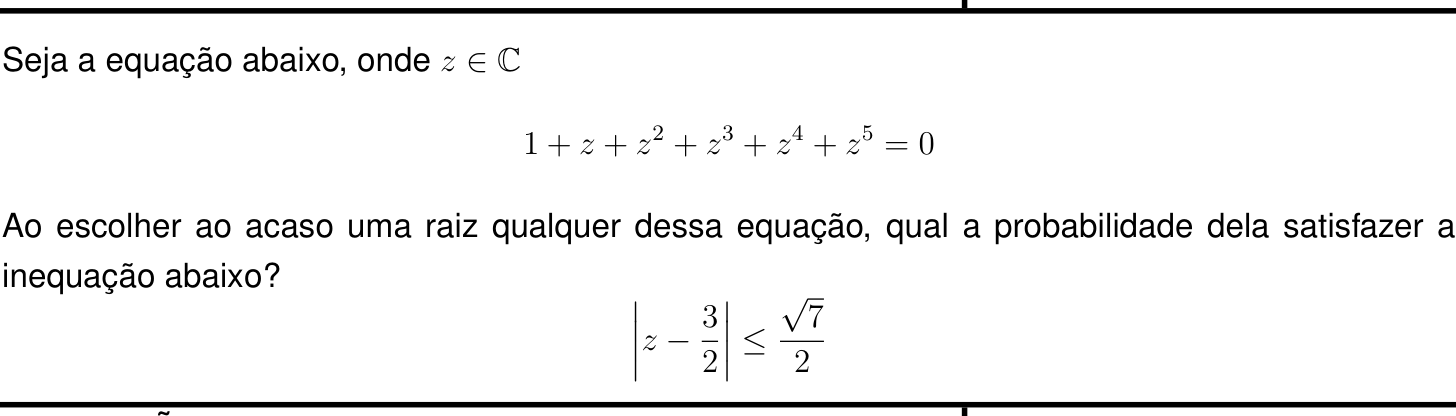
A questão

Questão 2 (Matemática)

Respostas das IAs

GPT-6 Astra

Respondeu · mesma resposta final de outras 9 IAs

\boxed{\dfrac25}.

levou 11 s

Como pensou
**Solving Portuguese Roots** I need to work on the coherent five roots of unity in Portuguese, excluding one, and focusing on the real inequality being greater than or equal to 1/2. I should demonstrate that z1 is not a root by dealing with modulus squared as 13/4 - 3 real, which must be less than or equal to 7/4. I'll list the roots and also express the roots as z = e^{ikπ/3}. Finally, I need to compute the modulus squared and show that the answer will be "Resposta final: \(\dfrac{2}{5}\)."

Como z=1 não é raiz da equação, podemos usar a identidade

(z-1)(1+z+z^2+z^3+z^4+z^5)=z^6-1.

Assim, as raízes da equação são as raízes sextas da unidade, exceto 1:

z_k=e^{ik\pi/3},\qquad k=1,2,3,4,5.

Explicitamente, são

\frac12\pm\frac{\sqrt3}{2}i,\qquad -\frac12\pm\frac{\sqrt3}{2}i,\qquad -1.

Todas têm módulo 1. Logo,

\left|z-\frac32\right|^2 =|z|^2-3\operatorname{Re}(z)+\frac94 =\frac{13}{4}-3\operatorname{Re}(z).

Portanto,

\left|z-\frac32\right|\leq\frac{\sqrt7}{2} \iff \frac{13}{4}-3\operatorname{Re}(z)\leq\frac74 \iff \operatorname{Re}(z)\geq\frac12.

Das cinco raízes, apenas \frac12\pm\frac{\sqrt3}{2}i satisfazem essa condição. Como a escolha é ao acaso, a probabilidade é

P=\frac{\text{número de raízes favoráveis}}{\text{número total de raízes}} =\frac25.

Resposta final: \boxed{\dfrac25}.

GPT-6.1 Sol

Respondeu · mesma resposta final de outras 9 IAs

\dfrac{2}{5}.

levou 10 s

Como pensou
**Breaking down the problem** I need to parse the roots of the sixth unity, excluding 1 through 5, and consider the inequality Re >= 1/2 with a boundary around ±pi/3. The probability calculation is 2/5. I should show how to multiply the identity for z not equal to 1 and find these sixth roots. I'll tackle the inequality from both sides. There's a need for a concise solution in Portuguese, ensuring that the image of the inequality holds true too. Lastly, I need to develop a full explanation in about 500 tokens.

Como z=1 não é raiz da equação, podemos usar a soma de uma progressão geométrica:

1+z+z^2+z^3+z^4+z^5=\frac{z^6-1}{z-1}=0.

Portanto, as raízes são as raízes sextas da unidade, exceto 1:

z_k=\cos\frac{k\pi}{3}+i\sen\frac{k\pi}{3}, \qquad k=1,2,3,4,5.

São, assim, cinco raízes distintas, todas com módulo 1.

Escrevendo z=x+iy, temos x^2+y^2=1. Logo,

\left|z-\frac32\right|^2 =\left(x-\frac32\right)^2+y^2 =\frac{13}{4}-3x.

A inequação dada equivale a

\frac{13}{4}-3x\leq\frac74 \quad\Longleftrightarrow\quad x\geq\frac12.

Entre as cinco raízes, apenas

z_1=\frac12+\frac{\sqrt3}{2}i \quad\text{e}\quad z_5=\frac12-\frac{\sqrt3}{2}i

satisfazem essa condição. Como as raízes são escolhidas com igual probabilidade,

P=\frac{2}{5}.

Resposta final: \dfrac{2}{5}.

GPT-6 Luna

Respondeu · mesma resposta final de outras 9 IAs

\frac25.

levou 7 s

Como pensou

Temos

1+z+z^2+z^3+z^4+z^5=\frac{z^6-1}{z-1}\quad(z\ne1).

Como z=1 não é raiz, as raízes são as seis raízes sextas da unidade, exceto 1:

z_k=e^{ik\pi/3},\qquad k=1,2,3,4,5.

Para qualquer uma delas, |z_k|=1. Logo,

\left|z_k-\frac32\right|^2 =|z_k|^2+\frac94-3\operatorname{Re}(z_k) =\frac{13}{4}-3\cos\left(\frac{k\pi}{3}\right).

A desigualdade dada equivale a

\frac{13}{4}-3\cos\left(\frac{k\pi}{3}\right)\le\frac74 \quad\Longleftrightarrow\quad \cos\left(\frac{k\pi}{3}\right)\ge\frac12.

Isso ocorre para k=1 e k=5, isto é, para 2 das 5 raízes.

Resposta final: \frac25.

Claude Fable 5.1

Respondeu · mesma resposta final de outras 9 IAs

2/5

levou 14 s

Como pensou
The equation factors as (z⁶−1)/(z−1)=0 with z≠1, so the roots are the five nontrivial sixth roots of unity, e^{ikπ/3} for k=1,...,5. I'm now working out the condition |z−3/2|≤√7/2 in terms of the angle θ, expanding |z|²−3Re z+9/4 as 1−3cosθ+9/4. This simplifies to cosθ≥1/2. Checking each k, only k=1 and k=5 satisfy this (giving cosθ=1/2 exactly), while k=2,3,4 fail. So 2 out of 5 roots qualify, giving probability 2/5.

Resolução

Para z \neq 1, multiplicando a equação por (z-1):

(z-1)(1+z+z^2+z^3+z^4+z^5) = z^6 - 1 = 0

Logo as raízes são as raízes sextas da unidade diferentes de 1:

z_k = \operatorname{cis}\left(\frac{k\pi}{3}\right) = \cos\frac{k\pi}{3} + i\,\operatorname{sen}\frac{k\pi}{3},\quad k = 1,2,3,4,5

(São 5 raízes, todas com |z_k| = 1.)

Análise da inequação: seja z = \cos\theta + i\,\operatorname{sen}\theta com |z|=1. Então

\left|z-\tfrac{3}{2}\right|^2 = \left(\cos\theta - \tfrac{3}{2}\right)^2 + \operatorname{sen}^2\theta = 1 - 3\cos\theta + \tfrac{9}{4} = \tfrac{13}{4} - 3\cos\theta

A condição \left|z-\tfrac32\right| \le \tfrac{\sqrt7}{2} equivale a

\tfrac{13}{4} - 3\cos\theta \le \tfrac{7}{4} \iff 3\cos\theta \ge \tfrac{6}{4} \iff \cos\theta \ge \tfrac{1}{2}

Verificando cada raiz:

  • k=1: \theta = \frac{\pi}{3}, \cos\theta = \frac12 ✓ (igualdade, satisfaz)
  • k=2: \theta = \frac{2\pi}{3}, \cos\theta = -\frac12 ✗
  • k=3: \theta = \pi, \cos\theta = -1 ✗
  • k=4: \theta = \frac{4\pi}{3}, \cos\theta = -\frac12 ✗
  • k=5: \theta = \frac{5\pi}{3}, \cos\theta = \frac12 ✓ (igualdade, satisfaz)

Portanto, das 5 raízes, exatamente 2 satisfazem a inequação (as raízes \frac{1}{2} \pm \frac{\sqrt3}{2}i).

P = \frac{2}{5}

Resposta final: 2/5

Claude Opus 5.5

Respondeu · mesma resposta final de outras 9 IAs

2/5

levou 9 s

Como pensou
I'm checking the five nontrivial sixth roots of unity and computing |z - 3/2|² = 13/4 - 3cosθ, then finding which angles satisfy cosθ ≥ 1/2 to meet the distance constraint. Only k=1 and k=5 satisfy this, while k=2,3,4 don't, giving a probability of 2/5.

Raízes da equação

O lado esquerdo é a soma de uma progressão geométrica. Para z \neq 1:

1+z+z^2+z^3+z^4+z^5=\frac{z^6-1}{z-1}=0 \iff z^6=1,\ z\neq 1.

z=1 não é raiz, pois daria 6 \neq 0. As raízes são então as raízes sextas da unidade, exceto 1:

z_k=\cos\frac{k\pi}{3}+i\,\mathrm{sen}\frac{k\pi}{3},\quad k=1,2,3,4,5.

São 5 raízes distintas, todas com |z|=1.

Condição da inequação

Escrevendo z=\cos\theta+i\,\mathrm{sen}\,\theta e usando |z|=1:

\left|z-\tfrac32\right|^2=|z|^2-3\,\mathrm{Re}(z)+\tfrac94=\tfrac{13}{4}-3\cos\theta.

A inequação equivale a

\tfrac{13}{4}-3\cos\theta\le\tfrac74 \iff 3\cos\theta\ge \tfrac32 \iff \cos\theta\ge\tfrac12.

Verificação de cada raiz

k \theta \cos\theta Satisfaz?
1 \pi/3 1/2 sim (igualdade)
2 2\pi/3 -1/2 não
3 \pi -1 não
4 4\pi/3 -1/2 não
5 5\pi/3 1/2 sim (igualdade)

Duas das cinco raízes satisfazem a inequação. A probabilidade é

P=\frac{2}{5}.

Resposta final: 2/5

Claude Sonnet 5.5

Respondeu · mesma resposta final de outras 9 IAs

2/5

levou 8 s

Como pensou
The roots of the polynomial are the sixth roots of unity excluding 1, giving five candidates. I'm checking which satisfy |z-3/2|² ≤ 7/4 by computing the distance squared using cosθ for each root on the unit circle. This simplifies to cosθ ≥ 1/2, which holds at θ = ±π/3 (equality) but fails for 2π/3, π, and 4π/3. That leaves 2 out of 5 roots satisfying the condition, giving probability 2/5.

Raízes da equação. Como 1 + z + z² + z³ + z⁴ + z⁵ = (z⁶ − 1)/(z − 1) para z ≠ 1, as raízes são as raízes sextas da unidade, exceto z = 1. Ou seja, z = e^{iθ} com θ = π/3, 2π/3, π, 4π/3, 5π/3. São 5 raízes, todas com |z| = 1.

Inequação. Para |z| = 1, com z = cos θ + i sen θ:

|z − 3/2|² = |z|² − 3·Re(z) + 9/4 = 1 − 3cos θ + 9/4 = 13/4 − 3cos θ.

A condição |z − 3/2| ≤ √7/2 equivale a |z − 3/2|² ≤ 7/4, isto é:

13/4 − 3cos θ ≤ 7/4 ⟹ 3cos θ ≥ 3/2 ⟹ cos θ ≥ 1/2.

Verificação das raízes:

  • θ = π/3: cos θ = 1/2, satisfaz (vale a igualdade).
  • θ = 5π/3: cos θ = 1/2, satisfaz (vale a igualdade).
  • θ = 2π/3 e 4π/3: cos θ = −1/2, não satisfazem.
  • θ = π: cos θ = −1, não satisfaz.

Portanto, 2 das 5 raízes satisfazem a inequação, e a probabilidade é 2/5.

Resposta final: 2/5

Grok 4.7

Respondeu · mesma resposta final de outras 9 IAs

2/5

levou 25 s

Como pensou
The problem is in Portuguese. Identifiquei a equação como a soma de uma progressão geométrica. As raízes são as raízes sextas da unidade distintas de 1. Agora estou analisando quais dessas raízes satisfazem a desigualdade |z - 3/2| ≤ √7 / 2. As cinco raízes são: 1/2 + i√3/2, −1/2 + i√3/2, −1, −1/2 − i√3/2 e 1/2 − i√3/2. Agora vou calcular a probabilidade de uma raiz aleatória satisfazer |z − 3/2| ≤ √7 / 2. O disco tem centro em 1,5 e raio √7/2 ≈ 1,32. Como as raízes estão na circunferência unitária, vou usar a condição |z − 3/2|² ≤ 7/4. Substituindo x² + y² = 1, chego à desigualdade −3x + 3,25 ≤ 1,75. A desigualdade se simplifica para x ≥ 1/2. Isso significa que as raízes que satisfazem a condição são aquelas com parte real maior ou igual a 1/2. As raízes com parte real maior ou igual a 1/2 são as de argumento ±60°. Dois dos cinco pontos satisfaem a condição. A probabilidade é 2/5.

A equação dada é a soma dos termos de uma progressão geométrica:

1 + z + z^2 + z^3 + z^4 + z^5 = \frac{z^6 - 1}{z - 1} = 0, \quad z \neq 1.

Assim, as raízes são as raízes sextas da unidade, exceto z = 1:

z_k = e^{2\pi i k/6} = \operatorname{cis}\Bigl(\frac{k\pi}{3}\Bigr), \quad k = 1,2,3,4,5.

Explicitamente,
\begin{align*}
z_1 &= \tfrac12 + i\tfrac{\sqrt3}{2}, \
z_2 &= -\tfrac12 + i\tfrac{\sqrt3}{2}, \
z_3 &= -1, \
z_4 &= -\tfrac12 - i\tfrac{\sqrt3}{2}, \
z_5 &= \tfrac12 - i\tfrac{\sqrt3}{2}.
\end{align*}
Todas satisfazem |z| = 1. A desigualdade |z - 3/2| \le \sqrt7/2 equivale, para esses pontos, a

\bigl(x - \tfrac32\bigr)^2 + y^2 \le \tfrac74.

Usando x^2 + y^2 = 1, obtém-se

1 + \tfrac94 - 3x \le \tfrac74 \implies x \ge \tfrac12.

Logo, a condição se reduz a \operatorname{Re}(z) \ge 1/2. Isso ocorre precisamente para z_1 e z_5 (em ambos os casos há igualdade). Portanto, 2 das 5 raízes satisfazem a inequação, e a probabilidade pedida é 2/5.

Resposta final: 2/5

DeepSeek V4.1 Flash

Respondeu · mesma resposta final de outras 9 IAs

2/5

levou 6 s

Como pensou
A equação é $1+z+z^2+z^3+z^4+z^5 = 0$, ou seja, $\frac{z^6-1}{z-1}=0$, com $z \ne 1$. As raízes são as raízes sextas da unidade excluindo 1: $z_k = e^{2\pi i k/6}$, $k=1,2,3,4,5$. Preciso verificar: $z_k = \cos(\pi k/3) + i\,\text{sen}(\pi k/3)$ com $k=1..5$. A condição é $|z - 3/2| \le \sqrt{7}/2$. Vamos calcular para cada $k$: Esta é $|z-1,5|^2 \le 7/4$. |z - 3/2|² = (cos θ - 3/2)² + sen²θ = cos²θ - 3cosθ + 9/4 + sen²θ = 1 - 3cosθ + 9/4 = 13/4 - 3cosθ. Condição: 13/4 - 3cosθ ≤ 7/4 → -3cosθ ≤ -6/4 = -3/2 → cosθ ≥ 1/2. Então precisamos de cosθ ≥ 1/2, onde θ = πk/3. - k=1: θ=60°, cos=1/2 ✓ (igual, satisfaz) - k=2: θ=120°, cos=-1/2 ✗ - k=3: θ=180°, cos=-1 ✗ - k=4: θ=240°, cos=-1/2 ✗ - k=5: θ=300°, cos=1/2 ✓ Então 2 das 5 raízes satisfazem. Probabilidade = 2/5. Verificando k=1: |z-3/2|² = 13/4 - 3(1/2) = 13/4 - 6/4 = 7/4. Então |z-3/2| = √7/2. Satisfaz a igualdade. Sim. Portanto, probabilidade 2/5. Deixa eu escrever a solução. $1+z+\cdots+z^5 = \frac{z^6-1}{z-1}=0$ com $z\ne 1$, então as raízes são as raízes sextas da unidade diferentes de 1: $z_k = e^{i\pi k/3}$, $k=1,\dots,5$. Para $z=e^{i\theta}$: $|z-3/2|^2 = (cosθ-3/2)^2 + sen^2θ = 1 - 3cosθ + 9/4 = 13/4 - 3cosθ$. A desigualdade é $13/4 - 3cosθ ≤ 7/4 \iff cosθ \ge 1/2$. Então $\theta \in [-\pi/3, \pi/3]$ (mod 2π), ou seja, $k=1$ (θ=π/3) e $k=5$ (θ=5π/3), que dão cos=1/2. Ambos satisfazem a igualdade $\cos\theta = 1/2$. Probabilidade = 2/5. Resposta final: 2/5.

Resolução:

A equação 1+z+z^2+z^3+z^4+z^5=0 é uma soma de PG de razão z:

\frac{z^6-1}{z-1}=0 \quad (z\ne 1).

Logo as raízes são as raízes sextas da unidade distintas de 1:
z_k=e^{i\theta_k},\qquad \theta_k=\frac{\pi k}{3},\quad k=1,2,3,4,5,

ou seja, os cinco pontos da circunferência unitária de ângulos 60^\circ,120^\circ,180^\circ,240^\circ,300^\circ.

Para z=e^{i\theta} na circunferência unitária, calculemos o módulo ao quadrado:

\left|z-\frac32\right|^2=\left(\cos\theta-\frac32\right)^2+\operatorname{sen}^2\theta=1-3\cos\theta+\frac94=\frac{13}{4}-3\cos\theta.

A condição \left|z-\frac32\right|\le\dfrac{\sqrt7}{2} equivale a

\frac{13}{4}-3\cos\theta\le\frac74\ \Longleftrightarrow\ -3\cos\theta\le-\frac32\ \Longleftrightarrow\ \cos\theta\ge\frac12.

Assim, apenas as raízes com \cos\theta\ge \frac12 contam. Avaliando as cinco raízes:

  • k=1: \theta=60^\circ, \cos\theta=\frac12 ✓
  • k=2: \theta=120^\circ, \cos\theta=-\frac12 ✗
  • k=3: \theta=180^\circ, \cos\theta=-1 ✗
  • k=4: \theta=240^\circ, \cos\theta=-\frac12 ✗
  • k=5: \theta=300^\circ, \cos\theta=\frac12 ✓

Há 2 raízes favoráveis dentre 5 igualmente prováveis, logo a probabilidade é

P=\frac{2}{5}.

Resposta final: 2/5

Gemini 3.8 Flash

Respondeu · mesma resposta final de outras 9 IAs

2/5

levou 21 s

Como pensou
**Analyzing Equation Roots** I'm currently examining the roots of the given polynomial equation. My focus is on determining which of these roots, when randomly selected, will satisfy the provided inequality. I'm exploring the properties of the roots to identify this subset. **Evaluating Inequality Satisfaction** I have identified the five roots of the equation and am now testing each one against the given inequality. My goal is to count how many of these roots satisfy the condition $|z - \frac{3}{2}| \le \frac{\sqrt{7}}{2}$. **Checking Root Conditions** I've determined the roots of the equation are the 6th roots of unity, excluding 1. I'm now systematically checking each of these complex numbers against the inequality $|z - \frac{3}{2}| \le \frac{\sqrt{7}}{2}$ to see which ones hold true. **Deriving Real Part Condition** I've successfully transformed the inequality into a condition on the real part of $z$. The requirement is now $\text{Re}(z) \ge \frac{1}{2}$, which simplifies the selection process for the roots. **Confirming Probability Calculation** I have successfully confirmed the probability. The original equation's roots are indeed the 6th roots of unity excluding 1. I've verified that the inequality simplifies to Re(z) >= 1/2, and precisely two of the five roots meet this condition, yielding a probability of 2/5.

Para determinar a probabilidade solicitada, determinamos primeiramente as raízes da equação dada e, em seguida, verificamos quais delas satisfazem a inequação.

1. Determinação das raízes da equação

A equação fornecida é:

1 + z + z^2 + z^3 + z^4 + z^5 = 0

Multiplicando ambos os membros por (z - 1), com z \neq 1:

(z - 1)(1 + z + z^2 + z^3 + z^4 + z^5) = 0 \iff z^6 - 1 = 0 \iff z^6 = 1

Logo, as soluções da equação são as raízes sextas da unidade, com exceção de z = 1:

z_k = e^{i\frac{2k\pi}{6}} = e^{i\frac{k\pi}{3}}, \quad \text{para } k \in \{1, 2, 3, 4, 5\}

Assim, o espaço amostral é composto por 5 raízes distintas:

  • z_1 = \cos\left(\frac{\pi}{3}\right) + i\sin\left(\frac{\pi}{3}\right) = \frac{1}{2} + i\frac{\sqrt{3}}{2}
  • z_2 = \cos\left(\frac{2\pi}{3}\right) + i\sin\left(\frac{2\pi}{3}\right) = -\frac{1}{2} + i\frac{\sqrt{3}}{2}
  • z_3 = \cos(\pi) + i\sin(\pi) = -1
  • z_4 = \cos\left(\frac{4\pi}{3}\right) + i\sin\left(\frac{4\pi}{3}\right) = -\frac{1}{2} - i\frac{\sqrt{3}}{2}
  • z_5 = \cos\left(\frac{5\pi}{3}\right) + i\sin\left(\frac{5\pi}{3}\right) = \frac{1}{2} - i\frac{\sqrt{3}}{2}

O número total de casos possíveis é:

n(\Omega) = 5


2. Análise da inequação

A inequação a ser satisfeita é:

\left|z - \frac{3}{2}\right| \le \frac{\sqrt{7}}{2}

Elevando ambos os membros ao quadrado:

\left|z - \frac{3}{2}\right|^2 \le \frac{7}{4}

Sabendo que |w|^2 = w \cdot \bar{w} e que |z| = 1 para todas as raízes z_k:

\left(z - \frac{3}{2}\right)\left(\bar{z} - \frac{3}{2}\right) \le \frac{7}{4}

|z|^2 - \frac{3}{2}(z + \bar{z}) + \frac{9}{4} \le \frac{7}{4}

Como |z|^2 = 1 e z + \bar{z} = 2\text{Re}(z):

1 - 3\text{Re}(z) + \frac{9}{4} \le \frac{7}{4}

\frac{13}{4} - 3\text{Re}(z) \le \frac{7}{4}

3\text{Re}(z) \ge \frac{13}{4} - \frac{7}{4} = \frac{6}{4} = \frac{3}{2}

\text{Re}(z) \ge \frac{1}{2}


3. Verificação das raízes favoráveis

Analisando a parte real de cada uma das 5 raízes:

  • \text{Re}(z_1) = \frac{1}{2} \ge \frac{1}{2} \implies Satisfaz
  • \text{Re}(z_2) = -\frac{1}{2} < \frac{1}{2} \implies Não satisfaz
  • \text{Re}(z_3) = -1 < \frac{1}{2} \implies Não satisfaz
  • \text{Re}(z_4) = -\frac{1}{2} < \frac{1}{2} \implies Não satisfaz
  • \text{Re}(z_5) = \frac{1}{2} \ge \frac{1}{2} \implies Satisfaz

O número de casos favoráveis é n(E) = 2 (as raízes z_1 e z_5).


4. Cálculo da probabilidade

A probabilidade procurada é dada por:

P = \frac{n(E)}{n(\Omega)} = \frac{2}{5}

Resposta final: 2/5

Gemini 4 Argon

Respondeu · mesma resposta final de outras 9 IAs

2/5

levou 32 s

Como pensou
**Analyzing Equation Roots** I am currently examining the roots of the provided complex equation. My focus is on understanding their properties before proceeding to calculate the probability requested by the problem. **Evaluating Inequality Conditions** I am now evaluating which of the previously identified roots satisfy the given geometric inequality. This step is crucial for determining the favorable outcomes within our sample space. **Determining Favorable Roots** I've now refined the condition on the real part of $z$ to $x \ge \frac{1}{2}$. Testing this against the previously found roots reveals that $z_1$ and $z_5$ are the only ones satisfying this criterion, indicating a probability of 2/5.

Resolução:

A equação dada é:

1 + z + z^2 + z^3 + z^4 + z^5 = 0

Sabendo que a soma acima representa uma progressão geométrica de razão z, e notando que z = 1 não é raiz da equação (pois 1 + 1 + 1 + 1 + 1 + 1 = 6 \neq 0), podemos reescrevê-la multiplicando ambos os lados por (z - 1):

\frac{z^6 - 1}{z - 1} = 0 \implies z^6 = 1, \quad \text{com } z \neq 1

As soluções dessa equação são as raízes sextas da unidade, exceto o número 1. Pelo Teorema de De Moivre, as 5 raízes são dadas por:

z_k = \cos\left(\frac{2k\pi}{6}\right) + i\cdot\text{sen}\left(\frac{2k\pi}{6}\right) = \cos\left(\frac{k\pi}{3}\right) + i\cdot\text{sen}\left(\frac{k\pi}{3}\right), \quad k \in \{1, 2, 3, 4, 5\}

Portanto, o espaço amostral possui 5 elementos equiprováveis, e todas as raízes têm módulo igual a 1 (|z| = 1).

Fazendo z = x + yi, com x, y \in \mathbb{R}, temos que x = \text{Re}(z) = \cos\left(\frac{k\pi}{3}\right) e |z|^2 = x^2 + y^2 = 1.

Agora, analisamos a inequação dada:

\left| z - \frac{3}{2} \right| \le \frac{\sqrt{7}}{2}

Como ambos os membros são não negativos, podemos elevá-los ao quadrado:

\left| z - \frac{3}{2} \right|^2 \le \left(\frac{\sqrt{7}}{2}\right)^2

\left(x - \frac{3}{2}\right)^2 + y^2 \le \frac{7}{4}

x^2 - 3x + \frac{9}{4} + y^2 \le \frac{7}{4}

Substituindo x^2 + y^2 = 1:

1 - 3x + \frac{9}{4} \le \frac{7}{4}

-3x \le \frac{7}{4} - \frac{13}{4}

-3x \le -\frac{6}{4} \implies x \ge \frac{1}{2}

Assim, uma raiz z_k satisfaz a inequação se, e somente se, sua parte real for maior ou igual a \frac{1}{2}, isto é:

\cos\left(\frac{k\pi}{3}\right) \ge \frac{1}{2}

Testando para os valores possíveis de k \in \{1, 2, 3, 4, 5\}:

  • Para k = 1: \cos\left(\frac{\pi}{3}\right) = \frac{1}{2} \ge \frac{1}{2} (satisfaz)
  • Para k = 2: \cos\left(\frac{2\pi}{3}\right) = -\frac{1}{2} < \frac{1}{2} (não satisfaz)
  • Para k = 3: \cos(\pi) = -1 < \frac{1}{2} (não satisfaz)
  • Para k = 4: \cos\left(\frac{4\pi}{3}\right) = -\frac{1}{2} < \frac{1}{2} (não satisfaz)
  • Para k = 5: \cos\left(\frac{5\pi}{3}\right) = \frac{1}{2} \ge \frac{1}{2} (satisfaz)

Dentre as 5 raízes da equação, apenas 2 (z_1 e z_5) satisfazem a condição. Logo, a probabilidade P pedida é:

P = \frac{2}{5}

Resposta final: 2/5