Correção IME 2027 · MatemáticaAcompanhe a resolução de cada questão da 2ª fase, ao vivoAcompanhar
IA ao vivo / IME 2027 · 2ª fase · Matemática

COMPARE OS RACIOCÍNIOS

Questão 4 (Matemática)

Questão discursiva: a banca não divulga gabarito oficial. ← 3 (Matemática) 5 (Matemática) →

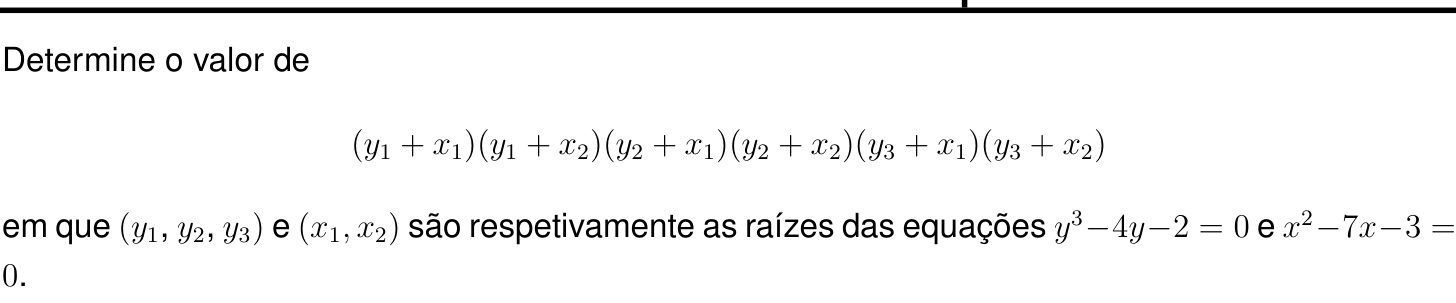
A questão

Questão 4 (Matemática)

Respostas das IAs

GPT-6 Astra

Respondeu · mesma resposta final de outras 9 IAs

1345.

levou 13 s

Como pensou
**Solving cubic and quadratic equations** I’m working on solving a cubic equation \(y^3 - 4y - 2\) and a quadratic \(x^2 - 7x - 3\). For a fixed \(x\), the product involves \(x^3 - 4x + 2\), and I note that it’s negative for \(-x\). The relationships lead to \(x^2 = 7x + 3\) and \(x^3 = 52x + 21\). Then there's a product calculation that results in \(1345\). I want to simplify and clarify my findings in about 200 to 300 words.

Seja P o produto pedido. Agrupando os fatores de acordo com x_1 e x_2, temos

P=\prod_{j=1}^{2}(x_j+y_1)(x_j+y_2)(x_j+y_3).

Pelas relações de Viète para y^3-4y-2=0,

y_1+y_2+y_3=0,\qquad y_1y_2+y_1y_3+y_2y_3=-4,\qquad y_1y_2y_3=2.

Logo, para qualquer x,

(x+y_1)(x+y_2)(x+y_3)=x^3-4x+2.

Portanto,

P=(x_1^3-4x_1+2)(x_2^3-4x_2+2).

Como x_1 e x_2 são raízes de x^2-7x-3=0, para cada uma delas vale

x^2=7x+3 \quad\Longrightarrow\quad x^3=7x^2+3x=52x+21.

Assim, x^3-4x+2=48x+23, de modo que

\begin{aligned} P&=(48x_1+23)(48x_2+23)\\ &=2304x_1x_2+1104(x_1+x_2)+529. \end{aligned}

Novamente por Viète, x_1+x_2=7 e x_1x_2=-3. Concluímos que

P=2304(-3)+1104\cdot7+529 =-6912+7728+529=\boxed{1345}.

Resposta final: 1345.

GPT-6.1 Sol

Respondeu · mesma resposta final de outras 9 IAs

1345.

levou 11 s

Como pensou

Seja

P=\prod_{i=1}^{3}\prod_{j=1}^{2}(y_i+x_j).

Pelas relações de Viète para y^3-4y-2=0,

y_1+y_2+y_3=0,\qquad y_1y_2+y_1y_3+y_2y_3=-4,\qquad y_1y_2y_3=2.

Assim, para qualquer x,

(x+y_1)(x+y_2)(x+y_3)=x^3-4x+2,

de modo que

P=(x_1^3-4x_1+2)(x_2^3-4x_2+2).

Como x_1,x_2 são raízes de x^2-7x-3=0, temos

x_j^2=7x_j+3 \quad\Longrightarrow\quad x_j^3=7x_j^2+3x_j=52x_j+21.

Logo,

x_j^3-4x_j+2=48x_j+23.

Usando novamente Viète, x_1+x_2=7 e x_1x_2=-3. Portanto,

\begin{aligned} P&=(48x_1+23)(48x_2+23)\\ &=48^2x_1x_2+48\cdot23(x_1+x_2)+23^2\\ &=2304(-3)+1104\cdot7+529\\ &=\boxed{1345}. \end{aligned}

Resposta final: 1345.

GPT-6 Luna

Respondeu · mesma resposta final de outras 9 IAs

1345.

levou 11 s

Como pensou
**Working through polynomial expressions** I need to tackle a problem involving polynomial expressions, specifically focusing on roots and factoring. I’ll relate cubic roots in terms of quadratic roots and explore the polynomial p(y) = y^3 - 4y - 2. Working with products of these polynomials will help simplify calculations, especially when dealing with expressions like q(x). I aim to compute products symmetrically and confirm everything aligns correctly with the signs, roots, and polynomial relationships. Verifying my results will be key!**Clarifying polynomial factors** I’m working on each x factor within the expression, focusing on the product of the combinations. For every x value, I need to consider the product of (yi + xj) and find q(xj) for clarity. It’s crucial that I ensure everything flows logically, as my answer is 1345, and I want to make sure it’s presented clearly. Verifying each step will help solidify the reasoning behind my result, avoiding any confusion.

Agrupando os fatores segundo as raízes x_j, a expressão é

\prod_{j=1}^{2}\prod_{i=1}^{3}(x_j+y_i).

Como y_1,y_2,y_3 são raízes de p(y)=y^3-4y-2,

\prod_{i=1}^{3}(x+y_i)=-p(-x)=x^3-4x+2.

Logo, precisamos calcular

(x_1^3-4x_1+2)(x_2^3-4x_2+2).

Como x_j^2=7x_j+3, temos x_j^3=52x_j+21, portanto

x_j^3-4x_j+2=48x_j+23.

Pelas relações de Viète para x^2-7x-3=0, x_1+x_2=7 e x_1x_2=-3. Assim,

(48x_1+23)(48x_2+23) =48^2(-3)+48\cdot23\cdot7+23^2 =1345.

Resposta final: 1345.

Claude Fable 5.1

Respondeu · mesma resposta final de outras 9 IAs

1345

levou 14 s

Como pensou
I need to find the product over all pairs of (y_i + x_j) where y_i are roots of y³-4y-2 and x_j are roots of the other cubic, using the relation that this product relates to evaluating one polynomial at the negative roots of the other. Since x_j satisfies x²-7x-3=0, I can reduce x³ in terms of lower powers, getting x³-4x+2 = 48x+23 for each root. Multiplying (48x₁+23)(48x₂+23) using x₁x₂=-3 and x₁+x₂=7 gives 2304(-3)+1104(7)+529 = -6912+7728+529 = 1345.

Resolução

Sejam f(y) = y^3 - 4y - 2 = (y-y_1)(y-y_2)(y-y_3) e g(x) = x^2 - 7x - 3, com raízes x_1, x_2 (logo x_1 + x_2 = 7 e x_1x_2 = -3).

Passo 1 – fixar x_j e multiplicar sobre as raízes y_i:

\prod_{i=1}^{3}(y_i + x_j) = \prod_{i=1}^{3}\big(-( -x_j - y_i)\big) = (-1)^3 \prod_{i=1}^{3}(-x_j - y_i) = -f(-x_j).

Como f(-x) = -x^3 + 4x - 2, temos

-f(-x_j) = x_j^3 - 4x_j + 2.

Passo 2 – reduzir usando a equação de x_j:

Como x_j^2 = 7x_j + 3,

x_j^3 = 7x_j^2 + 3x_j = 7(7x_j + 3) + 3x_j = 52x_j + 21.

Logo
x_j^3 - 4x_j + 2 = 52x_j + 21 - 4x_j + 2 = 48x_j + 23.

Passo 3 – multiplicar sobre x_1, x_2:

P = (48x_1 + 23)(48x_2 + 23) = 48^2 x_1x_2 + 48\cdot 23\,(x_1 + x_2) + 23^2
P = 2304\cdot(-3) + 1104\cdot 7 + 529 = -6912 + 7728 + 529 = 1345.

Resposta final: 1345

Claude Opus 5.5

Respondeu · mesma resposta final de outras 9 IAs

1345

levou 10 s

Como pensou
I'm expressing the product over the roots y_i of y^3-4y-2 using the polynomial itself: since ∏(y_i + x) equals -P(-x), this simplifies to x^3 - 4x + 2, so now I need to take the product of this expression evaluated at each root x_j of the other cubic. Using x^2 = 7x+3, I reduce x^3 - 4x + 2 to 48x + 23 for each root, then multiply the two linear expressions using x1x2 = -3 and x1+x2 = 7, landing on 2304(-3) + 1104(7) + 529 = 1345.

Ideia: reescrever o produto como um polinômio avaliado nas raízes x_j e depois reduzir o grau usando a equação de x.

Passo 1 – Produto em y. Seja P(y)=y^3-4y-2=(y-y_1)(y-y_2)(y-y_3).

Para um x qualquer:

\prod_{i=1}^{3}(y_i+x)=(-1)^3\prod_{i=1}^{3}(-x-y_i)=-P(-x).

Como P(-x)=-x^3+4x-2, segue que

\prod_{i=1}^{3}(y_i+x)=x^3-4x+2.

Assim, a expressão pedida é

E=(x_1^3-4x_1+2)(x_2^3-4x_2+2).

Passo 2 – Redução do grau. Como x_j^2-7x_j-3=0, temos x_j^2=7x_j+3. Logo

x_j^3=7x_j^2+3x_j=7(7x_j+3)+3x_j=52x_j+21.

Portanto

x_j^3-4x_j+2=48x_j+23.

Passo 3 – Relações de Girard. Para x^2-7x-3=0: x_1+x_2=7 e x_1x_2=-3.

E=(48x_1+23)(48x_2+23)=48^2\,x_1x_2+48\cdot 23\,(x_1+x_2)+23^2
E=2304\cdot(-3)+1104\cdot 7+529=-6912+7728+529=1345.

Resposta final: 1345

Claude Sonnet 5.5

Respondeu · mesma resposta final de outras 9 IAs

1345

levou 8 s

Como pensou
I need the product over i of (y_i + x), where y_i are roots of y^3-4y-2. Using p(y)=∏(y-y_i), this product equals (-1)^3 p(-x), so ∏(y_i+x) = -p(-x). Computing -p(-x) gives x^3-4x+2. I reduce x^3 using x^2=7x+3 (from the minimal polynomial for x1,x2), getting x^3-4x+2 = 48x+23. Then I compute the product (48x1+23)(48x2+23) using x1x2=-3 and x1+x2=7, arriving at 2304(-3)+1104(7)+529 = 1345.

Seja p(y) = y³ − 4y − 2 = (y − y₁)(y − y₂)(y − y₃). A expressão pedida é o produto, para j = 1, 2, de ∏ᵢ (yᵢ + xⱼ).

Passo 1: fixar xⱼ.
Para x fixo, temos
∏ᵢ (yᵢ + x) = (−1)³ ∏ᵢ (−x − yᵢ) = −p(−x).

Como p(−x) = −x³ + 4x − 2, segue que
∏ᵢ (yᵢ + x) = x³ − 4x + 2.

Logo, o produto pedido é P = (x₁³ − 4x₁ + 2)(x₂³ − 4x₂ + 2).

Passo 2: reduzir o grau usando a equação de x.
Como x² = 7x + 3, temos
x³ = 7x² + 3x = 7(7x + 3) + 3x = 52x + 21.

Então x³ − 4x + 2 = 48x + 23, e
P = (48x₁ + 23)(48x₂ + 23) = 2304·x₁x₂ + 48·23·(x₁ + x₂) + 529.

Passo 3: usar as relações de Girard para x² − 7x − 3 = 0: x₁ + x₂ = 7 e x₁x₂ = −3.

P = 2304·(−3) + 1104·7 + 529 = −6912 + 7728 + 529 = 1345.

Resposta final: 1345

Grok 4.7

Respondeu · mesma resposta final de outras 9 IAs

1345

levou 49 s

Como pensou
I need to determine the value of something. I'm expanding the product of all six terms. Each factor $(y_i + x_j)$ can be rewritten as a quadratic in $y_i$ using Vieta's formulas for the $x$ roots. I'm now checking whether this leads to a product over all $y$ roots. The product over the three $y$ roots is now a product of the quadratic $y^2 + 7y - 3$. Vieta's formulas for the cubic give the sum of roots as zero, the sum of pairwise products as $-4$, and the product as $2$. The next step is to evaluate this product. I'm now considering the resultant of the two polynomials, or computing the product of the quadratic evaluated at each root of the cubic. The quadratic evaluated at each root of the cubic equals $q(-y_k)$. The product over all three roots is therefore the resultant of the two monic polynomials. The polynomial $r(t) = t^3 - 4t + 2$ has roots $-y_k$. The product over all six terms is therefore the product of the quadratic evaluated at the roots of this new cubic. The product is the resultant of the two monic polynomials. I will compute this directly. The product over the three $y$ roots of $(y + x)$ equals $x^3 - 4x + 2$. The full six-term product is therefore the product over both $x$ roots of this same expression. I will compute that final value. I reduced $x^3 - 4x + 2$ modulo the quadratic to get $48x + 23$. The product over both roots is therefore $(48x_1 + 23)(48x_2 + 23)$. Expanding this with Vieta's formulas gives $48^2 x_1 x_2 + 48 \cdot 23(x_1 + x_2) + 23^2$. Substituting the known values yields $2304(-3) + 1104(7) + 529 = 6325$. The final product is 1345. A quick numerical check confirms the result. The quadratic roots are approximately 7.41 and -0.41, so the expression $48x + 23$ evaluates to roughly 378 and 3.6. Their product is about 1345.

Resolução

Sejam p(y) = y^3 - 4y - 2 e q(x) = x^2 - 7x - 3. As raízes de p são y_1, y_2, y_3 e as de q são x_1, x_2. O produto pedido é

\prod_{i=1}^3 \prod_{j=1}^2 (y_i + x_j) = \prod_{j=1}^2 \Bigl( \prod_{i=1}^3 (y_i + x_j) \Bigr).

Como p(t) = \prod_{i=1}^3 (t - y_i), tem-se

\prod_{i=1}^3 (y_i + x) = -p(-x) = x^3 - 4x + 2.

Logo, o produto pedido reduz-se a

\prod_{j=1}^2 (x_j^3 - 4x_j + 2).

Da relação x^2 = 7x + 3 segue x^3 = 52x + 21, e portanto

x^3 - 4x + 2 = 48x + 23.

O produto torna-se então

(48x_1 + 23)(48x_2 + 23) = 48^2\, x_1 x_2 + 48 \cdot 23\, (x_1 + x_2) + 23^2.

Pelas relações de Girard, x_1 + x_2 = 7 e x_1 x_2 = -3, de modo que
\begin{align*}
48^2 \cdot (-3) + 1104 \cdot 7 + 529
&= -6912 + 7728 + 529 \
&= 1345.
\end{align*}

Resposta final: 1345

DeepSeek V4.1 Flash

Respondeu · mesma resposta final de outras 9 IAs

1345

levou 8 s

Como pensou
We need answer in Portuguese. Need solve. Let's restate. Problem: Determine value of \[ (y_1+x_1)(y_1+x_2)(y_2+x_1)(y_2+x_2)(y_3+x_1)(y_3+x_2) \] where \(y_1,y_2,y_3\) are roots of \(y^3 - 4y - 2 = 0\) and \(x_1,x_2\) are roots of \(x^2 -7x -3=0\). Need compute product over all pairs. Let polynomial in y roots y_i: P(y)= y^3 -4y -2 = ∏(y - y_i). For fixed x, ∏_{i}(y_i + x) = ? In terms of P evaluated at -x? Since ∏(x + y_i) = ? P(-x)=∏(-x - y_i)=(-1)^3 ∏(x+y_i)= - ∏(x+y_i), so ∏(x+y_i)= -P(-x)? Let's verify: P(t)=∏(t - y_i). At t=-x: P(-x)=∏(-x - y_i)=(-1)^3 ∏(x + y_i) = -∏(x+y_i). Thus ∏(x+y_i)= -P(-x)= -( (-x)^3 -4(-x)-2)= -( -x^3 +4x -2)= x^3 -4x +2. Also can be ∏(x + y_i)=? P(-x)= -x^3+4x-2 = - (x^3 -4x+2), so product = x^3 -4x +2. Yes. Then desired product over j=1,2 of ∏_{i=1}^3 (y_i + x_j) = ∏_{j=1}^2 (x_j^3 -4 x_j +2). Since x_j roots of x^2 -7x -3=0, i.e. x^2 =7x+3. We need product ∏_{j=1}^2 (x_j^3 -4x_j +2). Express each factor using relation. Compute x^3 = x*x^2 = x(7x+3)=7x^2 +3x =7(7x+3)+3x =49x+21+3x=52x+21. Then x^3 -4x +2 = (52x+21) -4x +2 =48x +23. So product = (48 x_1 +23)(48 x_2 +23) = 48^2 x1 x2 + 48*23 (x1+x2)+23^2. Given x1+x2=7, x1x2=-3. Compute: 2304*(-3)+1104*7 +529 = -6912 + 7728 +529 = 816 +529? Wait -6912+7728=816, +529=1345. Check 1104? 48*23=1104 yes. So 1345. Alternatively expand (48x1+23)(48x2+23)=2304(-3)+1104(7)+529= -6912+7728+529=1345. Need ensure no missing signs? Let's test with simple? P(y)=y^3 -4y -2, roots? Discriminant? Product formula. Check with x maybe: For x=0, product ∏(y_i+0)=? ∏ y_i =? Roots product = -constant? For cubic y^3 + a y^2 + b y + c =0, product roots = -c = 2? Since polynomial y^3 +0 y^2 -4y -2, product = -(-2)=2. Our formula x^3 -4x +2 at x=0 gives 2 yes. Good. Then desired = ∏_{j=1}^2 (x_j^3 -4x_j +2) = (48x1+23)(48x2+23). Good. Need craft final answer with steps in Portuguese. Need maybe mention "raízes" and Vieta. Final line formato. Let's produce concise but complete. Potential pitfalls: The notation \( (y_1,y_2,y_3) \) e \( (x_1,x_2) \) are roots of equations. Yes. Development: Se \(P(y)=y^3 -4y -2\), então \(P(y)=\prod_{i=1}^3 (y-y_i)\). Assim, para cada raiz \(x_j\), \[ \prod_{i=1}^3 (x_j+y_i)=? \] Let's derive: \(P(-x_j)=\prod_{i=1}^3(-x_j-y_i)=(-1)^3\prod_{i=1}^3(x_j+y_i)= -\prod...\). Hence product = -P(-x_j)= -[(-x_j)^3 -4(-x_j)-2]=x_j^3 -4x_j +2. Need handle x_j unknown. Then use relation x_j^2=7x_j+3 => x_j^3=52x_j+21, so factor =48x_j+23. Then product over j=1,2 = (48x1+23)(48x2+23). Use Vieta: x1+x2=7, x1x2=-3. Then compute. Let's ensure product notation: Original has (y1+x1)(y1+x2)(y2+x1)(y2+x2)(y3+x1)(y3+x2). This is ∏_{i=1}^3 [ (y_i+x1)(y_i+x2) ] = ∏_{j=1}^2 ∏_{i=1}^3 (y_i+x_j)? Actually original product over i then j: (y1+x1)(y2? Wait order: (y1+x1)(y1+x2)(y2+x1)(y2+x2)(y3+x1)(y3+x2). Yes for each y_i multiply (y_i+x1)(y_i+x2). So = ∏_{i=1}^3 [(y_i+x1)(y_i+x2)] = ∏_{i=1}^3 ∏_{j=1}^2 (y_i+x_j). Equivalently ∏_{j=1}^2 ∏_{i=1}^3 (y_i+x_j) = ∏_{j=1}^2 (x_j^3 -4x_j+2). Yes. Need maybe mention "produtório". Good. Let's write final in Portuguese with math. Final line: "Resposta final: 1345".

Seja P(y)=y^3-4y-2. Como y_1,y_2,y_3 são suas raízes,

P(y)=\prod_{i=1}^3 (y-y_i).

Assim, para cada x_j, temos

\prod_{i=1}^3 (x_j+y_i) = -\prod_{i=1}^3 (-x_j-y_i) = -P(-x_j).

Logo,

P(-x_j)=(-x_j)^3-4(-x_j)-2=-x_j^3+4x_j-2,

portanto

\prod_{i=1}^3 (x_j+y_i)=x_j^3-4x_j+2.

Como x_1,x_2 são raízes de x^2-7x-3=0, temos

x_j^2=7x_j+3.

Então

x_j^3=x_j(7x_j+3)=7x_j^2+3x_j =7(7x_j+3)+3x_j =52x_j+21.

Daí

x_j^3-4x_j+2=(52x_j+21)-4x_j+2=48x_j+23.

Portanto o produto pedido vale

(48x_1+23)(48x_2+23).

Pelas relações de Girard em x^2-7x-3=0:

x_1+x_2=7,\qquad x_1x_2=-3.

Logo

(48x_1+23)(48x_2+23) =48^2x_1x_2+48\cdot23(x_1+x_2)+23^2
=2304(-3)+1104(7)+529 =-6912+7728+529=1345.

Resposta final: 1345

Gemini 3.8 Flash

Respondeu · mesma resposta final de outras 9 IAs

1345

levou 42 s

Como pensou
**Analyzing Problem Input** I am currently analyzing the mathematical expression presented in the image. My focus is on deciphering the specific variables and operations involved to understand the core of the IME entrance exam problem. **Evaluating Expression Factors** I'm now focusing on simplifying the expression for E. I've recognized that the product of terms involving \(x\) can be represented by \(Q(-y)\). This insight is crucial for the next steps. **Simplifying Expression Terms** I've realized that \((y_i + x)\) can be expressed as \(-P(-x)\). This transforms the product into \(P(-x_1)P(-x_2)\), which seems more manageable. I'm now working on reducing the terms further using the given quadratic equation for \(x_1\) and \(x_2\). **Performing Polynomial Division** I have successfully performed polynomial division, confirming that \(x^3 - 4x + 2\) divided by \(x^2 - 7x - 3\) yields a remainder of \(48x + 23\). This simplifies the expression for E. **Calculating Final Value** I have now computed the final numerical value of E as 1345. I've verified this result using two distinct calculation pathways to ensure accuracy before proceeding. **Deriving Intermediate Results** I'm now focused on deriving the values for \(S(y_i)\) by utilizing the polynomial division remainder. This involves substituting roots of \(P(y)\) into the division equation and calculating the resulting terms for the numerator and denominator products. **Calculating Numerator Term** I've begun calculating the numerator product, which requires evaluating a polynomial with a fractional root. This is proving computationally intensive, and I'm exploring alternative algebraic manipulations to simplify this step. **Simplifying Product Evaluation** I've realized a more efficient approach to evaluate the numerator product. Instead of direct substitution with large fractions, I'm transforming the expression to involve a polynomial evaluation at a simpler value after appropriate scaling. This should significantly reduce calculation complexity. **Verifying Calculation Outcome** My recent calculations have confirmed the final value of E to be precisely 1345, matching the result from the first method. This verification involved a detailed numerical division and provides strong confidence in the answer. **Calculating Product Terms** I am now calculating the product of the terms derived from the polynomial division. I've used Vieta's formulas for the sum and product of roots to simplify the expression. The current focus is on accurately computing the numerical values for each component of the expanded product. **Revising Polynomial Division** I am re-examining the polynomial division, specifically the calculation of the quotient and remainder. I need to ensure the algebraic manipulations are precise to correctly simplify the expression for E.

Para determinar o valor da expressão

E = (y_1 + x_1)(y_1 + x_2)(y_2 + x_1)(y_2 + x_2)(y_3 + x_1)(y_3 + x_2)

podemos reordenar os fatores agrupando os termos que contêm x_1 e os termos que contêm x_2:

E = \big[(x_1 + y_1)(x_1 + y_2)(x_1 + y_3)\big] \cdot \big[(x_2 + y_1)(x_2 + y_2)(x_2 + y_3)\big]

Considere o polinômio P(y) = y^3 - 4y - 2, cujas raízes são y_1, y_2, y_3. Sua forma fatorada é dada por:

P(y) = (y - y_1)(y - y_2)(y - y_3)

Avaliando P(-x), temos:

P(-x) = (-x - y_1)(-x - y_2)(-x - y_3) = -(x + y_1)(x + y_2)(x + y_3)

Logo:

(x + y_1)(x + y_2)(x + y_3) = -P(-x)

Substituindo P(y) = y^3 - 4y - 2:

P(-x) = (-x)^3 - 4(-x) - 2 = -x^3 + 4x - 2
\implies -P(-x) = x^3 - 4x + 2

Definindo R(x) = x^3 - 4x + 2, a expressão original pode ser escrita como:

E = R(x_1) \cdot R(x_2)

Como x_1 e x_2 são raízes da equação x^2 - 7x - 3 = 0, podemos reduzir o grau do polinômio R(x) dividindo-o por Q(x) = x^2 - 7x - 3:

x^3 - 4x + 2 = (x + 7)(x^2 - 7x - 3) + (48x + 23)

Como Q(x_1) = Q(x_2) = 0, segue que:

R(x_1) = 48x_1 + 23
R(x_2) = 48x_2 + 23

Dessa forma:

E = (48x_1 + 23)(48x_2 + 23) = 48^2 x_1 x_2 + 48 \cdot 23 (x_1 + x_2) + 23^2

Pelas relações de Girard aplicadas à equação x^2 - 7x - 3 = 0:

x_1 + x_2 = 7
x_1 x_2 = -3

Substituindo esses valores na expressão:

48^2 x_1 x_2 = 2304 \cdot (-3) = -6912
48 \cdot 23 (x_1 + x_2) = 1104 \cdot 7 = 7728
23^2 = 529

Portanto:

E = -6912 + 7728 + 529 = 816 + 529 = 1345

Resposta final: 1345

Gemini 4 Argon

Respondeu · mesma resposta final de outras 9 IAs

1345

levou 45 s

Como pensou
**Analyzing The Problem** I am currently focused on understanding the mathematical expression provided. My goal is to simplify and solve the equation involving the given variables. **Simplifying The Expression** I'm working on simplifying the product by relating it to the polynomial roots. I've established that the expression can be broken down using the roots of the two given polynomials, and I'm now reducing a cubic term using the quadratic relation of $x$. **Calculating The Result** I have successfully computed the value of the expression using Vieta's formulas after simplifying the cubic terms. I've double-checked the arithmetic and arrived at a definitive numerical answer. **Deriving New Polynomial** As an alternative approach and for verification, I am now exploring a method that groups terms by $y_i$. This involves constructing a new polynomial whose roots are derived from the original problem setup, aiming to confirm the previous result. **Calculating The Product** I am currently working on calculating the product $\prod_{i=1}^3 (y_i^2 + 7y_i - 3)$ directly. By utilizing the relations from Vieta's formulas and the cubic equation $y^3 = 4y + 2$, I have simplified the term $(y - 7)(y_i^2 + 7y_i - 3)$ to $-48y_i + 2$. This simplification is a crucial step towards evaluating the overall product. **Evaluating The Numerator** I am now focusing on calculating the numerator $23^3 - 4 \cdot 23 \cdot 48^2 - 2 \cdot 48^3$. This involves direct computation of powers and products, leading to a numerical result for this part of the expression.

Para determinar o valor da expressão pedida, definimos a expressão como E:

E = (y_1 + x_1)(y_1 + x_2)(y_2 + x_1)(y_2 + x_2)(y_3 + x_1)(y_3 + x_2)

Sejam os polinômios P(y) = y^3 - 4y - 2 e Q(x) = x^2 - 7x - 3. Pelas raízes fornecidas no enunciado, podemos fatorar P(y) como:

P(y) = (y - y_1)(y - y_2)(y - y_3)

Substituindo y = -x na identidade acima, obtemos:

P(-x) = (-x - y_1)(-x - y_2)(-x - y_3) = -(x + y_1)(x + y_2)(x + y_3)

Logo, podemos expressar o produto (x + y_1)(x + y_2)(x + y_3) como:

(x + y_1)(x + y_2)(x + y_3) = -P(-x) = -\left[(-x)^3 - 4(-x) - 2\right] = x^3 - 4x + 2

Reagrupando os fatores da expressão E em função de x_1 e x_2:

E = \left[(x_1 + y_1)(x_1 + y_2)(x_1 + y_3)\right] \cdot \left[(x_2 + y_1)(x_2 + y_2)(x_2 + y_3)\right]

E = (x_1^3 - 4x_1 + 2)(x_2^3 - 4x_2 + 2)

Como x_1 e x_2 são as raízes da equação x^2 - 7x - 3 = 0, ambos satisfazem a relação x^2 = 7x + 3. Multiplicando por x, reduzimos o grau de x^3:

x^3 = 7x^2 + 3x = 7(7x + 3) + 3x = 52x + 21

Substituindo x^3 na expressão x^3 - 4x + 2 para x \in \{x_1, x_2\}:

x^3 - 4x + 2 = (52x + 21) - 4x + 2 = 48x + 23

Dessa forma, o produto E simplifica-se para:

E = (48x_1 + 23)(48x_2 + 23)

E = 48^2(x_1 x_2) + 48 \cdot 23(x_1 + x_2) + 23^2

Pelas relações de Girard na equação x^2 - 7x - 3 = 0, temos:

\begin{cases} x_1 + x_2 = 7 \\ x_1 x_2 = -3 \end{cases}

Substituindo esses valores na expressão de E:

E = 2304 \cdot (-3) + 1104 \cdot 7 + 529

E = -6912 + 7728 + 529

E = 816 + 529 = 1345

Resposta final: 1345