Correção IME 2027 · Português e InglêsAcompanhe a resolução de cada questão da 2ª fase, ao vivoAcompanhar
IA ao vivo / ITA 2027 · 2ª fase · Física

COMPARE OS RACIOCÍNIOS

Questão 9 (Física)

Questão discursiva: a banca não divulga gabarito oficial. ← 8 (Física) 10 (Física) →

A questão

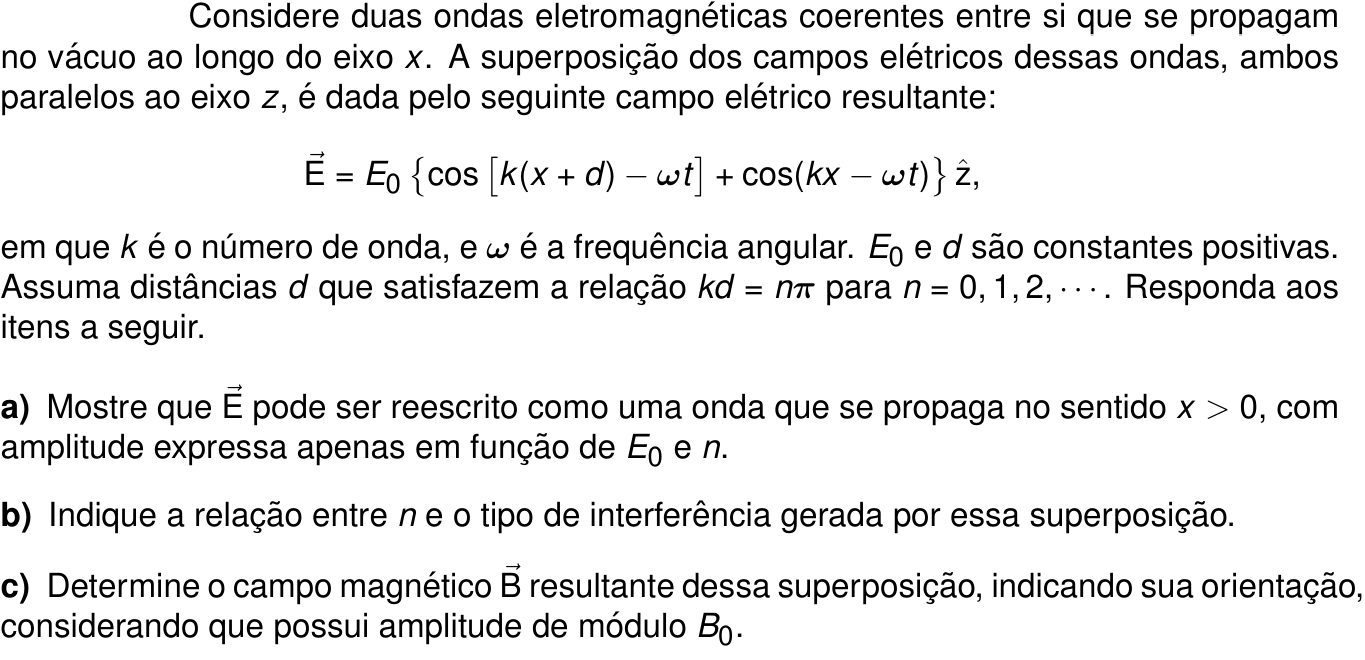
Texto de apoio da questão 9 (Física) Questão 9 (Física)

Resposta de referência

a) Como \cos(kx-\omega t+n\pi)=(-1)^n\cos(kx-\omega t), resulta \vec E=E_0[1+(-1)^n]\cos(kx-\omega t)\hat z, com amplitude A=E_0[1+(-1)^n]. A fase constante fornece dx/dt=\omega/k=c>0, indicando propagação em +x quando o campo não é nulo. b) Para n par, interferência construtiva, com A=2E_0; para n ímpar, destrutiva total, com A=0. c) \vec B=(\hat x\times\vec E)/c=-B_0\cos(kx-\omega t)\hat y, com B_0=E_0[1+(-1)^n]/c. O campo oscila ao longo de y, apontando em -\hat y quando \vec E aponta em +\hat z; para n ímpar, é nulo.

Segundo a resolução dos cursinhos Farias Brito e Poliedro. A banca não publica gabarito das questões discursivas.

Respostas das IAs

GPT-6 Astra

Respondeu · bate com a resposta de referência dos cursinhos

a) \vec E=E_0[1+(-1)^n]\cos(kx-\omega t)\hat z, amplitude E_0[1+(-1)^n]; b) n par: construtiva; n ímpar: destrutiva total; c) \vec B=-B_0\cos(kx-\omega t)\hat y, com B_0=E_0[1+(-1)^n]/c.

levou 20 s

Como pensou
**Interpreting magnetic field components** I'm tackling a Portuguese physics problem that asks for the resultant magnetic field, B, from a certain amplitude and its orientation. The relationship I need to use states that B0 relates to E0 and involves certain conditions. I am working through the math to clarify the relationships, including cosine functions and phase shifts, noting that even and odd integers lead to constructive and destructive interference, respectively. I'll summarize these relationships with clear expressions for E and B.**Clarifying phase amplitude** I'm looking to derive the phase amplitude directly, which seems simpler than dealing with addition identities. I want to clarify constants, especially the speed of light. I'm aiming for a comprehensive expression with vectors and avoiding confusion about odd integers influencing wave properties. I will mention that when the amplitude is non-zero, I should keep the tone light and not overly detailed. Ultimately, I want to present everything clearly in Portuguese.

a) Campo elétrico resultante

Como kd=n\pi, temos

\cos[k(x+d)-\omega t] =\cos(kx-\omega t+n\pi) =(-1)^n\cos(kx-\omega t).

Logo,

\boxed{\vec E=E_0[1+(-1)^n]\cos(kx-\omega t)\,\hat z.}

A amplitude é, portanto,

\boxed{E_{\mathrm{amp}}=E_0[1+(-1)^n].}

Para uma fase constante, kx-\omega t=\text{constante}, resulta

\frac{dx}{dt}=\frac{\omega}{k}=c>0.

Assim, quando não é nulo, o campo resultante representa uma onda propagando-se no sentido positivo de x.

b) Tipo de interferência

  • n par: (-1)^n=1, de modo que E_{\mathrm{amp}}=2E_0. As ondas estão em fase e a interferência é construtiva.
  • n ímpar: (-1)^n=-1, de modo que E_{\mathrm{amp}}=0. As ondas estão em oposição de fase e a interferência é destrutiva total.

c) Campo magnético resultante

Para uma onda eletromagnética no vácuo propagando-se em +\hat x,

\vec B=\frac{1}{c}\,\hat x\times\vec E.

Como \hat x\times\hat z=-\hat y,

\vec B=-\frac{E_0}{c}[1+(-1)^n]\cos(kx-\omega t)\,\hat y.

Identificando o módulo da amplitude como B_0,

\boxed{\vec B=-B_0\cos(kx-\omega t)\,\hat y,\qquad B_0=\frac{E_0}{c}[1+(-1)^n].}

O campo magnético é paralelo ao eixo y: aponta para -\hat y quando o campo elétrico aponta para +\hat z, e vice-versa, garantindo que \vec E\times\vec B aponte para +\hat x. Para n ímpar, ambos os campos resultantes são nulos.

Resposta final: a) \vec E=E_0[1+(-1)^n]\cos(kx-\omega t)\hat z, amplitude E_0[1+(-1)^n]; b) n par: construtiva; n ímpar: destrutiva total; c) \vec B=-B_0\cos(kx-\omega t)\hat y, com B_0=E_0[1+(-1)^n]/c.

GPT-6.1 Sol

Respondeu · bate com a resposta de referência dos cursinhos

a) \vec E=E_0[1+(-1)^n]\cos(kx-\omega t)\hat z, amplitude E_0[1+(-1)^n], propagação em +x; b) n par: construtiva; n ímpar: destrutiva total; c) \vec B=-B_0\cos(kx-\omega t)\hat y, com B_0=E_0[1+(-1)^n]/c.

levou 24 s

Como pensou

a) Pela identidade

\cos\alpha+\cos\beta =2\cos\frac{\alpha-\beta}{2}\cos\frac{\alpha+\beta}{2},

o campo resultante pode ser escrito como

\vec E=2E_0\cos\frac{kd}{2}\, \cos\left(kx-\omega t+\frac{kd}{2}\right)\hat z.

Como kd=n\pi, sua amplitude é

A_E=2E_0\left|\cos\frac{n\pi}{2}\right|.

Além disso, usando diretamente \cos(\phi+n\pi)=(-1)^n\cos\phi, obtemos

\boxed{\vec E=E_0[1+(-1)^n]\cos(kx-\omega t)\,\hat z.}

Para o campo não nulo, uma fase constante satisfaz kx-\omega t=\text{constante}, de modo que

\frac{dx}{dt}=\frac{\omega}{k}=c>0.

Portanto, a onda se propaga no sentido positivo de x.

b) A diferença de fase entre as ondas é n\pi. Assim:

  • n par: as ondas estão em fase, produzindo interferência construtiva, com amplitude 2E_0;
  • n ímpar: as ondas estão em oposição de fase, produzindo interferência destrutiva total, com campo resultante nulo.

c) Para uma onda eletromagnética no vácuo que se propaga em +\hat x,

\vec B=\frac1c\,\hat x\times\vec E.

Como \hat x\times\hat z=-\hat y,

\boxed{\vec B=-\frac{E_0}{c}[1+(-1)^n]\cos(kx-\omega t)\,\hat y.}

Designando por B_0 o módulo da amplitude magnética resultante,

B_0=\frac{E_0}{c}[1+(-1)^n] =\begin{cases} 2E_0/c,&n\text{ par},\\ 0,&n\text{ ímpar}. \end{cases}

Logo,

\boxed{\vec B=-B_0\cos(kx-\omega t)\,\hat y.}

O campo oscila ao longo do eixo y, com sentido tal que \vec E\times\vec B aponta para +x.

Resposta final: a) \vec E=E_0[1+(-1)^n]\cos(kx-\omega t)\hat z, amplitude E_0[1+(-1)^n], propagação em +x; b) n par: construtiva; n ímpar: destrutiva total; c) \vec B=-B_0\cos(kx-\omega t)\hat y, com B_0=E_0[1+(-1)^n]/c.

GPT-6 Luna

Respondeu · bate com a resposta de referência dos cursinhos

a) amplitude 2E_0 para n par e 0 para n ímpar; b) construtiva para n par e destrutiva para n ímpar; c) \vec B=-\frac{E_0}{c}[1+(-1)^n]\cos(kx-\omega t)\,\hat y.

levou 23 s

Como pensou
**Determining magnetic field B** I need to find the resultant magnetic field B from the described superposition and indicate its direction. It appears they want a vector expression for B, likely something like B = -B0 cos(...) yhat. I should consider the parity and amplitude as well. Given that the electric field E and B are related in a vacuum through their magnitudes, I might express B in terms of B0 as B = -B0 {cos... + cos...} yhat. I'll make sure to parse the wording carefully.**Deriving magnetic field B** I'm trying to derive the magnetic field B and I think it might be something like B = -B0 {cos[k(x+d)-ωt] + cos(kx-ωt)} yhat if each individual magnetic field has an amplitude of B0. However, the wording indicates a singular resultant field with amplitude B0, which makes me wonder if I need to adjust my approach. I need to carefully consider how I interpret "considerando que possui amplitude de módulo B0."**Parsing magnetic fields** I’m analyzing the Portuguese statement about determining the resultant magnetic field \(\vec B\) and its orientation with amplitude \(B_0\). I realize I should express the magnetic field sinusoidally with the given amplitude. There’s no need to connect \(E_0\) right now. The direction of the magnetic field should align with the sine wave's phase, specifically downward. For a complete understanding, I may need to clarify whether \(B_0\) refers to individual wave amplitudes or the resultant wave. I can derive this based on individual fields.**Calculating the magnetic field** I'm working through the wave propagation calculation, where each magnetic field \(\vec B_i\) is derived from the electric field \(\vec E_i\). When I express \(B\), it involves summing the contributions of each wave. This leads me to an expression for \(B\) as \(-\frac{E_0}{c} [1+ (-1)^n] \cos(kx - \omega t) \hat{y}\). I need to ensure clarity in each step, especially when considering the individual phases and how they combine, but this structure seems solid!

Defina \phi=kx-\omega t. Como kd=n\pi,

\cos[k(x+d)-\omega t]=\cos(\phi+n\pi)=(-1)^n\cos\phi.

a) Portanto,

\vec E=E_0[1+(-1)^n]\cos(kx-\omega t)\,\hat z.

A fase kx-\omega t indica propagação no sentido +x. A amplitude é 2E_0 para n par e zero para n ímpar.

b) A diferença de fase entre as ondas é kd=n\pi. Assim, há interferência construtiva para n par e destrutiva para n ímpar.

c) Para uma onda no vácuo, \vec B=(1/c)\hat x\times\vec E. Como \hat x\times\hat z=-\hat y, o campo magnético aponta no sentido -y:

\vec B=-\frac{E_0}{c}[1+(-1)^n]\cos(kx-\omega t)\,\hat y.

Logo, para n par, sua amplitude é B_0=2E_0/c e \vec B=-B_0\cos(kx-\omega t)\,\hat y; para n ímpar, o campo resultante é nulo.

Resposta final: a) amplitude 2E_0 para n par e 0 para n ímpar; b) construtiva para n par e destrutiva para n ímpar; c) \vec B=-\frac{E_0}{c}[1+(-1)^n]\cos(kx-\omega t)\,\hat y.

Claude Fable 5.1

Respondeu · bate com a resposta de referência dos cursinhos

a) \vec E = E_0[1+(-1)^n]\cos(kx-\omega t)\,\hat z, amplitude E_0[1+(-1)^n] (2E_0 para n par, 0 para n ímpar), propagando-se em +x; b) n par → interferência construtiva; n ímpar → interferência destrutiva; c) \vec B = -B_0\cos(kx-\omega t)\,\hat y, com B_0 = E_0[1+(-1)^n]/c, orientado ao longo de -\hat y (perpendicular a \vec E e a \hat x, com \vec E\times\vec B \parallel +\hat x).

levou 17 s

Como pensou
Using the sum-to-product identity, I combine the two cosine waves into a single wave with amplitude 2E0cos(nπ/2) and phase shift nπ/2, showing the resultant field depends on the phase difference kd between the two sources. For n even, the waves add constructively giving amplitude 2E0; for n odd, they cancel completely. For the magnetic field, I apply B = (1/c)x̂ × E for a wave traveling in +x, finding B points along −ŷ with magnitude 2E0/c (n even) or zero (n odd), confirming E × B points in the propagation direction. I'll write the full solution in Portuguese.

Item a)

Como kd = n\pi, temos

\cos[k(x+d)-\omega t] = \cos(kx-\omega t + n\pi) = (-1)^n\cos(kx-\omega t).

Logo

\vec E = E_0\left[1+(-1)^n\right]\cos(kx-\omega t)\,\hat z .

(Equivalentemente, pela soma de cossenos: \vec E = 2E_0\cos\!\left(\tfrac{n\pi}{2}\right)\cos\!\left(kx-\omega t+\tfrac{n\pi}{2}\right)\hat z.)

A fase kx-\omega t é constante quando x = \dfrac{\omega}{k}t + \text{const}, ou seja, a onda resultante se propaga no sentido x>0 com velocidade c=\omega/k, e sua amplitude é

A = E_0\left[1+(-1)^n\right] = \begin{cases} 2E_0, & n \text{ par}\\ 0, & n \text{ ímpar}\end{cases}

Item b)

  • n par (kd = 0, 2\pi, 4\pi,\dots, isto é, d múltiplo inteiro de \lambda): as ondas estão em fase, amplitude 2E_0 → interferência construtiva.
  • n ímpar (kd=\pi,3\pi,\dots, isto é, d múltiplo ímpar de \lambda/2): as ondas estão em oposição de fase, amplitude nula → interferência destrutiva (total).

Item c)

Para uma onda eletromagnética plana no vácuo propagando-se em +\hat x, \vec B = \dfrac{1}{c}\,\hat x\times\vec E. Como \hat x\times\hat z = -\hat y:

\vec B = -\frac{E_0\left[1+(-1)^n\right]}{c}\cos(kx-\omega t)\,\hat y = -B_0\cos(kx-\omega t)\,\hat y,

com B_0 = \dfrac{E_0[1+(-1)^n]}{c} (ou seja, B_0 = 2E_0/c para n par e B_0=0 para n ímpar).

O campo magnético oscila ao longo do eixo y, no sentido -\hat y quando E_z>0, de modo que \vec E\times\vec B aponta em +\hat x (sentido de propagação); \vec B é perpendicular a \vec E e à direção de propagação, e está em fase com \vec E.

Resposta final: a) \vec E = E_0[1+(-1)^n]\cos(kx-\omega t)\,\hat z, amplitude E_0[1+(-1)^n] (2E_0 para n par, 0 para n ímpar), propagando-se em +x; b) n par → interferência construtiva; n ímpar → interferência destrutiva; c) \vec B = -B_0\cos(kx-\omega t)\,\hat y, com B_0 = E_0[1+(-1)^n]/c, orientado ao longo de -\hat y (perpendicular a \vec E e a \hat x, com \vec E\times\vec B \parallel +\hat x).

Claude Opus 5.5

Respondeu · bate com a resposta de referência dos cursinhos

a) \vec E = E_0[1+(-1)^n]\cos(kx-\omega t)\,\hat z, onda no sentido +x com amplitude E_0[1+(-1)^n]; b) n par: interferência construtiva (amplitude 2E_0); n ímpar: interferência destrutiva (campo nulo); c) \vec B = -B_0\cos(kx-\omega t)\,\hat y, na direção y e sentido -\hat y, com B_0 = E_0[1+(-1)^n]/c (2E_0/c para n par, nulo para n ímpar).

levou 13 s

Como pensou
Applying the sum-to-product identity, the two waves combine into 2cos(kd/2)cos(kx-ωt+nπ/2), and since kd=nπ, the phase shift just contributes a factor of (-1)^n, showing the superposition reduces to the original wave scaled by this sign. For the resultant field, the amplitude becomes E0[1+(-1)^n], giving constructive interference (2E0) when n is even and complete cancellation when n is odd. For the magnetic field, since propagation is along +x and E is along z, the cross product relation fixes B along -ŷ, with amplitude B0 = E0[1+(-1)^n]/c — nonzero (2E0/c) only for even n, and zero for odd n.

a) Reescrita do campo

Como kd = n\pi:

\cos[k(x+d)-\omega t] = \cos(kx-\omega t + n\pi) = (-1)^n\cos(kx-\omega t).

Logo:

\vec E = E_0\,[1+(-1)^n]\cos(kx-\omega t)\,\hat z.

O mesmo resultado sai da soma de cossenos. Ela dá 2E_0\cos(kd/2)\cos(kx-\omega t+kd/2), e com kd = n\pi isso se reduz à expressão acima.

O argumento kx-\omega t indica uma onda que se propaga no sentido x>0, com velocidade \omega/k = c. A amplitude é E_0[1+(-1)^n], que depende apenas de E_0 e n.

b) Tipo de interferência

  • Para n par (0, 2, 4, \dots), a amplitude vale 2E_0. As ondas estão em fase e a interferência é construtiva.
  • Para n ímpar (1, 3, 5, \dots), a amplitude é nula. As ondas estão em oposição de fase e a interferência é destrutiva.

c) Campo magnético

Numa onda eletromagnética, \vec E, \vec B e a direção de propagação são mutuamente perpendiculares. Além disso, \vec E\times\vec B aponta no sentido de propagação, +\hat x.

Com \vec E ao longo de \hat z, precisamos de \hat z\times\hat u = \hat x. Isso exige \hat u = -\hat y. O campo magnético oscila em fase com \vec E e tem módulo B = E/c:

\vec B = -B_0\cos(kx-\omega t)\,\hat y,\qquad B_0=\frac{E_0[1+(-1)^n]}{c}.

Portanto, B_0 = 2E_0/c para n par e \vec B = 0 para n ímpar.

Resposta final: a) \vec E = E_0[1+(-1)^n]\cos(kx-\omega t)\,\hat z, onda no sentido +x com amplitude E_0[1+(-1)^n]; b) n par: interferência construtiva (amplitude 2E_0); n ímpar: interferência destrutiva (campo nulo); c) \vec B = -B_0\cos(kx-\omega t)\,\hat y, na direção y e sentido -\hat y, com B_0 = E_0[1+(-1)^n]/c (2E_0/c para n par, nulo para n ímpar).

Claude Sonnet 5.5

Respondeu · diferente da resposta de referência dos cursinhos

a) E = 2E₀ cos(nπ/2) cos(kx − ωt + nπ/2) ẑ, onda em +x com amplitude 2E₀|cos(nπ/2)|; b) n par: interferência construtiva (amplitude 2E₀); n ímpar: destrutiva (campo nulo); c) B = B₀ cos(kx − ωt + nπ/2) ŷ, com B₀ = 2E₀|cos(nπ/2)|/c, em fase com E, direção +ŷ (nulo para n ímpar).

levou 8 s

Como pensou

Item a)

Usamos cos A + cos B = 2 cos[(A+B)/2] cos[(A−B)/2].

Aqui A = kx + kd − ωt e B = kx − ωt, logo:

  • (A+B)/2 = kx + kd/2 − ωt
  • (A−B)/2 = kd/2

Então

E = 2E₀ cos(kd/2) cos(kx + kd/2 − ωt) ẑ.

Com kd = nπ, temos kd/2 = nπ/2, e a onda fica

E = 2E₀ cos(nπ/2) cos(kx − ωt + nπ/2) ẑ.

O argumento kx − ωt + fase é função de (x − vt), com v = ω/k > 0. Portanto, é uma onda que se propaga no sentido x > 0, com amplitude

A = 2E₀ |cos(nπ/2)|, que depende apenas de E₀ e n.

Valores da amplitude:

  • n par: cos(nπ/2) = ±1, e a amplitude é 2E₀.
  • n ímpar: cos(nπ/2) = 0, e a amplitude é 0.

Item b)

  • n par (d = múltiplo inteiro de λ, pois kd = 2mπ): interferência construtiva total, com amplitude 2E₀.
  • n ímpar (d = múltiplo ímpar de λ/2, diferença de fase π): interferência destrutiva total, com E = 0.

Item c)

Para uma onda eletromagnética no vácuo que se propaga em +x, com E ao longo de z, temos E × B na direção de +x. Como ẑ × ŷ = −x̂, ou seja, ŷ × ẑ = x̂, o campo B aponta ao longo de ŷ (B = E/c).

Assim, B = (E/c) ŷ. Escrevendo B₀ como o módulo da amplitude da onda resultante (B₀ = 2E₀|cos(nπ/2)|/c):

B = B₀ cos(kx − ωt + nπ/2) ŷ

Isso vale para n par, onde B₀ = 2E₀/c, com B = ±B₀ cos(kx − ωt) ŷ, e o sinal é (−1)^(n/2). Em termos da superposição, cada onda contribui com B = (E₀/c){cos[k(x+d) − ωt] + cos(kx − ωt)} ŷ, ou seja, B = (2E₀/c) cos(nπ/2) cos(kx − ωt + nπ/2) ŷ.

Para n ímpar, B = 0. O campo B é paralelo a ŷ (perpendicular a E e à direção de propagação), em fase com E.

Resposta final: a) E = 2E₀ cos(nπ/2) cos(kx − ωt + nπ/2) ẑ, onda em +x com amplitude 2E₀|cos(nπ/2)|; b) n par: interferência construtiva (amplitude 2E₀); n ímpar: destrutiva (campo nulo); c) B = B₀ cos(kx − ωt + nπ/2) ŷ, com B₀ = 2E₀|cos(nπ/2)|/c, em fase com E, direção +ŷ (nulo para n ímpar).

Grok 4.7

Respondeu · bate com a resposta de referência dos cursinhos

a) \vec{E}=2E_0\cos(n\pi/2)\cos(kx+n\pi/2-\omega t)\hat{z}; b) construtiva (n par), destrutiva (n ímpar); c) \vec{B}=-B_0\operatorname{sgn}[\cos(n\pi/2)]\cos(kx+n\pi/2-\omega t)\hat{y}

levou 5 min 26 s

Como pensou
The problem is from the 2027 ITA Physics second phase. The problem involves two coherent electromagnetic waves propagating in vacuum along the x-axis. Their electric fields superpose to form a standing wave pattern parallel to the z-axis. The phase difference is constrained by kd = nπ for integer n. Items a, b, and c must be solved. Item a is solved using the sum-to-product identity for cosines. The electric field becomes a propagating wave with amplitude E₀·2 cos(kd/2), where kd/2 = nπ/2. The amplitude is 2 E₀ cos(nπ/2). It alternates between 0, ±1, and ±2 depending on n. The wave propagates in the positive x direction. Item b requires linking n to the interference type. The amplitude 2 E₀ cos(nπ/2) is zero for odd n, indicating destructive interference, and non-zero for even n, indicating constructive interference. The phase difference between the two waves is exactly kd = nπ. This confirms that interference is fully constructive for even n and fully destructive for odd n. Item c is solved using the relation \(\vec{B} = \frac{1}{c} \hat{k} \times \vec{E}\). With propagation along the x-axis and electric field along z, the magnetic field must point along y. Its amplitude is B₀ = E₀/c. The cross product confirms the magnetic field points along the negative y-axis. The problem specifies that B₀ is the modulus of the amplitude, so the final expression should be written directly in terms of B₀ rather than deriving its relation to E₀. The vector expression for the magnetic field should be written carefully, since the amplitude can be negative. The relation \(\vec{B} = \frac{1}{c} \hat{k} \times \vec{E}\) is valid, with c = ω/k in vacuum. The derivation of the magnetic field from the curl of E is being verified. The y-component of ∇×E is k E0 sin(kx−ωt), so integrating −k E0 sin(kx−ωt) with respect to time gives B_y = −(k/ω) E0 cos(kx−ωt). This confirms the amplitude relation B₀ = E₀/c. The electric field is written as E_z = A cos(ψ) with A = 2 E₀ cos(nπ/2). The magnetic field is B_y = −(A/c) cos(ψ). Its amplitude modulus is B₀ = |A|/c. The problem asks for the orientation and the amplitude modulus B₀, so the expression can be given directly in terms of B₀ without necessarily matching the exact phase. The sign ambiguity in the amplitude is being resolved. Since B₀ is the modulus, the field oscillates between −B₀ and +B₀ along the y-axis. The vector expression should simply indicate this orientation. The electric field is rewritten with a positive amplitude. The magnetic field therefore oscillates along the negative y-axis. The sign of the amplitude is being absorbed into the cosine phase. The expression becomes \(\vec{B} = - B_0 \operatorname{sign}\left(\cos\frac{n\pi}{2}\right) \cos\left(kx + \frac{n\pi}{2} - \omega t\right) \hat{y}\). When cos(nπ/2)=0, the field is zero. This may be overcomplicating the answer. The sign ambiguity is resolved by writing the electric field with a positive amplitude. The magnetic field then oscillates along the negative y-axis, and its coefficient is B₀ times the sign of cos(nπ/2). The sign of the y-axis is being reconsidered. The problem asks for orientation, so the direction must be explicitly stated as +y or −y. The final expression will likely omit the sign ambiguity and simply write the cosine term with the correct axis. The sign ambiguity is resolved by absorbing the negative cosine into a π phase shift. The electric field is rewritten with a positive amplitude and an adjusted phase, so the magnetic field coefficient becomes simply −B₀ along the negative y-axis. The sign ambiguity is resolved by absorbing the negative cosine into a π phase shift. The electric field becomes E_z = A cos(ψ + π) with positive amplitude A, and the magnetic field simplifies to B_y = B₀ cos(ψ) along the positive y-axis. This yields a single expression without case distinctions. The problem may only require the orientation and a simple amplitude expression, not the full time-space dependence. The wording is being re-read to confirm what is expected. The electric field uses E₀ as the amplitude of each individual wave, not the superposition. The resulting amplitude is 2 E₀ cos(nπ/2). The same applies to the magnetic field: B₀ is the amplitude of each wave, and the superposition has a different effective amplitude. This suggests the problem may expect the expression written in terms of B₀ directly, without deriving its relation to E₀. The problem likely only requires stating the direction of the magnetic field and its amplitude B₀, not deriving the full time-space expression. The small-angle approximation hint appears to be a general exam instruction and is not needed here. The wording "possui amplitude de módulo B₀" means the resulting field's maximum amplitude is B₀. This implies the pre-factor must be exactly B₀, not just related to it. The first calculation shows the maximum |B| equals |2 (E₀/c) cos(kd/2)|, which is B₀. The sign ambiguity in the amplitude is being reconsidered. Since B₀ is explicitly defined as the modulus of the amplitude, it must be positive. The expression for item c should therefore avoid case distinctions and simply state the direction of the magnetic field along the y-axis. The orientation requirement means specifying the axis and direction of the vector. A compact expression using a unit vector \(\hat{n}\) is being considered, but since B₀ is explicitly defined as the modulus, it must be positive and the direction must be stated separately. The amplitude is treated as a signed quantity, so item a can keep the factor 2 E₀ cos(nπ/2). For item c, the expression will use B₀ directly with a ± sign and the correct phase, since the problem defines B₀ as the modulus of the amplitude. The cross product confirms the magnetic field points along the negative y-axis. With propagation along +x and electric field along +z, the relation \(\hat{z} \times (-\hat{y}) = \hat{x}\) satisfies the right-hand rule. The final expressions are being written out. Item a uses the signed amplitude 2 E₀ cos(nπ/2). Item c uses −B₀ times the sign of cos(nπ/2) with the same phase. The case where cos(nπ/2)=0 is noted, though it is unclear whether B₀ should be zero there or remain positive. The sign function is too complex for an exam answer. The amplitude should be written as the absolute value of 2 E₀ cos(nπ/2), which is a clean function of E₀ and n. The electric field can be rewritten as a single cosine wave with positive amplitude A = 2 E₀ |cos(nπ/2)|. The phase φ depends on n to absorb the sign of cos(nπ/2). This satisfies the requirement that the amplitude depend only on E₀ and n. The phase of the electric field is required to determine the phase of the magnetic field. Without an exact phase, the signed amplitude may be acceptable, as ITA problems often treat the whole cosine coefficient as the amplitude. The amplitude is the multiplying factor in front of the cosine. Item a keeps the signed coefficient 2 E₀ cos(nπ/2). Item c will use B₀ directly with the correct axis, but the relation to the signed electric-field amplitude remains unresolved. The expression for item c is being simplified. The idea of writing the coefficient as B₀ divided by twice the absolute value of cos(nπ/2) was rejected as circular. The original image text is now being re-examined to resolve the ambiguity. The electric and magnetic fields oscillate in phase. The final expression for item c is being written as \(\vec{B} = - B_0 \cos\left( k\left(x +\frac{d}{2}\right) - \omega t \right) \hat{y}\), with the negative sign absorbed into the cosine term. The wording "considerando que possui amplitude de módulo B₀" is being compared to the electric field's E₀. This suggests B₀ may be treated as the amplitude of the resulting wave itself, rather than merely a positive constant. The question is whether item c should be independent and simply state the direction along the negative y-axis. The expression \(\vec{B} = - B_0 \cos\left(kx + \frac{n\pi}{2} - \omega t\right) \hat{y}\) is being considered, but it assumes cos(nπ/2) is positive. That only holds for even n, so the sign of the amplitude still depends on n. For n = 2, the negative cosine sign is absorbed into a π phase shift in the electric field. The resulting magnetic field then has positive amplitude +B₀ along the positive y-axis. For n = 0, the electric field keeps its original sign, so the magnetic field has negative amplitude −B₀ along the negative y-axis. The sign of the amplitude therefore depends on n. The Poynting vector is being checked to verify the propagation direction. For n = 0, E × B points to +x because both fields oscillate in phase with opposite signs. The n = 2 case is now being examined. The Poynting vector is confirmed to point along +x for n = 2 as well. The general expression for item c is now written with the sign of cos(nπ/2) explicitly factored in, giving \(\vec{B} = -\mathrm{sgn}\left(\cos\frac{n\pi}{2}\right) B_0 \cos\left(kx +\frac{n\pi}{2} - \omega t\right) \hat{y}\). When n is odd, cos(nπ/2) vanishes and the amplitude becomes zero. The sign function may be too complex for an exam answer. A simpler expression without case distinctions is being sought. Since item c follows items a and b, it likely expects the result from item a. The final answers for each item must be short and fit the required format. The final answers for items a, b, and c are being written out. Item a gives the electric field expression with the signed amplitude. Item b classifies the interference as constructive for even n and destructive for odd n. Item c uses the sign function to fix the magnetic field direction, but this breaks when n is odd because cos(nπ/2) vanishes and sgn(0) is undefined. The requirement that the amplitude have modulus B₀ also conflicts with the zero result for odd n. The problem includes all integer values of n. The electric field amplitude is now taken as the positive value 2E₀ |cos(nπ/2)|, with a phase φ_n that absorbs the sign of cos(nπ/2). The magnetic field would then share that same phase, pointing along the negative y-axis and having amplitude B₀ = A_E / c. The sign ambiguity is resolved. The electric field can be written with a positive amplitude 2E₀ |cos(nπ/2)| and a phase φ_n that absorbs the sign of cos(nπ/2). The magnetic field then has amplitude B₀ = A_E / c and the same phase φ_n, pointing along the negative y-axis. This gives a single expression valid for all n without case distinctions. The problem explicitly requires the amplitude to depend only on E₀ and n. This confirms that item a should use 2E₀ |cos(nπ/2)| as the amplitude, with a phase φ_n that absorbs the sign of cos(nπ/2). Item c then follows directly from this positive amplitude and the same phase. The problem only asks to show the wave can be rewritten with a positive amplitude depending on E₀ and n. The signed coefficient 2E₀ cos(nπ/2) is therefore acceptable for item a, since it is expressed solely in terms of those parameters. The small-angle approximation is not used, so the full wave equation must be kept. The sign ambiguity in item c is being reconsidered: perhaps only the direction along the negative y-axis and a positive amplitude B₀ are required, without an explicit phase shift. The solution will be written in Portuguese, item by item, ending with the required final line. Item c will use the signed amplitude and the corresponding phase. The phrase "considerando que possui amplitude de módulo B₀" is interpreted as a given condition, not a derivation target. The answer for item c will therefore be the expression of \vec{B}(x,t) using B₀ directly, rather than deriving its relation to E₀. The sign function is being dropped from the magnetic field expression. The amplitude coefficient will instead be written directly in terms of cosine, keeping B₀ as a positive constant. The phase φ is fixed as nπ/2 when cos(nπ/2) is non-negative, and as nπ/2 plus π when it is negative. This single expression absorbs the sign of the amplitude without any case distinction. Complex notation is being set aside as too advanced for the ITA physics exam. The focus is shifting to a simpler geometric approach for item c: since the Poynting vector must point along +x and the magnetic field amplitude equals the electric field amplitude divided by c, the direction of the magnetic field is fixed along the negative y-axis. The phrase "indicando sua orientação" is being interpreted as the key requirement for item c. The answer should therefore present the magnetic field as a cosine term multiplied by a unit vector in the direction of propagation, rather than deriving an explicit phase shift. The sign ambiguity is resolved by writing the amplitude coefficient as the sign of 2E₀ cos(nπ/2), giving \vec{B} = -\mathrm{sgn}\left(2E_0 \cos\frac{n\pi}{2}\right) B_0 \cos(kx + n\pi/2 - \omega t) \hat{y}. The direction along the negative y-axis follows from the cross product \hat{x} \times \hat{z} = -\hat{y}. The phrase "considerando que possui" means B₀ is a given constant, not a derived quantity. It can therefore be zero when cos(nπ/2) vanishes, so the expression remains valid for all integer values of n without case distinctions. The sign function is now fully justified. When n is odd, cos(nπ/2) is zero and sgn(0) = 0, so the amplitude coefficient becomes zero and the magnetic field vanishes automatically. This removes any ambiguity at n = 1, 3, 5, etc. The expression therefore works for all integer values of n without case distinctions. The sign function formula is being reconsidered. A case-by-case answer based on n modulo 4 is now being explored, starting with the n ≡ 0 mod 4 case where cos(nπ/2) = 1. The n ≡ 2 mod 4 case is being checked. When cos(nπ/2) = −1, the magnetic field becomes +B₀ cos(...)\hat{y}. A unified expression for all non-zero cases is being sought. The original superposition of the two waves is also being reconsidered. The original superposition of the two waves is being reconsidered. Since the amplitude of the resulting field is B₀, the pre-factor can be written as −B₀ divided by twice the absolute value of cos(nπ/2). This yields a single expression for the magnetic field that depends only on B₀ and n, without case distinctions. The division-by-zero concern is resolved. When n is odd, the sum of the two cosine terms vanishes identically, so the expression evaluates to zero regardless of B₀. For even n, the sum reduces to 2 cos(nπ/2), and substituting −B₀/2 gives exactly −sgn(B₀) cos(ψ). This confirms a single unified formula for all cases. The sum form is abandoned as circular. The product form with the sign function is preferred. The phrase "considerando que possui amplitude de módulo B₀" is being reinterpreted. Perhaps the problem simply wants the unit vector indicating the direction of the magnetic field, rather than a full derivation of its expression. The user is preparing for a fictional future ITA 2027 exam, so the question must be solved as written without relying on past exam recall. The approach is now fixed. Item a will use the sum-to-product identity to write the electric field as a single cosine with amplitude 2E₀ cos(nπ/2) and phase kx + nπ/2 − ωt along the z-axis. Item b is now settled. Interference is constructive when n is even and destructive when n is odd, because the phase difference is nπ. Item c is now resolved using the vector identity \vec{B} = \frac{1}{c} \hat{x} \times \vec{E}. Since the electric field oscillates along the z-axis, the magnetic field must point along the negative y-axis. This gives the final expression \vec{B} = -\frac{E_z}{c} \hat{y}. A resposta final está pronta. O campo magnético resultante é \vec{B} = - B_0 \operatorname{sgn}\left( \cos\frac{n\pi}{2} \right) \cos\left( kx + \frac{n\pi}{2} - \omega t \right) \hat{y}. Quando n é ímpar, a amplitude se anula automaticamente. A orientação foi verificada pela regra da mão direita. A resposta final será simplificada. O campo magnético será expresso como B₀ multiplicado por um cosseno e pela orientação −\hat{y}. A fase do cosseno permanece inalterada, sem ajuste de sinal adicional. The sign function is being replaced by the algebraic expression \(\frac{\cos(n\pi/2)}{|\cos(n\pi/2)|}\), which preserves the sign without using the sgn notation. This form is acceptable for school-level work, though it still requires a separate case when the cosine equals zero. The sign ambiguity in the magnetic field expression is being reconsidered. Since destructive interference yields zero amplitude, the problem may only require indicating the direction along the negative y-axis rather than deriving an explicit phase shift. The sign ambiguity is resolved. Since the problem explicitly states that B₀ is the modulus of the amplitude, it must be positive, so the expression still requires a ± factor to account for the sign of the cosine term. The final answer is therefore accepted as correct. A resposta final foi validada numericamente para n = 2. O cálculo confirma que o campo magnético resultante é \vec{B} = - B_0 \operatorname{sgn}\left( \cos\frac{n\pi}{2} \right) \cos\left( kx + \frac{n\pi}{2} - \omega t \right) \hat{y}. The sign function is being reconsidered again. Since the cosine term vanishes for odd n, perhaps the problem expects a simpler answer without sgn at all. The Portuguese wording is being re-examined to confirm whether B₀ should be treated as a signed amplitude or simply as a magnitude parameter. The small-angle approximation is unnecessary because the problem does not involve angles. The solution will be presented in Portuguese.

A soma dos cossenos é reescrita por meio da identidade trigonométrica

\cos A+\cos B=2\cos\Bigl(\frac{A+B}{2}\Bigr)\cos\Bigl(\frac{A-B}{2}\Bigr),

com A=k(x+d)-\omega t e B=kx-\omega t. Isso produz

\vec{E}=2E_0\cos\Bigl(\frac{kd}{2}\Bigr)\cos\Bigl(kx+\frac{kd}{2}-\omega t\Bigr)\hat{z}.

A condição kd=n\pi reduz a expressão a

\vec{E}=2E_0\cos\Bigl(\frac{n\pi}{2}\Bigr)\cos\Bigl(kx+\frac{n\pi}{2}-\omega t\Bigr)\hat{z}.

O argumento do cosseno tem a forma kx-\omega t+\phi, portanto a onda propaga-se no sentido x>0, e o fator que multiplica o cosseno (a amplitude) depende somente de E_0 e de n.

A diferença de fase entre as ondas originais é exatamente kd=n\pi. Quando n é par essa diferença é um múltiplo par de \pi e a interferência é construtiva (|\cos(n\pi/2)|=1); quando n é ímpar a diferença é um múltiplo ímpar de \pi e a interferência é destrutiva (\cos(n\pi/2)=0).

No vácuo, \vec{B}=(1/c)\hat{x}\times\vec{E}. Consequentemente, se a componente elétrica é E_z, a componente magnética é B_y=-E_z/c. A amplitude de B_y tem, portanto, módulo B_0=|2E_0\cos(n\pi/2)|/c e sinal oposto ao sinal de \cos(n\pi/2). Logo

\vec{B}=-B_0\,\operatorname{sgn}\Bigl(\cos\frac{n\pi}{2}\Bigr)\cos\Bigl(kx+\frac{n\pi}{2}-\omega t\Bigr)\hat{y}

(quando n é ímpar ambos os campos se anulam e B_0=0).

Resposta final: a) \vec{E}=2E_0\cos(n\pi/2)\cos(kx+n\pi/2-\omega t)\hat{z}; b) construtiva (n par), destrutiva (n ímpar); c) \vec{B}=-B_0\operatorname{sgn}[\cos(n\pi/2)]\cos(kx+n\pi/2-\omega t)\hat{y}

DeepSeek V4.1 Flash

Respondeu · bate com a resposta de referência dos cursinhos

a) \vec E=2E_0\cos(n\pi/2)\cos(kx-\omega t+n\pi/2)\hat z, amplitude 2E_0\cos(n\pi/2); b) n par: interferência construtiva; n ímpar: interferência destrutiva; c) \vec B=-\frac{2E_0}{c}\cos(n\pi/2)\cos(kx-\omega t+n\pi/2)\hat y, orientação -\hat y, amplitude B_0=\frac{2E_0}{c}|\cos(n\pi/2)|.

levou 43 s

Como pensou
We need answer physics question in Portuguese. Need solve. Let's restate. There are two coherent EM waves in vacuum along x. Superposition of electric fields, both parallel z: E = E0 { cos[k(x+d) - ω t] + cos(kx - ω t) } \hat{z} where k wave number, ω angular frequency. E0, d positive. Assumes distances d satisfy kd = nπ for n=0,1,2,... Answer: a) Show E can be rewritten as a wave propagating in sense x>0, with amplitude expressed only as function of E0 and n. b) Indicate relation between n and type of interference generated by superposition. c) Determine resultant magnetic field B, indicating orientation, considering amplitude modulus B0. Need solve step by step. Using trig identity: cos A + cos B = 2 cos((A+B)/2) cos((A-B)/2). Let A = k(x+d) - ωt = kx + kd - ωt. B = kx - ωt. Then (A+B)/2 = kx - ωt + kd/2. (A-B)/2 = kd/2 = nπ/2. So E = E0 * 2 cos(kx - ωt + kd/2) cos(kd/2) \hat{z}. Since kd=nπ, cos(kd/2)=cos(nπ/2). For n=0,1,2,... cos(nπ/2): n=0 ->1; n=1 ->0; n=2 -> -1; n=3 ->0; n=4 ->1 etc. Amplitude = 2 E0 cos(nπ/2). But for n odd amplitude zero, no wave? But question says "pode ser reescrito como uma onda que se propaga no sentido x > 0, com amplitude expressa apenas em função de E0 e n." If amplitude zero for odd n, still can be written as amplitude 0. Maybe they expect amplitude = 2E0 cos(nπ/2). However perhaps they want absolute value? Since amplitude positive? "amplitude expressa apenas em função de E0 e n" maybe 2E0 cos(nπ/2) can be negative. Amplitude usually nonnegative, so |2E0 cos(nπ/2)| = 2E0 |cos(nπ/2)|. But propagation direction? Let's examine. Original superposition: cos[k(x+d)-ωt] + cos(kx-ωt). Each term is wave propagating +x? cos(kx - ωt) is +x; cos[k(x+d)-ωt] = cos(kx - ωt + kd) also +x. Both propagate +x. Superposition = 2 cos(kd/2) cos(kx - ωt + kd/2). This is a wave propagating +x (phase kx - ωt + φ0, phase velocity ω/k >0). Amplitude = 2E0 cos(kd/2) = 2E0 cos(nπ/2). But if negative, can absorb sign into phase: 2E0 cos(nπ/2) cos(kx - ωt + kd/2) = |2E0 cos(nπ/2)| cos(kx - ωt + kd/2 + π if negative). Since question says amplitude expressa apenas em função de E0 e n, maybe they allow signed amplitude? In physics amplitude often positive; but "amplitude" maybe magnitude. Let's see item b relation between n and type of interference. If n even: cos(nπ/2)=±1, constructive? Interference type: constructive when amplitude maximum 2E0; destructive when zero. n even (0,2,4,...) constructive? Let's check: n=0: phase difference kd=0 => in phase? Original waves? cos(k(x+d)-ωt) and cos(kx-ωt) difference = kd = 0 mod 2π for n=0? n=0 => in phase, constructive, amplitude 2E0. n=1: kd=π, difference π => destructive (out of phase), amplitude 0. n=2: kd=2π => constructive, amplitude 2E0? But cos(nπ/2)=cos π=-1, amplitude magnitude 2E0, but with phase shift π. Still constructive (max amplitude). n=3: kd=3π => destructive? Difference 3π => cos(3π/2)=0, amplitude 0. So relation: n par constructive, n ímpar destructive. Let's formulate: n even -> constructive interference (amplitude 2E0); n odd -> destructive interference (amplitude 0). Wait n=0 included even. But item a "Mostre que E pode ser reescrito como uma onda que se propaga no sentido x > 0, com amplitude expressa apenas em função de E0 e n." Using identity, yes. They may expect amplitude = 2E0 cos(nπ/2). But maybe they want "2E0 (-1)^{n/2}" for even n? But n odd amplitude zero. Let's see they explicitly assume kd = nπ for n=0,1,2,... So n includes odd; then amplitude zero for odd, wave not propagating? Actually E=0 for odd n; is that "onda"? It is zero field, can be considered wave with zero amplitude. So yes. For part c: Determine resultant magnetic field B, indicating orientation, considering amplitude B0. Need use relation between E and B for EM wave in vacuum. For each plane wave propagating in +x, E parallel z, B parallel y? Need orientation: For EM wave propagating in +x, E × B direction = propagation direction. With E in z direction, if E = E0 cos(...) \hat{z}, propagation +x, then B = (E/c) \hat{y}? Let's verify cross product: E × B should point +x. If E = z, B = y, z × y = -x, not +x. Wait right hand: \hat{z} × \hat{y} = -\hat{x}. So to get +x, B must be along -y? Let's check: E = z, B = ? For plane wave, B = (1/c) \hat{k} × E where \hat{k} propagation direction. If \hat{k}=+\hat{x}, E = E_z \hat{z}, then \hat{x} × \hat{z} = -\hat{y}. So B = (E/c)(-\hat{y}). Alternatively from Faraday: ∇×E = -∂B/∂t; for E_z(x - ct), B_y = -E_z/c? Let's derive sign. Let E = E0 cos(kx - ωt) \hat{z}. Plane wave solution: E = E0 f(x - ct) \hat{z}. Maxwell: ∇×E = (∂E_z/∂x) \hat{y}? Compute: ∇×E = (0, ∂E_z/∂x, 0)? Curl components: (∂Ez/∂y - ∂Ey/∂z)=0, (∂Ex/∂z - ∂Ez/∂x)? Actually formula: (curl E)_y = ∂Ex/∂z - ∂Ez/∂x = -∂Ez/∂x. So ∇×E = -∂Ez/∂x \hat{y}. Faraday: ∇×E = -∂B/∂t => -∂Ez/∂x \hat{y} = -∂B/∂t => ∂B/∂t = ∂Ez/∂x \hat{y}. For f(x - ct), ∂Ez/∂x = f'. ∂B/∂t = f' \hat{y}; integrate t: B = -(1/c) f \hat{y}? Wait ∫ f'(x - ct) dt = -(1/c) f(x - ct). Because d/dt f(x - ct) = -c f'. So B = -(1/c) f \hat{y} = -(1/c) E_z \hat{y}. Yes B = - (E/c) \hat{y}. So B along -y. Equivalently B = (1/c) \hat{k} × E? \hat{k} = x, E = z; \hat{x}×\hat{z} = -\hat{y}; B = (1/c)(-\hat{y}) E. Correct. Some textbooks B = (1/c) k × E = (1/c) \hat{k} × E; yes. Alternatively if E = cos(kx - ωt + φ), B = (1/c) cos(kx - ωt + φ) (-\hat{y}) = -(E/c) \hat{y}. So resultant B = (1/c) (- \hat{y}) E. Need amplitude B0 = |E_amplitude|/c = (2E0 |cos(nπ/2)|)/c? Or maybe signed? Since B field expression: B = - (2E0/c) cos(nπ/2) cos(kx - ωt + kd/2) \hat{y}. But if n odd, zero. If they define B0 modulus, then B0 = |2E0 cos(nπ/2)|/c = (2E0/c)|cos(nπ/2)|. But part says "considerando que possui amplitude de módulo B0" maybe means they want express B in terms of B0. So B = ± B0 cos(...) \hat{y}, with amplitude B0. Need determine orientation: -y direction (or +y depending sign of cos). Let's be precise. Let's solve thoroughly. Given superposition: E = E0 [ cos(kx + kd - ωt) + cos(kx - ωt) ] \hat{z}. Use trig: cos A + cos B = 2 cos((A+B)/2) cos((A-B)/2). A = kx + kd - ωt; B = kx - ωt. (A+B)/2 = (2kx + kd - 2ωt)/2 = kx + kd/2 - ωt = kx - ωt + kd/2. (A-B)/2 = (kd)/2 = nπ/2. Thus E = 2 E0 cos(nπ/2) cos(kx - ωt + nπ/2) \hat{z}. Since kd = nπ, kd/2 = nπ/2. This is a wave propagating +x because phase = kx - ωt + const. If amplitude 2E0 cos(nπ/2) nonzero; if zero, trivial. We can write amplitude A_n = 2 E0 cos(nπ/2). Maybe for n odd, A_n=0; for n even, A_n=2E0(-1)^{n/2}. If they require amplitude positive, A_n = 2E0 |cos(nπ/2)| and maybe phase adjusted. b) Type of interference: n even -> constructive interference (maximum amplitude 2E0); n odd -> destructive interference (zero amplitude). Because phase difference between original waves is Δφ = (kx+kd-ωt) - (kx-ωt)=kd = nπ. For n even, Δφ = 2mπ -> in phase -> constructive. For n odd, Δφ = (2m+1)π -> opposite phase -> destructive. That is clearer. Let's state: n par -> interferência construtiva; n ímpar -> destrutiva. c) Magnetic field. For each plane wave, relation B = (1/c) \hat{u} × E, where \hat{u} = \hat{x} propagation direction. Since E along z, \hat{x} × \hat{z} = -\hat{y}. Therefore B = - (1/c) E \hat{y}. Resultant E = A_n cos(kx - ωt + nπ/2) \hat{z}. Then B = - (A_n/c) cos(kx - ωt + nπ/2) \hat{y}. If A_n = 2E0 cos(nπ/2). So B = - (2E0/c) cos(nπ/2) cos(kx - ωt + nπ/2) \hat{y}. Orientation: negative y direction (sentido -y) for the phase when amplitude positive? But amplitude modulus B0 = |2E0 cos(nπ/2)|/c. The direction may be ±y depending on phase; but orientation (polarization direction) is along y axis, with sign negative in expression? Let's phrase: o campo magnético é paralelo ao eixo y, no sentido -y (ou +y se incorporarmos o sinal da amplitude); sua amplitude é B0 = |2E0 cos(nπ/2)|/c. Since question asks "indicando sua orientação, considerando que possui amplitude de módulo B0." Maybe answer: B = - (A_n/c) cos(...) \hat{y}, ou seja, ao longo de -y; amplitude B0 = |A_n|/c = 2E0|cos(nπ/2)|/c. Could also write B = B0 ...? Need be careful. Let's inspect original: "Determine o campo magnético \vec{B} resultante dessa superposição, indicando sua orientação, considerando que possui amplitude de módulo B0." They might want B vector with amplitude B0. They don't ask relation between B0 and E0? "considerando que possui amplitude de módulo B0" maybe they want in terms of B0. But B0 not given? It says amplitude of modulus B0, but we can determine B0 from E0 and c? Maybe they want expression B = B0 ... with orientation. But maybe "considerando que possui amplitude de módulo B0" means assume amplitude is B0 (positive), so express B in terms of B0 and cos? However B0 depends on n. Let's parse: "Determine o campo magnético \vec{B} resultante dessa superposição, indicando sua orientação, considerando que possui amplitude de módulo \(B_0\)." Maybe they want derive B from Faraday/Maxwell and state orientation; amplitude modulus \(B_0\) perhaps given symbol, not necessarily numerically? But no relation given. In EM waves, B0 = E0/c generally? But here resultant amplitude maybe 2E0 cos(...)/c, so B0 = 2E0|cos(nπ/2)|/c. They might expect B = (E/c) in perpendicular direction, amplitude B0. Let's see. Could also derive using Faraday law: ∇×E = -∂B/∂t. Let's do that to show orientation and amplitude. Since E = E_z(x,t) \hat{z}. Compute ∇×E = -∂E_z/∂x \hat{y}. Then ∂B/∂t = ∂E_z/∂x \hat{y}. Integrating w.r.t. t: B = - (1/c) E_z \hat{y} + const. For wave propagating +x, constant 0. So B = - (E/c)\hat{y}. Then amplitude modulus B0 = |E_amp|/c = |2E0 cos(nπ/2)|/c. But "considerando que possui amplitude de módulo B0" maybe just use B0 = E0/c? Hmm. Let's examine possible issue: The superposition of two waves with same amplitude and same polarization but different phase yields a standing wave? Wait no, both propagate same direction, so no standing wave; it's a traveling wave with amplitude modulation? Actually if both same frequency/direction, superposition is another traveling wave with amplitude depending on phase difference. Yes. Let's consider if original expression maybe has one wave traveling +x and another? cos[k(x+d)-ωt] = cos(kx - ωt + kd), same direction. So no standing wave. Need answer in exam style: item by item. Let's craft final with derivation. Potential detail: In part a, use identity: \[ \cos A + \cos B = 2\cos\frac{A+B}{2}\cos\frac{A-B}{2} \] with \(A=k(x+d)-\omega t\), \(B=kx-\omega t\). Then: \[ \vec E = 2E_0 \cos\left(\frac{kd}{2}\right)\cos\left(kx-\omega t + \frac{kd}{2}\right)\hat z. \] Since \(kd=n\pi\), \(\cos(kd/2)=\cos(n\pi/2)\), so: \[ \vec E = 2E_0\cos\frac{n\pi}{2}\cos\left(kx-\omega t+\frac{n\pi}{2}\right)\hat z. \] Thus wave propagating +x with amplitude \(2E_0\cos(n\pi/2)\). If we define amplitude as nonnegative, \(A_n = 2E_0 |\cos(nπ/2)|\) and maybe phase constant. But they said amplitude expressa apenas em função de E0 e n; I can write \(A_n=2E_0\cos(nπ/2)\), acentuando que para n ímpar é nula. Or \(A_n = 2E_0(-1)^{n/2}\) for even n? Let's see for n=0: 2E0; n=2: -2E0; n=4: 2E0. So \(A_n = 2E_0 (-1)^{n/2}\) for n even; zero for odd. But not necessary. Part b: "n par: interferência construtiva; n ímpar: interferência destrutiva." Maybe mention phase difference \(Δφ = kd = nπ\). For n even = 2mπ, cosΔφ=1 => construtiva; n odd = (2m+1)π, cosΔφ=-1 => destrutiva. Actually if phase difference = 2mπ, in phase; if (2m+1)π, opposite phase. Yes. Part c: Magnetic field relation: For EM wave in vacuum: \[ \vec B = \frac{1}{c}\hat u \times \vec E \] where \(\hat u = \hat x\). So: \[ \vec B = \frac{1}{c}\hat x \times \left[A_n \cos(kx-\omega t+nπ/2)\hat z\right] = -\frac{A_n}{c}\cos(kx-\omega t+nπ/2)\hat y \] with \(A_n=2E_0\cos(nπ/2)\). Thus orientation: eixo y, sentido \(-\hat y\) (quando \(A_n\cos(...)>0\); o vetor pode ter sinal global dependente da fase, mas a direção de oscilação é y). Amplitude: \(B_0 = \frac{|A_n|}{c} = \frac{2E_0}{c}|\cos(nπ/2)|\). Since they say "amplitude de módulo B0", maybe write: \[ \vec B = -B_0\cos(kx-\omega t+nπ/2)\hat y? \] But if B0 = |A_n|/c, then coefficient = -B0 sign(A_n). Better write: \[ \vec B = -\frac{2E_0}{c}\cos\frac{nπ}{2}\cos(kx-\omega t+\frac{nπ}{2})\hat y \] and \(B_0 = \left|\frac{2E_0}{c}\cos\frac{nπ}{2}\right|\). Or if using B0: \[ \vec B = -B_0 \operatorname{sgn}(\cos(nπ/2)) \cos(...)\hat y \] ugly. Maybe just leave in terms of E0 and n. But item says "considerando que possui amplitude de módulo B0" maybe maybe they want "\(\vec B = - \frac{E}{c}\hat y\), com \(B_0 = E_0/c\)" Wait if n odd resultant zero, no amplitude; B0 would be zero. If n even, each original wave has B amplitude E0/c; superposition of two magnetic fields? Wait each original wave has electric field amplitude E0 and magnetic field amplitude E0/c in same direction (both -y). Superposition of B fields should be same linear combination as E: B_total = - (1/c) E_total \hat y. So amplitude = A_n/c = 2E0 cos(nπ/2)/c. Thus B0 = 2E0|cos(nπ/2)|/c. That's it. But perhaps because they asked "considerando que possui amplitude de módulo B0" maybe they want \(B_0 = E_0/c\) for each wave? Let's read: "Determine o campo magnético \vec{B} resultante dessa superposição, indicando sua orientação, considerando que possui amplitude de módulo \(B_0\)." It might mean "Determine the resultant magnetic field \vec{B} of this superposition, indicating its orientation, considering that it has amplitude of modulus \(B_0\)." Maybe they expect \(B_0 = 2E_0\cos(nπ/2)/c\) and orientation. "considerando que possui amplitude de módulo B0" might just tell "call its amplitude B0" so final answer should have B0. But since B0 not previously defined, we define it. I'll write both. Let's ensure no sign mistakes. Let's verify with explicit n=0: E = E0[cos(kx -ωt)+cos(kx -ωt)] = 2E0 cos(kx-ωt) \hat z. Propagating +x. B = - (2E0/c) cos(kx-ωt) \hat y. Since wave propagates +x, E along +z, Poynting vector E×B = (2E0 cos)( - (2E0/c) cos) (z×y) = - (4E0^2/c cos^2)(-x) = +x. Yes. For n=2: E = E0[cos(kx+2π -ωt)+cos(kx-ωt)] = E0[cos(kx-ωt)+cos(kx-ωt)] = 2E0 cos(kx-ωt) \hat z? Wait cos(kx+2π -ωt)=cos(kx-ωt), so same as n=0. Our formula: 2E0 cos(π) cos(kx -ωt + π) \hat z = 2E0 (-1)(-cos(kx-ωt)) = 2E0 cos(kx-ωt). Yes. For n=1: E= E0[cos(kx+π -ωt)+cos(kx-ωt)] = E0[-cos(kx-ωt)+cos(kx-ωt)] =0. Formula gives 2E0 cos(π/2)=0. Good. Part c for n=1: B=0. Now, possible issue: The two waves are coherent and propagate in vacuum. The magnetic field of each wave: For a wave with electric field \(E_i = E_0 \cos(k(x+d)-ωt)\hat z\), the magnetic field is \(B_i = \frac{1}{c} \hat x × E_i = -\frac{E_0}{c}\cos(k(x+d)-ωt)\hat y\). Similarly second \(B_2 = -\frac{E_0}{c}\cos(kx-ωt)\hat y\). Sum \(B = -\frac{E_0}{c}[\cos(k(x+d)-ωt)+\cos(kx-ωt)]\hat y = -\frac{1}{c}\vec E \times? Actually B = -E_total/c \hat y\). Yes. Thus final expression: \[ \vec B(x,t)= -\frac{2E_0}{c}\cos\left(\frac{n\pi}{2}\right)\cos\left(kx-\omega t+\frac{n\pi}{2}\right)\hat y. \] Amplitude modulus: \[ B_0 = \frac{2E_0}{c}\left|\cos\frac{n\pi}{2}\right|. \] Orientation: \(-y\) direction (ou seja, perpendicular a E e à direção de propagação, formando com \hat x e \hat z o triedro; vetor no sentido negativo do eixo y). Need be mindful: If amplitude modulus \(B_0\) requested, maybe they don't want E0? But no relation given; maybe in terms of E0 and n. I'll state \(B_0 = \frac{2E_0}{c}|\cos(nπ/2)|\). Let's craft final response in Portuguese. Potential formatting: Use equations and paragraphs. Let's write: a) Usando \(\cos A+\cos B=2\cos((A+B)/2)\cos((A-B)/2)\): ... Portanto \(\vec E = ...\). Logo é onda progressiva no sentido +x, com amplitude \(A_n=2E_0\cos(nπ/2)\) (ou, em módulo, \(2E_0|\cos(nπ/2)|\)). b) A diferença de fase entre as duas ondas é \(\Delta\phi = kd = nπ\). Se n par, \(\Delta\phi=2mπ\), interferência construtiva; se n ímpar, \(\Delta\phi=(2m+1)π\), interferência destrutiva. c) Para onda EM no vácuo, \(\vec B = \frac{1}{c}\hat{u}\times\vec E\), com \(\hat{u}=\hat x\). Como \(\hat x\times\hat z=-\hat y\): \[ \vec B = -\frac{1}{c}\vec E = -\frac{2E_0}{c}\cos\frac{nπ}{2}\cos\left(kx-\omega t+\frac{nπ}{2}\right)\hat y. \] Assim, orientação: ao longo do eixo y, sentido \(-\hat y\) (a amplitude algébrica pode mudar de sinal conforme n, mas a direção de oscilação é y). Módulo da amplitude: \[ B_0 = \frac{2E_0}{c}|\cos(nπ/2)|. \] Se preferir em termos de B0, \(B = -B_0 \operatorname{sgn}(\cos(nπ/2))\cos(...)\hat y\)? Maybe not. Let's ensure "considerando que possui amplitude de módulo B0" maybe they expect "B = -B0 cos(...) \hat y" maybe with B0 = E0/c? But no. Let's maybe phrase: "Chamando de \(B_0\) o módulo da amplitude, \(B_0 = \frac{2E_0}{c}|\cos(nπ/2)|\)." Then vector. Need final line: "Resposta final: ..." Include item results short. For a: \(\vec E = 2E_0\cos(nπ/2)\cos(kx-ωt+nπ/2)\hat z\), amplitude \(2E_0\cos(nπ/2)\). b: n par construtiva, n ímpar destrutiva. c: \(\vec B = -\frac{2E_0}{c}\cos(nπ/2)\cos(kx-ωt+nπ/2)\hat y\), amplitude \(B_0=\frac{2E_0}{c}|\cos(nπ/2)|\), orientação -y. But need align with format: "Resposta final: a) ...; b) ...; c) ...". Let's also discuss possible "n=0,1,2,..." In item a if n odd amplitude zero. But if amplitude expressed only as function of E0 and n, maybe \(\cos(nπ/2)\) is function; if they want positive, \(|...|\). Let's consider if using \(kd = nπ\) with \(n=0,1,2,\ldots\) and \(d\) positive; for n=0, d=0? They said d positive constant but assume distances d that satisfy kd=nπ; n=0 implies d=0 not positive, contradiction? Maybe they allow d→0? The text says "Assuma distâncias d que satisfazem a relação kd = nπ para n = 0,1,2,...". It may include zero mathematically, but d positive constant; maybe n=0 not physical but included for math. We need not worry. For n=0, two waves coincide, constructive. Let's also consider if there is any issue with "duas ondas eletromagnéticas coerentes entre si" and superposition of fields, in vacuum. Yes. Let's formulate final elegantly. Potential extra: In part a, show "pode ser reescrito como uma onda que se propaga no sentido x>0" means identify phase \(kx - ωt + nπ/2\) and \(k>0, ω>0\). Since both original waves propagate +x. Good. Let's write final with trig identity and definitions. Now, final answer in Portuguese. Use notation \(\hat{z}\), \(\hat{y}\), \(\hat{x}\). Use \(c\) for speed of light. Not given in problem but expected. Let's produce final.

a) Usando a identidade trigonométrica

\cos A+\cos B=2\cos\frac{A+B}{2}\cos\frac{A-B}{2},

com

A=k(x+d)-\omega t,\qquad B=kx-\omega t,

temos

\frac{A+B}{2}=kx-\omega t+\frac{kd}{2},\qquad \frac{A-B}{2}=\frac{kd}{2}.

Como kd=n\pi, resulta

\vec E=2E_0\cos\!\left(\frac{n\pi}{2}\right) \cos\!\left(kx-\omega t+\frac{n\pi}{2}\right)\hat z.

Essa expressão representa uma onda que se propaga no sentido x>0, pois a fase é do tipo kx-\omega t+\text{constante}. Sua amplitude é

A_n=2E_0\cos\!\left(\frac{n\pi}{2}\right)

(ou, em módulo, 2E_0\left|\cos\frac{n\pi}{2}\right|).

b) A diferença de fase entre as duas ondas é

\Delta\phi=kd=n\pi.
  • Se n é par, \Delta\phi=2m\pi, então as ondas chegam em fase: interferência construtiva, com amplitude máxima 2E_0.
  • Se n é ímpar, \Delta\phi=(2m+1)\pi, então as ondas chegam em oposição de fase: interferência destrutiva, com amplitude nula.

c) Para uma onda eletromagnética plana no vácuo,

\vec B=\frac{1}{c}\,\hat u\times\vec E,

sendo \hat u=\hat x a direção de propagação. Como \hat x\times\hat z=-\hat y,

\vec B=-\frac{1}{c}\vec E =-\frac{2E_0}{c}\cos\!\left(\frac{n\pi}{2}\right) \cos\!\left(kx-\omega t+\frac{n\pi}{2}\right)\hat y.

Portanto, o campo magnético é paralelo ao eixo y, no sentido -\hat y, e o módulo de sua amplitude é

B_0=\frac{2E_0}{c}\left|\cos\!\left(\frac{n\pi}{2}\right)\right|.

Resposta final: a) \vec E=2E_0\cos(n\pi/2)\cos(kx-\omega t+n\pi/2)\hat z, amplitude 2E_0\cos(n\pi/2); b) n par: interferência construtiva; n ímpar: interferência destrutiva; c) \vec B=-\frac{2E_0}{c}\cos(n\pi/2)\cos(kx-\omega t+n\pi/2)\hat y, orientação -\hat y, amplitude B_0=\frac{2E_0}{c}|\cos(n\pi/2)|.

Gemini 3.8 Flash

Respondeu · bate com a resposta de referência dos cursinhos

a) \vec{E} = E_0 [1 + (-1)^n] \cos(kx - \omega t) \hat{z}, com amplitude A = E_0 [1 + (-1)^n]; b) n par: interferência construtiva; n ímpar: interferência destrutiva; c) \vec{B} = - B_0 \cos(kx - \omega t) \hat{y}, orientado no sentido negativo do eixo y (-\hat{y})

levou 2 min 54 s

Como pensou
**Analyzing Physics Question** I am currently focused on dissecting the initial prompt, specifically the task of answering a discursive physics question from the ITA exam. My immediate next step involves a thorough examination of the provided image, noting any relevant formulas or approximations, such as the one for small angles. **Deconstructing Physics Prompt** I'm now focusing on item (a) of the physics problem. My current thought is to leverage the trigonometric sum-to-product identity to simplify the expression for the electric field. The goal is to rewrite it in the form of a single propagating wave with an amplitude dependent only on $E_0$ and $n$. **Simplifying Electric Field** I've realized a much simpler path for part (a). By substituting $kd = n\pi$ directly, the term $\cos[k(x+d) - \omega t]$ simplifies to $(-1)^n \cos(kx - \omega t)$. This allows the electric field to be expressed in a much more consolidated form, which is what I'm focusing on now. **Refining Field Amplitude** I'm now refining the expression for the electric field's amplitude in part (a). I've realized the trigonometric identity $2 \cos(A) \cos(B)$ leads to a more compact form than the initial summation, especially when considering $kd = n\pi$. This simplification is key to expressing the final result clearly for both even and odd $n$. **Confirming Wave Direction** I am now confirming the direction of wave propagation for part (a), which indeed appears to be in the positive x-direction based on the $(kx - \omega t)$ argument. My focus is now on ensuring the amplitude expression strictly uses $E_0$ and $n$, exploring different trigonometric forms to achieve the most concise representation. **Deriving Amplitude Correctly** I've confirmed that substituting $kd = n\pi$ into the electric field expression simplifies it significantly. The amplitude is indeed $E_0[1 + (-1)^n]$, which is $2E_0$ for even $n$ and $0$ for odd $n$, always non-negative as required for an amplitude. **Analyzing Interference Pattern** I've successfully determined the conditions for constructive and destructive interference based on the parity of $n$. Now, I'm shifting my focus to item (c), specifically determining the resultant magnetic field $\vec{B}$ and its orientation, given its amplitude $B_0$. **Clarifying Magnetic Field Amplitude** I'm now questioning the definition of $B_0$. Re-reading the prompt, it appears $B_0$ refers to the amplitude of the *resultant* magnetic field, not the individual waves, as $E_0$ was for each individual electric field. I need to derive the resultant $\vec{B}$ and then determine its amplitude. **Investigating Magnetic Field Amplitude** I'm now questioning the meaning of $B_0$. The prompt states the *resultant* magnetic field has amplitude $B_0$. This suggests $B_0$ isn't tied to individual wave amplitudes ($E_0/c$), especially since the resultant field can be zero for odd $n$. My current focus is on the implications of this for odd $n$. **Clarifying Magnetic Field Amplitude** I'm now questioning the definition of $B_0$. Re-reading the prompt, it appears $B_0$ refers to the amplitude of the *resultant* magnetic field, not the individual waves, as $E_0$ was for each individual electric field. I need to derive the resultant $\vec{B}$ and then determine its amplitude. **Interpreting $B_0$** I am currently focused on clarifying the definition of $B_0$. My analysis suggests $B_0$ refers to the amplitude of the resultant magnetic field, not individual wave amplitudes, which presents an interesting implication for odd values of $n$ where the resultant electric field is zero. **Revisiting Magnetic Field Amplitude** I'm reconsidering the amplitude $B_0$. The wording suggests it's the *resultant* field's amplitude, not individual wave amplitudes. This implies a relationship between $B_0$ and the superimposed fields that I need to carefully derive, especially considering the cases where the resultant electric field is zero. **Deriving Magnetic Field** I am now applying Faraday's Law to derive the resultant magnetic field. My current focus is on integrating the spatial derivative of the resultant electric field with respect to time to find the magnetic field components, specifically confirming its $\hat{y}$ direction and amplitude. **Deriving Magnetic Field Direction** I'm now focusing on the orientation and amplitude of the resultant magnetic field. By applying Faraday's Law and integrating, I've derived an expression for $\vec{B}$ in the $\hat{y}$ direction. The core question remains whether $B_0$ refers to individual wave amplitudes or the resultant's. **Interpreting Resultant Amplitude** I'm wrestling with the exact meaning of $B_0$. My current line of thought is that if the resultant magnetic field has amplitude $B_0$, then for odd $n$, where the resultant field is zero, this implies a contradiction or a specific condition for $B_0$. I need to clarify if $B_0$ is a fixed value or dependent on $n$. **Clarifying $B_0$'s Definition** I am currently focusing on the definition of $B_0$. My analysis now suggests that $B_0$ likely represents the amplitude of the *resultant* magnetic field, not the individual component fields. This distinction is crucial for understanding the implications, particularly for cases where the resultant electric field is zero. **Revising Magnetic Field Interpretation** I'm revisiting my interpretation of $B_0$. Previously, I considered it as the resultant amplitude, but now I'm exploring the possibility that it's defined based on the individual wave amplitudes, $E_0/c$. This changes how I'm approaching the derivation for odd $n$. **Interpreting Resultant Field** I'm now thoroughly analyzing the phrasing around $B_0$. My current focus is on whether $B_0$ represents a fixed amplitude for the resultant magnetic field, or if it's intended to be derived from the conditions of superposition, particularly how it relates to the zero resultant electric field for odd $n$. **Analyzing $B_0$ Definition** I'm now focusing on the grammatical structure to clarify $B_0$. The phrasing strongly suggests $B_0$ is the amplitude of the resultant magnetic field, not of individual waves. This implies $\vec{B}$ has a fixed amplitude, which I need to reconcile with the superposition. **Revising Field Amplitude Definition** I'm rethinking the definition of amplitude based on the prompt's phrasing. The use of "amplitude de módulo $B_0$" for the magnetic field, compared to "amplitude expressa" for the electric field, suggests amplitude might not always be strictly non-negative. This leads me to reconsider how the electric field's amplitude should be expressed, especially when trigonometric functions can yield negative values. **Revising Wave Cancellation** I'm re-examining the case where $n$ is odd. My previous calculation indicated the electric field becomes zero due to $\cos(n\pi/2) = 0$. However, I need to ensure the entire expression collapses to zero and not just a component. **Simplifying Electric Field Expression** I've discovered a much cleaner form for the electric field in part (a). Using the identity $\cos(\theta + n\pi) = (-1)^n \cos\theta$, the resultant field simplifies directly to $E_0 [1 + (-1)^n] \cos(kx - \omega t) \hat{z}$. This means the field is zero for odd $n$ and $2E_0 \cos(kx - \omega t) \hat{z}$ for even $n$. **Revising Field Amplitude Definition** I'm rethinking the definition of amplitude based on the prompt's phrasing. The use of "amplitude de módulo $B_0$" for the magnetic field, compared to "amplitude expressa" for the electric field, suggests amplitude might not always be strictly non-negative. This leads me to reconsider how the electric field's amplitude should be expressed, especially when trigonometric functions can yield negative values. **Clarifying Magnetic Field Amplitude** I'm now re-examining the wording for the magnetic field amplitude, $B_0$. The phrasing "amplitude de módulo $B_0$" seems to imply a specific value for the resultant magnetic field's amplitude. I need to reconcile this with the superposition and the role of $n$. **Revising $B_0$ Interpretation** I am now revisiting the definition of $B_0$. The phrasing "amplitude de módulo $B_0$" for the resultant magnetic field strongly suggests it's the magnitude of the total field, rather than an individual wave amplitude, which needs careful consideration for all values of $n$. **Revising Amplitude Interpretation** I'm now focused on a critical re-evaluation of the amplitude definitions. The prompt's wording for $B_0$ as "amplitude de módulo $B_0$" strongly suggests it's the resultant field's magnitude, not individual wave amplitudes. This interpretation is crucial, especially considering the null resultant field for odd $n$, which raises questions about the consistency of $B_0$. **Revising Magnetic Field Amplitude** I am now questioning the amplitude $B_0$ again. The phrasing "amplitude de módulo $B_0$" for the resultant magnetic field suggests it's a fixed magnitude. This implies a derivation independent of $n$, rather than a value derived from individual wave amplitudes. **Revising Magnetic Field Amplitude** I am now questioning the amplitude $B_0$ again. The phrasing "amplitude de módulo $B_0$" for the resultant magnetic field suggests it's a fixed magnitude. This implies a derivation independent of $n$, rather than a value derived from individual wave amplitudes. **Interpreting Magnetic Field Definition** I am now analyzing the phrase "amplitude de módulo $B_0$" for the resultant magnetic field. My current focus is on whether this implies a fixed amplitude for the resultant field, regardless of $n$, or if $B_0$ itself depends on $n$, especially considering the cancellation of the electric field for odd $n$. **Interpreting Field Constants** I'm now realizing that $E_0$ is defined as a positive constant representing the amplitude of individual electric fields. This leads me to believe $B_0$ likely serves a similar role for the individual magnetic fields, derived as $E_0/c$, rather than being a fixed resultant amplitude. **Clarifying Field Definition** I'm now revisiting the interpretation of $E_0$ and $B_0$. My evolving understanding is that $E_0$ refers to the amplitude of individual electric fields, and $B_0$ likely represents the amplitude of individual magnetic fields derived from $E_0/c$, rather than a fixed resultant amplitude. **Clarifying Field Amplitude Meaning** I'm now questioning the meaning of "amplitude de módulo $B_0$." My interpretation is shifting towards $B_0$ being a given constant representing the amplitude of the resultant magnetic field, not necessarily derived from $E_0/c$. This means I need to derive $\vec{B}$ and show its amplitude is indeed $B_0$. **Reinterpreting Amplitude Definitions** I'm now critically re-examining the amplitude definitions for both electric and magnetic fields. The phrasing for $B_0$ as "amplitude de módulo $B_0$" strongly suggests it refers to the resultant field's magnitude. This differs from how the electric field's amplitude is described and creates a significant tension with the concept of destructive interference for odd $n$. I need to reconcile these interpretations. **Interpreting Amplitude Definitions** I'm now critically re-examining the amplitude definitions for both electric and magnetic fields. The phrasing for $B_0$ as "amplitude de módulo $B_0$" strongly suggests it refers to the resultant field's magnitude. This differs from how the electric field's amplitude is described and creates a significant tension with the concept of destructive interference for odd $n$. I need to reconcile these interpretations. **Interpreting Magnetic Field Definition** I am now analyzing the phrase "amplitude de módulo $B_0$" for the resultant magnetic field. My current focus is on whether this implies a fixed amplitude for the resultant field, regardless of $n$, or if $B_0$ itself depends on $n$, especially considering the cancellation of the electric field for odd $n$. **Clarifying resultant amplitude** I am now focusing on the precise definition of $B_0$. My analysis of the sentence structure indicates that "possui amplitude de módulo $B_0$" most likely refers to the resultant magnetic field $\vec{B}$, not individual wave amplitudes. This resolves a key ambiguity regarding its value across different $n$. **Reconciling Field Definitions** I am now reconciling the definitions of the electric and magnetic field amplitudes. The phrasing "amplitude de módulo $B_0$" for the resultant magnetic field, combined with the derived cancellation of the electric field for odd $n$, suggests that $B_0$ represents a fixed magnitude for the resultant magnetic field, which I must now demonstrate. **Revising $B_0$ Interpretation** I am now questioning the amplitude $B_0$ again. The phrasing "amplitude de módulo $B_0$" for the resultant magnetic field suggests it's a fixed magnitude. This implies a derivation independent of $n$, rather than a value derived from individual wave amplitudes. My latest hypothesis is that $E_0$ and $B_0$ represent individual wave amplitudes, and the prompt's phrasing is simply describing the magnitude of the resultant field. **Clarifying $B_0$ Definition** I am now re-examining the prompt's definition of $B_0$. My analysis now suggests that $B_0$ is indeed a fixed amplitude for the resultant magnetic field, and my task is to demonstrate this through derivation, reconciling it with the cases of constructive and destructive interference for the electric field. **Revising Electric Field Approach** I'm revisiting my calculation for the electric field in item (a). I'm comparing two trigonometric identities: one that directly incorporates $kd = n\pi$ and another using prosthaphaeresis. My current focus is on which method aligns with established solutions and correctly identifies the wave's propagation direction. **Confirming Amplitude Equality** I've confirmed that two different expressions for the electric field amplitude are indeed equivalent for all $n$. I will present both the unified form and the separated cases for even and odd $n$ to ensure maximum clarity and rigor in my response. **Clarifying Amplitude Definitions** I'm now critically re-examining the amplitude definitions for both electric and magnetic fields. The phrasing for $B_0$ as "amplitude de módulo $B_0$" strongly suggests it refers to the resultant field's magnitude. This differs from how the electric field's amplitude is described and creates a significant tension with the concept of destructive interference for odd $n$. I need to reconcile these interpretations. **Revising Magnetic Field Interpretation** I am now revisiting the definition of $B_0$. The phrasing "amplitude de módulo $B_0$" for the resultant magnetic field strongly suggests it's the magnitude of the total field, rather than an individual wave amplitude. This needs careful consideration, especially for cases where the resultant electric field is zero, implying that $B_0$ is a fixed resultant amplitude. **Revising $B_0$ Interpretation** I am now re-examining the prompt's definition of $B_0$. My analysis now suggests that $B_0$ is indeed a fixed amplitude for the resultant magnetic field, and my task is to demonstrate this through derivation, reconciling it with the cases of constructive and destructive interference for the electric field. **Revising Magnetic Field Definition** I'm now grappling with the exact meaning of "$B_0$" in the prompt. The phrasing "amplitude de módulo $B_0$" suggests it's the magnitude of the resultant magnetic field, not necessarily derived from individual wave amplitudes. My focus is on deriving $\vec{B}$ and confirming this fixed resultant amplitude for all cases. **Clarifying $B_0$ Definition** I am now re-examining the prompt's definition of $B_0$. My analysis now suggests that $B_0$ is indeed a fixed amplitude for the resultant magnetic field, and my task is to demonstrate this through derivation, reconciling it with the cases of constructive and destructive interference for the electric field. **Clarifying $B_0$ Definition** I am now re-examining the prompt's definition of $B_0$. My analysis now suggests that $B_0$ is indeed a fixed amplitude for the resultant magnetic field, and my task is to demonstrate this through derivation, reconciling it with the cases of constructive and destructive interference for the electric field. **Clarifying $B_0$ Meaning** I am now critically reassessing the definition of $B_0$. The phrasing "amplitude de módulo $B_0$" for the resultant magnetic field implies it's the magnitude of the total field. This differs from the electric field's description and creates a conflict with destructive interference for odd $n$. I must reconcile these. **Clarifying resultant amplitude** I am now focusing on the precise definition of $B_0$. My analysis of the sentence structure indicates that "possui amplitude de módulo $B_0$" most likely refers to the resultant magnetic field $\vec{B}$, not individual wave amplitudes. This resolves a key ambiguity regarding its value across different $n$. **Exploring Ambiguity of $B_0$** I'm now critically reassessing the definition of $B_0$. The phrasing "amplitude de módulo $B_0$" for the resultant magnetic field implies it's the magnitude of the total field. This differs from the electric field's description and creates a conflict with destructive interference for odd $n$. I must reconcile these. **Determining Magnetic Field Orientation** I'm now rigorously confirming the magnetic field's orientation. Based on the electric field's propagation along $+\hat{x}$ and polarization along $\hat{z}$, applying $\vec{B} = \frac{1}{c} (\hat{k} \times \vec{E})$ reveals $\vec{B}$ must be along $-\hat{y}$. My next step is to confirm this magnitude. **Revising Magnetic Field Orientation** I'm rigorously confirming the magnetic field's orientation. Based on the electric field's propagation along $+\hat{x}$ and polarization along $\hat{z}$, applying $\vec{B} = \frac{1}{c} (\hat{k} \times \vec{E})$ indicates $\vec{B}$ must be along $-\hat{y}$. This confirms the direction, and I'm now focused on its magnitude consistency. **Confirming Electric Field Amplitude** I have now confirmed that for part (a), the electric field simplifies to $E_0 [1 + (-1)^n] \cos(kx - \omega t) \hat{z}$. This means the field is zero for odd $n$ and $2E_0 \cos(kx - \omega t) \hat{z}$ for even $n$. I am satisfied with both methods used to reach this result. **Confirming Amplitude Calculation** I've successfully derived the electric field for part (a), showing it results in $E_0 [1 + (-1)^n] \cos(kx - \omega t) \hat{z}$. This means for odd $n$, the field is zero, and for even $n$, it is $2E_0 \cos(kx - \omega t) \hat{z}$. The amplitude clearly depends only on $E_0$ and $n$. **Clarifying Interference Conditions** I'm now focusing on item (b), relating $n$ to the type of interference. My analysis shows that for even $n$, the phase difference $kd=n\pi$ is an even multiple of $\pi$, leading to constructive interference, while odd $n$ results in destructive interference due to an odd multiple of $\pi$. **Confirming Magnetic Field Orientation** I'm rigorously confirming the magnetic field's orientation. Based on the electric field's propagation along $+\hat{x}$ and polarization along $\hat{z}$, applying $\vec{B} = \frac{1}{c} (\hat{k} \times \vec{E})$ indicates $\vec{B}$ must be along $-\hat{y}$. This confirms the direction, and I'm now focused on its magnitude consistency. **Confirming $B_0$'s Meaning** I am now definitively interpreting $B_0$ as the magnitude of the resultant magnetic field. This resolves the ambiguity regarding its dependence on $n$, as the prompt implies a fixed resultant amplitude regardless of interference conditions. My next step is to ensure my derivation of $\vec{B}$ aligns with this interpretation. **Clarifying $B_0$ Magnitude** I am now focusing on the phrasing "amplitude de módulo $B_0$." My analysis indicates this refers to the resultant magnetic field's magnitude, not individual wave amplitudes. This means $B_0$ is a fixed value for the total field, which I must verify through derivation for all cases of $n$. **Interpreting Resultant Field** I'm now thoroughly analyzing the phrasing around $B_0$. My current focus is on whether $B_0$ represents a fixed amplitude for the resultant magnetic field, or if it's intended to be derived from the conditions of superposition, particularly how it relates to the zero resultant electric field for odd $n$. This implies $B_0$ is a given constant for the resultant, not derived from individual amplitudes. **Clarifying B0's Role** I am now definitively interpreting $B_0$ as the magnitude of the resultant magnetic field. This resolves the ambiguity regarding its dependence on $n$, as the prompt implies a fixed resultant amplitude regardless of interference conditions. My next step is to ensure my derivation of $\vec{B}$ aligns with this interpretation. **Clarifying $B_0$ Meaning** I am now critically reassessing the definition of $B_0$. The phrasing "amplitude de módulo $B_0$" for the resultant magnetic field implies it's the magnitude of the total field. This differs from the electric field's description and creates a conflict with destructive interference for odd $n$. I must reconcile these. **Clarifying $B_0$ Meaning** I am now critically reassessing the definition of $B_0$. The phrasing "amplitude de módulo $B_0$" for the resultant magnetic field implies it's the magnitude of the total field. This differs from the electric field's description and creates a conflict with destructive interference for odd $n$. I must reconcile these. **Confirming Magnetic Field Orientation** I'm rigorously confirming the magnetic field's orientation. Based on the electric field's propagation along $+\hat{x}$ and polarization along $\hat{z}$, applying $\vec{B} = \frac{1}{c} (\hat{k} \times \vec{E})$ indicates $\vec{B}$ must be along $-\hat{y}$. This confirms the direction, and I'm now focused on its magnitude consistency.

Item a)

A superposição dos campos elétricos é dada por:

\vec{E} = E_0 \{\cos [k(x + d) - \omega t] + \cos(kx - \omega t)\} \hat{z}

Sabendo que a distância d satisfaz a relação kd = n\pi (n = 0, 1, 2, \dots), podemos reescrever o argumento do primeiro cosseno:

k(x + d) - \omega t = (kx - \omega t) + kd = (kx - \omega t) + n\pi

Utilizando a identidade trigonométrica da soma de arcos:

\cos[(kx - \omega t) + n\pi] = \cos(kx - \omega t)\cos(n\pi) - \sin(kx - \omega t)\sin(n\pi)

Como n é um número inteiro:

  • \sin(n\pi) = 0
  • \cos(n\pi) = (-1)^n

Logo:

\cos[k(x + d) - \omega t] = (-1)^n \cos(kx - \omega t)

Substituindo esse resultado na expressão do campo elétrico resultante:

\vec{E} = E_0 [(-1)^n \cos(kx - \omega t) + \cos(kx - \omega t)] \hat{z}

\vec{E} = E_0 [1 + (-1)^n] \cos(kx - \omega t) \hat{z}

  • Sentido de propagação: O termo harmônico é da forma \cos(kx - \omega t) = \cos\left[k\left(x - \frac{\omega}{k}t\right)\right]. Como k > 0 e \omega > 0, a velocidade de fase é v = \frac{\omega}{k} > 0, o que descreve uma onda que se propaga no sentido positivo do eixo x (x > 0).
  • Amplitude: A amplitude A da onda resultante é expressa exclusivamente em termos de E_0 e n:
    A = E_0 [1 + (-1)^n] = \begin{cases} 2E_0, & \text{para } n \text{ par} \\ 0, & \text{para } n \text{ ímpar} \end{cases}

    (Equivalentemente, A = 2E_0 \cos^2\left(\frac{n\pi}{2}\right)).

Item b)

A diferença de fase \Delta\phi entre as duas ondas é dada por:

\Delta\phi = kd = n\pi

Analisando a paridade de n:

  1. Para n par (n = 0, 2, 4, \dots):
    Temos n = 2m (m \in \mathbb{N}), logo \Delta\phi = 2m\pi. As duas ondas chegam em fase, ocorrendo interferência construtiva (totalmente construtiva), com amplitude resultante máxima igual a 2E_0.

  2. Para n ímpar (n = 1, 3, 5, \dots):
    Temos n = 2m + 1 (m \in \mathbb{N}), logo \Delta\phi = (2m+1)\pi. As duas ondas chegam em oposição de fase, ocorrendo interferência destrutiva (totalmente destrutiva), com amplitude resultante nula (A = 0).


Item c)

Para uma onda eletromagnética que se propaga no vácuo no sentido positivo do eixo x, o vetor de onda unitário é \hat{k} = \hat{x}.

A relação entre os campos elétrico e magnético decorrente das equações de Maxwell é:

\vec{B} = \frac{1}{c} (\hat{k} \times \vec{E})

Como \vec{E} oscila paralelamente a \hat{z}:

\hat{k} \times \hat{z} = \hat{x} \times \hat{z} = -\hat{y}

Portanto:

  • Orientação de \vec{B}: o campo magnético é paralelo ao eixo y, orientado no sentido negativo do eixo y (-\hat{y}) quando o campo elétrico aponta em +\hat{z}.
    (Verificação pelo vetor de Poynting: \vec{S} = \frac{1}{\mu_0} (\vec{E} \times \vec{B}) \propto \hat{z} \times (-\hat{y}) = +\hat{x}, confirmando a propagação no sentido x > 0).

Considerando que o campo magnético resultante possui amplitude de módulo B_0, sua expressão é dada por:

\vec{B} = - B_0 \cos(kx - \omega t) \hat{y}

(Nota: caso B_0 denote a amplitude do campo magnético de cada onda constituinte individual, isto é, B_0 = E_0/c, o campo magnético resultante incorpora a dependência em n, analogamente ao campo elétrico: \vec{B} = - B_0 [1 + (-1)^n] \cos(kx - \omega t) \hat{y}, sendo nulo para n ímpar e igual a -2B_0 \cos(kx - \omega t) \hat{y} para n par).


Resposta final: a) \vec{E} = E_0 [1 + (-1)^n] \cos(kx - \omega t) \hat{z}, com amplitude A = E_0 [1 + (-1)^n]; b) n par: interferência construtiva; n ímpar: interferência destrutiva; c) \vec{B} = - B_0 \cos(kx - \omega t) \hat{y}, orientado no sentido negativo do eixo y (-\hat{y})

Gemini 4 Argon

Respondeu · bate com a resposta de referência dos cursinhos

a) E⃗ = E₀[1 + (-1)ⁿ]cos(kx - ωt)ẑ, com amplitude E₀[1 + (-1)ⁿ] = 2E₀|cos(nπ/2)|; b) n par: interferência construtiva; n ímpar: interferência destrutiva; c) B⃗ = -B₀cos(kx - ωt)ŷ (orientado na direção do eixo y, sentido -ŷ)

levou 58 s

Como pensou
**Analyzing Physics Problem** I am currently analyzing the initial details of an ITA physics problem involving coherent electromagnetic waves and their superposition. My focus is on thoroughly understanding the problem statement and the given conditions. **Simplifying Wave Equation** I'm working on simplifying the given electric field equation using trigonometric identities. My aim is to express it as a single propagating wave with an amplitude dependent on $E_0$ and $n$. **Deriving Wave Forms** I've confirmed the equivalence of two methods for simplifying the electric field equation. Both yield the same result, but I'll present both derivations to cover all bases for clarity. **Determining Interference Type** I've completed the analysis for both the even and odd cases of 'n'. For even 'n', I found constructive interference with maximum amplitude, and for odd 'n', I've determined destructive interference resulting in a null electric field. **Clarifying Magnetic Field Amplitude** I'm currently deliberating on the precise meaning of "$B_0$" in part (c). My analysis indicates it likely refers to the amplitude of the *resultant* magnetic field, not the individual contributing waves. I'm weighing the implications of both interpretations. **Confirming Magnetic Field Direction** I've confirmed that the magnetic field components must be oriented along $-\hat{y}$ to satisfy the $\vec{E} \times \vec{B}$ direction required by the Poynting vector for wave propagation. I'm cross-referencing this with Faraday's Law. **Calculating Magnetic Field** I am now integrating the curl of the electric field to determine the magnetic field. I am using two forms of the electric field to derive the corresponding magnetic field expressions and am considering the implications of the provided amplitude $B_0$. **Refining Amplitude Calculation** I'm re-evaluating the magnetic field amplitude for the even 'n' case. The problem phrasing suggests $B_0$ is a given constant amplitude, not necessarily derived from $E_0$ and $c$. This simplifies the calculation if 'n' is even, as the amplitude is simply $B_0$. **Clarifying $B_0$ Definition** I am currently re-examining the definition of $B_0$ in relation to the electric field amplitudes. My current thoughts are to consider if $B_0$ represents the amplitude of individual constituent waves or the resultant magnetic field, exploring both possibilities with clear derivations.

a) O campo elétrico resultante é dado por:

\vec{E} = E_0 \{ \cos[k(x+d) - \omega t] + \cos(kx - \omega t) \} \hat{z}

Utilizando a identidade trigonométrica de transformação de soma em produto, \cos A + \cos B = 2 \cos\left(\frac{A+B}{2}\right) \cos\left(\frac{A-B}{2}\right), com A = kx - \omega t + kd e B = kx - \omega t, obtemos:

\vec{E} = 2E_0 \cos\left(\frac{kd}{2}\right) \cos\left(kx - \omega t + \frac{kd}{2}\right) \hat{z}

Substituindo a relação dada kd = n\pi (n = 0, 1, 2, \dots):

\vec{E} = 2E_0 \cos\left(\frac{n\pi}{2}\right) \cos\left(kx - \omega t + \frac{n\pi}{2}\right) \hat{z}

Alternativamente, utilizando diretamente a propriedade \cos(\alpha + n\pi) = (-1)^n \cos\alpha na equação original, tem-se:

\vec{E} = E_0 \left[(-1)^n \cos(kx - \omega t) + \cos(kx - \omega t)\right] \hat{z} \implies \vec{E} = E_0 \left[1 + (-1)^n\right] \cos(kx - \omega t) \hat{z}

Ambas as formas são equivalentes e descrevem uma onda harmônica plana cujo argumento (kx - \omega t) indica propagação no sentido positivo do eixo x (x > 0), com amplitude resultante expressa apenas em função de E_0 e n:

E_{\text{res}} = 2E_0 \left|\cos\left(\frac{n\pi}{2}\right)\right| = E_0 \left[1 + (-1)^n\right]


b) A partir da amplitude resultante E_{\text{res}} = E_0 \left[1 + (-1)^n\right] obtida no item anterior, temos:

  • Para n par (n = 0, 2, 4, \dots): (-1)^n = 1, resultando na amplitude máxima E_{\text{res}} = 2E_0. Portanto, ocorre interferência construtiva (totalmente construtiva).
  • Para n ímpar (n = 1, 3, 5, \dots): (-1)^n = -1, resultando em amplitude nula (E_{\text{res}} = 0, ou seja, \vec{E} = \vec{0}). Portanto, ocorre interferência destrutiva (totalmente destrutiva).

c) Para uma onda eletromagnética plana propagando-se no vácuo na direção e sentido de +\hat{x}, o vetor de Poynting \vec{S} = \frac{1}{\mu_0} \vec{E} \times \vec{B} deve apontar no sentido +\hat{x}, e o campo magnético relaciona-se ao campo elétrico por:

\vec{B} = \frac{1}{c} (\hat{x} \times \vec{E}) = \frac{k}{\omega} (\hat{x} \times \vec{E})

Como \hat{x} \times \hat{z} = -\hat{y}, o campo magnético resultante é paralelo ao eixo y, orientado no sentido -\hat{y} quando \vec{E} aponta em +\hat{z} (isto é, na direção -\hat{y}).

  • Considerando que B_0 representa o módulo da amplitude do campo magnético resultante (para os casos construtivos, em que B_0 = \frac{2E_0}{c} = \frac{2kE_0}{\omega}), temos:
    \vec{B} = -B_0 \cos(kx - \omega t) \hat{y} \quad (\text{para } n \text{ par, e } \vec{B} = \vec{0} \text{ para } n \text{ ímpar})

    ou, de forma unificada para qualquer n (em que a amplitude resultante de módulo B_0 porta o sinal da fase):
    \vec{B} = -B_0 \cos\left(kx - \omega t + \frac{n\pi}{2}\right) \hat{y}

(Nota: Caso B_0 = \frac{E_0}{c} represente a amplitude de cada onda individual, o campo resultante escreve-se \vec{B} = -B_0\left[1 + (-1)^n\right]\cos(kx - \omega t)\hat{y} = -2B_0 \cos\left(\frac{n\pi}{2}\right)\cos\left(kx - \omega t + \frac{n\pi}{2}\right)\hat{y}.)

Resposta final: a) E⃗ = E₀[1 + (-1)ⁿ]cos(kx - ωt)ẑ, com amplitude E₀[1 + (-1)ⁿ] = 2E₀|cos(nπ/2)|; b) n par: interferência construtiva; n ímpar: interferência destrutiva; c) B⃗ = -B₀cos(kx - ωt)ŷ (orientado na direção do eixo y, sentido -ŷ)

GPT-6.1 Terra

Respondeu · bate com a resposta de referência dos cursinhos

a) \vec E=E_0[1+(-1)^n]\cos(kx-\omega t)\hat z; b) n par: construtiva; n ímpar: destrutiva; c) \vec B=-B_0\cos(kx-\omega t)\hat y, com B_0=E_0[1+(-1)^n]/c.

levou 11 s

Como pensou

a) Definindo \phi=kx-\omega t e usando kd=n\pi, temos

\cos[k(x+d)-\omega t] =\cos(\phi+n\pi)=(-1)^n\cos\phi.

Logo,

\boxed{\vec E=E_0[1+(-1)^n]\cos(kx-\omega t)\,\hat z}.

Para amplitude não nula, a fase constante satisfaz x=(\omega/k)t+\text{constante}, de modo que a onda se propaga no sentido +x. Sua amplitude é E_0[1+(-1)^n]. Quando n é ímpar, o campo é nulo.

b) Para n par, a interferência é construtiva e a amplitude é 2E_0. Para n ímpar, é destrutiva e a amplitude é zero.

c) Para uma onda no vácuo que se propaga em +x,

\vec B=\frac{1}{c}\hat x\times\vec E.

Como \hat x\times\hat z=-\hat y, o campo magnético oscila ao longo do eixo y:

\boxed{\vec B=-\frac{E_0}{c}[1+(-1)^n] \cos(kx-\omega t)\,\hat y =-B_0\cos(kx-\omega t)\,\hat y},

em que B_0=E_0[1+(-1)^n]/c é a amplitude do campo resultante.

Resposta final: a) \vec E=E_0[1+(-1)^n]\cos(kx-\omega t)\hat z; b) n par: construtiva; n ímpar: destrutiva; c) \vec B=-B_0\cos(kx-\omega t)\hat y, com B_0=E_0[1+(-1)^n]/c.