Como pensou
We need answer in Portuguese. Need solve physics question. Let's restate.
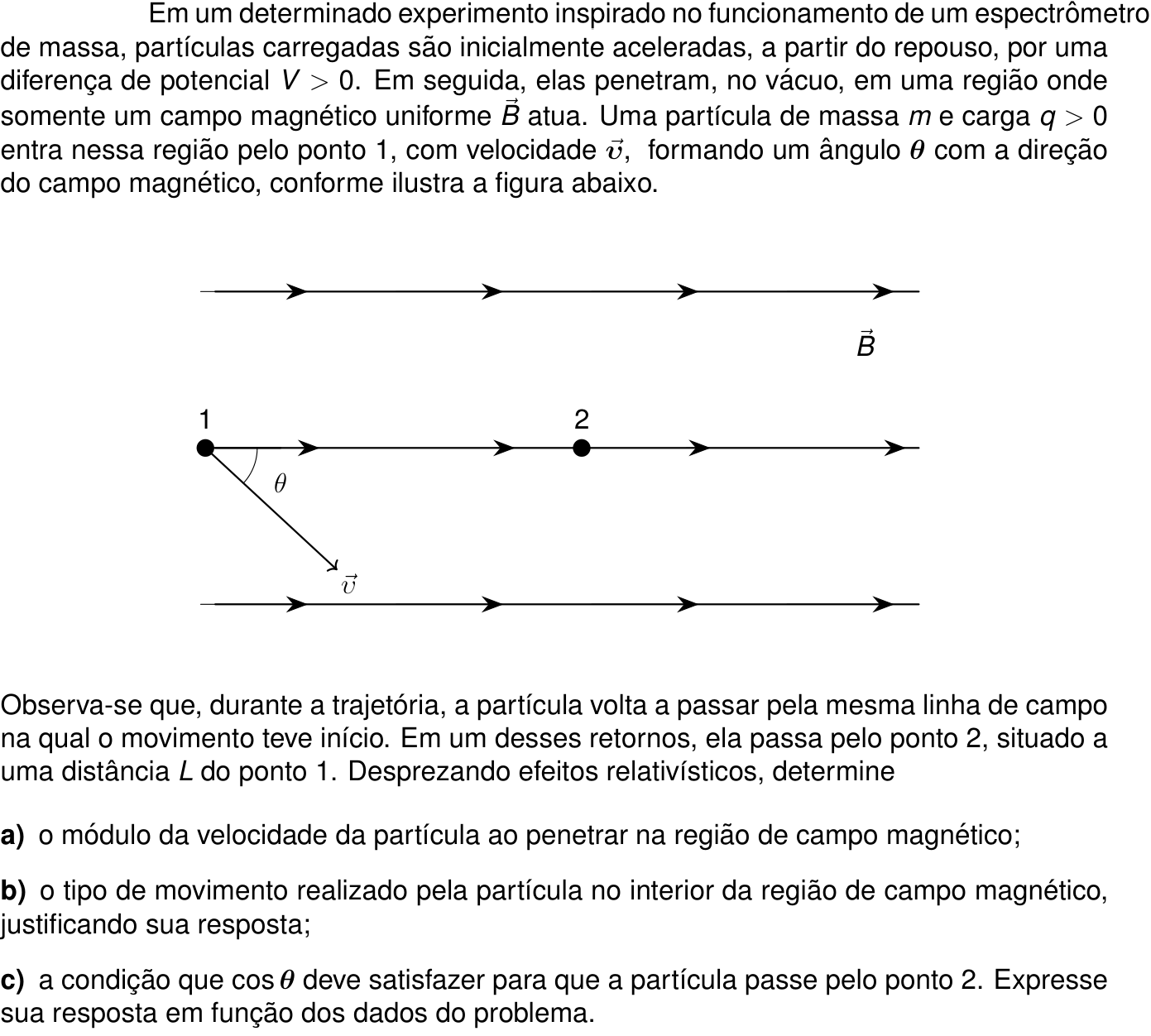
Problem: Charged particles accelerated from rest by potential difference V>0. Then enter vacuum region where only uniform magnetic field B acts. Particle mass m charge q>0 enters region at point 1, velocity v forming angle theta with direction of magnetic field. Figure: B field horizontal to right (lines arrows), particle enters point 1, velocity vector downward-right making angle theta with field direction (horizontal right). Then trajectory helical? It says during trajectory, particle returns to pass through same field line on which motion began. In one of these returns, it passes through point 2, located distance L from point 1. Determine a) speed magnitude upon entering magnetic field; b) type of motion inside magnetic field, justify; c) condition that cos theta must satisfy for particle to pass through point 2. Express in terms of data.
Need solve. Let's analyze.
Part a: accelerated by potential difference V: qV = (1/2) m v^2 => v = sqrt(2qV/m). Nonrelativistic.
Part b: Motion in uniform magnetic field: velocity has component parallel to B (v_parallel = v cos theta) and perpendicular (v_perp = v sin theta). Magnetic force q v × B acts only on perpendicular component, causing circular motion in plane perpendicular to B with radius r = m v_perp / (qB). Parallel component constant. Thus trajectory is a helix (helicoidal) with axis along B, uniform circular motion in transverse plane plus uniform translation along B. So type: movimento helicoidal uniforme (hélice cilíndrica) / composição de movimento retilíneo uniforme na direção de B e movimento circular uniforme no plano perpendicular a B. Justify: força magnética perpendicular à velocidade e a B; componente paralela não sofre força, componente perpendicular realiza MCU; raio etc.
Part c: Condition cos theta for particle passes through point 2. Let's understand geometry.
Particle enters at point 1 on a field line? "volta a passar pela mesma linha de campo na qual o movimento teve início." The magnetic field lines are horizontal straight lines. Point 1 is on a field line (the line through point 1). After entering, it follows helix. It returns to same magnetic field line (same line of B?) maybe after one or more full circular revolutions, because perpendicular motion circular; when it completes an integer number of turns, its transverse position returns to initial transverse coordinate, so it crosses the same field line (line parallel to B through initial point). "Em um desses retornos, ela passa pelo ponto 2" In one of these returns, it passes through point 2, located at distance L from point 1. Point 2 lies on same line of field as point 1? Figure: point 2 is on same horizontal line as point 1, distance L to right. Yes "mesma linha de campo na qual o movimento teve início" and point 2 situated at distance L from point 1, on that line.
Thus for particle to pass through point 2, after some number n of complete circular revolutions, it has translated along B by distance L? Actually point 2 on same field line, so transverse displacement zero, longitudinal displacement along B = L. The time to complete n cyclotron periods T_c = 2π m / (qB) each. During one period, displacement along B = v_parallel * T_c = (v cos theta) * (2π m / qB). For n turns, displacement = n * v cos theta * (2π m / qB) = L. Thus cos theta = L q B / (2π n m v). But need maybe condition? They ask "a condição que cos θ deve satisfazer para que a partícula passe pelo ponto 2. Expresse sua resposta em função dos dados do problema." Could be cos theta = L q B / (2π n m v) for some positive integer n? Or maybe because point 2 is "um desses retornos" but distance L may correspond to first return? Let's inspect.
They might want condition for cosθ? Let's derive carefully.
When particle returns to same field line, the transverse displacement is zero, i.e., after an integer number of turns. The point 2 is at distance L from point 1 along field line. The displacement along B after n complete turns equals L. But also note: The particle may pass through point 2 after multiple turns? "Em um desses retornos, ela passa pelo ponto 2" means there are multiple returns; one of them happens at point 2. Since returns occur at discrete positions x_n = n * v_parallel * T (assuming start at x=0). So L must equal n * v cosθ * T for some positive integer n. Therefore cosθ = L q B / (2π n m v). Since v = sqrt(2qV/m), perhaps express in terms of V: cosθ = L q B / (2π n m sqrt(2qV/m)) = L q B / (2π n sqrt(2 m q V))? Let's compute: m v = m sqrt(2qV/m)= sqrt(2 m q V). So cosθ = L q B / (2π n sqrt(2 m q V)) = L B / (2π n) * q / sqrt(2 m q V)? = L B sqrt(q) / (2π n sqrt(2 m V))? But maybe keep in terms m,q,V,B,L,n. Also maybe they expect cosθ = L B sqrt(q)/(2π n sqrt(2mV))? We can simplify: q / sqrt(2 m q V)= sqrt(q^2/(2 m q V)) = sqrt(q/(2 m V)). Yes = sqrt(q/(2 m V)). Thus cosθ = (L B / (2π n)) * sqrt(q/(2 m V)) = L B sqrt(q)/(2π n sqrt(2 m V)). Wait multiply: L B/(2π n) * sqrt(q/(2mV)) = L B sqrt(q) / (2π n sqrt(2mV)). Yes.
But maybe they don't want n? Let's see question c: "a condição que cos θ deve satisfazer para que a partícula passe pelo ponto 2. Expresse sua resposta em função dos dados do problema." It might be that "passe pelo ponto 2" only if after some number of complete revolutions, the displacement along B equals L. Thus condition involves an integer n? "condição" could be an equation with integer n, where n=1,2,...; maybe because there are many possible? But maybe due to geometry, if it passes through point 2, then L = n * pitch? But "condição que cosθ deve satisfazer" maybe they want cosθ = L q B / (2π m v) (n=1)? Let's examine wording: "Em um desses retornos, ela passa pelo ponto 2, situado a uma distância L do ponto 1." It doesn't say first return; "em um desses retornos" could imply one of the returns. Then it passes point 2 at one return. So yes n can be any positive integer. The condition: cosθ = L B q / (2π n m v) with n = 1,2,3,... Maybe they might define n as number of complete turns. But maybe because "passe pelo ponto 2" first time? The figure shows point 2 on the line; after first return (one full turn) maybe at distance equal to pitch; but if point 2 is arbitrary L, then if L equals pitch, particle passes after 1 turn; if L equals 2 pitch, after 2 turns, etc. The condition should include integer. But are there other possibilities? The particle could pass through point 2 not exactly at a return? It says "volta a passar pela mesma linha de campo na qual o movimento teve início. Em um desses retornos, ela passa pelo ponto 2" So point 2 is on that line, and at one return it passes there. It doesn't necessarily say it only passes at returns? But if it is on same field line, yes it passes through that line only at returns? Actually after entering at point 1, the particle may cross the original field line more than once if its transverse motion? Let's visualize: magnetic field lines are parallel horizontal; the "same field line" is the line through point 1 parallel to B. The particle's trajectory is helix; its projection onto transverse plane is circle. It crosses the original field line whenever its perpendicular displacement is zero, i.e., after each full period (and initial time? At t=0 at origin). Actually a charged particle in uniform B with initial velocity at angle to B moves in a helix. In the plane perpendicular to B, it performs a circle through the starting point (because initial perpendicular velocity radial? Wait: The guiding center drifts? Let's derive: v_perp rotates; position perpendicular is r_perp(t) = (v_perp/ω)(sin(ωt), 1 - cos(ωt)) if initial velocity along one axis? Starting at origin, after one full period returns to origin in transverse plane. Yes, crosses same field line at t = nT. Good. So no other crossings. Thus L must be n times pitch.
But maybe point 2 lies on the original field line after one return, not multiple? The problem statement: "Em um desses retornos, ela passa pelo ponto 2" could be any. Need include n.
Let's derive c fully.
Let v = sqrt(2qV/m). Component parallel: v_∥ = v cosθ. Magnetic force no work, so speed constant. Perpendicular component v_⊥ = v sinθ. Cyclotron angular frequency ω = qB/m. Period T = 2π m/(qB). Pitch (distance advanced along B in one period): p = v_∥ T = (v cosθ)(2π m / qB). After n periods (n=1,2,...), displacement along B = n p = L. Then cosθ = L / (n v T) = L q B / (2π n m v). Since v = sqrt(2qV/m), cosθ = L q B / (2π n m sqrt(2qV/m)) = L q B / (2π n sqrt(2m q V)) = L B sqrt(q) / (2π n sqrt(2m V))? Let's verify: q / sqrt(2m q V) = sqrt(q^2/(2m q V)) = sqrt(q/(2mV)). Yes. So cosθ = L B / (2π n) * sqrt(q/(2mV)) = L B sqrt(q) / (2π n sqrt(2mV)). Also can write = L B /(2π n) sqrt(q/(2mV)). Maybe leave as L q B / (2π n sqrt(2 m q V)). Which is best? The data include m, q, V, B, L. So expression in terms of dados: cosθ = L q B / (2π n sqrt(2 m q V)) or with n. But maybe if no n, take n=1? Let's see if "a condição que cosθ deve satisfazer" perhaps because if L is arbitrary, the condition is that there exists a positive integer n satisfying; but "condição" may be equality with n? They ask "a condição que cos θ deve satisfazer para que a partícula passe pelo ponto 2." Since L is fixed, it's a quantization condition on cosθ: cosθ = (L q B)/(2π n sqrt(...)) for some integer n. But perhaps they expect solving with "n" as an integer? Let's check if typical ITA problem? This might be from ITA 2024? There may be official solution. Let's recall maybe.
Question: "Observa-se que, durante a trajetória, a partícula volta a passar pela mesma linha de campo na qual o movimento teve início. Em um desses retornos, ela passa pelo ponto 2, situado a uma distância L do ponto 1. Desprezando efeitos relativísticos, determine ... c) a condição que cos θ deve satisfazer para que a partícula passe pelo ponto 2. Expresse sua resposta em função dos dados do problema." They might want: cosθ = L q B / (2π n m v), n=1,2,3... But maybe they want "cosθ = n L q B/(2π m v)"? Wait rearrange: If L = n p, then cosθ = L/(n vT). So n in denominator. But if they solve for cosθ perhaps they might define n as number of turns; yes.
Let's see if there is an alternative: Maybe "passe pelo ponto 2" after first return "em um desses retornos" but if point 2 is at distance L, condition might be that distance traveled along field line in one period equals L, so L = v cosθ * 2π m/(qB) => cosθ = L q B/(2π m v). Since they didn't mention n? But they said "em um desses retornos" could mean "at one of these returns", so after some number of turns; but perhaps if it's at point 2, which is on the same line, and "em um desses retornos" not "no primeiro retorno". Hmm.
Let's parse original Portuguese: "Observa-se que, durante a trajetória, a partícula volta a passar pela mesma linha de campo na qual o movimento teve início. Em um desses retornos, ela passa pelo ponto 2, situado a uma distância L do ponto 1." It says "Em um desses retornos" = "In one of these returns", not "no primeiro". So it definitely acknowledges multiple returns. Thus integer n.
But maybe they want condition on cosθ involving an arbitrary integer n? Could be.
Let's examine part b: "o tipo de movimento realizado pela partícula no interior da região de campo magnético, justificando sua resposta". Answer: movimento helicoidal uniforme (hélice cilíndrica), composição de um movimento circular uniforme no plano perpendicular ao campo com um movimento retilíneo uniforme na direção do campo. Justify: A força magnética é perpendicular à velocidade e ao campo; ela não realiza trabalho, então o módulo da velocidade é constante; a componente da velocidade paralela a B permanece constante (não há força nessa direção); a componente perpendicular descreve MCU de raio R = m v senθ/(qB). Thus helix.
Part a: v = sqrt(2qV/m). Part c: condition as above.
Need ensure notation: use θ (teta), possibly "senθ" etc. Use "≈" maybe not needed. The "Quando necessário, use ... Para θ << 1 assuma senθ ≈ θ." Not needed? Part c might involve cos theta not small? Probably not.
Let's derive c more rigorously maybe include geometric series? Let's formulate.
At t=0, particle at point 1. Velocity components: along B: v cosθ; perpendicular: v sinθ. Magnetic field B along positive x-axis. Let's choose coordinates: x along B, y,z transverse. Force q v × B. The motion:
x(t) = v cosθ t.
Transverse: circular motion with radius R = m v sinθ/(qB), angular frequency ω = qB/m. Starting at origin with velocity maybe along y-direction? It will trace circle; after time T = 2π/ω, it returns to transverse position (0,0). Thus at times t_n = nT, its coordinates are x_n = v cosθ * nT = n * (2π m v cosθ)/(qB), y=0,z=0. These are "retornos" to original field line. Point 2 is at distance L from point 1 along B, so its coordinate x = L. Thus L = n * (2π m v cosθ)/(qB). Solve for cosθ:
cosθ = L q B / (2π n m v). Since v = sqrt(2qV/m), yes.
Could also express using kinetic energy: m v = sqrt(2m qV). Then denominator 2π n sqrt(2m q V). Good.
Potential issue: The speed v in part a is sqrt(2qV/m). If q positive, acceleration from rest through potential difference V: work qV. Yes.
Let's include units? Not necessary.
Let's think if "condição que cos θ deve satisfazer" could be "cosθ = L q B/(2π m v)" and also "com n inteiro positivo"? Maybe answer: cosθ = L q B/(2π n m v), n=1,2,3,... But maybe they expect \( \cos\theta = \frac{L q B}{2\pi m v} \) because "em um desses retornos" first return? Let's check statement: "Em um desses retornos, ela passa pelo ponto 2, situado a uma distância L do ponto 1." If it passes at one of returns, then distance from point 1 to point 2 is L. If it passes at n-th return, L = n * pitch. They may want condition "cosθ = L B q/(2π n m v)" with n natural? But the problem might consider point 2 as the first point after point 1 on same field line reached at a return? But they didn't say "primeiro retorno". Let's search memory: This seems from ITA 2024/2025? The figure and statement maybe from "ITA 2024 Física" question? I vaguely recall an ITA problem about mass spectrometer: accelerated by V, enter magnetic field at angle theta; "A partícula volta a passar pela mesma linha de campo na qual o movimento teve início. Em um desses retornos, ela passa pelo ponto 2, situado a uma distância L do ponto 1. Determine ... c) a condição que cos θ deve satisfazer..." Maybe official answer might be \( \cos\theta = \frac{L q B}{2\pi m v} \) perhaps because they consider the first return? Let's see.
If they wanted integer multiple, the condition would have "n" and maybe they'd say "para que a partícula passe pelo ponto 2, é necessário que \( \cos\theta = \frac{L q B}{2\pi n m v}\), com n=1,2,3,...". But can a "condition" be multiple possibilities? Yes. However, in a mass spectrometer, maybe they select velocity? The angle theta is determined by geometry? Hmm.
Let's analyze: Particle enters at point 1, with speed v and angle theta. It follows helix. It will return to original field line at distances \(s_n = n L_0\), where \(L_0 = v \cos\theta T\). The point 2 is at a fixed distance L from point 1. If L is arbitrary, in order for particle to pass through point 2, L must be an integer multiple of the pitch \(L_0\). But since L and v are given, cosθ must satisfy relation. So there may be multiple possible cosθ (for different n). But perhaps the problem asks "a condição que cos θ deve satisfazer" singular, but may include n. Could be "cosθ = \frac{L q B}{2\pi n m v}, n\in\mathbb{N}^*". That seems mathematically correct.
Let's derive with n included, and maybe mention n = 1,2,3,... in answer.
Let's ensure part c "em função dos dados do problema" not "em função de n"? The data include L, q, B, m, V maybe. n is not data but a positive integer. So answer should include n as a natural number. Maybe acceptable.
Let's also consider the trajectory in the magnetic field: Because initial velocity has component parallel, the particle moves in a helix; it doesn't return to the same field line after a full period? Wait, the projection in transverse plane is a circle centered at guiding center. The initial point is on the circle. After one period, it returns to same transverse position. Yes. But if there is no electric field, the guiding center is fixed? Actually for a charged particle in uniform B, the guiding center is \( \mathbf{R} = \mathbf{r} + \frac{\mathbf{v}\times \mathbf{B}}{\omega B} \)? Let's compute: If B along x, v_perp = (0, v_y, v_z). The orbit is a circle; after one period, transverse position returns to initial. So yes.
Let's compute radius maybe not needed.
Let's formulate answer in Portuguese.
Potential final response:
a) Pelo teorema da energia cinética: \(qV = \frac12 m v^2\), logo \(v = \sqrt{\frac{2qV}{m}}\).
b) A força magnética é \( \vec F = q \vec v \times \vec B\). Ela é perpendicular à velocidade, portanto não altera o módulo da velocidade; a componente \(v_\parallel = v\cos\theta\) permanece constante ao longo de \(\vec B\), enquanto a componente perpendicular \(v_\perp = v\sin\theta\) descreve movimento circular uniforme de raio \(R = \frac{m v \sin\theta}{qB}\). Assim, a trajetória é uma hélice cilíndrica (movimento helicoidal uniforme), resultante da composição de um MRU na direção do campo com um MCU no plano perpendicular.
c) O período do movimento circular é \(T = \frac{2\pi m}{qB}\). Em cada período, a partícula avança ao longo do campo uma distância \(p = v_\parallel T = v\cos\theta \frac{2\pi m}{qB}\). Para que ela retorne à mesma linha de campo no ponto 2, situado a uma distância L do ponto 1, deve-se ter \(L = n p\), onde \(n=1,2,3,\ldots\). Portanto:
\[
\cos\theta = \frac{L q B}{2\pi n m v}
= \frac{L q B}{2\pi n \sqrt{2mqV}}?
\]
Wait check: v = sqrt(2qV/m), so m v = sqrt(2 m q V). Yes denominator \(2\pi n \sqrt{2 m q V}\). But let's verify: \(m v = m \sqrt{2qV/m} = \sqrt{2m^2 qV/m}? = \sqrt{2 m q V}\). Yes. So \(\cos\theta = \frac{L q B}{2\pi n \sqrt{2 m q V}}\). Alternatively \( \frac{L B}{2\pi n}\sqrt{\frac{q}{2mV}}\). Which is more elegant? Let's pick one.
Let's check dimensions: qB/(m v) = (C T)/(kg m/s) =? T = kg/(C s), so qB = C*kg/(C s)=kg/s; denominator m v = kg m/s; ratio=(kg/s)/(kg m/s)=1/m? Wait cos dimensionless; L q B/(m v) = m*(kg/s)/(kg m/s)=? kg/s / (kg m/s)=1/m. Then L times 1/m dimensionless. Good. qB/(m v) = (C * kg/(C s))/(kg m/s)= (kg/s)/(kg m/s)=1/m. Yes.
Alternative q/(sqrt(2 m q V)) dimension? q C; sqrt(kg C V)= sqrt(kg C * J/C?) J=kg m^2/s^2; V=J/C=kg m^2/(C s^2); kg C V = kg C * kg m^2/(C s^2)=kg^2 m^2/s^2 => sqrt = kg m/s = momentum. So q / momentum = C/(kg m/s); times L B? B T=kg/(C s); L B q/momentum = m*(kg/(C s))*C/(kg m/s)=? kg/s / (kg m/s)=1/m times m? Actually m* (kg/(C s))*C/(kg m/s) = m*(kg/s)/(kg m/s)=1. Good.
Let's include n in answer. Maybe if they expect "cosθ = L q B/(2π m v)" without n, would lose? Let's see: The problem says "Em um desses retornos, ela passa pelo ponto 2"; if point 2 is at distance L and it's "um desses retornos", then it could be first return? But "um desses" means "one of these"; however, in physics problems, they may not want n because point 2 could be after the first return? But if L is arbitrary, they may ask condition that cosθ must satisfy "para que a partícula passe pelo ponto 2" not "pela primeira vez". Since n can be any positive integer, including 1. If they wanted first return, they'd say "no primeiro retorno". So include n.
Let's consider if point 2 is located at distance L from point 1 along the same field line, but the particle may pass through point 2 at a return that is not the first. The condition is that there exists n such that L = n*pitch. If question asks "a condição que cosθ deve satisfazer", maybe answer is \(\cos\theta = \frac{L q B}{2\pi m v}\) with the understanding that \(L\) is the distance corresponding to one return? But "em um desses retornos" definitely means some return, not necessarily first. Let's search memory: ITA 2024 Física? I think the official answer might be \( \cos\theta = \frac{L q B}{2\pi m v} \sqrt{\frac{m}{2qV}}\)? Hmm.
Let's parse "a partícula volta a passar pela mesma linha de campo na qual o movimento teve início. Em um desses retornos, ela passa pelo ponto 2, situado a uma distância L do ponto 1." If it "volta a passar" in singular? Actually "volta a passar pela mesma linha de campo" could be a recurring event. "Em um desses retornos" = in one of these returns. Therefore they likely intend n. However, in many textbook solutions, they define "p" pitch and say "para que passe pelo ponto 2, L = n p, n=1,2,3,...". Then cosθ condition includes n. But maybe they ask "a condição que cosθ deve satisfazer" and answer "cosθ = L q B/(2π n m v), n=1,2,...". Let's do that.
Let's also consider if there is another possibility: The particle could pass through point 2 after an integer number of turns plus a partial turn? No, because point 2 is on the original field line, transverse displacement zero; that only occurs at full periods (unless velocity perpendicular component zero? But θ not 0). So integer n.
Let's ensure not missing factor 1/2? Period T = 2π m/(qB), yes. In one period, time T = 2π/ω = 2π m/(qB). Distance along B = v cosθ * T. Good.
Let's craft final answer with development item by item.
Need final line format: "Resposta final: a) ...; b) ...; c) ...". Short.
Let's write in Portuguese.
Potential final:
a) \(qV = \frac12 m v^2 \Rightarrow v = \sqrt{\frac{2qV}{m}}\).
b) Movimento helicoidal uniforme (hélice cilíndrica). Justificativa: a força magnética é perpendicular à velocidade e não realiza trabalho; a componente \(v_\parallel = v\cos\theta\) não sofre força e permanece constante, enquanto a componente \(v_\perp = v\sin\theta\) realiza MCU num plano perpendicular a \(\vec B\). Logo, a partícula descreve uma hélice de raio \(R = \frac{m v\sin\theta}{qB}\).
c) O período do MCU é \(T = \frac{2\pi m}{qB}\). Em cada volta, o deslocamento paralelo ao campo é \(p = v\cos\theta T = \frac{2\pi m v\cos\theta}{qB}\). Para que passe pelo ponto 2, a distância L deve ser um múltiplo inteiro de p:
\[
L = n p \Rightarrow \cos\theta = \frac{L q B}{2\pi n m v}
= \frac{L q B}{2\pi n\sqrt{2mqV}},
\quad n=1,2,3,\ldots
\]
Wait simplification: \(m v = m sqrt(2qV/m) = \sqrt{2m q V}\). Yes.
Let's verify simplification: \(m v = \sqrt{2m^2 q V/m}?\) Let's do carefully: v = sqrt(2qV/m). m v = m * sqrt(2qV/m) = sqrt(m^2 * 2qV/m) = sqrt(2m q V). Yes. Then denominator 2π n m v = 2π n sqrt(2 m q V). So cosθ = L q B / (2π n sqrt(2 m q V)). Good.
Could also write \( \cos\theta = \frac{L B}{2\pi n}\sqrt{\frac{q}{2mV}}\). But first is fine.
Let's make sure no error: \(m v\) multiplied by qB: qB * L / (2π n * sqrt(2 m q V)). Dimension mass? sqrt(2 m q V) has dimensions sqrt(kg C J/C)=sqrt(kg J)=sqrt(kg * kg m^2/s^2)=kg m/s = momentum. qB L? qB dimension C * kg/(C s)=kg/s; times L m = kg m/s; divide momentum = dimensionless. Good.
Let's final.
But we should include "n" in final line? Maybe "c) cosθ = ... , n∈N*". Yes.
Let's also address part b with "movimento helicoidal uniforme" not "helicoidal". In Portuguese "movimento helicoidal uniforme" or "hélice cilíndrica". Good.
Let's produce final answer with appropriate formatting.
a) A partícula é acelerada por uma diferença de potencial V. Pelo teorema da energia cinética:
qV=\frac12 mv^2 \quad\Rightarrow\quad v=\sqrt{\frac{2qV}{m}}.
b) No interior do campo magnético, a força magnética é
\vec F=q\,\vec v\times \vec B,
perpendicular à velocidade. Assim, ela não altera o módulo da velocidade. A componente da velocidade paralela ao campo, v_\parallel=v\cos\theta, permanece constante; a componente perpendicular, v_\perp=v\sin\theta, descreve um movimento circular uniforme. Portanto, a trajetória é uma hélice cilíndrica, ou seja, um movimento helicoidal uniforme: composição de um MRU na direção de \vec B com um MCU no plano perpendicular a \vec B.
c) O período do movimento circular é
T=\frac{2\pi m}{qB}.
Em cada período, a partícula avança ao longo da direção do campo magnético uma distância
p=v_\parallel T=v\cos\theta\cdot \frac{2\pi m}{qB}.
Para que ela volte à mesma linha de campo passando pelo ponto 2, situado a uma distância L do ponto 1, deve-se ter
L=n p,\qquad n=1,2,3,\ldots
Logo,
L=n\,v\cos\theta\frac{2\pi m}{qB}
e, portanto,
\cos\theta=\frac{LqB}{2\pi n m v}
=\frac{LqB}{2\pi n\sqrt{2mqV}},\qquad n=1,2,3,\ldots
Resposta final: a) v=\sqrt{\dfrac{2qV}{m}}; b) movimento helicoidal uniforme, pois a componente paralela ao campo é MRU e a perpendicular é MCU; c) \cos\theta=\dfrac{LqB}{2\pi n\sqrt{2mqV}}, com n=1,2,3,\ldots