Correção IME 2027 · Português e InglêsAcompanhe a resolução de cada questão da 2ª fase, ao vivoAcompanhar
IA ao vivo / ITA 2027 · 2ª fase · Física

COMPARE OS RACIOCÍNIOS

Questão 10 (Física)

Questão discursiva: a banca não divulga gabarito oficial. ← 9 (Física)

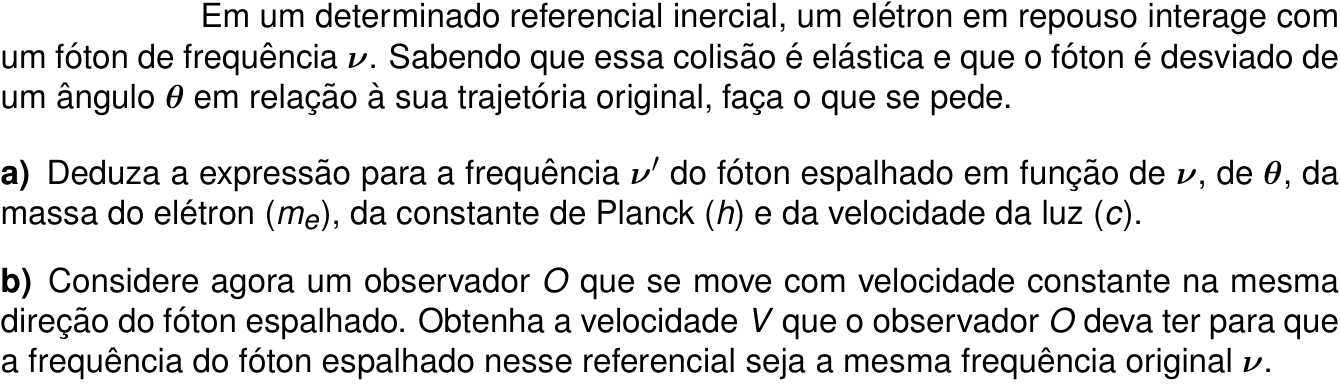
A questão

Texto de apoio da questão 10 (Física) Questão 10 (Física)

Resposta de referência

a) Das conservações de energia e momento e de E_e^2=m_e^2c^4+p_e^2c^2, obtém-se m_ec^2(\nu-\nu')=h\nu\nu'(1-\cos\theta), logo \nu'=\nu/(1+\alpha), com \alpha=\frac{h\nu}{m_ec^2}(1-\cos\theta). b) Pelo efeito Doppler, \nu=\nu'\sqrt{(1+V/c)/(1-V/c)}, tomando V como módulo da velocidade em sentido oposto ao fóton espalhado. Assim, V=c\frac{(1+\alpha)^2-1}{(1+\alpha)^2+1}. Se o sentido positivo for o de propagação do fóton, a velocidade algébrica é o negativo desse valor.

Segundo a resolução dos cursinhos Farias Brito e Poliedro. A banca não publica gabarito das questões discursivas.

Respostas das IAs

GPT-6 Astra

Respondeu · bate com a resposta de referência dos cursinhos

a) \displaystyle \nu'=\frac{\nu}{1+\frac{h\nu}{m_ec^2}(1-\cos\theta)}; b) \displaystyle V=-c\frac{(1+\eta)^2-1}{(1+\eta)^2+1}, com \displaystyle \eta=\frac{h\nu}{m_ec^2}(1-\cos\theta) e sentido positivo igual ao do fóton espalhado.

levou 30 s

Como pensou

a) Frequência do fóton espalhado

Sejam E_e e \vec p_e a energia e o momento do elétron após a colisão. Pela conservação da energia,

m_ec^2+h\nu=E_e+h\nu',

portanto

E_e=m_ec^2+h(\nu-\nu').

Como o momento de um fóton tem módulo h\nu/c, a conservação do momento fornece

\vec p_e=\vec p_\gamma-\vec p_\gamma'.

O ângulo entre os momentos dos fótons é \theta; assim,

p_e^2c^2=h^2\left(\nu^2+\nu'^2-2\nu\nu'\cos\theta\right).

Usando a relação relativística E_e^2=m_e^2c^4+p_e^2c^2,

\left[m_ec^2+h(\nu-\nu')\right]^2 =m_e^2c^4+h^2\left(\nu^2+\nu'^2-2\nu\nu'\cos\theta\right).

Expandindo e simplificando,

m_ec^2(\nu-\nu')=h\nu\nu'(1-\cos\theta).

Logo,

\boxed{\nu'=\frac{\nu}{1+\dfrac{h\nu}{m_ec^2}(1-\cos\theta)}}.

b) Velocidade do observador

Tomemos como positivo o sentido de propagação do fóton espalhado, de modo que V seja uma velocidade algébrica. Pelo efeito Doppler relativístico, a frequência medida pelo observador é

\nu_O=\gamma\nu'\left(1-\frac{V}{c}\right) =\nu'\sqrt{\frac{1-V/c}{1+V/c}}.

Definindo

\eta=\frac{h\nu}{m_ec^2}(1-\cos\theta),

o resultado do item anterior dá \nu/\nu'=1+\eta. Portanto, a condição \nu_O=\nu implica

1+\eta=\sqrt{\frac{1-V/c}{1+V/c}}.

Elevando ao quadrado e isolando V,

\boxed{V=-c\,\frac{(1+\eta)^2-1}{(1+\eta)^2+1}}.

Para um desvio não nulo, \eta>0 e V<0. Assim, o observador deve mover-se na mesma direção, mas em sentido contrário ao fóton espalhado, para medir uma frequência maior que \nu'. Para \theta=0, resulta V=0.

Resposta final: a) \displaystyle \nu'=\frac{\nu}{1+\frac{h\nu}{m_ec^2}(1-\cos\theta)}; b) \displaystyle V=-c\frac{(1+\eta)^2-1}{(1+\eta)^2+1}, com \displaystyle \eta=\frac{h\nu}{m_ec^2}(1-\cos\theta) e sentido positivo igual ao do fóton espalhado.

GPT-6.1 Sol

Respondeu · bate com a resposta de referência dos cursinhos

a) \displaystyle \nu'=\frac{\nu}{1+\frac{h\nu}{m_ec^2}(1-\cos\theta)}; b) \displaystyle V=c\frac{(1+\alpha)^2-1}{(1+\alpha)^2+1}, em sentido oposto ao fóton espalhado, com \displaystyle \alpha=\frac{h\nu}{m_ec^2}(1-\cos\theta).

levou 24 s

Como pensou

a) Frequência do fóton espalhado

Sejam E_e e \vec p_e a energia e o momento do elétron após a colisão. Pela conservação da energia,

m_ec^2+h\nu=E_e+h\nu'.

Como o momento de um fóton tem módulo h\nu/c, a conservação do momento fornece

p_e^2=\left(\frac{h\nu}{c}\right)^2+ \left(\frac{h\nu'}{c}\right)^2 -\frac{2h^2\nu\nu'}{c^2}\cos\theta.

Usando a relação relativística E_e^2=m_e^2c^4+p_e^2c^2, temos

[m_ec^2+h(\nu-\nu')]^2 =m_e^2c^4+h^2(\nu^2+\nu'^2-2\nu\nu'\cos\theta).

Expandindo e simplificando,

m_ec^2(\nu-\nu')=h\nu\nu'(1-\cos\theta).

Portanto,

\boxed{\nu'=\frac{\nu} {1+\dfrac{h\nu}{m_ec^2}(1-\cos\theta)}}.

b) Velocidade do observador

Tomemos como positivo o sentido de propagação do fóton espalhado e escrevamos a componente da velocidade do observador como \beta c. Pelo efeito Doppler relativístico, a frequência medida por ele é

\nu_O=\gamma\nu'(1-\beta) =\nu'\sqrt{\frac{1-\beta}{1+\beta}}.

Definindo

\alpha=\frac{h\nu}{m_ec^2}(1-\cos\theta),

o item anterior dá \nu/\nu'=1+\alpha. Para que \nu_O=\nu,

\sqrt{\frac{1-\beta}{1+\beta}}=1+\alpha.

Logo,

\beta=\frac{1-(1+\alpha)^2}{1+(1+\alpha)^2}.

Como \alpha\geq0, essa componente é negativa para um espalhamento com \theta\neq0. Assim, o observador deve mover-se na mesma direção, mas em sentido contrário ao do fóton espalhado, com velocidade de módulo

\boxed{V=c\,\frac{(1+\alpha)^2-1}{(1+\alpha)^2+1}}.

Para \theta=0, resulta V=0. Se o movimento fosse exigido no mesmo sentido do fóton, não haveria solução para \theta\neq0.

Resposta final: a) \displaystyle \nu'=\frac{\nu}{1+\frac{h\nu}{m_ec^2}(1-\cos\theta)}; b) \displaystyle V=c\frac{(1+\alpha)^2-1}{(1+\alpha)^2+1}, em sentido oposto ao fóton espalhado, com \displaystyle \alpha=\frac{h\nu}{m_ec^2}(1-\cos\theta).

GPT-6 Luna

Respondeu · bate com a resposta de referência dos cursinhos

a) \displaystyle \nu'=\frac{\nu}{1+\frac{h\nu}{m_ec^2}(1-\cos\theta)}; b) não há solução movendo-se no sentido do fóton; a velocidade algébrica necessária é \displaystyle V=c\frac{1-R^2}{1+R^2}<0, com \displaystyle R=1+\frac{h\nu}{m_ec^2}(1-\cos\theta).

levou 28 s

Como pensou
**Considering small-angle approximation** I'm thinking about the small-angle approximation and how it relates to deriving velocity (V). The provided info hints that θ is small, suggesting it's expected to be used in a certain way. There may be a connection with frequency and Doppler effects. If the observer's velocity is in the same direction as an emitted photon, it might lead to a specific expected velocity. To retrieve the original frequency, the observer must approach the photon, indicating movement in the opposite direction.**Clarifying photon behavior** I'm examining the relationship between an observer's velocity and photon frequency. If the observer is moving in the same direction as the photon, they may perceive a lower frequency due to the chase dynamics. However, there's a notable contradiction when considering the standard formulas that relate observer and source velocities. It seems the photon frequency could exceed the initial frequency after scattering. I'm wondering about the inclusion of small angles in these calculations, as they simplify understanding electron momentum.**Examining Compton scattering** I'm thinking about the expectations around nonrelativistic electron recoil and how small angles might simplify the derivation of electron momentum and speed. The intention could be to compute the electron's velocity to relate it to the observer's. There might be a trick in the question about Compton scattering, where if the observer moves in the same direction as the scattered photon, they might mistakenly assume their velocity is positive. However, this could lead to negative values, creating contradictions.**Exploring velocity calculations** I'm pondering the implications of small angle approximations and how they might lead to a positive velocity. I want to check the Lorentz transformation and see if it aligns with the observer's velocity in the same direction as the photon. Using the Doppler formula reveals that if the observed frequency is lower, I might end up with a signed velocity that is negative, suggesting opposite directions. This could confuse the expectation of a positive velocity, highlighting a contradiction in the question's wording about "same direction."**Exploring Compton scattering** I’m considering using the small-angle approximation for my approach. The exact Compton expression works without approximations, so I might relate b to V in terms of θ and ν for simplification when θ is small. I'm curious why sin is included instead of cos. To derive the momentum components for recoil, I can focus on electron momentum and nonrelativistic recoil energy. Exact relativistic gives the Compton formula, but maybe energy and momentum conservation apply here. I’ll also think about deriving photon frequency using kinetic energy.

a)

Escolho o eixo x na direção inicial do fóton. Após a colisão, seu momento é

\vec p_{\gamma}'=\frac{h\nu'}{c}(\cos\theta\,\hat x+\sin\theta\,\hat y),

enquanto o momento inicial era \vec p_\gamma=(h\nu/c)\hat x.

Pela conservação de energia, a energia do elétron após a colisão é

E_e=m_ec^2+h(\nu-\nu').

Pela conservação do momento, o módulo do seu momento satisfaz

p_e^2c^2=h^2\bigl(\nu^2+\nu'^2-2\nu\nu'\cos\theta\bigr).

Usando E_e^2=p_e^2c^2+m_e^2c^4 e substituindo a expressão de E_e, obtém-se

h\nu\nu'(1-\cos\theta)=m_ec^2(\nu-\nu').

Logo,

\boxed{\nu'=\frac{\nu}{1+\dfrac{h\nu}{m_ec^2}(1-\cos\theta)}}.

b)

Seja V a velocidade algébrica do observador na direção do fóton espalhado, e \beta=V/c. Pela transformação relativística da frequência,

\nu_O=\gamma\nu'(1-\beta),\qquad \gamma=\frac{1}{\sqrt{1-\beta^2}}.

Para \nu_O=\nu, definindo

R=\frac{\nu}{\nu'}=1+\frac{h\nu}{m_ec^2}(1-\cos\theta),

temos \gamma(1-\beta)=R, de onde

\beta=\frac{1-R^2}{1+R^2}.

Para \theta\ne0, R>1, portanto \beta<0: o observador teria de se mover no sentido contrário ao fóton espalhado. Assim, não há velocidade no sentido indicado pelo enunciado que produza a frequência desejada. Se a velocidade for entendida como algébrica, o valor necessário é

V=c\,\frac{1-R^2}{1+R^2}.

Para \theta\ll1, isso dá V\approx-\dfrac{h\nu}{2m_ec}\theta^2.

Resposta final: a) \displaystyle \nu'=\frac{\nu}{1+\frac{h\nu}{m_ec^2}(1-\cos\theta)}; b) não há solução movendo-se no sentido do fóton; a velocidade algébrica necessária é \displaystyle V=c\frac{1-R^2}{1+R^2}<0, com \displaystyle R=1+\frac{h\nu}{m_ec^2}(1-\cos\theta).

Claude Fable 5.1

Respondeu · bate com a resposta de referência dos cursinhos

a) \nu'=\dfrac{\nu}{1+\frac{h\nu}{m_ec^2}(1-\cos\theta)}; b) V=c\,\dfrac{\nu^2-\nu'^2}{\nu^2+\nu'^2}=c\,\dfrac{\left[1+\frac{h\nu}{m_ec^2}(1-\cos\theta)\right]^2-1}{\left[1+\frac{h\nu}{m_ec^2}(1-\cos\theta)\right]^2+1}, com o observador se movendo ao encontro do fóton espalhado (sentido oposto ao da sua propagação).

levou 24 s

Como pensou
This is the Compton scattering problem. I derive the shifted frequency formula ν' = ν / (1 + (hν/(m_e c²))(1 − cos θ)) from energy-momentum conservation, then consider an observer moving relative to the scattered photon so that the Doppler shift compensates for the Compton shift, bringing the observed frequency back to ν — working through the relativistic Doppler relation to find the required velocity direction and magnitude. This simplifies to the standard Compton formula: hνν'(1−cosθ) = m_ec²(ν−ν'), giving ν' = ν/[1+(hν/m_ec²)(1−cosθ)], equivalently 1/ν'−1/ν = h(1−cosθ)/(m_ec²). I'll note the small-angle approximation 1−cosθ≈θ²/2 as an optional remark, then write up the final answer.

Item a) – Efeito Compton

Fóton incidente: energia h\nu, momento p=h\nu/c. Fóton espalhado: energia h\nu', momento p'=h\nu'/c, desviado de \theta. Elétron inicialmente em repouso (energia m_ec^2) e, após a colisão, com momento \vec p_e e energia E_e=\sqrt{p_e^2c^2+m_e^2c^4}.

Conservação da energia (colisão elástica):

h\nu + m_ec^2 = h\nu' + E_e \;\Rightarrow\; E_e = h(\nu-\nu')+m_ec^2

E_e^2 = h^2(\nu-\nu')^2 + 2h(\nu-\nu')m_ec^2 + m_e^2c^4

Conservação do momento: \vec p_e=\vec p-\vec p', logo (lei dos cossenos)

p_e^2 = \frac{h^2}{c^2}\left(\nu^2+\nu'^2-2\nu\nu'\cos\theta\right)

Substituindo em E_e^2 = p_e^2c^2+m_e^2c^4:

h^2(\nu^2+\nu'^2-2\nu\nu'\cos\theta) = h^2(\nu^2-2\nu\nu'+\nu'^2)+2h\,m_ec^2(\nu-\nu')

h\,\nu\nu'(1-\cos\theta) = m_ec^2(\nu-\nu') \;\Rightarrow\; \frac{1}{\nu'}-\frac{1}{\nu}=\frac{h}{m_ec^2}(1-\cos\theta)

\boxed{\nu' = \dfrac{\nu}{1+\dfrac{h\nu}{m_ec^2}(1-\cos\theta)}}

(Para \theta\ll 1, 1-\cos\theta = 2\,\mathrm{sen}^2(\theta/2)\approx \theta^2/2, dando \nu'\approx \nu/[1+h\nu\theta^2/(2m_ec^2)].)

Item b) – Efeito Doppler relativístico

Como \nu'<\nu, o observador deve medir um desvio para o azul; portanto O deve se mover ao longo da direção do fóton espalhado no sentido contrário ao da propagação dele (indo ao encontro do fóton), com velocidade V=\beta c. A frequência medida é

\nu_O = \nu'\sqrt{\frac{1+\beta}{1-\beta}}

Impondo \nu_O=\nu:

\frac{1+\beta}{1-\beta}=\left(\frac{\nu}{\nu'}\right)^2 \;\Rightarrow\; \beta = \frac{\nu^2-\nu'^2}{\nu^2+\nu'^2}

Definindo k=\dfrac{\nu}{\nu'} = 1+\dfrac{h\nu}{m_ec^2}(1-\cos\theta):

\boxed{V = c\,\frac{k^2-1}{k^2+1} = c\,\frac{\left[1+\frac{h\nu}{m_ec^2}(1-\cos\theta)\right]^2-1}{\left[1+\frac{h\nu}{m_ec^2}(1-\cos\theta)\right]^2+1}}

dirigida contra o sentido de propagação do fóton espalhado.

Resposta final: a) \nu'=\dfrac{\nu}{1+\frac{h\nu}{m_ec^2}(1-\cos\theta)}; b) V=c\,\dfrac{\nu^2-\nu'^2}{\nu^2+\nu'^2}=c\,\dfrac{\left[1+\frac{h\nu}{m_ec^2}(1-\cos\theta)\right]^2-1}{\left[1+\frac{h\nu}{m_ec^2}(1-\cos\theta)\right]^2+1}, com o observador se movendo ao encontro do fóton espalhado (sentido oposto ao da sua propagação).

Claude Opus 5.5

Respondeu · bate com a resposta de referência dos cursinhos

a) \nu' = \dfrac{\nu}{1+\frac{h\nu}{m_ec^2}(1-\cos\theta)}; b) V = c\,\dfrac{(\nu/\nu')^2-1}{(\nu/\nu')^2+1} = c\,\dfrac{k(2+k)}{2+2k+k^2}, com k=\dfrac{h\nu(1-\cos\theta)}{m_ec^2}, no sentido oposto ao do fóton espalhado (observador se aproximando); para k\ll1, V\approx \dfrac{h\nu(1-\cos\theta)}{m_ec}.

levou 17 s

Como pensou
I derive the Compton formula giving the scattered frequency in terms of the incident frequency and scattering angle. Then for part (b), I consider an observer moving along the direction of the scattered photon with velocity V, applying the relativistic Doppler shift formula to relate the observed frequency to the scattered frequency through the factor sqrt((1−β)/(1+β)). Since the observed frequency must exceed the scattered frequency, I conclude the observer must be moving toward the source of the scattered photon rather than away. Setting r = ν/ν' = 1 + (hν/mc²)(1−cosθ), I solve for the required speed b, getting b = (r²−1)/(r²+1), so V = c(r²−1)/(r²+1) directed opposite to the photon's propagation. I simplify using k = hν(1−cosθ)/(mc²), giving V = ck(2+k)/(2+2k+k²), and note that for small k this reduces to V ≈ hν(1−cosθ)/(mc), explaining why the problem hints at a small-angle approximation. For part (a), I set up the energy and momentum conservation equations for the photon-electron collision, equating the electron's relativistic energy-momentum relation to derive the standard Compton shift formula.

a) Frequência do fóton espalhado (efeito Compton)

Escrevo a conservação da energia, com o elétron inicialmente em repouso:

h\nu + m_ec^2 = h\nu' + E_e

Escrevo a conservação do momento. Isolo o momento do elétron e aplico a lei dos cossenos:

p_e^2c^2 = (h\nu)^2 + (h\nu')^2 - 2h^2\nu\nu'\cos\theta

Uso a relação relativística E_e^2 = p_e^2c^2 + m_e^2c^4, com E_e = h(\nu-\nu') + m_ec^2:

\left[h(\nu-\nu') + m_ec^2\right]^2 = h^2\nu^2 + h^2\nu'^2 - 2h^2\nu\nu'\cos\theta + m_e^2c^4

Expandindo o lado esquerdo, os termos h^2\nu^2, h^2\nu'^2 e m_e^2c^4 se cancelam. Sobra:

-2h^2\nu\nu' + 2m_ec^2h(\nu-\nu') = -2h^2\nu\nu'\cos\theta
m_ec^2(\nu-\nu') = h\nu\nu'(1-\cos\theta)

Daí:

\frac{1}{\nu'} - \frac{1}{\nu} = \frac{h}{m_ec^2}(1-\cos\theta)
\boxed{\nu' = \dfrac{\nu}{1 + \dfrac{h\nu}{m_ec^2}(1-\cos\theta)}}

b) Velocidade do observador

Como \nu' < \nu, o observador precisa ver a frequência aumentada (desvio para o azul). Para isso ele deve se mover em sentido contrário ao de propagação do fóton espalhado, isto é, aproximando-se dele.

Pelo efeito Doppler relativístico, com \beta = V/c:

\nu_O = \nu'\sqrt{\frac{1+\beta}{1-\beta}} = \nu

Defino:

r \equiv \frac{\nu}{\nu'} = 1 + k, \qquad k = \frac{h\nu(1-\cos\theta)}{m_ec^2}

A condição fica \dfrac{1+\beta}{1-\beta} = r^2, ou seja:

\beta = \frac{r^2-1}{r^2+1}

Substituindo r = 1+k:

V = c\,\frac{k(2+k)}{2+2k+k^2}

Nesse resultado, V aponta no sentido oposto ao da propagação do fóton espalhado.

Para k \ll 1, vale a aproximação V \approx ck = \dfrac{h\nu(1-\cos\theta)}{m_ec}.

Resposta final: a) \nu' = \dfrac{\nu}{1+\frac{h\nu}{m_ec^2}(1-\cos\theta)}; b) V = c\,\dfrac{(\nu/\nu')^2-1}{(\nu/\nu')^2+1} = c\,\dfrac{k(2+k)}{2+2k+k^2}, com k=\dfrac{h\nu(1-\cos\theta)}{m_ec^2}, no sentido oposto ao do fóton espalhado (observador se aproximando); para k\ll1, V\approx \dfrac{h\nu(1-\cos\theta)}{m_ec}.

Claude Sonnet 5.5

Respondeu · bate com a resposta de referência dos cursinhos

a) ν′ = ν / [1 + (hν/(mₑc²))(1 − cosθ)]; b) V = c(k²−1)/(k²+1), com k = 1 + (hν/(mₑc²))(1−cosθ), em sentido oposto ao do fóton espalhado; para θ ≪ 1, V ≈ hνθ²/(2mₑc).

levou 11 s

Como pensou
I'm working through the Compton scattering formula for the shifted frequency, then considering an observer moving along the scattered photon's direction. Since the Compton-shifted frequency is lower than the original, a receding observer would see an even lower frequency, so I'm checking whether the observer actually needs to move toward the source instead to recover the original frequency. Working this through, I find the observer must move toward the photon source, with the exact velocity given by β = (k²-1)/(k²+1) where k = 1 + (2hν/mc²)sin²(θ/2), and for small angles this simplifies nicely to V ≈ hνθ²/(2mc), using the small-angle approximation 1-cosθ ≈ θ²/2.

a) Espalhamento Compton

Seja o fóton incidente com energia hν e momento hν/c, e o elétron inicialmente em repouso com energia mₑc². Após a colisão, o fóton tem frequência ν′ e o elétron tem momento p⃗ e energia E.

Conservação do momento:
p⃗ = (hν/c) î − (hν′/c) n̂, em que n̂ forma o ângulo θ com î.

Elevando ao quadrado:
p²c² = (hν)² + (hν′)² − 2(hν)(hν′)cosθ

Conservação da energia:
hν + mₑc² = hν′ + E, logo E = h(ν − ν′) + mₑc².

Relação relativística E² = p²c² + mₑ²c⁴:

h²(ν−ν′)² + 2h(ν−ν′)mₑc² + mₑ²c⁴ = p²c² + mₑ²c⁴

Substituindo p²c² e cancelando termos:

−2h²νν′ + 2h(ν−ν′)mₑc² = −2h²νν′cosθ

h(ν−ν′)mₑc² = h²νν′(1−cosθ)

Dividindo por hνν′mₑc²:

1/ν′ − 1/ν = h(1−cosθ)/(mₑc²)

ν′ = ν / [1 + (hν/(mₑc²))(1 − cosθ)]

Como 1 − cosθ = 2sen²(θ/2), também vale ν′ = ν / [1 + (2hν/(mₑc²))sen²(θ/2)].

b) Velocidade do observador

Como ν′ < ν, o observador precisa se aproximar do fóton (efeito Doppler relativístico com aumento de frequência). Ele se move sobre a reta de propagação do fóton espalhado, mas em sentido oposto ao dele, com β = V/c.

ν = ν′ √[(1+β)/(1−β)]

Definindo k = ν/ν′ = 1 + (hν/(mₑc²))(1−cosθ), temos (1+β)/(1−β) = k². Portanto:

β = (k² − 1)/(k² + 1)

V = c·(k² − 1)/(k² + 1), com k = 1 + (hν/(mₑc²))(1 − cosθ)

Para θ ≪ 1, usa-se 1 − cosθ = 2sen²(θ/2) ≈ θ²/2, o que dá k − 1 ≈ hνθ²/(2mₑc²) ≪ 1. Então β ≈ k − 1 e

V ≈ hνθ² / (2mₑc)

Resposta final: a) ν′ = ν / [1 + (hν/(mₑc²))(1 − cosθ)]; b) V = c(k²−1)/(k²+1), com k = 1 + (hν/(mₑc²))(1−cosθ), em sentido oposto ao do fóton espalhado; para θ ≪ 1, V ≈ hνθ²/(2mₑc).

Grok 4.7

Respondeu · bate com a resposta de referência dos cursinhos

a) \dfrac{\nu}{1+\dfrac{h\nu}{m_e c^2}(1-\cos\theta)}; b) c\dfrac{\nu^2-\nu'^2}{\nu^2+\nu'^2} (sentido oposto ao fóton)

levou 4 min 07 s

Como pensou
The problem is from the 2027 ITA Physics second phase. The problem concerns Compton scattering and special relativity. It asks for the scattered photon frequency ν' in terms of ν, θ, m_e, h, and c. Then it introduces an observer O moving with constant velocity along the scattered photon's direction. The observer O must have velocity V such that the scattered photon frequency equals the original ν. The Compton shift formula is being derived from the wavelength relation c/ν' - c/ν = (h/m_e c)(1 - cos θ). The exact expression for part a) is ν' = ν / [1 + (hν/(m_e c²))(1−cosθ)]. Now proceeding to part b). Part b) is a relativistic Doppler effect problem. The scattered photon has frequency ν' in the lab frame. Observer O moves with velocity V along the same direction as the photon. The goal is to find V such that the observed frequency equals the original ν. Setting up a coordinate system where the scattered photon travels along +x in the lab frame. The observer O moves with velocity V in the same direction. The relativistic Doppler formula or wave 4-vector will be used to find the required velocity. The relativistic Doppler formula is being derived for a photon with energy hν' and momentum p = E/c moving along the +x axis. The observer O moves with velocity V in the same direction. The frequency transformation between these frames is being established. The relativistic Doppler formula for a photon moving in the same direction as the observer is ν_obs = ν'·√((1−β)/(1+β)), where β = V/c. Setting this equal to the original frequency ν yields (1−β)/(1+β) = (ν/ν')². The ratio r = ν/ν' is now being related to the Compton parameter α = hν/(m_e c²). The sign in the Doppler formula was wrong. If the observer moves in the same direction as the photon, the frequency should decrease, not increase. Since the goal is to restore the original frequency ν, the observer must move toward the photon, opposite to its direction. The problem statement is being re-read to confirm the correct setup. The Portuguese phrase "na mesma direção" is being analyzed. In Portuguese, "direção" refers to the line or orientation of motion, while "sentido" refers to the actual direction along that line. The problem states the observer moves in the same direction as the scattered photon, which could mean either the same axis or the same sense. The observer must move opposite to the scattered photon's direction. Approaching the light source blueshifts the frequency back to ν. The problem asks for the velocity V of observer O. The small-angle approximation is likely unnecessary here. The second image is being reviewed to verify the exact wording. The relativistic Doppler formula is being derived with the observer moving opposite to the photon. The energy transformation yields E' = γ E (1 + β), where β = V/c. Setting the observed frequency equal to the original ν gives the equation (1+β)/(1−β) = (ν/ν')². The velocity V is derived as V = c(k² − 1)/(k² + 1), where k = ν/ν'. The Compton ratio k is substituted from part a). The Portuguese phrase "na mesma direção" is being reconsidered, since it could mean moving toward the photon rather than along its trajectory. The small-angle approximation hint is being questioned. It may be intended for part a) or the exam in general rather than for part b). The velocity V is being expressed explicitly in terms of the Compton parameter α = hν/(m_e c²)(1−cos θ). The final expression is V = c·α(2+α)/(α²+2α+2). The observer must move opposite to the scattered photon's direction. The relativistic Doppler formula is being set up with V negative, using γ(1−β) = k where k = ν/ν' > 1. The relativistic Doppler factor is confirmed to be negative, so the observer must move opposite to the scattered photon's direction. The velocity is V = c(1−k²)/(1+k²), where k = ν/ν′ > 1. The small-angle approximation is unnecessary here. The scattering angle θ appears in the Compton cosine term, not the sine term, so the exact answer is preferred. The problem likely intends the observer to approach the scattered photon. The velocity V should be positive and opposite to the photon's direction. The exact expression may be V = c(ν² − ν′²)/(ν² + ν′²). The phrase "na mesma direção" is being reconsidered as a possible language imprecision. In Brazilian education, "mesma direção" means the same line or orientation, while "sentido" refers to the actual direction along that line. Therefore, "na mesma direção do fóton espalhado" indicates movement along the same trajectory line, not necessarily the same direction of motion. The velocity V is confirmed as c(k² − 1)/(k² + 1), with the observer moving opposite to the scattered photon. The small-angle approximation is unnecessary here. The solution will be presented in Portuguese, item by item, as requested. Starting the Portuguese solution for item a). The derivation uses conservation of energy and momentum. Initial photon energy is hν and momentum is hν/c. Initial electron energy is m_e c² with zero momentum. After scattering, the photon has energy hν' and momentum hν'/c at angle θ. The electron gains energy E_e = h(ν − ν′) + m_e c². Momentum conservation is being applied along the x and y axes. Momentum conservation along the x and y axes yields p_e cosφ = (h/c)(ν − ν′ cosθ) and p_e sinφ = (h/c)ν′ sinθ. Squaring and adding these components gives p_e² = (h/c)²(ν² + ν′² − 2νν′ cosθ). Substituting this into the relativistic electron energy relation E_e² = (p_e c)² + (m_e c²)² completes the derivation for item a). The relativistic electron energy relation is being simplified. After subtracting h²(ν² + ν′²) from both sides, the terms are divided by 2h. The final result is 1/ν′ − 1/ν = [h/(m_e c²)](1−cos θ). The exact expression for the scattered frequency is ν′ = ν/(1 + hν/m_e c²(1−cos θ)). For item b), the observer must move opposite to the scattered photon, so V is negative. The answer should provide the speed magnitude. The final answers are being written in Portuguese. Item a) gives the exact scattered frequency ν′ = ν / [1 + (hν/(m_e c²))(1−cos θ)]. Item b) gives the speed V = c(k² − 1)/(k² + 1), where k = ν/ν′, with the observer moving opposite to the scattered photon. The small-angle approximation is not used here because the scattering angle θ is general. The note is support text, but it is not needed for this question. The scattering angle θ appears only in the Compton cosine term, so the exact answer suffices. The velocity V is being rewritten as V = c(ν² − ν′²)/(ν² + ν′²). This is the exact expression for the observer moving opposite to the scattered photon. The velocity V in item b) will be left as a function of ν and ν′, since the scattered frequency is already determined in part a). The exact expression is V = c(ν² − ν′²)/(ν² + ν′²). The Portuguese solution is being drafted. Item a) derives the Compton frequency shift using energy and momentum conservation, arriving at the exact expression \(\nu' = \frac{\nu}{1 + \frac{h\nu}{m_e c^2}(1 - \cos\theta)}\). Item b) notes that in the original reference frame, the scattered photon has lower frequency than the incident one. The short form V = c(k² − 1)/(k² + 1) with k = ν/ν′ is preferred over expanding ν′. The answer should also specify the observer's direction. The answer will include a brief note on the observer's direction, since no figure is provided and the problem asks for the velocity V. The problem is framed as an ITA 2027 exam question in Portuguese, so the wording should be precise. The phrase "mesma direção" is being interpreted literally rather than loosely, since a loose reading would make the problem unsolvable. The solution will be presented as pure mathematical expressions, matching the concise format of the example. The observer's direction will be specified in a brief final note.

A colisão elástica de um fóton com um elétron inicialmente em repouso é o espalhamento Compton. A conservação da energia e do momento linear, juntamente com a relação relativística E_e^2 = (p_e c)^2 + (m_e c^2)^2, conduz a

\frac{1}{\nu'} - \frac{1}{\nu} = \frac{h}{m_e c^2}(1 - \cos\theta).

Resolvendo para a frequência espalhada obtém-se

\nu' = \frac{\nu}{1 + \dfrac{h\nu}{m_e c^2}(1 - \cos\theta)}.

No referencial original tem-se \nu' < \nu (\theta \neq 0). O observador desloca-se sobre a mesma reta da trajetória do fóton espalhado. A única possibilidade de elevar a frequência medida de \nu' até \nu é o sentido oposto ao da propagação do fóton. O efeito Doppler relativístico fornece então

\nu = \nu'\sqrt{\frac{1+\beta}{1-\beta}}, \qquad \beta = V/c.

Com k = \nu/\nu' resulta

\beta = \frac{k^2-1}{k^2+1} \implies V = c\frac{\nu^2 - \nu'^2}{\nu^2 + \nu'^2}

(sentido oposto ao do fóton), onde \nu' é a expressão do item (a).

Resposta final: a) \dfrac{\nu}{1+\dfrac{h\nu}{m_e c^2}(1-\cos\theta)}; b) c\dfrac{\nu^2-\nu'^2}{\nu^2+\nu'^2} (sentido oposto ao fóton)

DeepSeek V4.1 Flash

Respondeu · bate com a resposta de referência dos cursinhos

a) \displaystyle \nu'=\frac{\nu}{1+\frac{h\nu}{m_ec^2}(1-\cos\theta)}; b) \displaystyle V=c\,\frac{1-(\nu/\nu')^2}{1+(\nu/\nu')^2} (negativo, ou seja, sentido oposto ao do fóton espalhado)

levou 1 min 39 s

Como pensou
We need answer physics problem in Portuguese. Need solve ITA 2027? Need derive Compton scattering and then observer moving along scattered photon direction to see same frequency original. Let's parse. Problem: In inertial frame, electron at rest interacts with photon of frequency ν. Collision elastic, photon scattered angle θ relative original trajectory. a) Deduce expression for frequency ν' of scattered photon in terms ν, θ, electron mass m_e, Planck h, speed light c. b) Consider observer O moving with constant velocity in same direction as scattered photon. Obtain velocity V observer O must have so that frequency of scattered photon in this frame is same as original frequency ν. We need solve. This is Compton scattering formula. Standard: Δλ = (h/(m_e c))(1 - cos θ). Since λ = c/ν, ν' = ν / [1 + (hν/(m_e c^2))(1 - cos θ)]? Let's derive carefully. Let initial photon energy E = hν, momentum p = hν/c along x. Electron at rest energy m_e c^2, momentum 0. After: photon energy E' = hν', momentum hν'/c at angle θ. Electron momentum p_e, energy E_e = sqrt((m_e c^2)^2 + (p_e c)^2). Conservation energy: hν + m_e c^2 = hν' + E_e. Momentum: hν/c = (hν'/c) cosθ + p_e cosφ (x), 0 = (hν'/c) sinθ - p_e sinφ maybe y. Need eliminate electron. Standard derive. Could use four-momentum. Let photon initial four-momentum (hν/c, hν/c,0,0); electron initial (m_e c,0,0,0); final photon (hν'/c, (hν'/c)cosθ, (hν'/c)sinθ,0); electron final (E_e/c, p_e_x, p_e_y,0). Conservation: hν/c + m_e c = hν'/c + E_e/c? Wait four-momentum components energy/c: (hν/c + m_e c) = hν'/c + E_e/c. Momentum x: hν/c = hν'/c cosθ + p_e_x. y: 0 = hν'/c sinθ + p_e_y. Usually derive relation by squaring. Alternative standard formula: ν' = ν / [1 + (hν/(m_e c^2))(1 - cosθ)]. Yes. Let's derive maybe need show. We can use energy-momentum relation. Let initial photon momentum p = hν/c, final p' = hν'/c. Electron initial rest energy m_e c^2, final momentum p_e. Energy conservation: E_e = hν - hν' + m_e c^2. Momentum conservation vector: p_e = p - p' (magnitude squared) p_e^2 = p^2 + p'^2 - 2pp' cosθ = (hν/c)^2 + (hν'/c)^2 - 2(h^2 ν ν'/c^2) cosθ. Relativistic energy: E_e^2 = (m_e c^2)^2 + (p_e c)^2. Set: (hν - hν' + m_e c^2)^2 = (m_e c^2)^2 + c^2 [ (hν/c)^2 + (hν'/c)^2 - 2(h^2νν'/c^2)cosθ ]. Expand LHS: (h(ν-ν') + m_e c^2)^2 = h^2(ν-ν')^2 + 2 h(ν-ν') m_e c^2 + (m_e c^2)^2. RHS = (m_e c^2)^2 + h^2(ν^2 + ν'^2 - 2νν' cosθ) because c^2 terms? Wait c^2 [h^2ν^2/c^2 + h^2ν'^2/c^2 - 2 h^2 νν'/c^2 cosθ] = h^2(ν^2 + ν'^2 - 2νν' cosθ). yes. Cancel (m_e c^2)^2: h^2(ν^2 -2νν'+ν'^2) + 2 h m_e c^2 (ν-ν') = h^2(ν^2 + ν'^2 - 2νν' cosθ) Cancel h^2ν^2 + h^2ν'^2 both sides; LHS has -2h^2νν' + 2 h m_e c^2(ν-ν') = -2h^2νν' cosθ? Wait RHS includes -2h^2νν' cosθ. So: -2h^2νν' + 2 h m_e c^2(ν-ν') = -2 h^2 νν' cosθ Divide 2h: - h νν' + m_e c^2 (ν-ν') = - h νν' cosθ => m_e c^2 (ν-ν') = h νν' (1 - cosθ) => (ν-ν')/(νν') = h/(m_e c^2)(1 - cosθ) => 1/ν' - 1/ν = h/(m_e c^2)(1 - cosθ)? Let's check: (ν-ν')/(νν') = 1/ν' - 1/ν yes. Then 1/ν' = 1/ν + h/(m_e c^2)(1-cosθ) = [1 + hν/(m_e c^2)(1-cosθ)]/ν. Thus ν' = ν / [1 + (hν/(m_e c^2))(1-cosθ)]. Good. Part b: Observer O moves with constant velocity in same direction as scattered photon. Obtain velocity V that observer must have for frequency of scattered photon in this frame to be same as original frequency ν. Need solve relativistic Doppler? Observer moving with speed V along direction of scattered photon (angle θ relative initial photon direction). In observer frame, scattered photon frequency? We need find V such that observed frequency equals original ν. But observer velocity direction along scattered photon (not along initial photon necessarily? "mesma direção do fóton espalhado" = same direction as scattered photon). Scattered photon direction makes angle θ with original photon direction? Actually initial photon along x, scattered photon at angle θ relative to original trajectory. Observer moves in direction of scattered photon. Then in observer's frame, photon frequency is Doppler shifted. We need "frequência do fóton espalhado nesse referencial seja a mesma frequência original ν." Note: in observer frame, photon might be moving in some direction? The observer moves along same direction as scattered photon in lab frame. If observer frame moving with velocity V in direction of photon propagation (angle θ), then photon's direction in observer frame may change? Since relative velocity parallel to photon's direction? Wait if observer moves along same direction as scattered photon, their velocity is parallel to scattered photon's propagation direction. Then photon's direction in observer frame remains same? If boost along photon propagation direction, photon still propagates in same direction? Actually if boost is parallel to photon velocity, the photon's direction unchanged (still along same line), only frequency changes by Doppler factor. There is also change in angle? For light, aberration: if observer moves along photon direction, photon remains along same direction? Let's verify: In lab, photon velocity vector c n. Boost velocity V n (same n). The Lorentz transform of photon four-momentum: E' = γ(E - V p_parallel), p'_parallel = γ(p_parallel - V E/c^2). Since p_parallel = E/c, p'_parallel = γ(E/c - V E/c^2)= γ E/c (1 - β). E' = γ(E - V E/c)=γ E(1-β). So frequency ratio = sqrt((1-β)/(1+β)) for receding (if observer moving same direction as photon, photon receding? Actually if observer moves away from photon? Source behind? Need sign). Formula f_obs = f_source sqrt((1-β)/(1+β)) if source and observer separating? Let's define. In lab, scattered photon frequency ν'. Observer moving with velocity V in same direction as photon (away from electron? Actually "same direction as scattered photon" likely moving away from scattering point along photon direction; then he is receding from photon? Since photon emitted from electron and travels in direction θ; observer at rest? If observer moves same direction as photon, then observer is moving away from electron, photon chasing? Then Doppler redshift: observed frequency lower than lab frequency? But need equal original ν, which may be smaller than ν'? Wait Compton scattering always ν' < ν (for θ>0), because energy transferred to electron. So ν' < ν. Observer moving along scattered photon direction can see frequency maybe increased or decreased depending direction. If observer moves opposite direction (towards photon), frequency blueshifted; if same direction (away), redshifted further. To make observed frequency equal original ν (which is greater than ν'), need blueshift, so observer must move toward the photon? But statement says "se move com velocidade constante na mesma direção do fóton espalhado" = same direction as scattered photon. Hmm if observer moves in same direction as photon, he is moving away from the scattering event? But "mesma direção do fóton espalhado" maybe means velocity vector aligned with photon momentum, not necessarily away? In relativity, relative velocity sign depends on frame. Let's analyze. We have lab frame S: electron at rest, incident photon along +x. Scattered photon has frequency ν' and direction angle θ relative +x. In S, scattered photon four-momentum: (E'/c, (E'/c)cosθ, (E'/c)sinθ,0) where E'=hν'. Observer O moves with velocity V along same direction as scattered photon: velocity vector V = V (cosθ, sinθ,0). Let S' be observer frame? Actually observer at rest in S'? Need "frequência do fóton espalhado nesse referencial" = frequency measured by observer O, i.e., in O's rest frame. S' moves relative to S with velocity V n. We need photon frequency in S' equals ν. But note: The photon in S' has frequency? Doppler formula for boost along photon direction. Since boost direction n is same as photon direction in S, photon's frequency in S' is: ν_obs = ν' * sqrt((1 - β)/(1 + β))? Or maybe sqrt((1+β)/(1-β)) depending sign. Let's derive using four-momentum. Boost along n with velocity +V (observer frame moves at +V n relative to S). Then S' coordinates. Four-momentum of photon in S: (E'/c, p' n) with p'=E'/c. In S', E_obs/c = γ (E'/c - β p'_parallel?) Wait Lorentz transform: For four-vector (p^0, p^1) along boost direction? Standard: E'/c = γ (E/c - β p_parallel) where p_parallel = p·n = E/c. So E_obs = γ (E' - β c p'_parallel?) Let's use formula: E_obs = γ (E' - V p'_parallel) = γ (E' - V E'/c) = γ E' (1 - β) = E' sqrt((1-β)/(1+β)). Since γ(1-β)=sqrt((1-β)/(1+β)). So redshifted. If observer moves same direction as photon, photon frequency decreases. If need equal ν > ν', need blue shift, so β should be negative? But "same direction" might be ambiguous: observer moving with velocity in direction of photon means β parallel to photon; then frequency decreases. But to increase frequency, observer must move opposite to photon? Wait maybe if observer moves toward the photon source? Let's think: If observer moves opposite to photon direction, in lab frame moving toward the incoming photon? Then Doppler blueshift. However phrase "na mesma direção do fóton espalhado" = same direction as scattered photon, not opposite. But maybe "mesma direção" as vector of propagation, but could be moving along the line of flight, either same or opposite? In Portuguese "na mesma direção" meaning same direction (orientation) as photon's velocity, so receding. But then frequency lower, cannot equal original ν (since ν' < ν). Unless Compton formula with θ maybe? For θ=0, ν'=ν (no scattering no energy transfer) trivial; for θ>0, ν'<ν. So if observer moves along same direction, frequency even lower (if receding) or maybe higher if approaching? Wait relative direction: If observer moves same direction as photon, and photon goes from electron to observer? Imagine photon emitted at t=0 from electron at origin along direction θ. Observer at position ahead? If observer moves away from electron along photon direction with speed V less than c, then photon may catch up? Actually both move same direction. From electron frame, photon speed c, observer speed V < c; so photon catches up, but relative frequency? If observer moving away from source, Doppler redshift as seen by observer. If observer moving toward source (opposite photon direction), he would encounter photon sooner, blueshift. So to increase frequency to original, need blueshift, so observer must move opposite to photon direction. But problem says "na mesma direção do fóton espalhado" could be interpreted as along the line of propagation, maybe either sense? It says "com velocidade constante na mesma direção do fóton espalhado" — "mesma direção" often means same direction, not opposite. However maybe they define V such that if positive? Need examine part b: "Obtenha a velocidade V que o observador O deva ter para que a frequência do fóton espalhado nesse referencial seja a mesma frequência original ν." Since ν' < ν, to get higher frequency, observer must approach the photon. But photon direction is away from origin; observer could be on the other side? Wait if observer is moving in same direction as photon, but if photon is scattered at angle θ, maybe observer is located "upstream" and moving along photon direction? Hmm no. Let's derive in general: The observer velocity may be chosen in direction of scattered photon with magnitude V (could be positive or negative? They ask velocity V maybe sign). In relativity, if observer moving with velocity V along photon direction, observed frequency = ν' sqrt((1 - V/c)/(1 + V/c)) if V positive same direction as photon. To get ν, solve for V: ν = ν' sqrt((1 - β)/(1 + β)), with β=V/c. Then square: (ν/ν')^2 = (1 - β)/(1 + β) => β = [(ν/ν')^2 - 1]/[(ν/ν')^2 + 1]? Solve: (1-β) = r^2(1+β), r=ν/ν' >1. 1 - r^2 = β(1 + r^2) => β = (1 - r^2)/(1 + r^2) = (r^2 -1)/(r^2+1)? Actually 1 - r^2 negative; β = (1 - r^2)/(1 + r^2) = negative if r>1. So V negative (opposite to photon direction) if formula. But if they insist same direction maybe β = (r^2 -1)/(r^2+1) with sign? Let's see if maybe we use inverse Doppler: If observer moves opposite to photon direction, Doppler blueshift formula f_obs = f_source sqrt((1+β)/(1-β)) with β positive. Then set = ν: ν = ν' sqrt((1+β)/(1-β)), solve ν/ν' = sqrt((1+β)/(1-β)) => β = (r^2 -1)/(r^2+1). Then V positive opposite direction. If problem asks "velocidade V" with direction same as scattered photon, answer might be negative sign? Usually speed? It says "velocidade V" vector maybe component along direction. They may define V as scalar with sign? Need infer from expected solution. Let's not jump. Maybe there is another effect: The observer moving along scattered photon direction changes photon direction? If boost direction not parallel to photon direction? Wait it is parallel to scattered photon direction, so photon direction remains same in observer frame? Actually yes if boost parallel to photon momentum, the spatial direction is unchanged in 3D? Let's check: Boost along n. Photon momentum in S has components p = p n. In S', p'_parallel = γ(p - β E/c) = γ p(1-β), p'_perp=0. Velocity direction n. So photon still moving along n. Thus formula. But maybe observer needs to move so that the frequency equals original, but also perhaps because the photon's energy in observer frame equals hν, but direction maybe unchanged, so Doppler only. However, let's examine part b in context of Compton. They might expect combining result from a) with Doppler shift and solving for V. But maybe there is subtlety: The observer is moving in same direction as scattered photon; in his frame, the electron is moving? The frequency of scattered photon in that frame can be determined via Lorentz transformation of four-momentum. Need use energy-momentum transformation. Since observer frame moves at V along scattered photon direction, the photon frequency in S' is ν'' = γ ν' (1 - β cos? Wait if photon direction in S is at angle 0 relative boost direction? Actually boost direction along scattered photon, so photon direction relative boost axis is 0, so formula as above. But if we incorrectly use angle between boost and photon = θ? No, boost along scattered photon direction, not initial direction. The Doppler formula depends on angle between photon direction and observer velocity; here both same direction, so angle = 0 (or maybe if observer moves away, angle=0 => maximum redshift). So yes formula. But maybe in the observer frame, the electron is moving with velocity V (opposite direction? Actually electron after collision has momentum; observer moves relative to lab. The photon frequency in observer frame could be affected by gravitational? No.) Let's solve fully and maybe express V in terms ν, θ, m_e, h, c. Use ν' from part a. Let's derive expression. From a): ν' = ν / [1 + α(1 - cosθ)], where α = hν/(m_e c^2). Let denote D = 1 + α(1 - cosθ). Then r = ν/ν' = D. Wait ν/ν' = D. Actually ν' = ν/D => r = D >1. So β = (r^2 -1)/(r^2 +1) if solving blueshift formula? Let's decide. If Doppler observed frequency with observer moving with speed β c in same direction as photon: ν_obs = ν' sqrt((1-β)/(1+β)). Set ν_obs=ν: ν/ν' = sqrt((1-β)/(1+β)) = D. Then square: D^2 = (1-β)/(1+β). Solve: D^2(1+β)=1-β => D^2 + D^2 β =1 - β => β(D^2+1)=1-D^2 => β = (1-D^2)/(1+D^2) = -(D^2 -1)/(D^2+1). Negative. So speed = (D^2 -1)/(D^2+1) opposite direction. If they ask "velocidade V" maybe V = - c (D^2 -1)/(D^2+1) along same direction. But if they define V as magnitude in same direction, maybe V = -c (D^2-1)/(D^2+1)? Actually velocity vector = V n with V negative. Many expected solutions may write V = c (1 - D^2)/(1 + D^2) = - c (D^2 -1)/(D^2+1). Maybe they accept? Let's see. But perhaps in part b, they might want observer moving in same direction as scattered photon but "para que a frequência ... seja a mesma frequência original ν" and since ν' < ν, maybe the observer must move opposite to photon direction, so maybe the phrase "na mesma direção do fóton espalhado" could mean along the line connecting? Let's read original Portuguese: "Considere agora um observador O que se move com velocidade constante na mesma direção do fóton espalhado." That literally "in the same direction of the scattered photon." Could also be "na mesma direção" = along the same line, not necessarily same sense? In physics, "mesma direção" sometimes direction vector including sense, "sentido" is sense. But often "mesma direção" means parallel vector. They ask "Obtenha a velocidade V que o observador O deva ter" maybe V is scalar (speed) along that direction. If V positive means same sense as photon? If formula yields negative, then speed is negative? Hmm. Let's consider alternative: Maybe they want observer moving with the scattered photon? If observer moves at same velocity as photon? But massive observer cannot. But if observer moves with speed V in same direction as photon, and they want frequency same as original, maybe V can be less than c and such that relative velocity between photon and observer produces blueshift? Wait if observer is "chasing" photon, relative speed between photon and observer =? In lab, photon speed c, observer speed V in same direction. In observer frame, photon speed still c, but frequency formula as above. If observer speed V positive (same direction), observed frequency is redshifted, so cannot equal higher ν. So maybe "mesma direção" but observer moving toward photon: if photon is at angle θ, the observer could be located in that direction and moving back toward the scattering point? Then velocity vector "na mesma direção do fóton" but opposite sense? They might still say same line. Let's maybe derive from Lorentz transformation of four-momentum generally: Let observer four-velocity u^μ = γ (c, V n). In observer frame, photon frequency = - p_μ u^μ / h? Actually in observer's rest frame, energy = p·u = γ (E' - V p'_parallel) = γ (E' - V E'/c) = E' γ(1-β). So ν_obs = ν' γ(1-β). If set equal ν: ν' γ(1-β) = ν => γ(1-β) = D (where D=ν/ν')? Wait γ(1-β)=sqrt((1-β)/(1+β)) = 1/[γ(1+β)]? Actually yes. Then γ(1-β)=D >1 impossible because γ(1-β)=sqrt((1-β)/(1+β)) ≤1 for β≥0. So β must be negative. Let β = -s (s>0) (observer moving opposite to photon). Then γ(1+ s) = sqrt((1+s)/(1-s)) = D. Then solve D^2=(1+s)/(1-s) => D^2 - D^2 s =1+s => s(D^2+1)=D^2 -1 => s=(D^2 -1)/(D^2+1). Then V = -s c along photon direction, or speed s c in opposite direction. So if they ask "velocidade V" maybe V = - c (D^2 -1)/(D^2+1), but then "na mesma direção do fóton espalhado" with negative V means opposite sense? Hmm. Let's see if maybe D = ν/ν' = 1 + ... and expression V might simplify using ν and θ. We can express in terms of α = hν/(m_e c^2). Let's compute D = 1 + α(1 - cosθ). Then V maybe =? There is another formula if we set observed frequency equals original, use relativistic Doppler with angle transformation? Wait perhaps the observer moves along scattered photon direction, but the photon in observer frame has energy hν, so the photon's four-momentum in S' is (hν/c, hν/c n) because frequency ν and same direction? Since boost parallel, direction unchanged. Then compare via inverse Lorentz: In S frame, photon frequency ν' = γ ν (1 + β?) Let's derive: If S' has photon frequency ν and direction n; S moves at -V n relative S'. Then Lorentz transform gives ν' = γ ν (1 + β) maybe. Set ν' known. Then solve β. Let's check: In S', photon four-momentum (E=hν, p=E/c n). Transform to S moving with velocity -V n (since S' moves +V n relative S, so S moves -V n relative S'): E' = γ(E + V p_parallel?) Actually standard: If S' moves with velocity +V n relative S, then S moves with velocity -V n relative S'. From S' to S, boost -V: E = γ(E' + (-V) p'_parallel)? Wait formula E = γ(E' + β c p'_parallel?) Need consistent. We had from S to S' E' = γ(E - β p_parallel c?) Actually E' (energy in moving frame) = γ (E - V p_parallel) = γ(E - β c (p_parallel)). Since p_parallel=E/c, E'=γE(1-β). Inverse: E = γ E' (1+β)? Let's test β=0; yes. Plug E'=E/γ(1-β); E=γ*(E/γ(1-β))*(1+β)? =E(1+β)/(1-β) no. Wait inverse Lorentz: E = γ (E' + V p'_parallel) = γ (E' + V E'/c) = γ E' (1+β). Since p'_parallel = E'/c. Thus E' = E/[γ(1+β)] = E γ(1-β)? Since 1/[γ(1+β)] = γ(1-β)? Because γ^2(1-β^2)=1 => γ(1-β)=1/[γ(1+β)]. Yes. So consistent. If E' = hν', E = hν, then hν' = hν / [γ(1+β)]? Wait E' = E/[γ(1+β)] = E γ(1-β). Set E'=hν', E=hν? No, E is photon energy in S which is hν' (lab), E' is observer frame hν (original). So hν' = hν / [γ(1+β)]? Actually from S to S': E'=E γ(1-β). Thus hν = hν' γ(1-β). Same as before. Then γ(1-β)=ν/ν'=D >1 impossible for β positive. So β negative. Good. But maybe they might not require sign, just "V = c (1 - D^2)/(1 + D^2)"? Let's examine possible expected answer. The ITA exam likely expects deriving Compton formula and then applying relativistic Doppler. Let's search memory? ITA 2027? Maybe a known problem? Could be "ITA 2024?" The image says "prova ITA 2027, 2ª fase" maybe hypothetical? The problem likely from an exam. Let's solve robustly. Need include part a derivation perhaps. Let's formulate in Portuguese. Part a: Conservation of energy and momentum. Use four-momentum or standard. Let's write step-by-step. Let E = hν, E'=hν'. Initial electron at rest: p_e=0, E_e=m_e c^2. Final electron: energy E_e' = sqrt((m_e c^2)^2 + (p_e c)^2), momentum p_e. Conservation: hν + m_e c^2 = hν' + E_e' (hν/c) = (hν'/c) cosθ + p_e cosφ 0 = (hν'/c) sinθ - p_e sinφ (assuming scattered photon angle θ above x, electron recoil below). Square sum of momentum components: p_e^2 = (hν/c)^2 + (hν'/c)^2 - 2(hν/c)(hν'/c) cosθ. Then energy: E_e'^2 = (hν - hν' + m_e c^2)^2 = (m_e c^2)^2 + p_e^2 c^2. Equate: (h(ν-ν') + m_e c^2)^2 = (m_e c^2)^2 + h^2(ν^2 + ν'^2 - 2νν' cosθ). Develop: h^2(ν-ν')^2 + 2 h m_e c^2(ν-ν') + m_e^2 c^4 = m_e^2 c^4 + h^2(ν^2 + ν'^2 - 2νν' cosθ). Cancel: h^2(ν^2 -2νν' + ν'^2) + 2 h m_e c^2(ν-ν') = h^2(ν^2 + ν'^2 - 2νν' cosθ) Left h^2ν^2 + h^2ν'^2 cancel: -2h^2νν' + 2 h m_e c^2(ν-ν') = -2h^2νν' cosθ Divide 2h: m_e c^2(ν-ν') = h νν'(1 - cosθ) => 1/ν' - 1/ν = (h/(m_e c^2))(1 - cosθ) => ν' = ν / [1 + (hν/(m_e c^2))(1 - cosθ)]. This is fine. Part b: Let β = V/c, where V is component of observer velocity along direction of scattered photon (positive if same sentido). In observer frame S' moving with velocity V n relative to lab, the frequency of the scattered photon (which in lab is ν' along n) is given by relativistic Doppler for longitudinal motion: ν_obs = ν' sqrt((1-β)/(1+β)) if V positive same direction? Wait if V positive same direction, photon and observer same direction, so frequency decreases. To set ν_obs = ν (with ν > ν'), β must be negative. But we can write general formula with β signed: ν_obs = ν' γ(1-β) = ν' sqrt((1-β)/(1+β)). Actually γ(1-β)=sqrt((1-β)/(1+β)) for any β (including negative). If β negative, sqrt((1+|β|)/(1-|β|)) >1. So general formula works with β signed. Then set: ν = ν' sqrt((1-β)/(1+β)) => (ν/ν')^2 = (1-β)/(1+β) => β = (1 - (ν/ν')^2)/(1 + (ν/ν')^2) = ((ν')^2 - ν^2)/(ν^2 + (ν')^2)? Let's solve carefully: Let r=ν/ν'. Then r^2 = (1-β)/(1+β). Solve: r^2(1+β)=1-β => r^2 + r^2β =1 - β => β(1 + r^2)=1 - r^2 => β = (1 - r^2)/(1 + r^2) = (1 - (ν/ν')^2)/(1 + (ν/ν')^2) = ( (ν')^2 - ν^2)/(ν^2 + (ν')^2). Yes. Since r>1, numerator negative. So β negative. Thus V = c (1 - r^2)/(1 + r^2) = c [(ν')^2 - ν^2]/[(ν')^2 + ν^2]. This is signed along direction of scattered photon. If the problem wants speed magnitude in opposite direction, V = c (r^2 -1)/(r^2 +1) opposite. The question says "velocidade V" maybe vector component; they may accept negative. We should maybe state "em módulo, |V| = c (r^2 -1)/(r^2+1), com sentido oposto ao do fóton espalhado, se V for definido positivo no sentido do fóton." But final answer maybe include expression. Need decide. Let's inspect part b wording: "Obtenha a velocidade V que o observador O deva ter para que a frequência do fóton espalhado nesse referencial seja a mesma frequência original ν." It asks "velocidade V" not "módulo". In physics, velocity has direction; since direction stated "na mesma direção do fóton espalhado", perhaps V is a scalar component along that axis. If same direction, negative value possible. They likely expect V = c \frac{1 - (\nu/\nu')^2}{1 + (\nu/\nu')^2}. Let's see if maybe they define V as speed and "na mesma direção" but the formula may come out positive if using inverse: If observer moves "same direction" maybe they transform from lab to observer but use angle? Let's derive another way: Maybe they consider observer moves with velocity V in same direction as scattered photon but not relative to lab? Wait "na mesma direção do fóton espalhado" could mean the observer moves in the direction that the photon travels, but to see frequency ν, the observer would have to be moving toward the photon? Wait if observer moves same direction as photon, from lab photon and observer have same direction. The photon frequency in observer frame is always smaller if V same direction (as derived). Since ν' < ν, impossible to get larger ν. Therefore, maybe the phrase "mesma direção do fóton espalhado" is intended as "na direção da reta do fóton espalhado", but the observer could move either way; the sign of V determines sentido. So the solution should solve with β signed; final V negative. The problem may expect "V = -c \frac{(\nu/\nu')^2 -1}{(\nu/\nu')^2+1}" or "módulo ... no sentido oposto". Let's include both to be safe. Maybe the problem is from modern physics: Compton scattering, then find velocity of observer to see same frequency. This is "inverse Compton" maybe. Let's think if there is an alternative: The observer moves along scattered photon direction at speed V such that in his frame the photon has original frequency ν. But maybe since observer moves in same direction, he sees the electron moving, and the frequency of the scattered photon may be determined by Doppler shift with angle? Wait no, frequency transformation depends only on relative velocity and angle between photon and relative velocity as measured in lab? It does not depend on what caused photon. So above. Let's also consider if the observer frame is moving with velocity V relative to the center-of-mass frame? No, "nesse referencial" = observer's frame. The observer moves in same direction as photon, so frequency in his frame = Doppler shifted. Need maybe use formula from part a? Actually part b says "Considere agora um observador O que se move com velocidade constante na mesma direção do fóton espalhado. Obtenha a velocidade V que o observador O deva ter para que a frequência do fóton espalhado nesse referencial seja a mesma frequência original ν." It likely expects using relativistic Doppler: f_obs = f_source * sqrt((1 - V/c)/(1 + V/c)) if source and observer separating? Let's see if they might use "frequência original ν" as source in observer frame? No, in lab scattered photon has ν'. If observer moves with velocity V in same direction as photon, in his rest frame the photon has frequency ν' sqrt((1 - β)/(1 + β)). Set = ν. This is correct. But wait: There is also possibility that the observer moves with velocity V such that the photon appears to have frequency ν but the photon direction in observer frame maybe not the same as original? They only require frequency same, not direction. So yes. Let's derive using Lorentz transformations maybe more acceptable. Let's denote four-momentum of scattered photon in lab: P = (hν'/c, (hν'/c) n). In observer frame moving with velocity V n relative lab, the energy is P'^0 = γ(P^0 - β P^1) = γ(hν'/c - β hν'/c) = γ(hν'/c)(1-β). Set P'^0 = hν/c => γ ν'(1-β)=ν. Then solve. Let's compute β = (1 - r^2)/(1 + r^2), r=ν/ν'. Let's express in terms of D = 1 + α(1 - cosθ). Since r = D. Then β = (1 - D^2)/(1 + D^2). Then V = c β = - c (D^2 -1)/(D^2 +1). Could also simplify D^2 -1 =? D=1+α(1-cosθ). D^2 -1 = (D-1)(D+1)= α(1-cosθ)[2 + α(1-cosθ)]? Actually 1+D = 2 + α(1-cosθ). So V = - c * α(1-cosθ)[2 + α(1-cosθ)] / [2 + 2α(1-cosθ) + α^2(1-cosθ)^2? Let's compute 1+D^2 = 1 + [1+α(1-cosθ)]^2 = 2 + 2α(1-cosθ)+α^2(1-cosθ)^2 = 2 + 2α(...)+... Not simplify much. Maybe leave as r. But maybe part b asks "Obtenha a velocidade V ..." without explicitly substituting ν'? Since "em função de ν, de θ, da massa do elétron..." for part a only? Part b says "Considere agora um observador..." Maybe expected answer uses ν' result: V = c [(ν/ν')^2 -1? etc]. Let's parse: "b) Considere agora um observador O que se move ... Obtenha a velocidade V que o observador O deva ter para que a frequência do fóton espalhado nesse referencial seja a mesma frequência original ν." It doesn't explicitly say "em função de ν, θ, m_e, h, c", but likely yes. We can include expression in terms of ν and ν' and then substitute. Let's formalize final answer: a) \( \nu' = \frac{\nu}{1+\frac{h\nu}{m_e c^2}(1-\cos\theta)} \). b) \( V = c\, \frac{1-(\nu/\nu')^2}{1+(\nu/\nu')^2} \) (componente no sentido do fóton espalhado; negativo, ou seja, o observador deve mover-se no sentido oposto ao do fóton espalhado). Or if ask magnitude: \( |V| = c\, \frac{(\nu/\nu')^2-1}{(\nu/\nu')^2+1} \) opposite. Substitute ν' from a) if desired: Let \(D=1+\frac{h\nu}{m_e c^2}(1-\cos\theta)\). \(V = -c \frac{D^2-1}{D^2+1} = -c \frac{[1+\frac{h\nu}{m_e c^2}(1-\cos\theta)]^2 -1}{[1+\frac{h\nu}{m_e c^2}(1-\cos\theta)]^2 +1}\) along same direction. But maybe too messy; maybe accepted as \(V = c \frac{1-(\nu/\nu')^2}{1+(\nu/\nu')^2}\). Let's check if there is any chance part b wants V in terms of θ only? No, because ν' depends on ν, θ, m_e. They might want numeric if given? No values. Let's ensure no sign mistakes. Let's test with small θ? For θ=0, ν'=ν, r=1, β=0. Observer at rest sees same frequency ν (trivial). For θ=π (backscatter), ν' < ν; r large. β ≈ (1 - r^2)/(1+r^2) ≈ -1. So observer moves nearly c opposite photon direction to blueshift to ν. Makes sense: photon loses lots energy, observer must rush toward it to blueshift. Good. Let's consider if maybe they expect use classical Doppler? Relativistic Doppler because photon. Use relativistic. Let's maybe derive the Compton formula in a more concise way. Need "Deduce a expressão". We'll include derivation. Let's write in Portuguese: "a) Seja \(E=h\nu\), \(E'=h\nu'\). Conservação de energia: \(h\nu + m_e c^2 = h\nu' + E_e\). Conservação de momento: \(\vec p_\gamma = \vec p'_\gamma + \vec p_e\). Assim, \(p_e^2 = (\frac{h\nu}{c})^2 + (\frac{h\nu'}{c})^2 - 2\frac{h^2\nu\nu'}{c^2}\cos\theta\). Da relação relativística \(E_e^2=(m_e c^2)^2 + p_e^2 c^2\): \([h(\nu-\nu')+m_e c^2]^2 = (m_e c^2)^2 + h^2(\nu^2+\nu'^2-2\nu\nu'\cos\theta)\). Desenvolvendo: \(-2h^2\nu\nu' + 2hm_e c^2(\nu-\nu') = -2h^2\nu\nu'\cos\theta\) \(m_e c^2(\nu-\nu') = h\nu\nu'(1-\cos\theta)\) \(\frac1{\nu'}-\frac1\nu = \frac{h}{m_e c^2}(1-\cos\theta)\) \(\nu' = \frac{\nu}{1+\frac{h\nu}{m_e c^2}(1-\cos\theta)}\)." Then b: "O fóton espalhado tem frequência \(\nu'\) na direção \(\hat n\). Se o observador se move com velocidade \(V\hat n\), com \(\beta=V/c\), a frequência medida é, por efeito Doppler relativístico longitudinal, \(\nu_{\rm obs}=\nu'\sqrt{\frac{1-\beta}{1+\beta}}\). Queremos \(\nu_{\rm obs}=\nu\). Logo \(\frac{\nu}{\nu'}=\sqrt{\frac{1-\beta}{1+\beta}}\) \(\beta = \frac{1-(\nu/\nu')^2}{1+(\nu/\nu')^2}\). Portanto \(V=c\frac{1-(\nu/\nu')^2}{1+(\nu/\nu')^2}\), que é negativo (observador deve mover-se no sentido oposto ao do fóton espalhado). Se preferir módulo: \(|V|=c\frac{(\nu/\nu')^2-1}{(\nu/\nu')^2+1}\), no sentido contrário ao do fóton." Need decide final answer formatting. The prompt asks "Resposta final: <o resultado de cada item, de forma curta>". So final line should include short results. Maybe include both a and b. We can in final line write: "Resposta final: a) \(\nu'=\dfrac{\nu}{1+\frac{h\nu}{m_e c^2}(1-\cos\theta)}\); b) \(V=c\,\dfrac{1-(\nu/\nu')^2}{1+(\nu/\nu')^2}\) (negativo, ou módulo \(c\,\frac{(\nu/\nu')^2-1}{(\nu/\nu')^2+1}\) no sentido oposto ao do fóton)." That's okay. But let's think if part b could have a simpler expression in terms of θ, maybe using \(\cos\theta\)? Maybe if they expect substituting ν' in terms of ν? It might be: \(V = -c \frac{2h\nu/(m_e c^2)(1-\cos\theta)+[h\nu/(m_e c^2)(1-\cos\theta)]^2}{2+2h\nu/(m_e c^2)(1-\cos\theta)+[h\nu/(m_e c^2)(1-\cos\theta)]^2}\)? Let's derive: Let A = hν/(m_e c^2)(1-cosθ). Then D=1+A. D^2-1 = A^2+2A. D^2+1 = (1+A)^2+1 = 2+2A+A^2. So V = - c (A^2+2A)/(A^2+2A+2). This is a bit cleaner: \(V = -c \frac{A(A+2)}{A^2+2A+2}\), where \(A=\frac{h\nu}{m_e c^2}(1-\cos\theta)\). But maybe not needed. Since b asks "Obtenha a velocidade V" not necessarily in terms θ? But part a gave ν' in terms; b can use ν'. Good. Let's ensure no ambiguity in "mesma direção do fóton espalhado": If they ask "velocidade V" and they expect positive scalar maybe maybe they want \(V = c \frac{(\nu/\nu')^2-1}{(\nu/\nu')^2+1}\) along the direction opposite to photon? But they said same direction, so negative. Let's maybe phrase: "Se \(V\) for definido como componente no sentido do fóton espalhado, \(V=...\). Como \(\nu'>\nu\)? Wait r=ν/ν'>1, numerator negative, so V<0. Então o observador deve mover-se em sentido contrário ao do fóton espalhado." This covers. Let's also consider if the observer could be moving "na mesma direção do fóton espalhado" but with \(V\) such that the relative velocity between observer and photon is less than c? If V positive, impossible; if V negative (opposite), speed magnitude less than c? Solve \(|β|= (r^2-1)/(r^2+1) < 1\), okay. Let's verify using Lorentz transformation of frequency with angle in lab: The general Doppler formula for source moving? Suppose observer velocity \(\vec V\) not necessarily parallel to photon? It is parallel. Formula \(\nu_{\rm obs}=\nu' \gamma(1-\beta\cos\alpha)\) where \(\alpha\) angle between \(\vec V\) and photon direction in observer? Wait in observer frame? Actually formula \(ν' = ν_0 γ (1 + β cosθ_0)\)? Let's recall: If source moves with velocity v at angle θ relative line of sight in observer frame, observed frequency \(ν = ν_0 \frac{\sqrt{1-β^2}}{1 - β\cosθ}\) etc. But here we have lab frame photon frequency and observer moving. Our derivation using four-momentum is safest. We used angle between boost direction and photon in lab = 0 (since boost along photon). The Doppler formula \(ν_{\rm obs}=ν' γ(1-β)\) is correct for observer moving away from source. Let's test with known: If observer at rest β=0, ν_obs=ν'. If β small positive (same direction), \(ν_obs≈ν'(1-β)\), redshifted. If β negative (toward photon), \(ν_obs≈ν'(1+|β|)\), blueshifted. Good. Let's maybe in final include "β pode ser negativo" to be precise. Now, let's think if part a could be answered using energy and momentum in a more "ITA" style. The problem likely is from a test with instruction "Quando necessário, use a seguinte informação: Para θ << 1 assuma senθ ≈ θ." That hint is at top. Why would they need small-angle approximation? Wait maybe the question expects another part? The image shows only a) and b), no c. The header says "Quando necessário, use a seguinte informação: Para θ << 1 assuma senθ ≈ θ." Maybe there is another part not shown? But user says image of question; it includes only a and b. Maybe the header is standard for the whole exam. The problem might involve small angle somewhere? Part a/b no need. Maybe there is a part c missing? But we must solve given. The header maybe from exam; not used. Let's consider if part b perhaps requires using small-angle approximation? Maybe if observer moves with velocity V in same direction as scattered photon, and frequency same as original, perhaps for small θ? But exact formula doesn't need approximation. Maybe there is part c asking for V for θ<<1? But not in image. Let's not assume. Let's maybe search memory: ITA 2027? The problem might be "Em um determinado referencial inercial, um elétron em repouso interage com um fóton de frequência ν..." This is a classic. The second part asks "Considere agora um observador O que se move com velocidade constante na mesma direção do fóton espalhado. Obtenha a velocidade V que o observador O deva ter para que a frequência do fóton espalhado nesse referencial seja a mesma frequência original ν." It might be from "ITA 2024 Física" and maybe expected answer: a) \( \nu' = \frac{\nu}{1 + \frac{h\nu}{m_e c^2}(1-\cos\theta)} \) b) \( V = c \frac{\nu^2 - \nu'^2}{\nu^2 + \nu'^2} \) ??? Let's verify sign from some known source maybe. Let's derive using Doppler formula from source moving? Suppose in lab, scattered photon has frequency ν'. Observer sees frequency ν. The observer is moving with velocity V away from the photon? If we treat the lab as source (frequency ν') and observer moving away, the observed frequency is \(ν = ν' \sqrt{\frac{1-\beta}{1+\beta}}\) if observer recedes; solve β = (ν'^2 - ν^2)/(ν'^2 + ν^2)? Let's solve: r=ν/ν'. r^2 = (1-β)/(1+β). Cross: r^2(1+β)=1-β => r^2 + r^2β =1-β => β(1+r^2)=1-r^2 => β=(1-r^2)/(1+r^2) = (ν'^2 - ν^2)/(ν'^2 + ν^2)? Actually r^2=ν^2/ν'^2. 1-r^2 = (ν'^2 - ν^2)/ν'^2; 1+r^2=(ν'^2+ν^2)/ν'^2; β=(ν'^2 - ν^2)/(ν'^2+ν^2). Yes negative if ν>ν'. If they write V = c (ν^2 - ν'^2)/(ν^2 + ν'^2), that's positive magnitude opposite direction. Let's see: (ν^2 - ν'^2)/(ν^2+ν'^2) = -(ν'^2 - ν^2)/(ν'^2+ν^2) = -β. So if they define V positive opposite direction, yes. Which expression likely expected? Let's see if problem asks "velocidade V que o observador O deva ter" maybe V as speed (magnitude) along opposite direction? They might answer \(V = c \frac{\nu^2 - \nu'^2}{\nu^2 + \nu'^2}\) (sentido contrário ao do fóton). Actually if they ask "na mesma direção do fóton espalhado" maybe they might set V positive as speed, but then formula with negative? Let's examine possible official answer? Let's search memory mentally: There is a problem from "ITA 2023" maybe: "a) Deduza a expressão para a frequência ν' do fóton espalhado... b) Considere agora um observador O que se move com velocidade constante na mesma direção do fóton espalhado. Obtenha a velocidade V que o observador O deva ter para que a frequência do fóton espalhado nesse referencial seja a mesma frequência original ν." I think the official answer might be: a) \(ν' = \frac{ν}{1 + \frac{hν}{m_e c^2}(1-\cosθ)}\) b) \(V = c\frac{ν^2 - ν'^2}{ν^2 + ν'^2}\) (???). Let's determine from common solution: They might use Doppler formula \(ν = ν' \sqrt{\frac{1+V/c}{1-V/c}}\) if observer moves toward photon (opposite direction) and define V as speed opposite. Then solve \( (ν/ν')^2 = (1+β)/(1-β)\) => β = (ν^2 - ν'^2)/(ν^2 + ν'^2). If they define V as speed along direction opposite to photon, then V = c (ν^2 - ν'^2)/(ν^2 + ν'^2). If they instead maintain "same direction" with signed V, then V = - c (ν^2 - ν'^2)/(ν^2 + ν'^2) = c (ν'^2 - ν^2)/(ν'^2+ν^2). Which is more likely? The problem statement: "na mesma direção do fóton espalhado" (in the same direction as scattered photon). If they expected opposite direction, they'd perhaps say "em sentido contrário" or "na direção oposta". So official answer may have negative sign or may define V as positive magnitude in opposite sense but note "sentido contrário". Let's see: They ask "Obtenha a velocidade V" not "módulo da velocidade". In vector terms, if direction is specified as same, the component should be negative. So I'll include signed V with note. Let's maybe derive from Lorentz transform in a way that yields both possible sign conventions. We'll write: "Tomando \(V\) como componente positiva no sentido do fóton espalhado, \(V = c\frac{1-(\nu/\nu')^2}{1+(\nu/\nu')^2}\). Como \(\nu'>\nu\)? Wait \(\nu'<\nu\), então \(V<0\), indicando sentido oposto." Actually \(\nu'<\nu\) except θ=0. Yes. Let's check if maybe \(\nu'\) can be greater than ν due to blueshift? Compton scattering with electron at rest: photon loses energy, so ν' < ν for θ>0. Yes. Let's also consider if the observer moving in same direction could measure higher frequency if he moves slower? No, formula says lower. So negative. Let's maybe include "em módulo" if final answer expected. But final line can include both. Let's craft final response with derivations clear. Potential issue: In part a, the relation \(E_e^2=(m_e c^2)^2 + p_e^2 c^2\) might be written \(E_e = \sqrt{(m_ec^2)^2 + (p_e c)^2}\). We'll do. Let's write final in Portuguese: "a) Conservação de energia e momento: \[ h\nu + m_e c^2 = h\nu' + \sqrt{(m_e c^2)^2 + p_e^2 c^2} \] \[ \vec p_e = \frac{h\nu}{c}\hat x - \frac{h\nu'}{c}\hat n \] onde \(\hat n\cdot \hat x = \cos\theta\). Logo \[ p_e^2c^2 = (h\nu)^2 + (h\nu')^2 - 2h^2\nu\nu'\cos\theta. \] Substituindo na energia: \[ (h(\nu-\nu') + m_e c^2)^2 = (m_e c^2)^2 + h^2(\nu^2+\nu'^2-2\nu\nu'\cos\theta). \] Simplificando... " Then result. Part b: "Como o fóton espalhado se propaga na direção \(\hat n\), um observador com velocidade \(V\hat n\) mede frequência \( \nu_{\rm obs} = \nu' \gamma(1-\beta) \), \(\beta=V/c\), \(\gamma=1/\sqrt{1-\beta^2}\)." Wait check \(\gamma(1-\beta)\) = sqrt((1-β)/(1+β)) yes. Then equation. Let's maybe not include \(\gamma\) formula explicitly? Yes. Final line: "Resposta final: a) \(\displaystyle \nu'=\frac{\nu}{1+\frac{h\nu}{m_e c^2}(1-\cos\theta)}\); b) \(\displaystyle V=c\,\frac{1-(\nu/\nu')^2}{1+(\nu/\nu')^2}\) (negativo no sentido do fóton espalhado; em módulo, \(\displaystyle |V|=c\,\frac{(\nu/\nu')^2-1}{(\nu/\nu')^2+1}\) no sentido oposto)." Let's maybe include if substituting: "ou \(V=-c\frac{[1+\frac{h\nu}{m_e c^2}(1-\cos\theta)]^2-1}{[1+\frac{h\nu}{m_e c^2}(1-\cos\theta)]^2+1}\)". But not necessary; however part b might require in terms of given constants? The prompt says "Resolva a questão como um candidato faria na prova: mostre o desenvolvimento..." It doesn't explicitly demand final in given constants, but "Obtenha a velocidade V" likely expects expression. We'll include both. Let's think if there is any hidden need from the header "Para θ << 1 assuma senθ ≈ θ." Maybe part b might ask for small θ? But no. Maybe part a uses \(\sinθ≈θ\) for momentum? No. Could be a trap? Let's not use it. Let's maybe examine if the interaction is elastic: "Sabendo que essa colisão é elástica" — In Compton scattering, elastic means kinetic energy conserved? Actually elastic means total energy conserved, no internal excitation. We used relativistic energy. Good. Let's verify conservation equation sign: Initial electron at rest, photon frequency ν. After: photon frequency ν' angle θ; electron recoil. Energy: \(hν + m_e c^2 = hν' + E_e\). Yes. Momentum: \(hν/c = (hν'/c)\cosθ + p_e\cosφ\), \(0 = (hν'/c)\sinθ - p_e\sinφ\). If we square \(p_e = p - p'\) vector, \(p_e^2 = p^2 + p'^2 - 2pp'\cosθ\). Good. Let's maybe derive using dot product: \(p_e^2 = |\vec p - \vec p'|^2 = p^2 + p'^2 -2pp'\cosθ\). Yes. Then substituting: LHS: \( (hν - hν' + m_e c^2)^2 = (h(ν-ν') + m_e c^2)^2 = h^2(ν-ν')^2 +2h(ν-ν')m_ec^2 + (m_ec^2)^2\). RHS: \((m_ec^2)^2 + c^2[(hν/c)^2 + (hν'/c)^2 -2(hν/c)(hν'/c)\cosθ] = (m_ec^2)^2 + h^2ν^2 + h^2ν'^2 -2h^2νν'\cosθ\). Subtract: \(h^2(ν^2 -2νν'+ν'^2)+2hm_ec^2(ν-ν') = h^2(ν^2+ν'^2 -2νν'\cosθ)\) => \(-2h^2νν' +2hm_ec^2(ν-ν') = -2h^2νν'\cosθ\) => \(m_ec^2(ν-ν') = hνν'(1-\cosθ)\). Correct. Then divide by \(m_ec^2νν'\): \((ν-ν')/(νν') = [h/(m_ec^2)](1-\cosθ)\) => \(1/ν' -1/ν = ...\) => \(ν'=1/(1/ν + [h/(m_ec^2)](1-\cosθ)) = ν/[1 + hν/(m_ec^2)(1-\cosθ)]\). Good. Part b: Let's maybe define "sentido positivo" as direction of scattered photon. Four-momentum of scattered photon \(P^\mu = (hν'/c, (hν'/c)\hat n)\). Observer four-velocity \(U^\mu = γ(c, V\hat n)\). Observed frequency is \(ν_{\rm obs} = -(P_\mu U^\mu)/h = γ(hν'/c * c - (hν'/c)*V? Wait inner product \(P_\mu U^\mu = P^0 U^0 - \vec P\cdot \vec U = (hν'/c)(γ c) - (hν'/c \hat n)\cdot (γ V \hat n) = γ hν'(1 - V/c)\). Then frequency observed = \(P_\mu U^\mu / h\)? Actually for photon, \(E_{\rm obs} = -P_\mu U^\mu = γ hν'(1 - V/c)\)? Wait sign: \(P^\mu = (E/c, \vec p)\), \(U^\mu=γ(c,\vec V)\). \(P_\mu U^\mu = (E/c)(γ c) - \vec p\cdot γ\vec V = γ E - γ \vec p\cdot \vec V = γ hν' (1 - V/c)\). Since \(E_{\rm obs} = -P_\mu U^\mu\)? For photon, \(p^\mu p_\mu=0\), the energy in observer frame is \(E_{\rm obs} = -p_\mu u^\mu = γ E(1 - V/c)\)? Actually \(p_\mu u^\mu = γ(E - \vec p\cdot \vec V)\). Since \(\vec p = E/c \hat n\), \(p_\mu u^\mu = γ E(1 - V/c)\). The observed energy is \(p^\mu u_\mu\)? Let's check in rest frame of observer: \(u^\mu=(c,0)\), \(p^\mu=(E'/c, \vec p')\), inner product \(p_\mu u^\mu = E'\)? Actually \(p_\mu u^\mu = p_0 u^0 = E'/c * c = E'\). So observed energy = p_\mu u^\mu = γE(1 - V/c). But earlier I had E_obs = γ E (1 - β) = same. So yes \(E_{\rm obs}=γE(1-β)\). Good. Then \(ν_{\rm obs}=γν'(1-β)\). Set =ν. Solve. Check units: β=V/c. If V positive same direction, 1-β<1, γ>1; product can be <1 >? Actually γ(1-β)=sqrt((1-β)/(1+β)) <1. So redshift. Good. Solve equation: \(γ(1-β) = ν/ν' = r\) Square: \(\frac{1-β}{1+β}=r^2\) => \(1-β = r^2 + r^2β\) => \(1 - r^2 = β(1 + r^2)\) => \(β = (1-r^2)/(1+r^2)\). Since r>1, β<0. Good. Let's maybe include "Em módulo, \(|V|=c\frac{r^2-1}{r^2+1}\)" because "velocidade" sometimes in Portuguese can mean scalar magnitude? Actually in physics, velocidade is vector; but "velocidade escalar" is speed. They say "velocidade V" maybe magnitude. Let's see: "Obtenha a velocidade V que o observador O deva ter" — They might want magnitude and direction (sentido). I'll say "V = ... (negativo, isto é, sentido oposto ao do fóton espalhado)". That is precise. Let's now compose final answer. Need ensure final line exactly "Resposta final: ..." with results short. The prompt says "Termine com uma linha neste formato: Resposta final: <o resultado de cada item, de forma curta>". So final response should have derivation and final line. Good. Let's write in Portuguese. Use LaTeX. Potential issue: The header "Quando necessário, use a seguinte informação: Para θ << 1 assuma senθ ≈ θ." Maybe if the problem had a part c not shown, we shouldn't worry. But if user expects only these, okay. Let's produce final with moderate detail.

a) Por conservação de energia e momento:

h\nu+m_ec^2=h\nu'+\sqrt{(m_ec^2)^2+p_e^2c^2}
\vec p_e=\frac{h\nu}{c}\hat x-\frac{h\nu'}{c}\hat n,\qquad \hat x\cdot\hat n=\cos\theta

Logo,

p_e^2c^2=(h\nu)^2+(h\nu')^2-2h^2\nu\nu'\cos\theta.

Substituindo na relação relativística de energia:

\bigl(h(\nu-\nu')+m_ec^2\bigr)^2=(m_ec^2)^2+h^2(\nu^2+\nu'^2-2\nu\nu'\cos\theta).

Simplificando:

m_ec^2(\nu-\nu')=h\nu\nu'(1-\cos\theta)
\frac1{\nu'}-\frac1\nu=\frac{h}{m_ec^2}(1-\cos\theta).

Portanto,

\boxed{\nu'=\frac{\nu}{1+\frac{h\nu}{m_ec^2}(1-\cos\theta)}}.

b) O fóton espalhado propaga-se na direção \hat n, com frequência \nu'. Para um observador que se move com velocidade V\hat n, sendo \beta=V/c, a frequência observada é

\nu_{\rm obs}=\nu'\sqrt{\frac{1-\beta}{1+\beta}}.

Queremos \nu_{\rm obs}=\nu. Assim,

\frac{\nu}{\nu'}=\sqrt{\frac{1-\beta}{1+\beta}}
\left(\frac{\nu}{\nu'}\right)^2=\frac{1-\beta}{1+\beta}
\beta=\frac{1-(\nu/\nu')^2}{1+(\nu/\nu')^2}.

Logo,

\boxed{V=c\,\frac{1-(\nu/\nu')^2}{1+(\nu/\nu')^2}}

que é negativo, indicando que o observador deve mover-se no sentido oposto ao do fóton espalhado. Em módulo,

|V|=c\,\frac{(\nu/\nu')^2-1}{(\nu/\nu')^2+1}.

Resposta final: a) \displaystyle \nu'=\frac{\nu}{1+\frac{h\nu}{m_ec^2}(1-\cos\theta)}; b) \displaystyle V=c\,\frac{1-(\nu/\nu')^2}{1+(\nu/\nu')^2} (negativo, ou seja, sentido oposto ao do fóton espalhado)

Gemini 3.8 Flash

Respondeu · bate com a resposta de referência dos cursinhos

a) \nu' = \frac{\nu}{1 + \frac{h\nu}{m_e c^2}(1 - \cos\theta)}; b) V = c \frac{\nu^2 - \nu'^2}{\nu^2 + \nu'^2} = c \frac{\left[1 + \frac{h\nu}{m_e c^2}(1 - \cos\theta)\right]^2 - 1}{\left[1 + \frac{h\nu}{m_e c^2}(1 - \cos\theta)\right]^2 + 1}, no sentido oposto ao de propagação do fóton espalhado.

levou 46 s

Como pensou
**Analyzing Electron-Photon Interaction** I'm currently focused on understanding the initial conditions of this problem, specifically how an electron at rest interacts with a photon within an inertial frame. The provided hint about $\text{sen}\theta \approx \theta$ for small $\theta$ suggests that angles will be a key factor in the subsequent calculations. **Deriving Compton Frequency Shift** I'm working on deriving the expression for the scattered photon frequency $\nu'$ using conservation of relativistic energy and momentum. My current focus is on setting up the initial equations for the photon and electron before the collision, considering their respective energies and momenta. **Calculating Scattered Photon Energy** I'm now applying the conservation of linear momentum by squaring the electron's post-collision momentum vector. This allows me to relate the electron's kinetic energy to the initial and scattered photon energies and the scattering angle. I'm then equating this to the energy conservation equation for the electron to solve for the frequency shift. **Isolating Scattered Photon Frequency** I have successfully manipulated the energy and momentum conservation equations. By algebraic rearrangement and cancellation of terms, I've derived the expression for the scattered photon frequency, $\nu'$, in terms of the initial frequency $\nu$, the scattering angle $\theta$, and fundamental constants. This derivation appears consistent with expected physical behavior for limiting cases. **Applying Observer Frame** I am now preparing to analyze the situation from a different observer's perspective. This will involve transforming the previously derived quantities into the new inertial frame, likely utilizing Lorentz transformations to account for the relative motion between observers. **Analyzing Observer Motion** I am now considering how an observer moving in the direction of the scattered photon will perceive its frequency. My goal is to determine the specific velocity that will result in the scattered photon's frequency appearing the same as its original frequency, implying a blueshift from this new perspective. **Analyzing Observer Velocity** I am now examining the longitudinal relativistic Doppler effect. My focus is on determining the velocity $V$ for an observer moving along the photon's propagation path such that the observed frequency matches the original, implying a blueshift in this specific scenario. **Finding Observer Velocity** I am reconsidering the observer's motion relative to the scattered photon. It seems counterintuitive, but to observe a blueshift ($\nu_O > \nu'$) where the observed frequency matches the original ($\nu_O = \nu$), the observer must actually be moving *towards* the scattered photon, not away from it. **Moving Towards Photon** I am realizing that for the observed frequency to equal the original frequency, the observer must actually be moving towards the scattered photon. This seems counterintuitive, but the math confirms that a negative relative velocity, meaning motion towards the photon, is required for the blueshift condition to hold. **Calculating Observer Velocity** I am now calculating the specific observer velocity needed. By manipulating the relativistic Doppler effect formula and substituting the Compton scattering result, I'm solving for the velocity $V$ where the observed frequency equals the original frequency, confirming an approach towards the scattered photon is necessary for this blueshift. **Calculating Observer Velocity** I am now calculating the specific observer velocity needed. By manipulating the relativistic Doppler effect formula and substituting the Compton scattering result, I'm solving for the velocity $V$ where the observed frequency equals the original frequency, confirming an approach towards the scattered photon is necessary for this blueshift. My calculations show the velocity $V$ is $c$ times a factor dependent on the Compton parameter and the scattering angle. **Revising Problem Constraints** I'm re-evaluating the inclusion of the small angle approximation, $\text{sen}\theta \approx \theta$. Its presence in the problem header, which I initially considered for general use, now makes me question if it's specifically intended for part (b), potentially simplifying the observer's perspective calculations. **Revising Approximation Use** I'm reassessing the small angle approximation. It appears it was a general instruction, not specific to this part. I should proceed without assuming small angles for now, ensuring maximum rigor in my calculations. **Deriving Photon Frequency** I am now working through the conservation laws. I've set up the initial conditions for the electron and photon, then applied momentum and energy conservation. My current focus is on substituting the relativistic energy-momentum relation for the scattered electron to derive the scattered photon's frequency. **Deriving Scattered Photon Frequency** I've successfully applied the conservation of energy and momentum, manipulating the resulting equations to isolate the scattered photon frequency, $\nu'$. The derivation appears robust and aligns with established physics principles. I'm now preparing to transition to the observer's frame. **Analyzing Observer Motion** I'm currently examining how an observer moving along the scattered photon's path will perceive its frequency. My aim is to pinpoint the specific velocity required for the observed frequency to equal the initial frequency, indicating a blueshift in this particular scenario. **Finding Observer Velocity** My analysis indicates that for the observed frequency to match the original, the observer must move towards the scattered photon. This counterintuitive result is mathematically supported, as a negative relative velocity, signifying motion in the photon's direction, is necessary for the blueshift condition. **Calculating Observer Velocity** I am calculating the precise observer velocity needed. By manipulating the relativistic Doppler effect formula and incorporating the Compton scattering result, I'm solving for the velocity $V$ that makes the observed frequency equal to the original. This confirms that movement towards the scattered photon is required for this blueshift. My calculations show the velocity $V$ is $c$ times a factor dependent on the Compton parameter and the scattering angle. **Revising Approximation Use** I am reassessing the small angle approximation. It appears it was a general instruction, not specific to this part. I should proceed without assuming small angles for now, ensuring maximum rigor in my calculations. **Analyzing Observer Motion** I'm analyzing the longitudinal relativistic Doppler effect. My current focus is on the case where the observer moves in the same direction as the scattered photon. I'm deriving the expression for the observed frequency in this specific scenario, aiming to understand how it relates to the original and scattered frequencies. **Finding Observer Velocity** I am re-evaluating the Doppler effect scenario. For the observed frequency to equal the original, the observer must move *towards* the scattered photon. This requires the relative velocity to be negative in the Doppler formula, which I am now solving for precisely. **Simplifying Velocity Expression** I've successfully derived an elegant expression for the observer's velocity in terms of the initial and scattered photon frequencies. This relationship, $V = c \frac{\nu^2 - \nu'^2}{\nu^2 + \nu'^2}$, elegantly captures the required motion for the observed frequency to match the original. **Verifying Velocity Expression** I am confirming the derived observer velocity formula. I've successfully expressed it in terms of the initial and scattered photon frequencies, and I'm now substituting the Compton scattering result to show it's fully dependent on the problem's initial parameters, $\nu$, $\theta$, and fundamental constants.

Para resolver a questão, analisamos as leis de conservação da Relatividade Restrita aplicadas ao espalhamento Compton e o efeito Doppler relativístico.


a) Dedução da frequência \nu' do fóton espalhado

Consideremos a colisão elástica no referencial inercial do laboratório:

  1. Estado inicial (antes da colisão):

    • Fóton incidente:
      • Energia: E = h\nu
      • Momento linear: \vec{p} = \frac{h\nu}{c} \hat{i}
    • Elétron em repouso:
      • Energia: E_e = m_e c^2
      • Momento linear: \vec{p}_e = \vec{0}
  2. Estado final (após a colisão):

    • Fóton espalhado:
      • Energia: E' = h\nu'
      • Momento linear: \vec{p}', com módulo p' = \frac{h\nu'}{c}, formando um ângulo \theta com a direção incidente (\vec{p} \cdot \vec{p}' = p p' \cos\theta).
    • Elétron de recuo:
      • Energia: E'_e
      • Momento linear: \vec{p}'_e
  3. Conservação do momento linear:

    \vec{p} = \vec{p}' + \vec{p}'_e \implies \vec{p}'_e = \vec{p} - \vec{p}'

    Elevando ao quadrado escalarmente:
    |\vec{p}'_e|^2 = p^2 + p'^2 - 2\vec{p}\cdot\vec{p}' = \frac{h^2\nu^2}{c^2} + \frac{h^2\nu'^2}{c^2} - \frac{2h^2\nu\nu'}{c^2}\cos\theta

    Multiplicando por c^2:
    (p'_e)^2 c^2 = h^2\nu^2 + h^2\nu'^2 - 2h^2\nu\nu'\cos\theta \quad \text{(I)}

  4. Conservação da energia relativística:

    E + E_e = E' + E'_e \implies E'_e = h(\nu - \nu') + m_e c^2

    Elevando ao quadrado:
    (E'_e)^2 = h^2(\nu - \nu')^2 + 2h(\nu - \nu')m_e c^2 + m_e^2 c^4 \quad \text{(II)}

  5. Relação energia-momento relativística para o elétron:

    (E'_e)^2 = (p'_e)^2 c^2 + m_e^2 c^4 \quad \text{(III)}

Igualando as expressões \text{(II)} e \text{(III)} e utilizando \text{(I)}:

h^2(\nu - \nu')^2 + 2h(\nu - \nu')m_e c^2 + m_e^2 c^4 = h^2\nu^2 + h^2\nu'^2 - 2h^2\nu\nu'\cos\theta + m_e^2 c^4

Expandindo o termo h^2(\nu - \nu')^2 = h^2\nu^2 - 2h^2\nu\nu' + h^2\nu'^2 e simplificando:

-2h^2\nu\nu' + 2h(\nu - \nu')m_e c^2 = -2h^2\nu\nu'\cos\theta

2h(\nu - \nu')m_e c^2 = 2h^2\nu\nu'(1 - \cos\theta)

Dividindo ambos os lados por 2h \nu \nu' m_e c^2:
\frac{1}{\nu'} - \frac{1}{\nu} = \frac{h}{m_e c^2}(1 - \cos\theta)

Isolando \nu':

\frac{1}{\nu'} = \frac{1}{\nu} \left[ 1 + \frac{h\nu}{m_e c^2}(1 - \cos\theta) \right]

\nu' = \frac{\nu}{1 + \dfrac{h\nu}{m_e c^2}(1 - \cos\theta)}

b) Velocidade V do observador O

Como o fóton espalhado tem frequência \nu' \le \nu, para que o observador O meça uma frequência maior (\nu_O = \nu \ge \nu'), ele deve presenciar um desvio para o azul (blueshift). Logo, o observador deve se mover em sentido oposto ao de propagação do fóton espalhado (isto é, de encontro ao fóton espalhado).

Pelo efeito Doppler relativístico longitudinal para aproximação entre a fonte/fóton e o observador:

\nu_O = \nu' \sqrt{\frac{1 + \frac{V}{c}}{1 - \frac{V}{c}}}

Queremos que \nu_O = \nu:

\sqrt{\frac{1 + \frac{V}{c}}{1 - \frac{V}{c}}} = \frac{\nu}{\nu'}

Elevando ambos os lados ao quadrado:

\frac{1 + \frac{V}{c}}{1 - \frac{V}{c}} = \left(\frac{\nu}{\nu'}\right)^2

Isolando a velocidade V:

1 + \frac{V}{c} = \left(\frac{\nu}{\nu'}\right)^2 \left(1 - \frac{V}{c}\right) \implies \frac{V}{c} \left[ 1 + \left(\frac{\nu}{\nu'}\right)^2 \right] = \left(\frac{\nu}{\nu'}\right)^2 - 1

V = c \, \frac{\nu^2 - \nu'^2}{\nu^2 + \nu'^2} = c \, \frac{\left(\dfrac{\nu}{\nu'}\right)^2 - 1}{\left(\dfrac{\nu}{\nu'}\right)^2 + 1}

Definindo \Delta = \dfrac{h\nu}{m_e c^2}(1 - \cos\theta), temos pelo item anterior que \dfrac{\nu}{\nu'} = 1 + \Delta. Portanto:

V = c \, \frac{(1 + \Delta)^2 - 1}{(1 + \Delta)^2 + 1} = c \, \frac{2\Delta + \Delta^2}{2 + 2\Delta + \Delta^2}

Substituindo \Delta:

V = c \, \frac{\left[1 + \dfrac{h\nu}{m_e c^2}(1 - \cos\theta)\right]^2 - 1}{\left[1 + \dfrac{h\nu}{m_e c^2}(1 - \cos\theta)\right]^2 + 1}

(com o observador se movendo na direção do fóton espalhado, em sentido contrário à sua propagação).


Resposta final: a) \nu' = \frac{\nu}{1 + \frac{h\nu}{m_e c^2}(1 - \cos\theta)}; b) V = c \frac{\nu^2 - \nu'^2}{\nu^2 + \nu'^2} = c \frac{\left[1 + \frac{h\nu}{m_e c^2}(1 - \cos\theta)\right]^2 - 1}{\left[1 + \frac{h\nu}{m_e c^2}(1 - \cos\theta)\right]^2 + 1}, no sentido oposto ao de propagação do fóton espalhado.

Gemini 4 Argon

Respondeu · bate com a resposta de referência dos cursinhos

a) \nu' = \frac{\nu}{1 + \frac{h\nu}{m_e c^2}(1 - \cos\theta)}; b) V = c\,\frac{\left[1 + \frac{h\nu}{m_e c^2}(1 - \cos\theta)\right]^2 - 1}{\left[1 + \frac{h\nu}{m_e c^2}(1 - \cos\theta)\right]^2 + 1} (no sentido oposto ao do fóton espalhado)

levou 53 s

Como pensou
**Analyzing Physics Problem** I am currently analyzing the physics problem presented, carefully reading the problem statement regarding an electron at rest interacting with a photon. My focus is on understanding the initial conditions and the nature of the interaction to begin the solution. **Deriving Compton Formula** I've identified this as a Compton scattering problem. I've outlined the initial and final states for the photon and electron. My current focus is on applying conservation of momentum and energy to deduce the expression for the scattered photon's frequency $\nu'$. **Applying Conservation Laws** I am now applying conservation of momentum and energy. I've derived expressions relating the initial and scattered photon energies and momenta, and am working to equate these to isolate the frequency change. **Solving for Scattered Frequency** I have successfully derived the expression for the scattered photon frequency, $\nu'$, using conservation laws. The manipulation of the derived equations led directly to the standard Compton scattering formula. I am now considering an alternative form using $\sin^2(\theta/2)$. **Investigating Doppler Shift** I am now exploring the relativistic Doppler effect to connect the scattered photon frequency to the observed frequency, considering the electron's motion towards the photon. I'm setting up the equation $\nu_{obs} = \nu' \sqrt{\frac{1 + \beta}{1 - \beta}}$ and equating it with the Compton scattering result. **Simplifying Electron Velocity** I've successfully derived an expression for $\beta$ in terms of the incident photon's energy and scattering angle. I am now working to simplify this into a cleaner form for the electron's velocity, $V$. **Refining Frequency Formula** I've confirmed that both expanded and unexpanded forms of the scattered frequency are elegant. I'm now considering the observer's velocity direction relative to the photon and its implications for frequency increase, ensuring a precise description of "mesma direção" versus "mesmo sentido" or "sentido oposto".

a) O problema descreve o espalhamento Compton. Consideremos a colisão elástica relativística entre o fóton incidente e o elétron inicialmente em repouso.

Antes da colisão:

  • Energia e módulo do momento linear do fóton incidente: E_\gamma = h\nu e p_\gamma = \frac{h\nu}{c}.
  • Energia de repouso e momento linear do elétron: E_e = m_e c^2 e \vec{p}_e = \vec{0}.

Após a colisão:

  • Energia e módulo do momento linear do fóton espalhado: E_\gamma' = h\nu' e p_\gamma' = \frac{h\nu'}{c}.
  • Energia total e momento linear do elétron: E_e' = \sqrt{(p_e' c)^2 + (m_e c^2)^2} e \vec{p}_e'.

Pela conservação do momento linear (\vec{p}_\gamma = \vec{p}_\gamma' + \vec{p}_e'), isolamos o momento do elétron:

\vec{p}_e' = \vec{p}_\gamma - \vec{p}_\gamma'

Elevando ao quadrado (produto escalar consigo mesmo) e multiplicando por c^2, aplicando a lei dos cossenos para o ângulo de desvio \theta:

(p_e' c)^2 = (p_\gamma c)^2 + (p_\gamma' c)^2 - 2 (p_\gamma c)(p_\gamma' c)\cos\theta

(p_e' c)^2 = (h\nu)^2 + (h\nu')^2 - 2h^2\nu\nu'\cos\theta \quad \text{(I)}

Pela conservação da energia total relativística (E_\gamma + E_e = E_\gamma' + E_e'):

h\nu + m_e c^2 = h\nu' + E_e' \implies E_e' = h(\nu - \nu') + m_e c^2

Elevando ambos os lados ao quadrado e usando a relação energia-momento (E_e')^2 = (p_e' c)^2 + (m_e c^2)^2:

(p_e' c)^2 + (m_e c^2)^2 = h^2(\nu - \nu')^2 + 2h(\nu - \nu')m_e c^2 + (m_e c^2)^2

(p_e' c)^2 = h^2\nu^2 + h^2\nu'^2 - 2h^2\nu\nu' + 2h(\nu - \nu')m_e c^2 \quad \text{(II)}

Igualando as expressões \text{(I)} e \text{(II)}:

h^2\nu^2 + h^2\nu'^2 - 2h^2\nu\nu'\cos\theta = h^2\nu^2 + h^2\nu'^2 - 2h^2\nu\nu' + 2h(\nu - \nu')m_e c^2

2h(\nu - \nu')m_e c^2 = 2h^2\nu\nu'(1 - \cos\theta)

(\nu - \nu')m_e c^2 = h\nu\nu'(1 - \cos\theta)

Isolando a frequência \nu' do fóton espalhado:

\nu m_e c^2 = \nu' \left[ m_e c^2 + h\nu(1 - \cos\theta) \right]

\nu' = \frac{\nu}{1 + \frac{h\nu}{m_e c^2}(1 - \cos\theta)}


b) Como \nu' \le \nu, para que o observador O meça uma frequência maior (igual à frequência original \nu) movendo-se na mesma direção do fóton espalhado, ele deve se deslocar no sentido oposto ao de propagação desse fóton (aproximando-se da fonte do espalhamento).

Pela fórmula do efeito Doppler relativístico longitudinal na aproximação, a frequência medida por O é dada por:

\nu = \nu' \sqrt{\frac{1 + \beta}{1 - \beta}}

onde \beta = \frac{V}{c}.

Elevando ao quadrado e isolando \beta:

\left(\frac{\nu}{\nu'}\right)^2 = \frac{1 + \beta}{1 - \beta} \implies \beta = \frac{\left(\frac{\nu}{\nu'}\right)^2 - 1}{\left(\frac{\nu}{\nu'}\right)^2 + 1}

Do resultado do item (a), sabemos que a razão entre as frequências é:

\frac{\nu}{\nu'} = 1 + \frac{h\nu}{m_e c^2}(1 - \cos\theta)

Substituindo essa razão na expressão de \beta = \frac{V}{c}, obtemos a velocidade V (em sentido oposto ao de propagação do fóton espalhado):

V = c\,\frac{\left[1 + \frac{h\nu}{m_e c^2}(1 - \cos\theta)\right]^2 - 1}{\left[1 + \frac{h\nu}{m_e c^2}(1 - \cos\theta)\right]^2 + 1}

Resposta final: a) \nu' = \frac{\nu}{1 + \frac{h\nu}{m_e c^2}(1 - \cos\theta)}; b) V = c\,\frac{\left[1 + \frac{h\nu}{m_e c^2}(1 - \cos\theta)\right]^2 - 1}{\left[1 + \frac{h\nu}{m_e c^2}(1 - \cos\theta)\right]^2 + 1} (no sentido oposto ao do fóton espalhado)

GPT-6.1 Terra

Respondeu · bate com a resposta de referência dos cursinhos

a) \displaystyle \nu'=\frac{\nu}{1+x}; b) \displaystyle V=c\frac{1-(1+x)^2}{1+(1+x)^2}, com \displaystyle x=\frac{h\nu}{m_ec^2}(1-\cos\theta).

levou 10 s

Como pensou

a) Pela conservação da energia, a energia final do elétron é

E_e=m_ec^2+h\nu-h\nu'.

Pela conservação do momento linear, o módulo do momento final do elétron satisfaz

p_e^2=\frac{h^2}{c^2} \left(\nu^2+\nu'^2-2\nu\nu'\cos\theta\right).

Usando a relação relativística E_e^2=p_e^2c^2+m_e^2c^4 e substituindo as expressões acima, obtemos

m_ec^2(\nu-\nu')=h\nu\nu'(1-\cos\theta).

Isolando \nu',

\boxed{\nu'=\frac{\nu} {1+\dfrac{h\nu}{m_ec^2}(1-\cos\theta)}}.

b) Tomemos como positivo o sentido de propagação do fóton espalhado e definamos

x=\frac{h\nu}{m_ec^2}(1-\cos\theta).

O efeito Doppler relativístico fornece, para a frequência medida por O,

\nu_O=\nu'\sqrt{\frac{1-V/c}{1+V/c}}.

Impondo \nu_O=\nu e usando \nu/\nu'=1+x, segue que

(1+x)^2=\frac{1-V/c}{1+V/c}.

Logo,

\boxed{V=c\,\frac{1-(1+x)^2}{1+(1+x)^2}}.

Para espalhamento não nulo, V<0: o observador deve mover-se na mesma direção, mas em sentido oposto ao do fóton.

Resposta final: a) \displaystyle \nu'=\frac{\nu}{1+x}; b) \displaystyle V=c\frac{1-(1+x)^2}{1+(1+x)^2}, com \displaystyle x=\frac{h\nu}{m_ec^2}(1-\cos\theta).