Respondeu · mesma resposta final de outras 9 IAs
\left(\pm2\sqrt3,\pm\frac17\right), com sinais independentes (quatro pontos).
levou 28 s
Como pensou
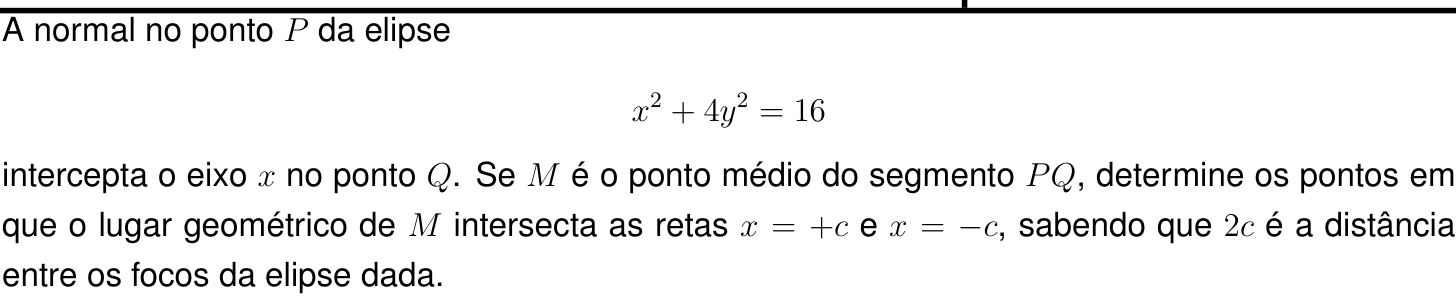
A elipse pode ser escrita como
\frac{x^2}{16}+\frac{y^2}{4}=1.
Logo, seus semieixos são a=4 e b=2, de modo que
c^2=a^2-b^2=12\quad\Rightarrow\quad c=2\sqrt3.
Seja P=(u,v), com u^2+4v^2=16. A tangente à elipse em P tem equação
ux+4vy=16.
Portanto, a normal tem direção (u,4v) e equação
u(y-v)=4v(x-u).
Para v\ne0, fazendo y=0, obtemos a abscissa de Q:
-uv=4v(x_Q-u)\quad\Rightarrow\quad x_Q=\frac{3u}{4}.
Assim,
Q=\left(\frac{3u}{4},0\right),
e o ponto médio M=(X,Y) de PQ é
X=\frac{7u}{8},\qquad Y=\frac v2.
Substituindo u=\frac{8X}{7} e v=2Y na equação da elipse, encontramos
\left(\frac{8X}{7}\right)^2+4(2Y)^2=16
\quad\Rightarrow\quad
\frac{4X^2}{49}+Y^2=1.
Nas retas X=\pm c=\pm2\sqrt3, temos
Y^2=1-\frac{4\cdot12}{49}=\frac1{49},
portanto Y=\pm\frac17. Esses valores são não nulos, satisfazendo a condição usada na determinação de Q.
Resposta final: \left(\pm2\sqrt3,\pm\frac17\right), com sinais independentes (quatro pontos).
Respondeu · mesma resposta final de outras 9 IAs
\left(2\sqrt3,\frac17\right),\ \left(2\sqrt3,-\frac17\right),\ \left(-2\sqrt3,\frac17\right),\ \left(-2\sqrt3,-\frac17\right).
levou 16 s
Como pensou
Escrevendo a equação da elipse na forma reduzida,
\frac{x^2}{16}+\frac{y^2}{4}=1,
temos a=4, b=2 e, portanto,
c=\sqrt{a^2-b^2}=\sqrt{16-4}=2\sqrt3.
Seja P=(u,v), com u^2+4v^2=16. Como o vetor (u,4v) é normal à elipse em P, a reta normal pode ser parametrizada por
(x,y)=(u,v)+t(u,4v).
Para v\neq0, sua interseção com o eixo x ocorre quando
v+4vt=0\quad\Longrightarrow\quad t=-\frac14.
Logo,
Q=\left(\frac{3u}{4},0\right),
\qquad
M=\left(\frac{7u}{8},\frac v2\right).
Denotando M=(X,Y), obtemos u=\frac{8X}{7} e v=2Y. Substituindo na equação da elipse,
\left(\frac{8X}{7}\right)^2+4(2Y)^2=16
\quad\Longrightarrow\quad
\frac{4X^2}{49}+Y^2=1.
Nas retas X=\pm c=\pm2\sqrt3, segue que
Y^2=1-\frac{4(2\sqrt3)^2}{49}
=1-\frac{48}{49}
=\frac1{49},
isto é, Y=\pm\frac17. Esses valores correspondem a v\neq0, de modo que os quatro pontos são válidos.
Resposta final: \left(2\sqrt3,\frac17\right),\ \left(2\sqrt3,-\frac17\right),\ \left(-2\sqrt3,\frac17\right),\ \left(-2\sqrt3,-\frac17\right).
Respondeu · mesma resposta final de outras 9 IAs
(2\sqrt3,\frac17), (2\sqrt3,-\frac17), (-2\sqrt3,\frac17) e (-2\sqrt3,-\frac17).
levou 18 s
Como pensou
**Analyzing gradient and ellipse**
I’m working through the problem involving the gradient of F = x² + 4y², which leads me to a tangent equation. The gradient gives me the normal vector, but I realize that I need to focus on the tangent plane instead. As I derive equations, I notice how the locus forms an ellipse. By substituting adjusted values into the equation, I determine specific points on this ellipse. All the signs seem independent, which gives me four valid points, interestingly enough!**Considering exceptional cases**
I need to look at exceptional cases where y = 0. This leads me to points P = (±4, 0) and a normal that is horizontal. If the normal vector is horizontal, the line y = 0 intersects the x-axis without a unique point—meaning it coincides. This leaves Q undefined, suggesting that the normal at the vertex is horizontally coincident with the x-axis. It's interesting how this situation highlights the lack of uniqueness in these conditions!
Escreva P=(x,y). Um vetor diretor da normal à elipse nesse ponto é (x,4y). Para y\neq 0, a normal pode ser parametrizada por
(x,y)+t(x,4y).
Sua interseção com o eixo x ocorre quando y+4ty=0, isto é, para t=-\frac14. Logo,
Q=\left(\frac{3x}{4},0\right),
\qquad
M=\left(\frac{7x}{8},\frac y2\right).
Se M=(X,Y), então x=\frac{8X}{7} e y=2Y. Como x^2+4y^2=16,
\frac{64X^2}{49}+16Y^2=16
\quad\Longrightarrow\quad
\frac{4X^2}{49}+Y^2=1.
Assim, esse é o lugar geométrico de M.
A elipse dada tem semieixos 4 e 2; portanto, a distância do centro a cada foco é
c=\sqrt{4^2-2^2}=2\sqrt3.
Nas retas X=\pm c=\pm2\sqrt3, a equação do lugar dá
Y^2=1-\frac{4(2\sqrt3)^2}{49}=\frac1{49},
logo Y=\pm\frac17.
Resposta final: (2\sqrt3,\frac17), (2\sqrt3,-\frac17), (-2\sqrt3,\frac17) e (-2\sqrt3,-\frac17).
Respondeu · mesma resposta final de outras 9 IAs
(\pm2\sqrt3,\ \pm\tfrac17), isto é, os quatro pontos (2\sqrt3, 1/7), (2\sqrt3,-1/7), (-2\sqrt3,1/7), (-2\sqrt3,-1/7); o lugar geométrico de M é a elipse \dfrac{4x^2}{49}+y^2=1.
levou 14 s
Como pensou
Setting up the ellipse with a=4, b=2, c=2√3, I'm parametrizing point P and finding the normal line's direction, then computing where that normal intersects the x-axis.
Solving gives Q = (3x₀/4, 0), so the midpoint M of P and Q has x₀ = 8x/7 and y₀ = 2y, which substituted into the ellipse equation yields the locus x²/(49/4) + y² = 1. Checking this locus at x = ±2√3 (matching the foci), I find y² = 1/49, giving points (±2√3, ±1/7).
Elipse: \dfrac{x^2}{16}+\dfrac{y^2}{4}=1, logo a=4, b=2, c^2=a^2-b^2=12 \Rightarrow c=2\sqrt3.
Normal em P=(x_0,y_0):
Derivando x^2+4y^2=16: 2x+8y\,y'=0 \Rightarrow y'=-\dfrac{x_0}{4y_0} (coeficiente angular da tangente).
Coeficiente angular da normal: m_n=\dfrac{4y_0}{x_0}.
Equação da normal: y-y_0=\dfrac{4y_0}{x_0}(x-x_0).
Ponto Q (interseção com o eixo x, y=0):
-y_0=\dfrac{4y_0}{x_0}(x-x_0)\Rightarrow x-x_0=-\dfrac{x_0}{4}\Rightarrow x=\dfrac{3x_0}{4}.
Logo Q=\left(\dfrac{3x_0}{4},\,0\right).
Ponto médio M=(x,y) de PQ:
x=\dfrac{x_0+\frac{3x_0}{4}}{2}=\dfrac{7x_0}{8},\qquad y=\dfrac{y_0}{2}
Assim x_0=\dfrac{8x}{7} e y_0=2y.
Lugar geométrico de M: substituindo na elipse,
\left(\dfrac{8x}{7}\right)^2+4(2y)^2=16 \Rightarrow \dfrac{64x^2}{49}+16y^2=16 \Rightarrow \dfrac{4x^2}{49}+y^2=1,
ou seja, a elipse \dfrac{x^2}{49/4}+y^2=1.
Interseção com x=\pm c=\pm2\sqrt3:
\dfrac{4\cdot 12}{49}+y^2=1\Rightarrow y^2=1-\dfrac{48}{49}=\dfrac{1}{49}\Rightarrow y=\pm\dfrac17.
Portanto os pontos são \left(2\sqrt3,\ \tfrac17\right), \left(2\sqrt3,\ -\tfrac17\right), \left(-2\sqrt3,\ \tfrac17\right) e \left(-2\sqrt3,\ -\tfrac17\right).
Resposta final: (\pm2\sqrt3,\ \pm\tfrac17), isto é, os quatro pontos (2\sqrt3, 1/7), (2\sqrt3,-1/7), (-2\sqrt3,1/7), (-2\sqrt3,-1/7); o lugar geométrico de M é a elipse \dfrac{4x^2}{49}+y^2=1.
Respondeu · mesma resposta final de outras 9 IAs
(2\sqrt3,\tfrac17), (2\sqrt3,-\tfrac17), (-2\sqrt3,\tfrac17), (-2\sqrt3,-\tfrac17)
levou 11 s
Como pensou
I'm setting up the ellipse with a=4, b=2, parametrizing point P as (4cosθ, 2sinθ), then finding where the normal line at P intersects the x-axis to get point Q, so I can work out the midpoint M.
Substituting x0=8X/7, y0=2Y into the ellipse equation gives the locus 4X²/49 + Y² = 1, and checking X=±2√3 yields Y=±1/7, so the points are (±2√3, ±1/7), noting the edge case where y0=0 makes Q undefined but doesn't affect these solutions.
Resposta: os quatro pontos (2√3, 1/7), (2√3, −1/7), (−2√3, 1/7) e (−2√3, −1/7).
Dados da elipse
x^2+4y^2=16 \iff \frac{x^2}{16}+\frac{y^2}{4}=1,
logo a=4 e b=2. Então c^2=a^2-b^2=16-4=12, ou seja, c=2\sqrt3.
Normal em P=(x_0,y_0)
O gradiente de F(x,y)=x^2+4y^2 em P é proporcional a (x_0,\,4y_0), que é a direção da normal. A reta normal é
\frac{x-x_0}{x_0}=\frac{y-y_0}{4y_0}.
Fazendo y=0, obtemos x-x_0=-\dfrac{x_0}{4}, isto é, x=\dfrac{3x_0}{4}. Logo Q=\left(\dfrac{3x_0}{4},\,0\right).
Ponto médio M=(X,Y) de PQ
X=\frac{x_0+\frac{3x_0}{4}}{2}=\frac{7x_0}{8},\qquad Y=\frac{y_0}{2}.
Portanto x_0=\dfrac{8X}{7} e y_0=2Y.
Lugar geométrico de M
Como P pertence à elipse, x_0^2+4y_0^2=16. Substituindo:
\frac{64X^2}{49}+16Y^2=16 \iff \frac{4X^2}{49}+Y^2=1.
O lugar geométrico é a elipse \dfrac{X^2}{49/4}+Y^2=1.
Observação: quando y_0=0 (vértices do eixo maior), a normal coincide com o eixo x e Q não fica definido. Esses pontos não interferem no resultado, pois as interseções pedidas têm Y\neq 0.
Interseção com x=\pm c=\pm2\sqrt3
\frac{4\cdot 12}{49}+Y^2=1 \;\Rightarrow\; Y^2=\frac{1}{49} \;\Rightarrow\; Y=\pm\frac17.
Resposta final: (2\sqrt3,\tfrac17), (2\sqrt3,-\tfrac17), (-2\sqrt3,\tfrac17), (-2\sqrt3,-\tfrac17)
Respondeu · mesma resposta final de outras 9 IAs
(±2√3, ±1/7), isto é, os quatro pontos (2√3, 1/7), (2√3, −1/7), (−2√3, 1/7) e (−2√3, −1/7), sobre o lugar geométrico x²/(49/4) + y² = 1.
levou 8 s
Como pensou
For the ellipse with a=4, b=2, I'm finding c=2√3, then parametrizing P as (4cosθ, 2sinθ) and working out the normal line's direction at P. I'm finding where this normal line crosses the x-axis by solving for the parameter t where y becomes zero.
So Q ends up with x-coordinate 3x0/4, and M, the midpoint, becomes (7x0/8, y0/2). Substituting back into the ellipse equation gives the locus 4X²/49 + Y² = 1. Intersecting this locus with the lines x=±2√3 (the foci lines), I solve for Y² = 1/49, giving four points at (±2√3, ±1/7). I also note the degenerate case where y0=0, which corresponds to P at the vertices (±4,0) where the normal line coincides with the x-axis itself, making Q undefined there — so I need to exclude this case from the locus.
Dados da elipse. Escrevendo x²/16 + y²/4 = 1, temos a = 4 e b = 2. Então c² = a² − b² = 12, ou seja, c = 2√3. As retas pedidas são x = ±2√3.
Normal e ponto Q. Seja P = (x₀, y₀) na elipse, com y₀ ≠ 0 (se y₀ = 0, a normal é o próprio eixo x e Q não fica definido). O gradiente de x² + 4y² é (2x, 8y), que no ponto P é paralelo a (x₀, 4y₀). A normal em P é
(x, y) = (x₀, y₀) + t(x₀, 4y₀).
Fazendo y = 0, obtemos y₀(1 + 4t) = 0, logo t = −1/4. Assim
Q = (x₀ − x₀/4, 0) = (3x₀/4, 0).
Ponto médio M.
M = ((x₀ + 3x₀/4)/2, y₀/2) = (7x₀/8, y₀/2).
Chamando M = (X, Y), temos x₀ = 8X/7 e y₀ = 2Y.
Lugar geométrico. Substituindo em x₀² + 4y₀² = 16:
64X²/49 + 16Y² = 16, ou seja, 4X²/49 + Y² = 1, que é X²/(49/4) + Y² = 1.
Trata-se de uma elipse de semieixos 7/2 e 1 (sem os pontos (±7/2, 0), que correspondem a y₀ = 0).
Interseção com x = ±2√3. Com X² = 12:
Y² = 1 − 4·12/49 = 1 − 48/49 = 1/49, logo Y = ±1/7.
Os pontos de interseção são (2√3, 1/7), (2√3, −1/7), (−2√3, 1/7) e (−2√3, −1/7).
Resposta final: (±2√3, ±1/7), isto é, os quatro pontos (2√3, 1/7), (2√3, −1/7), (−2√3, 1/7) e (−2√3, −1/7), sobre o lugar geométrico x²/(49/4) + y² = 1.
Respondeu · mesma resposta final de outras 9 IAs
levou 41 s
Como pensou
The problem is in Portuguese. I will translate it.
The problem involves an ellipse and its normal. The normal at point P intersects the x-axis at Q. M is the midpoint of PQ. I need to find where the locus of M meets the lines x = ±c, given that 2c is the distance between the foci. First, I will rewrite the ellipse in standard form.
The ellipse is x²/16 + y²/4 = 1 with a = 4 and b = 2. The distance between foci is 4√3, so c = 2√3. I am using the parametric form (4 cos θ, 2 sin θ) for point P. I derived the slope of the tangent as y' = -x/(4y) to find the normal line.
The slope of the normal is 4y0/x0. The normal intersects the x-axis at Q(3x0/4, 0). M is the midpoint of PQ.
The midpoint M has coordinates (7x0/8, y0/2). Substituting into the ellipse equation gives the locus (4/49)x² + y² = 1. This is an ellipse with semi-major axis 7/2 and semi-minor axis 1. I am now finding where this intersects x = ±2√3.
The intersection points are (2√3, ±1/7) and (-2√3, ±1/7). I verified the derivative and normal slope.
I am checking the case where P lies on the x-axis, such as (±4, 0). At these vertices, y0 = 0 and the derivative becomes infinite. I am verifying whether the tangent is vertical at these points.
At the vertices (±4, 0), the tangent is vertical and the normal coincides with the x-axis. This degenerate case does not define a unique point Q, so it is excluded from the locus. The derived equation implicitly assumes y0 ≠ 0.
I checked the case where P lies on the y-axis, such as (0, ±2). The normal there is vertical and intersects the x-axis at the origin, giving midpoints (0, ±1) that satisfy the locus equation. This confirms the four intersection points are (±2√3, ±1/7).
Resolução
A elipse dada pode ser reescrita na forma canônica
\frac{x^2}{16}+\frac{y^2}{4}=1.
Assim, a^2=16, b^2=4 e
c=\sqrt{a^2-b^2}=\sqrt{12}=2\sqrt{3}.
As retas mencionadas no enunciado são, portanto, x=\pm 2\sqrt{3}.
Seja P=(x_0,y_0) um ponto da elipse com y_0\neq 0. Diferenciando implicitamente a equação da elipse obtém-se que o coeficiente angular da reta tangente em P é -\dfrac{x_0}{4y_0}. Logo, o coeficiente angular da reta normal em P é \dfrac{4y_0}{x_0}, e a equação dessa normal é
Y-y_0=\frac{4y_0}{x_0}(X-x_0).
A interseção Q da normal com o eixo x ocorre quando Y=0, o que fornece a abscissa
X=\frac{3}{4}x_0.
Assim, Q=\bigl(\tfrac{3}{4}x_0,\,0\bigr).
O ponto médio M=(x,y) do segmento PQ satisfaz
x=\frac{7}{8}x_0,\qquad y=\frac{y_0}{2},
ou seja,
x_0=\frac{8}{7}x,\qquad y_0=2y.
Substituindo essas expressões na equação da elipse, obtém-se o lugar geométrico de M:
\frac{4}{49}x^2+y^2=1.
As interseções desse lugar com as retas x=\pm 2\sqrt{3} são determinadas substituindo x=\pm 2\sqrt{3} na equação anterior:
\frac{4}{49}\cdot(2\sqrt{3})^2+y^2=1\implies\frac{48}{49}+y^2=1\implies y^2=\frac{1}{49}.
Portanto, y=\pm\dfrac{1}{7}. Os quatro pontos de interseção são
\bigl(2\sqrt{3},\tfrac{1}{7}\bigr),\quad
\bigl(2\sqrt{3},-\tfrac{1}{7}\bigr),\quad
\bigl(-2\sqrt{3},\tfrac{1}{7}\bigr),\quad
\bigl(-2\sqrt{3},-\tfrac{1}{7}\bigr).
(Os vértices (\pm 4,0) da elipse original produzem normais coincidentes com o eixo x e não contribuem para o lugar geométrico acima; os pontos encontrados correspondem a pontos P efetivamente situados sobre a elipse.)
Resposta final: (\pm 2\sqrt{3},\pm 1/7)
Respondeu · mesma resposta final de outras 9 IAs
\left(2\sqrt3,\frac17\right),\left(2\sqrt3,-\frac17\right),\left(-2\sqrt3,\frac17\right),\left(-2\sqrt3,-\frac17\right)
levou 16 s
Como pensou
We need answer in Portuguese, solve problem. Need parse image. Let's restate.
Problem: "A normal no ponto P da elipse x^2 + 4y^2 = 16 intercepta o eixo x no ponto Q. Se M é o ponto médio do segmento PQ, determine os pontos em que o lugar geométrico de M intersecta as retas x = +c e x = -c, sabendo que 2c é a distância entre os focos da elipse dada."
Need solve. Ellipse equation x^2 + 4y^2 = 16 => standard x^2/16 + y^2/4 = 1. Semi-major a=4 along x, semi-minor b=2. c^2 = a^2 - b^2 = 16 - 4 = 12 => c = 2√3. Distance between foci = 2c = 4√3. So c=2√3. Lines x = ±c = ±2√3. Need locus of midpoint M of P on ellipse and Q intersection of normal at P with x-axis. Find intersection with x=±c.
We need derive locus of M.
Let P=(x0, y0) on ellipse: x0^2 + 4y0^2 =16, y0 ≠ 0 maybe? Normal at P intersects x-axis Q. If y0=0? Normal vertical? Let's see tangent? At vertices (±4,0), tangent vertical? Ellipse x^2+4y^2=16, derivative 2x +8y y'=0 => y'=-x/(4y). At y=0, derivative infinite? Tangent vertical x=±4; normal horizontal y=0, intersects x-axis infinitely? Actually normal line y=0, intersects x-axis entire line, Q not unique. So exclude vertices with y=0 maybe.
Normal line at P: gradient of F=x^2+4y^2-16 is (2x0, 8y0). Normal line: 2x0 (x - x0) + 8y0 (y - y0)=0 => x0(x - x0) + 4y0(y - y0)=0 => x0 x - x0^2 + 4y0 y -4y0^2=0 => x0 x + 4y0 y = x0^2 +4y0^2 =16. Yes.
Intersection with x-axis y=0: x0 x_Q = 16 => Q=(16/x0, 0), assuming x0≠0. If x0=0, normal horizontal? At (0,±2), normal horizontal y=±2, doesn't intersect x-axis? Actually line y=±2 parallel no intersection. But x0=0, equation 4y0 y=16 => y=4/y0 = ±2 if y0=±2, parallel x-axis; no intersection. So exclude x0=0 too.
M midpoint of P=(x0,y0) and Q=(16/x0,0): M=( (x0 + 16/x0)/2, y0/2 ). Let M=(X,Y). Then Y = y0/2 => y0=2Y. X = (x0 + 16/x0)/2 => 2X = x0 + 16/x0 => multiply x0: 2X x0 = x0^2 + 16 => x0^2 - 2X x0 +16=0? Actually x0^2 - 2X x0 +16=0. And ellipse condition: x0^2 +4y0^2=16 => x0^2 +4(4Y^2)=16 => x0^2 +16Y^2=16 => x0^2 = 16(1 - Y^2).
Need eliminate x0 between X equation and ellipse. We have x0^2 = 2X x0 -16? From 2X x0 = x0^2 +16 => x0^2 = 2X x0 -16. Also x0^2 =16 -16Y^2. Thus 2X x0 -16 =16 -16Y^2 => 2X x0 =32 -16Y^2 => X x0 =16 -8Y^2 =8(2 - Y^2). Also x0^2 =16(1-Y^2). We can square? But X x0 relation maybe can solve for X^2? X = (x0 +16/x0)/2 => X^2 = (x0^2 +32 +256/x0^2)/4? But use x0^2 =16(1-Y^2), 256/x0^2 =256/[16(1-Y^2)] =16/(1-Y^2). Then X^2 = [16(1-Y^2)+32 + 16/(1-Y^2)]/4 = [48 -16Y^2 + 16/(1-Y^2)]/4 = 12 -4Y^2 + 4/(1-Y^2). So locus equation: X^2 = 12 -4Y^2 + 4/(1-Y^2). Alternatively multiply? But maybe there is simpler.
Alternatively derive locus: M coordinates satisfy? Let's use relationship X x0 =8(2 - Y^2). Also x0 = ±4√(1-Y^2). Then X = 8(2 - Y^2)/(±4√(1-Y^2)) = ± 2(2 - Y^2)/√(1-Y^2). Thus X^2 = 4(2 - Y^2)^2/(1-Y^2). This is simpler. Check with previous: 4(4 -4Y^2 + Y^4)/(1-Y^2)=? =4(Y^4 -4Y^2 +4)/(1-Y^2) =? Previous 12 -4Y^2 +4/(1-Y^2) = [(12 -4Y^2)(1-Y^2)+4]/(1-Y^2) = [12 -12Y^2 -4Y^2 +4Y^4 +4]/... = [16 -16Y^2 +4Y^4]/... =4(Y^4 -4Y^2 +4)/(1-Y^2). Yes.
So locus of M: X^2 = 4(2 - Y^2)^2/(1 - Y^2), for |Y|<1, Y≠0? Actually ellipse y0 ∈ [-2,2], Y∈[-1,1]. Exclude Y=±1? x0=0 no Q? At y0=±2, Y=±1, x0=0, normal horizontal no Q; locus may not include. Y=0? y0=0, x0=±4, normal y=0 intersects x-axis all points, Q not unique; locus? If y0=0, P=(±4,0), normal y=0, Q any? Actually line y=0 equals x-axis, intersection not unique? The normal at vertex is x-axis, so Q can be any point on x-axis? But "intercepta o eixo x no ponto Q" usually unique intersection? At vertex normal is x-axis, intersects at all points, not unique; so exclude. Locus may have holes Y=0? But maybe limit. However lines x=±c likely Y≠0.
Need "determine os pontos em que o lugar geométrico de M intersecta as retas x = +c e x = -c". So set X = ±c = ±2√3 in locus equation and solve Y.
Equation: X^2 = 12? Since c=2√3, c^2=12. Locus: X^2 = 4(2 - Y^2)^2/(1 - Y^2). Set 12 = 4(2 - Y^2)^2/(1 - Y^2) => 3 = (2 - Y^2)^2/(1 - Y^2). Let t=Y^2, 0<t<1. 3(1 - t) = (2 - t)^2 => 3 - 3t = 4 -4t + t^2 => 0 = 1 - t + t^2 => t^2 - t +1=0? Wait 3 -3t =4 -4t + t^2 => 0 = 4 -4t + t^2 -3 +3t =1 -t + t^2 => t^2 - t +1=0? Actually 4-3=1; -4t+3t=-t; +t^2. Equation t^2 - t +1=0. Discriminant (-1)^2 -4*1*1 =1-4=-3 <0. No real solutions! That can't? Did I sign? Let's re-evaluate: 12 = 4(2 - t)^2/(1 - t) => divide 4: 3 = (2-t)^2/(1-t) => 3(1-t)= (2-t)^2 =4 -4t + t^2 => 3 -3t =4 -4t + t^2 => bring: 0 =4 -4t + t^2 -3 +3t =1 - t + t^2 = t^2 - t +1. No real. So no intersection? But problem expects points? Maybe I made mistake? Let's verify.
Wait c= distance between foci /2: "sabendo que 2c é a distância entre os focos da elipse dada." Distance between foci = 2c_ellipse = 2√(a^2-b^2)=2√12=4√3. So 2c (given) = 4√3 => c=2√3. Lines x=±c = ±2√3. Yes.
Maybe normal intersection with x-axis formula Q=(?): Normal line at P: gradient (2x0, 8y0). Equation: 2x0(X-x0)+8y0(Y-y0)=0 => x0 X - x0^2 +4y0 Y -4y0^2=0 => x0 X +4y0 Y = x0^2 +4y0^2 =16. Intersection y=0: x0 X =16 => X=16/x0. Yes.
Midpoint X = (x0 + 16/x0)/2. Let's test with P=(4,0)? Normal y=0 intersects all; midpoint not unique. For P=(0,2), normal horizontal y=2 no x-axis intersection. But maybe Q at infinity? no. For P=(2, √3)? x0=2, y0=√3? Check x0^2+4y0^2=4+12=16 yes. Q=(8,0). M=(5, √3/2). Then X=5, Y=√3/2≈0.866. Locus X^2=25, RHS 4(2-0.75)^2/(1-0.75)=4*(1.25)^2/0.25=4*1.5625/0.25=25. Good. Set X=3.464 (2√3≈3.464): Need solve Y? LHS=12. RHS 4(2 - t)^2/(1-t). For t between 0 and1, RHS? At t=0: 4*4/1=16. At t=1: tends infinity? Actually denominator ->0, RHS ->∞ (since numerator ->1). At t=0.5: 4*(1.5)^2/0.5=4*2.25/0.5=18. So minimum? Derivative? RHS decreasing? At t=0 16, at t=0.5 18, at t=0.8: 4*(1.44)/0.2=28.8, so increasing? Wait 18 >16, so not decreasing. Actually at t=0.9: 4*(1.21)/0.1=48.4. So RHS >=? It might have min? Let's compute derivative: f(t)=4(2-t)^2/(1-t). ln f = ln4 +2ln(2-t)-ln(1-t). derivative = -2/(2-t)+1/(1-t) = [-(2-t)+ (2-t)? wait combine: (-2(1-t)+(2-t))/((2-t)(1-t)) = (-2+2t+2-t)/... = t/... >0. So f increasing on (0,1). At t=0 f=16; as t→1 f→∞. So RHS >=16? Actually f(0)=16, increases. Thus cannot equal 12. So no intersection. But problem says "determine os pontos em que ... intersecta ...". Could there be no real points? But maybe c is different? Let's re-read: "sabendo que 2c é a distância entre os focos da elipse dada." Ellipse x^2 +4y^2=16 => a^2=16, b^2=4, c^2=a^2-b^2=12, distance between foci = 2c_f = 2√12=4√3. So 2c (problem's c) = 4√3 => c=2√3. Lines x=±c = ±2√3. Then no intersection? Maybe I made locus equation wrong? Let's derive more carefully.
Maybe normal line at P: For ellipse x^2/a^2 + y^2/b^2 =1 with a^2=16, b^2=4. Equation tangent at (x0,y0): x x0/a^2 + y y0/b^2 =1 => x x0/16 + y y0/4 =1 => x0 x/16 + y0 y/4=1 => multiply 16: x0 x +4 y0 y=16. Normal line? The normal is perpendicular to tangent: slope of tangent = - (x0/a^2)/(y0/b^2) = - (x0/16)/(y0/4)= - x0/(4y0). So normal slope = 4y0/x0. Equation through P: y-y0 = (4y0/x0)(x - x0) => x0(y-y0)=4y0(x-x0) => x0 y - x0 y0 =4y0 x -4y0 x0 => 4y0 x - x0 y = 4y0 x0 - x0 y0? Wait rearrange: x0 y -4y0 x = x0 y0 -4y0 x0? Let's do properly: y - y0 = (4y0/x0)(x - x0) => x0 y - x0 y0 =4y0 x -4y0 x0 => 4y0 x + x0 y? No: bring all: x0 y -4y0 x = x0 y0 -4y0 x0? Actually x0 y =4y0 x -4y0 x0 + x0 y0. So 4y0 x - x0 y =4y0 x0 - x0 y0 = y0(4x0 - x0)=3x0 y0? Wait that's not matching normal equation from gradient.
Earlier gradient method gave normal: x0 x +4 y0 y=16. Let's test with P=(2,√3): gradient (4, 8√3), normal line: 4(x-2)+8√3(y-√3)=0 => 4x -8 +8√3 y -24=0 =>4x +8√3 y=32 => divide 4: x +2√3 y=8, not 16? But gradient equation said x0 x +4y0 y = x0^2+4y0^2=16 => 2x +4√3 y=16 => x+2√3 y=8. Yes divide by 2? Wait x0=2, 4y0=4√3, RHS=16 => 2x +4√3 y=16 => x +2√3 y=8. So normal equation is x0 x +4 y0 y =16? Here 2x +4√3 y=16, yes RHS 16. So 4? Actually coefficients: x0 x +4y0 y =16. For P=(2,√3): 2x +4√3 y=16 => divide 2: x+2√3 y=8. Good.
Now slope of normal: coefficient of x =x0, y=4y0 => slope = -x0/(4y0) = -2/(4√3)= -1/(2√3)? Wait normal slope from line x+2√3 y=8 => y=(8-x)/(2√3)= -x/(2√3)+... slope -1/(2√3). But earlier normal slope =4y0/x0=4√3/2=2√3, not -1/(2√3). So gradient line not normal? Wait normal line should be perpendicular to tangent. Let's compute tangent slope from derivative: y'=-x/(4y)= -2/(4√3)= -1/(2√3). That's tangent slope! Oh I confused: derivative dy/dx = -x/(4y) = tangent slope. Normal slope = 4y/x = 2√3. So normal line slope positive, equation through (2,√3): y-√3 = 2√3(x-2) => y = 2√3 x -4√3 +√3 = 2√3 x -3√3 => 2√3 x - y =3√3? Multiply? Let's see gradient line slope? Gradient normal line equation x0 x +4y0 y=16 -> 2x +4√3 y=16 -> y=(16-2x)/(4√3)= (8 - x)/(2√3)= -x/(2√3)+4/√3? Slope -1/(2√3). That's tangent? Since line equation x0 x +4y0 y =16 is actually tangent? Standard tangent: x x0/16 + y y0/4 =1 => x0 x/16 + y0 y/4 =1 => x0 x +4 y0 y =16. Yes tangent line! Ah gradient of F gives normal? Wait F=x^2+4y^2, gradient (2x,8y) is normal to level curve; level curve tangent line equation gradient · (X-P)=0 => 2x0(X-x0)+8y0(Y-y0)=0 => x0 X +4y0 Y = x0^2 +4y0^2 =16. This is tangent line, not normal? Let's check: Gradient is normal vector, so gradient perpendicular to tangent; equation with gradient gives tangent line? Actually a line with normal vector (2x0,8y0) through P has equation 2x0(X-x0)+8y0(Y-y0)=0, which is tangent because normal to curve? Wait curve is level set, gradient is normal to level set, so tangent line is perpendicular to gradient: gradient dot (X-P)=0 => yes tangent line. So equation x0 X +4y0 Y =16 is tangent line, not normal. Oops! Important! The normal line is perpendicular to tangent, so direction vector along gradient (2x0,8y0) i.e. (x0,4y0). Normal line through P: (X-P) parallel gradient: (X-x0, Y-y0) = λ (x0,4y0) or cross product zero: 4y0(X-x0) - x0(Y-y0)=0 => 4y0 X - x0 Y = 4y0 x0 - x0 y0 =3 x0 y0? Let's derive: 4y0(X-x0) = x0(Y-y0) => 4y0 X -4y0 x0 = x0 Y - x0 y0 => 4y0 X - x0 Y = 4y0 x0 - x0 y0 = x0 y0(4-1)=3x0 y0. Yes normal line: 4 y0 X - x0 Y = 3 x0 y0. Alternatively from tangent line normal slope = 4y0/x0? Let's verify with P=(2,√3): 4√3 X - 2 Y = 3*2*√3=6√3 => divide 2: 2√3 X - Y =3√3 => Y = 2√3 X -3√3, matches. Good.
Thus normal line equation: 4y0 x - x0 y = 3 x0 y0. Intersection with x-axis y=0: 4y0 x = 3 x0 y0 => assuming y0≠0: x = 3 x0 /4. So Q=(3x0/4, 0). Ah! Big difference.
Then midpoint M of P=(x0,y0) and Q=(3x0/4,0): X = (x0 + 3x0/4)/2 = (7x0/4)/2 = 7x0/8 => x0 = 8X/7. Y = y0/2 => y0=2Y.
Ellipse: x0^2 +4y0^2 =16 => (64 X^2/49) +4*(4Y^2)=16 => 64 X^2/49 +16 Y^2 =16 => divide 16: (4 X^2)/49 + Y^2 =1? Actually 64/49 /16 =4/49? Let's compute: 64 X^2/49 +16 Y^2 =16 => divide 16: (4 X^2)/49 + Y^2 =1 => 4X^2/49 + Y^2 =1. That's locus ellipse! Nice.
Then intersect lines X=±c=±2√3. Plug X^2=12: 4*12/49 + Y^2 =1 => 48/49 + Y^2 =1 => Y^2 =1 -48/49 =1/49 => Y=±1/7. So points (±2√3, ±1/7) with four combinations? Since X=+c gives Y=±1/7; X=-c gives Y=±1/7. But check if valid? Need ensure y0≠0? If Y=±1/7, y0=±2/7 ≠0, x0=8X/7 = ± (8*2√3)/7 = ±16√3/7. Then ellipse check: x0^2 +4y0^2 = (256*3)/49 +4*(4/49)=768/49 +16/49=784/49=16 yes. x0≠0. Good.
But wait, is Q always defined? y0=0 excluded? For Y=0? Not relevant. Lines X=±c: c=2√3. X positive/negative. Locus ellipse. Intersections four points.
Question: "determine os pontos em que o lugar geométrico de M intersecta as retas x = +c e x = -c" Maybe answer: points are (±2√3, ±1/7)? But need be careful: "os pontos" plural; on line x=+c, there are two points (2√3, 1/7) and (2√3, -1/7); on x=-c, (-2√3, 1/7) and (-2√3, -1/7). So four points.
Let's ensure no alternative interpretation: "A normal no ponto P da elipse x^2 + 4y^2 = 16 intercepta o eixo x no ponto Q. Se M é o ponto médio do segmento PQ, determine os pontos em que o lugar geométrico de M intersecta as retas x = +c e x = -c, sabendo que 2c é a distância entre os focos da elipse dada." Yes.
Let's craft final answer in Portuguese with steps.
Need show development. Let's solve elegantly.
Let P=(x0,y0) on ellipse. Normal line equation: 4 y0 X - x0 Y =3 x0 y0? Let's derive maybe via tangent? In final: A reta normal à elipse no ponto P=(x0,y0) tem equação 4y0 x - x0 y =3x0 y0 (obtida da perpendicular à tangente). Intersecta eixo x em Q=(3x0/4,0). Midpoint M=(X,Y): X=(x0+3x0/4)/2 =7x0/8 => x0=8X/7; Y=y0/2 => y0=2Y. Substitute in ellipse: (8X/7)^2 +4(2Y)^2=16 => 64X^2/49 +16Y^2=16 => 4X^2/49 + Y^2=1. Thus locus is ellipse 4X^2/49 + Y^2=1.
Foci: from original ellipse a^2=16, b^2=4 => c_f^2=12 => distance between foci=2√12=4√3. Given 2c=4√3 => c=2√3. Lines x=±2√3. Substitute X=±2√3, X^2=12: 4*12/49 + Y^2=1 => 48/49 + Y^2=1 => Y^2=1/49 => Y=±1/7. Therefore points: (2√3, 1/7), (2√3, -1/7), (-2√3,1/7), (-2√3,-1/7).
Need ensure notation: c maybe positive. 2c distance foci = 4√3 => c=2√3. Good.
Let's produce final answer with steps concise.
Potential pitfalls: The normal line equation maybe could be derived differently. Let's verify normal line intersection: At P=(2,√3), Q=(3*2/4=1.5,0). Midpoint X=(2+1.5)/2=1.75=7*2/8? 7*2/8=1.75 yes; Y=√3/2≈0.866. Locus X=1.75,Y=0.866: 4*(3.0625)/49 +0.75 =12.25/49+0.75=0.25+0.75=1 yes. Good. Then line X=2√3≈3.464: Y^2=0.0204 =>Y≈0.142857=1/7. Good.
Final answer line: "Resposta final: (2√3, 1/7), (2√3, -1/7), (-2√3, 1/7), (-2√3, -1/7)" or "Os pontos são ...". Need exactly.
Seja P=(x_0,y_0) um ponto da elipse
x^2+4y^2=16.
A reta normal à elipse em P tem equação
4y_0x-x_0y=3x_0y_0.
Ela intercepta o eixo x quando y=0:
4y_0x=3x_0y_0 \Rightarrow x=\frac{3x_0}{4},
logo
Q=\left(\frac{3x_0}{4},0\right).
Seja M=(X,Y) o ponto médio de PQ. Então
X=\frac{x_0+\frac{3x_0}{4}}{2}=\frac{7x_0}{8}
\quad\Rightarrow\quad
x_0=\frac{8X}{7},
Y=\frac{y_0}{2}
\quad\Rightarrow\quad
y_0=2Y.
Como P pertence à elipse,
x_0^2+4y_0^2=16
\left(\frac{8X}{7}\right)^2+4(2Y)^2=16
\frac{64X^2}{49}+16Y^2=16
\frac{4X^2}{49}+Y^2=1.
Assim, o lugar geométrico de M é a elipse
\frac{4X^2}{49}+Y^2=1.
Na elipse original,
a^2=16,\quad b^2=4,\quad c_{\text{foco}}^2=16-4=12,
logo a distância entre os focos é
2\sqrt{12}=4\sqrt3.
Como o enunciado diz que 2c é essa distância,
2c=4\sqrt3 \Rightarrow c=2\sqrt3.
As retas são X=\pm 2\sqrt3. Substituindo X^2=12 na equação do lugar geométrico:
\frac{4\cdot 12}{49}+Y^2=1
\frac{48}{49}+Y^2=1
Y^2=\frac{1}{49}
Y=\pm\frac17.
Portanto, os pontos de interseção são:
\boxed{\left(2\sqrt3,\frac17\right),\
\left(2\sqrt3,-\frac17\right),\
\left(-2\sqrt3,\frac17\right),\
\left(-2\sqrt3,-\frac17\right)}.
Resposta final: \left(2\sqrt3,\frac17\right),\left(2\sqrt3,-\frac17\right),\left(-2\sqrt3,\frac17\right),\left(-2\sqrt3,-\frac17\right)
Respondeu · mesma resposta final de outras 9 IAs
\left(2\sqrt{3}, \frac{1}{7}\right), \left(2\sqrt{3}, -\frac{1}{7}\right), \left(-2\sqrt{3}, \frac{1}{7}\right) \text{ e } \left(-2\sqrt{3}, -\frac{1}{7}\right)
levou 27 s
Como pensou
**Exploring Locus Geometry**
I'm currently working through the specifics of the ellipse's normal line and its intersection with the x-axis to define point Q. From there, I'll determine the midpoint M of PQ, aiming to establish the locus of M and its intersections with the given vertical lines.
**Deriving Normal Lines**
I'm currently calculating the normal line to the ellipse at point P. My focus is on determining its slope and then finding its intersection with the x-axis to define point Q. This step is crucial for the next phase of finding the midpoint.
**Calculating Midpoint Coordinates**
I've successfully determined the coordinates of point Q by finding the x-intercept of the ellipse's normal line. Now, I'm calculating the coordinates of M, the midpoint of PQ, using the derived Q and P points.
**Finding Ellipse Equation**
I have successfully derived the equation of the locus of M as an ellipse. It appears to intersect the lines $x = \pm c$, and I am currently verifying these intersection points.
**Confirming Intersection Points**
I've confirmed the four intersection points of the locus ellipse with the lines $x = \pm 2\sqrt{3}$. The calculations for these points appear to be accurate, showing $\left(\pm 2\sqrt{3}, \pm \frac{1}{7}\right)$.
**Deriving Midpoint Equation**
I've successfully derived the relationships $x_0 = \frac{8}{7}x$ and $y_0 = 2y$. I will now substitute these into the ellipse equation $\frac{x_0^2}{16} + \frac{y_0^2}{4} = 1$ to determine the locus of M.
Para determinar os pontos em que o lugar geométrico de M intersecta as retas x = +c e x = -c, seguimos os passos abaixo:
1. Determinação dos focos da elipse
A equação da elipse é:
\frac{x^2}{16} + \frac{y^2}{4} = 1
Identificamos os semieixos:
- Semieixo maior: a^2 = 16 \implies a = 4
- Semieixo menor: b^2 = 4 \implies b = 2
A relação fundamental da elipse fornece a semidistância focal c:
c^2 = a^2 - b^2 = 16 - 4 = 12 \implies c = 2\sqrt{3}
Portanto, as retas são x = 2\sqrt{3} e x = -2\sqrt{3}.
2. Determinação do ponto Q
Seja P(x_0, y_0) um ponto pertencente à elipse, tal que:
x_0^2 + 4y_0^2 = 16
A reta tangente à elipse no ponto P tem equação:
\frac{x_0 x}{16} + \frac{y_0 y}{4} = 1 \implies x_0 x + 4y_0 y = 16
O vetor normal à reta tangente (que é o vetor diretor da reta normal à elipse em P) é:
\vec{v} = (x_0, 4y_0)
Assim, a reta normal à elipse em P(x_0, y_0) pode ser representada parametricamente por:
\begin{cases} x = x_0 + x_0 t \\ y = y_0 + 4y_0 t \end{cases}
O ponto Q é a interseção dessa reta normal com o eixo das abscissas (y = 0). Fazendo y = 0 (para y_0 \neq 0):
y_0 + 4y_0 t = 0 \implies t = -\frac{1}{4}
Substituindo t na coordenada x:
x_Q = x_0 + x_0\left(-\frac{1}{4}\right) = \frac{3}{4}x_0
Logo, as coordenadas do ponto Q são:
Q = \left(\frac{3}{4}x_0, \, 0\right)
(Note que a expressão também é válida nos vértices da elipse onde y_0 = 0 ou x_0 = 0).
3. Lugar geométrico do ponto médio M
O ponto M(x, y) é o ponto médio do segmento PQ:
x = \frac{x_P + x_Q}{2} = \frac{x_0 + \frac{3}{4}x_0}{2} = \frac{7}{8}x_0 \implies x_0 = \frac{8}{7}x
y = \frac{y_P + y_Q}{2} = \frac{y_0 + 0}{2} = \frac{y_0}{2} \implies y_0 = 2y
Como o ponto P(x_0, y_0) pertence à elipse:
x_0^2 + 4y_0^2 = 16
Substituindo x_0 e y_0 em termos de x e y:
\left(\frac{8}{7}x\right)^2 + 4(2y)^2 = 16 \implies \frac{64}{49}x^2 + 16y^2 = 16
Dividindo toda a equação por 16:
\frac{4}{49}x^2 + y^2 = 1
4. Interseção com as retas x = \pm c
Substituindo x = \pm c = \pm 2\sqrt{3} na equação do lugar geométrico:
\frac{4}{49}(\pm 2\sqrt{3})^2 + y^2 = 1
\frac{4}{49} \cdot 12 + y^2 = 1
\frac{48}{49} + y^2 = 1 \implies y^2 = 1 - \frac{48}{49} = \frac{1}{49}
y = \pm \frac{1}{7}
Obtêm-se quatro pontos de interseção:
- Para a reta x = +c = 2\sqrt{3}: \left(2\sqrt{3}, \, \frac{1}{7}\right) e \left(2\sqrt{3}, \, -\frac{1}{7}\right)
- Para a reta x = -c = -2\sqrt{3}: \left(-2\sqrt{3}, \, \frac{1}{7}\right) e \left(-2\sqrt{3}, \, -\frac{1}{7}\right)
Resposta final: \left(2\sqrt{3}, \frac{1}{7}\right), \left(2\sqrt{3}, -\frac{1}{7}\right), \left(-2\sqrt{3}, \frac{1}{7}\right) \text{ e } \left(-2\sqrt{3}, -\frac{1}{7}\right)
Respondeu · mesma resposta final de outras 9 IAs
levou 44 s
Como pensou
**Analyzing the Equation**
I am currently focused on understanding the provided equation for the ellipse and identifying the initial conditions of the problem. My next steps involve determining the specific point P and then proceeding with the normal line calculation.
**Deriving the Normal**
I've successfully identified the ellipse's parameters and the equations for the focal lines. My current focus is on deriving the general equation for the normal line at an arbitrary point $P(x_0, y_0)$ on the ellipse.
**Calculating Normal Intersection**
I have derived the general equation for the normal line at point $P$ on the ellipse and successfully determined the coordinates of $Q$, the x-intercept of this normal line. My current focus is on establishing the locus of the midpoint $M$ between $P$ and $Q$.
**Determining Midpoint Locus**
I have successfully derived the parametric relationships between the midpoint M and the original point P, and substituted these into the ellipse equation. This has yielded the locus of M, and I've now calculated the intersection points of this locus with the lines $x=\pm c$.
**Verifying Intersection Points**
I have completed the verification of the intersection point calculations, confirming the coordinates $\left(\pm 2\sqrt{3}, \pm \frac{1}{7}\right)$. My focus has now shifted to re-examining the derivation of the midpoint M's coordinates and its subsequent substitution into the ellipse equation, ensuring absolute accuracy in the locus determination.
Para determinar os pontos de interseção solicitados, primeiramente colocamos a equação da elipse na sua forma canônica, dividindo ambos os lados por 16:
\frac{x^2}{16} + \frac{y^2}{4} = 1
Dessa equação, identificamos os semieixos maior e menor da elipse:
a^2 = 16 \implies a = 4
b^2 = 4 \implies b = 2
Pela relação fundamental da elipse, a semidistância focal c é dada por:
c^2 = a^2 - b^2 = 16 - 4 = 12 \implies c = 2\sqrt{3}
Seja P(x_0, y_0) um ponto pertencente à elipse, de modo que x_0^2 + 4y_0^2 = 16.
Derivando implicitamente a equação da elipse em relação a x, obtemos o coeficiente angular da reta tangente:
2x + 8y \cdot y' = 0 \implies y' = -\frac{x}{4y}
Para y_0 \neq 0, o coeficiente angular da reta tangente no ponto P(x_0, y_0) é m_t = -\frac{x_0}{4y_0}. Consequentemente, o coeficiente angular da reta normal à elipse em P é:
m_n = -\frac{1}{m_t} = \frac{4y_0}{x_0} \quad (\text{para } x_0 \neq 0)
A equação da reta normal no ponto P(x_0, y_0) é, portanto:
y - y_0 = \frac{4y_0}{x_0}(x - x_0)
O ponto Q(x_Q, 0) é a interseção dessa reta normal com o eixo x (y = 0). Substituindo y = 0 na equação da normal (com y_0 \neq 0):
-y_0 = \frac{4y_0}{x_0}(x_Q - x_0) \implies -1 = \frac{4}{x_0}(x_Q - x_0) \implies x_Q - x_0 = -\frac{x_0}{4} \implies x_Q = \frac{3}{4}x_0
(Nota: Caso x_0 = 0, a reta normal coincide com o eixo y, ou seja, x = 0, intersectando o eixo x na origem Q(0,0), o que também satisfaz a relação x_Q = \frac{3}{4}x_0).
Assim, as coordenadas do ponto Q são \left(\frac{3}{4}x_0, 0\right).
Sendo M(x, y) o ponto médio do segmento PQ, suas coordenadas são dadas por:
\begin{cases}
x = \dfrac{x_0 + x_Q}{2} = \dfrac{x_0 + \frac{3}{4}x_0}{2} = \dfrac{7}{8}x_0 \\[10pt]
y = \dfrac{y_0 + 0}{2} = \dfrac{y_0}{2}
\end{cases}
\implies
\begin{cases}
x_0 = \dfrac{8}{7}x \\[10pt]
y_0 = 2y
\end{cases}
Como P(x_0, y_0) pertence à elipse x_0^2 + 4y_0^2 = 16 (com y_0 \neq 0 \implies y \neq 0), substituímos x_0 e y_0 para encontrar a equação do lugar geométrico de M:
\left(\frac{8}{7}x\right)^2 + 4(2y)^2 = 16
\frac{64}{49}x^2 + 16y^2 = 16
Dividindo toda a equação por 16, obtemos a equação do lugar geométrico de M:
\frac{4}{49}x^2 + y^2 = 1 \quad (y \neq 0)
Por fim, buscamos a interseção desse lugar geométrico com as retas x = +c e x = -c. Substituindo x = \pm c = \pm 2\sqrt{3} (ou seja, x^2 = c^2 = 12) na equação obtida:
\frac{4}{49}(12) + y^2 = 1
\frac{48}{49} + y^2 = 1 \implies y^2 = 1 - \frac{48}{49} = \frac{1}{49} \implies y = \pm \frac{1}{7}
Logo, há 4 pontos de interseção:
\left(2\sqrt{3}, \frac{1}{7}\right), \quad \left(2\sqrt{3}, -\frac{1}{7}\right), \quad \left(-2\sqrt{3}, \frac{1}{7}\right) \quad \text{e} \quad \left(-2\sqrt{3}, -\frac{1}{7}\right)
Resposta final: (±2√3, ±1/7)