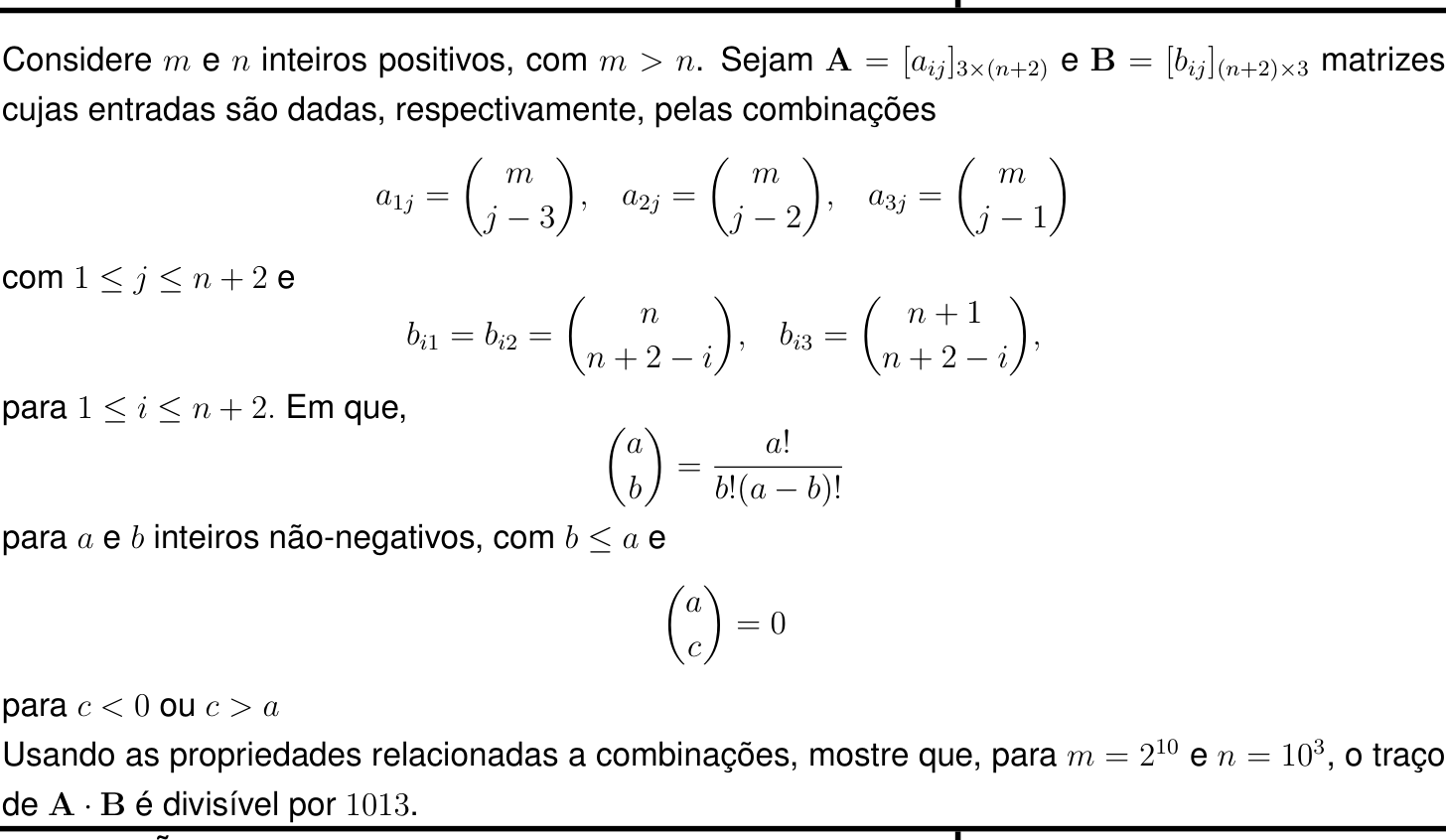
Como pensou
We need answer problem. Need solve. Let's restate.
We have m,n positive integers m>n. A = [a_{ij}]_{3 x (n+2)} entries:
a_{1j} = C(m, j-3), a_{2j}=C(m, j-2), a_{3j}=C(m, j-1), for 1<=j<=n+2.
B = [b_{ij}]_{(n+2)x3} entries:
b_{i1}=b_{i2}=C(n, n+2 - i), b_{i3}=C(n+1, n+2 - i), for 1<=i<=n+2.
Binomial conventions. Show using properties binomial coefficients: for m=2^10, n=10^3, trace of A·B is divisible by 1013. Wait "o traço de A · B" maybe trace of product? A is 3 x (n+2), B is (n+2)x3, product AB is 3x3, trace defined. Need show tr(AB) divisible by 1013.
Need compute trace = sum_{k=1}^3 (AB)_{kk} = sum_{k=1}^3 sum_{j=1}^{n+2} a_{k j} b_{j k}. Need find expression.
Let's analyze.
A rows correspond k=1,2,3: a_{k j} = C(m, j - (4-k)? Wait for k=1: a_{1j}=C(m, j-3). k=2: C(m, j-2). k=3: C(m, j-1). So a_{k j}= C(m, j + k - 4?) Let's see k=1: j-3 = j +1 -4; k=2: j-2 = j+2-4; k=3: j+3-4. Yes a_{k,j}= C(m, j + k - 4) = C(m, j + k -4). Since j 1..n+2.
B columns: for row index j? In product B, index j row of B? b_{j k}: b_{j1}=b_{j2}=C(n, n+2 - j), b_{j3}=C(n+1, n+2 - j), for j=1..n+2. Then trace sum k=1..3 sum_{j=1}^{n+2} a_{k,j} b_{j,k}.
For k=1: sum_j C(m, j-3) * C(n, n+2-j)
k=2: sum_j C(m, j-2)* C(n, n+2-j)
k=3: sum_j C(m, j-1)* C(n+1, n+2-j).
We need simplify using Vandermonde convolution.
Recall sum_{j} C(m, j + r) C(n, N - j) = C(m+n, N + r?) Let's derive.
Known sum_{j} C(m, j) C(n, k - j)= C(m+n, k). Here upper terms maybe j - a and N - j = n+2 - j = (n+2) - j. Let change variable maybe.
For k=1: sum_{j=1}^{n+2} C(m, j-3) C(n, n+2-j). Let i = j? Let r = j-3, so j = r+3. Then second C(n, n+2 - (r+3)) = C(n, n-1 - r) = C(n, (n) - (n-1-r)? Actually C(n, n-1-r)=C(n, n-(n-1-r))=C(n, r+1)? Since C(n,k)=C(n,n-k); k=n-1-r => n-k = n-(n-1-r)=r+1. Yes = C(n, r+1). Sum r from? j=1 => r=-2; j=n+2 => r=n-1. Terms maybe r from -2 to n-1. But binomial convention zero outside. Then sum_r C(m, r) C(n, r+1). Need identity?
Alternative set q = j-3 maybe. Vandermonde variant: sum_r C(m, r) C(n, s - r) = C(m+n, s). Here C(n, r+1) = C(n, n - (r+1)) = C(n, n-1-r). Then sum_r C(m, r) C(n, n-1-r)= C(m+n, n-1). Yes by Vandermonde: sum_r C(m,r) C(n, n-1-r)=C(m+n, n-1). Because second lower n-1-r. Great. So k=1 trace contribution = C(m+n, n-1).
Check: C(n, n+2-j)=C(n, n-(n+2-j))=C(n, j-2)? Wait C(n, k)=C(n,n-k); k=n+2-j => n-k = n-(n+2-j)=j-2. Ah simpler! Since n+2-j = (n+2)-j = n - (j-2)? Actually n-(j-2)= n - j + 2 = n+2-j yes. So C(n, n+2-j)=C(n, j-2). So first sum = sum_j C(m, j-3) C(n, j-2). Let r=j-3 => j-2 = r+1. Sum C(m,r) C(n, r+1)= C(m+n, n-1) by above. Good.
k=2: sum_j C(m, j-2) C(n, n+2-j)= sum_j C(m, j-2) C(n, j-2)? Since C(n, n+2-j)=C(n, j-2). Let r=j-2; sum_r C(m,r) C(n,r) = C(m+n, n?)? Wait identity sum_r C(m,r) C(n,r) = C(m+n, n)? Check Vandermonde: C(m,r) C(n, r) = C(m,r) C(n, n-r)? No C(n,r)=C(n,n-r), so = C(n, n-r), then sum_r C(m,r) C(n, n-r)= C(m+n, n). Yes because Vandermonde sum_r C(m,r) C(n, k-r)=C(m+n,k), with k=n => C(n, n-r). So contribution = C(m+n, n).
k=3: sum_j C(m, j-1) C(n+1, n+2-j). Let r=j-1 => j = r+1. Second C(n+1, n+2 - (r+1)) = C(n+1, n+1 - r) = C(n+1, r) because C(n+1, n+1-r)=C(n+1, (n+1)-(n+1-r))=C(n+1, r). Sum_r C(m, r) C(n+1, r) = C(m+n+1, n+1)? Since sum_r C(m,r) C(n+1, n+1-r)=C(m+n+1, n+1) by Vandermonde with k=n+1? Wait sum_r C(m,r) C(n+1, n+1 - r)=C(m+n+1, n+1). Yes. So trace = C(m+n, n-1)+ C(m+n, n)+ C(m+n+1, n+1). But C(m+n, n-1)+C(m+n,n)=C(m+n+1,n) by Pascal. Then + C(m+n+1, n+1). =? C(m+n+1,n)+C(m+n+1,n+1)=C(m+n+2,n+1). So trace = C(m+n+2, n+1). Is that correct? Let's verify with small numbers. m=3,n=2. Compute trace maybe. m=3,n=2, A 3x4, B 4x3. Let's compute directly maybe.
A entries: C(3,j-3), C(3,j-2), C(3,j-1), j=1..4.
j=1: C(3,-2)=0, C(3,-1)=0, C(3,0)=1
j=2: C(3,-1)=0, C(3,0)=1, C(3,1)=3
j=3: C(3,0)=1, C(3,1)=3, C(3,2)=3
j=4: C(3,1)=3, C(3,2)=3, C(3,3)=1
A =
[0 0 1 3? Wait row1: j=1 C(3,-2)=0; j=2 C(3,-1)=0; j=3 C(3,0)=1; j=4 C(3,1)=3 => [0,0,1,3]
row2: j=1 C(3,-1)=0; j=2 C(3,0)=1; j=3 C(3,1)=3; j=4 C(3,2)=3 => [0,1,3,3]
row3: j=1 C(3,0)=1; j=2 C(3,1)=3; j=3 C(3,2)=3; j=4 C(3,3)=1 => [1,3,3,1]
B rows i=1..4:
b_{i1}=b_{i2}=C(2,2+2-i)=C(2,4-i), b_{i3}=C(3,4-i).
i=1: C(2,3)=0, C(3,3)=1 => [0,0,1]
i=2: C(2,2)=1, C(3,2)=3 => [1,1,3]
i=3: C(2,1)=2, C(3,1)=3 => [2,2,3]
i=4: C(2,0)=1, C(3,0)=1 => [1,1,1]
Product AB 3x3:
Row1 A [0,0,1,3] dot columns:
col1: B entries b_{i1}: [0,1,2,1] => 0*0+0*1+1*2+3*1=5
col2 same as col1 =5
col3: B entries b_{i3}: [1,3,3,1] => 0*1+0*3+1*3+3*1=6
Row1 = [5,5,6]
Row2 [0,1,3,3]:
col1: 0*0 +1*1 +3*2 +3*1 =1+6+3=10
col2=10
col3: 0*1+1*3+3*3+3*1=3+9+3=15
Row2=[10,10,15]
Row3 [1,3,3,1]:
col1: 1*0+3*1+3*2+1*1=0+3+6+1=10
col2=10
col3:1*1+3*3+3*3+1*1=1+9+9+1=20
Trace=5+10+20=35. Formula C(m+n+2,n+1)=C(3+2+2,3)=C(7,3)=35. Yes.
Great. So for m=2^10, n=10^3, trace = C(2^10 + 10^3 + 2, 10^3 + 1). Need show divisible by 1013. Note 1013 prime? 1013 is prime? Check sqrt ~31.8; not divisible 3,5,7 (7*144=1008+? 7*144=1008, +5; no), 11*92=1012+? no, 13*77=1001+? 13*78=1014, 17*59=1003+? 19*53=1007+? 23*44=1012+? 29*34=986+? 31*32=992+? So prime likely. Need show binomial divisible by 1013.
m=2^10 = 1024. n=1000. Then m+n+2 = 1024+1000+2 = 2026 = 2*1013? Yes 1013*2 = 2026. n+1 = 1001. So trace = C(2026, 1001). Need show divisible by 1013. Since 2026 = 2*1013, and 1001 < 1013? 1001. Binomial C(2p, (p-12)?) where p=1013? Actually n+1=1001, p=1013; 2p = 2026; k=1001 < p. Then C(2p, k) modulo p? Since p prime > k, denominator k! not divisible by p. Numerator (2p)(2p-1)...(2p-k+1). Mod p, factors? Product = (2p) * (2p-1)*...*(2p-k+1). Mod p, factor 2p ≡0 mod p, so product divisible by p, but denominator not divisible by p, so binomial ≡0 mod p. Yes simple. But let's ensure k < p? 1001 < 1013 yes. So C(2p, k) divisible by p. That's it. But problem likely expects using binomial properties and maybe Lucas? Since m=2^10, n=10^3 maybe p? Wait 1013 is prime? Need prove? Maybe not required? They ask using properties related to combinations, show divisible by 1013. We can note 2026=2*1013 and 1001<1013, then C(2026,1001) divisible by 1013. Need maybe prove 1013 prime? Divisible only by 1 and itself. We can state 1013 é primo (verifica-se). But maybe need show 2026 = 2*1013, 1001<1013 e p primo.
But wait trace formula might be C(m+n+2, n+1). For m=2^10, n=10^3: C(2026,1001). Since 2026=2*1013 and 1001<1013, product 2026*...*(2026-1000? wait k=1001, factors from 2026 down to 2026-1000=1026? Actually C(N,k)=N(N-1)...(N-k+1)/k!, with N=2026, k=1001. Numerator has factor 2026 (the first) = 2*1013, divisible by 1013. Denominator k! = 1001! has no factor 1013 because 1013 > 1001. Thus p divides numerator but not denominator, so p divides binomial. Since p prime, no cancellation. Good.
Need craft final answer in Portuguese showing derivation. Need include matrix definitions? The user says solve as candidate. Need show development item by item (a,b,c? This question has no items, single). We need show trace calculation using Vandermonde and Pascal. Then apply m,n.
Let's formulate nicely.
Detailed steps:
1. Trace(AB) = Σ_{k=1}^3 Σ_{j=1}^{n+2} a_{k j} b_{j k}.
2. Substitute definitions:
a_{k j} = C(m, j+k-4) (since row 1: j-3, row2:j-2,row3:j-1 = j+k-4? For k=1: j-3 yes; k=2: j-2 = j+2-4; k=3: j-1 = j+3-4). Yes.
b_{j1}=b_{j2}=C(n, n+2-j), b_{j3}=C(n+1, n+2-j).
Then trace = S1 + S2 + S3 where
S1 = Σ_j C(m, j-3) C(n, n+2-j)
S2 = Σ_j C(m, j-2) C(n, n+2-j)
S3 = Σ_j C(m, j-1) C(n+1, n+2-j).
3. Use symmetry C(n, n+2-j)=C(n, j-2) because C(n, n+2-j)=C(n, n-(n+2-j))=C(n, j-2). Then:
S1 = Σ_j C(m, j-3) C(n, j-2). Set r=j-3 => Σ_r C(m,r) C(n, r+1). Since C(n,r+1)=C(n, n-1-r) (because C(n,n-1-r)=C(n, n-(n-1-r))=C(n, r+1)). Vandermonde: Σ_r C(m,r) C(n, n-1-r) = C(m+n, n-1). Actually need confirm indices. Vandermonde: Σ_{r} C(m,r) C(n, k-r)=C(m+n,k). Here second lower = n-1-r, so k=n-1. Yes.
S2 = Σ_j C(m,j-2) C(n, j-2) = Σ_r C(m,r) C(n,r) = C(m+n, n) because C(n,r)=C(n,n-r), Vandermonde with k=n.
S3 = Σ_j C(m,j-1) C(n+1, n+2-j). Let r=j-1 => C(m,r); second C(n+1, n+2-(r+1)) = C(n+1, n+1-r)=C(n+1, r) (since C(n+1,r)=C(n+1,n+1-r)). Then Σ_r C(m,r) C(n+1,r) = C(m+n+1, n+1)? Wait Vandermonde: Σ_r C(m,r) C(n+1, n+1-r)=C(m+n+1, n+1). Since C(n+1,r)=C(n+1, n+1-r). Yes. So S3=C(m+n+1, n+1).
Thus trace = C(m+n, n-1)+C(m+n,n)+C(m+n+1,n+1). Use Pascal: C(m+n,n-1)+C(m+n,n)=C(m+n+1,n). Then trace=C(m+n+1,n)+C(m+n+1,n+1)=C(m+n+2,n+1) by Pascal again.
4. For m=2^10=1024, n=10^3=1000, trace = C(1024+1000+2, 1000+1)=C(2026,1001).
5. Now 2026=2*1013; 1001<1013. Show divisibility: C(2026,1001)= (2026*2025*...*1026)/(1001!). The factor 2026=2*1013 appears in numerator; denominator 1001! has no factor 1013 because all factors ≤1001<1013. Since 1013 é primo, a fração é inteira e o fator 1013 não é cancelado. Logo 1013 divide C(2026,1001). (Actually if p prime > k, denominator not divisible; numerator divisible due to one factor multiple of p. Yes.)
Need consider if 1013 prime? We can state "1013 é primo" maybe need demonstrate. In contest solution, can state "1013 é primo (suas divisões pelos primos ≤31 não são exatas)"? Might be overkill. But let's mention.
Potential issue: 2026=2*1013, factor 2026 in numerator; but binomial numerator product from 2026 down 1026? Wait C(2026,1001) numerator has 1001 factors: 2026,2025,...,2026-1000=1026. The first factor 2026 divisible by 1013. Denominator 1001! =1*...*1001, no factor 1013 because 1013>1001 and prime. Thus integer has factor 1013. Good.
Let's ensure no other interpretation: The problem statement says "Usando as propriedades relacionadas a combinações, mostre que, para m=2^10 e n=10^3, o traço de A·B é divisível por 1013." We did.
Need final answer in Portuguese with development.
Let's write final with equations maybe in LaTeX.
Potential nuance: The matrix A is 3 x (n+2); B is (n+2)x3; product AB is defined. Trace of AB = sum_{i=1}^3 (AB)_{ii}. We computed.
Let's produce final answer concise but with full derivation.
Check if any chance trace formula wrong? Let's test with m=4,n=3 maybe? Formula C(4+3+2,4)=C(9,4)=126. Compute maybe? Not needed but trust.
Let's maybe derive Vandermonde identity carefully. In final, I'll write:
Pela identidade de Vandermonde, para inteiros não negativos,
\[
\sum_{r} \binom{m}{r}\binom{n}{k-r}=\binom{m+n}{k}.
\]
Using it.
For S1: \(S_1=\sum_j \binom{m}{j-3}\binom{n}{n+2-j}\). Como \(\binom{n}{n+2-j}=\binom{n}{j-2}\), set r=j-3:
\[
S_1=\sum_r \binom{m}{r}\binom{n}{r+1}
=\sum_r \binom{m}{r}\binom{n}{n-1-r}
=\binom{m+n}{n-1}.
\]
Because \(\binom{n}{r+1}=\binom{n}{n-(r+1)}=\binom{n}{n-1-r}\).
S2:
\[
S_2=\sum_j \binom{m}{j-2}\binom{n}{j-2}
=\sum_r \binom{m}{r}\binom{n}{r}
=\sum_r \binom{m}{r}\binom{n}{n-r}
=\binom{m+n}{n}.
\]
S3:
\[
S_3=\sum_j \binom{m}{j-1}\binom{n+1}{n+2-j}
=\sum_r \binom{m}{r}\binom{n+1}{r}
=\sum_r \binom{m}{r}\binom{n+1}{n+1-r}
=\binom{m+n+1}{n+1}.
\]
Then trace = ...
Actually in S1, C(n, n+2-j)=C(n, j-2) because n+2-j = n-(j-2). check: n-(j-2)=n-j+2=n+2-j yes. Good.
In S3, C(n+1, n+2-j): set r=j-1 => n+2-j = n+2-(r+1)=n+1-r; then = C(n+1, n+1-r)? Wait C(n+1, n+1-r) = C(n+1, (n+1)-(n+1-r)) = C(n+1, r). Yes. In summation I wrote \(\binom{n+1}{r}\), then equals \(\binom{n+1}{n+1-r}\). Good.
Then Pascal: \(\binom{m+n}{n-1}+\binom{m+n}{n}=\binom{m+n+1}{n}\). Then + \(\binom{m+n+1}{n+1}\) = \(\binom{m+n+2}{n+1}\). Yes.
For m=2^10,n=10^3: m+n+2=1024+1000+2=2026, n+1=1001. trace = C(2026,1001).
Divisibility: \(2026=2\cdot 1013\). 1013 is prime? Let's verify quickly: sqrt(1013)≈31.8. Primes ≤31: 2,3,5,7,11,13,17,19,23,29,31. 1013 odd, digit sum 5 no 3, ends 3 no 5, 7*144=1008 remainder5, 11*92=1012 rem1, 13*77=1001 rem12? 13*78=1014 rem -1, 17*59=1003 rem10, 19*53=1007 rem6, 23*44=1012 rem1, 29*34=986 rem27, 31*32=992 rem21. So prime. We can state "1013 é primo" or "como 1013 > 1001 e não divide 1001!, o fator 1013 do numerador permanece". Actually if 1013 composite with prime factors ≤1001 then denominator could contain those primes and cancel? Wait to show binomial divisible by 1013 as integer, if denominator contains factor 1013? No, denominator numbers ≤1001, so none equal 1013, but could contain a multiple of 1013? Multiples: 1013, 2026 >1001, so no. Could contain prime factors of 1013 if composite? But if 1013 composite, it might have prime factors <1013, denominator could contain those primes and cancel? Actually if 1013 = a*b with a,b <1013, denominator could contain a and b, canceling 1013 entirely even if no factor =1013? Wait integer divisibility by 1013 requires after cancellation the prime factors of 1013 in numerator remain. If denominator contains the same prime factors, they could cancel, so 1013 might not divide. But 1013 is prime so no issue. Need ensure 1013 prime. We can state it's prime (can be verified). Or maybe problem expects using Lucas theorem? But m,n chosen to get p=1013. 1013 prime. We'll mention.
Alternatively, use binomial property \(\binom{2p}{k}\) divisible by p for prime p and 1≤k≤2p-1? Actually p divides C(2p,k) for all 0<k<2p? Not always? Let's check p=5, C(10,5)=252 not divisible by 5? 252/5=50.4. Wait C(10,5)=252 not divisible by 5! Oh! Important! My earlier claim "factor 2p in numerator gives p factor" is false for k=p? Let's test p=5, C(10,5)=252, numerator first factor 10, denominator 5! contains 5, cancels? 10/5=2, so no p factor remains. The factor 2p = 2*5; denominator 5! has factor 5, so cancels. Ah! I made mistake. In our case k=1001 < p=1013, denominator k! has no factor p because k < p, so p factor remains. But if k=p, denominator has p. So our argument valid because k < p. Good. But if 1013 prime and k=1001<p, denominator no p. So p divides. Good.
Need be careful: C(2p,k) with k<p: numerator factors from 2p down to 2p-k+1 = p+? Actually 2p-k+1 >? k=1001, 2p-k+1=2026-1001+1=1026 > p (1013). So numerator contains factor p? The factor 2p is divisible by p; also possibly others? But one factor enough. Denominator no p because k<p. So yes.
We can write:
\[
\binom{2026}{1001}=\frac{2026\cdot2025\cdots1026}{1001!}.
\]
Since \(2026=2\cdot1013\) e \(1001!\) não possui fator \(1013\) (pois \(1013\) é primo e maior que 1001), o fator \(1013\) não é cancelado. Logo divisível.
Need maybe justify 1001! não possui fator 1013: all factors ≤1001 < 1013, and 1013 prime, so no multiple of 1013 in 1..1001. Good.
Let's craft final answer with "Resposta final: 1013 divide o traço" maybe.
The user wants "Resposta final: <o resultado de cada item>". Since single item, maybe write "Resposta final: 1013 divide C(2026,1001), logo o traço é divisível por 1013." But they asked "mostre que ... é divisível por 1013", so final result is "divisível por 1013". Could write "Resposta final: C(2026,1001) é divisível por 1013." But they want result. I'll put final line: "Resposta final: O traço de A·B é igual a C(2026,1001), que é divisível por 1013."
Let's ensure no missing: "traço de A·B" maybe trace of product AB. We computed trace(AB). Good.
Let's produce final in Portuguese.