Como pensou
We need answer in Portuguese. Need solve problem. Need determine number of ordered sextuples of natural numbers (x1,...,x6) satisfying linear system. Need count solutions.
Let's restate equations:
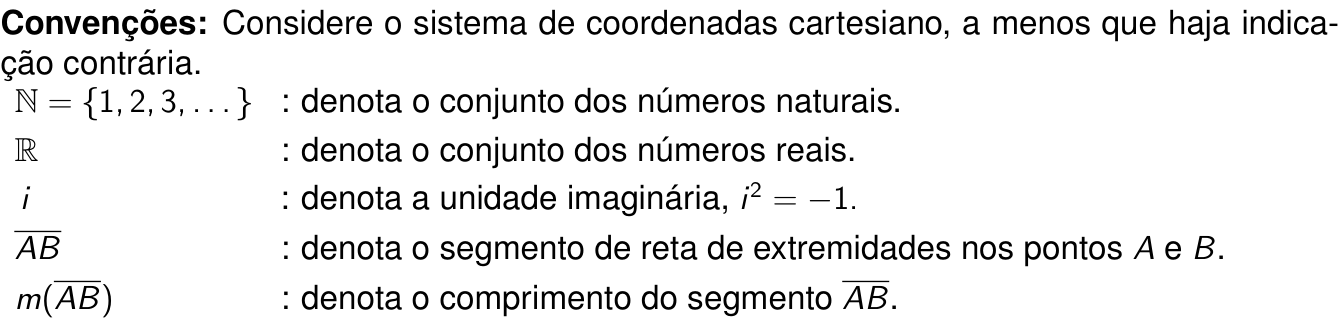
Let variables x1,x2,x3,x4,x5,x6 nonnegative integers? Natural numbers in Brazil sometimes includes 0? The convenções says N = {1,2,3,...} denotes naturais, so positive integers, not including 0. Good.
System:
(1) x1 + x2 + x3 + x4 + x5 + 3x6 = 30
(2) x1 + 2x2 + 2x3 + 2x4 + 2x5 + 4x6 = 52
(3) 2x1 + 2x2 + 3x3 + 3x4 + 3x5 + 7x6 = 76
Need count positive integer solutions.
Let's solve. Maybe use linear combinations.
Let S = x2+x3+x4+x5? Equations structure.
Eq1: x1 + (x2+x3+x4+x5) + 3x6 = 30. Let y = x2+x3+x4+x5? Eq1: x1 + y + 3x6 = 30.
Eq2: x1 + 2y + 4x6 = 52.
Eq3: 2x1 + [2x2+2x3+2x4+2x5? actually 2x2+3x3+3x4+3x5? Wait eq3: 2x1 + 2x2 + 3x3 + 3x4 + 3x5 + 7x6. Not solely y because x2 coefficient 2 while x3,x4,x5 coefficient 3. So need more.
Let's denote a = x1, b = x2+x3+x4+x5 = y, c = x3+x4+x5? Then x2 = y - c? Hmm.
Eq3 = 2a + 2x2 + 3(x3+x4+x5) + 7c? Actually x6 = z. Let p = x3+x4+x5, so x2 = y - p. Then eq3 = 2a + 2(y-p) + 3p + 7z = 2a + 2y + p + 7z = 76.
Eq2 = a + 2y + 4z = 52.
Eq1 = a + y + 3z = 30.
So we can solve a,y,p,z in terms? 3 equations, 4 unknowns (a,y,p,z), plus constraints x_i positive and p partition into 3 positive? Wait p = x3+x4+x5, with x3,x4,x5 positive. Number of triples positive summing p = C(p-1,2) for p>=3. x2 = y-p positive => y > p. Also x6=z positive. a positive.
Let's solve linear system:
a + y + 3z = 30 (E1)
a + 2y + 4z = 52 (E2)
2a + 2y + p + 7z = 76 (E3)
Subtract E2 - E1: y + z = 22 => y = 22 - z.
Then E1: a + (22 - z) + 3z = 30 => a + 22 + 2z = 30 => a = 8 - 2z.
Then E3: 2a + 2y + p + 7z = 76. Substitute a=8-2z, y=22-z:
2(8-2z) + 2(22-z) + p + 7z = 76
16 -4z +44 -2z + p +7z =76
60 + z + p =76 => p = 16 - z.
So a = 8 - 2z, y = 22 - z, p = x3+x4+x5 = 16 - z, z = x6.
Constraints:
a = x1 positive => 8 - 2z >=1 => 2z <=7 => z <=3.5 => z in {1,2,3} since positive.
z positive integer. Also y = 22 - z, p=16-z. Need x2 positive and x3,x4,x5 positive.
x2 = y - p = (22-z) - (16-z) = 6. Nice constant. So x2 = 6.
p = x3+x4+x5 = 16 - z, with each >=1. Also x3,x4,x5 positive. For p >=3. Since z<=3, p>=13, okay. Number of solutions for (x3,x4,x5) positive sum p is C(p-1,2) = (p-1)(p-2)/2.
Additionally x1 = a = 8 - 2z positive, z in {1,2,3}; x6=z positive; x2=6; x3+x4+x5 determined. We need count over z.
For each z=1,2,3:
x1 = 8 - 2z: z=1 ->6, z=2 ->4, z=3 ->2.
x6 = z: 1,2,3.
x2 =6.
p = 16 - z: z=1 ->15; z=2 ->14; z=3 ->13.
Number of positive triples summing p: C(p-1,2).
Total = sum_{z=1}^{3} C(16-z -1,2) = sum_{p=15,14,13} C(p-1,2).
p=15: C(14,2)=91.
p=14: C(13,2)=78.
p=13: C(12,2)=66.
Total = 91+78+66 = 235? 91+78=169, +66=235.
Check if any other constraints? x3,x4,x5 are variables but ordered triple, yes count compositions. Positive integers. Could there be constraints from original variable nonnegative? No positive.
Wait maybe natural numbers includes 0? Convenções explicitly N={1,2,3,...}, so positive. Good.
But let's verify by solving original maybe. Equations:
x1 + S + 3x6 =30
x1 + 2S + 4x6 =52
2x1 +2x2 +3p+7x6 =76 where S=x2+p.
We got x2=6. Let's verify E2-E1: y+z=22? Actually subtract E2-E1: (x1 +2y +4z) - (x1 +y+3z)= y+z =22. yes.
E1: x1+y+3z=30 => x1 + (22-z)+3z=30 => x1 =8-2z. y=22-z.
E3: 2x1 +2y + p +7z =2(8-2z)+2(22-z)+p+7z=16-4z+44-2z+p+7z=60+z+p=76 => p=16-z.
x2 = y-p = (22-z)-(16-z)=6. Good.
z constraints: x1 positive => 8-2z>=1 => z<=3. x6 positive z>=1. So z=1,2,3. Yes.
Number of triples x3,x4,x5 positive sum p: for p=15: C(14,2)=91; p=14: C(13,2)=78; p=13: C(12,2)=66. Total 235.
Need present as candidate. Could phrase "Portanto, há 235 sêxtuplas ordenadas."
Need ensure no overcount: x1 determined, x2 fixed, x6 z, x3,x4,x5 compositions. For each z, number of ordered triples = binomial(p-1,2), yes.
Let's maybe produce solution in Portuguese.
But let's think if there is any possibility that natural numbers includes 0 in some Brazilian contexts? The convenção says N={1,2,3,...}, so no.
Let's maybe derive using linear combination alternative: subtract first from second, etc. We can write elegantly.
Potential issue: The problem asks "Determine quantas sêxtuplas ordenadas de números naturais ... satisfazem o sistema". Ordered sextuples. We count ordered triples for x3,x4,x5, yes.
Let's formulate:
Sejam:
S = x2+x3+x4+x5
T = x3+x4+x5
z = x6
De (2)-(1): x2+x3+x4+x5 + x6 =22? Wait (x1+2x2+2x3+2x4+2x5+4x6) - (x1+x2+x3+x4+x5+3x6) = x2+x3+x4+x5 + x6 =22. So y+z=22. yes.
Then from (1): x1 + (22-z)+3z=30 => x1 =8-2z.
Then from (3), need express x2? Actually x2 = (x2+x3+x4+x5) - (x3+x4+x5) = (22-z) - p. We need p. Use (3):
(3) = 2x1 +2x2+3x3+3x4+3x5+7x6 = 2x1 +2(x2+x3+x4+x5) + (x3+x4+x5)+7x6? Since 2x2+3(x3+x4+x5) = 2(x2+x3+x4+x5) + (x3+x4+x5). Yes. So =2x1 +2y + p +7z =76. Substitute x1=8-2z, y=22-z: 2(8-2z)+2(22-z)+p+7z=76 -> 16-4z+44-2z+p+7z=76 -> 60+z+p=76 -> p=16-z.
Then x2 = y - p = (22-z)-(16-z)=6.
Then variables:
x1=8-2z, x2=6, x6=z, x3+x4+x5=16-z.
Since positive naturals:
z ∈ {1,2,3}. For each z, count positive integer solutions (x3,x4,x5) of x3+x4+x5=16-z: C((16-z)-1,2). Sum.
Let's compute:
z=1: p=15 -> C(14,2)=91
z=2: p=14 -> C(13,2)=78
z=3: p=13 -> C(12,2)=66
Total 235.
Potential alternative: We can also count for x3,x4,x5 positive sum p is number of solutions = (p-1)(p-2)/2. Let's verify formula: For n positive variables summing p, number = C(p-1, n-1). For n=3, C(p-1,2). Yes.
Let's consider if x1 positive imposes z<=3; x6 positive z>=1; x2=6 positive; p positive? For z=3 p=13, positive triples exist. For z=4? x1=0 not natural; z=4 gives p=12, x1=0, but x1 positive disallows. Also if z=0 not positive x6. Good.
Let's maybe mention "e x3,x4,x5 são inteiros positivos, então p>=3; como p=16-z≥13, não há restrição adicional."
Need final line exactly: "Resposta final: 235" maybe with "sêxtuplas". The instruction says if single answer, write only result. So final line: Resposta final: 235.
But perhaps they expect "Resposta final: 235 sêxtuplas ordenadas." The prompt says "<o resultado de cada item, de forma curta>" and "Se a questão tiver uma resposta só, escreva só o resultado." So final line could be "Resposta final: 235". Good.
Let's ensure no hidden issue: The system's coefficient matrix maybe rank? We solved uniquely for some combinations, but did we need to ensure all variables positive? Yes.
Let's maybe test one solution: z=1, x1=6,x2=6,x6=1, x3+x4+x5=15. E.g. (x3,x4,x5)=(1,1,13). Eq1:6+6+1+1+13+3=30? 6+6+15+3=30 yes. Eq2:6+12+2+2+26+4=52? 6+12+30? Wait 2x3=2, 2x4=2, 2x5=26, 4x6=4 total 6+12+2+2+26+4=52 yes. Eq3:12+12+3+3+39+7=76? 12+12+3+3+39+7=76 yes. Good.
Thus answer 235.
Need provide development in Portuguese, item by item? No items, single answer. We can write a clean solution.
Let's craft final response:
"Sejam ..." Then solve.
Maybe use notation:
x_1 + x_2 + x_3 + x_4 + x_5 + 3x_6=30 (I)
...
Subtraindo (I) de (II): x_2+x_3+x_4+x_5 + x_6 =22. Chamando z=x_6 e S=x_2+x_3+x_4+x_5, temos S+z=22 => S=22-z.
Em (I): x_1 + (22-z)+3z=30 => x_1=8-2z.
Em (III), escrevendo x_3+x_4+x_5 = P, temos x_2 = S-P = 22-z-P. A equação (III) fica:
2x_1 + 2x_2 +3(x_3+x_4+x_5)+7z = 2x_1 + 2(S-P) +3P+7z = 2x_1+2S+P+7z = 76.
Substituindo x_1=8-2z e S=22-z:
16-4z +44-2z +P+7z=76 => 60+z+P=76 => P=16-z.
Então x_2=S-P=6.
Como x_1=8-2z>0 => z<4, e z>0, então z∈{1,2,3}. Para cada z, número de soluções positivas de x_3+x_4+x_5=16-z é C((16-z)-1,2).
Total = C(14,2)+C(13,2)+C(12,2)=91+78+66=235.
Resposta final: 235"
Need check C(16-z -1,2): for z=1, C(14,2); z=2, C(13,2); z=3, C(12,2). Good.
Let's provide final.
Sejam
S=x_2+x_3+x_4+x_5,\qquad P=x_3+x_4+x_5,\qquad z=x_6.
O sistema é
\begin{cases}
x_1+S+3z=30,\\
x_1+2S+4z=52,\\
2x_1+2x_2+3x_3+3x_4+3x_5+7z=76.
\end{cases}
Subtraindo a primeira equação da segunda:
S+z=22 \quad\Rightarrow\quad S=22-z.
Substituindo na primeira:
x_1+(22-z)+3z=30 \quad\Rightarrow\quad x_1=8-2z.
A terceira equação pode ser escrita como
2x_1+2(x_2+x_3+x_4+x_5)+(x_3+x_4+x_5)+7z=76,
ou seja,
2x_1+2S+P+7z=76.
Substituindo x_1=8-2z e S=22-z:
2(8-2z)+2(22-z)+P+7z=76
16-4z+44-2z+P+7z=76
60+z+P=76 \quad\Rightarrow\quad P=16-z.
Assim,
x_2=S-P=(22-z)-(16-z)=6.
Como x_1=8-2z>0, devemos ter z=1,2,3 apenas.
Para cada z\in\{1,2,3\}, as variáveis x_3,x_4,x_5 são números naturais positivos tais que
x_3+x_4+x_5=16-z.
O número de soluções positivas dessa equação é
\binom{(16-z)-1}{2}.
Logo o total é
\binom{14}{2}+\binom{13}{2}+\binom{12}{2}
=91+78+66=235.
Resposta final: 235