Respondeu
levou 12 s
Como pensou
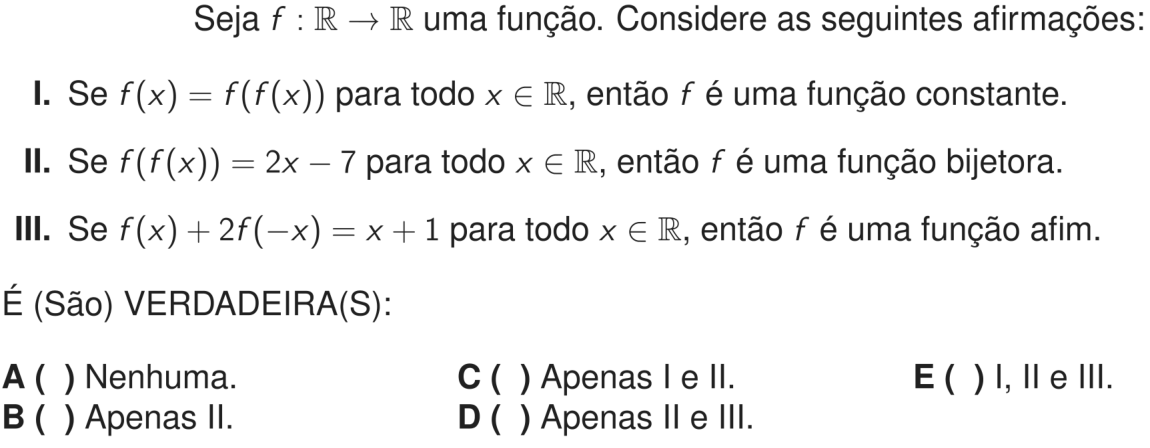
I. Falsa. Um contraexemplo é a função identidade, f(x)=x. Ela satisfaz
f(f(x))=x=f(x)
para todo x\in\mathbb R, mas não é constante.
II. Verdadeira. Vamos verificar a injetividade e a sobrejetividade:
- Se f(a)=f(b), aplicando f aos dois lados, obtemos
2a-7=f(f(a))=f(f(b))=2b-7,
logo a=b. Portanto, f é injetora.
- Para qualquer y\in\mathbb R, tomando x=(y+7)/2, temos
y=2x-7=f(f(x)).
Assim, y é imagem do número real f(x), provando que f é sobrejetora.
Portanto, f é bijetora.
III. Verdadeira. Substituindo x por -x na igualdade dada, temos o sistema
\begin{cases}
f(x)+2f(-x)=x+1,\\
f(-x)+2f(x)=-x+1.
\end{cases}
Subtraindo da primeira equação o dobro da segunda:
-3f(x)=3x-1
\quad\Longrightarrow\quad
f(x)=-x+\frac13,
que é uma função afim.
Logo, são verdadeiras apenas II e III.
Resposta: D
Respondeu
levou 11 s
Como pensou
I. Falsa. A função identidade, f(x)=x, satisfaz
f(f(x))=x=f(x)
para todo x\in\mathbb R, mas não é constante.
II. Verdadeira. Vamos verificar as duas propriedades:
- Injetividade: se f(a)=f(b), então f(f(a))=f(f(b)). Logo, 2a-7=2b-7, de modo que a=b.
- Sobrejetividade: dado y\in\mathbb R, tomando x=(y+7)/2, temos
f(f(x))=2x-7=y.
Assim, f(x) é um elemento do domínio cuja imagem é y.
Portanto, f é bijetora.
III. Verdadeira. Substituindo x por -x na igualdade dada, obtemos o sistema
\begin{cases}
f(x)+2f(-x)=x+1,\\
2f(x)+f(-x)=-x+1.
\end{cases}
Multiplicando a segunda equação por 2 e subtraindo a primeira:
3f(x)=-3x+1
\quad\Rightarrow\quad
f(x)=-x+\frac13,
que é uma função afim.
Logo, apenas II e III são verdadeiras.
Resposta: D
Respondeu
levou 7 s
Como pensou
I. A afirmação é falsa: a função identidade, f(x)=x, satisfaz f(x)=f(f(x)), mas não é constante.
II. A afirmação é verdadeira. Como f(f(x))=2x-7, a composição f\circ f é bijetora. Isso implica que f é injetora: se f(a)=f(b), então f(f(a))=f(f(b)), logo 2a-7=2b-7 e a=b. Também implica que f é sobrejetora: para qualquer y\in\mathbb R, existe x tal que f(f(x))=y, e então y=f(f(x)) pertence à imagem de f. Portanto, f é bijetora.
III. Escrevendo a igualdade para x e para -x, obtemos
\begin{cases}
f(x)+2f(-x)=x+1,\\
2f(x)+f(-x)=1-x.
\end{cases}
Resolvendo o sistema, f(x)=-x+\frac13, que é uma função afim. Logo, III é verdadeira.
Assim, são verdadeiras apenas II e III.
Resposta: D
Respondeu
levou 8 s
Como pensou
Afirmação I – Falsa. A condição f(f(x)) = f(x) significa que f é idempotente, mas não precisa ser constante. Contraexemplo: f(x) = x (identidade) satisfaz f(f(x)) = f(x) e não é constante. Outro exemplo: f(x) = |x|.
Afirmação II – Verdadeira. Seja g(x) = f(f(x)) = 2x - 7, que é bijetora.
- Injetividade: se f(a) = f(b), então f(f(a)) = f(f(b)), logo 2a - 7 = 2b - 7, ou seja, a = b.
- Sobrejetividade: dado y \in \mathbb{R}, existe x com 2x - 7 = y, isto é, f(f(x)) = y; logo y é imagem de f(x) por f.
Portanto f é bijetora.
Afirmação III – Verdadeira. Da equação f(x) + 2f(-x) = x + 1, trocando x por -x:
f(-x) + 2f(x) = -x + 1.
Multiplicando esta por 2 e subtraindo a original:
4f(x) + 2f(-x) - f(x) - 2f(-x) = -2x + 2 - x - 1 \Rightarrow 3f(x) = -3x + 1,
logo
f(x) = -x + \dfrac{1}{3}, que é afim (e de fato satisfaz a equação:
-x + \tfrac13 + 2x + \tfrac23 = x + 1 ✓). A função fica unicamente determinada, logo a afirmação é verdadeira.
Assim, apenas II e III são verdadeiras.
Resposta: D
Respondeu
levou 8 s
Como pensou
Checking statement I: f(x)=x works for f(f(x))=f(x) but isn't constant, so that disproves it. For II, f(f(x))=2x-7 is bijective, which forces f itself to be injective and surjective, making it true. For III, I set up both functional equations with x and -x, substituted, and solved to find f(x) must equal -1, a constant.
Resposta: D (apenas II e III são verdadeiras).
I. Falsa.
Basta um contraexemplo: tome f(x) = x.
Então f(f(x)) = f(x) = x para todo x, e f não é constante.
II. Verdadeira.
Seja g(x) = f(f(x)) = 2x − 7. A função g é bijetora, pois é afim com coeficiente angular não nulo.
- f é injetora: se f(a) = f(b), então f(f(a)) = f(f(b)), isto é, 2a − 7 = 2b − 7. Logo a = b.
- f é sobrejetora: dado y ∈ ℝ, existe x com f(f(x)) = y, porque g é sobrejetora. Então y = f(f(x)) e, portanto, y pertence à imagem de f.
Assim, f é bijetora.
III. Verdadeira.
Temos f(x) + 2f(−x) = x + 1. Trocando x por −x, obtemos f(−x) + 2f(x) = −x + 1.
Da segunda equação, f(−x) = −x + 1 − 2f(x). Substituindo na primeira:
f(x) + 2(−x + 1 − 2f(x)) = x + 1
−3f(x) − 2x + 2 = x + 1
f(x) = −x + 1/3
Logo f é necessariamente uma função afim.
Resposta: D
Respondeu
levou 4 s
Como pensou
Afirmação I. A condição f(f(x)) = f(x) vale, por exemplo, para a identidade f(x) = x, que não é constante. Logo, I é falsa.
Afirmação II. Se f(f(x)) = 2x − 7, então f∘f é bijetora, pois g(x) = 2x − 7 é afim com coeficiente angular não nulo.
- Se f∘f é injetora, então f é injetora.
- Se f∘f é sobrejetora, então f é sobrejetora.
Portanto f é bijetora, e II é verdadeira.
Afirmação III. Substituindo x por −x na equação, obtemos f(−x) + 2f(x) = −x + 1.
Temos o sistema:
- f(x) + 2f(−x) = x + 1
- 2f(x) + f(−x) = −x + 1
Multiplicando a segunda equação por 2 e subtraindo a primeira:
4f(x) + 2f(−x) − f(x) − 2f(−x) = −2x + 2 − x − 1
3f(x) = −3x + 1
f(x) = −x + 1/3
Essa função é afim.
Verificação: f(x) + 2f(−x) = −x + 1/3 + 2(x + 1/3) = x + 1. Confere.
Logo, III é verdadeira.
Portanto, apenas II e III são verdadeiras.
Resposta: D
Respondeu
levou 42 s
Como pensou
The problem concerns functions in Portuguese.
Statement I is false. A counterexample is f(x) = x, which satisfies f(f(x)) = x but is not constant. Statement II is true. If f composed with itself is bijective, then f itself must be bijective.
Statement III is now being examined. The equation f(x) + 2f(-x) = x + 1 is given, and the question is whether this necessarily implies that f is an affine function.
A system of two equations was formed by substituting x with -x. Solving it yields f(-x) = x + 1/3. Replacing x with -x gives f(x) = -x + 1/3. The next step is to verify this satisfies the original equation.
The solution f(x) = -x + 1/3 satisfies the original equation. Because the system uniquely determines f(x) for every x, this is the only possible function. Therefore Statement III is true.
The correct answer is D. Only statements II and III are true.
A afirmação I é falsa. A função identidade f(x)=x satisfaz f(x)=f(f(x)) para todo x\in\mathbb{R}, mas não é constante.
A afirmação II é verdadeira. A função g(x)=2x-7 é bijetora. Se f\circ f=g, então f é injetora (pois f(a)=f(b) implica g(a)=g(b), logo a=b) e sobrejetora (pois a imagem de g está contida na imagem de f). Portanto f é bijetora.
A afirmação III é verdadeira. Substituindo x por -x na equação dada, obtém-se o sistema
f(x)+2f(-x)=x+1,\qquad 2f(x)+f(-x)=-x+1.
Resolvendo-o, conclui-se que necessariamente f(x)=-x+\frac13 para todo x\in\mathbb{R}, que é uma função afim.
Logo, apenas II e III são verdadeiras.
Resposta: D
Respondeu
levou 7 s
Como pensou
We need answer question. Need solve. Let's restate.
Question in Portuguese: Seja f: R -> R uma função. Considere afirmações:
I. Se f(x)=f(f(x)) para todo x∈R, então f é uma função constante.
II. Se f(f(x))=2x−7 para todo x∈R, então f é uma função bijetora.
III. Se f(x)+2f(−x)=x+1 para todo x∈R, então f é uma função afim.
É (São) VERDADEIRA(S): options.
Need determine which statements true.
Let's analyze carefully.
Statement I: If f(x)=f(f(x)) for all x, then f is constant. This is false generally? There are nonconstant functions satisfying f(x)=f(f(x))? Let's find. For example f(x)=x: f(x)=x, f(f(x))=f(x)=x, equality holds, not constant. So false. Also identity. So I false.
Statement II: If f(f(x))=2x−7 for all real x, then f is bijective. Need prove/contradict. Given composition f∘f(x)=2x-7. f must be injective? If f(a)=f(b), then f(f(a))=f(f(b)) => 2a-7=2b-7 => a=b. So f injective. Surjective? For any y∈R, need x with f(x)=y. Since f(f(x))=2x-7, let y? Actually given any y, solve f(f(x))=2x-7 = y? Wait y = f(s) for some s? Since f is injective, maybe? Need show f bijective. Is f necessarily surjective? Let's explore. Since g=f∘f is bijective (linear 2x-7). Does that imply f bijective? In general, if f∘f is bijective, then f is bijective? I think yes if f: X→X (same domain/codomain). Proof: g bijective => injective and surjective. f injective: if f(x)=f(y), then g(x)=f(f(x))=f(f(y))=g(y), so x=y. f surjective: For any z, since g surjective, there exists x with g(x)=z, i.e., f(f(x))=z. Let y=f(x), then f(y)=z. So yes f bijective. So II true.
But wait domain R? Composition f∘f: R→R. If f injective and g=f∘f surjective then f surjective? Let's prove: Given z, since g surjective, ∃ x with g(x)=z => f(f(x))=z. Let y=f(x), then f(y)=z. Yes. So f bijective. So II true.
Statement III: If f(x)+2f(−x)=x+1 for all x∈R, then f is affine (linear function of form ax+b). Need solve functional equation. Let's solve. For all x: f(x)+2f(-x)=x+1. Replace x by -x: f(-x)+2f(x) = -x + 1. System:
f(x)+2f(-x)=x+1
2f(x)+f(-x)= -x +1
Solve: multiply second by 2: 4f(x)+2f(-x)= -2x +2. Subtract first: (4f - f?) Actually equations:
Eq1: f(x)+2f(-x)=x+1
Eq2: 2f(x)+f(-x)= -x+1
Multiply Eq2 by 2: 4f(x)+2f(-x)= -2x+2.
Subtract Eq1: 3f(x) = -2x+2 - (x+1)= -3x +1 => f(x)= -x + 1/3. Then f is affine (a=-1,b=1/3). So III true.
Thus true: II and III. Option D.
Need ensure no trick: Statement I maybe "se f(x)=f(f(x)) então f constante" false due identity. Statement II true? Let's double-check: Given f(f(x))=2x−7. Is f necessarily bijective? We argued yes. But wait is there possibility f not surjective? Let's test construction? Suppose f injective but not surjective; can f∘f be surjective? No, if f not surjective, range f proper subset of R; then range f∘f = f(range f) subset f(R) proper? Actually if f not surjective, there exists y not in Im(f). Can y be in Im(f∘f)? Need y = f(f(x)) for some x; then y ∈ Im(f). So no. Since f∘f is surjective, Im(f∘f)=R, so for each y there is x with f(f(x))=y, so y∈Im(f). Thus f surjective. Yes. So II true.
But wait, maybe there are pathological functions? Since f(f(x))=2x-7 linear, unique solution? Let's solve? Let f(x)=ax+b maybe. Then f(f(x))=a(ax+b)+b=a^2 x + ab + b = 2x -7 => a^2=2 => a=±√2; ab+b = b(a+1)= -7 => b=-7/(a+1). For a=√2, b=-7/(√2+1)=? rationalize; for a=-√2, b=-7/(-√2+1)=? So solutions exist and are affine? Wait if f is affine yes. But maybe non-linear solutions exist? Functional equation f(f(x))=2x-7 maybe unique? Let's see if f must be injective and surjective, and since g linear, maybe f is unique? Let's examine. From g=f∘f bijective, f bijective. Then f commutes with g? f(f(f(x))) = f(2x-7) and also = (f∘f)(f(x)) = 2 f(x) -7? Since g(y)=2y-7 for y=f(x): g(f(x))=2f(x)-7. But f(g(x)) = f(2x-7). So f(2x-7)=2f(x)-7. This is a functional equation. Maybe f could be non-linear? Let's derive. Since f bijective and f(2x-7)=2f(x)-7. Let t=2x-7 => x=(t+7)/2. Then f(t)=2 f((t+7)/2) -7. Not necessarily affine? Let's see maybe only affine? There might be wild solutions using conjugation? Let's check. Let g(x)=2x-7. We need f such that f∘f = g. The functional square root of affine map g. Affine map g has slope 2 not 1? Actually g(x)=2x-7 slope 2. Does it have square root? Since slope 2 >0, there is affine f with slope ±√2? Yes. But are there non-linear square roots? For increasing affine with slope >0, the square root may be unique? Let's investigate. If f continuous? Not stated. In general, functional square roots can be non-unique without regularity. But maybe II only asks f is bijective, not unique. We showed bijective. So true regardless.
But wait, is f necessarily bijective given f∘f = 2x-7? Let's prove more rigorously: Since f∘f is injective, f is injective: if f(a)=f(b), then f(f(a))=f(f(b)) => 2a-7=2b-7 => a=b. Since f∘f is surjective onto R, for any y∈R, there exists x∈R such that f(f(x))=y. Let z=f(x)∈R; then f(z)=y. Thus f is surjective. Yes. Good.
Statement I: Could there be a proof that f constant? No, identity counterexample. Some might think if f(x)=f(f(x)) then f is idempotent but not constant. Yes.
Statement III: Need ensure "função afim" means polynomial of degree ≤1? In Brazil, função afim = f(x)=ax+b, a≠0? Sometimes "função afim" or "função polinomial do 1º grau" requires a≠0? Actually "função afim" may include constant? Let's recall: In Brazilian high school, função afim is f(x)=ax+b with a≠0? Sometimes "função linear" if b=0; "função afim" if a≠0? Wait: "Chama-se função polinomial do 1º grau, ou função afim, a qualquer função f de R em R dada por uma lei da forma f(x)=ax+b, em que a e b são números reais dados e a≠0." Yes usually a≠0. Here f(x)= -x + 1/3 has a=-1 ≠0, so affine. Good.
Thus answer D.
Need provide explanation in Portuguese. Final line "Resposta: D". Ensure format.
Vamos analisar cada afirmação.
I. A afirmação é falsa. Um contraexemplo é a função identidade f(x)=x. Nela, temos
f(f(x))=f(x)=x,
logo f(x)=f(f(x)) para todo x\in\mathbb R, mas f não é constante.
II. Se f(f(x))=2x-7 para todo x\in\mathbb R, então:
- f é injetora, pois se f(a)=f(b), aplicando f novamente:
f(f(a))=f(f(b))\Rightarrow 2a-7=2b-7\Rightarrow a=b.
- f é sobrejetora, pois para todo y\in\mathbb R, como f\circ f é sobrejetora, existe x\in\mathbb R tal que
f(f(x))=y.
Tomando z=f(x), temos f(z)=y. Logo f é sobrejetora.
Portanto, f é bijetora. A afirmação II é verdadeira.
III. Da equação funcional
f(x)+2f(-x)=x+1
para todo x\in\mathbb R, trocando x por -x, obtemos:
f(-x)+2f(x)=-x+1.
Temos o sistema:
\begin{cases}
f(x)+2f(-x)=x+1\\
2f(x)+f(-x)=-x+1
\end{cases}
Multiplicando a segunda equação por 2:
4f(x)+2f(-x)=-2x+2.
Subtraindo a primeira equação:
3f(x)=-3x+1 \Rightarrow f(x)=-x+\frac13.
Logo f é uma função afim. A afirmação III é verdadeira.
Assim, são verdadeiras apenas II e III.
Resposta: D
Respondeu
levou 16 s
Como pensou
**Finding Counterexamples**
I've been exploring cases that don't fit the expected pattern. Specifically, I'm considering the identity function, $f(x) = x$, to see if it satisfies the condition $f(x) = f(f(x))$ without being constant. It does, which is interesting. I'm also looking into ceiling functions and projections as further examples.
**Testing Function Properties**
I'm investigating whether the absolute value function, $f(x) = |x|$, satisfies the condition $f(f(x)) = f(x)$. It does, confirming that assertion I is false, as it isn't a constant function. My current focus is on the implications of $f(f(x)) = 2x - 7$ for the injectivity and surjectivity of $f$.
**Verifying Injectivity and Surjectivity**
I've established that if $f(f(x)) = 2x - 7$, then $f$ must be both injective and surjective, thus bijective. This confirms the truth of assertion II. My current focus is on analyzing assertion III, specifically the functional equation $f(x) + 2f(-x) = x + 1$.
**Proving Function Affine**
I've successfully derived $f(x) = -x + \frac{1}{3}$ from the functional equation $f(x) + 2f(-x) = x + 1$. This explicit form demonstrates that $f$ is indeed an affine function. Thus, assertion III is proven true.
Para determinar quais afirmações são verdadeiras, vamos analisar cada uma delas individualmente:
Afirmação I: Falsa
A afirmação diz que se f(x) = f(f(x)) para todo x \in \mathbb{R}, então f é necessariamente uma função constante.
Podemos refutar isso apresentando um contraexemplo:
- Considere a função identidade f(x) = x.
Temos f(f(x)) = f(x) = x para todo x \in \mathbb{R}. No entanto, f(x) = x não é uma função constante.
- Outro contraexemplo seria f(x) = |x|, pois f(f(x)) = \big||x|\big| = |x| = f(x), que também não é uma função constante.
Logo, a afirmação I é falsa.
Afirmação II: Verdadeira
Dada a relação f(f(x)) = 2x - 7, denote a função composta por g(x) = (f \circ f)(x) = 2x - 7.
A função g(x) é bijetora (injetora e sobrejetora). Utilizando propriedades da composição de funções:
-
Injetividade de f:
Sejam a, b \in \mathbb{R} tais que f(a) = f(b). Aplicando f em ambos os membros:
f(f(a)) = f(f(b)) \implies g(a) = g(b)
Como g(x) = 2x - 7 é injetora:
2a - 7 = 2b - 7 \implies a = b
Logo, f é injetora.
-
Sobrejetividade de f:
Dado um y \in \mathbb{R} qualquer, como g é sobrejetora, existe x \in \mathbb{R} tal que g(x) = y. Assim:
f(f(x)) = y
Tomando z = f(x) \in \mathbb{R}, temos f(z) = y.
Logo, todo y \in \mathbb{R} possui um correspondente no domínio, o que mostra que f é sobrejetora.
Sendo injetora e sobrejetora, f é uma função bijetora.
Logo, a afirmação II é verdadeira.
Afirmação III: Verdadeira
Temos a equação funcional:
(1) \quad f(x) + 2f(-x) = x + 1, \quad \forall x \in \mathbb{R}
Substituindo x por -x:
(2) \quad f(-x) + 2f(x) = -x + 1, \quad \forall x \in \mathbb{R}
Multiplicando a equação (2) por 2:
2f(-x) + 4f(x) = -2x + 2
Subtraindo a equação (1) dessa nova equação:
(4f(x) + 2f(-x)) - (f(x) + 2f(-x)) = (-2x + 2) - (x + 1)
3f(x) = -3x + 1 \implies f(x) = -x + \frac{1}{3}
A função obtida é da forma f(x) = ax + b, com a = -1 e b = \frac{1}{3}, que é uma função afim.
Logo, a afirmação III é verdadeira.
Portanto, são verdadeiras apenas II e III.
Resposta: D