Correção UNICAMP 2027Confira as respostas e a resolução de cada questão da 1ª faseVer a correção
IA ao vivo / ITA 2027 · 1ª fase

COMPARE OS RACIOCÍNIOS

Questão 9

Gabarito oficial: D. ← 8 10 →

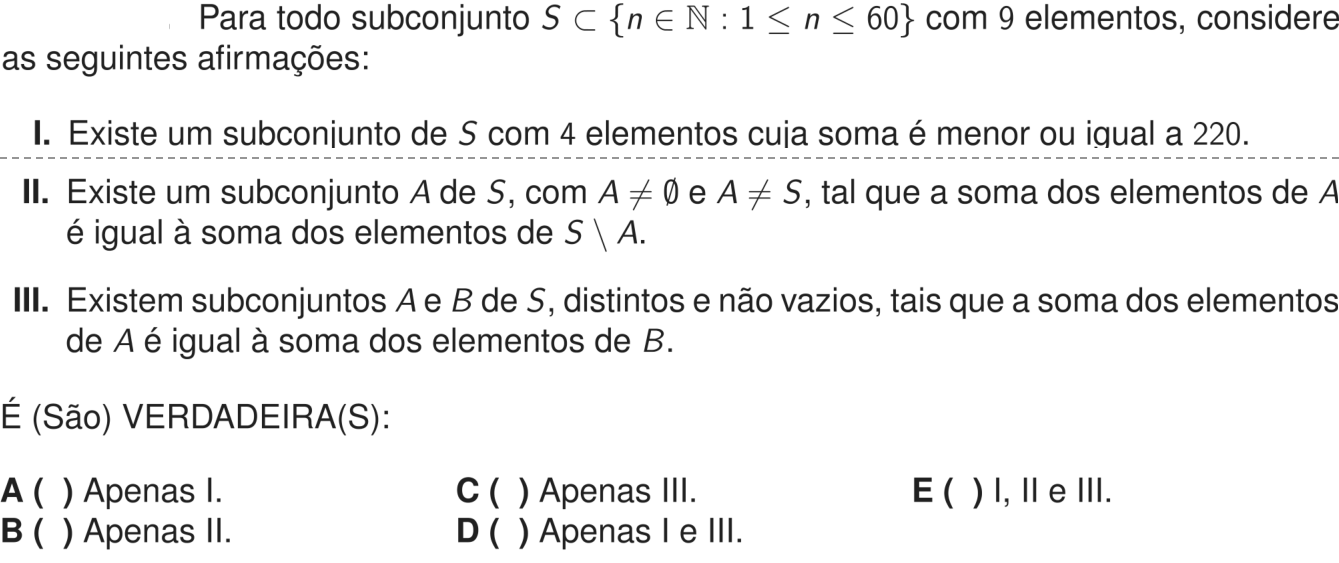
A questão

Texto de apoio da questão 9 Questão 9

Respostas das IAs

GPT-6 Astra

D

Respondeu

levou 16 s

Como pensou

I. Verdadeira. Entre 1 e 60, há apenas cinco números maiores que 55: 56,57,58,59,60. Portanto, qualquer conjunto S com nove elementos contém pelo menos quatro números menores ou iguais a 55. A soma desses quatro números é, assim, no máximo

4\cdot55=220.

II. Falsa. Considere S=\{1,2,\ldots,9\}. A soma de seus elementos é

1+2+\cdots+9=45.

Se A e S\setminus A tivessem somas iguais, a soma total seria par, o que contradiz o valor 45.

III. Verdadeira. Um conjunto de nove elementos possui

2^9-1=511

subconjuntos não vazios. A soma dos elementos de qualquer um deles é um inteiro positivo e não supera a maior soma possível para nove números distintos entre 1 e 60:

52+53+\cdots+60=\frac{9(52+60)}2=504.

Logo, há 511 subconjuntos não vazios e apenas 504 valores possíveis para suas somas. Pelo princípio da casa dos pombos, dois desses subconjuntos distintos têm a mesma soma.

Portanto, apenas I e III são verdadeiras.

Resposta: D

GPT-6.1 Sol

D

Respondeu

levou 11 s

Como pensou

I. Verdadeira. Entre os números de 1 a 60, apenas cinco são maiores que 55: 56,57,58,59,60. Portanto, qualquer conjunto S com nove elementos contém pelo menos quatro números menores ou iguais a 55. A soma desses quatro números é, no máximo,

4\cdot55=220.

II. Falsa. Considere S=\{1,2,\ldots,9\}. A soma de seus elementos é

1+2+\cdots+9=45.

Se A e S\setminus A tivessem somas iguais, a soma total seria par, contrariando o valor 45.

III. Verdadeira. Há

2^9-1=511

subconjuntos não vazios de S. A soma de cada um é um inteiro positivo e não ultrapassa a maior soma possível dos nove elementos:

52+53+\cdots+60=\frac{9(52+60)}2=504.

Assim, há 511 subconjuntos para, no máximo, 504 valores de soma. Pelo princípio da casa dos pombos, dois subconjuntos distintos e não vazios têm a mesma soma.

Logo, são verdadeiras apenas I e III.

Resposta: D

GPT-6 Luna

D

Respondeu

levou 9 s

Como pensou
**Interpreting subsets and sums** I need to tackle the problem of determining universally true statements for subsets S of {1..60} with 9 elements. First, I consider if there's a 4-element subset whose sum is ≤ 220. In the worst-case scenario, if S contains the largest numbers (52 to 60), the sum of the smallest four would be 214, which fits. For the second statement, partitioning an odd total like {1..9} gives a false result because it can’t equal half. Lastly, I explore the existence of distinct nonempty subsets A and B of S that have the same sum, even if they’re not disjoint.**Analyzing subset sums** When dealing with any 9 distinct positive integers up to 60, I think about pigeonhole principles regarding subset sums. With 511 nonempty subsets and possible sums ranging from 1 to a maximum of 504, there must be collisions where different subsets yield the same sum, which confirms part of my reasoning. The first statement appears true, and the third does too. However, the second statement is false, especially with an odd total like {1..9} summing to 45. I need to clarify that when considering ascending order and the bounds on the elements, the conclusion about the sums holds true.

Sejam s_1<s_2<\cdots<s_9 os elementos de S.

I. Verdadeira. Como há 9 elementos distintos entre 1 e 60, temos s_i\le 51+i. Portanto, os quatro menores somam no máximo

s_1+s_2+s_3+s_4\le 52+53+54+55=214\le220.

II. Falsa. Para S=\{1,2,\ldots,9\}, a soma de todos os elementos é 45, que é ímpar. Não é possível dividi-la em duas partes de mesma soma.

III. Verdadeira. Existem 2^9-1=511 subconjuntos não vazios de S. Além disso, a soma de todos os elementos de S é no máximo 52+53+\cdots+60=504; assim, as somas dos subconjuntos não vazios são inteiros entre 1 e 504. Pelo princípio da casa dos pombos, dois subconjuntos distintos têm a mesma soma.

Logo, são verdadeiras apenas I e III.

Resposta: D

Claude Fable 5.1

D

Respondeu

levou 11 s

Como pensou
Checking statement I first: in the worst case where S consists of the nine largest numbers, the four smallest among them still sum to only 214, which is under 220, so I holds true. Then I start checking statement II, which requires splitting S into two subsets with equal sums—this only works if the total sum is even, so I need to test whether an odd-sum subset could break this. For statement III, I count nonempty subsets of a 9-element set: 2^9 - 1 = 511, while possible subset sums only range up to 504 (the sum of the nine largest numbers). Since 511 exceeds 504, by pigeonhole two distinct subsets must share the same sum, confirming III is true, and I land on answer D.

Análise das afirmações:

I. O pior caso para encontrar 4 elementos de soma pequena é quando S tem os maiores elementos possíveis: S = {52, 53, ..., 60}. Os 4 menores elementos são 52, 53, 54, 55, cuja soma é 52+53+54+55 = 214 ≤ 220. Em qualquer outro S os 4 menores elementos dão soma ainda menor. Logo, I é verdadeira.

II. Para que a soma de A seja igual à soma de S\A, a soma total de S deve ser par. Mas, por exemplo, S = {1, 2, ..., 9} tem soma 45 (ímpar), logo não existe tal A. Como a afirmação deve valer para todo S, II é falsa.

III. S tem 2⁹ − 1 = 511 subconjuntos não vazios. A soma de qualquer subconjunto não vazio está entre 1 e 52+53+...+60 = 504 (soma máxima possível). Há, portanto, no máximo 504 valores possíveis para as somas e 511 subconjuntos. Pelo Princípio da Casa dos Pombos, existem dois subconjuntos distintos não vazios com a mesma soma. III é verdadeira.

Portanto, são verdadeiras apenas I e III.

Resposta: D

Claude Opus 5.5

D

Respondeu

levou 11 s

Como pensou
For statement I, checking the 9 smallest elements from the set - since the i-th smallest element is at most 51+i, the four smallest sum to at most 214, which is under 220, so this holds true. For statement II about partitioning into equal sums, I'm noting that the total sum could be odd, which would make an equal partition impossible, so I need to find a concrete counterexample. For statement III, since there are 511 nonempty subsets but sums can only range up to 504, pigeonhole guarantees two distinct subsets share the same sum — so this is true, pointing to answer D.

Resposta: D (I e III verdadeiras, II falsa)

Afirmação I. Ordene os elementos de S: s₁ < s₂ < … < s₉ ≤ 60.

  • Como há 9 − i elementos de S maiores que sᵢ, e todos são inteiros distintos até 60, vale sᵢ ≤ 60 − (9 − i) = 51 + i.
  • Logo, a soma dos 4 menores elementos satisfaz s₁ + s₂ + s₃ + s₄ ≤ 52 + 53 + 54 + 55 = 214.
  • Como 214 ≤ 220, sempre existe esse subconjunto.

A afirmação é verdadeira.

Afirmação II. Para que a soma de A seja igual à soma de S \ A, a soma total de S precisaria ser par.

  • Contraexemplo: S = {1, 2, …, 9}, cuja soma é 45, um número ímpar.
  • Nesse caso, nenhuma divisão em duas partes de mesma soma é possível.

A afirmação é falsa.

Afirmação III. Use o princípio da casa dos pombos.

  • S tem 2⁹ − 1 = 511 subconjuntos não vazios.
  • A soma de cada um é um inteiro entre 1 e, no máximo, 52 + 53 + … + 60 = 504.
  • Como há 511 subconjuntos e apenas 504 valores possíveis de soma, dois subconjuntos distintos têm necessariamente a mesma soma.

A afirmação é verdadeira.

Resposta: D

Claude Sonnet 5.5

D

Respondeu

levou 8 s

Como pensou
For statement I, checking a 9-element subset of {1,...,60}: the four smallest elements of S always sum to at most 52+53+54+55=214, which is ≤220, so I is true. For II, I'm trying to find a counterexample where S can't be split into two equal-sum halves, perhaps by choosing an odd total sum. For III, there are 511 nonempty subsets of S, but subset sums only range up to 504, so by pigeonhole two distinct subsets must share the same sum, making III true. That points to answer D.

Afirmação I. Os 4 menores elementos de S são, no máximo, 52, 53, 54 e 55, que são os menores valores possíveis quando S = {52, …, 60}. Em qualquer outro S, os 4 menores elementos são ainda menores ou iguais a esses. Logo, a soma deles é no máximo 52 + 53 + 54 + 55 = 214 ≤ 220. A afirmação é verdadeira.

Afirmação II. Ela exige que a soma dos elementos de S seja par, pois A e S∖A teriam somas iguais. Isso não vale para todo S. Por exemplo, S = {1, 2, …, 9} tem soma 45, que é ímpar, e portanto nenhuma divisão desse tipo existe. A afirmação é falsa.

Afirmação III. S tem 2⁹ − 1 = 511 subconjuntos não vazios. A soma de qualquer um deles está entre 1 e 52 + 53 + … + 60 = 504, o que dá no máximo 504 valores distintos possíveis. Como 511 > 504, o princípio da casa dos pombos garante que dois subconjuntos distintos e não vazios têm a mesma soma. A afirmação é verdadeira.

São verdadeiras apenas I e III.

Resposta: D

Grok 4.7

D

Respondeu

levou 1 min 29 s

Como pensou
The problem is in Portuguese from ITA 2027. The problem asks which of three statements about 9-element subsets of {1,2,...,60} are true. Statement I claims a 4-element subset with sum ≤ 220 exists. Statement II claims a non-empty proper subset A has sum equal to the sum of S \ A. Statement III claims two distinct non-empty subsets have equal sums. Checking if statement I is always true. The four smallest elements of any 9-element subset provide the minimum possible sum for a 4-element subset. The four smallest elements of S must sum to at most 220. If they summed to more than 220, all elements would be large and every 4-element subset would exceed that bound. A concrete example with the largest possible smallest elements, {52, 53, ..., 60}, yields a four-element sum of 214. This confirms statement I is always true. Statement II requires the total sum of S to be even. A non-empty proper subset with half the sum would split S into two equal parts. The question is whether this holds for every 9-element subset. Statement II is false. A 9-element subset with an odd total sum cannot be split into two equal integer sums, so the condition fails for some sets. Statement III is now being evaluated. The question is whether every 9-element subset must contain two distinct non-empty subsets with equal sums. Statement III is being evaluated by considering whether all 511 non-empty subset sums of a 9-element set can be distinct. The maximum possible sum for such a set is 504, which is the sum of {52, 53, ..., 60}. This bound is being used to determine if duplicate subset sums are unavoidable. The maximum possible sum of a 9-element subset is 504. Since there are 511 non-empty subsets, the pigeonhole principle guarantees that at least two distinct non-empty subsets must share the same sum. This confirms statement III is always true.

A afirmação I é verdadeira. De fato, em qualquer subconjunto S com 9 elementos de \{1,\dots,60\}, a soma dos seus quatro menores elementos é no máximo 52+53+54+55=214 (valor atingido precisamente quando S=\{52,\dots,60\}). Como 214\le 220, o subconjunto formado por esses quatro elementos satisfaz a condição exigida. (Qualquer outro conjunto de 9 elementos possui soma dos quatro menores ainda menor.)

A afirmação II é falsa. Basta tomar qualquer S cuja soma dos elementos seja ímpar (por exemplo, S=\{1,2,\dots,9\}). Nesse caso é impossível existir A\subset S não vazio e próprio com \operatorname{soma}(A)=\operatorname{soma}(S\setminus A), pois isso forçaria a soma total de S a ser par.

A afirmação III é verdadeira. O maior valor possível para a soma dos elementos de um conjunto de 9 elementos em \{1,\dots,60\} é 504 (atingido por \{52,\dots,60\}). Assim, para um S arbitrário, todas as somas de subconjuntos não vazios são inteiros entre 1 e \operatorname{soma}(S)\le 504. Há, porém, 2^9-1=511 subconjuntos não vazios e apenas no máximo 504 somas distintas possíveis. Pelo princípio da casa dos pombos, existem necessariamente dois subconjuntos não vazios distintos com a mesma soma.

Portanto, apenas I e III são verdadeiras.

Resposta: D

DeepSeek V4.1 Flash

D

Respondeu

levou 12 s

Como pensou
We need answer question. Need solve. Let's restate problem. Given any subset S ⊂ {n ∈ N : 1 ≤ n ≤ 60} with 9 elements. Consider statements: I. Existe um subconjunto de S com 4 elementos cuja soma é menor ou igual a 220. II. Existe um subconjunto A de S, com A ≠ ∅ e A ≠ S, tal que a soma dos elementos de A é igual à soma dos elementos de S \ A. III. Existem subconjuntos A e B de S, distintos e não vazios, tais que a soma dos elementos de A é igual à soma dos elementos de B. É (São) VERDADEIRA(S): A) Apenas I. B) Apenas II. C) Apenas III. D) Apenas I e III. E) I, II e III. We need determine which statements always true for any 9-element subset of 1..60? Likely I, II, maybe III? Need analyze. This is combinatorics / additive number theory. For any 9-element subset of {1,...,60}, statements about subset sums. I: There exists 4-element subset of S with sum ≤ 220. Since max sum of 4 largest numbers in range? Worst-case: S contains largest numbers {52,...,60}? Sum largest 4 = 60+59+58+57=234 >220. But maybe there exists 4 elements sum ≤220? For S={52,53,...,60}, the 4 smallest are 52+53+54+55=214 ≤220, so yes. More generally, sorted a1<...<a9. Since a_i ≤ 60 - (9-i)? Actually if 9 distinct numbers ≤60, the k-th smallest ≤ 60 - (9-k) = 51+k? Wait smallest possible largest? Let's see sorted ascending a1<...<a9. Minimum possible a_i? The i-th smallest in any 9-element subset of 1..60 is at most? To maximize the smallest numbers, choose largest possible 9 numbers: {52,...,60}. Then a_i = 51+i? Actually a1=52, a2=53,..., a9=60. General upper bound a_i ≤ 51 + i? Check if i=1: ≤52? Actually if i-th smallest could be 60? No because need 9-i numbers larger so a_i ≤ 60-(9-i)=51+i. Yes a_i ≤ 51+i. Then 4 smallest sum ≤ (52)+(53)+(54)+(55)? General: a1+a2+a3+a4 ≤ 52+53+54+55 =214? Wait using bound a_i ≤51+i gives sum ≤ 51*4 + (1+2+3+4)=204+10=214 ≤220. So indeed exists 4-element subset (the four smallest) sum ≤214 ≤220. So I true. II: For any 9-element set S, exists nonempty proper subset A with sum(A)=sum(S\A), i.e. total sum T even and some subset sum T/2. Is it always true? 9 elements, total sum could be odd? Then impossible. But wait statement says exists A with equal sums => T must be even. Sum of 9 distinct numbers from 1..60 can be odd or even. Example S={1,2,...,9} sum=45 odd, then no equal partition. Is there S of 9 numbers with odd sum? Yes many. So II not always true? But maybe "Para todo subconjunto S ..." consider statements, some may be true for all S? If S={1,...,9} sum=45 odd, then II false. So II not always true? But options include maybe only I and III? Let's check. Wait maybe "Para todo subconjunto S ..." means "For every subset S, ..." Then statement II "Existe..." must be true for all S? If there exists one counterexample, false. So II not always. But maybe due to 9 elements and range up to 60, any 9-element subset has even sum? No 1+...+9=45 odd. So II false. But hold on: Is S={1,...,9} possible? Yes subset of {1,...,60} with 9 elements. Then II false. So answer not B/E? But maybe question asks "É (São) VERDADEIRA(S)" among statements for the given S? Actually "Para todo subconjunto S ... considere as seguintes afirmações" Then statements are universal? They ask which are true for all S? Yes. But maybe II is true for all 9-element subsets? Wait if total sum can be odd, cannot partition equal. But maybe there is always subset A with sum(S\A) equal? Need T even. Let's test S={1,...,9} sum 45 odd. No. So II false. Then answer A? But III maybe? Let's analyze. III: Existem subconjuntos A e B de S, distintos e não vazios, tais que soma(A)=soma(B). This is about existence of two distinct nonempty subsets with same sum (not necessarily partition). This is true for any set with 9 elements? Since number of nonempty subsets = 2^9 -1 =511. Possible subset sums range? Elements are distinct from 1..60, sums from 1 to sum of largest 9 = 60+59+...+52 = (52+60)*9/2=504. Actually max sum of 9 largest = 504. Number of possible sums 1..504 =504. But 511 subsets >504 sums, so by pigeonhole two distinct nonempty subsets have same sum. Yes III always true. Good. But wait statement III says "subconjuntos A e B de S, distintos e não vazios" same sum. Pigeonhole works because 2^9 -1=511 > 504 possible sums? Sums can be 1..504, but also empty sum 0 maybe; nonempty subset sums at least 1 and at most 504. 511 subsets, 504 possible sums, so yes. However if S contains numbers >? But max sum ≤504. So III true. Then I true, II false, III true => option D (Apenas I e III). But need verify II maybe actually true? Let's re-read II: "Existe um subconjunto A de S, com A ≠ ∅ e A ≠ S, tal que a soma dos elementos de A é igual à soma dos elementos de S \ A." This is equivalent to partition S into two nonempty subsets with equal sum. For S={1,...,9}, sum 45 odd -> impossible. So definitely false. But wait maybe S must be any 9-element subset, and statements maybe for that arbitrary S, but if counterexample then statement not always true. So II not necessarily true. So option D. But let's be cautious: Could there be another interpretation? Maybe "Para todo subconjunto S ... considere as seguintes afirmações" and statements are "Existe..." within that S? Then for a given S, sometimes true sometimes false. But multiple choice asks "É (São) VERDADEIRA(S):" likely meaning which statements are true for every such S? In ITA context, usually "Para todo conjunto S ..." means prove which assertions are true for all S. Yes. But maybe II is true? Let's examine if there is any 9-element subset with odd sum? Yes. But maybe statement II says "Existe um subconjunto A ..." not "para todo A"? It's an existence for each S? If T odd impossible. So not always. However, could it be that for any 9-element subset of {1,...,60}, total sum is always even? No, 1+...+9=45 odd. So II false. Let's verify I rigorously: Need show there exists 4-element subset sum ≤220 for any 9-element S. We can prove as above. But let's ensure no tricky: S may contain 60 numbers? Only 9 elements. Sort a1<a2<...<a9. Since a_i are distinct positive integers ≤60. The maximum possible a1+a2+a3+a4 occurs when a1,a2,a3,a4 are as large as possible under constraint that there are 5 larger numbers ≤60. The four smallest are maximized when the whole set is top 9 numbers {52,...,60}; then a1=52,a2=53,a3=54,a4=55 sum=214 ≤220. If the set is not top, the four smallest are even smaller. Formal: Since at most 8 numbers greater than a4, a4 ≤ 60-5? Wait a4 is 4th smallest, so there are 5 numbers larger than a4, so a4 ≤ 60-5 =55? Actually if 5 larger, then a4 ≤ 60-5 =55 (because numbers 56,57,58,59,60 are 5 larger; a4 could be 55). Also a3 ≤54? There are 6 larger, a3 ≤54. a2 ≤53, a1≤52. So sum ≤214. Yes. Thus I true. III proof as above: Number of nonempty subsets 511, maximum possible sum? Since maximum element 60, max sum of any subset ≤ sum of largest 9? But S has 9 elements, largest sum is sum of all elements ≤ sum of largest 9 numbers 52+...+60 = 504. Actually if S not exactly top 9, sum smaller. But since each element ≤60 and there are at most 9 elements, subset sum ≤ 9*60=540, not tight. Better max sum of any subset of S equals sum of all elements ≤ sum of largest 9 numbers = 504. Because S has 9 elements each ≤60, the maximum total sum is achieved by 9 largest available numbers 52..60 sum 504. So possible subset sums are integers between 1 and 504 inclusive (at most 504 values). But number of nonempty subsets = 2^9 -1 =511 >504. So two distinct nonempty subsets have same sum. Good. Distinct subsets? Pigeonhole maps subsets to sums, 511 subsets, 504 sums, two subsets A,B distinct with same sum. They could be empty? Nonempty by definition excluded empty; empty sum 0 distinct from positive sums. So yes. Thus III true. II false because counterexample S={1,2,...,9}: number of elements 9, subset of {1..60}, sum=45 odd, so no subset A with sum(A)=sum(S\A) because that would require sum(A)=sum(S)/2=22.5 not integer. So statement II not always true. Therefore only I and III true. Answer D. But wait, let's check if there is any chance II is actually always true due to some theorem? For any 9-element subset of 1..60 maybe sum always even? Is it possible that 9 distinct numbers from 1..60 always have even sum? No, {1,2,3,4,5,6,7,8,9} sum 45 odd. So no. So II false. Potential issue: The problem statement: "Para todo subconjunto S ⊂ {n ∈ N : 1 ≤ n ≤ 60} com 9 elementos, considere as seguintes afirmações:" then statements. The phrase "considere as seguintes afirmações" might be interpreted as: For each such S, consider statements; which are true? Since S arbitrary, the true statements are those that hold for every S (because they ask "É (São) VERDADEIRA(S)" without specifying particular S). Usually in math competitions, yes universal quantification over S. So answer D. But let's double-check III: Is it possible that two distinct subsets A and B have same sum but one contains the other? They are distinct subsets not necessarily disjoint. Statement doesn't require disjoint. Pigeonhole gives distinct subsets same sum; they could be nested. That's fine. Example S has many subsets. Good. Could II be true for all S except odd sum? But no, "para todo" means all. Let's search memory: This might be from ITA 2027? Maybe known problem. There is a known result: any 9-element subset of {1,...,60} has a 4-element subset with sum ≤220? Maybe yes. There is also theorem: any 10 numbers from 1..100 contain two disjoint subsets same sum? But here 9 elements. Wait maybe statement II: "Existe um subconjunto A de S, com A ≠ ∅ e A ≠ S, tal que a soma dos elementos de A é igual à soma dos elementos de S\A." Actually if S sum odd, impossible. But maybe any 9-element subset of {1,...,60} has even sum? Let's test: 9 distinct numbers from 1..60. Can sum be odd? Yes, 1+2+...+9=45. Also 1+2+...+8+10=46 even. Many. So not guaranteed. So II false. But maybe the question asks "Para todo subconjunto S ... considere as seguintes afirmações" and then "É (São) VERDADEIRA(S):" could mean for a given arbitrary S, which statements are always true for that S? Since S is arbitrary, the only ones true for all S are I and III. Yes. Let's formulate final answer with explanation in Portuguese. Need mention counterexample for II. But let's examine if I can be proven more elegantly: The four smallest elements of S have sum ≤ 52+53+54+55=214? Actually if S contains less than 4 elements? No 9 elements. Yes. Wait, if S contains numbers like 1,2,3,4,... then four smallest sum very small. If S contains large numbers, the four smallest are at most 52,53,54,55 as argued. Because the maximum possible value of the 4th smallest is 55? Let's verify: Could a4 be 56? Then there are 5 elements >56 (57,58,59,60) but only 4 numbers greater than 56 up to 60? Wait numbers >56 are 57,58,59,60 (4 numbers). If a4=56, then we need at least 5 elements larger than 56 because a4 is 4th smallest, so there are 5 elements >a4 (since total 9, a4 is 4th, so 5 larger). But only 4 numbers (57-60) >56 in the universe. Contradiction. So a4 ≤55. Similarly a3 ≤54, etc. Yes. Alternative proof: The sum of four smallest ≤ average? No need. For III, number of nonempty subsets 2^9 -1 =511. Maximum possible subset sum is sum of all elements ≤ sum of largest 9 numbers = 504. Since subset sums are integers between 1 and 504, only 504 possible values. By pigeonhole, two distinct nonempty subsets share same sum. Good. Now final answer should be in Portuguese with reasoning and final "Resposta: D". The user asked "Resolva a questão e explique o seu raciocínio em português. Termine com uma linha neste formato: Resposta: X". So final response should include explanation and last line. Let's craft final answer: - Discuta I: ordene S: a1<...<a9. Mostre a1≤52, a2≤53, a3≤54, a4≤55 => soma ≤214 ≤220. Logo I verdadeira. - Discuta II: Contraexemplo S={1,...,9} soma 45 ímpar, não há partição igual. Logo II falsa. - Discuta III: 2^9 -1=511 subconjuntos não vazios; soma máxima ≤504; pelo princípio da casa dos pombos, existem dois subconjuntos distintos não vazios com mesma soma. Logo III verdadeira. - Conclusão: I e III verdadeiras => D. Need be careful: In III, pigeonhole: number of nonempty subsets =511, possible sums =? Actually possible sums from 1 to maximum total sum ≤504, so at most 504 values. Since 511 >504, two distinct subsets have same sum. Good. Let's produce final.

Vamos analisar cada afirmação.

I. Ordene os elementos de S: a_1<a_2<\cdots<a_9. Como S tem 9 elementos distintos de \{1,\dots,60\}, o maior valor possível para o 4º menor elemento a_4 é 55 (pois deve haver 5 elementos maiores que ele). Assim:

a_1\le 52,\quad a_2\le 53,\quad a_3\le 54,\quad a_4\le 55.

Logo,

a_1+a_2+a_3+a_4 \le 52+53+54+55=214<220.

Portanto, existe um subconjunto de 4 elementos com soma \le 214, logo \le 220. I é verdadeira.

II. Considere S=\{1,2,3,4,5,6,7,8,9\}. A soma dos elementos de S é

1+2+\cdots+9=45,

que é ímpar. Se existisse A\subset S, A\ne\varnothing, A\ne S, tal que

\sum_{a\in A}a=\sum_{b\in S\setminus A}b,

então a soma total 45 seria o dobro da soma de A, um número par, contradição. Logo II é falsa.

III. O número de subconjuntos não vazios de S é

2^9-1=511.

A maior soma possível de um subconjunto de S é no máximo a soma dos 9 maiores números disponíveis:

52+53+\cdots+60=504.

Assim, as somas dos subconjuntos não vazios são inteiros de 1 a 504, ou seja, no máximo 504 valores distintos. Como há 511 subconjuntos não vazios e apenas 504 somas possíveis, pelo princípio da casa dos pombos existem dois subconjuntos distintos não vazios com a mesma soma. III é verdadeira.

Logo, são verdadeiras apenas I e III.

Resposta: D
Gemini 3.8 Flash

D

Respondeu

levou 19 s

Como pensou
**Exploring Subset Sums** I'm currently analyzing subsets of size 9 from the numbers 1 to 60. My focus is on determining if there's always a 4-element subset within these that sums to 220 or less. I'm trying to establish a proof for this statement. **Proving Subset Properties** I'm now examining two specific properties for any subset $S$ of size 9 from $\{1, ..., 60\}$. My analysis focuses on whether distinct, non-empty subsets $A$ and $B$ exist such that their element sums are equal. **Confirming Subset Sums** I've confirmed that for any subset of size 9 from 1 to 60, a 4-element subset summing to 220 or less always exists. This is because the maximum sum of the four smallest elements ($52+53+54+55=214$) is less than 220. **Investigating Partitions** I've demonstrated that statement II, regarding the existence of non-trivial subsets with equal sums to their complements, is not always true. This is because the total sum of elements in a subset $S$ must be even for such a partition to exist, and I've found examples of subsets with odd total sums. **Proving Subset Sums** I have confirmed that statement II, concerning non-trivial subsets with sums equal to their complements, is indeed false. This is due to the requirement of an even total sum for such partitions, which I've shown isn't always met by subsets of size 9.

Para analisar a validade de cada afirmação sobre qualquer subconjunto S \subset \{1, 2, \dots, 60\} com |S| = 9, considere os elementos de S ordenados em ordem crescente: x_1 < x_2 < \dots < x_9 \le 60.


Afirmação I: Verdadeira

O subconjunto de 4 elementos de S que possui a menor soma é \{x_1, x_2, x_3, x_4\}.

Para maximizar essa soma mínima, devemos escolher os maiores elementos possíveis em \{1, 2, \dots, 60\}, ou seja, o caso extremo ocorre quando:

S = \{52, 53, 54, 55, 56, 57, 58, 59, 60\}

Nesse caso extremo, a menor soma de 4 elementos é:

52 + 53 + 54 + 55 = 214

Como 214 \le 220, e para qualquer outro conjunto S a soma dos 4 menores elementos será menor ou igual a 214, sempre existirá um subconjunto de 4 elementos com soma menor ou igual a 220.


Afirmação II: Falsa

Se existisse um subconjunto A \subset S (A \ne \emptyset e A \ne S) tal que a soma dos elementos de A fosse igual à soma dos elementos de S \setminus A, então a soma de todos os elementos de S deveria ser par, pois:

\sum_{x \in S} x = \sum_{x \in A} x + \sum_{x \in S \setminus A} x = 2 \sum_{x \in A} x

No entanto, a soma total dos elementos de S pode ser ímpar. Por exemplo, se tomarmos:

S = \{1, 2, 3, 4, 5, 6, 7, 8, 9\}

a soma total é:
1 + 2 + \dots + 9 = 45 \quad (\text{ímpar})

Neste caso, é impossível particionar S em dois subconjuntos de mesma soma.


Afirmação III: Verdadeira

Podemos utilizar o Princípio da Casa dos Pombos (Princípio das Gavetas):

  • O conjunto S possui 9 elementos, logo o número de subconjuntos não vazios de S é:
    2^9 - 1 = 512 - 1 = 511
  • Para qualquer conjunto S, a maior soma possível de um subconjunto ocorre quando S = \{52, 53, \dots, 60\} e somamos todos os seus elementos:
    \text{Soma máxima} = 52 + 53 + \dots + 60 = \frac{52 + 60}{2} \times 9 = 56 \times 9 = 504
  • A menor soma possível para um subconjunto não vazio é no mínimo 1.

Assim, os valores das somas de quaisquer subconjuntos não vazios são inteiros situados no intervalo [1, 504], totalizando no máximo 504 valores possíveis.

Como há 511 subconjuntos não vazios e no máximo 504 somas possíveis, pelo Princípio da Casa dos Pombos, pelo menos dois subconjuntos não vazios distintos de S devem ter a mesma soma.


Portanto, apenas as afirmações I e III são verdadeiras.

Resposta: D