Respondeu
levou 18 s
Como pensou
Primeiro, devemos respeitar o domínio da equação:
1-\cos x\ne0
\quad\text{e}\quad
\cos\left(\frac x2\right)\ne0.
Essas condições excluem, respectivamente, os múltiplos pares e ímpares de \pi. Logo, x\ne k\pi, com k\in\mathbb Z.
Usando as identidades
\sen^2x=(1-\cos x)(1+\cos x)
\quad\text{e}\quad
\tg\left(\frac x2\right)=\frac{\sen x}{1+\cos x},
o lado esquerdo se simplifica para
\frac{\sen^2x}{1-\cos x}\,\tg\left(\frac x2\right)
=(1+\cos x)\frac{\sen x}{1+\cos x}
=\sen x.
Assim, a equação equivale a
\sen x=1-\sen x-\cos x
\;\Longleftrightarrow\;
2\sen x=1-\cos x.
Como \sen x\ne0 no domínio, podemos dividir por \sen x:
2=\frac{1-\cos x}{\sen x}=\tg\left(\frac x2\right).
Portanto,
\frac x2=\arctg(2)+k\pi
\quad\Longrightarrow\quad
\boxed{x=2\arctg(2)+2k\pi,\quad k\in\mathbb Z}.
Todos esses valores pertencem ao domínio.
Resposta: B
Respondeu
levou 12 s
Como pensou
Primeiro, é preciso considerar o domínio da equação:
1-\cos x\neq0
\quad\text{e}\quad
\cos\frac x2\neq0.
Essas condições excluem, respectivamente, os múltiplos pares e ímpares de \pi. Portanto, x\neq k\pi, com k\in\mathbb Z.
No domínio permitido,
\frac{\sen^2x}{1-\cos x}=1+\cos x.
Usando as identidades de meio ângulo,
(1+\cos x)\tg\frac x2
=2\cos^2\frac x2\cdot\frac{\sen(x/2)}{\cos(x/2)}
=\sen x.
Assim, a equação original equivale a
\sen x=1-\sen x-\cos x
\quad\Longrightarrow\quad
2\sen x=1-\cos x.
Novamente pelas identidades de meio ângulo,
4\sen\frac x2\cos\frac x2=2\sen^2\frac x2.
Como \sen(x/2)\neq0 e \cos(x/2)\neq0 no domínio, podemos dividir e obter
\tg\frac x2=2.
Logo,
\frac x2=\arctg(2)+k\pi
\quad\Longrightarrow\quad
\boxed{x=2\arctg(2)+2k\pi,\qquad k\in\mathbb Z}.
Todos esses valores pertencem ao domínio da equação.
Resposta: B
Respondeu
levou 8 s
Como pensou
**Explaining simplification options**
I'm considering the correct answer, which is B. I see that option A involves kπ and shifted π solutions, which I don't want. I need to explore alternate solving methods to identify x where cos = -1, stating x = 2 arctg2 + 2kπ. It's important to check the original denominator restrictions as well. I feel like I'm on the right track! I'll confirm that Resposta: B is in Portuguese.
A expressão está definida somente quando \cos x\ne 1 e \tan(x/2) existe. Nesses casos,
\frac{\sen^2 x}{1-\cos x}=1+\cos x
\quad\text{e}\quad
(1+\cos x)\tan\left(\frac x2\right)=\sen x.
Assim, a equação se reduz a
\sen x=1-\sen x-\cos x,
ou seja,
2\sen x+\cos x=1.
Como \tan(x/2) está definida, podemos fazer t=\tan(x/2), com
\sen x=\frac{2t}{1+t^2},\qquad \cos x=\frac{1-t^2}{1+t^2}.
Substituindo:
\frac{4t+1-t^2}{1+t^2}=1
\;\Longrightarrow\;
4t-2t^2=0
\;\Longrightarrow\;
t=0\ \text{ou}\ t=2.
O caso t=0 dá x=2k\pi, mas esses valores não pertencem ao domínio original, pois 1-\cos x=0. Portanto,
\tan\left(\frac x2\right)=2
\quad\Longrightarrow\quad
x=2\arctg(2)+2k\pi,\qquad k\in\mathbb Z.
Resposta: B
Respondeu
levou 14 s
Como pensou
Simplifying sin²x/(1−cos x) using the Pythagorean identity gives 1+cos x, which cancels nicely with tan(x/2) written as sin x/(1+cos x), leaving the left side equal to just sin x — so now I need cos x ≠ -1 as a condition and to compare this to the right side, 1 − sin x − cos x.
Setting sin x = 1 − sin x − cos x gives 2 sin x + cos x = 1. Substituting t = tan(x/2) using the half-angle formulas turns this into 4t = 2t², so t = 0 or t = 2; t=0 corresponds to cos x = 1, which is excluded, so the valid solution is t = 2, giving x = 2 arctan 2 + 2kπ — matching answer B.
Simplificando o lado esquerdo
Como \operatorname{sen}^2 x = 1-\cos^2 x = (1-\cos x)(1+\cos x), para \cos x \neq 1:
\frac{\operatorname{sen}^2 x}{1-\cos x} = 1+\cos x.
Além disso, \operatorname{tg}\left(\frac{x}{2}\right) = \dfrac{\operatorname{sen} x}{1+\cos x} (com \cos x \neq -1).
Logo o lado esquerdo vale:
(1+\cos x)\cdot\frac{\operatorname{sen} x}{1+\cos x} = \operatorname{sen} x.
Equação resultante
\operatorname{sen} x = 1 - \operatorname{sen} x - \cos x \quad\Longrightarrow\quad 2\operatorname{sen} x + \cos x = 1.
Substituição t = \operatorname{tg}(x/2)
\operatorname{sen} x = \dfrac{2t}{1+t^2}, \cos x = \dfrac{1-t^2}{1+t^2}:
\frac{4t}{1+t^2} + \frac{1-t^2}{1+t^2} = 1 \;\Longrightarrow\; 4t + 1 - t^2 = 1 + t^2 \;\Longrightarrow\; 2t^2 - 4t = 0 \;\Longrightarrow\; t = 0 \text{ ou } t = 2.
- t = 0: x = 2k\pi, mas aí \cos x = 1 e o denominador 1-\cos x se anula — solução excluída.
- t = 2: \dfrac{x}{2} = \operatorname{arctg}(2) + k\pi \Rightarrow x = 2\operatorname{arctg}(2) + 2k\pi, k\in\mathbb{Z}.
Verificação: para t=2, \operatorname{sen} x = 4/5, \cos x = -3/5, e 2\cdot\frac45 - \frac35 = 1 ✓; além disso \cos x \neq \pm 1, então todas as expressões estão bem definidas.
Resposta: B
Respondeu
levou 9 s
Como pensou
Simplifying sin²x/(1-cosx) reduces nicely to sinx after multiplying by tan(x/2), with domain restrictions cosx≠±1. This turns the equation into 2sinx+cosx=1, which I can tackle using the tangent half-angle substitution t=tan(x/2).
Solving the resulting quadratic 2t²-4t=0 gives t=0 or t=2; t=0 corresponds to x=2kπ but that's excluded since cosx=1 there. So the valid solution is t=2, giving x=2arctan2+2kπ, matching answer B.
Resposta: B, ou seja, x = 2·arctg(2) + 2kπ, com k ∈ ℤ. A ideia é simplificar o lado esquerdo, que se reduz a sen(x), e resolver a equação resultante pela tangente do arco metade.
Condições de existência
- É preciso ter 1 − cos(x) ≠ 0, logo x ≠ 2kπ.
- A tangente tg(x/2) precisa existir, logo cos(x/2) ≠ 0, isto é, x ≠ π + 2kπ.
Simplificação do lado esquerdo
Como sen²(x) = (1 − cos x)(1 + cos x), temos:
sen²(x)/(1 − cos x) = 1 + cos x.
Usando tg(x/2) = sen(x)/(1 + cos x), válida no domínio:
(1 + cos x)·tg(x/2) = sen x.
Equação resultante
sen x = 1 − sen x − cos x, ou seja, 2 sen x + cos x = 1.
Substituímos t = tg(x/2), com sen x = 2t/(1+t²) e cos x = (1−t²)/(1+t²):
4t + 1 − t² = 1 + t²
2t² − 4t = 0
t = 0 ou t = 2.
Verificação das soluções
- t = 0 corresponde a x = 2kπ. Esses valores estão excluídos, pois anulam 1 − cos(x).
- t = 2 corresponde a x/2 = arctg(2) + kπ, isto é, x = 2·arctg(2) + 2kπ, que é válido.
Resposta: B
Respondeu
levou 7 s
Como pensou
Simplifying sen²x/(1−cos x) using difference of squares gives 1+cos x, and tg(x/2) equals sen x/(1+cos x), so the left side reduces neatly to sen x. This turns the equation into sen x = 1 − sen x − cos x, which is much simpler to solve.
Substituting t = tg(x/2) to convert everything into rational functions of t, the equation simplifies down to 4t = 2t², giving t=0 or t=2. The t=0 case gets excluded since it makes cos x=1, so only t=2 works, giving x=2arctg2+2kπ — matching answer B, and I verify this by plugging back in and confirming both sides equal 4/5.
Simplificando o lado esquerdo
Para cos x ≠ 1:
sen²(x)/(1 − cos x) = (1 − cos x)(1 + cos x)/(1 − cos x) = 1 + cos x.
Além disso, tg(x/2) = sen x/(1 + cos x), que exige x ≠ π + 2kπ.
Então o lado esquerdo vale (1 + cos x) · sen x/(1 + cos x) = sen x.
Resolvendo a equação
sen x = 1 − sen x − cos x, ou seja, 2 sen x + cos x = 1.
Com t = tg(x/2), temos sen x = 2t/(1 + t²) e cos x = (1 − t²)/(1 + t²). Substituindo:
4t + 1 − t² = 1 + t², logo 2t² − 4t = 0, e portanto t = 0 ou t = 2.
- t = 0 dá x = 2kπ. Nesses valores cos x = 1 e o denominador se anula, então essas soluções são descartadas.
- t = 2 dá x = 2·arctg(2) + 2kπ. Verificação: sen x = 4/5 e cos x = −3/5. O lado esquerdo é (16/25)/(8/5) · 2 = 4/5, e o direito é 1 − 4/5 + 3/5 = 4/5. ✓
Os valores x = π + 2kπ também não pertencem ao domínio, e de fato não aparecem entre as soluções.
Solução: x = 2 arctg(2) + 2kπ, k ∈ ℤ.
Resposta: B
Respondeu
levou 2 min 19 s
Como pensou
The problem is from ITA 2027. I need to solve the equation.
I identified domain restrictions: x cannot equal 2kπ or π + 2kπ. I will use the Weierstrass substitution t = tan(x/2) to simplify the equation.
I simplified the left-hand side using half-angle identities. The fraction \(\frac{\sin^2(x)}{1 - \cos(x)}\) equals \(2\cos^2(x/2)\). This confirms the domain restrictions are consistent.
The left-hand side simplifies to \(\sin(x)\) within the domain. I verified this with a numerical check at \(\pi/2\).
The equation reduces to 2 sin x + cos x = 1. I will solve this using a sum-to-product identity.
I considered rewriting the equation as a single sine function, but the answer options involve 2 arctan expressions. I am now substituting the Weierstrass formulas for sin x and cos x into the equation to solve for t.
The Weierstrass substitution yields t = 0 or t = 2. The case t = 0 is extraneous because it falls outside the domain. Only tan(x/2) = 2 remains valid, giving x = 2 arctan(2) + 2kπ for integer k.
I verified that the solutions x = 2 arctan(2) + 2kπ satisfy the domain restrictions. The period is 2π, not π.
I checked the solution numerically. With tan(x/2)=2, sin x = 0.8 and cos x = -0.6, so both sides of the original equation equal 0.8. This confirms the result.
The amplitude of 2 sin x + cos x is √5, which is greater than 1. This means the equation has two solutions per period of 2π.
I realized that x = 2kπ satisfies the simplified equation 2 sin x + cos x = 1, but these values are excluded from the original equation's domain because they make 1 - cos x and tan(x/2) zero. This confirms that only x = 2 arctan(2) + 2kπ are valid solutions.
I am now checking whether the equation actually has two solutions per period. The case sin(x/2)=0 gives x=2kπ, which is excluded from the domain. The tan(x/2)=2 case yields one solution every 2π. This suggests there may be only one valid solution family, not two.
I confirmed that tan(x/2) = 2 has only one solution per period of π, specifically in the interval (0, π/2). This means the equation 2 sin x + cos x = 1 has exactly two solutions per 2π period. I will now solve it using the auxiliary angle method.
I solved the equation using the auxiliary angle method. The left-hand side becomes √5 sin(x + α) = 1, where α = arctan(1/2). The general solutions are x + α = arcsin(1/√5) + 2kπ and x + α = π − arcsin(1/√5) + 2kπ. One family gives x = 2kπ, which is excluded from the domain, while the other gives x = 2 arctan(2) + 2kπ. This confirms there are exactly two valid solutions per period of 2π.
I am checking whether the algebraic simplification holds when cos(x/2) is negative. For θ = β + π, both sin and cos are negative, so tan remains positive. I need to verify that the identity still works in this case.
The algebraic simplification is valid for all values where tan(x/2) is defined. The identity holds even when cos(x/2) is negative, because the cancellation preserves the correct sign.
tan(x/2)=2 uniquely fixes sin x and cos x modulo 2π. The Weierstrass formulas confirm that whenever tan(x/2)=2, we have sin x = 4/5 and cos x = -3/5. This means the equation is satisfied for every x in the valid family.
I verified that none of the valid solutions equal π + 2kπ or 2kπ, so every member of the family remains defined. The answer is option B.
A equação está definida se e somente se \cos x\neq 1 e \operatorname{tg}(x/2) existe, isto é, x\neq 2k\pi e x\neq\pi+2k\pi, com k\in\mathbb{Z}.
No domínio, as identidades de arco metade fornecem
\frac{\operatorname{sen}^2 x}{1-\cos x}=2\cos^2(x/2),
e portanto o primeiro membro se reduz a
2\cos^2(x/2)\cdot\operatorname{tg}(x/2)=\operatorname{sen} x.
A equação original equivale, assim, a
\operatorname{sen} x=1-\operatorname{sen} x-\cos x\qquad\Leftrightarrow\qquad 2\operatorname{sen} x+\cos x=1,
ainda restrita ao domínio acima.
A substituição t=\operatorname{tg}(x/2) transforma a última equação em
\frac{4t+1-t^2}{1+t^2}=1\qquad\Leftrightarrow\qquad t(t-2)=0.
Logo t=0 ou t=2. O caso t=0 corresponde exatamente aos pontos x=2k\pi, excluídos do domínio. Resta
\operatorname{tg}(x/2)=2\qquad\Leftrightarrow\qquad x=2\operatorname{arctg}(2)+2k\pi,\quad k\in\mathbb{Z}.
Todos esses valores pertencem ao domínio e satisfazem a equação original (neles se tem \operatorname{sen} x=4/5 e \cos x=-3/5, e ambos os membros valem 4/5).
Não há outras soluções.
Resposta: B
Respondeu
levou 8 s
Como pensou
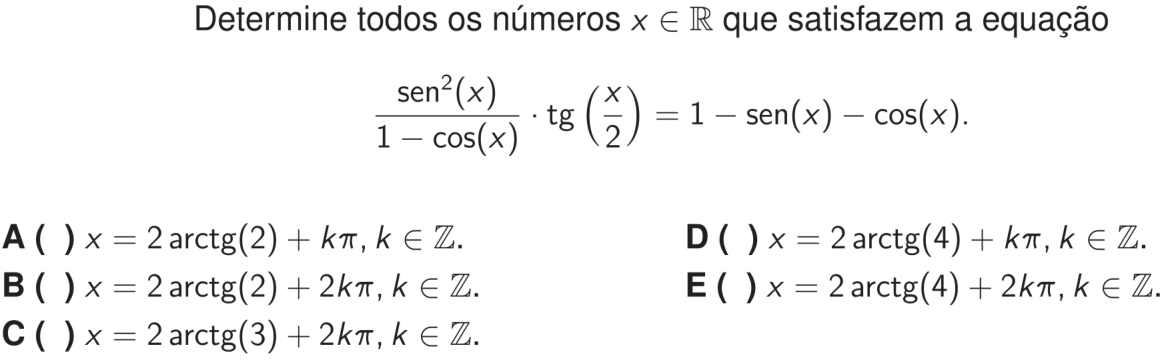
We need answer question in Portuguese. Need solve. Let's restate equation: Determine all real x satisfying
sen^2(x)/(1 - cos x) * tg(x/2) = 1 - sen x - cos x.
Options:
A x = 2 arctg(2) + kπ, k∈Z
B x = 2 arctg(2) + 2kπ
C x = 2 arctg(3) + 2kπ
D x = 2 arctg(4) + kπ
E x = 2 arctg(4) + 2kπ
Need choose correct.
We need solve carefully domain: denominator 1 - cos x !=0 => cos x !=1 => x != 2kπ. Also tg(x/2) defined => x/2 != π/2 + kπ => x != π + 2kπ? Actually tangent defined except cos(x/2)=0 => x/2 = π/2 + kπ => x = π + 2kπ. So x ≠ π + 2kπ? But tg(x/2) has period 2π? Let's see.
Equation:
sin^2 x / (1 - cos x) * tan(x/2) = 1 - sin x - cos x.
Use identity sin^2 x = 1 - cos^2 x = (1-cos x)(1+cos x). So sin^2 x/(1 - cos x)=1+cos x, provided denominator nonzero. Domain already x≠2kπ. Then LHS = (1+cos x) tan(x/2). Also tan(x/2)= sin x/(1+cos x)? Actually half-angle: tan(x/2)= sin x/(1+cos x) = (1-cos x)/sin x, for cos x ≠ -1? Actually sin x/(1+cos x) if cos x != -1; also equals (1-cos x)/sin x if sin x !=0. Since x≠π+2kπ maybe? Wait tan(x/2) defined if cos(x/2)≠0; but formula sin x/(1+cos x) has denominator 1+cos x; at x=π+2kπ, cos=-1, denominator 0, tan(x/2) undefined? tan(π/2) undefined, yes. But sin x=0 so sin x/(1+cos) 0/0; need exclude. But original tan undefined there, so domain excludes x=π+2kπ. Then LHS = (1+cos x)*(sin x/(1+cos x)) = sin x, for x where 1+cos x≠0, i.e., x≠π+2kπ. Actually equals sin x. Then equation becomes sin x = 1 - sin x - cos x => 2 sin x + cos x = 1? Wait: sin x = 1 - sin x - cos x => 2 sin x + cos x =1. Let's verify: sin x + sin x + cos x =1 => 2 sin x + cos x =1.
So need solve 2 sin x + cos x =1 with domain constraints x ≠ 2kπ and x ≠ π+2kπ? Let's solve.
2 sin x + cos x =1. Use t = tan(x/2)? Or linear combination: R = sqrt5, angle φ with cosφ=1/√5? Actually a sin x + b cos x = c. 2 sin x + cos x =1. Write √5 sin(x+α)=1 with tan α? Let's derive. 2 sin x + cos x = R sin(x+θ) where R=√(4+1)=√5, θ = arctan(1/2)? Because sin(x+θ)= sin x cos θ + cos x sin θ. Multiply R: R cosθ sin x + R sinθ cos x =2 sin x +1 cos x => R cosθ=2, R sinθ=1 => tanθ = 1/2, cosθ=2/√5, sinθ=1/√5. So θ = arctan(1/2). Equation √5 sin(x+θ)=1 => sin(x+θ)=1/√5. Then x+θ = arcsin(1/√5) + 2kπ or π - arcsin(1/√5)+2kπ. But arcsin(1/√5)=? θ=arctan(1/2). Note sinθ=1/√5. Since θ∈(0,π/2), arcsin(1/√5)=θ. So solutions:
x+θ = θ + 2kπ => x=2kπ (excluded because denominator 1-cos x=0).
or x+θ = π - θ + 2kπ => x = π - 2θ + 2kπ = π - 2 arctan(1/2)+2kπ. But π - 2 arctan(1/2) =? Is it 2 arctan(2)? Let's check: arctan(2)+? Since arctan(2)+arctan(1/2)=π/2 (for positive), so 2 arctan(2) + 2 arctan(1/2)=π => π - 2 arctan(1/2)=2 arctan(2). Yes. So x = 2 arctan(2)+2kπ. This is option B. But need check domain: x=2 arctan(2)+2kπ. Does it violate x ≠ π+2kπ? arctan(2)≈63.435°, 2θ≈126.87°, not π? Actually 2 arctan(2)≈126.87° not 180°; plus 2kπ, not π+2kπ? π≈180°, no. Also not 2kπ because 126° not 0 mod 360. So valid. Option B.
But let's be careful: Did simplification LHS = sin x valid? Original LHS = sin^2 x/(1-cos x) * tan(x/2). At x where cos x=1, denominator zero, excluded. At x where cos x=-1, sin x=0 denominator 1-cos=2? Wait sin^2 x=0, (1-cos x)=2, quotient 0; tan(x/2)=tan(π/2) undefined. So excluded. At x where sin x=0 but cos x≠1? x=π+2kπ (cos=-1) excluded due tan; x=2kπ excluded due denominator; other multiples? sin x=0 => x=kπ. k even => x=2mπ denominator zero; k odd => x=(2m+1)π = π+2mπ denominator? cos=-1 denominator 2, quotient 0; tan(x/2)=tan(π/2) undefined. So excluded. Fine.
But in solving sin x = RHS transformed to 2sin x + cos x =1. Let's verify algebra: Original: (1+cos x) tan(x/2) = 1 - sin x - cos x. tan(x/2)= sin x/(1+cos x) for x ≠ π+2kπ. Then LHS=sin x. Equation sin x = 1 - sin x - cos x => 2 sin x + cos x =1. Correct.
But wait, because tan(x/2) formula sin x/(1+cos x) maybe also valid when sin x=0? Let's see at x=π+2kπ: tan(x/2)=tan(π/2 + kπ) undefined; formula gives sin x/(1+cos x)=0/0? Actually 0/0 undefined, so not valid. But excluded. At x=0? formula 0/2=0 but tan(0)=0; okay valid. At x=π? excluded. Good.
Alternatively use t=tan(x/2). Let's solve to ensure no missing.
Let t=tan(x/2), domain t defined (x ≠ π+2kπ). sin x = 2t/(1+t^2), cos x = (1 - t^2)/(1 + t^2). Also original sin^2/(1-cos) =? sin^2 = (2t/(1+t^2))^2 =4t^2/(1+t^2)^2. 1-cos = 1 - (1-t^2)/(1+t^2)= (1+t^2 -1 + t^2)/(1+t^2)=2t^2/(1+t^2). Quotient = [4t^2/(1+t^2)^2] / [2t^2/(1+t^2)] = 2/(1+t^2), provided t≠0? t=0 => x=2kπ? Actually t=0 tan=0 => x=2kπ? But t=0 gives sin=0 cos=1 denominator zero, excluded. For t≠0. Then LHS = 2/(1+t^2) * t = 2t/(1+t^2). RHS = 1 - 2t/(1+t^2) - (1-t^2)/(1+t^2) = [1+t^2 -2t -1 + t^2]/(1+t^2)= [2t^2 -2t]/(1+t^2)=2t(t-1)/(1+t^2). Equation: 2t/(1+t^2) = 2t(t-1)/(1+t^2) => 2t = 2t(t-1) => if t≠0 (excluded), divide 2t: 1 = t - 1 => t=2. Then x/2 = arctan(2) + kπ => x = 2 arctan(2) + 2kπ? Wait tangent period π for t variable? Let's see t=tan(x/2)=2. General x/2 = arctan(2)+ kπ => x = 2 arctan(2)+2kπ. Yes. Option B. Also t=0 was excluded but check if satisfies original? x=2kπ denominator zero, no. So only B.
Need ensure no other solutions from dividing? We divided by t after excluding t=0. But t=0 corresponds x=2kπ, excluded. Good.
Option D has kπ not multiple 2; but t=2 gives x/2 = arctan2 + kπ => x = 2 arctan2 + 2kπ, not kπ. If x = 2 arctan2 + kπ? Does any odd multiple satisfy? Let's test x = 2 arctan2 + π. Then x/2 = arctan2 + π/2 => tan(x/2)=tan(arctan2+π/2)= -cot(arctan2)? Actually tan(a+π/2)= -cot a = -1/tan a = -1/2. Then t=-1/2 not 2. Would it satisfy? Let's see original? Maybe not. So only B.
Let's verify via direct substitution: x=2 arctan(2). sin x =? sin(2 arctan 2)= 2 tan/(1+tan^2)=4/(1+4)=4/5. cos=(1-tan^2)/(1+tan^2)= (1-4)/5=-3/5. Then LHS: sin^2/(1-cos) = (16/25)/(1+3/5)= (16/25)/(8/5)= (16/25)*(5/8)=80/200=2/5? Wait 16/25*5/8=80/200=2/5=0.4. tan(x/2)=tan(arctan2)=2. LHS=0.4*2=0.8=4/5=sin x. RHS=1 - 4/5 - (-3/5)=1 -0.8+0.6=0.8=4/5. Yes. Good.
Options:
A +kπ includes π? No, 2 arctan2 + π maybe? Not solution.
B +2kπ correct.
C arctg3 not.
D, E arctg4 not.
Answer B.
Need provide explanation in Portuguese. Final line "Resposta: B". Include reasoning.
A equação é
\frac{\operatorname{sen}^2 x}{1-\cos x}\cdot \operatorname{tg}\frac{x}{2}=1-\operatorname{sen}x-\cos x.
Primeiro, usamos a identidade \operatorname{sen}^2 x=(1-\cos x)(1+\cos x), válida no domínio 1-\cos x\neq 0, ou seja, x\neq 2k\pi. Assim:
\frac{\operatorname{sen}^2 x}{1-\cos x}=1+\cos x.
Além disso,
\operatorname{tg}\frac{x}{2}=\frac{\operatorname{sen}x}{1+\cos x}
no domínio em que \operatorname{tg}(x/2) está definida, isto é, x\neq \pi+2k\pi. Logo,
\frac{\operatorname{sen}^2 x}{1-\cos x}\cdot \operatorname{tg}\frac{x}{2}
= (1+\cos x)\cdot \frac{\operatorname{sen}x}{1+\cos x}
= \operatorname{sen}x.
Portanto, a equação se reduz a:
\operatorname{sen}x = 1-\operatorname{sen}x-\cos x
\Rightarrow 2\operatorname{sen}x+\cos x=1.
Agora resolvemos 2\operatorname{sen}x+\cos x=1. Escrevendo \operatorname{sen}x = \frac{2t}{1+t^2} e \cos x = \frac{1-t^2}{1+t^2}, com t=\operatorname{tg}(x/2), obtemos:
2\cdot \frac{2t}{1+t^2}+\frac{1-t^2}{1+t^2}=1
\frac{4t+1-t^2}{1+t^2}=1
4t+1-t^2 = 1+t^2
2t^2-4t=0
2t(t-2)=0.
Como t=0 implica x=2k\pi, que não pertence ao domínio, resta
t=2 \Rightarrow \operatorname{tg}\frac{x}{2}=2.
Assim,
\frac{x}{2}=\operatorname{arctg}(2)+k\pi
x=2\operatorname{arctg}(2)+2k\pi,\quad k\in\mathbb Z.
Portanto, a alternativa correta é a B.
Resposta: B
Respondeu
levou 18 s
Como pensou
**Solving the Equation**
I am currently working through the trigonometric equation involving sine, cosine, and tangent functions. My focus is on simplifying the expression and identifying the real numbers $x$ that satisfy the given condition.
Para resolver a equação dada, primeiro devemos analisar as condições de existência dos termos envolvidos para x \in \mathbb{R}:
- O denominador não pode ser nulo:
1 - \cos(x) \neq 0 \implies \cos(x) \neq 1 \implies x \neq 2k\pi, \quad k \in \mathbb{Z}
- A função tangente deve estar definida:
\frac{x}{2} \neq \frac{\pi}{2} + k\pi \implies x \neq \pi + 2k\pi, \quad k \in \mathbb{Z}
Agora, simplificamos o lado esquerdo da equação:
Lembrando que \operatorname{sen}^2(x) = 1 - \cos^2(x) = (1 - \cos(x))(1 + \cos(x)), temos:
\frac{\operatorname{sen}^2(x)}{1 - \cos(x)} = 1 + \cos(x)
Usando a identidade trigonométrica do arco metade, \operatorname{tg}\left(\frac{x}{2}\right) = \frac{\operatorname{sen}(x)}{1 + \cos(x)} (ou alternativamente, 1 + \cos(x) = 2\cos^2(x/2)):
\frac{\operatorname{sen}^2(x)}{1 - \cos(x)} \cdot \operatorname{tg}\left(\frac{x}{2}\right) = (1 + \cos(x)) \cdot \frac{\operatorname{sen}(x)}{1 + \cos(x)} = \operatorname{sen}(x)
Substituindo de volta na equação original:
\operatorname{sen}(x) = 1 - \operatorname{sen}(x) - \cos(x)
2\operatorname{sen}(x) + \cos(x) = 1
Utilizando a substituição da tangente do arco metade, t = \operatorname{tg}\left(\frac{x}{2}\right), na qual:
\operatorname{sen}(x) = \frac{2t}{1 + t^2} \quad \text{e} \quad \cos(x) = \frac{1 - t^2}{1 + t^2}
A equação se torna:
2\left(\frac{2t}{1+t^2}\right) + \frac{1-t^2}{1+t^2} = 1
\frac{4t + 1 - t^2}{1+t^2} = 1
4t + 1 - t^2 = 1 + t^2
2t^2 - 4t = 0 \implies 2t(t - 2) = 0
As soluções para t são:
- t = 0 \implies \operatorname{tg}\left(\frac{x}{2}\right) = 0 \implies \frac{x}{2} = k\pi \implies x = 2k\pi. Contudo, essa solução não satisfaz a condição de existência, pois anula o denominador 1 - \cos(x).
- t = 2 \implies \operatorname{tg}\left(\frac{x}{2}\right) = 2.
Resolvendo para x:
\frac{x}{2} = \operatorname{arctg}(2) + k\pi, \quad k \in \mathbb{Z}
x = 2\operatorname{arctg}(2) + 2k\pi, \quad k \in \mathbb{Z}
Resposta: B