Respondeu
levou 17 s
Como pensou
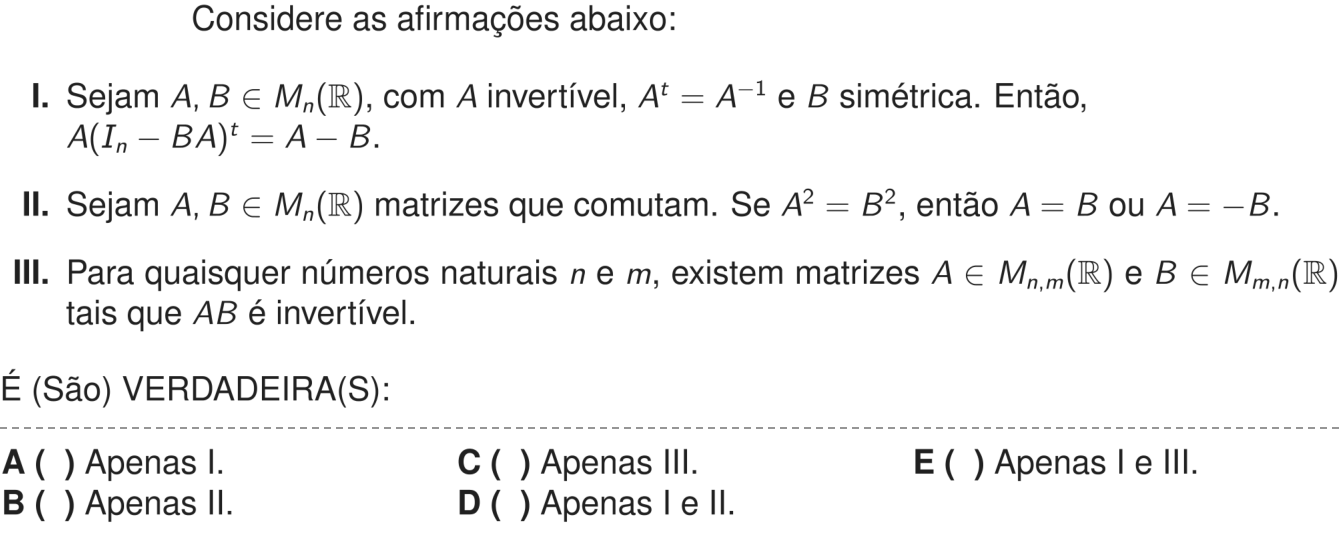
I. Verdadeira. Como B é simétrica, B^t=B. Usando também A^t=A^{-1}, temos
A(I_n-BA)^t
=A(I_n-A^tB^t)
=A-AA^{-1}B
=A-B.
II. Falsa. Considere
A=\begin{pmatrix}1&0\\0&1\end{pmatrix},
\qquad
B=\begin{pmatrix}1&0\\0&-1\end{pmatrix}.
Essas matrizes comutam e satisfazem A^2=B^2=I_2, mas A\ne B e A\ne -B. A fatoração (A-B)(A+B)=0 não obriga um dos fatores a ser a matriz nula.
III. Falsa. Se n>m, para quaisquer matrizes com as dimensões indicadas,
\operatorname{posto}(AB)\leq \operatorname{posto}(A)\leq m<n.
Logo, AB, que é uma matriz de ordem n, não pode ser invertível. Portanto, a existência afirmada não vale para quaisquer n e m.
Assim, apenas I é verdadeira.
Resposta: A
Respondeu
levou 13 s
Como pensou
**Clarifying mathematical concepts**
I need to solve a Portuguese problem about finding the transpose inverse AA t B. I notice that diag 1,1 vs 1,-1 commutes, but they aren’t equal. There's something regarding the rank being maximally m, which might lead to a false example where n2 with m1 results in an outer determinant of zero. I want to explain rank, ideally with a straightforward example to avoid any assumptions, and to ensure the computations and ranks are clear. Finally, I need to check if "A(I_n - BA)^t" is correct.
I. Verdadeira. Como B é simétrica, B^t=B. Além disso, A^t=A^{-1}. Assim,
A(I_n-BA)^t
=A(I_n-A^tB^t)
=A-AA^{-1}B
=A-B.
II. Falsa. Considere
A=\begin{pmatrix}1&0\\0&1\end{pmatrix},
\qquad
B=\begin{pmatrix}1&0\\0&-1\end{pmatrix}.
Essas matrizes comutam e satisfazem A^2=B^2=I_2, mas A\neq B e A\neq -B.
III. Falsa. Se n>m, para quaisquer matrizes A\in M_{n,m}(\mathbb R) e B\in M_{m,n}(\mathbb R),
\operatorname{posto}(AB)\leq m<n.
Logo, AB, que é uma matriz de ordem n, não pode ser invertível. Portanto, a afirmação não vale para quaisquer n e m.
Apenas a afirmação I é verdadeira.
Resposta: A
Respondeu
levou 12 s
Como pensou
I. Verdadeira. Como A^t=A^{-1} e B^t=B,
A(I_n-BA)^t
=A(I_n-A^tB^t)
=A-AA^{-1}B
=A-B.
II. Falsa. Tome A=\begin{pmatrix}1&0\\0&-1\end{pmatrix} e B=I_2. As matrizes comutam e A^2=B^2=I_2, mas A\ne B e A\ne -B.
III. Falsa. O posto de AB não pode ser maior que o posto de A, que é no máximo m. Logo, se n>m, AB não pode ter posto n e, portanto, não pode ser invertível.
Assim, apenas a afirmação I é verdadeira.
Resposta: A
Respondeu
levou 15 s
Como pensou
Checking statement I, the algebra confirms A(I−BA)^t simplifies to A−B, so it's true. For statement II, I find a counterexample with A=I and B=diag(1,-1): they commute and A²=B²=I, but A≠B and A≠−B, so it's false. Now I'm starting to examine statement III about the dimensions of AB.
Since the rank of AB is at most min(n,m), if m<n then AB can't be invertible, making statement III false too. So the answer is A.
Afirmação I: Como A^t = A^{-1} (A ortogonal) e B^t = B (B simétrica):
A(I_n - BA)^t = A\left(I_n - A^tB^t\right) = A - AA^tB = A - I_nB = A - B.
Verdadeira.
Afirmação II: Contraexemplo: A = I_2 e B = \begin{pmatrix}1 & 0\\ 0 & -1\end{pmatrix}. Elas comutam (a identidade comuta com qualquer matriz), A^2 = B^2 = I_2, mas A \neq B e A \neq -B. Falsa. (Matrizes não formam um domínio de integridade: (A-B)(A+B)=0 não implica um dos fatores nulo.)
Afirmação III: AB \in M_n(\mathbb{R}) e \text{posto}(AB) \le \min(\text{posto}(A), \text{posto}(B)) \le \min(n, m). Se m < n, então \text{posto}(AB) \le m < n, logo AB nunca é invertível. Por exemplo, n = 2, m = 1: AB é uma matriz 2\times 2 de posto no máximo 1. Falsa.
Apenas I é verdadeira.
Resposta: A
Respondeu
levou 13 s
Como pensou
Checking statement I: expanding A(I-BA)^t using the orthogonality relations confirms it equals A-B, so true. For II, a counterexample with A=I and B=diag(1,-1) shows the implication fails. For III, AB being n×n with rank bounded by m when m<n means it can't be invertible, so III is false — the answer is A.
Resposta: A (apenas I é verdadeira).
Afirmação I. Usamos (XY)ᵗ = YᵗXᵗ, Bᵗ = B e AAᵗ = AA⁻¹ = Iₙ:
A(Iₙ − BA)ᵗ = A(Iₙ − AᵗBᵗ) = A − (AAᵗ)B = A − B.
Portanto, I é verdadeira.
Afirmação II. Um contraexemplo em M₂(ℝ): A = I₂ e B = diag(1, −1).
- As duas matrizes são diagonais, logo comutam.
- A² = I₂ e B² = I₂, logo A² = B².
- Porém A ≠ B e A ≠ −B.
Portanto, II é falsa.
Afirmação III. O produto AB é uma matriz n×n, e seu posto satisfaz posto(AB) ≤ min(n, m). Se m < n, então posto(AB) ≤ m < n, e AB não pode ser invertível. Por exemplo, com n = 2 e m = 1, AB = (coluna)·(linha) tem posto no máximo 1, e seu determinante é 0.
Portanto, III é falsa.
Resposta: A
Respondeu
levou 10 s
Como pensou
Afirmação I. Como A é invertível com Aᵗ = A⁻¹, temos AAᵗ = I. Como B é simétrica, Bᵗ = B. Calculando:
(I − BA)ᵗ = I − AᵗBᵗ = I − AᵗB.
Multiplicando por A à esquerda:
A(I − AᵗB) = A − AAᵗB = A − B.
A afirmação I é verdadeira.
Afirmação II. Se A e B comutam e A² = B², então (A − B)(A + B) = A² − B² = 0. Isso não implica A = B ou A = −B, pois o produto de matrizes pode ser nulo sem que algum fator seja nulo.
Contraexemplo: A = I₂ e B = diag(1, −1). Elas comutam e A² = B² = I, mas A ≠ B e A ≠ −B.
A afirmação II é falsa.
Afirmação III. Para quaisquer n e m naturais, precisamos de A (n×m) e B (m×n) com AB (n×n) invertível. Isso exige posto n para AB, e o posto de AB é no máximo min(n, m). Se m < n, o posto de AB é no máximo m < n, e AB não é invertível. Por exemplo, n = 2 e m = 1 dá AB de posto no máximo 1, portanto singular.
A afirmação III é falsa.
Somente a I é verdadeira.
Resposta: A
Respondeu
levou 20 s
Como pensou
This is a multiple-choice matrix problem from ITA 2027.
Statement I is true. The left side simplifies to A - B using the orthogonal and symmetric properties.
Statement II is false. A counterexample with commuting matrices A and B shows that A² = B² does not imply A equals B or negative B.
Statement III is false. For AB to be invertible, the product must have full rank n. Since A is n by m and B is m by n, the rank of A cannot exceed m. If n exceeds m, the rank of AB falls below n, so the matrix cannot be invertible.
A afirmação I é verdadeira. Como A^t=A^{-1}, a matriz A é ortogonal, logo AA^t=I_n. Como B é simétrica, B^t=B. Assim,
(I_n-BA)^t=I_n-A^tB,
e portanto
A(I_n-BA)^t=A(I_n-A^tB)=A-AA^tB=A-B,
como afirmado.
A afirmação II é falsa. As matrizes
A=\begin{pmatrix}1&0\\0&-1\end{pmatrix},\qquad B=I_2
comutam e satisfazem A^2=B^2, mas A\neq B e A\neq-B.
A afirmação III é falsa. O produto AB é uma matriz n\times n. Se n>m, então \operatorname{rank}(A)\le m<n, de modo que \operatorname{rank}(AB)<n e AB não pode ser invertível.
Portanto, apenas a afirmação I é verdadeira.
Resposta: A
Respondeu
levou 8 s
Como pensou
We need answer in Portuguese, explanation, final line "Resposta: X". Need solve.
Let's parse statements.
I. Sejam A,B ∈ M_n(R), com A invertível, A^t = A^{-1} e B simétrica. Então, A(I_n - BA)^t = A - B.
Need verify. A invertible, A^t = A^{-1}, so A orthogonal? Actually A^t = A^{-1} => A A^t = I. B symmetric B^t = B. Compute left: A(I_n - BA)^t = A [I_n^t - (BA)^t] = A [I_n - A^t B^t] = A [I - A^{-1} B] = A I - A A^{-1} B = A - B. True. Good.
II. Sejam A,B ∈ M_n(R) matrizes que comutam. Se A^2 = B^2, então A = B ou A = -B.
Need determine false? Consider n=2, A = identity? A^2=I, B = [[1,0],[0,-1]]? B^2=I, A,B commute? A commutes with all. A≠B, A≠-B. So false. Actually A^2=B^2=I, but A not equal B nor -B. Also B = -? B ≠ -A? B = diag(1,-1), -A = -I = diag(-1,-1), not. So false. Also matrices may be nilpotent? But counterexample enough. So II false.
III. Para quaisquer números naturais n e m, existem matrizes A ∈ M_{n,m}(R) e B ∈ M_{m,n}(R) tais que AB é invertível.
Need check. AB is n x n. For AB invertible, rank(AB)=n. Since rank(AB) ≤ min(rank A, rank B) ≤ min(n,m). Thus need min(n,m) ≥ n => m ≥ n. But statement says "quaisquer números naturais n e m", including m < n, e.g. n=2, m=1: AB 2x2 but rank ≤ min(2,1)=1 <2 not invertible. So false. But wait natural numbers maybe positive? Yes. Statement says quaisquer n e m, so false for n > m. Thus only I true. Answer A.
Need ensure no hidden nuance: III "existem matrizes A ∈ M_{n,m}(R) e B ∈ M_{m,n}(R) tais que AB é invertível." For arbitrary n,m? If m ≥ n, yes choose A with full row rank n and B with full column rank n? Example A = [I_n 0] n x m, B = [I_n; 0] m x n => AB=I_n invertible. But if m < n impossible because rank AB ≤ m < n. Thus statement false. So only I.
Need write explanation in Portuguese.
Final line: Resposta: A.
Let's craft concise but enough.
Vamos analisar cada afirmação.
I. Temos A invertível e A^t = A^{-1}, e B simétrica, isto é, B^t = B. Calculamos:
A(I_n - BA)^t = A\left(I_n^t - (BA)^t\right)
= A\left(I_n - A^tB^t\right)
= A\left(I_n - A^{-1}B\right)
= A - AA^{-1}B = A - B.
Portanto, a afirmação I é verdadeira.
II. A afirmação é falsa. Contraexemplo:
A = \begin{pmatrix}1&0\\0&1\end{pmatrix},\quad
B = \begin{pmatrix}1&0\\0&-1\end{pmatrix}.
As matrizes comutam, e A^2 = B^2 = I_2, mas A \neq B e A \neq -B. Logo, II é falsa.
III. Para que AB seja invertível, como AB é uma matriz n\times n, é necessário que \operatorname{rank}(AB)=n. Mas
\operatorname{rank}(AB) \le \min(\operatorname{rank}A,\operatorname{rank}B) \le \min(n,m).
Se m<n, então \min(n,m)=m<n, e AB não pode ser invertível. Como o enunciado diz “quaisquer números naturais n e m”, a afirmação é falsa para m<n. Logo, III é falsa.
Assim, apenas I é verdadeira.
Resposta: A
Respondeu
levou 18 s
Como pensou
**Analyzing Matrix Statements**
I am currently evaluating the truthfulness of three propositions concerning matrices, focusing on properties like invertibility and transpose relationships. My analysis for the first statement, concerning an invertible matrix $A$ and its transpose $A^t$, is well underway.
**Proving Statement I**
I have successfully proven the first statement to be true. The key was utilizing the properties of invertible matrices and symmetric matrices to simplify the expression $A(I_n - BA)^t$. My next focus is on disproving statement II.
**Disproving Statement II**
I have definitively shown statement II to be false. By constructing a counterexample using specific matrices, I demonstrated that $A$ is neither equal to $B$ nor $-B$, thus invalidating the proposition. My attention now shifts to statement III.
**Proving Statement III**
I am now examining statement III, which posits the existence of invertible products $AB$ for any $n, m$. I've identified that if $AB$ is invertible, its rank must equal $n$. However, the rank of $AB$ is bounded by $m$, suggesting a potential contradiction when $m < n$. This line of reasoning is my current focus.
Para resolver a questão, vamos analisar cada uma das afirmações:
Afirmação I: Sejam A, B \in M_n(\mathbb{R}), com A invertível, A^t = A^{-1} e B simétrica (B^t = B).
Desenvolvendo a expressão dada:
A(I_n - BA)^t = A\left(I_n^t - (BA)^t\right)
Utilizando a propriedade da transposta de um produto,
(BA)^t = A^t B^t:
A(I_n - BA)^t = A(I_n - A^t B^t)
Como
B^t = B e
A^t = A^{-1}, temos:
A(I_n - A^{-1} B) = A \cdot I_n - A(A^{-1} B) = A - (A A^{-1}) B = A - I_n B = A - B
Portanto, a afirmação
I é verdadeira.
Afirmação II: Sejam A, B \in M_n(\mathbb{R}) matrizes que comutam. Se A^2 = B^2, então A = B ou A = -B.
Podemos testar um contraexemplo para n = 2:
Considere A = I_2 = \begin{pmatrix} 1 & 0 \\ 0 & 1 \end{pmatrix} e B = \begin{pmatrix} 1 & 0 \\ 0 & -1 \end{pmatrix}.
- Como A = I_2, temos que AB = BA = B, logo comutam.
- A^2 = I_2^2 = I_2 e B^2 = \begin{pmatrix} 1^2 & 0 \\ 0 & (-1)^2 \end{pmatrix} = I_2, logo A^2 = B^2.
- No entanto, A \neq B e A \neq -B.
Portanto, a afirmação II é falsa.
Afirmação III: Para quaisquer números naturais n e m, existem matrizes A \in M_{n,m}(\mathbb{R}) e B \in M_{m,n}(\mathbb{R}) tais que AB é invertível.
A matriz resultante do produto AB pertence a M_n(\mathbb{R}). Para que seja invertível, seu posto deve ser igual a n (\operatorname{posto}(AB) = n).
Pelas propriedades de posto do produto de matrizes:
\operatorname{posto}(AB) \le \min\{\operatorname{posto}(A), \operatorname{posto}(B)\} \le \min\{n, m\}
Se escolhermos
m < n (por exemplo,
n = 2 e
m = 1), temos:
\operatorname{posto}(AB) \le m < n
Assim, o posto de
AB será estritamente menor que
n, o que implica
\det(AB) = 0, tornando impossível que
AB seja invertível.
Portanto, a afirmação III é falsa.
Conclui-se que apenas a afirmação I é verdadeira.
Resposta: A