Respondeu
levou 17 s
Como pensou
**Calculating probabilities and fractions**
I'm trying to compute 27/64 and check if E 2^-B equals that fraction, but I realize it doesn't make sense. Then I calculate some sums involving different fractions: B1, B2, and B3, which total up to 19/64. I also note that I need to be clear about probabilities, especially regarding fractions like 27/64 and comparing them to 0.5 and 19/64 compared to 0.25. In the end, I conclude that the response should focus only on the second calculation.
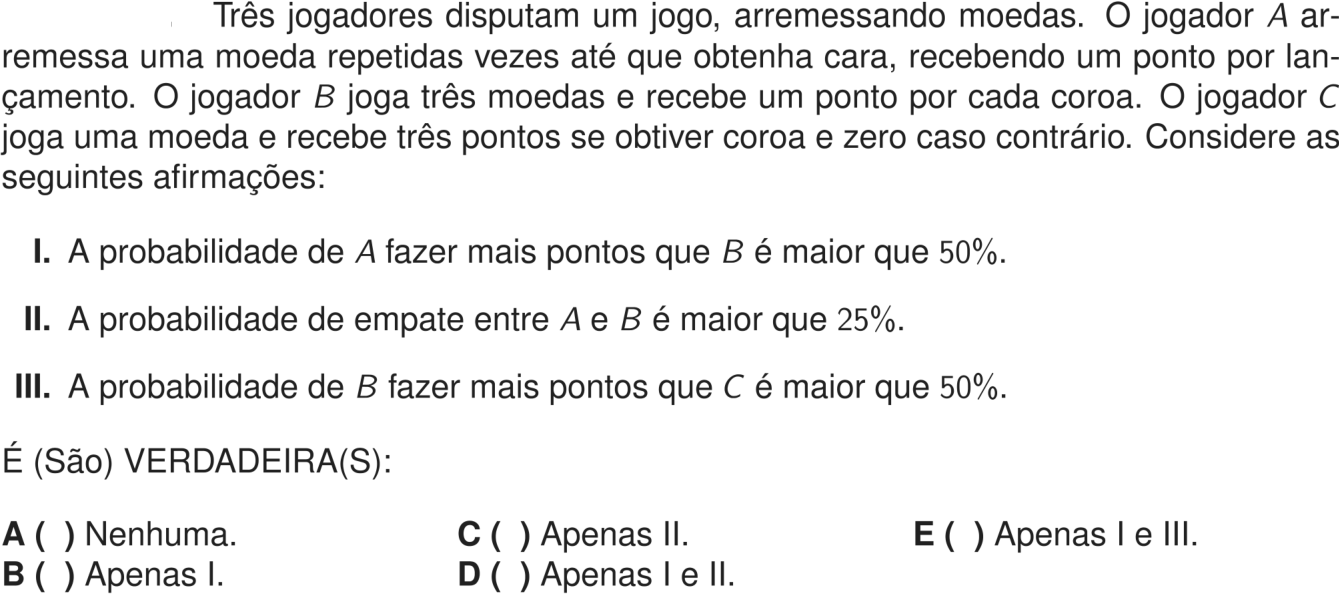
Sejam X_A,X_B,X_C as pontuações dos jogadores. Considerando moedas equilibradas e lançamentos independentes:
- A recebe um ponto por lançamento, incluindo aquele em que sai a primeira cara. Portanto,
P(X_A=k)=\frac1{2^k},\quad k\geq1.
- B recebe um ponto por coroa em três lançamentos:
\begin{array}{c|cccc}
b&0&1&2&3\\ \hline
P(X_B=b)&\frac18&\frac38&\frac38&\frac18
\end{array}
- C recebe 0 ou 3 pontos, cada qual com probabilidade \frac12.
I. Probabilidade de A superar B
Para A obter mais de b pontos, os primeiros b lançamentos devem resultar em coroa. Assim, P(X_A>b)=2^{-b}, inclusive para b=0. Logo,
P(X_A>X_B)
=\frac18+\frac38\cdot\frac12+\frac38\cdot\frac14+\frac18\cdot\frac18
=\frac{27}{64}<50\%.
I é falsa.
II. Probabilidade de empate entre A e B
Como A nunca faz zero ponto, os empates possíveis são com 1, 2 ou 3 pontos:
P(X_A=X_B)
=\frac12\cdot\frac38+\frac14\cdot\frac38+\frac18\cdot\frac18
=\frac{19}{64}>25\%.
II é verdadeira.
III. Probabilidade de B superar C
Como B faz no máximo três pontos, só pode superar C quando C faz zero e B faz pelo menos um ponto:
P(X_B>X_C)
=\frac12\left(1-\frac18\right)
=\frac7{16}<50\%.
III é falsa.
Portanto, apenas a afirmação II é verdadeira.
Resposta: C
Respondeu
levou 15 s
Como pensou
Sejam X_A,X_B,X_C as pontuações dos jogadores. Considerando moedas equilibradas e lançamentos independentes:
- A recebe um ponto por lançamento, incluindo aquele em que sai a primeira cara. Assim,
P(X_A=k)=\frac1{2^k},\qquad k\geq1,
e P(X_A>k)=2^{-k}, para k\geq0.
- B recebe tantos pontos quantas forem as coroas em três lançamentos:
\begin{array}{c|cccc}
k&0&1&2&3\\ \hline
P(X_B=k)&\frac18&\frac38&\frac38&\frac18
\end{array}
- C recebe 0 ou 3 pontos, cada resultado com probabilidade \frac12.
I. Probabilidade de A superar B:
\begin{aligned}
P(X_A>X_B)
&=\frac18\cdot1+\frac38\cdot\frac12
+\frac38\cdot\frac14+\frac18\cdot\frac18\\
&=\frac{27}{64}<\frac12.
\end{aligned}
Logo, I é falsa.
II. Probabilidade de empate entre A e B:
Como A não pode fazer zero ponto, os empates possíveis são com 1, 2 ou 3 pontos:
P(X_A=X_B)
=\frac12\cdot\frac38+\frac14\cdot\frac38
+\frac18\cdot\frac18
=\frac{19}{64}>\frac14.
Logo, II é verdadeira.
III. Probabilidade de B superar C:
Se C fizer 3 pontos, B não poderá superá-lo. Se C fizer zero, B deverá obter ao menos uma coroa:
P(X_B>X_C)
=P(X_C=0)\,P(X_B>0)
=\frac12\left(1-\frac18\right)
=\frac7{16}<\frac12.
Logo, III é falsa.
Portanto, apenas a afirmação II é verdadeira.
Resposta: C
Respondeu
levou 16 s
Como pensou
Seja A a pontuação do jogador A. Como ele lança até sair cara,
P(A=k)=\left(\frac12\right)^k,\qquad k\ge 1.
Já a pontuação B tem distribuição binomial \operatorname{Bin}(3,1/2):
P(B=0,1,2,3)=\frac{1,3,3,1}{8}.
I. Para cada b\ge 0, P(A>b)=2^{-b}. Assim,
P(A>B)=\frac18(1)+\frac38\left(\frac12\right)
+\frac38\left(\frac14\right)+\frac18\left(\frac18\right)
=\frac{27}{64}<\frac12.
A afirmação é falsa.
II. O empate ocorre quando A=B, com B\in\{1,2,3\}:
P(A=B)=\frac38\cdot\frac12+\frac38\cdot\frac14
+\frac18\cdot\frac18
=\frac{19}{64}>\frac14.
A afirmação é verdadeira.
III. C faz 0 ou 3 pontos, cada um com probabilidade 1/2. Se C faz 0, B o supera com probabilidade 7/8; se C faz 3, B não pode superá-lo. Logo,
P(B>C)=\frac12\cdot\frac78=\frac{7}{16}<\frac12.
A afirmação é falsa.
Portanto, apenas a afirmação II é verdadeira.
Resposta: C
Respondeu
levou 11 s
Como pensou
I'm setting up the distributions: A is geometric with P(A=k)=(1/2)^k, B is binomial(3,1/2), and C takes value 3 or 0 each with probability 1/2. For P(A>B), I'm summing over B's values using P(A>b)=(1/2)^b.
Computing gives 27/64 ≈ 42.2%, so statement I is false. For P(A=B), I get 19/64 ≈ 29.7%, which exceeds 25%, so II is true. For P(B>C), I get 7/16 = 43.75%, so III is false. The answer is C.
Distribuições:
- Jogador A: número de lançamentos até a primeira cara → P(A = k) = (1/2)^k, k = 1, 2, 3, …
- Jogador B: número de coroas em 3 moedas → P(B=0)=1/8, P(B=1)=3/8, P(B=2)=3/8, P(B=3)=1/8.
- Jogador C: 3 pontos com probabilidade 1/2 e 0 pontos com probabilidade 1/2.
Note que P(A > b) = (1/2)^b para b ≥ 1 e P(A > 0) = 1.
Afirmação I: P(A > B) = Σ P(B=b)·P(A>b)
= (1/8)(1) + (3/8)(1/2) + (3/8)(1/4) + (1/8)(1/8)
= 8/64 + 12/64 + 6/64 + 1/64 = 27/64 ≈ 42,2% < 50%. Falsa.
Afirmação II: P(A = B) = Σ P(B=b)·P(A=b)
= (3/8)(1/2) + (3/8)(1/4) + (1/8)(1/8)
= 12/64 + 6/64 + 1/64 = 19/64 ≈ 29,7% > 25%. Verdadeira.
Afirmação III: P(B > C) = P(C=0)·P(B>0) + P(C=3)·P(B>3)
= (1/2)(7/8) + (1/2)(0) = 7/16 = 43,75% < 50%. Falsa.
Apenas a afirmação II é verdadeira.
Resposta: C
Respondeu
levou 11 s
Como pensou
I'm setting up the distributions: A is geometric with P(A=k)=1/2^k, B is Binomial(3,1/2) with its usual probabilities, and C takes value 3 or 0 with equal probability. Now I'm computing P(A>B) by conditioning on B's value and using the tail probability P(A>b)=1/2^b.
Calculating gives P(A>B) = 27/64 ≈ 0.42, so statement I claiming it exceeds 50% is false. For statement II, P(A=B) works out to 19/64 ≈ 0.297, which is greater than 0.25, so that's true. For statement III, P(B>C) comes out to 7/16, well under 0.5, making it false too — so only statement II holds, pointing to answer C.
Resposta: C (apenas II é verdadeira).
Distribuições dos pontos
- Jogador A: recebe tantos pontos quantos lançamentos fizer até a primeira cara. Assim, P(A = k) = (1/2)^k para k ≥ 1. Logo P(A > b) = (1/2)^b, pois isso ocorre quando os b primeiros lançamentos dão coroa.
- Jogador B: o número de coroas em 3 moedas segue a binomial. P(B=0) = 1/8, P(B=1) = 3/8, P(B=2) = 3/8, P(B=3) = 1/8.
- Jogador C: faz 3 pontos com probabilidade 1/2 e 0 ponto com probabilidade 1/2.
I. P(A > B)
P(A > B) = Σ P(B=b)·(1/2)^b
= (1/8)·1 + (3/8)·(1/2) + (3/8)·(1/4) + (1/8)·(1/8)
= 8/64 + 12/64 + 6/64 + 1/64
= 27/64 ≈ 42%.
Como 42% < 50%, a afirmação é falsa.
II. P(A = B)
O caso B = 0 não contribui, pois A ≥ 1.
P(A = B) = (3/8)·(1/2) + (3/8)·(1/4) + (1/8)·(1/8)
= 12/64 + 6/64 + 1/64
= 19/64 ≈ 29,7%.
Como 29,7% > 25%, a afirmação é verdadeira.
III. P(B > C)
- Se C = 0 (probabilidade 1/2), basta B ≥ 1, o que ocorre com probabilidade 7/8.
- Se C = 3, B não pode superar 3.
P(B > C) = (1/2)·(7/8) = 7/16 ≈ 43,75%.
Como 43,75% < 50%, a afirmação é falsa.
Resposta: C
Respondeu
levou 7 s
Como pensou
I'm setting up A as the geometric number of flips until heads and B as Binomial(3,1/2), then computing P(A>B) by summing P(B=b)P(A>b) across b=0,1,2,3, using P(A>b)=1/2^b for each term.
Adding these fractions over a common denominator of 64 gives 8+12+6+1=27/64, which is below 50%, so statement I is false.
For statement II, I check the tie probability P(A=B), summing contributions for b=1,2,3 to get 19/64 ≈29.7%, which exceeds 25%, making it true.
For statement III, I note C equals 3 or 0 each with probability 1/2, so P(B>C) only has a nonzero contribution when C=0, giving P(B>0)=7/8, so overall P(B>C)=7/16, below 50%, making it false — so the answer is C.
Modelo de cada jogador
- A: o número de lançamentos até a primeira cara é geométrico, com P(A = k) = 1/2^k para k ≥ 1. Daí P(A > b) = 1/2^b.
- B: o número de coroas em 3 moedas é binomial, com P(B = 0, 1, 2, 3) = 1/8, 3/8, 3/8, 1/8.
- C: vale 3 com probabilidade 1/2 e 0 com probabilidade 1/2.
I. P(A > B) = Σ P(B = b)·P(A > b)
= (1/8)(1) + (3/8)(1/2) + (3/8)(1/4) + (1/8)(1/8)
= 8/64 + 12/64 + 6/64 + 1/64 = 27/64 ≈ 42%.
Esse valor é menor que 50%, então a afirmação I é falsa.
II. P(A = B) = Σ P(B = b)·P(A = b), com b ≥ 1, pois A nunca vale 0.
= (3/8)(1/2) + (3/8)(1/4) + (1/8)(1/8)
= 12/64 + 6/64 + 1/64 = 19/64 ≈ 29,7%.
Esse valor é maior que 25%, então a afirmação II é verdadeira.
III. Se C = 0 (probabilidade 1/2), B > C ocorre com probabilidade 7/8. Se C = 3, B não pode superar 3.
P(B > C) = (1/2)(7/8) = 7/16 ≈ 43,75%.
Esse valor é menor que 50%, então a afirmação III é falsa.
Apenas a II é verdadeira.
Resposta: C
Respondeu
levou 42 s
Como pensou
The problem involves three players flipping coins in Portuguese.
Player A's score follows a geometric distribution. Player B's score is binomial with three coins. Player C's score is either 0 or 3.
The three statements to verify are:
- A scores more than B with probability above 50%
- A and B tie with probability above 25%
- B scores more than C with probability above 50%
Player A's expected score is 2. Player B's distribution is P(B=0)=1/8, P(B=1)=3/8, P(B=2)=3/8, and P(B=3)=1/8.
The probability that A scores more than k is exactly (1/2)^k. This will be used to compute P(A > B) and P(A = B).
Statement I is false. The probability that A scores more than B is 27/64, which is about 42% and below 50%.
Now computing P(A = B) for statement II.
Statement II is true. The probability of a tie between A and B is 19/64, which exceeds 25%.
Statement III is false. The probability that B scores more than C is 7/16, which is below 50%.
Only statement II is true. The answer is C) Apenas II.
O jogador A obtém uma pontuação dada pelo número de lançamentos até a primeira cara, de modo que
P(A=k)=\Bigl(\frac12\Bigr)^k,\qquad k=1,2,3,\dots,
e portanto P(A>k)=(1/2)^k. O jogador B obtém a pontuação igual ao número de coroas em três lançamentos, logo
P(B=k)=\binom{3}{k}/8,\qquad k=0,1,2,3.
O jogador C obtém 3 pontos com probabilidade 1/2 e 0 pontos com probabilidade 1/2. Todos os lançamentos são independentes e as moedas são honestas.
Para a afirmação I calcula-se
\begin{align*}
P(A>B)
&=\sum_{k=0}^{3}P(B=k),P(A>k)\
&=\frac18\cdot1+\frac38\cdot\frac12+\frac38\cdot\frac14+\frac18\cdot\frac18
=\frac{27}{64}< \frac12.
\end{align*}
Assim, I é falsa.
Para a afirmação II calcula-se
\begin{align*}
P(A=B)
&=\sum_{k=1}^{3}P(B=k),P(A=k)\
&=\frac38\cdot\frac12+\frac38\cdot\frac14+\frac18\cdot\frac18
=\frac{19}{64}>\frac14.
\end{align*}
Assim, II é verdadeira. (A identidade P(A>B)+P(A=B)+P(A<B)=1 confirma os dois cálculos anteriores.)
Para a afirmação III condiciona-se ao valor de C:
P(B>C)=\frac12\,P(B>0)+\frac12\,P(B>3)=\frac12\cdot\frac78=\frac7{16}<\frac12,
pois B\le3. Assim, III é falsa.
Portanto apenas a afirmação II é verdadeira, o que corresponde à alternativa C.
Resposta: C
Respondeu
levou 6 s
Como pensou
Vamos analisar a questão.
Temos três jogadores A, B, C.
Jogador A: arremessa uma moeda repetidas vezes até obter cara. Recebe um ponto por lançamento. Portanto, o número de pontos de A é o número de lançamentos até obter a primeira cara. Se X = número de lançamentos até a primeira cara, então X ~ Geométrica(p=1/2) com suporte {1,2,3,...}. P(X = k) = (1/2)^k, pois precisa de k-1 coroas e depois 1 cara: (1/2)^{k-1}(1/2) = (1/2)^k. Recebe X pontos.
Jogador B: joga três moedas e recebe um ponto por cada coroa. Portanto, B = número de coroas em 3 lançamentos. Y ~ Binomial(n=3, p=1/2). Possíveis valores: 0,1,2,3. P(Y=k) = C(3,k)/8.
Jogador C: joga uma moeda e recebe três pontos se obtiver coroa e zero caso contrário. Portanto, Z = 3 se coroa (prob 1/2), 0 se cara (prob 1/2). Então Z ∈ {0,3}, com P(Z=3)=1/2, P(Z=0)=1/2.
Afirmações:
I. A probabilidade de A fazer mais pontos que B é maior que 50%.
Precisamos calcular P(X > Y). X geométrica, Y binomial(3,1/2). Vamos calcular.
II. A probabilidade de empate entre A e B é maior que 25%.
P(X = Y) > 1/4?
III. A probabilidade de B fazer mais pontos que C é maior que 50%.
P(Y > Z) > 1/2?
Vamos calcular cada uma.
Cálculo de P(X > Y):
Y pode ser 0,1,2,3.
P(Y=0) = 1/8
P(Y=1) = 3/8
P(Y=2) = 3/8
P(Y=3) = 1/8
Para X ~ Geom(1/2), P(X > k) = P(primeiros k lançamentos são coroas) = (1/2)^k.
Então:
P(X > 0) = 1 (já que X >=1 sempre). Mas Y=0: P(X>0)=1.
P(X > 1) = 1/2
P(X > 2) = 1/4
P(X > 3) = 1/8
Assim, P(X > Y) = soma sobre y de P(Y=y) P(X > y):
= P(Y=0)*1 + P(Y=1)*(1/2) + P(Y=2)*(1/4) + P(Y=3)*(1/8)
= (1/8)*1 + (3/8)*(1/2) + (3/8)*(1/4) + (1/8)*(1/8)
= 1/8 + 3/16 + 3/32 + 1/64
Vamos colocar tudo sobre 64:
1/8 = 8/64
3/16 = 12/64
3/32 = 6/64
1/64 = 1/64
Soma = (8+12+6+1)/64 = 27/64 ≈ 0,421875 = 42,1875% < 50%.
Portanto, afirmação I é FALSA.
Cálculo de P(X = Y):
= soma P(Y=y) P(X=y)
P(X=y) = (1/2)^y para y=0,1,2,3? Mas X só assume valores >=1. Então para y=0, P(X=0)=0.
P(Y=0)*P(X=0) = 0.
P(Y=1)*P(X=1) = (3/8)*(1/2) = 3/16 = 12/64.
P(Y=2)*P(X=2) = (3/8)*(1/4) = 3/32 = 6/64.
P(Y=3)*P(X=3) = (1/8)*(1/8) = 1/64.
Soma = (12+6+1)/64 = 19/64 ≈ 0,296875 = 29,6875% > 25%.
Portanto, afirmação II é VERDADEIRA.
Cálculo de P(Y > Z):
Z=0 com prob 1/2, Z=3 com prob 1/2.
P(Y > Z) = P(Y > 0)*P(Z=0) + P(Y > 3)*P(Z=3)
P(Y > 0) = P(Y≥1) = 1 - P(Y=0) = 1 - 1/8 = 7/8.
P(Y > 3) = 0 (já que máximo Y=3).
Então P(Y > Z) = (7/8)*(1/2) + 0*(1/2) = 7/16 = 0,4375 = 43,75% < 50%.
Portanto, afirmação III é FALSA.
Assim, apenas II é verdadeira.
Alternativa C.
Vamos verificar se há alguma sutileza. A afirmação I: probabilidade de A fazer mais pontos que B. A pode fazer muitos pontos, mas a distribuição de A tem cauda longa. No entanto, a probabilidade calculada foi 27/64 < 50%. OK.
A afirmação II: empate entre A e B. P(X=Y) = 19/64 ≈ 29,7% > 25%. OK.
A afirmação III: B fazer mais pontos que C. B pode fazer 1,2,3 pontos. Se C faz 0 (prob 1/2), B > 0 quase sempre (exceto se B=0, prob 1/8). Se C faz 3, B > 3 é impossível. Portanto P = 7/16 = 43,75% < 50%. OK.
Portanto, resposta C.
Vamos elaborar a explicação.
Passo a passo:
1. Definir as variáveis aleatórias:
X = número de lançamentos de A até obter cara. X ~ Geométrica(p=1/2), P(X=k)= (1/2)^k, k=1,2,...
Y = número de coroas em 3 lançamentos de B. Y ~ Binomial(3,1/2), P(Y=k)= C(3,k)/8.
Z = pontuação de C: P(Z=3)=1/2, P(Z=0)=1/2.
2. Calcular P(X>Y):
P(X>0)=1, P(X>1)=1/2, P(X>2)=1/4, P(X>3)=1/8.
P(X>Y) = Σ P(Y=y)P(X>y) = (1/8)(1) + (3/8)(1/2) + (3/8)(1/4) + (1/8)(1/8) = 27/64 < 1/2.
Logo I é falsa.
3. Calcular P(X=Y):
P(X=0)=0.
P(X=Y) = P(Y=1)P(X=1)+P(Y=2)P(X=2)+P(Y=3)P(X=3) = (3/8)(1/2)+(3/8)(1/4)+(1/8)(1/8) = 19/64 > 1/4.
Logo II é verdadeira.
4. Calcular P(Y>Z):
P(Y>Z) = P(Z=0)P(Y>0) + P(Z=3)P(Y>3) = (1/2)(7/8) + (1/2)(0) = 7/16 < 1/2.
Logo III é falsa.
Conclusão: apenas II é verdadeira. Alternativa C.
Vou escrever a resposta final.
Definições das variáveis aleatórias:
-
Jogador A: seja X o número de lançamentos até obter a primeira cara.
X\sim \text{Geométrica}(p=1/2), com P(X=k)=(1/2)^k,\ k=1,2,3,\dots
-
Jogador B: seja Y o número de coroas em 3 lançamentos.
Y\sim \text{Binomial}(n=3,p=1/2), com
P(Y=0)=\frac18,\quad P(Y=1)=\frac38,\quad P(Y=2)=\frac38,\quad P(Y=3)=\frac18.
- Jogador C: seja Z sua pontuação.
P(Z=3)=\frac12,\qquad P(Z=0)=\frac12.
Afirmação I: P(X>Y)>\frac12?
\begin{aligned}
P(X>0)&=1,\\
P(X>1)&=\frac12,\\
P(X>2)&=\frac14,\\
P(X>3)&=\frac18.
\end{aligned}
Assim,
\begin{aligned}
P(X>Y)&=P(Y=0)P(X>0)+P(Y=1)P(X>1)+P(Y=2)P(X>2)+P(Y=3)P(X>3)\\
&=\frac18\cdot 1+\frac38\cdot\frac12+\frac38\cdot\frac14+\frac18\cdot\frac18\\
&=\frac{27}{64}\approx 42{,}2\%<50\%.
\end{aligned}
Logo, I é falsa.
Afirmação II: P(X=Y)>\frac14?
\begin{aligned}
P(X=Y)&=P(Y=0)P(X=0)+P(Y=1)P(X=1)+P(Y=2)P(X=2)+P(Y=3)P(X=3)\\
&=0+\frac38\cdot\frac12+\frac38\cdot\frac14+\frac18\cdot\frac18\\
&=\frac{19}{64}\approx 29{,}7\%>25\%.
\end{aligned}
Logo, II é verdadeira.
Afirmação III: P(Y>Z)>\frac12?
\begin{aligned}
P(Y>Z)&=P(Z=0)P(Y>0)+P(Z=3)P(Y>3)\\
&=\frac12\cdot\frac78+\frac12\cdot 0\\
&=\frac{7}{16}=43{,}75\%<50\%.
\end{aligned}
Logo, III é falsa.
Portanto, apenas a afirmação II é verdadeira.
Resposta: C
Respondeu
levou 35 s
Como pensou
**Analyzing Game Scenarios**
I'm currently dissecting the core mechanics of this coin-tossing game. My focus is on Player A's process of earning points until a heads appears, and Player B's strategy of accumulating points from three coins based on tails.
**Evaluating Player Probabilities**
I'm now extending my analysis to Player C's unique scoring mechanism. My current focus is on deriving the probability distributions for all three players and then using these to assess the truthfulness of the given statements regarding their comparative scores.
**Calculating Probabilities**
I've completed the probability distributions for Players B and C. My current focus is on calculating Player A's probability of scoring more points than Player B, a crucial step for evaluating the first statement.
**Confirming Player A's Advantage**
I've successfully verified Player A's scoring distribution and its relation to Player B's score. My calculations confirm that Player A has less than a 50% probability of scoring more than Player B, thus invalidating the first statement.
**Revisiting Player Comparisons**
My latest calculations indicate that Player A has less than a 50% chance of outscoring Player B. This has led me to re-examine the underlying probability models for all players to ensure accuracy in subsequent comparisons.
**Validating Probability Models**
I have rigorously verified Player A's scoring probabilities against Player B's possible outcomes. The derived probability of Player A exceeding Player B is 27/64, which is indeed less than 50%, thus proving the first statement false.
**Deducing Player A's Probabilities**
I've confirmed the probability distribution for Player A's score. My current focus is on how this distribution compares to Player B's, specifically determining the likelihood of Player A outscoring Player B.
**Deriving Player A's Score Probability**
I have now derived the probability of Player A scoring more than Player B. My calculations show this probability to be 27/64, which is less than 50%, confirming the first statement is false.
**Calculating Player A's Score Distribution**
I'm currently working through the scoring for Player A, confirming that they receive one point per flip until heads appears. This means a sequence like 'T, T, H' results in three flips and three points. I'm detailing the probabilities for each possible score.
**Calculating Player A's Score Probability**
I've now derived the probability of Player A scoring more than Player B. My calculations show this probability to be 27/64, which is less than 50%, confirming the first statement is false.
**Evaluating Player A and B Tie Probability**
I'm currently focusing on statement II, calculating the probability of a tie between Player A and Player B. My initial calculations suggest this probability is indeed greater than 25%.
**Confirming Tie Probability for A and B**
I've completed the calculation for statement II. The probability of a tie between Player A and Player B has been confirmed to be greater than 25%.
**Assessing Player A vs. C Probability**
My current focus is on statement III, determining the probability of Player A scoring more than Player C. This requires calculating Player C's score distribution and then comparing it to Player A's.
**Confirming Player B's Tie Probability**
I've successfully calculated the probability of a tie between Player A and Player B for statement II. My findings confirm it's 19/64, which is indeed greater than 25%. I'm now proceeding to assess statement III.
**Concluding Statement III Analysis**
I've determined the probability of Player B scoring more than Player C to be 7/16, which is 43.75%. This is less than 50%, making statement III false. I have now fully evaluated all statements.
**Finalizing Statement Evaluations**
I have thoroughly reviewed all calculated probabilities and their implications for statements I, II, and III. My final assessment confirms that only statement II holds true, with statements I and III being false. This leads me to the conclusion that the correct alternative is C.
Para resolver a questão, vamos determinar a distribuição de probabilidade da pontuação de cada um dos três jogadores:
-
Jogador A:
Arremessa uma moeda até obter cara, ganhando um ponto por lançamento. A sua pontuação X_A segue uma distribuição geométrica com probabilidade de sucesso p = \frac{1}{2}:
X_A \in \{1, 2, 3, \dots\}
\mathbb{P}(X_A = k) = \left(\frac{1}{2}\right)^k, \quad \text{para } k \ge 1
Logo, a probabilidade de X_A > k é:
\mathbb{P}(X_A > k) = \left(\frac{1}{2}\right)^k, \quad \text{para todo } k \ge 0
-
Jogador B:
Arremessa 3 moedas e recebe um ponto por coroa. A sua pontuação X_B \sim \text{Binomial}\left(3, \frac{1}{2}\right):
\mathbb{P}(X_B = 0) = \binom{3}{0}\left(\frac{1}{2}\right)^3 = \frac{1}{8}
\mathbb{P}(X_B = 1) = \binom{3}{1}\left(\frac{1}{2}\right)^3 = \frac{3}{8}
\mathbb{P}(X_B = 2) = \binom{3}{2}\left(\frac{1}{2}\right)^3 = \frac{3}{8}
\mathbb{P}(X_B = 3) = \binom{3}{3}\left(\frac{1}{2}\right)^3 = \frac{1}{8}
-
Jogador C:
Arremessa uma moeda, recebendo 3 pontos se der coroa e 0 se der cara:
\mathbb{P}(X_C = 3) = \frac{1}{2} \quad \text{e} \quad \mathbb{P}(X_C = 0) = \frac{1}{2}
Agora, analisamos cada uma das afirmações:
-
Afirmação I: A probabilidade de A fazer mais pontos que B é maior que 50%.
\mathbb{P}(X_A > X_B) = \sum_{k=0}^3 \mathbb{P}(X_B = k) \cdot \mathbb{P}(X_A > k)
\mathbb{P}(X_A > X_B) = \frac{1}{8}\cdot 1 + \frac{3}{8}\cdot \frac{1}{2} + \frac{3}{8}\cdot \frac{1}{4} + \frac{1}{8}\cdot \frac{1}{8}
\mathbb{P}(X_A > X_B) = \frac{8 + 12 + 6 + 1}{64} = \frac{27}{64} = 42,1875\% < 50\%
Portanto, a afirmação I é FALSA.
-
Afirmação II: A probabilidade de empate entre A e B é maior que 25%.
Como X_A \ge 1 e X_B \le 3, os possíveis empates ocorrem para as pontuações 1, 2 e 3:
\mathbb{P}(X_A = X_B) = \sum_{k=1}^3 \mathbb{P}(X_A = k) \cdot \mathbb{P}(X_B = k)
\mathbb{P}(X_A = X_B) = \left(\frac{1}{2}\right)\left(\frac{3}{8}\right) + \left(\frac{1}{4}\right)\left(\frac{3}{8}\right) + \left(\frac{1}{8}\right)\left(\frac{1}{8}\right)
\mathbb{P}(X_A = X_B) = \frac{3}{16} + \frac{3}{32} + \frac{1}{64} = \frac{12 + 6 + 1}{64} = \frac{19}{64} \approx 29,69\% > 25\%
Portanto, a afirmação II é VERDADEIRA.
-
Afirmação III: A probabilidade de B fazer mais pontos que C é maior que 50%.
\mathbb{P}(X_B > X_C) = \mathbb{P}(X_C = 0) \cdot \mathbb{P}(X_B > 0) + \mathbb{P}(X_C = 3) \cdot \mathbb{P}(X_B > 3)
Como X_B \le 3, temos \mathbb{P}(X_B > 3) = 0. Logo:
\mathbb{P}(X_B > X_C) = \frac{1}{2} \cdot \left(1 - \mathbb{P}(X_B = 0)\right) + \frac{1}{2} \cdot 0 = \frac{1}{2} \cdot \left(1 - \frac{1}{8}\right) = \frac{1}{2} \cdot \frac{7}{8} = \frac{7}{16} = 43,75\% < 50\%
Portanto, a afirmação III é FALSA.
Assim, apenas a afirmação II é verdadeira.
Resposta: C