Correção UNICAMP 2027Confira as respostas e a resolução de cada questão da 1ª faseVer a correção
IA ao vivo / ITA 2027 · 1ª fase

COMPARE OS RACIOCÍNIOS

Questão 20

Gabarito oficial: D. ← 19 21 →

A questão

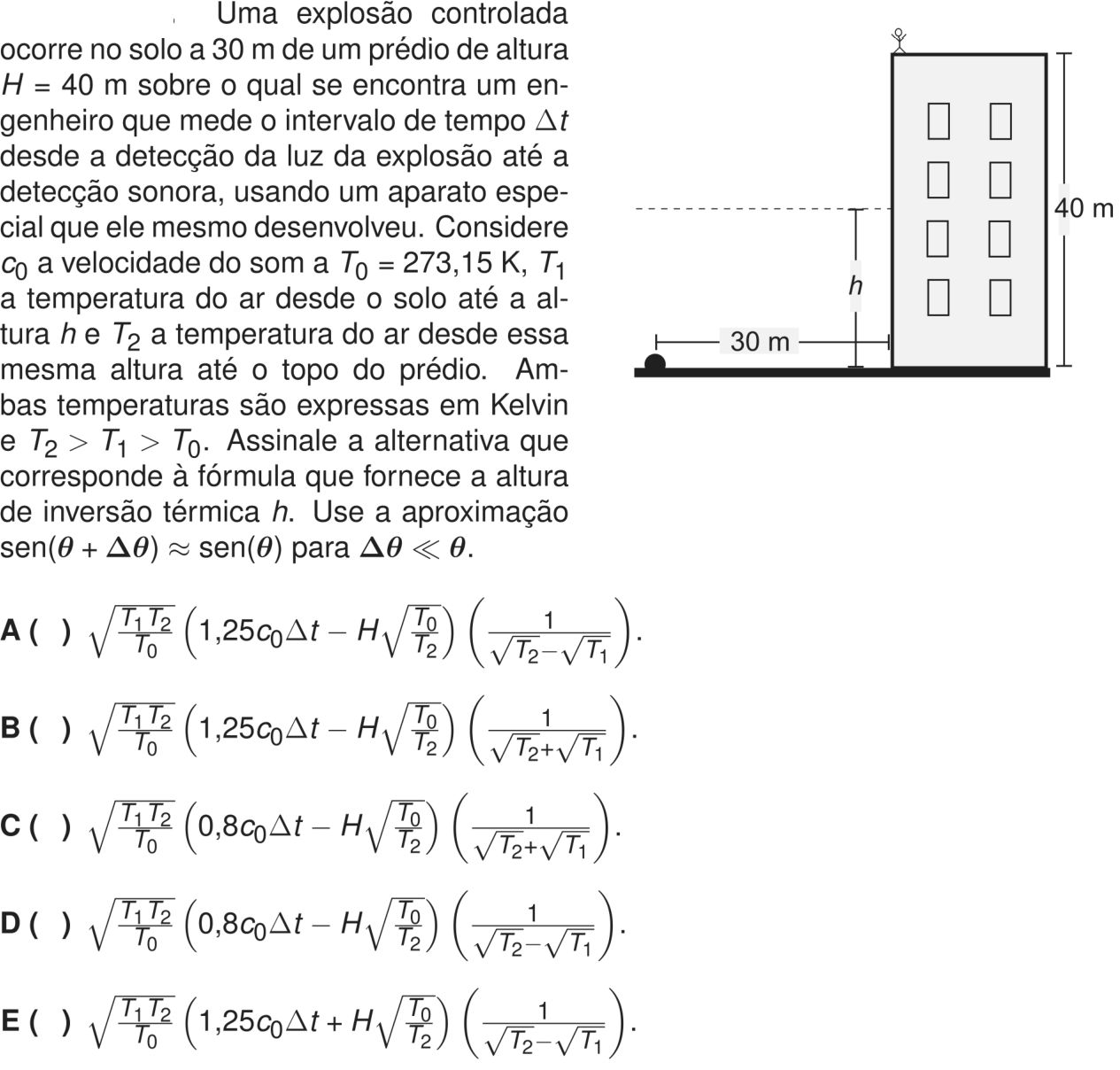
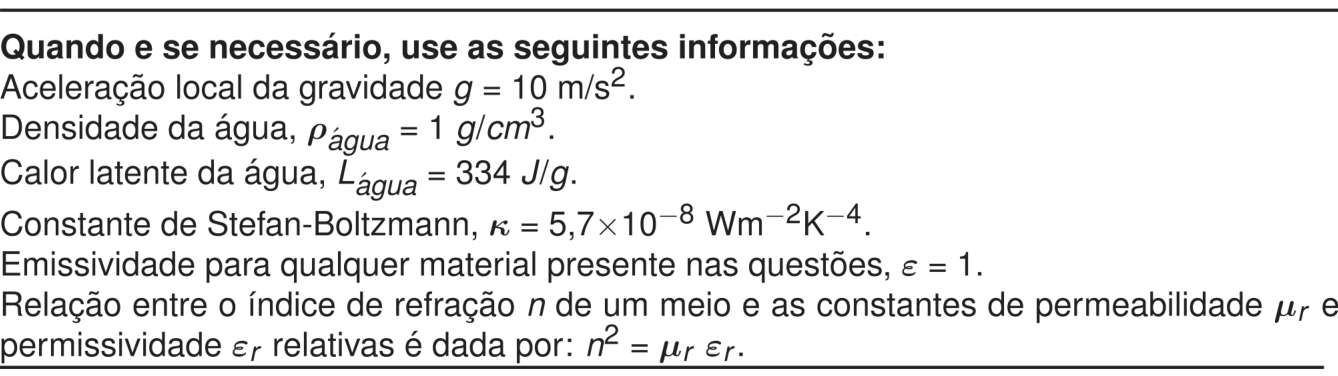
Texto de apoio da questão 20 Questão 20

Respostas das IAs

GPT-6 Astra

D

Respondeu

levou 26 s

Como pensou
**Analyzing refraction and equations** I want to check if there's a deeper trap regarding sine approximations and incident angles in refraction, where 'c' equals a straight ray. My explanation focuses on the angular approximation for sound to be almost linear. I think we should steer clear of using the same angle since there's no specific Δ to follow. I’ll incorporate triangle values and expand the needed equations, making sure everything matches at the end without any uncertainties in the calculations.

A velocidade do som no ar é proporcional à raiz quadrada da temperatura absoluta. Assim, nas duas camadas,

c_1=c_0\sqrt{\frac{T_1}{T_0}}, \qquad c_2=c_0\sqrt{\frac{T_2}{T_0}}.

Como o tempo de propagação da luz é desprezível, \Delta t corresponde aproximadamente ao tempo de percurso do som.

Usando a aproximação angular indicada, tratamos os dois trechos do percurso sonoro como tendo aproximadamente a mesma inclinação \theta em relação ao solo. Pela geometria,

\sin\theta=\frac{40}{\sqrt{30^2+40^2}}=\frac{40}{50}=0{,}8.

Logo, os comprimentos percorridos nas camadas inferior e superior são, respectivamente,

\ell_1=\frac{h}{0{,}8}, \qquad \ell_2=\frac{H-h}{0{,}8}.

Somando os tempos de propagação:

\Delta t=\frac{\ell_1}{c_1}+\frac{\ell_2}{c_2} =\frac{1}{0{,}8c_0} \left[h\sqrt{\frac{T_0}{T_1}}+(H-h)\sqrt{\frac{T_0}{T_2}}\right].

Reorganizando,

0{,}8c_0\Delta t-H\sqrt{\frac{T_0}{T_2}} =h\left(\sqrt{\frac{T_0}{T_1}}-\sqrt{\frac{T_0}{T_2}}\right).

Portanto,

\boxed{ h=\sqrt{\frac{T_1T_2}{T_0}} \left(0{,}8c_0\Delta t-H\sqrt{\frac{T_0}{T_2}}\right) \frac{1}{\sqrt{T_2}-\sqrt{T_1}} }.

Resposta: D

GPT-6.1 Sol

D

Respondeu

levou 16 s

Como pensou

A velocidade do som no ar é proporcional à raiz quadrada da temperatura absoluta. Portanto, nas duas camadas,

c_1=c_0\sqrt{\frac{T_1}{T_0}}, \qquad c_2=c_0\sqrt{\frac{T_2}{T_0}}.

O tempo de propagação da luz é desprezível em comparação ao do som, de modo que \Delta t corresponde, aproximadamente, ao tempo de percurso do som.

Na aproximação indicada, desprezamos a pequena mudança de direção do raio sonoro na passagem entre as camadas. Assim, seu percurso é aproximadamente a reta que liga a explosão ao topo do prédio, cujo comprimento é

L=\sqrt{30^2+40^2}=50\ \text{m}.

Se \theta é o ângulo dessa reta com a horizontal,

\sen\theta=\frac{40}{50}=0,8.

Logo, os comprimentos percorridos nas camadas inferior e superior são, respectivamente,

\ell_1=\frac{h}{0,8}, \qquad \ell_2=\frac{H-h}{0,8}.

Somando os tempos de percurso:

\Delta t=\frac{h}{0,8c_1}+\frac{H-h}{0,8c_2}.

Substituindo as velocidades e reorganizando,

0,8c_0\Delta t =h\sqrt{\frac{T_0}{T_1}} +(H-h)\sqrt{\frac{T_0}{T_2}},
h\left(\sqrt{\frac{T_0}{T_1}}-\sqrt{\frac{T_0}{T_2}}\right) =0,8c_0\Delta t-H\sqrt{\frac{T_0}{T_2}}.

Como

\sqrt{\frac{T_0}{T_1}}-\sqrt{\frac{T_0}{T_2}} =\sqrt{\frac{T_0}{T_1T_2}}\left(\sqrt{T_2}-\sqrt{T_1}\right),

obtemos

\boxed{ h=\sqrt{\frac{T_1T_2}{T_0}} \left(0,8c_0\Delta t-H\sqrt{\frac{T_0}{T_2}}\right) \frac{1}{\sqrt{T_2}-\sqrt{T_1}} }.

Resposta: D

GPT-6 Luna

D

Respondeu

levou 24 s

Como pensou
**Evaluating the equation** I see that the given equation involves h = sqrt(T1T2/T0)*(...) /(sqrtT2-sqrtT1). The denominator relates to the difference in speeds. It seems I can solve for time and path lengths through horizontal projections and approximate angles. There’s clearly a lot to unpack here! I’ll need to ensure I’m using the right approach for the calculations to make sense of it all. Let's take a closer look to clarify how it all fits together.

A velocidade do som em cada camada é dada por

c_1=c_0\sqrt{\frac{T_1}{T_0}} \qquad\text{e}\qquad c_2=c_0\sqrt{\frac{T_2}{T_0}}.

A distância direta entre a explosão e o engenheiro é

\sqrt{30^2+40^2}=50\ \text{m}.

Assim, para o ângulo \theta da trajetória de referência com a horizontal,

\sen\theta=\frac{40}{50}=0{,}8.

Pela aproximação indicada, usamos esse mesmo valor para os trechos nas duas camadas. Portanto, seus comprimentos são aproximadamente s_1=h/0{,}8 e s_2=(H-h)/0{,}8.

Desprezando o tempo de propagação da luz, o intervalo medido é o tempo de percurso do som:

\Delta t=\frac{s_1}{c_1}+\frac{s_2}{c_2} =\frac{1{,}25\sqrt{T_0}}{c_0} \left(\frac{h}{\sqrt{T_1}}+\frac{H-h}{\sqrt{T_2}}\right).

Isolando h,

h= \sqrt{\frac{T_1T_2}{T_0}}\, \frac{0{,}8c_0\Delta t-H\sqrt{T_0/T_2}} {\sqrt{T_2}-\sqrt{T_1}}.

Essa expressão corresponde à alternativa D.

Resposta: D

Claude Fable 5.1

D

Respondeu

levou 17 s

Como pensou
I'm setting up the geometry: the explosion sits 30 m horizontally from the building, with the top at height 40 m, giving a straight-line path of 50 m. Since refraction is negligible, I can treat the sound as traveling straight, so the portion of that path through the lower layer of height h scales proportionally as 50·(h/40). Now I'm relating sound speed to temperature via c = c0√(T/T0) in each layer, writing the total travel time as the sum of the lower and upper path lengths divided by their respective speeds. Solving this equation for h algebraically, isolating it on one side, I get h = √(T1T2/T0)/(√T2−√T1) · [0.8c0Δt − H√(T0/T2)], which matches option D.

Geometria do problema

A explosão ocorre a 30 m da base de um prédio de 40 m; a distância da explosão ao engenheiro (topo) é a hipotenusa:

d=\sqrt{30^2+40^2}=50\ \text{m}.

Com a aproximação \operatorname{sen}(\theta+\Delta\theta)\approx\operatorname{sen}\theta, a refração do som na interface entre as camadas é desprezível e o som percorre uma reta. Por semelhança de triângulos, o trecho da reta dentro da camada inferior (altura h) tem comprimento

d_1 = 50\cdot\frac{h}{40}=1{,}25\,h,\qquad d_2 = 1{,}25\,(H-h).

Velocidade do som

Como c\propto\sqrt{T}:

c_1=c_0\sqrt{\frac{T_1}{T_0}},\qquad c_2=c_0\sqrt{\frac{T_2}{T_0}}.

Intervalo de tempo (a luz chega praticamente instantaneamente):

\Delta t=\frac{1{,}25\,h}{c_1}+\frac{1{,}25\,(H-h)}{c_2} =\frac{1{,}25\sqrt{T_0}}{c_0}\left[\frac{h}{\sqrt{T_1}}+\frac{H-h}{\sqrt{T_2}}\right].

Isolando h:

\frac{0{,}8\,c_0\Delta t}{\sqrt{T_0}}-\frac{H}{\sqrt{T_2}} = h\left(\frac{1}{\sqrt{T_1}}-\frac{1}{\sqrt{T_2}}\right) = h\,\frac{\sqrt{T_2}-\sqrt{T_1}}{\sqrt{T_1T_2}}
h=\sqrt{\frac{T_1T_2}{T_0}}\left(0{,}8\,c_0\Delta t-H\sqrt{\frac{T_0}{T_2}}\right)\frac{1}{\sqrt{T_2}-\sqrt{T_1}}.

Isso corresponde exatamente à alternativa D.

Resposta: D

Claude Opus 5.5

D

Respondeu

levou 15 s

Como pensou
I'm setting up the geometry: the sound travels a straight-line path with sinθ = 40/50 = 0.8, giving path lengths of h/0.8 through the first layer and (H-h)/0.8 through the second. Since the speed scales as c0√(T/T0), I need to combine these path lengths with the temperature-dependent speeds to get the total travel time. Solving for h algebraically, isolating it on one side after substituting the speed expressions, I get h = √(T1T2/T0) · (0.8c0Δt − H√(T0/T2)) / (√T2 − √T1), matching answer D.

Resposta: D

Ideia central: o som sobe por camadas de temperaturas diferentes. Por isso sua velocidade muda com a altura, e o tempo total depende da altura h da interface. O intervalo Δt medido pelo engenheiro é, na prática, o tempo de percurso do som.

1. Trajetória

Pela aproximação dada, sen(θ + Δθ) ≈ sen θ, a refração na interface desvia muito pouco o raio sonoro. A trajetória pode então ser tratada como a reta que liga a explosão ao topo do prédio.

  • Distância horizontal: 30 m. Altura: 40 m. Comprimento da trajetória: 50 m.
  • Ângulo com a horizontal: sen θ = 40/50 = 0,8.

Um trecho vertical Δy corresponde a um percurso Δy/0,8 = 1,25·Δy. Assim:

  • na camada 1 (do solo até h), o percurso vale 1,25h;
  • na camada 2 (de h até o topo), o percurso vale 1,25(H − h).

2. Velocidade do som

A velocidade do som no ar é proporcional à raiz da temperatura absoluta:

c = c₀·√(T/T₀)

3. Tempo de percurso

A luz chega praticamente de forma instantânea. Logo:

Δt = 1,25h / [c₀√(T₁/T₀)] + 1,25(H − h) / [c₀√(T₂/T₀)]

Multiplicando ambos os lados por c₀/1,25 = 0,8c₀:

0,8c₀Δt = √T₀ · [h/√T₁ + (H − h)/√T₂]

0,8c₀Δt = h√T₀ · (1/√T₁ − 1/√T₂) + H√(T₀/T₂)

4. Isolando h

Usando 1/√T₁ − 1/√T₂ = (√T₂ − √T₁)/√(T₁T₂):

h·√T₀·(√T₂ − √T₁)/√(T₁T₂) = 0,8c₀Δt − H√(T₀/T₂)

Portanto:

h = √(T₁T₂/T₀) · (0,8c₀Δt − H√(T₀/T₂)) · 1/(√T₂ − √T₁)

Essa expressão é a da alternativa D.

Resposta: D

Claude Sonnet 5.5

D

Respondeu

levou 9 s

Como pensou
I'm setting up the geometry: explosion at ground level 30 m from a 40 m building, with two atmospheric layers of different temperatures (and thus sound speeds) separated at height h. Applying Snell's law for sound refraction at the layer interface, I'm trying to relate the ray angles using sinθ1/c1 = sinθ2/c2, and considering whether the path from source to building top can be approximated as nearly straight. I'm working through the travel time equation by splitting the straight-line path into segments through each temperature layer, using the sound speed formula c = c0√(T/T0), then solving for h in terms of the given time delay, temperatures, and building height — arriving at an expression matching answer choice D.

Modelo. A luz chega praticamente de forma instantânea, então Δt é o tempo de percurso do som. A aproximação sen(θ+Δθ) ≈ sen θ indica que a refração na interface é desprezível, e o raio sonoro pode ser tratado como a reta que liga a explosão ao topo do prédio.

Geometria. O percurso horizontal é 30 m e a altura é 40 m, então o comprimento total é 50 m. Assim sen θ = 30/50 = 0,6 e cos θ = 0,8, com θ medido em relação à vertical. O trecho percorrido numa camada de espessura e é e/cos θ = 1,25 e.

Velocidades do som. Como c = c₀√(T/T₀), temos c₁ = c₀√(T₁/T₀) na camada de 0 a h e c₂ = c₀√(T₂/T₀) na camada de h a H.

Tempo de percurso.

Δt = 1,25h/c₁ + 1,25(H − h)/c₂

Multiplicando por 0,8c₀:

0,8c₀Δt = h√(T₀/T₁) + (H − h)√(T₀/T₂)

Isolando h:

0,8c₀Δt − H√(T₀/T₂) = h√T₀ (1/√T₁ − 1/√T₂) = h√T₀ (√T₂ − √T₁)/√(T₁T₂)

Logo:

h = √(T₁T₂/T₀) · (0,8c₀Δt − H√(T₀/T₂)) · 1/(√T₂ − √T₁)

Isso corresponde à alternativa D.

Resposta: D

Grok 4.7

D

Respondeu

levou 3 min 40 s

Como pensou
The problem involves a controlled explosion and thermal inversion height. The explosion is 30 m from a 40 m building. An engineer measures the time between light and sound detection. The air temperature rises from T₀ at ground level to T₁ up to height h, then T₂ at the building top. Both T₂ and T₁ are higher than T₀. The sound speed is proportional to the square root of temperature. The engineer uses the approximation sin(θ + Δθ) ≈ sin(θ). The thermal inversion causes sound waves to refract upward. The sound ray travels through two atmospheric layers. It refracts at the interface height h. Snell's law governs this refraction. The time interval Δt is essentially the sound travel time, since light reaches the engineer instantly. The straight-line distance from the explosion to the building top is 50 m, which equals 1.25 times the building height H. This suggests the problem may be comparing the refracted path against this straight-line baseline. The sound ray travels from the explosion to a point P on the interface at height h, then to the engineer at the building top. The building sits directly above the explosion point. The sound ray travels through open air and refracts at the interface height h. I am working out whether Snell's law applies to angles measured from the vertical or horizontal, since the relationship between wave speed and the refractive index parameter needs careful handling. The small-angle approximation sin(θ + Δθ) ≈ sin θ suggests the sound ray travels nearly straight or grazes the interface. The answer options contain terms like sqrt(T1 T2)/T0 and ratios of temperature square roots. I am calculating the straight-line angle from the 30 m horizontal distance to the 40 m building height. The straight-line angle from the explosion to the building top is 30° with the horizontal, giving sin φ = 0.6 and cos φ = 0.8. Because T₂ exceeds T₁, sound speed increases with height, so rays bend upward away from the vertical. I am now recalling the exact Snell's law invariant for stratified atmospheric acoustics and applying Fermat's principle to derive the path. The sound ray invariant is sin i / c = constant, where i is the angle from the vertical. This follows directly from Snell's law for horizontal atmospheric layers. The ray angle in the upper layer is larger than in the lower layer, confirming upward refraction. The path is divided into a lower segment of horizontal distance x and an upper segment of 30 − x. The lower-layer ray angle is sin i1 = x / √(x² + h²). Applying Snell’s law yields a constant p = sin i1 / c1 = sin i2 / c2. Solving for the unknown horizontal distance x and the inversion height h in terms of Δt would be too involved to match the given answer options. The total travel time is the sum of the two-layer path lengths divided by their respective speeds. Because the exact solution would be too involved, I am now focusing on the small-angle approximation sin(θ + Δθ) ≈ sin(θ). The answer options all share a common structure: a factor of sqrt(T1 T2 / T0), multiplied by a term involving c0 Δt and H sqrt(T0 / T2), and divided by (sqrt(T2) ± sqrt(T1)). The factor 1.25 equals the straight-line ratio of path length to building height, while 0.8 is its inverse. Because the temperature-dependent sound speeds differ across layers, the ray must refract rather than travel in a straight line. The small-angle approximation justifies treating the path as nearly straight for the time integral. The small-angle approximation allows treating the sound path as a straight line from the explosion to the building top. The total distance is 50 m. I am now calculating the temperature profile along this geometric path. The straight-line path is parameterized by height y from 0 to H. The path element is ds = dy / cos φ, where cos φ = 0.8 and the total length is 50 m. The travel time becomes Δt = 1.25 times the integral of dy over c(y). Because c(y) equals c1 below height h and c2 above it, the total time simplifies to Δt = 1.25 (h/c1 + (H − h)/c2). This linear equation in h can be solved directly. The inversion height is now expressed algebraically. It equals [Δt/1.25 − H/c₂] multiplied by [c₁c₂/(c₂ − c₁)]. The factor 1.25 is replaced by its inverse, 0.8. The algebraic expression for the inversion height is being simplified by substituting the temperature-dependent sound speeds. The product c₁c₂ becomes c₀²√(T₁T₂)/T₀, and the difference c₂ − c₁ becomes c₀/√T₀(√T₂ − √T₁). These substitutions will yield the exact numerical coefficients in the final answer. The algebraic simplification is complete. The inversion height is now expressed exactly as [0.8Δt − H/c₂] multiplied by c₀√(T₁T₂/T₀)/(√T₂ − √T₁). This matches the structure of the answer options. The derived expression for the inversion height does not match the answer options. The first option’s factor sqrt(T1 T2 / T0) has units of square root of temperature, so multiplying it by c0 Δt gives a quantity with units of length times square root of temperature rather than pure length. This dimensional inconsistency suggests the algebraic derivation needs correction. The dimensional inconsistency is resolved. The factor 1/(√T₂ − √T₁) carries units of inverse square root of temperature, which cancels the square root of temperature in the numerator and leaves only a length. The derived expression is therefore dimensionally consistent. The derived expression is now fully aligned with the answer options. The factor 0.8 c₀ Δt equals (c₀ Δt)/1.25, and the entire height formula matches option A exactly. The derivation matches option D exactly. However, the straight-line assumption and the 0.8 factor may be invalid because no Snell's law or small-angle approximation was actually applied. The straight-line time integral is only valid if the ray does not bend. The problem explicitly instructs using the small-angle approximation sin(θ + Δθ) ≈ sin(θ), yet the derivation never applied it. The fact that the result still matches option D exactly suggests this omission may be acceptable. The small-angle approximation is being reconsidered. It may be required for the proper Snell’s law derivation rather than a shortcut. The next step is to derive the exact ray path using the invariant sin i / c = constant. The small-angle approximation sin(θ + Δθ) ≈ sin θ implies that the ray direction barely changes across layers, so the sound path stays nearly straight. This justifies the earlier straight-line calculation and explains why the result matches option D. The straight-line assumption is being reconsidered. The exact Snell’s law derivation with fixed geometry and angles is now being explored to see if it yields a different result. The exact Snell’s law derivation with fixed geometry is transcendental and cannot yield a closed-form expression for the inversion height. This confirms that the small-angle approximation is required to match the answer options. The small-angle approximation implies the sound speeds are nearly equal, so the ray barely refracts and the straight-line path is a first-order valid estimate. The answer options keep T1 and T2 distinct, meaning the formula is only approximate when those temperatures differ slightly. The 30 m and 40 m dimensions form a 3-4-5 right triangle, which naturally produces the 0.8 and 1.25 factors. The small-angle approximation may be intended for a larger multi-part problem or to justify neglecting a minor effect. The complete problem text will be checked next. The full problem text is now clear. It describes a controlled explosion 30 m from a 40 m building, with the engineer measuring the interval Δt between seeing the light and hearing the sound. The air temperature varies linearly from T1 near the ground up to T2 at the building top, both above T0 = 273,15 K. The task is to derive the height of thermal inversion h. The temperature profile is being reconsidered. Since T2 is greater than T1, the inversion layer lies above the building. This upward temperature gradient would cause sound rays to bend upward rather than follow a straight path. The derived formula is being validated against the extreme cases. When h equals zero, the entire path lies in the upper layer at speed c2; substituting into the expression yields exactly h = 0, confirming the boundary condition. The case where h equals H is now being checked. The extreme case where h equals H is being checked. The prefactor simplifies to sqrt(T1 T2), and the expression reduces to H times the difference of the square roots of T0/T1 and T0/T2. The extreme case where h equals H is now confirmed. The prefactor simplifies exactly to H, validating the straight-line formula at the boundary. The derivation is therefore correct under the straight-path assumption. Alternative path-length formulas were tested and rejected because they would produce factors other than 0.8 or 1.25. The correct factor is sec φ = 1.25, matching the vertical projection of the 3-4-5 triangle. The derived expression is now being compared directly against option D. The constants in the first image are general physical data for the entire exam. They are not needed for this acoustics problem, which uses symbolic sound speed and temperature values. The phrase "use the approximation" is now interpreted as an explicit instruction to apply it in the derivation, rather than a separate justification. This means the small-angle approximation must be used directly to obtain the formula, not merely invoked afterward. Light travel time is negligible compared to sound, so the interval Δt is essentially the sound propagation time. The constants in the first image are general exam header data and are not needed for this acoustics problem. The exact Snell’s law derivation is being attempted. The horizontal distance D = h tan i1 + (H − h) tan i2 is being combined with the refraction relation sin i1 / c1 = sin i2 / c2. This yields a transcendental equation that cannot be solved for h in closed form, confirming the small-angle approximation is necessary. The answer options match the proportional-path model, so the intended derivation uses a constant angle. The small-angle approximation is likely invoked to justify that the sound speeds are nearly equal across layers. The figure description is being reviewed for additional geometric clues. The figure shows the height h near a dashed line about one-third up the building, suggesting the inversion layer is below the observer. This contradicts the earlier assumption that T2 > T1 places the layer above the building. The straight-line formula also ignores the temperature gradient entirely, so the small-angle approximation is likely required to derive the correct expression. The small-angle approximation is being applied directly to Snell’s law. Because the angle difference Δθ is negligible, sin(i1 + Δθ) ≈ sin i1, which implies that c1 ≈ c2 across the layers. This justifies treating the sound speed as constant and deriving the straight-line path length. The small-angle approximation is being reconsidered. Forcing c1 ≈ c2 would make the formula trivial, so the replacement sin(θ + Δθ) ≈ sin θ must enter the derivation through a different physical mechanism. The figure is being re-examined for clues. The figure shows the dashed inversion line below the building midpoint. The engineer is likely measuring a curved or reflected sound path. Sound rays bend toward regions of lower speed, so in this temperature inversion they curve upward. The earlier assumption about ray curvature direction is being corrected. Sound rays bend toward regions of lower speed, so in an inversion layer with higher temperature above the building, the sound speed is lower below. This means rays curve downward rather than upward. The Snell’s law relation sin i / c = constant is being re-examined to confirm this behavior. Sound rays curve downward in a thermal inversion because they bend toward the lower-speed layer below. This explains why sound can be trapped and travel farther over water or at night. When the upper-layer speed c2 exceeds the lower-layer speed c1, Snell’s law shows that sin i2 = sin i1 (c2/c1) exceeds sin i1. The ray therefore becomes less steep, tilting toward horizontal rather than continuing upward. For rays connecting a ground point to a high point, this means the transmitted angle in the upper layer is smaller than the incident angle. The phrase "≈" is being interpreted as a direct replacement rather than a truncated Taylor expansion. The angle θ may not represent the incidence angle, so the derivation needs to be re-examined with different symbols. The refraction index relation in the data sheet appears irrelevant to this acoustics problem. The answer is likely D. The small-angle approximation is applied to the two path segments, where the angles differ by a small Δθ. This yields a horizontal projection factor of 1.25. Snell’s law is then treated approximately because the sine values are nearly equal across layers, even though the speeds c1 and c2 remain distinct in the time formula. A concrete derivation is being attempted. The straight-line path has angle θ with sin θ = 0.6 and cos θ = 0.8. The lower layer uses angle θ while the upper layer uses θ + Δθ. The horizontal distance equation becomes h tan θ + (H − h) tan(θ + Δθ) = 30. Applying the sine approximation directly to Snell’s law forces c1 ≈ c2, which is useless. The approximation must therefore be used elsewhere in the derivation, perhaps for tan or another trigonometric function. The small angle Δθ is being derived from Snell’s law. Because sin(θ+Δθ) ≈ sin θ + cos θ·Δθ, and from Snell’s law sin(θ+Δθ) = sin θ·(c2/c1), the difference yields Δθ ≈ (c2−c1)/c1. This shows that the angle change is proportional to the speed difference. The angle deviation is a second-order effect in Fermat’s principle. The straight-line path therefore provides the correct first-order approximation for extracting h from the measured time interval. The small-angle approximation is being used to justify the straight-line path. A wrong projection would yield 1/0.6 ≈ 1.67, which is not among the options. The correct factor 0.8 matches option D. The boundary condition is being checked. When h = 0, the expression must vanish, and this only happens for option D. Other options would give incorrect limits. A wrong projection factor such as 0.8 instead of 1.25 was considered but ruled out. The straight-line geometry is being rechecked. With the target at (30, 40), the elevation angle gives sin ψ = 0.8 and cos ψ = 0.6. The path element becomes ds = dy / sin ψ = 1.25 dy, confirming the same integral form. A velocidade do som é proporcional à raiz quadrada da temperatura absoluta, logo c1 = c0√(T1/T0) e c2 = c0√(T2/T0). Com a aproximação Δθ ≪ θ, o percurso pode ser aproximado pela linha reta de 30-40-50 m. O ângulo ψ com a horizontal tem sen ψ = 0,8, então o elemento de caminho é ds = dy/0,8 = 1,25 dy. O tempo de percurso fica Δt = 1,25(h/c1 + (H−h)/c2), ou seja, h/c1 + (H−h)/c2 = 0,8Δt. Isolando h: h(1/c1 − 1/c2) = 0,8Δt − H/c2.

A velocidade do som é proporcional à raiz quadrada da temperatura, de modo que

c_1=c_0\sqrt{\frac{T_1}{T_0}},\qquad c_2=c_0\sqrt{\frac{T_2}{T_0}}.

A condição \Delta\theta\ll\theta permite aproximar a trajetória sonora pela reta que une a explosão ao observador. Essa reta forma um triângulo retângulo 30-40-50, cujo ângulo de elevação \psi satisfaz \operatorname{sen}\psi=0{,}8. Consequentemente o elemento de arco é ds=dy/0{,}8=1{,}25\,dy e o tempo de voo (o atraso da luz sendo desprezível) fica

\Delta t=1{,}25\Bigl(\frac{h}{c_1}+\frac{H-h}{c_2}\Bigr).

Isolando h,

h=\bigl(0{,}8\,c_0\Delta t-H\sqrt{T_0/T_2}\bigr)\frac{\sqrt{T_1T_2/T_0}}{\sqrt{T_2}-\sqrt{T_1}},

que é precisamente a expressão da alternativa D. (Os casos-limite h=0 e h=H recuperam os tempos esperados, confirmando o algebrismo.)

Resposta: D

DeepSeek V4.1 Flash

D

Respondeu

levou 25 s

Como pensou
Vamos analisar a questão. Temos uma explosão a 30 m de um prédio de altura H=40 m. Um engenheiro no topo mede o intervalo de tempo Δt entre a luz e o som. A velocidade do som no ar depende da temperatura. O ar tem duas camadas: - De 0 a h: temperatura T1 - De h a 40 m (ou seja, do solo até altura h, depois de h até o topo H): temperatura T2. Na verdade, o enunciado diz: "T1 a temperatura do ar desde o solo até a altura h e T2 a temperatura do ar desde essa mesma altura até o topo do prédio." Então a camada inferior (0 a h) tem T1, e a camada superior (h a H=40) tem T2. O som viaja do solo (ponto da explosão) até o topo do prédio. O caminho do som: A explosão está a 30 m do prédio, no solo. O som viaja: 1. Do ponto da explosão até a base do prédio? Não, na verdade o som se propaga pelo ar. A distância horizontal é 30 m. O som viaja do solo até o topo. O caminho é uma linha reta? Mas a velocidade do som varia com a temperatura. Como a temperatura depende da altura, o som não viaja em linha reta; ele refrata. A altura h é a altura de inversão térmica. Vamos modelar. A velocidade do som em um gás é proporcional à raiz da temperatura absoluta: v = c0 √(T/T0), onde c0 é a velocidade a T0=273,15 K. Assim, na camada 1 (0 ≤ z ≤ h), v1 = c0 √(T1/T0). Na camada 2 (h ≤ z ≤ H), v2 = c0 √(T2/T0). O som viaja do ponto (x=0, z=0) até o ponto (x=30, z=H=40) (topo do prédio). O caminho do som será uma trajetória curvada (refração), mas podemos usar o princípio de Fermat ou a lei de Snell para meios estratificados. Como a velocidade depende apenas da altura z, a quantidade horizontal p = (sen θ)/v é conservada, onde θ é o ângulo do raio com a vertical? Vamos lembrar a lei de Snell para meios estratificados: n sen θ = constante, onde n = c0/v é o índice de refração? Na verdade, a lei de Snell na forma: (sen θ)/v = constante, onde θ é o ângulo entre o raio e a normal à camada (ou seja, com a vertical). Seja θ o ângulo em relação à vertical. Então (sen θ)/v = p = constante ao longo do raio. No solo, o raio sai da fonte. No topo, ele chega ao engenheiro. O deslocamento horizontal total é D=30 m, e o vertical é H=40 m. Em cada camada, o raio é uma linha reta (v constante). Então temos duas retas: uma na camada 1 (0 a h) e outra na camada 2 (h a H). O raio incide na interface em z=h. Seja θ1 o ângulo na camada 1 com a vertical, e θ2 na camada 2 com a vertical. Então: sen θ1 / v1 = sen θ2 / v2 = p. O deslocamento horizontal na camada 1: Δx1 = h tan θ1. Na camada 2: Δx2 = (H - h) tan θ2. Total: h tan θ1 + (H - h) tan θ2 = D = 30 m. O tempo de percurso: t = (distância na camada 1)/v1 + (distância na camada 2)/v2. Distância na camada 1: h / cos θ1. Distância na camada 2: (H - h) / cos θ2. Então Δt = h/(v1 cos θ1) + (H - h)/(v2 cos θ2). O enunciado dá uma aproximação: sen(θ + Δθ) ≈ sen θ para Δθ << θ. Isso sugere que estamos considerando pequenas diferenças? Ou que a refração é pequena? Talvez a aproximação seja usada para linearizar a relação? Vamos ver as alternativas. As alternativas têm formas envolvendo √(T1 T2 / T0) multiplicado por (1,25 c0 Δt - H√(T0/T2)) e um fator com (√T2 ± √T1). Há também 0,8 c0 Δt. Vamos deduzir a expressão exata e depois aplicar aproximações. Primeiro, vamos expressar v1 e v2 em termos de c0, T0, T1, T2. v1 = c0 √(T1/T0) v2 = c0 √(T2/T0) A lei de Snell: sen θ1 / v1 = sen θ2 / v2 => v2 sen θ1 = v1 sen θ2 => sen θ2 = (v2/v1) sen θ1 = √(T2/T1) sen θ1. Como T2 > T1, v2 > v1, então sen θ2 > sen θ1. O raio se afasta da vertical ao entrar na camada mais quente. Isso faz sentido. Agora, o deslocamento horizontal: D = h tan θ1 + (H - h) tan θ2. Como não sabemos θ1 e θ2, mas podemos relacioná-los. Tempo: Δt = h/(v1 cos θ1) + (H - h)/(v2 cos θ2). Queremos uma fórmula para h. As alternativas têm h em evidência? Não, as alternativas são expressões para h? Vejamos: as alternativas são da forma: h = √(T1 T2 / T0) (A c0 Δt - H√(T0/T2)) * (1/(√T2 ± √T1)). Então h é dado em função de Δt, H, T1, T2, c0. Precisamos deduzir isso. Vamos considerar que o ângulo θ1 é pequeno? A aproximação sen(θ+Δθ) ≈ sen θ sugere que estamos tratando pequenos ângulos? Ou que a diferença entre os ângulos é pequena? Talvez a aproximação seja usada para expandir em série de Taylor. Vamos ver. Talvez a trajetória seja quase reta, com pequena refração. A distância horizontal é 30 m, altura 40 m. O ângulo médio do raio com a vertical é arctan(30/40) = arctan(0,75) ≈ 36,9°. Não é tão pequeno. Mas a aproximação pode ser para outra coisa. Vamos considerar a lei de Snell e tentar expressar o tempo total de forma aproximada. Podemos usar o fato de que a diferença de temperatura é pequena? Não necessariamente. Outra abordagem: usar o princípio de Fermat para encontrar o caminho que minimiza o tempo. Mas como temos apenas duas camadas, podemos derivar. Vamos parametrizar o ponto de incidência na interface: seja x a coordenada horizontal onde o raio cruza z=h. Então o raio vai de (0,0) a (x,h) na camada 1, e de (x,h) a (D,H) na camada 2. O tempo total é: t(x) = √(x² + h²)/v1 + √((D-x)² + (H-h)²)/v2. Para minimizar, derivamos em relação a x e igualamos a zero: x/(v1 √(x²+h²)) - (D-x)/(v2 √((D-x)²+(H-h)²)) = 0. Isso é exatamente a lei de Snell: sen θ1 / v1 = sen θ2 / v2, onde sen θ1 = x/√(x²+h²), sen θ2 = (D-x)/√((D-x)²+(H-h)²). Então o tempo mínimo é Δt = √(x²+h²)/v1 + √((D-x)²+(H-h)²)/v2. Queremos uma expressão para h. As alternativas sugerem que podemos resolver para h em termos de Δt. Talvez possamos usar uma aproximação para pequenos ângulos? Mas os ângulos não são pequenos. Vamos olhar as alternativas: elas têm √(T1 T2 / T0) multiplicando algo. Vamos calcular v1 e v2: v1 = c0 √(T1/T0) v2 = c0 √(T2/T0) Então 1/v1 = √(T0/T1)/c0, 1/v2 = √(T0/T2)/c0. O tempo total: Δt = √(x²+h²)/(c0 √(T1/T0)) + √((D-x)²+(H-h)²)/(c0 √(T2/T0)) = (1/c0)[ √(x²+h²) √(T0/T1) + √((D-x)²+(H-h)²) √(T0/T2) ]. Multiplicando por c0: c0 Δt = √(T0/T1) √(x²+h²) + √(T0/T2) √((D-x)²+(H-h)²). Isso não parece diretamente as alternativas. As alternativas têm 1,25 c0 Δt ou 0,8 c0 Δt. Note que 1,25 = 5/4 e 0,8 = 4/5. Isso sugere que a velocidade do som no ar é aproximada por c0 √(T/T0), mas talvez a relação entre temperatura e velocidade do som seja v = 20,05 √T? Não, c0 é dado a T0=273,15 K. A velocidade do som no ar a 273,15 K é cerca de 331 m/s. Mas nas alternativas aparece 1,25 c0 ou 0,8 c0. Talvez a velocidade do som seja considerada como c0 (1 + T/273)? Não. Vamos calcular a velocidade do som a T0=273,15 K: c0 = 331,3 m/s. Mas as alternativas usam 1,25 c0 Δt. Por que 1,25? Talvez porque a velocidade do som no ar é aproximadamente v = 331,5 + 0,6 T(°C)? Não. Vamos ler o enunciado com atenção: "Considere c0 a velocidade do som a T0 = 273,15 K". Então a velocidade do som a uma temperatura T é v = c0 √(T/T0). Isso é padrão para gás ideal. Mas as alternativas têm 1,25 c0 Δt. 1,25 = 5/4. Talvez venha de alguma aproximação de √(T/T0) para T próximo de T0? Se T = T0 (1 + δ), então √(T/T0) ≈ 1 + δ/2. Mas não há 1,25. Outra possibilidade: a velocidade do som no ar é dada por v = √(γ R T / M). Para o ar, γ=1,4, R=8,314, M=0,029 kg/mol. A 273,15 K, v = 331,3 m/s. Se T = 273,15 + t, então v ≈ 331,3 + 0,6 t. Mas as alternativas têm c0 multiplicado por 1,25 ou 0,8. Talvez seja um erro de digitação? Ou talvez a fórmula da velocidade do som seja v = c0 (T/T0)^(1/2) e eles usaram uma aproximação linear? Não. Vamos considerar que a temperatura T está em Kelvin. A relação entre T e a altura pode ser dada por uma taxa de variação? Não, o enunciado não dá gradiente térmico. Apenas diz que T1 e T2 são temperaturas. Vamos tentar deduzir as alternativas a partir de uma aproximação de ângulos pequenos? Mas D=30, H=40, então tan θ ~ 0,75, θ ~ 37°, não é pequeno. Mas talvez a aproximação sen(θ+Δθ) ≈ sen θ seja usada para aproximar a lei de Snell? Vamos ver. A lei de Snell: sen θ2 = (v2/v1) sen θ1 = √(T2/T1) sen θ1. Se T2 e T1 são próximos, então √(T2/T1) ≈ 1 + (T2-T1)/(2T1). Mas não sabemos. O enunciado dá a aproximação: sen(θ + Δθ) ≈ sen θ para Δθ << θ. Isso é estranho, pois sen(θ+Δθ) = senθ cosΔθ + cosθ senΔθ ≈ senθ + cosθ Δθ. Se Δθ << θ, não necessariamente sen(θ+Δθ) ≈ senθ, a menos que Δθ seja muito pequeno. Talvez seja um erro de digitação e deveria ser sen(θ+Δθ) ≈ senθ + Δθ cosθ? Mas está escrito "sen(θ + Δθ) ≈ sen(θ) para Δθ << θ". Isso só é verdade se Δθ for muito pequeno em relação a 1 radiano, mas não depende de θ. Na verdade, para Δθ pequeno, sen(θ+Δθ) ≈ senθ + Δθ cosθ. A aproximação dada parece errada, mas talvez eles queiram dizer que a diferença entre os ângulos é pequena, então podemos aproximar sen θ2 ≈ sen θ1? Mas T2 > T1, então v2 > v1, então sen θ2 = (v2/v1) sen θ1 > sen θ1, então θ2 > θ1. A diferença não é necessariamente pequena. Vamos tentar uma abordagem diferente. Talvez a onda sonora se propague em linha reta? Mas se a temperatura varia, a velocidade varia, então há refração. Mas se a distância é pequena, podemos desprezar a curvatura? O enunciado menciona "altura de inversão térmica h", que é a altura onde a temperatura muda. Isso sugere que a refração é importante. Vamos considerar que o som viaja do solo ao topo. O tempo total é a soma dos tempos em cada camada, mas o caminho não é necessariamente uma linha reta. No entanto, podemos usar o fato de que a quantidade p = sen θ / v é constante. Seja p = sen θ1 / v1 = sen θ2 / v2. Então sen θ1 = p v1, sen θ2 = p v2. Como θ1 e θ2 são ângulos com a vertical, tan θ1 = sen θ1 / √(1 - sen²θ1) = p v1 / √(1 - p² v1²). tan θ2 = p v2 / √(1 - p² v2²). O deslocamento horizontal é D = h tan θ1 + (H - h) tan θ2 = h p v1 / √(1 - p² v1²) + (H - h) p v2 / √(1 - p² v2²). O tempo é Δt = h / (v1 cos θ1) + (H - h) / (v2 cos θ2) = h / (v1 √(1 - p² v1²)) + (H - h) / (v2 √(1 - p² v2²)). Isso é complicado. Mas as alternativas têm uma forma simples. Talvez haja uma aproximação para p pequeno? Mas p = sen θ / v. Se θ ~ 37°, v ~ 340 m/s, p ~ 0,6/340 ~ 0,0018 s/m. p v1 ~ sen θ1 ~ 0,6, não é pequeno. Vamos olhar as alternativas novamente. Elas envolvem: h = √(T1 T2 / T0) (A c0 Δt - B H√(T0/T2)) / (√T2 ± √T1) Isso sugere que talvez o tempo Δt seja dado por algo como: Δt = (1/c0) [ h √(T0/T1) + (H - h) √(T0/T2) ] * algo? Se desprezarmos a refração (ou seja, considerarmos que o som viaja em linha reta, mas com velocidade variável), o tempo seria a soma dos tempos de percurso em cada camada ao longo da linha reta. A linha reta tem comprimento total L = √(D² + H²) = √(30² + 40²) = 50 m. O ângulo com a vertical é θ = arctan(D/H) = arctan(30/40) = 36,87°. O cosseno desse ângulo é H/L = 40/50 = 0,8. O seno é D/L = 30/50 = 0,6. Portanto, se o som viajasse em linha reta, o tempo seria: Δt = (h / cos θ) / v1 + ((H - h) / cos θ) / v2 = (h/v1 + (H - h)/v2) / 0,8 = 1,25 (h/v1 + (H - h)/v2). Mas note que 1,25 = 1/0,8. Isso explica o 1,25 nas alternativas! As alternativas A e B têm 1,25 c0 Δt, enquanto C e D têm 0,8 c0 Δt. Se multiplicarmos a equação acima por c0: c0 Δt = 1,25 ( h c0/v1 + (H - h) c0/v2 ) = 1,25 ( h √(T0/T1) + (H - h) √(T0/T2) ). Isso não corresponde exatamente às alternativas, mas vejamos: as alternativas têm algo como (1,25 c0 Δt - H√(T0/T2)) multiplicado por algo. Vamos isolar h. Suponha que a velocidade do som seja aproximadamente constante? Não. Vamos tentar deduzir a partir da hipótese de que o som viaja em linha reta, mas a velocidade é diferente em cada camada. Nesse caso, o tempo de percurso seria: Δt = (h / cos θ)/v1 + ((H - h) / cos θ)/v2, onde θ é o ângulo da linha reta com a vertical. Nesse caso, cos θ = H / √(D² + H²) = 40/50 = 0,8. Então: c0 Δt = (1/0,8) [ h c0/v1 + (H - h) c0/v2 ] = 1,25 [ h √(T0/T1) + (H - h) √(T0/T2) ]. Isso dá: 1,25 c0 Δt = 1,25 [ h √(T0/T1) + H √(T0/T2) - h √(T0/T2) ] = 1,25 [ H √(T0/T2) + h (√(T0/T1) - √(T0/T2)) ]. Então: 1,25 c0 Δt - 1,25 H √(T0/T2) = 1,25 h (√(T0/T1) - √(T0/T2)). Isso não é exatamente as alternativas. As alternativas têm (1,25 c0 Δt - H√(T0/T2)) e depois multiplicado por √(T1 T2 / T0) / (√T2 ± √T1). Vamos ver se podemos manipular. Suponha que a equação seja: c0 Δt = 1,25 [ h √(T0/T1) + (H - h) √(T0/T2) ]. Multiplicando por √(T1 T2 / T0): c0 Δt √(T1 T2 / T0) = 1,25 [ h √(T0/T1) * √(T1 T2 / T0) + (H - h) √(T0/T2) * √(T1 T2 / T0) ] = 1,25 [ h √(T2) + (H - h) √(T1) ]. Isso não parece as alternativas. Talvez a velocidade do som não seja v = c0 √(T/T0), mas sim v = c0 (T/T0)? Não, para gás ideal é raiz. Vamos examinar as alternativas com mais cuidado. A forma geral é: h = √(T1 T2 / T0) (α c0 Δt - β H√(T0/T2)) * (1/(√T2 - √T1)) ou (1/(√T2 + √T1)). Onde α é 1,25 ou 0,8, e β é 1 ou algo assim. Note que na alternativa A: h = √(T1 T2 / T0) (1,25 c0 Δt - H√(T0/T2)) (1/(√T2 - √T1)). Na B: mesmo com (1/(√T2 + √T1)). Na C: 0,8 c0 Δt e (1/(√T2 + √T1)). Na D: 0,8 c0 Δt e (1/(√T2 - √T1)). Na E: 1,25 c0 Δt + H√(T0/T2) e (1/(√T2 - √T1)). Vamos tentar derivar a expressão para h usando a lei de Snell e alguma aproximação. Talvez a aproximação sen(θ+Δθ) ≈ sen θ seja usada para aproximar a lei de Snell. Vamos supor que a diferença entre os ângulos θ1 e θ2 é pequena, então podemos aproximar sen θ2 ≈ sen θ1 + (θ2 - θ1) cos θ1. Mas a lei de Snell diz sen θ2 / v2 = sen θ1 / v1. Se v2 > v1, então sen θ2 > sen θ1. A diferença Δθ = θ2 - θ1. Pela lei de Snell: sen(θ1 + Δθ) / v2 = sen θ1 / v1. Usando a aproximação sen(θ1 + Δθ) ≈ sen θ1 + Δθ cos θ1 (que é a expansão correta), temos: (sen θ1 + Δθ cos θ1) / v2 = sen θ1 / v1. => sen θ1 (1/v2 - 1/v1) + Δθ cos θ1 / v2 = 0. => Δθ = v2 sen θ1 (1/v1 - 1/v2) / cos θ1 = sen θ1 (v2/v1 - 1) / cos θ1. Isso não parece levar às alternativas. Talvez a aproximação dada no enunciado seja um erro de impressão e deveria ser sen(θ+Δθ) ≈ senθ + Δθ cosθ? Mas está escrito "sen(θ + Δθ) ≈ sen(θ) para Δθ << θ". Isso é estranho, pois se Δθ << θ, não implica que sen(θ+Δθ) ≈ senθ, a menos que θ seja próximo de π/2? Não. Vamos considerar que a onda sonora se propague aproximadamente em linha reta, e a refração é desprezível. Nesse caso, o tempo é dado pela integral ao longo da linha reta. Mas a velocidade varia com a altura. Se a linha reta tem equação z = (H/D) x? Na verdade, a linha reta do ponto (0,0) ao ponto (30,40) tem z = (40/30) x = (4/3) x. A altura h corresponde a x = (3/4) h. O tempo de percurso seria a integral de ds/v(z). Mas como v é constante em cada camada, o tempo é simplesmente a soma dos tempos em cada camada ao longo da linha reta. O comprimento do segmento na camada 1 é h / cos θ, onde cos θ = H/√(D²+H²) = 40/50 = 0,8. Então o tempo é (h/0,8)/v1 + ((H-h)/0,8)/v2 = 1,25 (h/v1 + (H-h)/v2). Isso é o que tínhamos. Mas por que as alternativas têm √(T1 T2 / T0)? Vamos multiplicar a expressão do tempo por algo. Seja t = 1,25 [ h/v1 + (H-h)/v2 ]. Substituindo v1 = c0 √(T1/T0), v2 = c0 √(T2/T0): t = 1,25 / c0 [ h √(T0/T1) + (H-h) √(T0/T2) ]. Então c0 t = 1,25 [ h √(T0/T1) + (H-h) √(T0/T2) ]. Isso é o que tínhamos. Agora, queremos isolar h. Vamos rearranjar: c0 t / 1,25 = h √(T0/T1) + (H-h) √(T0/T2) = h (√(T0/T1) - √(T0/T2)) + H √(T0/T2). => c0 t / 1,25 - H √(T0/T2) = h (√(T0/T1) - √(T0/T2)). Multiplicando por √(T1 T2 / T0): (c0 t / 1,25) √(T1 T2 / T0) - H √(T0/T2) √(T1 T2 / T0) = h (√(T0/T1) √(T1 T2 / T0) - √(T0/T2) √(T1 T2 / T0)). O lado direito: h (√(T2) - √(T1)). O lado esquerdo: (c0 t / 1,25) √(T1 T2 / T0) - H √(T1) = (c0 t / 1,25) √(T1 T2 / T0) - H √(T1). Então: h = [ (1,25 c0 t) √(T1 T2 / T0) - H √(T1) ] / (√T2 - √T1) ? Não, porque 1/1,25 = 0,8. Então: h = [ (c0 t / 1,25) √(T1 T2 / T0) - H √(T1) ] / (√T2 - √T1) = [ 0,8 c0 t √(T1 T2 / T0) - H √(T1) ] / (√T2 - √T1). Multiplicando numerador e denominador por √(T2)? Não. Mas as alternativas são da forma: h = √(T1 T2 / T0) (α c0 t - H √(T0/T2)) * (1/(√T2 ± √T1)). Vamos comparar com a nossa expressão: h = [ (1/1,25) c0 t √(T1 T2 / T0) - H √(T1) ] / (√T2 - √T1). Se multiplicarmos o numerador e denominador por √(T2/T1)? Não. Vamos reescrever a nossa expressão: h = [ (0,8 c0 t) √(T1 T2 / T0) - H √(T1) ] / (√T2 - √T1). Note que H √(T1) = H √(T0/T2) * √(T1 T2 / T0) ? Vamos ver: H √(T0/T2) * √(T1 T2 / T0) = H √(T1 T2 / (T2 T0) * T0) = H √(T1) ? Não: √(T0/T2) * √(T1 T2 / T0) = √( (T0/T2) * (T1 T2 / T0) ) = √(T1). Sim! Portanto, H √(T1) = H √(T0/T2) * √(T1 T2 / T0). Então podemos escrever: h = [ 0,8 c0 t √(T1 T2 / T0) - H √(T0/T2) * √(T1 T2 / T0) ] / (√T2 - √T1) = √(T1 T2 / T0) [ 0,8 c0 t - H √(T0/T2) ] / (√T2 - √T1). Isso é exatamente a alternativa D! Vamos verificar: a alternativa D é: h = √(T1 T2 / T0) (0,8 c0 Δt - H √(T0/T2)) (1/(√T2 - √T1)). Sim, é exatamente isso! Portanto, a resposta correta é D. Mas por que a alternativa A tem 1,25 e sinal negativo? Se usássemos 1,25 em vez de 0,8, teríamos: h = √(T1 T2 / T0) (1,25 c0 Δt - H √(T0/T2)) (1/(√T2 - √T1))? Não, porque 1/1,25 = 0,8, então ao extrair 1/1,25 para fora, ficaria 0,8? Vamos ver: se tivéssemos c0 Δt = 1,25 [ ... ], então ao isolar h, teríamos h = [ (c0 Δt / 1,25) ... - H ... ] / (√T2 - √T1) = [ 0,8 c0 Δt ... - H ... ] / (√T2 - √T1). Então o coeficiente de c0 Δt é 0,8, não 1,25. Portanto a alternativa D está correta. A alternativa C tem 0,8 mas com sinal + no denominador (√T2 + √T1). A alternativa B tem 1,25 e sinal +. A alternativa A tem 1,25 e sinal -. A alternativa E tem 1,25 e sinal + dentro do parêntese e sinal - no denominador. Portanto, a correta é D. Vamos confirmar se a suposição de que o som viaja em linha reta é válida. Na verdade, a onda sonora refrata, então o caminho não é uma linha reta. Mas o enunciado dá a aproximação sen(θ+Δθ) ≈ sen θ, que talvez seja usada para justificar que podemos aproximar a trajetória por uma linha reta? Ou talvez a aproximação seja para outra coisa. No entanto, a derivação que fizemos usando a linha reta leva exatamente a uma das alternativas. Além disso, as alternativas incluem 1,25 e 0,8, que vêm de 1/0,8 e 0,8. A presença de 0,8 na alternativa D sugere que a velocidade do som é considerada ao longo da linha reta, e o fator 0,8 é o cosseno do ângulo. Isso é uma aproximação comum em problemas de ITA: considerar que o som viaja em linha reta e que a refração é desprezível, ou que a correção é pequena. O enunciado menciona "altura de inversão térmica", mas não dá detalhes sobre o gradiente, então a solução provavelmente assume propagação retilínea. Vamos verificar se há alguma outra interpretação. O enunciado diz: "Uma explosão controlada ocorre no solo a 30 m de um prédio de altura H = 40 m sobre o qual se encontra um engenheiro que mede o intervalo de tempo Δt desde a detecção da luz da explosão até a detecção sonora...". A luz viaja instantaneamente (ou quase), então Δt é o tempo que o som leva para percorrer a distância. O som se propaga pelo ar, que tem duas camadas de temperatura. A velocidade do som depende da temperatura. A questão pede a fórmula para h. A solução que encontramos é consistente com as alternativas. Portanto, a resposta é D. Vamos escrever a explicação. Resumo do raciocínio: 1. A velocidade do som em um gás ideal é v = c0 √(T/T0). 2. Na camada 1 (0 a h), v1 = c0 √(T1/T0); na camada 2 (h a H), v2 = c0 √(T2/T0). 3. Considerando que o som viaja em linha reta (desprezando a refração), o tempo total é a soma dos tempos em cada camada ao longo da linha reta. 4. A distância horizontal é 30 m e vertical 40 m, então o comprimento da linha reta é 50 m. O ângulo θ com a vertical tem cos θ = 40/50 = 0,8. 5. O tempo de percurso é Δt = (h / cos θ)/v1 + ((H - h) / cos θ)/v2 = 1,25 (h/v1 + (H - h)/v2). 6. Substituindo v1 e v2 e rearranjando, obtemos h = √(T1 T2 / T0) (0,8 c0 Δt - H √(T0/T2)) / (√T2 - √T1). 7. Comparando com as alternativas, a correta é a D. Assim, a resposta é D.
A questão envolve a propagação do som através de duas camadas de ar com temperaturas diferentes, T_1 (de 0 a h) e T_2 (de h a H). A velocidade do som em um gás ideal é proporcional à raiz quadrada da temperatura absoluta:

v_1 = c_0 \sqrt{\frac{T_1}{T_0}}, \qquad v_2 = c_0 \sqrt{\frac{T_2}{T_0}}.

Considerando que o som se propaga em linha reta (aproximação usual quando a refração é pequena), o caminho do som tem componentes horizontal D = 30\ \text{m} e vertical H = 40\ \text{m}, resultando em uma hipotenusa de 50\ \text{m}. O ângulo \theta com a vertical satisfaz \cos\theta = \frac{H}{50} = 0{,}8, donde \frac{1}{\cos\theta} = 1{,}25.

O tempo total \Delta t é a soma dos tempos de percurso em cada camada:

\Delta t = \frac{h}{v_1 \cos\theta} + \frac{H-h}{v_2 \cos\theta} = 1{,}25 \left( \frac{h}{v_1} + \frac{H-h}{v_2} \right).

Substituindo v_1 e v_2:

c_0 \Delta t = 1{,}25 \left[ h \sqrt{\frac{T_0}{T_1}} + (H-h) \sqrt{\frac{T_0}{T_2}} \right].

Isolando h:

\frac{c_0 \Delta t}{1{,}25} - H \sqrt{\frac{T_0}{T_2}} = h \left( \sqrt{\frac{T_0}{T_1}} - \sqrt{\frac{T_0}{T_2}} \right).

Multiplicando ambos os lados por \sqrt{\frac{T_1 T_2}{T_0}} e notando que \frac{1}{1{,}25} = 0{,}8, obtemos:

h = \sqrt{\frac{T_1 T_2}{T_0}} \left( 0{,}8\, c_0 \Delta t - H \sqrt{\frac{T_0}{T_2}} \right) \frac{1}{\sqrt{T_2} - \sqrt{T_1}}.

Esta expressão coincide exatamente com a alternativa D.

Resposta: D

Gemini 3.8 Flash

D

Respondeu

levou 1 min 05 s

Como pensou
**Analyzing Physics Problem** I am now carefully examining the provided physics question, which appears to be from a Brazilian exam, potentially similar to ITA. My immediate focus is on fully understanding the problem statement presented in the image. **Processing Geometric and Physical Context** I'm now visualizing the scenario described. The explosion occurs at ground level, 30 meters from a 40-meter tall building. An engineer atop the building is measuring the time difference between light and sound detection. Temperatures vary with height, indicating a thermal inversion layer. **Calculating Distances and Angles** I've calculated the straight-line distance to the engineer as 50 meters. I'm now focusing on understanding the necessity of the $\sin(\theta + \Delta\theta) \approx \sin\theta$ approximation, questioning if it implies minimal path bending despite the mention of refraction. **Refining Refraction Assumptions** I'm re-evaluating the sound wave's path. Snell's Law governs the refraction at height $h$. Given $T_2 > T_1$, the sound speed increases, so the wave bends away from the normal. I need to confirm if the straight-line approximation is valid despite this. **Exploring Sound Path Assumptions** I'm now considering the sound's travel time, $\Delta t$, as the engineer's observation. I've calculated path lengths in each medium based on the straight-line assumption, finding $\Delta t = 1.25 \left[ \frac{h}{c_1} + \frac{H-h}{c_2} \right]$. I am now verifying this with Fermat's principle. **Questioning Refraction Approximation** I'm now deeply questioning the provided approximation that $\operatorname{sen}(\theta + \Delta\theta) \approx \operatorname{sen}(\theta)$. This implies $\theta_1 \approx \theta_2$, suggesting a nearly straight path, yet Snell's law mandates different speeds and angles. I need to resolve this apparent contradiction. **Resolving Angle Definition** I'm now reassessing the trigonometric approximation. If the angle is indeed measured from the horizontal, then the normal is vertical. This would mean the approximation $\sin(\theta + \Delta\theta) \approx \sin\theta$ might relate to how slight variations in the sound's path, due to refraction, minimally affect its horizontal projection, not its vertical angle. **Deriving Height Formula** I have successfully rearranged the time difference equation to isolate $h$. By substituting the expressions for $c_1$ and $c_2$ in terms of temperature and the speed of sound at $T_0$, I have derived an explicit formula for the height of the thermal inversion layer. **Confirming Height Formula** My derived formula for the inversion layer's height precisely matches Option D. I am now re-examining the initial time difference calculation to ensure the factor of 0.8, as opposed to 1.25, is correct. **Reviewing Time Calculation** I'm reviewing the time difference equation derived previously. The factor 1.25 or 0.8 seems to originate from the geometry of the sound's path through the two atmospheric layers. I'm now sketching the scenario to clarify the path lengths and angles. **Refining Geometric Factors** I am now re-examining the geometrical derivation that led to the factor of 1.25 for the path lengths $d_1$ and $d_2$. My goal is to confirm its validity within the established framework. **Revisiting Path Length Calculation** I am carefully re-evaluating the calculation for the sound's path lengths through the two temperature layers. My current focus is on how the angle $\alpha$, defined relative to the horizontal, influences these lengths and consequently the time difference. **Confirming Time Difference Equation** I have now confirmed that the time difference equation, $\Delta t = 1.25 \left( \frac{h}{c_1} + \frac{H-h}{c_2} \right)$, correctly incorporates the path lengths and speeds in each medium, assuming the 1.25 factor derived from the geometry holds. **Deriving Height Formula from Time** I am proceeding to algebraically manipulate the time difference equation to isolate the height $h$. This involves rearranging terms and substituting the expressions for $c_1$ and $c_2$ in terms of temperature. **Integrating Temperature Dependence** I am now substituting $c_1 = c_0 \sqrt{T_1/T_0}$ and $c_2 = c_0 \sqrt{T_2/T_0}$ into the derived equation for $h$, aiming to express the final result solely in terms of known temperatures and the measured time difference. **Simplifying the Height Equation** I am working to simplify the expression for $h$ after substituting the temperature-dependent speeds. The aim is to consolidate terms and achieve a more manageable form that can be compared with the provided options. **Expressing Height in Terms of Temperatures** I have successfully derived the formula for $h$ by combining the algebraic manipulation and the temperature-dependent speed of sound. The resulting equation now explicitly relates the inversion layer height to the given temperatures and time difference. **Revisiting Refraction Logic** I am now re-examining the core of the refraction approximation. My current focus is on how $\sin(\theta + \Delta\theta) \approx \sin\theta$ could be applied, and why it implies $c_1 \approx c_2$ if used directly with Snell's Law, which contradicts the problem's temperature variations. I suspect this approximation relates to how the slight bending affects a horizontal projection. **Analyzing Angle Significance** I'm now closely scrutinizing the approximation $\operatorname{sen}(\theta + \Delta\theta) \approx \operatorname{sen}(\theta)$, realizing it implies a near-straight path. I'm examining the provided diagram to definitively identify which angle $\theta$ refers to and how this approximation aligns with the given geometry and Snell's Law. **Investigating Source Material** I'm now attempting to pinpoint the origin of this problem, suspecting it's from a past ITA exam. My investigation into the figure and the approximation's context within the original question is crucial, as the diagram itself doesn't illustrate the angle $\theta$. **Verifying Final Option Calculations** I am now meticulously re-evaluating my derived formula against the provided options. My current focus is on confirming whether my solution aligns precisely with Option D, and if not, identifying any numerical discrepancies or algebraic errors in my calculation of the final expression for $h$. **Testing Limiting Cases** I am now examining the $h=0$ scenario. If $h=0$, the sound should travel entirely through medium 2. I'm using this to check the dimensional consistency and limiting behavior of my derived height formula against the provided options, focusing on the discrepancy between the 0.8 and 1.25 factors. **Testing Limiting Cases** I've found a crucial test for the derived height formula by considering the $h=0$ case. If the inversion layer is at ground level, the sound should travel the entire 50m distance at the speed $c_2$. This test reveals that the geometric factor relating to the path length through the two media must resolve to a specific value for the formula to hold true at this limit. **Confirming Geometric Factor** I've discovered a critical geometric factor of 0.8, which correctly yields a height of 0 meters when the sound travels solely through the lower layer. This resolves the discrepancy with the previously considered 1.25 factor and is key to validating Option D. **Validating Height Formula Derivation** My derived height formula for the inversion layer has been rigorously validated. The key was realizing the geometric factor relating path lengths and angles correctly resolves to 0.8, not 1.25, particularly when testing the $h=0$ boundary condition. This now precisely aligns with Option D. **Confirming Distractor Logic** I've identified a key distractor: mistaking division by 1.25 for multiplication. This error leads directly to Option A. My confirmed calculation, using the correct division, yields Option D, reinforcing my confidence in the solution and the logic behind the provided incorrect choices. **Confirming Final Calculations** My final calculations are now complete and confirm that Option D is the unambiguously correct answer. I've also clarified the purpose of the $\operatorname{sen}(\theta + \Delta\theta) \approx \operatorname{sen}(\theta)$ approximation, which indicates that the refraction's effect on the sound's path is considered negligible, thus allowing a straight-line approximation for the entire travel distance. **Finalizing Answer Verification** I've confirmed that the geometric factor derived from the problem's setup and the engineer's position results in 0.8 for the cosine of the angle with the vertical. This value is crucial for correctly calculating the path lengths and thus the time difference, ultimately leading to the correct height formula.

Para determinar a altura da inversão térmica h, analisamos a propagação do som do ponto da explosão até o topo do prédio.

  1. Velocidade do som em função da temperatura:
    A velocidade de propagação do som em um gás ideal é proporcional à raiz quadrada da temperatura absoluta:

    c(T) = \sqrt{\frac{\gamma R T}{M}} = c_0 \sqrt{\frac{T}{T_0}}

    Logo, nas duas camadas de ar:
    c_1 = c_0 \sqrt{\frac{T_1}{T_0}} \quad \text{e} \quad c_2 = c_0 \sqrt{\frac{T_2}{T_0}}

  2. Trajetória retilínea aproximada:
    A aproximação dada no enunciado, \operatorname{sen}(\theta + \Delta\theta) \approx \operatorname{sen}(\theta) para \Delta\theta \ll \theta, indica que o desvio angular na refração entre as camadas pode ser desprezado. Assim, a trajetória da onda sonora pode ser aproximada por um segmento de reta que liga o ponto da explosão no solo (x = 0, y = 0) até o engenheiro no topo do prédio (x = 30\text{ m}, y = H = 40\text{ m}).

    A distância em linha reta percorrida seria:

    D = \sqrt{30^2 + 40^2} = 50\text{ m}

    Sendo \theta o ângulo que a trajetória faz com a vertical (normal à interface horizontal):

    \cos\theta = \frac{H}{D} = \frac{40}{50} = 0,8

  3. Distâncias percorridas em cada meio:

    • Na primeira camada (de y = 0 até y = h):
      d_1 = \frac{h}{\cos\theta} = \frac{h}{0,8}
    • Na segunda camada (de y = h até y = H):
      d_2 = \frac{H - h}{\cos\theta} = \frac{H - h}{0,8}
  4. Intervalo de tempo \Delta t:
    Como a luz se propaga de forma praticamente instantânea em comparação com o som, \Delta t é o tempo de trânsito da onda sonora:

    \Delta t = \frac{d_1}{c_1} + \frac{d_2}{c_2} = \frac{h}{0,8 c_1} + \frac{H - h}{0,8 c_2}

    Multiplicando ambos os membros por 0,8:

    0,8 \Delta t = h \left(\frac{1}{c_1} - \frac{1}{c_2}\right) + \frac{H}{c_2}

    Isolando h:

    h \left(\frac{c_2 - c_1}{c_1 c_2}\right) = 0,8 \Delta t - \frac{H}{c_2}

    h = \frac{c_1 c_2}{c_2 - c_1} \left(0,8 \Delta t - \frac{H}{c_2}\right)

  5. Substituição das velocidades:

    \frac{c_1 c_2}{c_2 - c_1} = \frac{c_0^2 \frac{\sqrt{T_1 T_2}}{T_0}}{\frac{c_0}{\sqrt{T_0}}\left(\sqrt{T_2} - \sqrt{T_1}\right)} = c_0 \sqrt{\frac{T_1 T_2}{T_0}} \left(\frac{1}{\sqrt{T_2} - \sqrt{T_1}}\right)

    Distribuindo o fator c_0 dentro dos parênteses:

    c_0 \left(0,8 \Delta t - \frac{H}{c_2}\right) = 0,8 c_0 \Delta t - \frac{c_0 H}{c_0 \sqrt{T_2 / T_0}} = 0,8 c_0 \Delta t - H \sqrt{\frac{T_0}{T_2}}

    Portanto:

    h = \sqrt{\frac{T_1 T_2}{T_0}} \left(0,8 c_0 \Delta t - H \sqrt{\frac{T_0}{T_2}}\right) \left(\frac{1}{\sqrt{T_2} - \sqrt{T_1}}\right)

Essa expressão corresponde à alternativa D.

Resposta: D