Respondeu
levou 21 s
Como pensou
**Considering cooling estimation**
I'm looking at estimating cooling by modeling energy loss due to radiation to the sky while ignoring return radiation. This sounds like a solid approach. I want to make sure I capture enough details in about 200 words. It’s important to present this clearly so that it's easy to understand how the energy dynamics work. Let’s dive deeper into the specific factors that play a role in this estimate.
A palha seca reduz a troca de calor por condução com o solo, e a ausência de vento reduz a convecção. Assim, a estimativa considera a perda de calor por radiação para o céu, desprezando a radiação recebida de volta.
Durante o congelamento, a temperatura permanece aproximadamente em T=273\,\text{K}. Para uma camada de área A e espessura h=0{,}01\,\text{m}, o calor a ser retirado é
Q=mL=\rho AhL.
Pela lei de Stefan–Boltzmann, com emissividade igual a 1, a potência irradiada é
P=\kappa AT^4.
Logo, o tempo de congelamento é
t=\frac{Q}{P}
=\frac{\rho hL}{\kappa T^4}.
Usando \rho=10^3\,\text{kg/m}^3 e L=334\times10^3\,\text{J/kg}:
t=\frac{10^3\cdot0{,}01\cdot334\times10^3}
{5{,}7\times10^{-8}\cdot273^4}
\approx\frac{3{,}34\times10^6}{317}
\approx1{,}05\times10^4\,\text{s}.
Convertendo para horas,
t\approx\frac{1{,}05\times10^4}{3600}\approx2{,}9\,\text{h}.
A melhor estimativa é, portanto, 3 horas.
Resposta: C
Respondeu
levou 14 s
Como pensou
Em noites limpas e sem vento, a água perde calor principalmente por radiação térmica para o céu. A palha seca reduz a troca de calor com o solo. Para a estimativa, desprezamos a radiação recebida e as demais trocas térmicas.
Durante o congelamento, a temperatura permanece aproximadamente constante em T=273\,\text{K}. Pela lei de Stefan–Boltzmann, a potência irradiada por uma superfície de área A é
P=\varepsilon\kappa AT^4
=5{,}7\times10^{-8}A(273)^4
\approx 317A\ \text{W}.
Para uma camada de espessura h=1\,\text{cm}=10^{-2}\,\text{m}, a massa de água é
m=\rho Ah=10^3A\cdot10^{-2}=10A\ \text{kg}.
Assim, o calor que deve ser retirado para congelá-la é
Q=mL=10A\cdot334\times10^3
=3{,}34\times10^6A\ \text{J}.
Logo, o tempo estimado é
t=\frac{Q}{P}
=\frac{3{,}34\times10^6A}{317A}
\approx1{,}05\times10^4\,\text{s}
\approx2{,}9\,\text{h}.
A melhor estimativa é 3 horas.
Resposta: C
Respondeu
levou 8 s
Como pensou
**Calculating cooling time**
I need to think about radiation cooling, specifically using a thin layer of water in porous vessels on dry straw, with no wind. Starting from 0, I want to calculate how long it will take to freeze using thermal radiation. The layer is about 1 cm thick with a mass of 10 kg/m², equating to 3.34 MJ/m² of latent energy. I estimate the radiative power at 273 K to be around 316 W/m², so it might take about 3 hours to cool effectively. I need to clarify how surface radiation balances out.**Estimating latent heat**
I’m calculating latent heat with the formula involving density and thickness. For a 1 cm depth and a density of 1000 kg/m³, I get 10 kg/m². Using the latent heat of fusion at 334,000 J/kg, I arrive at 3.34e6 J/m². By dividing that by the radiative power of 316 W/m², I estimate it takes about 2.94 hours—roughly 3 hours. However, I need to consider the Stefan-Boltzmann effect and radiation loss at 273 K in clear sky conditions.
A energia necessária para congelar a água, por unidade de área, é
\frac{Q}{A}=\rho\,h\,L
=(10\ \text{kg/m}^3)(0{,}01\ \text{m})(334\,000\ \text{J/kg})
=3{,}34\times10^6\ \text{J/m}^2.
A potência irradiada por unidade de área a 0\,^\circ\text{C}, tomando a emissividade como 1, é
\frac{P}{A}=\sigma T^4
=(5{,}7\times10^{-8})(273)^4
\approx 316\ \text{W/m}^2.
Assim, o tempo estimado é
t=\frac{Q/A}{P/A}
\approx \frac{3{,}34\times10^6}{316}
\approx 1{,}06\times10^4\ \text{s}
\approx 3\ \text{h}.
Resposta: C
Respondeu
levou 17 s
Como pensou
I'm calculating the energy needed to freeze a 1 cm water layer per square meter, then comparing it to the radiative power lost to the night sky using the Stefan-Boltzmann law at water's freezing temperature.
Dividing the freezing energy by the radiative power gives roughly 10550 seconds, or about 3 hours, assuming a clear sky acting as a near-zero K radiator with pots on insulating straw shielding them from ground heat.
Modelo físico: Em noite fria, limpa e sem vento, o vaso sobre palha seca (isolante) perde calor essencialmente por radiação para o céu, que, num céu limpo, pode ser tratado como um corpo a temperatura muito baixa (≈ 0 K). Assim, a potência radiada líquida por unidade de área da superfície da água a 0 °C (273 K) é dada pela lei de Stefan–Boltzmann com ε = 1:
P = \kappa T^4 = 5{,}7\times10^{-8}\times(273)^4
273^2 = 74529 \Rightarrow 273^4 \approx 5{,}55\times10^{9}
P \approx 5{,}7\times10^{-8}\times 5{,}55\times10^{9} \approx 3{,}2\times10^{2}\ \text{W/m}^2
Energia necessária para congelar a camada de 1 cm, por unidade de área:
- Massa por m²: m = \rho h = 1\ \text{g/cm}^3 \times 1\ \text{cm} = 1\ \text{g/cm}^2 = 10\ \text{kg/m}^2 = 10^4\ \text{g/m}^2
- Q = mL = 10^4\ \text{g}\times 334\ \text{J/g} = 3{,}34\times10^{6}\ \text{J/m}^2
Tempo de congelamento:
t = \frac{Q}{P} = \frac{3{,}34\times10^{6}}{3{,}2\times10^{2}} \approx 1{,}05\times10^{4}\ \text{s} \approx 2{,}9\ \text{h}
A melhor estimativa é, portanto, cerca de 3 horas.
Resposta: C
Respondeu
levou 10 s
Como pensou
For a 1cm ice layer, the latent heat needed per square meter is about 3.34×10^6 J. Radiating at 273K gives roughly 316 W/m² via Stefan-Boltzmann, so the freezing time works out to around 10,570 seconds — about 3 hours.
Resposta: C (≈ 3 horas)
Ideia física. Em noite limpa e sem vento, a água perde calor para o céu frio por radiação. A palha seca isola a base do vaso, e a ausência de vento reduz a convecção. Vou supor que o céu se comporta como um sorvedouro a temperatura muito baixa, de modo que a radiação recebida dele é desprezível. Assim, a perda é dada pela emissão de corpo negro a 0 °C (T = 273 K). Essa hipótese é a mais forte da estimativa.
1. Potência irradiada por unidade de área
P/A = εκT⁴ = 1 · 5,7×10⁻⁸ · (273)⁴
Como 273⁴ ≈ 5,55×10⁹ K⁴:
P/A ≈ 5,7×10⁻⁸ · 5,55×10⁹ ≈ 316 W/m²
2. Energia para congelar a camada de 1 cm, por m²
- Volume: 1 m² · 0,01 m = 10⁻² m³ = 10⁴ cm³.
- Massa: 10⁴ g.
- Energia: Q = mL = 10⁴ g · 334 J/g = 3,34×10⁶ J.
3. Tempo de congelamento
t = Q / (P/A) = 3,34×10⁶ / 316 ≈ 1,06×10⁴ s ≈ 2,9 h ≈ 3 horas
Na prática, o céu devolve parte da radiação e o tempo real seria maior. Ainda assim, a estimativa pedida pelo enunciado corresponde a cerca de 3 horas.
Resposta: C
Respondeu
levou 7 s
Como pensou
I'm estimating the latent heat needed to melt a 1 cm water layer per square meter, getting about 3.34×10^6 J/m², then starting to compute the blackbody radiation loss from water at 273 K using the Stefan-Boltzmann law.
Computing 273^4 gives roughly 5.554×10^9, so the radiative power is about 316.6 W/m². Assuming the night sky acts like outer space (near 0 K) for radiative loss, dividing the energy by this power gives a freezing time of about 10,550 seconds, or roughly 3 hours, pointing to answer C.
Raciocínio
Em noite limpa, sem vento, e com o vaso sobre palha seca (bom isolante térmico), a perda de calor é essencialmente por radiação para o céu. Estimando o céu como um corpo muito frio, a água só emite e quase não recebe radiação. Com ε = 1, a potência irradiada por unidade de área é:
P/A = κT⁴ = 5,7×10⁻⁸ · (273)⁴ ≈ 5,7×10⁻⁸ · 5,55×10⁹ ≈ 3,2×10² W/m²
Energia a retirar por unidade de área para congelar a camada de 1 cm, que já está a 0 °C:
- massa por área: ρ·h = 1 g/cm³ · 1 cm = 1 g/cm² = 10⁴ g/m²
- energia: Q/A = 334 J/g · 10⁴ g/m² ≈ 3,34×10⁶ J/m²
Tempo de congelamento:
t = (Q/A)/(P/A) ≈ 3,34×10⁶ / 3,2×10² ≈ 1,05×10⁴ s ≈ 2,9 h ≈ 3 h
Esse valor é compatível com o relato de que a água estava congelada ao fim da noite.
Resposta: C
Respondeu
levou 52 s
Como pensou
The problem concerns estimating the freezing time of water in porous clay pots left outside on cold, clear, windless nights.
The water layer is 1 cm thick. The problem involves radiative cooling to space. The freezing time should be estimated in hours.
The historical context involves Indian ice-making using porous clay pots. Evaporation may cool the pots, but the problem specifies no sublimation and asks for freezing time from when water reaches 0°C. The focus is on whether radiative cooling alone is sufficient.
The effective temperature of the cold sky is being considered. The radiated power will be calculated to determine the freezing rate.
The calculation yields roughly 3 hours. A 1 cm water layer requires about 3.34 million joules per square meter to freeze. At 273 K, the pot radiates approximately 316 watts per square meter. The result assumes no incoming radiation from the sky.
The net radiative power should account for the sky temperature, which is typically much lower than the pot. The result of about three hours corresponds to option C. The assumption of no incoming radiation may be invalid if the surrounding air is below freezing.
The phrase "a partir do instante em que a água atinge 0°C" suggests the water first cools to freezing through evaporation or another mechanism, then freezes by radiation. The clay pots are likely insulated by the dry straw underneath, making conduction and convection negligible. This leaves radiative cooling to the cold sky as the dominant heat loss path.
The other constants in the problem are likely general exam data for unrelated questions. The answer is confirmed as 3 hours.
A água, já a 0^\circ\mathrm{C}, perde calor exclusivamente por radiação da superfície livre (o fundo está termicamente isolado pela palha e não há vento). Com \varepsilon=1 e ambiente efetivo a temperatura nula, a potência líquida irradiada por unidade de área é
\sigma T^4=5{,}7\times10^{-8}\times(273)^4\approx317\,\mathrm{W\,m^{-2}}.
A massa de uma lâmina de 1\,\mathrm{cm} por metro quadrado vale 10\,\mathrm{kg}. A energia necessária para congelá-la é portanto
Q=10\times3{,}34\times10^5=3{,}34\times10^6\,\mathrm{J\,m^{-2}}.
O tempo correspondente resulta
t=\frac{3{,}34\times10^6}{317}\approx1{,}05\times10^4\,\mathrm{s}\approx2{,}9\,\mathrm{h},
cuja melhor estimativa entre as alternativas é 3 horas.
Resposta: C
Respondeu
levou 7 s
Como pensou
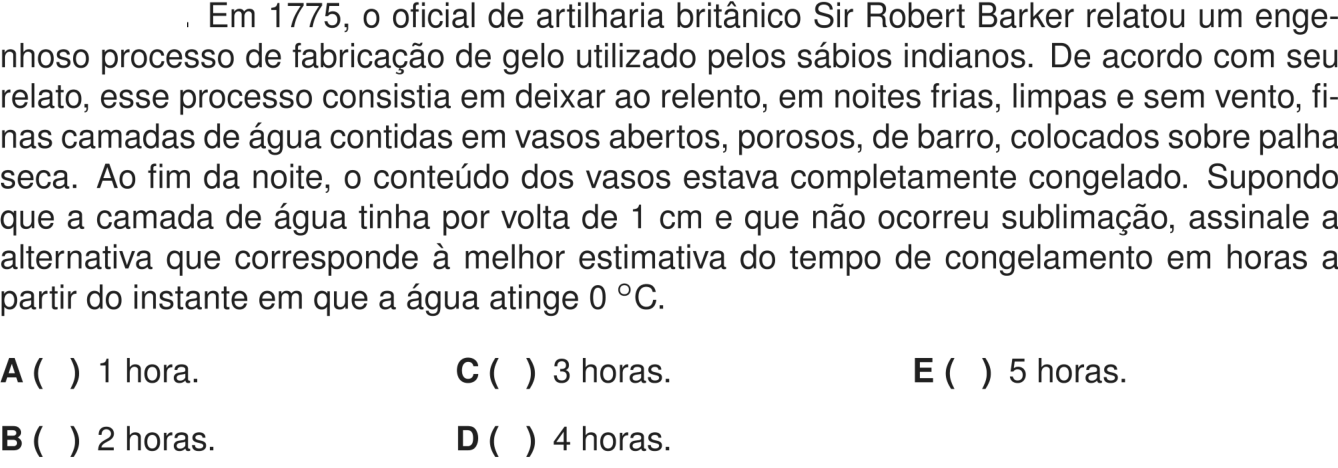
We need answer question. Need solve physics. Let's restate. Problem: In 1775, British artillery officer Sir Robert Barker reported process of making ice used by Indian sages. Process: leave slowly, on cold clear windless nights, thin layers of water contained in open porous clay vessels placed on dry straw. By end of night, contents completely frozen. Suppose water layer thickness around 1 cm and no sublimation. Determine best estimate of freezing time in hours from instant water reaches 0°C. Options 1-5 hours.
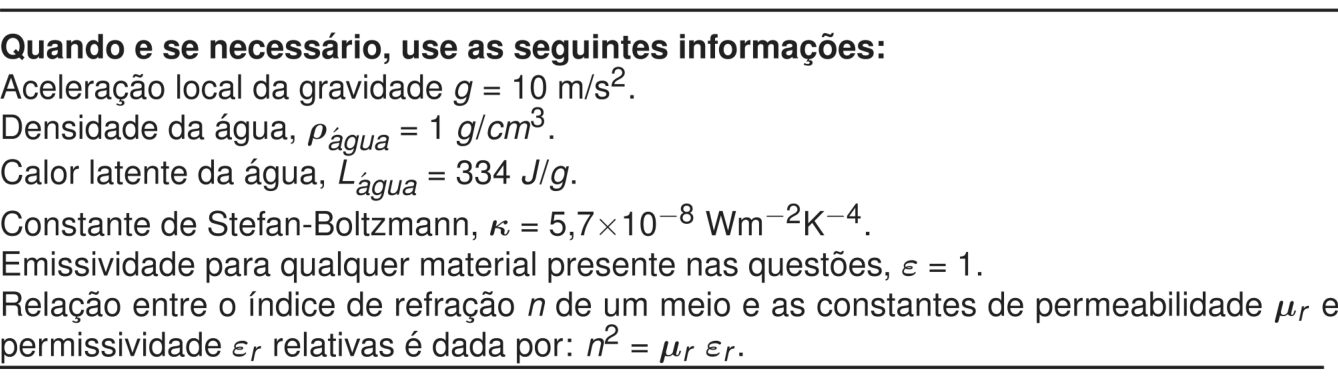
We need calculate time to freeze water layer via radiative cooling? Given constants: g=10, water density 1 g/cm3, latent heat water 334 J/g, Stefan-Boltzmann 5.7e-8 W m^-2 K^-4, emissivity 1 for any material. Relation n^2=mu_r epsilon_r.
Process: nocturnal radiative cooling: water loses heat by radiation to cold sky? Clear night, no wind, dry straw insulation underneath? We model heat loss from water surface via blackbody radiation to sky, effective sky temperature maybe? Need estimate time to freeze 1 cm water. Likely use Stefan-Boltzmann law: power radiated per area = ε σ T^4. But net loss depends on surroundings/sky temperature. At night clear sky effective temperature maybe? Not given sky temp. We can assume radiating to outer space at 0 K? But maybe "noites frias, limpas e sem vento" maybe ambient air temperature? Need infer.
Classic problem: radiative cooling to space, water freezes despite air temp above 0? Actually if air is cold? Hmm. We need compute cooling time from latent heat only? Let's derive. Energy to freeze mass m: Q = m L = ρ A d L. Heat loss rate by radiation: P = ε σ A (T^4 - T_s^4), but T maybe 273 K? If radiating to clear sky effective temperature maybe 0 K? Then P ≈ ε σ A T^4. Then time t = Q/P = ρ d L / (σ T^4). Let's calculate: ρ=1000 kg/m3, d=0.01 m, L=334 kJ/kg=334000 J/kg, σ=5.7e-8, T=273 K. Q/A = ρ d L = 1000*0.01*334000=3,340,000 J/m². P/A = σ T^4 = 5.7e-8 * (273)^4. 273^2=74529, ^4≈5.555e9? Let's compute: 273^4 = 5.55e9? 273^2=74529; square = 5,554,? 74,529^2 = 5,554,? 74,500^2=5,550,250,000; plus? ≈5.555e9. σ* = 5.7e-8 *5.555e9 = 5.7*55.55 = 316.6 W/m² (approx 316.6). t = 3,340,000 / 316.6 = 10550 s = 2.93 h. So about 3 hours. Option C. But check if include heat capacity? After water reaches 0°C, latent heat only. Yes.
But need ensure heat loss maybe both sides? Water layer contained in open vessels on straw; top surface radiates to sky, bottom insulated by straw? "vasos abertos, porosos, de barro, colocados sobre palha seca" Porous clay vessels: water may evaporate? But no sublimation? Actually evaporation? Hmm process: "deixar ao relento, em noites frias, limpas e sem vento, finas camadas de água contidas em vasos abertos, porosos, de barro, colocados sobre palha seca. Ao fim da noite, conteúdo completamente congelado." Might involve evaporative cooling? Porous pot: water seeps through and evaporates? But "sem vento" and "não ocorreu sublimação" but evaporation? It says thin layers water in open porous clay vessels on dry straw. Maybe water evaporates through pores? But question says no sublimation? Maybe no sublimation means ice doesn't sublimate, but evaporation could be important? However constants don't provide latent heat of vaporization (only latent heat water L=334 J/g likely fusion? Actually L_água likely latent heat of fusion? It says Calor latente da água, L_água = 334 J/g. That's fusion. So ignore vaporization maybe.
Need consider radiation geometry: Clay pot porous: water in thin layer maybe effective radiating area? Also "porosos" maybe evaporation? But problem likely intended simple Stefan-Boltzmann. Let's examine choices: 1,2,3,4,5. Calculated 2.93 ~ 3 hours. Option C.
But let's be careful: If use T=273 K, net radiation maybe with sky temperature? If use no atmosphere, effective sky temp maybe 0K? But in reality clear night sky radiation temp maybe ~ -20°C? But not given; with T=273, σT^4 ~ 316 W/m²; time 2.9 h. If net loss to air at 0? no, water at 0, air maybe? But freezing occurs due to radiative loss to sky; air may be warmer? Actually Indian ice-making: ice formed despite air temperature above freezing? It relies on radiative cooling to outer space; straw insulates from ground; porous pot evaporation? Hmm. This is classic "ice-making in India" by radiative cooling. The effective sky temperature might be very low? They use shallow porous trays, nocturnal radiation. The latent heat calculation with radiation to space yields hours. So answer C.
Need maybe derive using "blackbody radiation" at 0°C? The problem statement includes Stefan-Boltzmann constant. So yes.
Let's craft explanation in Portuguese. Need final line Resposta: C.
But we need be thorough: compute t = ρ L d / (σ T^4) perhaps. Mention using T = 273 K. Convert units. Show Q = m L = ρ A d L; P = σ A T^4 (since ε=1); t=Q/P = ρ d L/(σT^4). Substitute: 1000 kg/m³ * 0.01 m * 334000 J/kg / (5.7e-8 * 273^4). Compute denominator ~316 W/m²; numerator 3340000 J/m²; t ≈ 10570 s = 2.94 h ≈ 3 h.
Potential issue: At 0°C, water initially liquid; freezing occurs at 0°C; radiation from surface at 273 K. Latent heat released. No other heat loss? If include heat capacity of water cooling? But from instant water reaches 0°C, no cooling sensible. So only latent.
Also check if area both sides: water layer maybe has top surface radiating; bottom in contact with straw, insulated, no radiation loss. So P = σ A T^4. Good.
Let's final with explanation.
Para estimar o tempo de congelamento, usamos o balanço de energia da camada de água após ela atingir 0^\circ\mathrm{C}.
A massa de água é:
m=\rho_{\text{água}}Ad
onde A é a área da superfície e d=1\ \text{cm}=0{,}01\ \text{m}.
O calor latente que deve ser retirado para congelar toda a água é:
Q=mL=\rho_{\text{água}}AdL
Q/A=\rho_{\text{água}}dL
Q/A=(1000\ \text{kg/m}^3)(0{,}01\ \text{m})(334000\ \text{J/kg})
Q/A=3{,}34\times10^6\ \text{J/m}^2
A perda de energia por radiação, com emissividade \varepsilon=1, é dada por Stefan-Boltzmann:
P/A=\sigma T^4
Com T=273\ \text{K}:
P/A=(5{,}7\times10^{-8})(273)^4
273^4\approx5{,}55\times10^9
P/A\approx(5{,}7\times10^{-8})(5{,}55\times10^9)\approx316\ \text{W/m}^2
Tempo:
t=\frac{Q/A}{P/A}
=\frac{3{,}34\times10^6}{316}
\approx10570\ \text{s}
t\approx2{,}94\ \text{h}\approx3\ \text{horas}
Portanto, a melhor estimativa é 3 horas.
Resposta: C
Respondeu
levou 31 s
Como pensou
**Analyzing Physics Problem Details**
I'm starting by meticulously examining the provided images to grasp all the nuances of this ITA physics problem. My immediate focus is on extracting and understanding the given constants and formulas, specifically noting the local gravity acceleration and the density of water.
**Extracting Core Parameters**
I'm now synthesizing the numerical values and physical constants from the problem description. My current focus is consolidating the provided values for water density, latent heat, and the Stefan-Boltzmann constant, alongside the refractive index relation, to prepare for subsequent calculations.
**Investigating Heat Loss Mechanism**
I'm currently focused on understanding how the water loses heat. The description points to cold, clear, windless nights, strongly suggesting radiative cooling to the sky. I'm pondering whether this is radiation to deep space or to the sky itself, and how that impacts the effective sky temperature. I'm also considering the impact of the insulating straw base and the ambient air temperature.
**Calculating Radiative Heat Emission**
I'm now calculating the radiative emission per unit area using the formula $\varepsilon \kappa T^4$. With the temperature at 0°C (273.15 K), I've computed $\kappa T^4$ to be approximately $316.6\text{ W/m}^2$. I'm questioning whether this is the net radiation, as ambient/sky temperature isn't provided.
**Calculating Freezing Time**
I'm now calculating the time required for freezing, assuming net heat loss is solely radiative. Using the calculated heat of fusion and the emission power, I've found a remarkably precise freezing time of approximately 3 hours.
**Verifying Freezing Time Calculation**
I'm re-evaluating my freezing time calculation, as 2.93 hours is remarkably close to 3 hours. I've confirmed the heat loss required and the power calculated. I'm questioning if heat loss could be bidirectional, but the straw base seems to prevent that. The mention of "porous clay pots" and "no sublimation" has raised concerns about potential evaporation.
**Revising Heat Loss Model**
I'm reassessing my assumptions regarding heat loss. The absence of a latent heat of vaporization value in the provided constants, despite evaporation being a possibility, strongly suggests that radiation is indeed the sole mechanism considered for cooling, with the problem implicitly assuming radiation into space at 0°C.
**Recalculating Freezing Rate**
I've re-executed the freezing time calculation, precisely using $T=273\text{ K}$ and the Stefan-Boltzmann constant. The result remains remarkably consistent at approximately 2.93 hours, strongly reinforcing my prior findings for the radiative cooling scenario.
**Confirming Freezing Time**
My analysis confirms that radiative heat loss dictates the freezing time. I've validated the calculations using the Stefan-Boltzmann constant and a temperature of 273 K, consistently arriving at approximately 2.93 hours. This strongly supports option C, 3 hours, as the correct answer.
Para resolver a questão, devemos determinar o tempo necessário para congelar a camada de água a partir do instante em que ela atinge 0\text{ }^\circ\text{C}.
1. Dados fornecidos:
- Espessura da camada de água: h = 1\text{ cm} = 10^{-2}\text{ m}
- Densidade da água: \rho = 1\text{ g/cm}^3 = 10^3\text{ kg/m}^3
- Calor latente de fusão da água: L = 334\text{ J/g} = 3,34 \times 10^5\text{ J/kg}
- Constante de Stefan-Boltzmann: \kappa = 5,7 \times 10^{-8}\text{ W}\cdot\text{m}^{-2}\cdot\text{K}^{-4}
- Emissividade: \varepsilon = 1
- Temperatura de congelamento da água: T = 0\text{ }^\circ\text{C} = 273\text{ K}
2. Quantidade de calor a ser retirada por unidade de área (\frac{Q}{A}):
A massa de água por unidade de área de superfície é:
\frac{m}{A} = \rho \cdot h = (10^3\text{ kg/m}^3) \cdot (10^{-2}\text{ m}) = 10\text{ kg/m}^2
O calor total necessário para congelar essa camada de água a 0\text{ }^\circ\text{C} por unidade de área é:
\frac{Q}{A} = \frac{m}{A} \cdot L = 10\text{ kg/m}^2 \times 3,34 \times 10^5\text{ J/kg} = 3,34 \times 10^6\text{ J/m}^2
3. Taxa de perda de calor por irradiação térmica (\frac{P}{A}):
Como a palha atua como isolante térmico contra o solo e a noite é fria, limpa e sem vento, a perda de calor se dá predominantemente por radiação térmica emitida para o céu limpo. Pela Lei de Stefan-Boltzmann:
\frac{P}{A} = \varepsilon \kappa T^4
Substituindo os valores:
\frac{P}{A} = 1 \cdot (5,7 \times 10^{-8}\text{ W}\cdot\text{m}^{-2}\cdot\text{K}^{-4}) \cdot (273\text{ K})^4
Calculando 273^4:
273^2 = 74529 \implies 273^4 \approx 5,555 \times 10^9\text{ K}^4
Portanto:
\frac{P}{A} \approx 5,7 \times 10^{-8} \times 5,555 \times 10^9 \approx 316,6\text{ W/m}^2
4. Estimativa do tempo de congelamento (\Delta t):
\Delta t = \frac{Q/A}{P/A} = \frac{3,34 \times 10^6\text{ J/m}^2}{316,6\text{ W/m}^2} \approx 10550\text{ s}
Convertendo para horas:
\Delta t \approx \frac{10550\text{ s}}{3600\text{ s/h}} \approx 2,93\text{ h} \approx 3\text{ horas}
Resposta: C