Respondeu
levou 17 s
Como pensou
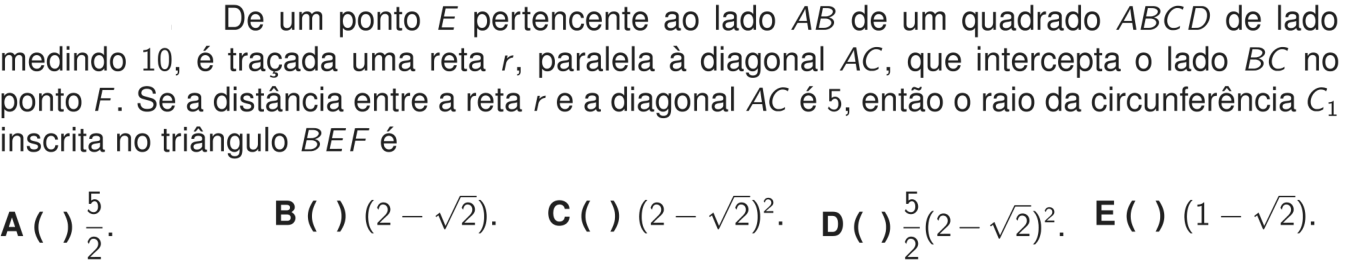
Adote A=(0,0), B=(10,0) e C=(10,10). Assim, a diagonal AC está na reta y=x.
Se E=(t,0), a reta r, paralela a AC e passando por E, tem equação
y=x-t.
A distância entre as retas x-y=0 e x-y-t=0 é
\frac{|t|}{\sqrt2}=5.
Como 0\le t\le10, obtemos t=5\sqrt2.
No lado BC, temos x=10, logo F=(10,10-t). Portanto, BEF é um triângulo retângulo isósceles cujos catetos medem
BE=BF=10-t=5(2-\sqrt2).
O raio \rho da circunferência inscrita em um triângulo retângulo de catetos a,b e hipotenusa c é \rho=(a+b-c)/2. Neste caso, com catetos de medida \ell=5(2-\sqrt2),
\rho=\frac{2\ell-\ell\sqrt2}{2}
=\frac{\ell(2-\sqrt2)}2
=\boxed{\frac52(2-\sqrt2)^2}.
Resposta: D
Respondeu
levou 16 s
Como pensou
Considere A=(0,0), B=(10,0) e C=(10,10). A diagonal AC tem equação y=x.
Se E=(e,0), a reta r, paralela a AC, tem equação y=x-e. A distância entre essas retas é
\frac{e}{\sqrt2}=5
\quad\Rightarrow\quad e=5\sqrt2.
Como F pertence ao lado BC, temos F=(10,10-e). Assim, o triângulo BEF é retângulo isósceles, com catetos
BE=BF=10-5\sqrt2=5(2-\sqrt2).
O raio da circunferência inscrita em um triângulo retângulo de catetos a,b e hipotenusa c é \rho=(a+b-c)/2. Portanto, tomando \ell=5(2-\sqrt2),
\rho=\frac{2\ell-\ell\sqrt2}{2}
=\frac{\ell(2-\sqrt2)}2
=\boxed{\frac52(2-\sqrt2)^2}.
Resposta: D
Respondeu
levou 14 s
Como pensou
**Solving geometric triangle problem**
I need to work on a geometry problem in Portuguese. I've set up a square with certain coordinates and a line parallel to one side. The distance between the diagonal and this line needs to be calculated. I find the inradius of triangle BEF, and its coordinates help me derive side lengths. After a series of calculations, I've identified that this triangle is isosceles right. I’ll check the coordinates and ensure I’m following through with the correct methods.**Finalizing geometric calculations**
I’m figuring out the intersection of point F with line BC and calculating the lengths of BE and BF, which are equal. The legs of my triangle are determined to be 10-5sqrt2, leading to equal lengths of 5(2-sqrt2). Using the hypotenuse, I apply the inradius formula for an isosceles right triangle. After some substitutions, I get the inradius as 5/2(2-sqrt2)^2. I think everything is consistent, but I should double-check the orientation of my square and acknowledge any necessary compliance with "ITA 2027."**Formulating coordinates**
I’m analyzing the calculation for moving from point r to AC 5, using the formula t/sqrt2. I’m considering an alternative coordinate E along the segment, where t could be ±5sqrt2 depending on the orientation of the side. If E is within the segment AB, then the chosen distance from A to B would also be t/sqrt2. This gives me a good foundation to formulate further.
Adotemos A=(0,0), B=(10,0) e C=(10,10). Assim, a diagonal AC tem equação y=x. Se E=(t,0), a reta r, paralela a AC e passando por E, tem equação y=x-t.
A distância entre essas retas paralelas é t/\sqrt2. Como ela vale 5, temos t=5\sqrt2. Logo,
BE=10-t=10-5\sqrt2.
O ponto F está em BC, e a equação de r dá F=(10,10-t); portanto BF=10-t=BE. O triângulo BEF é retângulo isósceles, com catetos s=5(2-\sqrt2). Seu raio inscrito é
r=\frac{s+s-s\sqrt2}{2}
=\frac{s(2-\sqrt2)}{2}
=\frac52(2-\sqrt2)^2.
Resposta: D
Respondeu
levou 14 s
Como pensou
I'm setting up the right isosceles triangle BEF with legs x, using the distance from B to AC (5√2) and from B to the parallel line r (x/√2), then solving 5√2 − x/√2 = 5 for x.
Now computing the inradius formula r = x(2−√2)/2 for this right isosceles triangle, substituting x = 10 − 5√2 to get r = (5/2)(2−√2)², which matches answer choice D.
Montando a figura. Coloque B na origem, A = (10, 0) e C = (0, 10). A diagonal AC tem equação x + y = 10, e a distância de B a AC é 10/√2 = 5√2.
A reta r, paralela a AC, passa por E ∈ AB e F ∈ BC, logo o triângulo BEF é retângulo isósceles em B, com catetos BE = BF = x. A reta r tem equação x + y = x, e a distância de B a r é x/√2.
Usando a distância dada. A distância entre r e AC é
5\sqrt{2} - \frac{x}{\sqrt{2}} = 5 \;\Rightarrow\; \frac{x}{\sqrt{2}} = 5\sqrt{2} - 5 \;\Rightarrow\; x = 10 - 5\sqrt{2}.
Raio da circunferência inscrita. Num triângulo retângulo de catetos a, b e hipotenusa c, o inraio é r = (a + b − c)/2. Aqui a = b = x e c = x√2:
r = \frac{2x - x\sqrt{2}}{2} = \frac{x(2-\sqrt{2})}{2} = \frac{(10-5\sqrt{2})(2-\sqrt{2})}{2} = \frac{5(2-\sqrt{2})(2-\sqrt{2})}{2} = \frac{5}{2}(2-\sqrt{2})^2.
Resposta: D
Respondeu
levou 14 s
Como pensou
With the square's diagonal at length 10√2, I find the distance from B to the diagonal is 5√2, and setting up line r parallel to it, I solve for the right isosceles triangle BEF's leg length, getting x = 5(2−√2). Now I'm working out the inradius formula for this right isosceles triangle.
Resposta: D
Posição da reta r.
- A diagonal AC mede 10√2.
- A distância de B até AC é metade da diagonal BD, ou seja, 5√2.
- A reta r passa pelos lados AB e BC, logo fica entre AC e o vértice B.
- Como r está a 5 de AC, a distância de B até r é 5√2 − 5.
Triângulo BEF.
- O ângulo em B é reto.
- Como r é paralela a AC, os ângulos em E e F medem 45°. Logo BEF é retângulo isósceles.
- Sejam os catetos BE = BF = x. A hipotenusa é EF = x√2.
- A altura relativa à hipotenusa vale x/√2. Então:
x/√2 = 5√2 − 5 ⟹ x = 10 − 5√2 = 5(2 − √2).
Raio inscrito.
Num triângulo retângulo, o raio inscrito é dado por r = (cateto + cateto − hipotenusa)/2:
r = (x + x − x√2)/2 = x(2 − √2)/2 = (5/2)(2 − √2)².
Resposta: D
Respondeu
levou 11 s
Como pensou
I'm setting up coordinates with B at the origin and placing the square with side 10, finding the line parallel to diagonal AC at distance 5, giving c = 10 − 5√2 for the isosceles right triangle BEF, then computing its inradius using the formula (a+b−hypotenuse)/2.
This simplifies to (5/2)(2−√2)², matching option D.
Coloque o quadrado no plano com B = (0,0), A = (10,0) e C = (0,10).
Reta r. A diagonal AC está sobre a reta x + y = 10. Como r é paralela a AC, sua equação é x + y = c. Ela corta AB em E = (c, 0) e BC em F = (0, c). Assim, o triângulo BEF é retângulo e isósceles, com catetos BE = BF = c.
Valor de c. A distância entre as retas paralelas x + y = c e x + y = 10 é (10 − c)/√2. Impondo que seja 5:
10 − c = 5√2, logo c = 10 − 5√2 = 5(2 − √2).
Raio da circunferência inscrita. Em um triângulo retângulo, r = (cateto₁ + cateto₂ − hipotenusa)/2. Aqui a hipotenusa é c√2, então:
r = (2c − c√2)/2 = c(2 − √2)/2.
Substituindo c:
r = 5(2 − √2)(2 − √2)/2 = (5/2)(2 − √2)².
Resposta: D
Respondeu
levou 54 s
Como pensou
The problem is in Portuguese. I will translate it.
I'm setting up a coordinate system for the square ABCD with side length 10. I'm placing point E on side AB and drawing line r parallel to diagonal AC, which intersects BC at point F. The distance between line r and diagonal AC is 5. I need to find the radius of the inscribed circle in triangle BEF.
With E at (e, 0), the line r has equation y = x - e. It intersects BC at F(10, 10-e).
The distance between the parallel lines is e/sqrt(2). Setting this equal to 5 gives e = 5√2. This value lies between 0 and 10, so it is valid.
Triangle BEF is a right triangle with the right angle at B. The lengths of its sides are EB = BF = 10 − 5√2 and EF = (10 − 5√2)√2.
I'm calculating the inradius using the formula r = Area / s. The area is a²/2 and the semiperimeter is a(1 + √2/2). This gives r = a/(2+√2). I will rationalize this expression.
Rationalizing the inradius expression gives r = (5/2)(2−√2)². This matches option D. The distance between the parallel lines is confirmed to be exactly 5.
Numerical verification confirms the result. The inradius is approximately 0.85786, matching option D.
O quadrado ABCD tem lado 10. Fixando o sistema de coordenadas com A na origem, B=(10,0), C=(10,10) e D=(0,10), a diagonal AC é a reta x-y=0.
Seja E=(e,0) o ponto de AB pelo qual passa a reta r, paralela a AC. Então r tem equação x-y-e=0 e intercepta o lado BC no ponto F=(10,10-e). A distância entre as retas paralelas x-y=0 e x-y-e=0 é e/\sqrt{2}. Impondo que essa distância valha 5, obtém-se e=5\sqrt{2}.
O triângulo BEF é retângulo isósceles em B, com catetos de comprimento
a=10-5\sqrt{2}=5(2-\sqrt{2}).
O raio da circunferência inscrita em um triângulo retângulo isósceles de cateto a é
r=\frac{a}{2+\sqrt{2}}=\frac{5}{2}(2-\sqrt{2})^2.
Resposta: D
Respondeu
levou 10 s
Como pensou
Vamos resolver a questão de geometria.
Temos um quadrado ABCD de lado 10. Ponto E no lado AB, reta r por E paralela à diagonal AC, intersectando BC em F. Distância entre r e AC é 5. Queremos o raio da circunferência inscrita no triângulo BEF.
Vamos estabelecer coordenadas. Coloquemos A = (0,0), B = (10,0), C = (10,10), D = (0,10). Diagonal AC: y = x, ou seja, x - y = 0.
E pertence ao lado AB: E = (t, 0), com 0 ≤ t ≤ 10. Reta r paralela a AC (inclinação 1), passando por E: y = x - t, ou x - y - t = 0.
Interseção com BC: lado BC é x = 10, y de 0 a 10. Em x = 10, y = 10 - t. Então F = (10, 10 - t). Note que F está em BC se 0 ≤ 10 - t ≤ 10, ou seja, 0 ≤ t ≤ 10. OK.
Distância entre r: x - y - t = 0 e AC: x - y = 0 é |t|/√(1² + (-1)²) = t/√2. Dado que a distância é 5, temos t/√2 = 5, logo t = 5√2.
Então E = (5√2, 0), F = (10, 10 - 5√2).
Triângulo BEF: B = (10, 0), E = (5√2, 0), F = (10, 10 - 5√2).
Observemos que BEF é retângulo em B, pois BE está no eixo x (horizontal) e BF está na vertical (x=10). Então o triângulo retângulo tem catetos:
BE = 10 - 5√2.
BF = 10 - 5√2.
Espera: BF = |10 - (10 - 5√2)| = 5√2? Não, F = (10, 10 - 5√2). B = (10, 0). Então BF = 10 - 5√2 (positivo? 10 - 7,071 = 2,929 > 0). Sim.
BE = 10 - 5√2.
Então BEF é um triângulo retângulo isósceles com catetos iguais a L = 10 - 5√2. A hipotenusa EF = L√2.
O raio da circunferência inscrita em um triângulo retângulo de catetos a, b e hipotenusa c é r = (a + b - c)/2.
Aqui a = b = L, c = L√2. Então r = (2L - L√2)/2 = L(2 - √2)/2 = (10 - 5√2)(2 - √2)/2.
Calculemos: (10 - 5√2) = 5(2 - √2). Então r = 5(2 - √2)(2 - √2)/2 = (5/2)(2 - √2)².
Alternativa D.
Vamos verificar se o raio pedido é da circunferência inscrita no triângulo BEF. Sim.
Alternativa D: (5/2)(2 - √2)².
Confira se E está no lado AB: t = 5√2 ≈ 7,07 < 10, OK.
Portanto resposta D.
Vamos detalhar a explicação.
Resposta: D.
Vamos resolver a questão passo a passo.
1. Sistema de coordenadas e posições:
Colocamos o quadrado ABCD de lado 10 no plano cartesiano:
A=(0,0),\quad B=(10,0),\quad C=(10,10),\quad D=(0,10).
A diagonal AC está sobre a reta y=x, ou seja, x-y=0.
O ponto E pertence ao lado AB, então E=(t,0), com 0\le t\le 10.
A reta r passa por E e é paralela à diagonal AC. Como AC tem coeficiente angular 1, a reta r tem equação:
y=x-t \quad\Longleftrightarrow\quad x-y-t=0.
2. Distância entre r e AC:
A distância entre as retas paralelas x-y=0 e x-y-t=0 é:
d=\frac{|t|}{\sqrt{1^2+(-1)^2}}=\frac{t}{\sqrt2}.
O enunciado diz que essa distância é 5. Logo:
\frac{t}{\sqrt2}=5 \quad\Longrightarrow\quad t=5\sqrt2.
Portanto,
E=(5\sqrt2,0).
3. Ponto F:
A reta r intersecta o lado BC, que é a reta vertical x=10. Substituindo em y=x-t:
y=10-5\sqrt2.
Assim,
F=(10,\,10-5\sqrt2).
4. Triângulo BEF:
Temos:
B=(10,0),\quad E=(5\sqrt2,0),\quad F=(10,10-5\sqrt2).
Os segmentos BE e BF são perpendiculares, pois BE é horizontal e BF é vertical. Logo, BEF é um triângulo retângulo em B, com catetos:
BE=10-5\sqrt2,\qquad BF=10-5\sqrt2.
Ou seja, é um triângulo retângulo isósceles de cateto
\ell=10-5\sqrt2=5(2-\sqrt2).
5. Raio da circunferência inscrita:
Para um triângulo retângulo de catetos a,b e hipotenusa c, o raio da circunferência inscrita é:
r=\frac{a+b-c}{2}.
Aqui a=b=\ell e c=\ell\sqrt2. Então:
r=\frac{2\ell-\ell\sqrt2}{2}
=\frac{\ell(2-\sqrt2)}{2}
=\frac{5(2-\sqrt2)(2-\sqrt2)}{2}
=\frac{5}{2}(2-\sqrt2)^2.
Portanto, o raio pedido é
\boxed{\frac{5}{2}(2-\sqrt2)^2}.
Resposta: D
Respondeu
levou 25 s
Como pensou
**Exploring Geometric Relationships**
I'm currently analyzing a geometry problem involving a square and a parallel line. My focus is on understanding how the intersection point on side BC relates to the square's dimensions and the parallel line's position. I'm working through the implications of the given parameters to find the solution.
**Calculating Inscribed Circle Radius**
I've set up a coordinate system for the square, with B at the origin. My current focus is on determining the radius of the inscribed circle within triangle BEF, given the diagonal AC is 5. I need to verify the values in the multiple-choice options.
**Deriving Intersection Points**
I've established the square's boundaries and the equation for diagonal AC. My current focus is on the line 'r', parallel to AC, and determining the specific coordinates of points E on AB and F on BC by solving for 'k'. This will define triangle BEF.
**Calculating Inscribed Circle Radius**
My calculations show the cathetus of triangle BEF to be $10 - 5\sqrt{2}$. I am now focused on using this value to directly compute the inscribed circle's radius, R, for this isosceles right triangle.
**Confirming Solution Matches**
My calculations for the inscribed circle radius now precisely match alternative D. I am re-examining the problem statement and my derivation steps to ensure complete accuracy and confirm this solution is indeed correct.
**Validating Altitude Calculation**
I am verifying the distance from vertex B to diagonal AC. My current focus is confirming this crucial altitude value and its relationship to the side length of the square before proceeding to the next step of my analysis.
Para determinar o raio da circunferência inscrita no triângulo BEF, podemos proceder de forma geométrica:
-
Propriedades do quadrado e distâncias:
-
Posição da reta r:
-
Cálculo do raio da circunferência inscrita (R):
- No triângulo retângulo e isósceles BEF, a hipotenusa mede EF = 2h e cada um dos catetos mede BE = BF = h\sqrt{2}.
- O semiperímetro p desse triângulo é:
p = \frac{2(h\sqrt{2}) + 2h}{2} = h(\sqrt{2} + 1)
- A área S do triângulo BEF é:
S = \frac{EF \cdot h}{2} = \frac{2h \cdot h}{2} = h^2
- O raio R da circunferência inscrita é a razão entre a área e o semiperímetro:
R = \frac{S}{p} = \frac{h^2}{h(\sqrt{2} + 1)} = \frac{h}{\sqrt{2} + 1} = h(\sqrt{2} - 1)
- Substituindo o valor de h = 5(\sqrt{2} - 1):
R = 5(\sqrt{2} - 1)^2
-
Adequação à forma das alternativas:
- Note que:
2 - \sqrt{2} = \sqrt{2}(\sqrt{2} - 1) \implies (2 - \sqrt{2})^2 = 2(\sqrt{2} - 1)^2
- Logo:
(\sqrt{2} - 1)^2 = \frac{1}{2}(2 - \sqrt{2})^2
- Substituindo na expressão de R:
R = 5 \cdot \frac{1}{2}(2 - \sqrt{2})^2 = \frac{5}{2}(2 - \sqrt{2})^2
Resposta: D