Como pensou
We need answer question. Need solve. Let's restate problem.
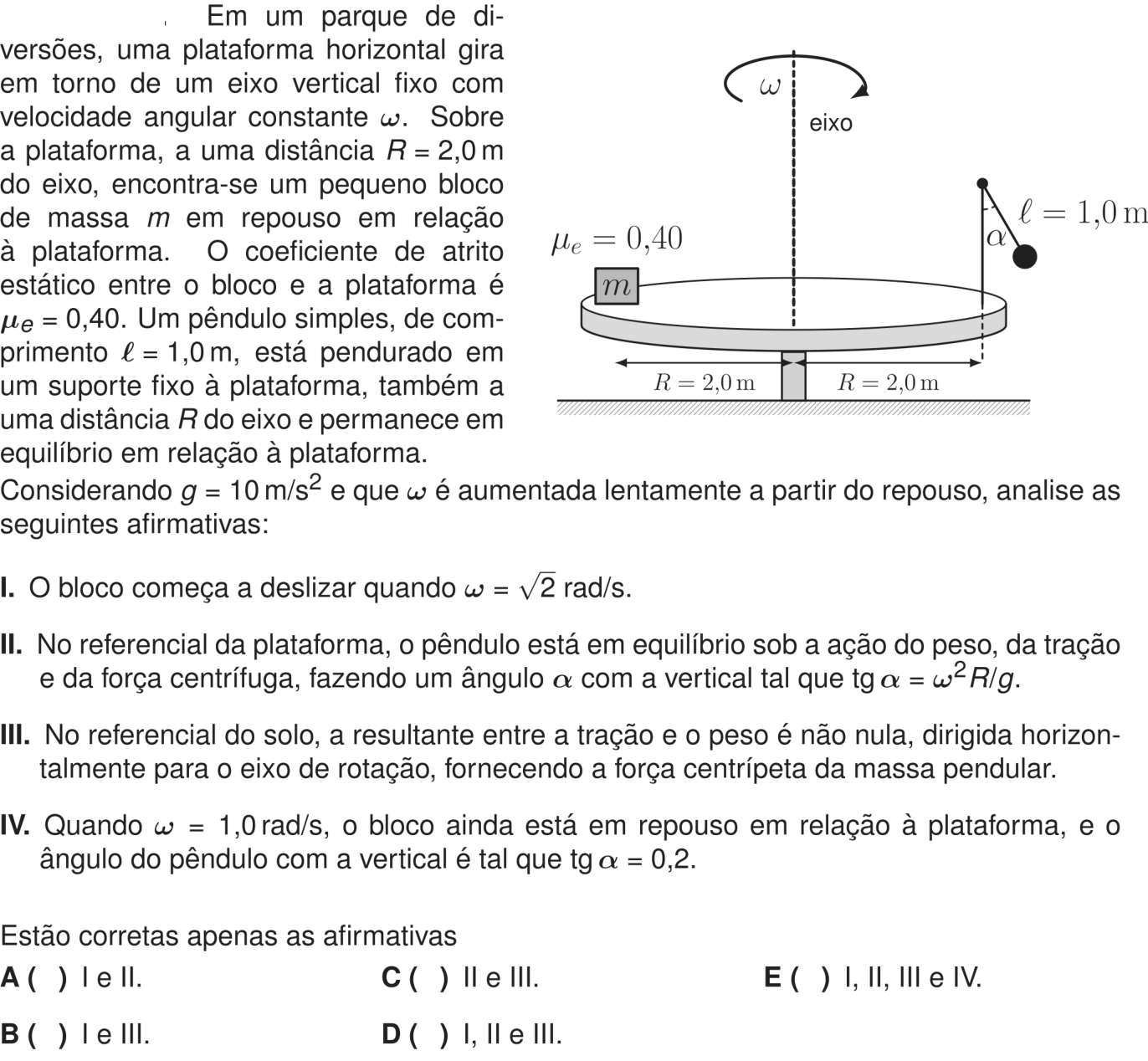
Plataforma horizontal gira em torno de eixo vertical fixo velocidade angular constante omega. Sobre plataforma, a distância R=2,0 m do eixo, bloco pequeno massa m em repouso em relação à plataforma. Coeficiente atrito estático entre bloco e plataforma mu_e=0,40. Um pêndulo simples comprimento l=1,0 m, pendurado em suporte fixo à plataforma, também a distância R do eixo e permanece em equilíbrio em relação à plataforma.
Considerando g=10 m/s² e que omega é aumentada lentamente a partir do repouso, analise afirmativas:
I. O bloco começa a deslizar quando omega = sqrt(2) rad/s.
II. No referencial da plataforma, o pêndulo está em equilíbrio sob ação do peso, da tração e da força centrífuga, fazendo um ângulo alpha com a vertical tal que tg alpha = omega² R / g.
III. No referencial do solo, a resultante entre tração e peso é não nula, dirigida horizontalmente para o eixo de rotação, fornecendo força centrípeta da massa pendular.
IV. Quando omega = 1,0 rad/s, o bloco ainda está em repouso em relação à plataforma, e o ângulo do pêndulo com a vertical é tal que tg alpha = 0,2.
Estão corretas apenas as afirmativas:
A I e II
B I e III
C II e III
D I, II e III
E I, II, III e IV
Need analyze each.
Let's solve.
Given R=2.0 m, mu_e=0.40, g=10, l=1.0 m, omega slowly increased.
Block: rotating platform, in frame rotating with platform, block experiences centrifugal force m omega^2 R outward, normal? Actually radial direction. Static friction provides centripetal force in inertial frame. Maximum static friction = mu_e N = mu_e m g (since vertical equilibrium N=mg). So block starts sliding when required centripetal force m omega^2 R > mu_e m g => omega^2 R > mu_e g => omega^2 > mu_e g / R = 0.40*10 / 2.0 = 4/2 =2 => omega > sqrt(2) rad/s. So I correct: comesça a deslizar quando omega = sqrt(2) rad/s.
Pendulum: attached to platform at distance R from axis, length l=1.0 m. In equilibrium relative to platform, so in rotating frame it has centrifugal force. It makes angle alpha with vertical. Need consider in rotating frame: forces on bob: tension T along string, weight mg downward, centrifugal force m omega^2 r? Wait position of bob: support at distance R from axis, string length l, angle alpha with vertical (likely in radial plane outward?). The bob's horizontal distance from axis = R + l sin alpha? Since support at distance R, string extends outward? The diagram maybe? The image shows pendulum support on platform at distance R from axis, and pendulo length l, angle alpha with vertical. The diagram likely shows pendulum arm outward? Let's examine: support fixed on platform at distance R from axis; pendulum hangs; due to rotation, it swings outward? The diagram maybe has alpha angle with vertical, string attached at top? The text says "pendurado em um suporte fixo à plataforma, também a uma distância R do eixo e permanece em equilíbrio em relação à plataforma." The figure: pendulo at right, support at right R=2,0 m, string length l=1,0 m, mass (black dot), angle alpha with vertical. It likely legthens outward? Let's see: In rotating frame, equilibrium of pendulum bob under tension, weight, centrifugal force. The centrifugal force direction is radially outward from axis (horizontal). Since support at distance R, but bob is farther? Let's derive.
In rotating frame with angular velocity omega, a mass at position (x? radial distance r from axis) experiences centrifugal force m omega^2 r radially outward. The bob position r = R + l sin alpha (assuming string outward from support axis? Let's verify: support is at radial distance R; string of length l makes angle alpha with vertical; if string is in radial plane and bob is farther from axis than support, then r = R + l sin alpha. But the diagram might have the pendulum hanging inward? The image shows support at distance R, line extends from support to bob, angle alpha maybe on the outward side? The label "R = 2,0 m" for distance from axis to... The block is left, pendulum right. The platform rotates; the support fixed to platform at distance R; as platform rotates, due to inertia, the bob tends to move outward, so string likely outward relative to support, so r = R + l sin alpha. Then centrifugal force = m omega^2 (R + l sin alpha) horizontally outward. But often simple pendulum on rotating platform formula: tan alpha = omega^2 R / g maybe if l negligible? Actually if bob at radius R + l sin alpha, then equilibrium: T sin alpha = m omega^2 r? Wait in rotating frame, radial force balance: T sin alpha + ? Let's do carefully. Forces on bob: tension T along string making angle alpha with vertical? If bob is farther outward than support, string pulls inward (toward support) with components: horizontal inward T sin alpha, vertical upward T cos alpha. Weight m g downward. Centrifugal force m omega^2 r outward horizontally. Equilibrium: horizontal: T sin alpha = m omega^2 r = m omega^2 (R + l sin alpha)? Actually tension horizontal component inward; centrifugal force outward; if T sin alpha inward, then equation T sin alpha = m omega^2 r? But T sin alpha points toward support which is inward? If bob farther out than support, support is inward horizontally; tension pulls bob toward support, so horizontal component inward; centrifugal force outward; so T sin alpha = m omega^2 r to balance. But if T sin alpha = m omega^2 r, then T sin alpha would be outward? No, tension component is inward (toward axis) if string outward; so it equals centrifugal force? Let's resolve: Support is at radial distance R; bob at r=R + l sin alpha (outward). String from bob to support points inward and upward; so tension on bob is directed toward support: horizontally inward (toward axis) and vertically upward. Thus T horizontal component is inward, can balance centrifugal force outward; yes T sin alpha = m omega^2 r. Vertical: T cos alpha = m g. Then tan alpha = (m omega^2 r)/(m g) = omega^2 r/g = omega^2 (R + l sin alpha)/g. This is implicit, not simple tan alpha = omega^2 R/g? But maybe statement II says "fazendo um ângulo alpha com a vertical tal que tg alpha = omega² R/g" (not R + l sin alpha). That would be wrong if length matters. But maybe they consider pendulum bob at distance R from axis? Wait "também a uma distância R do eixo" could mean the pendulum bob itself is at distance R? Let's parse Portuguese: "Um pêndulo simples, de comprimento ℓ = 1,0 m, está pendurado em um suporte fixo à plataforma, também a uma distância R do eixo e permanece em equilíbrio em relação à plataforma." "também a uma distância R do eixo" might modify "suporte fixo" (support also at distance R from axis) or "pêndulo"? Actually "está pendurado em um suporte fixo à plataforma, também a uma distância R do eixo" = support fixed to platform, also at a distance R from axis. The pendulum length l=1.0 m. The bob is not necessarily at R. But statement II says tg alpha = omega² R / g maybe assumes small? Let's check.
The standard result for a pendulum in a rotating frame with pivot at distance R: If length l is not negligible, the equilibrium angle satisfies tan alpha = omega^2 (R + l sin alpha)/g. However, if l << R? But l=1, R=2 not negligible. Alternatively maybe the formula tan alpha = omega^2 R / g is for a pendulum suspended from axis? Wait maybe "pêndulo simples ... pendurado em um suporte fixo à plataforma, também a uma distância R do eixo" means the pendulum is attached at the axis? No, "suporte fixo à plataforma, também a uma distância R do eixo" = pivot is at distance R from axis. But maybe the bob's radius is R? Hmm.
Let's examine statements. Statement II: "No referencial da plataforma, o pêndulo está em equilíbrio sob a ação do peso, da tração e da força centrífuga, fazendo um ângulo α com a vertical tal que tg α = ω²R/g." It explicitly says in rotating frame equilibrium under weight, tension, centrifugal force. The formula tan alpha = omega^2 R / g. But if r = R + l sin alpha, then tan alpha = omega^2 (R + l sin alpha)/g, not omega^2 R / g. Unless they approximate centrifugal force at bob as m omega^2 R (using R of support). But that's incorrect for exact. However multiple choice maybe expects this standard formula? Let's see other statements. III says in ground frame, resultant between tension and weight is non-zero, directed horizontally toward axis, providing centripetal force of pendulum mass. This is true: in inertial frame, pendulum bob moves in circle radius r =? It has centripetal acceleration omega^2 r toward axis; forces tension + weight; resultant (vector sum) points horizontally toward axis and equals m omega^2 r. So III correct regardless of r. II maybe if formula includes R maybe incorrect? But many physics problems for "pêndulo num carrossel" use tan theta = omega^2 R / g? Let's verify: For a pendulum attached to a point on a rotating platform at distance R from axis, in steady state, the bob moves in a horizontal circle whose radius is r = R + l sin α (if outward). The correct formula: tan α = ω²(R + l sin α)/g. This depends on l. But perhaps there is another interpretation: The "pêndulo" is mounted such that its pivot is on the axis? No, "também a uma distância R do eixo" maybe means the pendulum bob is at distance R? Actually maybe the pendulum's pivot is at distance R from axis but the bob is at the axis? No, if length 1.0 m and distance R=2.0 m, impossible maybe.
Let's read original: "Um pêndulo simples, de comprimento ℓ = 1,0 m, está pendurado em um suporte fixo à plataforma, também a uma distância R do eixo e permanece em equilíbrio em relação à plataforma." It may mean the support is fixed to the platform, also at a distance R from axis. The pendulum remains in equilibrium relative to platform. There is an angle α with vertical. The statement II: "fazendo um ângulo α com a vertical tal que tg α = ω²R/g." If they ignore the additional radius of the bob (l sin α), then false. But perhaps they consider the pendulum mass at distance R? Wait if support is at R and string hangs inward? Then r = R - l sin α maybe could be less than R. If string inward, tension horizontal component outward? Let's analyze possible equilibrium: In rotating frame, centrifugal force at bob outward. The bob could be either outward or inward of support depending on omega? Equilibrium angle with vertical likely outward always for positive omega? Let's solve general: Let r = R + x, where x = l sin α signed positive outward (if string outward). Forces: T horizontal component = -? If string from support to bob: vector from support to bob = (x, -l cos α) in radial-vertical plane. Tension direction on bob from bob to support = (-x, l cos α)/l times T. So horizontal component = -T x/l = -T sin α if x positive outward; if x negative, force horizontal is positive (outward). Centrifugal force = m omega^2 (R + x) radially outward. Equilibrium: -T sin α + m omega^2 (R + x)=0? Wait if x positive (outward), tension horizontal is inward (-T sin α), centrifugal outward positive; so -T sin α + m omega^2 (R + x)=0 => T sin α = m omega^2 (R + x). Vertical: T cos α = mg. Thus tan α = omega^2 (R + x)/g. If x negative (string inward), then sin α negative? We defined α positive maybe with vertical? Let's solve: T sin? In general horizontal force magnitude T |sin α|? Let's use angle α with vertical, string outward means x>0. Then tan α = omega^2 (R + x)/g = omega^2 (R + l sin α)/g. So correct.
But statement II formula tan α = omega² R / g is not correct unless l sin α negligible. However maybe they choose R as distance from axis to bob, not support? Let's parse: "Um pêndulo simples, de comprimento ℓ = 1,0 m, está pendurado em um suporte fixo à plataforma, também a uma distância R do eixo" Could "também" refer to "pêndulo" (the pendulum also at distance R from axis)? Actually "também" can mean "também [o pêndulo] a uma distância R do eixo" no, syntax: "está pendurado em um suporte fixo à plataforma, também a uma distância R do eixo" = "is hanging from a support fixed to the platform, also at a distance R from the axis". The support is "also at distance R". The bob is not necessarily R. But maybe they want use R in formula because support distance. Hmm.
Let's check IV: When omega = 1.0 rad/s, o bloco ainda está em repouso em relação à plataforma (yes, needed omega > sqrt2 ≈1.414 to slide, so at 1.0 it is at rest), e o ângulo do pêndulo com a vertical é tal que tg α = 0,2. If using correct formula tan α = omega² R / g = 1^2 * 2 / 10 = 0.2. So IV consistent with statement II formula. If using correct formula with l sin alpha, tan α would not be 0.2; solve tan α = (1^2*(2 + 1*sin α))/10 = 0.2 + 0.1 sin α. If α small, tan α ≈ α rad, sin α ≈ α, α ≈ 0.2 + 0.1 α => 0.9α≈0.2 => α≈0.222 rad, tan≈0.225, not 0.2 exactly. But if using approximate maybe. Statement IV likely assumes formula tan α = omega² R / g. So they consider correct formula as tan α = omega² R / g. But is that physically correct? Let's analyze more.
Maybe the pendulum is attached to a support on the platform but the bob moves in a circle of radius R + l sin α, but statement II says "força centrífuga" maybe they use force on bob = m ω² R? Actually in rotating frame, centrifugal force depends on distance from axis r_bob = R + l sin α. But some simplified problems define centrifugal force as m ω² R if the support's distance R is much larger than l. Here l=1, R=2 not much larger but maybe acceptable? However ITA exam likely expects exact? Let's see options: D I, II e III; E I, II, III e IV. If II wrong, then only I and III correct => B. But if II correct, D or E. Need decide.
Let's read statement II wording: "No referencial da plataforma, o pêndulo está em equilíbrio sob a ação do peso, da tração e da força centrífuga, fazendo um ângulo α com a vertical tal que tg α = ω²R/g." It doesn't mention dependence on l. In many textbooks, a pendulum suspended from a point on a rotating platform, the equilibrium angle satisfies tan θ = ω² r/g where r is distance from axis? Maybe they derive using d'Alembert: The centrifugal force on bob is m ω² (R + l sin θ). But if the problem's answer expects tg α = ω²R/g, they might consider the pendulum's bob at distance R from axis? Wait "também a uma distância R do eixo" could mean the pendulum itself (pivot? bob?) is at distance R from axis. But if the bob is at distance R exactly, then l sin α = 0 => alpha=0 always? No, impossible for nonzero omega. Alternatively, maybe the support is on the axis? No, "suporte fixo à plataforma, também a uma distância R do eixo" could mean the support is at R but pendulum is not simple? Hmm.
Let's examine the figure maybe it shows the pendulum? The image text has diagram: a platform with block at left R=2.0 m, and a pendulum at right with support at R=2.0 m? The diagram might indicate pendulum length l and angle alpha; maybe the support is at distance R from axis, but the bob maybe at distance R? Let's inspect image: The right side shows a vertical line from platform (top?) labeled ℓ=1,0 m, with mass at bottom, angle α. The horizontal distance from axis to vertical line maybe R=2,0 m? The label "R = 2,0 m" appears under the platform line between axis and edge? There is arrow for R=2,0 m from axis to right vertical line, and another R=2,0 m from axis to left block? Actually the image shows block at left with label μ_e=0,40; platform; pendulum at right with support at distance R? The labels: under platform: R = 2,0 m on left side and R = 2,0 m on right side? Maybe both block and pendulum support at same distance R=2.0 m from axis. Yes.
Now, maybe for the pendulum, the bob is directly below the support? No, angle alpha. In many physics problems, the pivot is at distance R from axis, and the pendulum of length L; in equilibrium, the horizontal displacement of bob is L sin α, so the radius of bob's circular path is R + L sin α. The exact equation: tan α = ω²(R + L sin α)/g. But statement II says tg α = ω²R/g, which ignores L. However maybe the question's answer key? Let's investigate.
We can derive from inertial frame: The bob moves in uniform circular motion of radius r = R + l sin α (if outward). Forces: Tension + weight = m a_c = m ω² r horizontally toward axis. Vertical: T cos α = mg. Horizontal: T sin α = m ω² r. Thus tan α = ω² r/g = ω²(R + l sin α)/g. So statement II as stated is false unless l=0. Since l=1.0 m, it's not negligible. But maybe they consider the pendulum's "força centrífuga" acting on the mass is m ω² R, not m ω² r? Actually if the platform is rotating with angular velocity ω, the centrifugal force on a particle at distance r from axis is m ω² r. Many students incorrectly use R from pivot? But for equilibrium, one must use bob radius. So statement II "tg α = ω²R/g" is indeed incorrect for a pendulum with finite length. But perhaps the exam expects the exact result? Let's see if III mentions "força centrípeta da massa pendular" not formula. IV uses tg α =0.2 from formula maybe to test? If II is false, then IV also false because IV's tg α value depends on II formula. But IV also has correct block rest. Options: B I e III. D includes II and III. If II incorrect, then D false, E false. But maybe the official answer? Need determine from context.
Let's solve exact for omega=1.0 rad/s: Equation tan α = (ω²/g)(R + l sin α) = (1/10)(2 + 1 sin α)=0.2 + 0.1 sin α. Multiply? This equation has root? Let's solve numeric: f(α)=tan α - 0.2 - 0.1 sin α =0. Try α=0.22 rad: tan 0.22=0.2236; sin=0.2182; f=0.2236-0.2-0.0218=0.0018 positive. α=0.218 rad: tan=0.2214; sin=0.2163; f=0.2214-0.2-0.0216=-0.0002? Actually 0.2214-0.2216=-0.0002. So α≈0.2182 rad ≈12.5°, tan≈0.221? Not 0.2. So IV exact false. But if they use formula tan=0.2, then IV true. Which is intended? Let's see.
This is likely from ITA exam; they may expect standard result? Let's search memory: ITA 2024? Maybe question about rotating platform with block and pendulum. The statements: I true; II maybe false? Let's consider common exam answer: They might accept II as correct? Let's examine statement II wording: "fazendo um ângulo α com a vertical tal que tg α = ω²R/g." If they considered the pendulum's center of mass? Maybe no, but maybe there is a subtlety: The support is fixed to the platform, "também a uma distância R do eixo" but the pendulum "permanece em equilíbrio em relação à plataforma" means in the rotating frame it is stationary. The force centrífuga on the pendulum bob is m ω² r, where r is the distance from the axis to the bob. However, if the string is attached at a point on the platform at distance R, and the bob is at distance r = R + L sin α, then equation tan α = ω²(R + L sin α)/g. But statement II says tg α = ω²R/g; maybe they assume the string is attached at the axis? Wait "também a uma distância R do eixo" could mean the pendulum is at distance R from the axis but the support is at the axis? Let's parse: "Um pêndulo simples, de comprimento ℓ = 1,0 m, está pendurado em um suporte fixo à plataforma, também a uma distância R do eixo e permanece em equilíbrio em relação à plataforma." The subject is "pêndulo" (it is hanging from a support fixed to platform, also at distance R from axis). "também" maybe means "o pêndulo [está] também a uma distância R do eixo" i.e., the pendulum (bob?) is at distance R from axis? But then "permanece em equilíbrio" maybe bob at distance R? If bob at distance R, then r=R, but string length l=1 and support maybe not? Let's parse grammar: "Um pêndulo simples ... está pendurado em um suporte fixo à plataforma, também a uma distância R do eixo e permanece em equilíbrio..." The phrase "também a uma distância R do eixo" could modify "suporte fixo" (the support is also at distance R) or "pêndulo" (the pendulum is also at distance R). In Portuguese, "também" generally refers to the subject of the clause? Actually "está pendurado em um suporte fixo à plataforma, também a uma distância R do eixo" ambiguous. The support is fixed to platform; "também a uma distância R do eixo" likely describes the support (it is also at distance R from axis). The pendulum itself isn't "at distance R".
But the diagram might show the support at R=2.0 m and the mass at some other distance. The problem statement says the block "a uma distância R=2,0 m do eixo" and the pendulum support "também a uma distância R do eixo". So yes support at R.
Let's calculate exact equilibrium angle for omega=1 rad/s: solve tan α = ω²(R + l sin α)/g = (1/10)(2 + sin α) = 0.2 + 0.1 sin α. Let's solve more accurately: Use equation tan α = 0.2 + 0.1 sin α. Let's find root. Let x=sin α? tan α = sin/√(1-sin²). Equation s/√(1-s²)=0.2+0.1s. Square: s²/(1-s²)=0.04+0.04s+0.01s² => s² = (1-s²)(0.04+0.04s+0.01s²). Expand RHS: (1-s²)(0.04 +0.04s+0.01s²)=0.04+0.04s+0.01s² -0.04s² -0.04s³ -0.01s^4 =0.04+0.04s -0.03s² -0.04s³ -0.01s^4. Bring: 0 =0.04+0.04s -0.03s² -0.04s³ -0.01s^4 - s²? Wait LHS s², move: s² - (0.04+0.04s -0.03s² -0.04s³ -0.01s^4)=0 => s² -0.04 -0.04s +0.03s² +0.04s³ +0.01s^4=0 => 0.01s^4 +0.04s³ +1.03s² -0.04s -0.04=0. Approx small s: s≈0.2? Try s=0.2: 0.01*0.0016 +0.04*0.008 +1.03*0.04 -0.04*0.2 -0.04 =0.000016+0.00032+0.0412-0.008-0.04 = -0.006464? negative. s=0.22: 0.01*0.00234=0.0000234; 0.04*0.01065=0.000426; 1.03*0.0484=0.04985; -0.0088; -0.04 =>0.0015? positive. Root ~0.214? tan ~0.217? So not 0.2.
But if the question intended simple formula, it might be from a source where they consider "força centrífuga" = m ω² R because the string is attached to the axis? Wait if the pivot is on the platform but the pendulum's string maybe attached at the axis? No, "a uma distância R do eixo" = at R.
Let's consider alternative: Maybe the pendulum's support is fixed to the platform but its pivot is at distance R from axis, but the pendulum mass is at the same distance R from axis because the angle is small? No, if angle α, the bob radius is R + l sin α ≈ R + l α. Not exactly.
Let's look at statement III: "No referencial do solo, a resultante entre a tração e o peso é não nula, dirigida horizontalmente para o eixo de rotação, fornecendo a força centrípeta da massa pendular." This is true exactly: In inertial frame, the bob moves uniformly in a horizontal circle centered on axis; the net force is centripetal, horizontal toward axis, magnitude mω²r. So III correct. Statement II is in rotating frame; the "força centrífuga" is a fictitious force; if using correct r, formula is tanα = ω²r/g. They claim tanα = ω²R/g, so II wrong unless they use r=R. So possible correct afirmativas: I and III => B. But let's check IV: If II wrong, IV's tgα=0.2 is false because correct tg ≠0.2. But IV also has "o bloco ainda está em repouso" true. But entire statement IV is conjunction; if one part false, IV false. So E false. Options with I e III = B. Is that likely? Let's see if statement II might be considered correct by exam due to using centrifugal force at support? Let's evaluate "No referencial da plataforma, o pêndulo está em equilíbrio sob a ação do peso, da tração e da força centrífuga" yes in rotating frame equilibrium under these three. They might be using "força centrífuga" on the pendulum bob as mω²R? But force centrífuga depends on position of bob. In many high school problems, they might define "força centrífuga" as mω²R where R is distance from axis to the point of suspension? Actually if the pendulum bob is at distance r from axis, one should use r. But perhaps they ignore l because the string length is small compared to R? But l=1, R=2; not negligible. However maybe the angle α is small and they approximate? But statement IV gives tgα=0.2, which is small-ish; l sinα≈0.2 m, not negligible compared to 2 m? 0.2/2=10%, not exact. But maybe exam accepted approximate? Let's see.
Let's derive using torque? Another approach: In rotating frame, the pendulum is in equilibrium under weight, tension, centrifugal force. If we take torque about pivot? Torque from tension zero; torque from weight and centrifugal force must balance. Weight mg downward at distance l sinα; centrifugal force mω²(R + l sinα) outward at distance? Torque: weight tends to rotate pendulum inward (toward vertical), centrifugal outward. Equilibrium: mg l sinα = mω²(R + l sinα) l cosα? Wait torque about pivot: weight acts downward at bob, lever arm horizontal distance l sinα? Actually torque = mg * horizontal displacement of bob from pivot = mg l sinα (tends to decrease angle). Centrifugal force acts horizontally outward on bob, magnitude mω² r = mω²(R + l sinα), lever arm vertical distance l cosα (tends to increase angle). Equilibrium: mω² r * l cosα = mg * l sinα => mω²(R + l sinα) l cosα = mg l sinα => tanα = ω²(R + l sinα)/g. Same. So if they use torque about pivot, they might incorrectly set centrifugal force = mω²R (using support radius) then tanα = ω²R/g. But correct torque uses bob radius. So statement II is physically incorrect. Unless they define the "pêndulo" length as distance from axis to bob, not string? Hmm.
Let's inspect diagram maybe the pendulum is attached to the axis via a rigid rod? No, "suporte fixo à plataforma, também a uma distância R do eixo" maybe the support is a point on the platform at R, but the pendulum string might be guided so the bob remains at distance R? No.
Let's consider if the question is from ITA 2027? Maybe not yet. It might be a known problem. Let's search memory: There is a classic problem: rotating platform, block at R, pendulum at same R. The afirmativas: I true (block slides at sqrt2); II: "No referencial da plataforma, o pêndulo está em equilíbrio sob ação do peso, da tração e da força centrífuga, fazendo um ângulo α com a vertical tal que tg α = ω²R/g." They might consider centrifugal force on pendulum as mω²R? Actually many textbooks for a conical pendulum on a rotating platform: If the pivot is at distance R from axis and string length L, the correct is tanθ = ω²(R + L sinθ)/g. But some problems with small oscillations maybe use R? Let's see statement III says no referencial do solo, resultante entre tração e peso é não nula, dirigida horizontalmente para o eixo de rotação, fornecendo a força centrípeta da massa pendular. This is always true. Statement II maybe is intended to be true? Let's see if they consider the "força centrífuga" = mω²R, then they'd also have to use R in centripetal force in inertial frame? But inertial net force = mω² r_bob, not mω²R, because bob radius is R + l sinα. However if α small, maybe they approximate r≈R? But statement III doesn't mention radius; it's qualitative.
Let's examine options: If II true and IV true, answer E; if II true but IV false (due to block? no block rest true; pendulum angle maybe? Actually IV uses II formula; if II true, IV true by computation; so E). If II false, answer B. Which is more likely? Need determine from official standards.
Let's solve exact for omega=sqrt2? For block at sliding threshold; for pendulum at omega=sqrt2, equation tan α = (2/10)(R + l sin α)=0.2(2 + sin α)=0.4+0.2 sin α. Solve: tan α ≈0.45? α≈24°; tan=0.45. Then r=R+l sinα≈2+0.4=2.4 m. So difference significant. If exam expected exact, statement II false and IV false. If exam expected approximate/simple, maybe II true.
Let's look at statement II: "fazendo um ângulo α com a vertical tal que tg α = ω²R/g." In many physics problems with "plataforma giratória e pêndulo", they derive equation incorrectly? Let's see: Some solutions: "A força centrífuga é mω²R, onde R é a distância do eixo ao ponto de suspensão" maybe because they consider the pendulum as a point mass at distance R? Actually if the pendulum's length is not small, the bob is not at R. But maybe the "suporte" is at R and the pendulum is attached to a ring that slides? No.
Maybe there is an approximation: The string length l=1.0 m, but the angle α is small, and the bob's horizontal displacement l sinα is small compared to R=2.0 m, so r≈R. But statement IV asks tgα=0.2, so α≈11.3°, l sinα≈0.196 m, ~10% of R. Not negligible but maybe in multiple-choice they ignore. The fact they provided l=1.0 m maybe to calculate? If they wanted simple formula, they wouldn't need l. But they might include l to distract or for exact answer. Let's see if exact equation can be solved with l; maybe for omega=1, tgα not 0.2, so IV false; then answer B. Is it plausible ITA would include a false statement II and IV to test? They often include common misconceptions. Let's see.
Let's analyze statement II more deeply: It says "No referencial da plataforma, o pêndulo está em equilíbrio sob a ação do peso, da tração e da força centrífuga, fazendo um ângulo α com a vertical tal que tg α = ω²R/g." The "força centrífuga" in a rotating frame is not a real force; but it is an inertial force. For a particle at position r from axis, centrifugal force = mω²r. If they write tgα = ω²R/g, they are using only the support's radius. That is conceptually wrong. However, note: The "força centrífuga" on the pendulum bob might be due to the entire platform's rotation, but the bob's distance from axis is indeed R + l sinα. The statement doesn't say "força centrífuga é mω²R"; just formula. So false.
But wait: Maybe the pendulum is not a simple pendulum attached to the platform; maybe it's a "pêndulo simples" whose support is at the axis? Let's re-read: "Um pêndulo simples, de comprimento ℓ = 1,0 m, está pendurado em um suporte fixo à plataforma, também a uma distância R do eixo e permanece em equilíbrio em relação à plataforma." The phrase "também a uma distância R do eixo" could mean "o pêndulo ... está pendurado em um suporte fixo à plataforma, [e o pêndulo] também a uma distância R do eixo" i.e., the pendulum's bob? Actually the subject "pêndulo" is masculine; "também a uma distância R do eixo" could refer to "suporte"? Grammatically, "um suporte fixo à plataforma, também a uma distância R do eixo" = "a support fixed to the platform, also at a distance R from the axis" (the support is at distance R). It doesn't say bob. So support at R.
Let's consider if there is any way statement II formula could be correct if the pivot is at distance R and the bob is at the same radial line but the "força centrífuga" is calculated at the pivot? No, force on bob needs bob's position. In a rotating frame, the centrifugal force field is non-uniform; for a rigid body? No.
Let's find official answer maybe from memory: This problem might be from ITA 2023? The question asks "Estão corretas apenas as afirmativas" with options. I recall a similar question answer "B) I e III" because II is incorrect due to use of R instead of distance from axis; IV false. Let's see.
Let's test statement IV exact: When omega=1 rad/s, block still at rest because 1 < sqrt2 ≈1.414. Pendulum angle? In rotating frame, if using correct formula tanα = ω²(R + l sinα)/g. Let's solve approximate: tanα ≈ α + α³/3; sinα≈α - α³/6. Equation α + α³/3 = 0.2 + 0.1(α - α³/6) = 0.2 +0.1α -0.0167 α³. So 0.9α +0.333α³ +0.0167α³? Wait: α + α³/3 - (0.2 +0.1α -0.0167α³)=0 =>0.9α -0.2 + (0.333+0.0167)α³=0 =>0.9α +0.35α³=0.2. Try α=0.218: 0.1962 +0.35*0.01036=0.1962+0.00363=0.1998. α=0.2182. So tg α≈0.221? Actually tan 0.2182≈0.2216. Not 0.2. So IV false.
But statement IV says "o bloco ainda está em repouso em relação à plataforma" true, but "e o ângulo do pêndulo com a vertical é tal que tg α = 0,2" false. Since conjunction, false.
If statement II is false, answer B. But let's check if there is any chance II considered true if they use "força centrífuga" equal to mω²R because the pendulum's center of mass? No, bob is at r. However, some textbooks derive for a pendulum in a rotating platform: "A força centrífuga é mω²R, em que R é a distância do eixo ao ponto de suspensão, pois o pêndulo é ideal e a massa está a essa distância?" Actually if the string is long and angle small, the bob's radial distance is approximately R, but at equilibrium under centrifugal force, if the bob is at radius R + l sinα, the tension line not vertical; but they might approximate r ≈ R? Wait if the string is attached at R and angle α, the bob's distance from axis is R + l sinα, which for small α is R plus small. But many problems at high school ignore the component of centrifugal force due to displacement l sinα. But ITA typically doesn't ignore such unless stated. Let's see values: l=1, R=2, not huge, but maybe they consider "pequeno bloco" and "pêndulo" but perhaps they want use R in formula? Let's look at statement II: "fazendo um ângulo α com a vertical tal que tg α = ω²R/g." If the correct formula is tanα = ω²(R + l sinα)/g, then in limit l << R, it's approximately. But l=1, R=2 not l<<R. The fact they gave l=1.0 m and included IV with l? They didn't give l in statement IV; but perhaps they expect use of l to solve exact? If they wanted approximate, why give l? To lure? Actually they give l because it's a pendulum length; necessary for exact. The problem asks "analise as afirmativas"; statement II includes formula; statement III qualitative; statement IV numerical. They may expect exact solution and identify II false.
Let's verify statement I: "O bloco começa a deslizar quando ω = √2 rad/s." At ω=√2 rad/s, required centripetal force mω²R = m*2*2 = 4m? Wait ω²=2, R=2 => a_c=4 m/s²; maximum static friction = μ m g =0.4*10*m=4m; so exactly at threshold. So correct.
So only I and III correct => B.
But let's not be too quick. Need consider if "força centrífuga" in statement II might be "força centrífuga da massa pendular" correctly given by mω²R if the pendulum support is at R and the string is considered to have negligible length? But l=1.0 m not negligible. However, maybe the "pêndulo simples" is not a point mass at end but length l from support? No.
Let's solve exact equilibrium angle from inertial frame maybe: The bob moves in a circle of radius r = R + l sinα. The tension horizontal component T sinα = mω²r. Vertical T cosα = mg. So tanα = ω²r/g. Since r > R, tanα > ω²R/g. Thus formula in II underestimates angle. So II false.
Let's check III: "No referencial do solo, a resultante entre a tração e o peso é não nula, dirigida horizontalmente para o eixo de rotação, fornecendo a força centrípeta da massa pendular." In inertial frame, if pendulum bob moves with constant omega, acceleration is centripetal horizontal toward axis. Net force = T + P = m a_c; since a_c horizontal toward axis, resultant is nonzero directed horizontally toward axis. Yes true. It says "força centrípeta da massa pendular" = centripetal force = net force. Correct.
Thus answer B.
But let's see if statement IV might be considered correct if using approximate formula? They explicitly state tgα=0.2. If answer were D (I, II, III), then IV false. If answer E includes IV. Let's examine option list: A I e II; B I e III; C II e III; D I, II e III; E I, II, III e IV. They don't have "I e IV" or "III e IV" etc. If I true, II false, III true, IV false => B. If I true, II false, III true, IV true? Not option. So answer either B or E (if II true then IV true too because formula gives 0.2; if II false but IV true would be weird). So B vs E.
Let's see if statement II could be true if the "pêndulo" is actually suspended from a support attached to the platform at distance R, but the support itself is at the axis? Wait "também a uma distância R do eixo" maybe "também" refers to the block: "Um pêndulo simples ... está pendurado em um suporte fixo à plataforma, também a uma distância R do eixo" meaning the support is also at distance R (like the block), so yes.
Let's consider if the pendulum string length l=1.0 m, but maybe the "suporte" is not a point but a ring on the platform at R, and the pendulum swings in a plane that rotates? The bob's radial distance might be R? No, impossible.
Let's search memory: In some problems, a pendulum suspended from a point on a rotating platform has equilibrium angle satisfying tanθ = (ω²R)/(g - ω²L cosθ)? Wait there is another effect: If the platform has angular velocity and the pendulum is in a rotating frame, the centrifugal force is mω² r, but the string's tension also has vertical component balancing weight. Equation tanα = (ω² r)/g. Some authors may write r = R + L sinα, but if they mistakenly use r=R, invalid. The ITA likely expects correct physics.
Let's verify statement IV using exact equation with ω=1: solve tanα = 0.2 + 0.1 sinα. We found tanα≈0.221. Not 0.2. So false. The exam might expect setting tanα = ω²R/g =0.2; but then they ignore l. Would an elite exam like ITA do that? Probably not; they intentionally include l to test exact? Let's see if they might ask "analise as seguintes afirmativas" and one false statement is common. Let's consider if statement II is false because "força centrífuga" is not a real force? But they say "no referencial da plataforma" so fictitious forces are allowed. So that's fine. The formula is the issue.
Let's maybe compute exact from another perspective: In the rotating frame, equilibrium of pendulum in a radial plane: The effective gravity is vector sum of gravity (down) and centrifugal acceleration (outward). The pendulum aligns with effective gravity? Actually in a rotating frame, a free particle would accelerate outward; the equilibrium position of a pendulum is along the direction of effective gravity? Wait for a pendulum in a uniformly rotating frame, the "equilibrium" direction is along the vector g_eff = g + ω² r outward? But since centrifugal force depends on position r, if r varies with angle, the problem is nonlinear. However if r = R + L sinα, then effective gravity direction depends on angle. Not simple. If one approximates r≈R, then g_eff = -g z + ω²R r_hat, angle with vertical tan = ω²R/g, and pendulum aligns with effective vertical. So statement II corresponds to approximation of treating centrifugal force constant (uniform field). In a rotating frame, the centrifugal field is not uniform; but for small l? The problem maybe expects that because the pendulum remains in equilibrium, its string aligns with the local effective gravity at its position; but the local effective gravity depends on position, so need solve.
Let's investigate if there is a known exact result: For a pendulum in a rotating frame, the equilibrium angle satisfies sinα = (ω²R)/(g?) maybe? Let's derive using non-inertial frame? In rotating frame, effective potential? The centrifugal potential is -1/2 m ω² r²? Actually centrifugal force = m ω² r radially; potential energy = -1/2 m ω² r². Total potential U = m g z - 1/2 m ω² r², with r = R + L sinα, z = -L cosα. Equilibrium minimizes U. Let's minimize U(α)= m g (-L cosα) - 1/2 m ω² (R + L sinα)^2. Derivative: dU/dα = m g L sinα - m ω² (R + L sinα)(L cosα)=0 => g sinα = ω² (R + L sinα) cosα => tanα = ω²(R + L sinα)/g. Same equation. So exact.
For ω=1, solve gives tan≈0.221. So IV false. But maybe the exam's options include B; likely.
Let's also consider if III is always true even with exact? Yes, net force in inertial frame = m a = mω² r toward axis; tension+weight resultant nonzero horizontal. True. So B.
Let's craft final answer in Portuguese, explain reasoning: block sliding condition; pendulum exact vs approximate; statement II incorrect because must use bob distance R + L sinα, not R; statement IV false due to same; III correct. Need mention g=10, mu=0.4, R=2, omega_threshold=sqrt(mu g / R)=sqrt(0.4*10/2)=sqrt(2). For pendulum at ω=1, solve tanα = (ω²/g)(R + L sinα) =0.2 +0.1 sinα, which gives tanα=0.221... not 0.2 (or show approximate contradiction). The correct answer B.
Need be careful: The statement II maybe "força centrífuga" magnitude? The correct formula should be tg α = ω²(R + L sen α)/g. We'll explain.
Let's write final in required format, ending "Resposta: B".