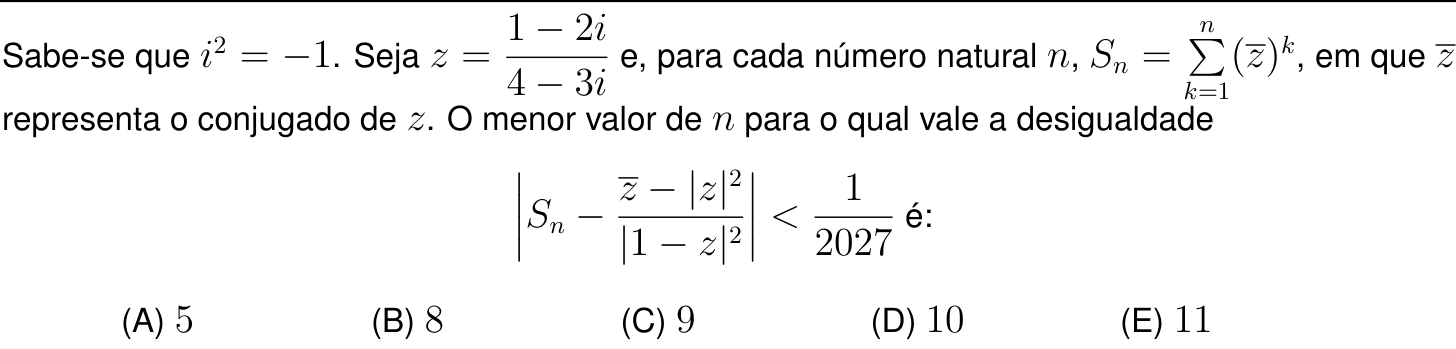
Respondeu
levou 22 s
Como pensou
Racionalizando z, obtemos
z=\frac{(1-2i)(4+3i)}{25}=\frac{2-i}{5}.
Assim,
|z|^2=\frac15
\quad\text{e}\quad
|1-z|^2=\left|\frac{3+i}{5}\right|^2=\frac25.
Pela fórmula da soma de uma progressão geométrica,
S_n=\frac{\overline z\left(1-\overline z^{\,n}\right)}{1-\overline z}.
Além disso,
\frac{\overline z-|z|^2}{|1-z|^2}
=\frac{\overline z(1-z)}{(1-z)(1-\overline z)}
=\frac{\overline z}{1-\overline z}.
Portanto, o módulo da diferença pedida é
\left|-\frac{\overline z^{\,n+1}}{1-\overline z}\right|
=\frac{|z|^{n+1}}{|1-z|}
=\frac{(1/\sqrt5)^{n+1}}{\sqrt{2/5}}
=\frac1{\sqrt{2\cdot5^n}}.
Logo, a desigualdade equivale a
2\cdot5^n>2027^2=4\,108\,729.
Como
2\cdot5^9=3\,906\,250<4\,108\,729
\quad\text{e}\quad
2\cdot5^{10}=19\,531\,250>4\,108\,729,
e 5^n é crescente, o menor valor é \boxed{n=10}.
Resposta: D
Respondeu
levou 21 s
Como pensou
**Verifying complex equations**
I'm working on verifying a complex equation where z equals (1-2i)/(4-3i), which simplifies down to (2-i)/5. Then I calculate the modulus |z| and proceed with checking the necessary conditions for summing based on the finite series. I’m focusing on inequalities to analyze growth relative to cutoff points. My outcome will involve breaking down the math into three clear paragraphs, and I’ll also need to provide a Portuguese derivation.
Racionalizando z, temos
z=\frac{(1-2i)(4+3i)}{4^2+3^2}
=\frac{2-i}{5}.
Logo,
|z|=\frac1{\sqrt5}
\quad\text{e}\quad
|1-z|=\left|\frac{3+i}{5}\right|=\sqrt{\frac25}.
Pela fórmula da soma de uma progressão geométrica,
S_n=\frac{\overline z\bigl(1-(\overline z)^n\bigr)}{1-\overline z}.
Além disso,
\frac{\overline z-|z|^2}{|1-z|^2}
=\frac{\overline z(1-z)}{(1-z)(1-\overline z)}
=\frac{\overline z}{1-\overline z}.
Assim, o módulo da diferença indicada no enunciado é
\left|-\frac{(\overline z)^{n+1}}{1-\overline z}\right|
=\frac{|z|^{n+1}}{|1-z|}
=\frac1{\sqrt{2\cdot5^n}}.
Portanto, a desigualdade equivale a
2\cdot5^n>2027^2=4\,108\,729.
Como
2\cdot5^9=3\,906\,250<4\,108\,729
e
2\cdot5^{10}=19\,531\,250>4\,108\,729,
e 5^n é crescente, o menor valor é n=10.
Resposta: D
Respondeu
levou 12 s
Como pensou
Calculando z e seu módulo:
z=\frac{1-2i}{4-3i}=\frac{2-i}{5},
\qquad
\bar z=\frac{2+i}{5},
\qquad
|z|^2=\frac15.
Além disso,
|1-z|^2=\left|\frac{3+i}{5}\right|^2=\frac25
e, portanto,
\frac{\bar z-|z|^2}{|1-z|^2}
=\frac{(1+i)/5}{2/5}
=\frac{1+i}{2}
=\frac{\bar z}{1-\bar z}.
Assim, esse quociente é a soma da série geométrica infinita \sum_{k=1}^{\infty}(\bar z)^k. A diferença entre ela e S_n é o módulo da cauda:
\left|S_n-\frac{\bar z-|z|^2}{|1-z|^2}\right|
=\left|\frac{(\bar z)^{n+1}}{1-\bar z}\right|
=\frac{1}{\sqrt{2\cdot 5^n}}.
A desigualdade pedida equivale a 2\cdot5^n>2027^2. Para n=9, temos 2\cdot5^9=3\,906\,250<2027^2=4\,108\,729; para n=10, 2\cdot5^{10}=19\,531\,250>2027^2. Logo, o menor valor é 10.
Resposta: D
Respondeu
levou 16 s
Como pensou
I simplify z = (1-2i)/(4-3i) by multiplying by the conjugate, getting (2-i)/5. So |z|² = 1/5, and now I need to work with z̄ = (2+i)/5 to compute the sum S_n of its powers.
The sum S_n = z̄(1-z̄^n)/(1-z̄) converges to z̄/(1-z̄), so the deviation from the limit is -z̄^{n+1}/(1-z̄), whose modulus is |z|^{n+1}/|1-z|. Computing |1-z| = √10/5, I get |diff| = 5^{(1-n)/2}/√10. Setting this less than 1/2027 requires 5^{(n-1)/2} > 641, and since 5^4 = 625 falls short while 5^{4.5} ≈ 1397.5 clears it, n-1 must be at least 9 — testing n=9 fails (625<641) but n=10 works. Answer is D.
Calculando z:
z=\frac{1-2i}{4-3i}=\frac{(1-2i)(4+3i)}{25}=\frac{4+3i-8i+6}{25}=\frac{10-5i}{25}=\frac{2-i}{5}.
Logo \bar z=\dfrac{2+i}{5}, |z|^2=\dfrac{4+1}{25}=\dfrac15 e |z|=\dfrac{1}{\sqrt5}<1.
Soma geométrica:
S_n=\sum_{k=1}^{n}\bar z^{\,k}=\frac{\bar z\,(1-\bar z^{\,n})}{1-\bar z}.
Observe que o termo subtraído é exatamente a soma da série infinita:
\frac{\bar z}{1-\bar z}=\frac{\bar z(1-z)}{(1-\bar z)(1-z)}=\frac{\bar z-|z|^2}{|1-z|^2}.
Portanto
S_n-\frac{\bar z-|z|^2}{|1-z|^2}=-\frac{\bar z^{\,n+1}}{1-\bar z}
\quad\Longrightarrow\quad
\left|S_n-\frac{\bar z-|z|^2}{|1-z|^2}\right|=\frac{|z|^{n+1}}{|1-z|}.
Calculando |1-z|:
1-z=\frac{5-(2-i)}{5}=\frac{3+i}{5}\ \Rightarrow\ |1-z|=\frac{\sqrt{10}}{5}.
Desigualdade:
\frac{5^{-(n+1)/2}\cdot 5}{\sqrt{10}}<\frac{1}{2027}
\iff 5^{\frac{n-1}{2}}>\frac{2027}{\sqrt{10}}\approx 641.
- n=9: 5^{4}=625<641 — não serve.
- n=10: 5^{4{,}5}=625\sqrt5\approx 1397>641 — serve.
Logo o menor n é 10.
Resposta: D
Respondeu
levou 13 s
Como pensou
I compute z = (1-2i)/(4-3i), simplifying to (2-i)/5, giving |z| = 1/√5. Then I set up the geometric series S_n with w = z̄, and work toward the limiting sum S = w/(1-w) by expressing it in terms of z and |z|².
Checking the error bound: |S_n - S| = |w|^(n+1)/|1-w|, and computing |1-w| = √10/5. I need this ratio under 1/2027, so I solve 5^((n+1)/2) > 2027√10/2 ≈ 3205. Testing n=9 gives 3125 (too small) and n=10 gives roughly 6988 (sufficient), so n=10 is the answer.
Resposta: n = 10 (alternativa D)
1. Cálculo de z
z=\frac{1-2i}{4-3i}=\frac{(1-2i)(4+3i)}{25}=\frac{10-5i}{25}=\frac{2-i}{5}
Logo |z|^2=\dfrac{1}{5}. Seja w=\overline z=\dfrac{2+i}{5}, com |w|=\dfrac{1}{\sqrt5}<1.
2. Soma da progressão geométrica
S_n=\sum_{k=1}^n w^k=\frac{w(1-w^n)}{1-w}
3. Identificação da expressão subtraída
Multiplicando numerador e denominador por \overline{1-w}=1-z:
\frac{w}{1-w}=\frac{w(1-z)}{|1-w|^2}=\frac{\overline z-|z|^2}{|1-z|^2}
Usou-se wz=|z|^2 e |1-w|=|1-z|. Portanto a expressão é a soma infinita S=\dfrac{w}{1-w}, e:
|S_n-S|=\left|\frac{-w^{n+1}}{1-w}\right|=\frac{|w|^{n+1}}{|1-w|}
4. Módulo de 1 − w
|1-w|=\left|\frac{3-i}{5}\right|=\frac{\sqrt{10}}{5}
5. Desigualdade
\frac{5^{-(n+1)/2}\cdot 5}{\sqrt{10}}<\frac{1}{2027}\iff 5^{(n+1)/2}>\frac{2027\cdot 5}{\sqrt{10}}=\frac{2027\sqrt{10}}{2}\approx 3205
Testando os valores:
- Para n=9: 5^{5}=3125<3205, não satisfaz.
- Para n=10: 5^{5{,}5}\approx 6988>3205, satisfaz.
Logo o menor valor é n=10.
Resposta: D
Respondeu
levou 9 s
Como pensou
Simplifying z gives (2-i)/5, with modulus squared 1/5. I'm setting w as the conjugate and computing the infinite geometric series sum w/(1-w), then checking whether it matches the claimed closed-form expression involving z̄ and |1-z|².
Working through the algebra, the difference between the partial sum and infinite sum reduces to |w|^{n+1}/|1-w|, and plugging in |1-w|=√10/5 gives a clean exponential inequality. Solving 5^{(n-1)/2}·√10 > 2027 shows n-1=8 fails (625·√10≈1976.4) while n-1=9 works, so n=10, matching answer D.
Cálculo de z. Multiplicando numerador e denominador pelo conjugado do denominador:
z = (1 − 2i)(4 + 3i)/25 = (10 − 5i)/25 = (2 − i)/5.
Logo, z̄ = (2 + i)/5 e |z|² = 5/25 = 1/5.
Soma. Seja w = z̄. Então Sₙ = w(1 − wⁿ)/(1 − w), uma soma de PG com razão w.
Como |w| < 1, a soma infinita é S = w/(1 − w). Multiplicando numerador e denominador por 1 − w̄:
S = w(1 − w̄)/|1 − w|² = (w − |w|²)/|1 − w|².
Como |1 − z̄| = |1 − z| e |z̄| = |z|, o termo subtraído na desigualdade, (z̄ − |z|²)/|1 − z|², é exatamente S.
Reescrevendo a desigualdade.
|Sₙ − S| = |w|ⁿ⁺¹/|1 − w|.
Temos |w| = 1/√5 e 1 − w = (3 − i)/5, de modo que |1 − w| = √10/5. Então:
|Sₙ − S| = 5^(−(n+1)/2) · 5/√10 = 5^((1−n)/2)/√10.
Condição. Precisamos de 5^((1−n)/2)/√10 < 1/2027, ou seja, 5^((n−1)/2) · √10 > 2027.
- Para n = 9: 5⁴ · √10 = 625 · 3,162 ≈ 1976 < 2027, e a condição não vale.
- Para n = 10: 5^4,5 · √10 = 625 · √5 · √10 ≈ 625 · 7,07 ≈ 4419 > 2027, e a condição vale.
Para n < 9 o valor é ainda menor, então a condição também não vale. Portanto, o menor n é 10.
Resposta: D
Respondeu
levou 1 min 10 s
Como pensou
The problem is in Portuguese. I will translate it.
I am solving the complex number problem. First I will compute z by multiplying numerator and denominator by the conjugate of the denominator.
I found that z = 2/5 − 1/5i, so its conjugate is 2/5 + 1/5i and |z|² = 1/5. Now I am examining the sum S_n.
The sum S_n is a geometric series. The target expression simplifies to \(\frac{\bar{z}}{1 - \bar{z}}\), which is the infinite sum of the series.
I derived the exact error term for the partial sum. It equals \(\frac{|\bar{z}|^{n+1}}{|1 - \bar{z}|}\). I will now compute these values to find the smallest n satisfying the inequality.
I simplified the error bound to \(\frac{|z|^{n+1}}{|1-z|}\). I noted that \(\sqrt{5} = 1/|z|\), so the numerator is \((1/\sqrt{5})^{n+1}\). I also computed that \(\overline{1-z} = |1-z|\). Now I am evaluating the denominator.
I computed the denominator as \(\frac{\sqrt{10}}{5}\). The error bound simplifies to \(\frac{5^{1 - (n+1)/2}}{\sqrt{10}}\). I am now solving the inequality for the smallest natural number n.
I verified the error bound simplifies to \(\frac{\sqrt{5^{1-m}}}{\sqrt{2}}\), where m = n+1.
I squared 2027 to get 4,108,729. Dividing by 2 gives 2,054,364.5. I am now checking powers of 5 to find the smallest m such that 5^{m-1} exceeds this value.
I checked the powers of 5. Since 5^9 = 1,953,125 is below 2,054,364.5 and 5^10 = 9,765,625 exceeds it, m−1 must be at least 10. This means n+1 ≥ 11, so n ≥ 10. The smallest natural number satisfying the strict inequality is therefore 10.
I verified the algebraic simplification numerically. The fraction equals 0.5 + 0.5i, matching \(\bar{z}/(1 - \bar{z})\). The smallest natural number n is 10, so the answer is D.
I checked the numerical values for n = 9. The error term is approximately 0.000506, which is slightly larger than 1/2027 ≈ 0.0004933. This confirms that n = 9 does not satisfy the inequality.
O número complexo dado é
z=\frac{1-2i}{4-3i}=\frac{2}{5}-\frac{1}{5}i.
Segue que \overline{z}=\frac{2}{5}+\frac{1}{5}i, |z|^2=\frac{1}{5} e
|1-z|=\frac{\sqrt{10}}{5}.
A soma S_n é a soma parcial de uma série geométrica de razão \overline{z}. O termo que aparece na desigualdade é precisamente a soma da série infinita correspondente:
\frac{\overline{z}-|z|^2}{|1-z|^2}=\frac{\overline{z}}{1-\overline{z}}.
Portanto o erro cometido ao truncar a série no termo de ordem n é
\left|S_n-\frac{\overline{z}-|z|^2}{|1-z|^2}\right|=\frac{|z|^{n+1}}{|1-z|}=\frac{1}{\sqrt{2\cdot5^n}}.
A desigualdade pedida equivale então a
5^n>\frac{2027^2}{2}=2054364{,}5.
Como 5^9=1953125<2054364{,}5 e 5^{10}=9765625>2054364{,}5, o menor natural n que satisfaz a desigualdade é n=10.
Resposta: D
Respondeu
levou 7 s
Como pensou
We need answer in Portuguese, solve. Need parse problem. Let's restate.
i^2=-1. z = (1 - 2i)/(4 - 3i). For natural n, S_n = sum_{k=1}^n (\bar z)^k, where \bar z conjugate. Find least n such that
| S_n - ( \bar z - |z|^2 ) / |1 - z|^2 | < 1/2027.
Need determine n options.
We need solve carefully. Let's compute z, \bar z, |z|, modulus |1-z|. Then S_n geometric finite. The expression inside absolute is S_n minus some constant. We can find its magnitude as function of n likely geometric term. Then inequality.
Let's compute exact.
z = (1 - 2i)/(4 - 3i). Multiply by conjugate denom: (1-2i)(4+3i)/(16+9=25). Numerator: 4 + 3i - 8i -6 i^2? Wait (1)(4+3i)=4+3i; (-2i)(4+3i)= -8i -6 i^2 = -8i +6 (since i^2=-1 -> -6(-1)=+6). Total 10 -5i. /25 = (2 - i)/5? 10/25=2/5, -5/25=-1/5 i. So z = 2/5 - (1/5)i = (2 - i)/5. Check.
Conjugate \bar z = (2 + i)/5 = 2/5 + i/5.
|z|^2 = (4+1)/25 = 5/25 = 1/5.
Compute |1 - z|^2. 1 - z = 1 - (2/5 - i/5) = 3/5 + i/5. Mod squared = (9+1)/25 = 10/25 = 2/5.
Then constant C = (\bar z - |z|^2)/|1-z|^2 = ( (2+i)/5 - 1/5 ) / (2/5) = ( (2+i -1)/5 ) / (2/5) = ((1+i)/5) * (5/2) = (1+i)/2. So C = (1+i)/2.
S_n = sum_{k=1}^n (\bar z)^k. Let q = \bar z = (2+i)/5 = 2/5 + i/5. Sum finite = q (1 - q^n)/(1 - q). Because k=1 to n. Need S_n - C. We can derive closed form maybe equals? Let's compute.
Alternatively S_n = q/(1-q) (1 - q^n). Then S_n - C = q/(1-q) - C - q^{n+1}/(1-q)? Since q(1 - q^n)/(1-q)= q/(1-q) - q^{n+1}/(1-q). Need maybe q/(1-q) equals? Let's compute.
q = \bar z = (2+i)/5. 1 - q = 1 - (2+i)/5 = (5 -2 - i)/5 = (3 - i)/5. q/(1-q) = ((2+i)/5) / ((3-i)/5) = (2+i)/(3-i). Multiply (3+i): (2+i)(3+i)/(9+1) = (6 +2i +3i + i^2)/10 = (6 +5i -1)/10 = (5+5i)/10 = (1+i)/2. Ah same C! Indeed q/(1-q) = C. Then S_n = C (1 - q^n)? Wait q/(1-q)(1 - q^n) = C (1 - q^n) because q/(1-q)=C. So S_n = C(1 - q^n). Then S_n - C = - C q^n? Actually C(1 - q^n) - C = -C q^n. Magnitude = |C| |q|^n. |C| = |(1+i)/2| = sqrt(2)/2 = 1/sqrt2. |q|^2 = |\bar z|^2 = |z|^2 = 1/5, so |q| = 1/sqrt5. So |S_n - C| = (1/sqrt2) * (1/sqrt5)^n = 1/(sqrt2 * 5^{n/2})? Actually (1/sqrt2)*(1/sqrt5)^n = 1/(sqrt2 * 5^{n/2}). Need < 1/2027.
So inequality: 1/(sqrt2 * 5^{n/2}) < 1/2027 -> sqrt2 * 5^{n/2} > 2027 -> 5^{n/2} > 2027 / sqrt2 ≈ 2027 / 1.41421356 ≈ 1433.5? Let's compute: 2027*0.7071=1433.5. Then take logs: (n/2) log10 5 > log10(1433.5) ≈ 3.1564? log10 1433.5 = log10(1.4335e3)=3.1564. log10 5≈0.69897. n/2 > 3.1564/0.69897 = 4.515 something? n > 9.03. Thus n min integer 10? Let's check options include 10. But need verify exact maybe n=10? Let's compute precisely.
Alternatively simplify inequality exact maybe |1+i|/2 * (1/√5)^n <? Wait |C| = √2/2 = 1/√2. |q|^n = (1/√5)^n. Product = 1/(√2 * 5^{n/2}). Yes.
Need smallest n such that √2 * 5^{n/2} > 2027. Let's test n=9: 5^{4.5}=5^4*sqrt5=625*2.2360679=1397.542? times √2 = 1976.4? Actually 1397.54*1.4142 = 1976.5 <2027. n=10: 5^5=3125 * sqrt2? Wait 5^{5}=3125 times sqrt2 =4419>2027. So n=10. Check n=9 maybe 5^{9/2}=5^4*sqrt5=1397.54, times sqrt2=1976.4 <2027, so inequality |...| = 1/1976.4 ≈0.000506 >1/2027≈0.000493, so not strict. n=10: 1/(√2*3125)=1/4419≈0.000226 <1/2027. So answer D.
Need produce explanation in Portuguese. Need maybe mention computations. Let's craft final with steps.
But ensure no mistakes. Let's recalc z exactly.
z = (1-2i)/(4-3i) = (1-2i)(4+3i)/25 = (4+3i -8i -6 i^2)/25 = (4+3i -8i +6)/25 = (10 -5i)/25 = (2 - i)/5. Yes.
Conjugate q = (2+i)/5.
|q| = sqrt(4+1)/5 = sqrt5/5 = 1/√5. Yes.
C = (q - |z|^2)/(|1-z|^2). |z|^2 = 1/5. 1-z = 1 - (2-i)/5 = (3+i)/5? Wait wait careful! z = (2 - i)/5. Then 1 - z = 1 - (2/5 - i/5) = 1 - 2/5 + i/5 = 3/5 + i/5 = (3 + i)/5. Yes. Mod square = (9+1)/25 = 10/25=2/5. Good. q - |z|^2 = (2+i)/5 - 1/5 = (1+i)/5. Divide by 2/5 = (1+i)/2. Yes.
S_n = sum_{k=1}^n q^k = q(1 - q^n)/(1-q). Since q/(1-q) =? q = (2+i)/5, 1-q=(3-i)/5, ratio=(2+i)/(3-i). Multiply by (3+i): (2+i)(3+i)/(9+1)= (6+2i+3i+i^2)/10 = (5+5i)/10 = (1+i)/2 = C. Thus S_n = C(1 - q^n). Then S_n - C = -C q^n. Magnitude = |C||q|^n = (√2/2)*(1/√5)^n = 1/(√2*5^{n/2}). Wait √2/2 = 1/√2 yes.
Inequality: 1/(√2*5^{n/2}) < 1/2027 => √2*5^{n/2} > 2027.
Now test n=9: √2*5^{4.5} = √2*625√5 maybe approximate: √2*625*2.236 = 1414.2*? Actually √2*√5=√10≈3.16227766. Times 625 = 1976.42? 3.16227766*625 = 3.16227766*600 + *25 = 1897.3666 + 79.0569 = 1976.4235. <2027.
n=10: √2*5^5 = √2*3125 = 4419.4 >2027. Therefore smallest n=10.
Check if there is any subtlety: natural n maybe includes 0? They define S_n for natural n sum k=1 to n, so n≥1. Options min 5. No issue.
Potential issue: S_n = sum_{k=1}^n (\bar z)^k, so q=\bar z. We used q. Good.
Need answer: D. Provide explanation.
But let's consider if they want "menor valor de n" among options (A)5 (B)8 (C)9 (D)10 (E)11. Our n=10, D.
Let's craft final in Portuguese.
Need maybe include all calculations. Since final answer with line "Resposta: D".
Let's write.
Temos:
z=\frac{1-2i}{4-3i}\cdot \frac{4+3i}{4+3i}
=\frac{4+3i-8i-6i^2}{25}
=\frac{10-5i}{25}
=\frac{2-i}{5}.
Assim,
\bar z=\frac{2+i}{5},\qquad |z|^2=\frac{2^2+1^2}{25}=\frac15.
Além disso,
1-z=1-\frac{2-i}{5}=\frac{3+i}{5}
e
|1-z|^2=\frac{3^2+1^2}{25}=\frac{10}{25}=\frac25.
A soma pedida é uma PG de razão \bar z:
S_n=\sum_{k=1}^n(\bar z)^k
=\bar z\frac{1-(\bar z)^n}{1-\bar z}.
Como
\frac{\bar z}{1-\bar z}
=\frac{(2+i)/5}{(3-i)/5}
=\frac{2+i}{3-i}
=\frac{(2+i)(3+i)}{10}
=\frac{5+5i}{10}
=\frac{1+i}{2},
temos
S_n=\frac{1+i}{2}\left[1-(\bar z)^n\right].
Agora,
\frac{\bar z-|z|^2}{|1-z|^2}
=
\frac{\frac{2+i}{5}-\frac15}{\frac25}
=
\frac{\frac{1+i}{5}}{\frac25}
=
\frac{1+i}{2}.
Portanto,
S_n-\frac{\bar z-|z|^2}{|1-z|^2}
=
-\frac{1+i}{2}(\bar z)^n.
Logo,
\left|S_n-\frac{\bar z-|z|^2}{|1-z|^2}\right|
=
\left|\frac{1+i}{2}\right|\cdot |\bar z|^n
=
\frac{\sqrt2}{2}\left(\frac1{\sqrt5}\right)^n
=
\frac1{\sqrt2\cdot 5^{n/2}}.
Queremos:
\frac1{\sqrt2\cdot 5^{n/2}}<\frac1{2027}
\iff
\sqrt2\cdot 5^{n/2}>2027.
Testando:
\sqrt2\cdot 5^{9/2}=625\sqrt{10}\approx 1976{,}4<2027,
então não vale.
\sqrt2\cdot 5^5=3125\sqrt2\approx 4419>2027,
então vale.
Portanto, o menor valor de n é 10.
Resposta: D
Respondeu
levou 28 s
Como pensou
**Exploring Complex Number Properties**
I'm currently working through a complex numbers problem involving a geometric series of conjugated complex numbers. My focus is on simplifying the initial complex number $z$ and then evaluating the sum $S_n$ for various natural numbers $n$. The ultimate goal is to determine the smallest $n$ satisfying a specific condition, which I'm still analyzing.
**Simplifying Complex Geometric Series**
I've calculated $|z|$ and $|z|^2$, confirming that $|\overline{z}| < 1$. I'm now working on the sum $S_n = \sum_{k=1}^n (\overline{z})^k$ and comparing it to the given condition. I need to determine if $\frac{\overline{z} - |z|^2}{|1-z|^2}$ simplifies to $\frac{\overline{z}}{1 - \overline{z}}$.
**Confirming Complex Series Simplification**
I've successfully verified the simplification of the sum expression. My focus has shifted to calculating $|1-z|$, which I've determined to be $\frac{\sqrt{10}}{5}$. This value will be crucial for assessing the magnitude of the series difference.
**Calculating Series Magnitude Bounds**
I've confirmed the simplification of the complex series. My current focus involves bounding the magnitude of the series difference, which I've refined to $\frac{1}{\sqrt{2} \cdot 5^{n/2}}$. The next step is to find the smallest $n$ such that this magnitude is less than $\frac{1}{2027}$, leading to an inequality $2 \cdot 5^n > 2027^2$.
**Determining Smallest Natural Number**
I've completed the calculations to determine the smallest natural number $n$. By squaring 2027 and comparing it to powers of 5, I found that $n=10$ is the smallest value satisfying the derived inequality $2 \cdot 5^n > 2027^2$.
**Calculating Series Magnitude Bounds**
I've confirmed the simplification of the complex series and the expression for its difference. My current focus involves calculating the magnitude of this difference using the previously determined values for $|z|$ and $|1-z|$. This will allow me to establish a bound for the subsequent inequality.
Para resolver a questão, vamos inicialmente simplificar os termos dados.
-
Cálculo de |z|:
Dado z = \dfrac{1 - 2i}{4 - 3i}, calculamos o módulo do numerador e do denominador:
|1 - 2i| = \sqrt{1^2 + (-2)^2} = \sqrt{5}
|4 - 3i| = \sqrt{4^2 + (-3)^2} = \sqrt{25} = 5
Portanto:
|z| = \frac{\sqrt{5}}{5} = \frac{1}{\sqrt{5}} \implies |z|^2 = \frac{1}{5}
Como o conjugado tem o mesmo módulo, temos |\overline{z}| = |z| = \dfrac{1}{\sqrt{5}}.
-
Cálculo de |1 - z|:
1 - z = 1 - \frac{1 - 2i}{4 - 3i} = \frac{(4 - 3i) - (1 - 2i)}{4 - 3i} = \frac{3 - i}{4 - 3i}
Calculando o módulo:
|3 - i| = \sqrt{3^2 + (-1)^2} = \sqrt{10}
|1 - z| = \frac{|3 - i|}{|4 - 3i|} = \frac{\sqrt{10}}{5}
-
Cálculo da soma S_n:
A soma S_n = \sum_{k=1}^n (\overline{z})^k é a soma dos n primeiros termos de uma progressão geométrica com primeiro termo a_1 = \overline{z} e razão q = \overline{z}:
S_n = \overline{z} \cdot \frac{1 - (\overline{z})^n}{1 - \overline{z}} = \frac{\overline{z}}{1 - \overline{z}} - \frac{(\overline{z})^{n+1}}{1 - \overline{z}}
-
Simplificação da fração \dfrac{\overline{z} - |z|^2}{|1 - z|^2}:
Lembrando que |1 - z|^2 = (1 - z)\overline{(1 - z)} = (1 - z)(1 - \overline{z}) e que |z|^2 = z\overline{z}:
\frac{\overline{z} - |z|^2}{|1 - z|^2} = \frac{\overline{z} - z\overline{z}}{(1 - z)(1 - \overline{z})} = \frac{\overline{z}(1 - z)}{(1 - z)(1 - \overline{z})} = \frac{\overline{z}}{1 - \overline{z}}
-
Substituição na desigualdade:
A diferença entre S_n e essa expressão torna-se:
S_n - \frac{\overline{z} - |z|^2}{|1 - z|^2} = -\frac{(\overline{z})^{n+1}}{1 - \overline{z}}
Tomando o módulo:
\left| S_n - \frac{\overline{z} - |z|^2}{|1 - z|^2} \right| = \frac{|\overline{z}|^{n+1}}{|1 - \overline{z}|} = \frac{|z|^{n+1}}{|1 - z|}
Substituindo os valores encontrados:
\frac{\left(\frac{1}{\sqrt{5}}\right)^{n+1}}{\frac{\sqrt{10}}{5}} = \frac{5}{\sqrt{10}} \cdot \frac{1}{\sqrt{5} \cdot (\sqrt{5})^n} = \frac{\sqrt{5}}{\sqrt{2}\sqrt{5}} \cdot \frac{1}{5^{n/2}} = \frac{1}{\sqrt{2} \cdot 5^{n/2}}
-
Determinando o menor valor de n:
Queremos que:
\frac{1}{\sqrt{2} \cdot 5^{n/2}} < \frac{1}{2027} \iff \sqrt{2} \cdot 5^{n/2} > 2027
Elevando ambos os lados ao quadrado:
2 \cdot 5^n > 2027^2 = 4.108.729 \iff 5^n > \frac{4.108.729}{2} = 2.054.364,5
Analisando as potências de 5:
- Para n = 9: 5^9 = 1.953.125 < 2.054.364,5
- Para n = 10: 5^{10} = 9.765.625 > 2.054.364,5
Portanto, o menor valor natural de n é 10.
Resposta: D