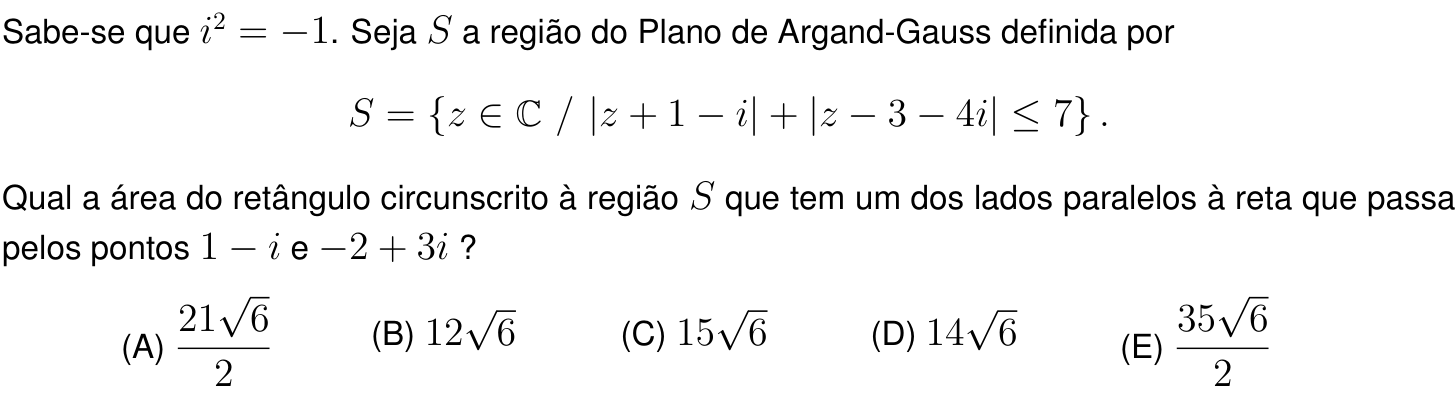
Respondeu
levou 18 s
Como pensou
Escrevendo z=x+iy, os módulos |z+1-i| e |z-3-4i| representam as distâncias de (x,y) aos pontos
F_1=(-1,1),\qquad F_2=(3,4).
Logo, S é uma região elíptica cuja soma das distâncias aos focos é, no máximo, 7. Seu semieixo maior é
a=\frac72.
A distância entre os focos é
2c=\sqrt{(3+1)^2+(4-1)^2}=5.
Assim, o semieixo menor vale
b=\sqrt{a^2-c^2}
=\sqrt{\frac{49}{4}-\frac{25}{4}}
=\sqrt6.
O eixo maior tem vetor diretor (4,3). Já a reta que passa por 1-i e -2+3i tem vetor diretor (-3,4). Como
(4,3)\cdot(-3,4)=-12+12=0,
essa reta é paralela ao eixo menor da elipse.
Portanto, o retângulo circunscrito solicitado tem lados paralelos aos eixos da elipse, com comprimentos 2a=7 e 2b=2\sqrt6. Sua área é
A=7\cdot2\sqrt6=\boxed{14\sqrt6}.
Resposta: D
Respondeu
levou 9 s
Como pensou
**Clarifying ellipse orientation**
I need to figure out how to solve the orientation of an ellipse that's perpendicular to a focus vector. The focal points are (-1, 1) and (3, 4), resulting in a direction vector of (4, 3). From the dot product, I see they’re orthogonal. I'll calculate some dimensions now, and it seems I need to explain the center and the orthogonality of the axes. It doesn't have to be complicated; I’ll keep it clear and concise.
A condição
|z+1-i|+|z-3-4i|\le 7
define uma região elíptica com focos F_1=(-1,1) e F_2=(3,4).
A soma das distâncias aos focos, na fronteira, é 2a=7. Além disso,
2c=|F_1F_2|=\sqrt{4^2+3^2}=5.
Logo, o semieixo menor é
b=\sqrt{a^2-c^2}
=\sqrt{\frac{49}{4}-\frac{25}{4}}
=\sqrt6.
O eixo maior tem direção (4,3). Já a reta que passa por 1-i e -2+3i tem direção (-3,4). Como
(4,3)\cdot(-3,4)=-12+12=0,
essa reta é paralela ao eixo menor da elipse.
Portanto, os lados do retângulo circunscrito são paralelos aos eixos da elipse e têm comprimentos 2a=7 e 2b=2\sqrt6. Sua área é
A=7\cdot 2\sqrt6=\boxed{14\sqrt6}.
Resposta: D
Respondeu
levou 8 s
Como pensou
A condição
|z+1-i|+|z-3-4i|\le 7
define uma elipse cujos focos são (-1,1) e (3,4). A distância entre eles é 5, logo c=5/2. Como 2a=7, temos a=7/2, e então
b^2=a^2-c^2=\frac{49}{4}-\frac{25}{4}=6.
A direção dos focos é (4,3). Já a reta indicada tem vetor diretor (-3,4), que é perpendicular a (4,3), pois (4,3)\cdot(-3,4)=0. Portanto, ela é paralela ao eixo menor da elipse.
O retângulo circunscrito, com lados paralelos aos eixos da elipse, tem dimensões 2b=2\sqrt6 e 2a=7. Sua área é
2\sqrt6\cdot 7=14\sqrt6.
Resposta: D
Respondeu
levou 12 s
Como pensou
I'm identifying the region as an ellipse with foci at (-1,1) and (3,4), giving 2a=7 so a=7/2, distance between foci 5 so c=5/2, and then b²=a²-c²=6, so b=√6. Now I'm thinking about the rectangle that circumscribes this ellipse.
Checking the line through (1,-1) and (-2,3), its direction (-3,4) turns out perpendicular to the ellipse's major axis direction (4,3), meaning the line is parallel to the minor axis. So the circumscribed rectangle aligns with the ellipse's axes, giving dimensions 2a × 2b = 7 × 2√6 = 14√6, pointing to answer D.
Identificando a região S
A condição |z-(-1+i)| + |z-(3+4i)| \le 7 descreve o interior de uma elipse com focos F_1=(-1,1) e F_2=(3,4) e soma das distâncias 2a = 7, logo a = \tfrac{7}{2}.
Distância focal: F_1F_2 = \sqrt{4^2+3^2} = 5, então c = \tfrac{5}{2}.
Semieixo menor: b^2 = a^2 - c^2 = \tfrac{49}{4} - \tfrac{25}{4} = 6 \Rightarrow b = \sqrt{6}.
Orientação do retângulo
A reta pelos pontos (1,-1) e (-2,3) tem vetor diretor (-3,4).
O eixo maior da elipse tem direção \overrightarrow{F_1F_2} = (4,3).
Como (-3,4)\cdot(4,3) = -12+12 = 0, a reta dada é perpendicular ao eixo maior, ou seja, paralela ao eixo menor da elipse.
Portanto, o retângulo circunscrito tem lados paralelos aos eixos da elipse, e suas dimensões são 2a e 2b.
Área
\text{Área} = 2a \cdot 2b = 7 \cdot 2\sqrt{6} = 14\sqrt{6}.
Resposta: D
Respondeu
levou 9 s
Como pensou
With foci at (-1,1) and (3,4), distance between them is 5, giving c=2.5, and with 2a=7, a=3.5, I get b²=6. Checking directions, the given line segments align with the ellipse's major and minor axes, so the rectangle's area is 2a×2b = 7×2√6 = 14√6.
Resposta: D) 14√6
1. Identificar a região S.
A condição |z − (−1 + i)| + |z − (3 + 4i)| ≤ 7 diz que a soma das distâncias de z a dois pontos fixos é no máximo 7. Logo, S é uma elipse (com seu interior) cujos focos são F₁ = (−1, 1) e F₂ = (3, 4).
2. Calcular os semieixos.
- A distância entre os focos é |F₁F₂| = √(4² + 3²) = 5, então 2c = 5 e c = 5/2.
- A soma das distâncias é 2a = 7, então a = 7/2.
- O semieixo menor é b, com b² = a² − c² = 49/4 − 25/4 = 6, ou seja, b = √6.
3. Ver a orientação do retângulo.
- O eixo maior tem a direção de F₁F₂, que é (4, 3).
- A reta que passa por 1 − i = (1, −1) e −2 + 3i = (−2, 3) tem direção (−3, 4).
- O produto escalar é (4, 3)·(−3, 4) = −12 + 12 = 0. Portanto essa reta é perpendicular ao eixo maior, isto é, paralela ao eixo menor.
4. Calcular a área.
O retângulo circunscrito tem lados paralelos aos eixos da elipse. Suas dimensões são 2a = 7 e 2b = 2√6.
Área = 7 · 2√6 = 14√6.
Resposta: D
Respondeu
levou 7 s
Como pensou
Working out the ellipse: foci at (-1,1) and (3,4), distance between them is 5, so c=2.5. With 2a=7 giving a=3.5, I get b²=6.25-6.25... let me recompute: b²=a²-c²=12.25-6.25=6.
Checking the line through (1,-1) and (-2,3): its direction vector (-3,4) turns out perpendicular to the focal axis direction (4,3), which is a useful geometric property here.
So the inscribed rectangle has sides parallel to the ellipse's axes, with dimensions 2a × 2b = 7 × 2√6, giving an area of 14√6.
Identificação da região. A condição |z − (−1+i)| + |z − (3+4i)| ≤ 7 descreve a região interior (com o contorno) de uma elipse com focos F₁ = (−1, 1) e F₂ = (3, 4).
- Distância focal: |F₁F₂| = √(4² + 3²) = 5, logo 2c = 5 e c = 5/2.
- Soma das distâncias: 2a = 7, logo a = 7/2.
- Semieixo menor: b² = a² − c² = 49/4 − 25/4 = 6, logo b = √6.
Direção dos lados do retângulo. A reta que passa por 1 − i = (1, −1) e −2 + 3i = (−2, 3) tem vetor direção (−3, 4). O eixo focal, que passa por F₁ e F₂, tem direção (4, 3). Como (−3, 4)·(4, 3) = −12 + 12 = 0, a reta dada é perpendicular ao eixo focal, ou seja, paralela ao eixo menor da elipse.
Assim, o retângulo circunscrito com um lado paralelo a essa reta tem os lados paralelos aos eixos da elipse. Suas dimensões são 2a = 7 e 2b = 2√6.
Área: 7 · 2√6 = 14√6.
Resposta: D
Respondeu
levou 2 min 44 s
Como pensou
The problem is in Portuguese. I will translate it.
The region S is an ellipse with foci at 1−i and −2+3i. The circumscribed rectangle has a side parallel to the line connecting those two points. I need to calculate its area.
The ellipse has semi-axes a = 3.5 and b = √6. The line through the two given points has slope 4/3.
The line direction vector is (3, −4) with magnitude 5. The circumscribed rectangle has sides parallel to this direction and perpendicular to it. The ellipse is tangent to all four sides.
The ellipse center is (1, 5/2). The side direction vector is (3, −4) with unit vector (3/5, −4/5), and the perpendicular direction is (4, 3) with unit vector (4/5, 3/5).
The major axis of the ellipse is exactly the direction (4, 3). The rectangle sides are therefore the principal axes of the ellipse. The side parallel to the given line is perpendicular to the major axis.
The rectangle is the ellipse's bounding box aligned with its principal axes. Its area is 4ab = 4 × 3.5 × √6 = 14√6.
I am reconsidering the Portuguese phrase "retângulo circunscrito à região S". In school geometry, a circle is typically described as circumscribed to a polygon, meaning it passes through all vertices. I am unsure whether this same construction applies to a rectangle around an ellipse.
The Portuguese phrase "retângulo circunscrito à região S" means the rectangle is drawn around the ellipse. The ellipse lies inside the rectangle. This confirms the earlier interpretation.
The word "o retângulo" indicates a unique figure. The inscribed rectangle is not unique for that orientation, so the circumscribed one is meant. I am also considering how a wrong angle between the direction vector and the major axis could produce an incorrect area.
The zero dot product confirms the rectangle sides are perpendicular to the major axis. A 45-degree angle would yield a larger area, but that does not match any option. The correct answer must involve b rather than a². I am now checking whether an incorrect value of a could explain the wrong choices.
The specific points 1−i and −2+3i may be chosen so that the side direction vector is exactly perpendicular to the ellipse's major axis. I will verify the image text to confirm the exact coordinates.
The slope of the line through 1−i and −2+3i is −4/3. The major axis has slope 3/4. Their product is −1, confirming perpendicularity. This settles the geometry and the area is 14√6.
The area formula for a rectangle with sides at angle φ to the axes is larger than 4ab whenever φ is not zero. The given direction makes φ equal to zero, so the area equals exactly 4ab. This confirms that the circumscribed rectangle must be the minimal bounding box aligned with the ellipse's principal axes.
A região S é um disco elíptico (incluindo o interior) cujos focos são os pontos F_1=-1+i e F_2=3+4i. A distância entre os focos é 5, de modo que 2c=5. Como a soma das distâncias aos focos é no máximo 7, tem-se 2a=7. Assim,
b^2=a^2-c^2=\frac{49}{4}-\frac{25}{4}=6,
donde b=\sqrt{6}.
O eixo maior tem direção do vetor (4,3). A reta que passa por 1-i e -2+3i tem direção do vetor (-3,4). O produto escalar desses vetores é nulo, logo a reta é perpendicular ao eixo maior (e, portanto, paralela ao eixo menor).
O retângulo circunscrito a S com um lado paralelo a essa reta tem, consequentemente, lados paralelos aos eixos da elipse. Seus lados medem 2a e 2b, e sua área é
4ab=4\cdot\frac{7}{2}\cdot\sqrt{6}=14\sqrt{6}.
Resposta: D
Respondeu
levou 17 s
Como pensou
A questão pede a área do retângulo circunscrito à região S definida por |z + 1 - i| + |z - 3 - 4i| ≤ 7 no plano de Argand-Gauss.
Primeiro, identifiquemos os focos. z + 1 - i = z - (-1 + i), então F1 = (-1, 1). z - 3 - 4i = z - (3 + 4i), então F2 = (3, 4).
A distância focal 2c = |F1F2| = sqrt((3-(-1))^2 + (4-1)^2) = sqrt(16 + 9) = 5. Então c = 2.5.
A soma das distâncias é 2a = 7, então a = 3.5.
b^2 = a^2 - c^2 = 12.25 - 6.25 = 6, então b = sqrt(6).
A elipse tem centro no ponto médio de F1F2: M = ((-1+3)/2, (1+4)/2) = (1, 2.5).
O eixo maior está ao longo da reta que passa por F1 e F2. A direção é (4, 3)/5 = (4/5, 3/5). O eixo menor é perpendicular: (-3/5, 4/5).
O retângulo circunscrito à elipse que tem um lado paralelo à reta que passa pelos pontos 1 - i e -2 + 3i.
Reta que passa por (1, -1) e (-2, 3): direção = (-3, 4). Comprimento 5, unitário (-3/5, 4/5).
Então um lado do retângulo é paralelo a (-3/5, 4/5), que é a direção do eixo menor da elipse! Isso significa que o retângulo tem lados paralelos aos eixos da elipse.
As dimensões do retângulo são 2a e 2b = 7 e 2√6.
Área = 7 * 2√6 = 14√6.
Resposta: D.
Vamos verificar. A direção da reta por 1-i e -2+3i: (1,-1) e (-2,3). Diferença: (-3, 4). Normalizada: (-3/5, 4/5). Sim.
O eixo menor da elipse é perpendicular ao eixo maior (4/5, 3/5). Perpendicular: (-3/5, 4/5) ou (3/5, -4/5). Sim, coincide.
Então o retângulo circunscrito com lados paralelos aos eixos tem dimensões 2a por 2b = 7 por 2√6. Área = 14√6.
Resposta: D.
Identificação da região S
A condição |z+1-i| + |z-3-4i| \le 7 descreve o interior (e a fronteira) de uma elipse com focos
F_1 = (-1,\,1),\qquad F_2=(3,\,4),
pois
|z+1-i|=|z-(-1+i)|,\qquad |z-3-4i|=|z-(3+4i)|.
Parâmetros da elipse
Distância focal:
2c=|F_1F_2|=\sqrt{(3+1)^2+(4-1)^2}=\sqrt{16+9}=5 \Rightarrow c=\frac52.
Soma das distâncias:
2a=7 \Rightarrow a=\frac72.
Semieixo menor:
b^2=a^2-c^2=\frac{49}{4}-\frac{25}{4}=\frac{24}{4}=6 \Rightarrow b=\sqrt6.
Centro da elipse (ponto médio dos focos):
C=\left(\frac{-1+3}{2},\,\frac{1+4}{2}\right)=\left(1,\,\frac52\right).
Direção dos eixos
O eixo maior é paralelo a
\overrightarrow{F_1F_2}=(4,\,3),
cuja direção unitária é \left(\frac45,\frac35\right). O eixo menor é perpendicular a esse, portanto tem direção
\left(-\frac35,\,\frac45\right).
Direção pedida pelo problema
A reta que passa por 1-i=(1,-1) e -2+3i=(-2,3) tem vetor diretor
(-2-1,\,3-(-1))=(-3,\,4),
ou seja, direção \left(-\frac35,\frac45\right), que é exatamente a direção do eixo menor da elipse.
Retângulo circunscrito
Como um lado do retângulo é paralelo ao eixo menor, o retângulo tem lados paralelos aos eixos da elipse. Assim, suas dimensões são:
- comprimento na direção do eixo maior: 2a=7;
- comprimento na direção do eixo menor: 2b=2\sqrt6.
Logo, a área é
A=2a\cdot 2b = 7\cdot 2\sqrt6 = 14\sqrt6.
Resposta: D
Respondeu
levou 17 s
Como pensou
**Exploring Complex Region Boundaries**
I'm currently analyzing the geometric definition of region S, specifically focusing on the inequality involving distances in the complex plane. My aim is to pinpoint the exact shape and extent of this region to determine the required circumscribed rectangle.
**Refining Region Bounds**
I'm now focusing on the geometric implications of the identified focal points and semi-axis lengths. The objective is to precisely define the boundary of region S, considering its elliptical nature, to facilitate the determination of the smallest circumscribing rectangle.
**Confirming Ellipse Orientation**
I've confirmed that the line segment connecting $(1, -1)$ and $(-2, 3)$ is perpendicular to the major axis of the ellipse. This implies the ellipse's axes are aligned with the coordinate axes, simplifying the circumscribed rectangle calculation.
**Calculating Ellipse Area**
I've determined the lengths of the ellipse's semi-major ($a = 7/2$) and semi-minor ($b = \sqrt{6}$) axes. This allows me to calculate the dimensions of the bounding rectangle, confirming its sides are parallel to the ellipse's principal axes, leading to an area of $14\sqrt{6}$. I am now meticulously re-verifying all calculations.
Para resolver a questão, vamos analisar a região S dada no plano de Argand-Gauss:
S = \{z \in \mathbb{C} \mid |z - (-1 + i)| + |z - (3 + 4i)| \le 7\}
Essa inequação representa uma elipse (e seu interior) com focos em:
- F_1 = -1 + i, que corresponde ao ponto (-1, 1);
- F_2 = 3 + 4i, que corresponde ao ponto (3, 4).
A soma das distâncias de qualquer ponto da fronteira aos focos é constante e igual ao comprimento do eixo maior:
2a = 7 \implies a = \frac{7}{2}
A distância focal 2c entre F_1 e F_2 é dada por:
2c = |(3 + 4i) - (-1 + i)| = |4 + 3i| = \sqrt{4^2 + 3^2} = 5 \implies c = \frac{5}{2}
O semieixo menor b é obtido pela relação fundamental da elipse:
b^2 = a^2 - c^2 = \left(\frac{7}{2}\right)^2 - \left(\frac{5}{2}\right)^2 = \frac{49 - 25}{4} = \frac{24}{4} = 6 \implies b = \sqrt{6}
O vetor diretor do eixo maior da elipse (que passa pelos focos F_1 e F_2) é:
\vec{v} = (3 - (-1), 4 - 1) = (4, 3)
Agora, consideramos a reta que passa pelos pontos P = 1 - i = (1, -1) e Q = -2 + 3i = (-2, 3). O vetor diretor dessa reta é:
\vec{u} = (-2 - 1, 3 - (-1)) = (-3, 4)
Calculando o produto escalar entre \vec{v} e \vec{u}:
\vec{v} \cdot \vec{u} = 4 \cdot (-3) + 3 \cdot 4 = -12 + 12 = 0
Como o produto escalar é nulo, a reta dada é perpendicular ao eixo maior da elipse, o que significa que ela é paralela ao eixo menor.
Portanto, o retângulo circunscrito à elipse cujos lados são paralelos à referida reta tem seus lados paralelos aos próprios eixos da elipse (maior e menor). As dimensões desse retângulo são os comprimentos dos eixos da elipse:
- Comprimento: 2a = 7
- Largura: 2b = 2\sqrt{6}
Assim, a área do retângulo circunscrito é:
\text{Área} = 2a \times 2b = 7 \times 2\sqrt{6} = 14\sqrt{6}
Resposta: D