Respondeu
levou 21 s
Como pensou
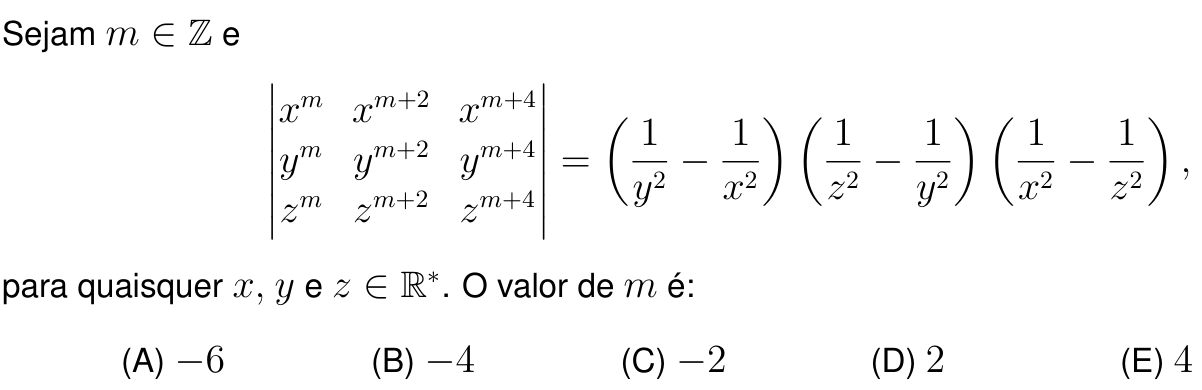
Colocando x^m, y^m e z^m em evidência nas respectivas linhas, o determinante fica
(xyz)^m
\begin{vmatrix}
1&x^2&x^4\\
1&y^2&y^4\\
1&z^2&z^4
\end{vmatrix}.
O determinante restante é de Vandermonde, logo o lado esquerdo é
(xyz)^m(y^2-x^2)(z^2-x^2)(z^2-y^2).
Por outro lado, o lado direito pode ser escrito como
\frac{(x^2-y^2)(y^2-z^2)(z^2-x^2)}{x^4y^4z^4}
=
(xyz)^{-4}(y^2-x^2)(z^2-x^2)(z^2-y^2),
pois a inversão dos sinais nos dois primeiros fatores não altera o produto.
Assim, para x^2,y^2,z^2 distintos, podemos cancelar os fatores comuns e obter
(xyz)^m=(xyz)^{-4}.
Como a igualdade vale para quaisquer valores não nulos, tomando, por exemplo, x=1, y=2 e z=3, temos
6^m=6^{-4}\quad\Longrightarrow\quad \boxed{m=-4}.
Esse valor também satisfaz a identidade quando há quadrados iguais, pois ambos os lados se anulam.
Resposta: B
Respondeu
levou 17 s
Como pensou
Colocando x^m, y^m e z^m em evidência nas respectivas linhas, o determinante fica
(xyz)^m
\begin{vmatrix}
1&x^2&x^4\\
1&y^2&y^4\\
1&z^2&z^4
\end{vmatrix}.
O determinante restante é de Vandermonde, logo vale
(y^2-x^2)(z^2-x^2)(z^2-y^2).
Por outro lado,
\begin{aligned}
\left(\frac1{y^2}-\frac1{x^2}\right)
\left(\frac1{z^2}-\frac1{y^2}\right)
\left(\frac1{x^2}-\frac1{z^2}\right)
&=\frac{(x^2-y^2)(y^2-z^2)(z^2-x^2)}{x^4y^4z^4}\\
&=(xyz)^{-4}(y^2-x^2)(z^2-x^2)(z^2-y^2).
\end{aligned}
Como a igualdade deve valer para quaisquer valores não nulos, podemos tomar x=1, y=2 e z=3. Nesse caso, o produto de diferenças é não nulo e pode ser cancelado, dando
6^m=6^{-4}\quad\Longrightarrow\quad \boxed{m=-4}.
Esse valor também garante a identidade para todos os demais valores não nulos.
Resposta: B
Respondeu
levou 17 s
Como pensou
**Explaining products and exponents**
I’m considering a situation where the product is arbitrary and non-zero, possibly leading to an equation like m + 4 = 0. To explore this, I might choose distinct values for x, y, and z, such as 2, to help illustrate the idea. The equation 2^(m + 4) = 1 indicates that m + 4 must equal 0, thus giving m a value of -4. I need to clarify a subtle issue here regarding repeated squares and negative m defined due to the non-zero constraint.
Defina a=x^2, b=y^2 e c=z^2. Colocando x^m,y^m,z^m em evidência nas linhas do determinante, obtemos
\det\begin{pmatrix}
x^m&x^{m+2}&x^{m+4}\\
y^m&y^{m+2}&y^{m+4}\\
z^m&z^{m+2}&z^{m+4}
\end{pmatrix}
=(xyz)^m(b-a)(c-a)(c-b).
Já o produto do lado direito da questão é
\left(\frac1b-\frac1a\right)
\left(\frac1c-\frac1b\right)
\left(\frac1a-\frac1c\right)
=\frac{(b-a)(c-a)(c-b)}{a^2b^2c^2}
=\frac{(b-a)(c-a)(c-b)}{(xyz)^4}.
Escolhendo, por exemplo, x=1, y=2 e z=3, o fator (b-a)(c-a)(c-b) é não nulo. Portanto, a igualdade implica 6^m=6^{-4}, logo m=-4.
Resposta: B
Respondeu
levou 16 s
Como pensou
Factoring out x^m, y^m, z^m from the rows, I get a Vandermonde-type determinant in x², y², z², which evaluates to (xyz)^m(y²-x²)(z²-x²)(z²-y²). On the right side, I'm computing differences like 1/y² - 1/x² in terms of (x²-y²).
Multiplying out, the right-hand product simplifies to (y²-x²)(z²-y²)(z²-x²)/(xyz)^4 after sign flips cancel. Matching powers gives (xyz)^m = (xyz)^{-4}, so m = -4, confirming answer B.
Passo 1 – Simplificar o determinante.
Colocando em evidência x^m, y^m e z^m das linhas:
\begin{vmatrix} x^m & x^{m+2} & x^{m+4}\\ y^m & y^{m+2} & y^{m+4}\\ z^m & z^{m+2} & z^{m+4}\end{vmatrix}
=(xyz)^m\begin{vmatrix} 1 & x^2 & x^4\\ 1 & y^2 & y^4\\ 1 & z^2 & z^4\end{vmatrix}
O determinante restante é de Vandermonde com a=x^2,\ b=y^2,\ c=z^2:
(xyz)^m\,(y^2-x^2)(z^2-x^2)(z^2-y^2).
Passo 2 – Simplificar o lado direito.
\left(\frac{1}{y^2}-\frac{1}{x^2}\right)\left(\frac{1}{z^2}-\frac{1}{y^2}\right)\left(\frac{1}{x^2}-\frac{1}{z^2}\right)
=\frac{(x^2-y^2)(y^2-z^2)(z^2-x^2)}{x^4y^4z^4}.
Como (x^2-y^2)=-(y^2-x^2) e (y^2-z^2)=-(z^2-y^2), os dois sinais se cancelam:
=\frac{(y^2-x^2)(z^2-y^2)(z^2-x^2)}{(xyz)^4}=(xyz)^{-4}(y^2-x^2)(z^2-x^2)(z^2-y^2).
Passo 3 – Comparar.
Para a igualdade valer para quaisquer x,y,z\in\mathbb{R}^*, devemos ter (xyz)^m=(xyz)^{-4}, ou seja, m=-4.
Resposta: B
Respondeu
levou 15 s
Como pensou
I'm factoring out x^m y^m z^m to reduce the determinant to a Vandermonde form in x^2, y^2, z^2, then expanding the right side's reciprocal differences over the squared variables to compare the two expressions term by term.
Since the sign patterns in both expansions match exactly, the equation reduces to (xyz)^m = (xyz)^{-4}, giving m = -4.
Resposta: m = −4
Passo 1 – Colocar fatores em evidência.
Em cada linha do determinante, coloca-se em evidência x^m, y^m e z^m:
\det = x^m y^m z^m
\begin{vmatrix}
1 & x^2 & x^4\\
1 & y^2 & y^4\\
1 & z^2 & z^4
\end{vmatrix}.
Passo 2 – Calcular o determinante de Vandermonde.
Fazendo a=x^2, b=y^2 e c=z^2, o determinante restante é um Vandermonde:
\begin{vmatrix}1&a&a^2\\1&b&b^2\\1&c&c^2\end{vmatrix}=(b-a)(c-a)(c-b).
Como (b-a)(c-b)=(a-b)(b-c), isso equivale a (a-b)(b-c)(c-a).
Logo, o lado esquerdo vale:
\text{LE} = (xyz)^m\,(a-b)(b-c)(c-a).
Passo 3 – Simplificar o lado direito.
\left(\frac{1}{y^2}-\frac{1}{x^2}\right)\left(\frac{1}{z^2}-\frac{1}{y^2}\right)\left(\frac{1}{x^2}-\frac{1}{z^2}\right)
=\frac{(x^2-y^2)(y^2-z^2)(z^2-x^2)}{x^4y^4z^4}.
Em termos de a, b e c:
\text{LD} = (xyz)^{-4}\,(a-b)(b-c)(c-a).
Passo 4 – Comparar os dois lados.
A igualdade deve valer para quaisquer x, y, z \in \mathbb{R}^*. Isso exige (xyz)^m=(xyz)^{-4}, ou seja, m=-4.
Resposta: B
Respondeu
levou 11 s
Como pensou
Factoring x^m, y^m, z^m out of the rows reduces the determinant to a Vandermonde-type expression, giving (y²-x²)(z²-x²)(z²-y²) times x^m y^m z^m. I'm now comparing this to the right side, which involves differences of reciprocals that I can rewrite as fractions with products in the denominator.
Simplifying the sign and denominator structure, this right side also reduces to the same Vandermonde factor divided by (xyz)^4. Matching both sides shows x^m y^m z^m must equal (xyz)^{-4}, so m = -4.
Resolução
Coloque x^m, y^m e z^m em evidência nas linhas 1, 2 e 3 do determinante. Com a = x², b = y² e c = z², obtemos:
\text{LHS} = (xyz)^m \begin{vmatrix}1&a&a^2\\1&b&b^2\\1&c&c^2\end{vmatrix} = (xyz)^m\,(b-a)(c-a)(c-b),
que é um determinante de Vandermonde.
Agora o lado direito:
\left(\tfrac1b-\tfrac1a\right)\left(\tfrac1c-\tfrac1b\right)\left(\tfrac1a-\tfrac1c\right)=\frac{(a-b)}{ab}\cdot\frac{(b-c)}{bc}\cdot\frac{(c-a)}{ca}=\frac{(a-b)(b-c)(c-a)}{(abc)^2}.
Como (a−b)(b−c) = (b−a)(c−b), o numerador é (b−a)(c−b)(c−a), ou seja, o mesmo produto de Vandermonde. Assim:
\text{RHS}=\frac{(b-a)(c-a)(c-b)}{(abc)^2}=\frac{(b-a)(c-a)(c-b)}{(xyz)^4}.
Igualando os dois lados e cancelando o Vandermonde (que não é nulo em geral), temos (xyz)^m = (xyz)^{-4}. Logo, m = −4.
Resposta: B
Respondeu
levou 48 s
Como pensou
The problem is in Portuguese. I will translate it.
I need to find the integer m such that the given determinant equals the product of differences of inverse squares for all non-zero real x, y, z. The right-hand side is independent of m, so I will evaluate the determinant and match it to the expression.
Factoring out powers from each row gives the product of x^m, y^m, and z^m times a 3×3 matrix with entries 1, x², x⁴. This resembles a Vandermonde matrix.
The Vandermonde determinant evaluates to (y² − x²)(z² − x²)(z² − y²). The full expression is therefore x^m y^m z^m times this product.
The right-hand side is rewritten as a product of three fractions. Each fraction is the negative of a difference of squares divided by the product of two squared variables.
The right-hand side simplifies to a fraction with denominator x⁴y⁴z⁴ and numerator (y² − x²)(z² − y²)(z² − x²). The signs are now fully accounted for.
The numerator is identical on both sides. The equation becomes (xyz)^m times the numerator equals that same numerator divided by (xyz)^4. This implies m must be −4.
I considered verifying the result numerically with specific values, but I cannot run code. I also briefly reconsidered whether the Vandermonde ordering might be wrong. My algebraic reasoning appears sound.
I checked the right-hand side numerically with x=1, y=2, z=3. The product of differences of inverse squares evaluates to 5/54.
The numerical check confirms the right-hand side equals 5/54. The determinant evaluates to (xyz)^m times 120, which must equal that same fraction. This forces m = −4. The equality holds for all non-zero real values of x, y, and z.
A matriz do determinante pode ser reescrita fatorando-se x^m, y^m e z^m de cada linha, o que produz
(xyz)^m
\begin{vmatrix}
1 & x^2 & x^4 \\
1 & y^2 & y^4 \\
1 & z^2 & z^4
\end{vmatrix}.
A matriz restante é de Vandermonde nas variáveis x^2, y^2 e z^2, cujo determinante vale
(y^2-x^2)(z^2-x^2)(z^2-y^2).
Assim, o lado esquerdo da igualdade é exatamente
(xyz)^m(y^2-x^2)(z^2-x^2)(z^2-y^2).
No lado direito, cada diferença de inversos se reescreve como
\frac1{y^2}-\frac1{x^2}=-\frac{y^2-x^2}{x^2y^2},\qquad
\frac1{z^2}-\frac1{y^2}=-\frac{z^2-y^2}{y^2z^2},\qquad
\frac1{x^2}-\frac1{z^2}=\frac{z^2-x^2}{x^2z^2}.
O produto desses três fatores é
\frac{(y^2-x^2)(z^2-y^2)(z^2-x^2)}{(xyz)^4}.
Igualando os dois lados (e cancelando o fator comum não nulo para x,y,z genéricos) obtém-se
(xyz)^m=(xyz)^{-4},
donde m=-4. A identidade vale para todo x,y,z\in\mathbb{R}^* precisamente quando esse valor de m é escolhido.
Resposta: B
Respondeu
levou 26 s
Como pensou
We need answer in Portuguese, solve. Need parse image. We have determinant:
| x^m x^{m+2} x^{m+4} |
| y^m y^{m+2} y^{m+4} |
| z^m z^{m+2} z^{m+4} | = (1/y^2 - 1/x^2)(1/z^2 - 1/y^2)(1/x^2 - 1/z^2), for all x,y,z in R*. Find m.
We need solve. Let's denote determinant D. Matrix columns are powers with exponents m, m+2, m+4. Factor x^m, y^m, z^m from rows? Actually row i has factor variable_i^m? Yes first column x^m, second x^{m+2}=x^m x^2, third x^m x^4. So determinant = x^m y^m z^m * det([[1, x^2, x^4],[1,y^2,y^4],[1,z^2,z^4]]). This is Vandermonde-like in variables X=x^2, Y=y^2, Z=z^2. Determinant of rows [1, X, X^2]? Wait [1, x^2, x^4] = [1, X, X^2]. Yes. So determinant = (xyz)^m * det Vandermonde in X,Y,Z with rows [1,X,X^2], [1,Y,Y^2], [1,Z,Z^2]. Vandermonde determinant = (Y-X)(Z-X)(Z-Y)? Need sign. Standard det [[1,a,a^2],[1,b,b^2],[1,c,c^2]] = (b-a)(c-a)(c-b). Check with a=0,b=1,c=2: det [[1,0,0],[1,1,1],[1,2,4]] = 4-2=2. (1-0)(2-0)(2-1)=2. Yes = (Y-X)(Z-X)(Z-Y). So D = (xyz)^m (y^2 - x^2)(z^2 - x^2)(z^2 - y^2).
RHS given: (1/y^2 - 1/x^2)(1/z^2 - 1/y^2)(1/x^2 - 1/z^2). Let's simplify signs/factors. Compute:
1/y^2 - 1/x^2 = (x^2 - y^2)/(x^2 y^2) = -(y^2 - x^2)/(x^2 y^2).
1/z^2 - 1/y^2 = (y^2 - z^2)/(y^2 z^2) = -(z^2 - y^2)/(y^2 z^2).
1/x^2 - 1/z^2 = (z^2 - x^2)/(x^2 z^2) = ? = -(x^2 - z^2)/(x^2 z^2) = ? We need relate to (z^2 - x^2) = -(x^2 - z^2). Let's keep.
Product = [(x^2 - y^2)/(x^2 y^2)] * [(y^2 - z^2)/(y^2 z^2)] * [(z^2 - x^2)/(x^2 z^2)].
= (x^2 - y^2)(y^2 - z^2)(z^2 - x^2) / (x^4 y^4 z^4)? Denominator x^2 y^2 * y^2 z^2 * x^2 z^2 = x^4 y^4 z^4.
Now (x^2 - y^2) = -(y^2 - x^2). (y^2 - z^2) = -(z^2 - y^2). (z^2 - x^2) = ? = (z^2 - x^2) = -(x^2 - z^2)? Not in D. Let's express product in terms of (y^2 - x^2)(z^2 - x^2)(z^2 - y^2). D factors: A=(y^2-x^2), B=(z^2-x^2), C=(z^2-y^2). Product RHS:
x^2 - y^2 = -A.
y^2 - z^2 = -C? Since C=z^2-y^2, so y^2 - z^2 = -C.
z^2 - x^2 = B (since B=z^2-x^2). So numerator = (-A)(-C)(B)= A B C. Yes two negatives. So RHS = ABC / (x^4 y^4 z^4) = (y^2-x^2)(z^2-x^2)(z^2-y^2) / (x^4 y^4 z^4).
Equality:
(xyz)^m * ABC = ABC / (x^4 y^4 z^4) = ABC * (xyz)^{-4}.
For all x,y,z nonzero. Since ABC not identically zero and can be nonzero, we need (xyz)^m = (xyz)^{-4} for all x,y,z? Wait equality: (xyz)^m ABC = (xyz)^{-4} ABC for all x,y,z. For all x,y,z with ABC ≠ 0, divide: (xyz)^m = (xyz)^{-4}. This must hold for all nonzero x,y,z. Let t=xyz can be any nonzero real? For any t≠0, choose x=t,y=1,z=1 => xyz=t. Then t^m = t^{-4} for all t≠0. This implies m = -4. Check if m integer. Yes. Alternative perhaps sign? Let's verify determinant expansion sign. Let's test numeric.
Take x=1,y=2,z=3, m=-4. D = (xyz)^m * (4-1)(9-1)(9-4) = (6)^-4 * 3*8*5 = 120/1296 = 5/54? RHS = (1/4 -1)(1/9 -1/4)(1 -1/9) = (-3/4)*(? 1/9-1/4=4/36-9/36=-5/36)*(8/9) = (-3/4)*(-5/36)*(8/9) = (15/144)*(8/9)= (5/48)*(8/9)=40/432=5/54. Yes. m=-4.
Need provide explanation in Portuguese, concise. Let's craft. Ensure final line "Resposta: B". The alternative B is -4.
Need maybe show determinant factoring. Let's write:
D = x^m y^m z^m det [[1,x^2,x^4],...] = (xyz)^m (y^2-x^2)(z^2-x^2)(z^2-y^2). Then RHS simplify to same product over (xyz)^4. Equality for all x,y,z implies (xyz)^m = (xyz)^-4, so m=-4.
Need maybe mention all x,y,z nonzero so divide by Vandermonde product, which is not identically zero; indeed for any t choose x=t,y=1,z=1. Good.
Final answer with explanation.
Fatorando x^m, y^m, z^m de cada linha do determinante, obtemos:
D=(xyz)^m
\begin{vmatrix}
1&x^2&x^4\\
1&y^2&y^4\\
1&z^2&z^4
\end{vmatrix}
O determinante restante é um Vandermonde nas variáveis x^2,y^2,z^2:
\begin{vmatrix}
1&x^2&x^4\\
1&y^2&y^4\\
1&z^2&z^4
\end{vmatrix}
=(y^2-x^2)(z^2-x^2)(z^2-y^2)
Logo,
D=(xyz)^m(y^2-x^2)(z^2-x^2)(z^2-y^2).
Agora simplificamos o lado direito:
\left(\frac1{y^2}-\frac1{x^2}\right)
\left(\frac1{z^2}-\frac1{y^2}\right)
\left(\frac1{x^2}-\frac1{z^2}\right)
=
\frac{(y^2-x^2)(z^2-x^2)(z^2-y^2)}{x^4y^4z^4}.
Como x^4y^4z^4=(xyz)^4, a igualdade do enunciado fica:
(xyz)^m(y^2-x^2)(z^2-x^2)(z^2-y^2)
=
\frac{(y^2-x^2)(z^2-x^2)(z^2-y^2)}{(xyz)^4}.
Para x,y,z\in\mathbb R^*, podemos cancelar o fator comum não identicamente nulo, obtendo:
(xyz)^m=(xyz)^{-4}.
Como isso deve valer para quaisquer x,y,z\neq 0, conclui-se que:
m=-4.
Resposta: B
Respondeu
levou 31 s
Como pensou
**Analyzing the IME Problem**
I'm currently looking at an IME problem involving a determinant and trying to understand its structure. My focus is on the relationship between the determinant's value and the given expression. The presence of variables in the exponents makes me think about factorizing or finding some key relationship. I am beginning to explore the properties of determinants and algebraic manipulation to get a sense of how the variables interact. I aim to reduce the complexity to identify the variables involved.
**Calculating the Determinant**
I've successfully computed the determinant, factoring out $x^m, y^m,$ and $z^m$. Recognizing the remaining matrix as a Vandermonde determinant, I expressed it in terms of $x^2, y^2,$ and $z^2$. My next step is to analyze the right-hand side of the equation and relate it to the determinant. This should let me find the value of $m$.
**Confirming the Solution**
The right-hand side has been thoroughly simplified, factoring out the differences of squares and simplifying the fractions. I've carefully checked the signs and verified the power of the denominator. By equating both sides, I'm now certain that the only way the equality holds true is if *m* equals -4. Thus, answer (B) seems correct.
Para resolver a questão, vamos calcular o determinante no lado esquerdo da igualdade e comparar a expressão com o lado direito.
Seja o determinante:
D = \begin{vmatrix}
x^m & x^{m+2} & x^{m+4} \\
y^m & y^{m+2} & y^{m+4} \\
z^m & z^{m+2} & z^{m+4}
\end{vmatrix}
Podemos colocar x^m em evidência na primeira linha, y^m na segunda linha e z^m na terceira linha:
D = x^m y^m z^m \begin{vmatrix}
1 & x^2 & x^4 \\
1 & y^2 & y^4 \\
1 & z^2 & z^4
\end{vmatrix}
O determinante restante é um determinante de Vandermonde associado aos termos a = x^2, b = y^2 e c = z^2:
\begin{vmatrix}
1 & a & a^2 \\
1 & b & b^2 \\
1 & c & c^2
\end{vmatrix} = (b - a)(c - b)(c - a)
Substituindo a, b, c:
\begin{vmatrix}
1 & x^2 & x^4 \\
1 & y^2 & y^4 \\
1 & z^2 & z^4
\end{vmatrix} = (y^2 - x^2)(z^2 - y^2)(z^2 - x^2)
Portanto, o lado esquerdo é dado por:
\text{LHS} = (xyz)^m (y^2 - x^2)(z^2 - y^2)(z^2 - x^2)
Agora, manipulando o lado direito da igualdade:
\text{RHS} = \left(\frac{1}{y^2} - \frac{1}{x^2}\right)\left(\frac{1}{z^2} - \frac{1}{y^2}\right)\left(\frac{1}{x^2} - \frac{1}{z^2}\right)
Reescrevendo cada termo com denominadores comuns:
- \frac{1}{y^2} - \frac{1}{x^2} = \frac{x^2 - y^2}{x^2 y^2} = -\frac{y^2 - x^2}{x^2 y^2}
- \frac{1}{z^2} - \frac{1}{y^2} = \frac{y^2 - z^2}{y^2 z^2} = -\frac{z^2 - y^2}{y^2 z^2}
- \frac{1}{x^2} - \frac{1}{z^2} = \frac{z^2 - x^2}{x^2 z^2}
Multiplicando os fatores:
\text{RHS} = \left(-\frac{y^2 - x^2}{x^2 y^2}\right) \left(-\frac{z^2 - y^2}{y^2 z^2}\right) \left(\frac{z^2 - x^2}{x^2 z^2}\right) = \frac{(y^2 - x^2)(z^2 - y^2)(z^2 - x^2)}{x^4 y^4 z^4}
\text{RHS} = (xyz)^{-4} (y^2 - x^2)(z^2 - y^2)(z^2 - x^2)
Igualando \text{LHS} = \text{RHS}:
(xyz)^m (y^2 - x^2)(z^2 - y^2)(z^2 - x^2) = (xyz)^{-4} (y^2 - x^2)(z^2 - y^2)(z^2 - x^2)
Como a igualdade é válida para quaisquer x, y, z \in \mathbb{R}^*, temos:
(xyz)^m = (xyz)^{-4} \implies m = -4
Resposta: B