Como pensou
We need answer question. Need solve. Let's restate.
Question in Portuguese. Reactions:
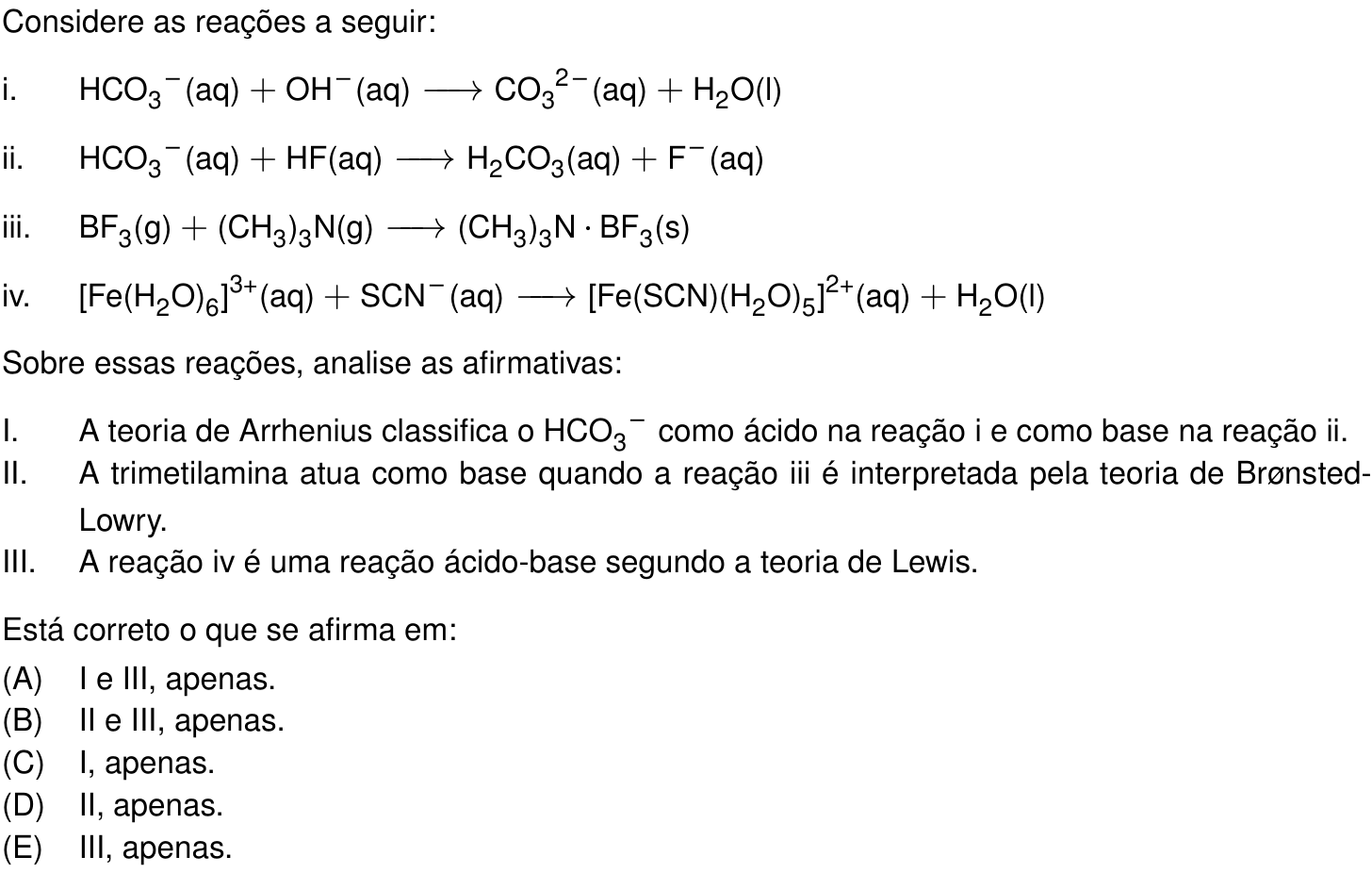
i. HCO3-(aq) + OH-(aq) -> CO3^2-(aq) + H2O(l)
ii. HCO3-(aq) + HF(aq) -> H2CO3(aq) + F-(aq)
iii. BF3(g) + (CH3)3N(g) -> (CH3)3N·BF3(s)
iv. [Fe(H2O)6]^3+(aq) + SCN-(aq) -> [Fe(SCN)(H2O)5]^2+(aq) + H2O(l)
Affirmatives:
I. A teoria de Arrhenius classifica o HCO3- como ácido na reação i e como base na reação ii.
II. A trimetilamina atua como base quando a reação iii é interpretada pela teoria de Brønsted-Lowry.
III. A reação iv é uma reação ácido-base segundo a teoria de Lewis.
Está correto o que se afirma em:
(A) I e III, apenas.
(B) II e III, apenas.
(C) I, apenas.
(D) II, apenas.
(E) III, apenas.
Need evaluate.
Let's parse chemistry.
Reaction i: HCO3- + OH- -> CO3^2- + H2O. Here HCO3- donates proton to OH-? Actually HCO3- + OH- -> CO3^2- + H2O. HCO3- loses H+ to OH-, forming CO3^2-. So HCO3- acts as acid (Brønsted-Lowry proton donor). OH- acts as base. Arrhenius? Arrhenius acid is substance that increases H+ (H3O+) in water; base increases OH-. But HCO3-? It reacts with OH-; in Arrhenius? Let's see. The statement: "A teoria de Arrhenius classifica o HCO3- como ácido na reação i e como base na reação ii." Is this correct? Arrhenius theory limited to aqueous solutions, acids produce H+, bases produce OH-. In reaction i, HCO3- reacts with OH-; does HCO3- produce H+? It releases H+ to OH-, so could be acid? But Arrhenius acid in water produces hydronium; here it's proton transfer to OH-. However HCO3- can act as acid? It has H, can donate; Arrhenius? Actually Arrhenius definition: acid is compound that contains hydrogen and produces H+ in water; base produces OH- in water. HCO3- in water can dissociate? HCO3- is amphoteric; it can act as acid: HCO3- ⇌ H+ + CO3^2-, but in presence of OH-, equilibrium shifts. As Arrhenius acid? It could produce H+? But the reaction with OH- is neutralization: HCO3- (acid) + OH- (base) -> CO3^2- + H2O. Arrhenius acid? Yes maybe. But reaction ii: HCO3- + HF -> H2CO3 + F-. Here HCO3- accepts a proton from HF, forming H2CO3. So HCO3- acts as base (Brønsted). Under Arrhenius? HF is acid (produces H+), HCO3- acts as base? Arrhenius base produces OH-? HCO3- doesn't produce OH-; it accepts H+. So Arrhenius classification? Could classify HCO3- as base? In Arrhenius, base is substance that produces OH- in water; but HCO3- is not Arrhenius base? However in reaction with acid, it neutralizes acid, maybe "base" according to Arrhenius? Actually Arrhenius base is hydroxide compound? Wait Arrhenius base: substance that dissociates in water to produce OH- ions. HCO3- does not produce OH-. But it can accept H+; not Arrhenius base. So statement I may be wrong? Let's see.
The statement says "A teoria de Arrhenius classifica o HCO3- como ácido na reação i e como base na reação ii." In reaction i, HCO3- maybe acid because it neutralizes base? Arrhenius acid? In reaction ii, HCO3- acts as base? Arrhenius? Maybe not. Let's evaluate.
In reaction i, HCO3- + OH- -> CO3^2- + H2O. If consider Arrhenius, acid is species that increases H+ concentration; HCO3- can donate H+ to OH-, so yes acid? Base OH- neutralizes acid. So HCO3- could be Arrhenius acid? It contains H and can liberate H+? But Arrhenius acids are molecular compounds that ionize in water to produce H+. HCO3- is anion, not neutral acid. But "classifica o HCO3- como ácido" maybe not standard? Let's check.
Arrhenius theory: acid = substance that in aqueous solution dissociates to produce H+ (H3O+); base = produces OH-. HCO3- in water can dissociate? HCO3- ⇌ H+ + CO3^2- (acid ionization). So it can act as acid in water. In reaction i, OH- consumes H+, shifting equilibrium; so yes Arrhenius acid? It's a Brønsted acid too. Base? In reaction ii, HCO3- + HF -> H2CO3 + F-. HCO3- accepts proton; is it Arrhenius base? Arrhenius base must produce OH- in water; HCO3- hydrolysis: HCO3- + H2O ⇌ H2CO3 + OH- (base hydrolysis). So yes HCO3- can act as Arrhenius base? It produces OH- by hydrolysis? In presence of acid, it consumes H+ and produces H2CO3; same as base behavior. But Arrhenius base definition? It produces OH- in water; hydrolysis of HCO3- produces OH-, so yes it is a base (weak). However in reaction ii, HF is acid, HCO3- acts as base? The statement says "como base na reação ii" maybe under Arrhenius? It might be acceptable? But need check with theory.
Let's analyze all statements for correct.
II. "A trimetilamina atua como base quando a reação iii é interpretada pela teoria de Brønsted-Lowry." Reaction iii: BF3(g) + (CH3)3N(g) -> (CH3)3N·BF3(s). Trimethylamine has lone pair on N; it donates electron pair to BF3, forming adduct. This is Lewis acid-base, not Brønsted-Lowry because no proton transfer. Brønsted-Lowry requires proton (H+) transfer. In reaction iii, no proton transfer; BF3 is Lewis acid (electron pair acceptor), trimethylamine is Lewis base (electron pair donor). Under Brønsted-Lowry, base is proton acceptor; trimethylamine can accept proton? Yes, trimethylamine is a Brønsted base in water: (CH3)3N + H2O ⇌ (CH3)3NH+ + OH-. But in reaction iii, it donates electron pair to BF3, not accepting proton. So interpretation by Brønsted-Lowry? No, because BF3 doesn't donate proton; it accepts electron pair. Brønsted-Lowry acid-base reaction involves proton transfer. So statement II: "A trimetilamina atua como base quando a reação iii é interpretada pela teoria de Brønsted-Lowry." False. In reaction iii, under Lewis theory, trimethylamine is base, but not Brønsted-Lowry. So II incorrect.
III. "A reação iv é uma reação ácido-base segundo a teoria de Lewis." Reaction iv: [Fe(H2O)6]^3+(aq) + SCN-(aq) -> [Fe(SCN)(H2O)5]^2+(aq) + H2O(l). This is ligand substitution; SCN- donates electron pair to Fe3+ (Lewis acid), forming coordinate covalent bond. Fe3+ is Lewis acid (electron pair acceptor), SCN- is Lewis base (electron pair donor). So yes Lewis acid-base. Statement III correct.
I? Let's check. It says Arrhenius classifies HCO3- as acid in reaction i and base in reaction ii. Need determine if true. Let's examine possible expected in Brazilian chemistry.
Reaction i: HCO3- + OH- -> CO3^2- + H2O. According to Arrhenius, acid is substance that in water releases H+; base releases OH-. HCO3- has H and can release H+ to OH-, so acts as acid? But it's not neutral acid; it's anion. Arrhenius theory can classify ions? The statement says "A teoria de Arrhenius classifica o HCO3- como ácido na reação i e como base na reação ii." Let's consider: In reaction i, HCO3- neutralizes OH-; so it's acid (neutralizes base). In reaction ii, HCO3- neutralizes HF (acid), so it acts as base; HF is acid. Arrhenius base? HCO3- does not have OH, but it can neutralize acid, so maybe "base" according to Arrhenius? Actually Arrhenius base must contain OH? No, Arrhenius base produces OH- in water; HCO3- hydrolysis produces OH-, so yes it is a base. But maybe the statement is false because Arrhenius theory only classifies neutral molecules? Let's see.
Reaction i: HCO3- acts as acid because it donates H+ to OH-? But Arrhenius acids produce H+ in water; HCO3- is amphoteric; it can produce H+ (acid) and OH- (base) by hydrolysis. So yes. Reaction ii: HCO3- acts as base because it accepts H+ from HF? But Arrhenius base? In Arrhenius, base is substance that produces OH- in water; HCO3- does produce OH- in hydrolysis: HCO3- + H2O ⇌ H2CO3 + OH-. So yes base. So I maybe true.
But wait, reaction ii: HCO3- + HF -> H2CO3 + F-. HF is Arrhenius acid? HF in water produces H+; yes. HCO3- neutralizes acid, so it's base. The Arrhenius classification of HCO3- as base? It can be considered base because it neutralizes acid and produces OH-? Hmm.
Let's check if there is nuance: "A teoria de Arrhenius classifica o HCO3- como ácido na reação i e como base na reação ii." Maybe in reaction i, HCO3- acts as acid because it has H+? But Arrhenius acid definition: "ácido é toda substância que em água produz como íon positivo apenas o cátion hidrogênio (H+)." HCO3- is not a substance that produces H+ as only positive ion? When HCO3- dissociates in water, it produces H+ and CO3^2-, but also Na+ if sodium salt. But HCO3- itself is ion. Hmm. Arrhenius definition applies to compounds, not ions? But many textbooks classify ions like HCO3- as amphoteric; can act as acid/base by Brønsted-Lowry, not Arrhenius? Let's investigate.
The question likely tests acid-base theories: Arrhenius vs Brønsted-Lowry vs Lewis. Statement I: "A teoria de Arrhenius classifica o HCO3- como ácido na reação i e como base na reação ii." Under Arrhenius, acids produce H+ in water; bases produce OH- in water. In reaction i, HCO3- reacts with OH-; the species HCO3- could be acid because it releases H+ to OH-? But Arrhenius acid should release H+ in water, not necessarily to OH-? But reaction with OH- is neutralization; yes. In reaction ii, HCO3- reacts with HF; HF is acid (releases H+), HCO3- acts as base by accepting H+? Arrhenius base accepts H+? Actually Arrhenius base neutralizes acid; but definition is produce OH-. HCO3- can produce OH- by hydrolysis, so yes. However, one could argue that in reaction ii, HCO3- is not Arrhenius base because it doesn't have OH; but it produces OH- in water via hydrolysis. Hmm.
Let's see if statement I might be incorrect because "HCO3- como base na reação ii" under Arrhenius? The Arrhenius theory doesn't explain acid-base reactions in non-aqueous or with ions? It does for aqueous.
Let's recall from química: Arrhenius: ácido libera H+ em água; base libera OH- em água. HCO3- é um íon anfótero; em água pode sofrer hidrólise:
HCO3- + H2O ⇌ H2CO3 + OH- (comportamento básico)
HCO3- ⇌ H+ + CO3^2- (comportamento ácido)
Assim, pode ser classificado como ácido ou base de Arrhenius dependendo da reação. A afirmação I pode estar correta.
But wait: Reaction i: HCO3- + OH- -> CO3^2- + H2O. Under Arrhenius, the acid is HCO3-; it reacts with base OH- to form salt CO3^2- and water. Yes, HCO3- acts as acid. Reaction ii: HCO3- + HF -> H2CO3 + F-. HF is acid; HCO3- acts as base (neutralizes acid). Arrhenius base? It accepts H+? Actually Arrhenius base is OH- producer; but HCO3- in water can produce OH- (hydrolysis), so it is a base. So I correct? Need consider alternatives.
If I correct and III correct => alternative A (I e III). If II also? We determined II false. So likely A. But let's verify statement III and I thoroughly.
Let's evaluate III: "A reação iv é uma reação ácido-base segundo a teoria de Lewis." Reaction iv: [Fe(H2O)6]^3+ + SCN- -> [Fe(SCN)(H2O)5]^2+ + H2O. Fe3+ is a Lewis acid (vacant orbital? Actually transition metal cation accepts electron pairs). SCN- is Lewis base (has lone pairs on S and N; donates to Fe). The product is complex; yes Lewis acid-base adduct. So III correct.
Statement II: "A trimetilamina atua como base quando a reação iii é interpretada pela teoria de Brønsted-Lowry." Reaction iii: BF3 + N(CH3)3 -> F3B-N(CH3)3. This is classic Lewis acid-base reaction; no proton transfer. Brønsted-Lowry acid-base requires proton transfer; BF3 is not proton donor, trimethylamine is not proton acceptor in this reaction. So false. Thus A.
But let's ensure statement I not false due to Arrhenius classification of HCO3- as base in reaction ii? Maybe under Arrhenius, HCO3- is not classified as base because it doesn't produce OH-? Let's examine reaction ii more: HCO3- + HF -> H2CO3 + F-. Is HCO3- Arrhenius base? Arrhenius base is a substance that in aqueous solution dissociates to give OH- as the only negative ion. HCO3- is an anion; it doesn't dissociate to give OH-? But its conjugate acid H2CO3? Actually HCO3- can hydrolyze: HCO3- + H2O ⇌ H2CO3 + OH-. This produces OH-; so HCO3- can be considered a base by Arrhenius? However, in the presence of acid HF, it accepts H+; but Arrhenius theory might not cover this because the base is not OH- but HCO3-. But "base segundo Arrhenius" maybe no, because Arrhenius bases are hydroxides (OH-) that release OH- in water. HCO3- is not a hydroxide; it's a bicarbonate. Wait, Arrhenius definition: base is any substance that in water yields OH- ions. It doesn't strictly require hydroxide formula? Historically Arrhenius defined bases as substances that produce hydroxide ions in aqueous solution. Many salts like Na2CO3, NaHCO3 produce OH- by hydrolysis and are considered Arrhenius bases? Actually Na2CO3 is a base? In Arrhenius, yes, because it neutralizes acids and turns red litmus blue? But Arrhenius theory only considers acids as substances that produce H+ and bases as substances that produce OH- in water. NaHCO3 solution is basic due to hydrolysis producing OH-, so it is Arrhenius base? But it doesn't contain OH in formula. Some textbooks might classify it as base by Arrhenius? Let's check.
Common chemistry: "Segundo Arrhenius, ácido é toda substância que em solução aquosa libera H+ e base é toda substância que em solução aquosa libera OH-." Then examples: HCl acid; NaOH base. But later they say "bases são hidróxidos metálicos"? No, actually Arrhenius base = hydroxide? The definition includes substances that produce OH-; but most bases are hydroxides. However NH3 is not Arrhenius base? NH3 + H2O ⇌ NH4+ + OH- produces OH-, so yes Arrhenius base? In many textbooks, NH3 is considered Arrhenius base? Let's recall: "A teoria de Arrhenius não explica o caráter básico da amônia, pois ela não possui OH em sua fórmula." Wait, but ammonia in water produces OH-; some textbooks classify ammonia as base by Arrhenius? Actually in Arrhenius theory, NH3 is not a base because it doesn't contain OH? Hmm conflict. Let's check: Arrhenius definition: base is substance that dissociates in water to form OH-; NH3 doesn't dissociate to form OH-; it reacts with water to produce OH-, but not direct dissociation. So Arrhenius theory doesn't explain basicity of NH3; Brønsted-Lowry does. The question statement II specifically "A trimetilamina atua como base quando a reação iii é interpretada pela teoria de Brønsted-Lowry." Since trimethylamine (like ammonia) acts as base by accepting proton, but in reaction iii no proton, so false. For HCO3- in reaction ii, Arrhenius? HCO3- is not a hydroxide; it doesn't release OH- by simple dissociation? It does by hydrolysis. Hmm.
Let's determine expected answer from IME maybe. The alternatives: (A) I e III apenas; (D) II apenas etc. Could be B? Let's not rush. We need be accurate.
Let's analyze each statement with official definitions:
I. "A teoria de Arrhenius classifica o HCO3- como ácido na reação i e como base na reação ii."
In reaction i, HCO3- + OH- -> CO3^2- + H2O. HCO3- transfers H+ to OH-, so Brønsted acid. Arrhenius? HCO3- can be considered acid because in water it ionizes to H+ and CO3^2-. But the reaction is with OH-, not water. However Arrhenius acid in water produces H+. HCO3- in water is amphiprotic; it can produce H+ (acid) but also OH- (base). In the presence of base OH-, equilibrium shifts to produce H+ (or donate to OH-), so yes acid. In reaction ii, HCO3- + HF -> H2CO3 + F-. HCO3- accepts H+; in water, it can accept H+ from acid, forming H2CO3; this is characteristic of Arrhenius base? Actually Arrhenius base neutralizes acid; HCO3- neutralizes acid, so yes. But does it produce OH-? Not necessarily in this reaction. But the definition "base é toda substância que em água produz OH-" applies to its behavior in water; HCO3- hydrolysis: HCO3- + H2O -> H2CO3 + OH- -> yes base. So statement I acceptable.
But wait, another classification: According to Arrhenius, acid is a substance that in water ionizes to produce H+ as the only positive ion. HCO3- is not a substance; it's an ion. But the theory can be applied to ions? "HCO3-" as species can act as acid in reaction i? It has H; it can release H+. The statement says "classifica o HCO3- como ácido na reação i" yes.
However, maybe the correct theory for reaction i is Brønsted-Lowry, not Arrhenius. But statement specifically says "A teoria de Arrhenius classifica..." Maybe it's false because Arrhenius theory doesn't classify HCO3- as base in reaction ii because HCO3- is not a hydroxide; it's an acid salt? Let's see.
Let's search memory: In some Brazilian vestibular questions, they use "Teoria de Arrhenius" for acids/bases: ácido libera H+ em água; base libera OH- em água. They classify substances like HCO3-? There is a known issue: HCO3- is anfótero; it can act as acid or base depending on medium. According to Arrhenius, it can act as acid (liberando H+) e como base (liberando OH- por hidrólise). So I true.
Let's check statement II: "A trimetilamina atua como base quando a reação iii é interpretada pela teoria de Brønsted-Lowry." Reaction iii: BF3 + N(CH3)3 -> F3B-N(CH3)3. Under Brønsted-Lowry, base is proton acceptor. In this reaction, trimethylamine donates electron pair to BF3, not accepts proton; BF3 does not have proton. So false. So answer A.
But let's consider if III could be false? Reaction iv: ligand substitution; Fe3+ is Lewis acid, SCN- is Lewis base; yes. Under Lewis theory, acid is electron pair acceptor, base electron pair donor. The reaction is formation of coordinate covalent bond; yes. So III true. Thus A.
But let's be cautious: Statement I might be considered false because Arrhenius theory only applies to aqueous solutions and neutral molecules; HCO3- is ion, but can be classified? Let's search memory: There is a known question: "Considere as reações: I. HCO3- + OH- -> CO3^2- + H2O; II. HCO3- + HF -> H2CO3 + F-; III. BF3 + (CH3)3N -> ...; IV. [Fe(H2O)6]3+ + SCN- -> ... Sobre essas reações, analise: I. A teoria de Arrhenius classifica o HCO3- como ácido na reação i e como base na reação ii. II. A trimetilamina atua como base quando a reação iii é interpretada pela teoria de Brønsted-Lowry. III. A reação iv é uma reação ácido-base segundo a teoria de Lewis." Maybe from a test? Let's identify. Maybe the correct answer is B? Let's verify.
I recall a question from Brazilian "IME 2027"? Maybe "ITA/IME" chemistry. There might be a trick: "A teoria de Arrhenius classifica o HCO3- como ácido na reação i e como base na reação ii." Actually according to Arrhenius, HCO3- is not acid in reaction i because it doesn't release H+ in water? Wait, reaction i is in aqueous solution, yes. But maybe "HCO3-" is an amphoteric ion; Arrhenius theory cannot classify it because it doesn't have H+ as only positive ion? Hmm.
Let's reason from official theory:
- Arrhenius acid: substance that in water dissociates producing H+ as the only cation.
- Arrhenius base: substance that in water dissociates producing OH- as the only anion.
For HCO3-: It can dissociate in water:
HCO3- ⇌ H+ + CO3^2- (acid behavior). But the only cation is H+? Yes. So it could be Arrhenius acid.
HCO3- + H2O ⇌ H2CO3 + OH- (base behavior). Here OH- is produced, but also H2CO3 (not cation? It's molecule). Arrhenius base requires OH- as only anion; yes. So HCO3- can act as Arrhenius base due to hydrolysis. But note: Arrhenius base is usually a hydroxide, but not necessarily? "Base é toda substância que em água dissocia liberando OH-". HCO3- doesn't dissociate liberating OH-; it reacts with water to produce OH-, not dissociation. Is that considered Arrhenius base? The definition says "dissocia" (dissociates), not "reage". So hydrolysis is not dissociation. Ah! Important. Arrhenius base definition: substance that in water dissociates, releasing OH- as the only anion. HCO3- does not have OH to dissociate; it reacts with water to produce OH-, so it's not an Arrhenius base; it's a Brønsted base. Thus statement I may be false! Let's examine.
Arrhenius acid: HCl -> H+ + Cl- (dissociation). HCO3- -> H+ + CO3^2- (dissociation? It can dissociate, yes, as acid). Arrhenius base: NaOH -> Na+ + OH- (dissociation). HCO3- does not dissociate to give OH-; it hydrolyzes with water to give OH-. So Arrhenius theory probably does not classify HCO3- as base in reaction ii. Therefore I false. Then possible answer E (III only) or B? Let's see.
But the statement "A teoria de Arrhenius classifica o HCO3- como base na reação ii" could be interpreted loosely: In reaction ii, HCO3- neutralizes acid, so it behaves as a base; Arrhenius classification maybe yes? Let's see in Brazilian textbooks: "Segundo Arrhenius, base é todo composto que em água libera OH-. O íon HCO3- não é uma base de Arrhenius, pois não libera OH- em água; ele sofre hidrólise, mas não é classificado como base de Arrhenius." I recall that Arrhenius theory doesn't explain basicity of salts like NaHCO3? Actually many textbooks say "A teoria de Arrhenius não explica o caráter básico do bicarbonato de sódio, pois não há OH- em sua fórmula; é uma base de Brønsted-Lowry." So I likely false.
Let's analyze statement I more carefully. The reaction i: HCO3- + OH- -> CO3^2- + H2O. Here HCO3- acts as acid because it donates H+ to OH-. Under Arrhenius, HCO3- is an acid? It can release H+ in water; yes, HCO3- is the acid salt of carbonic acid (HCO3- -> H+ + CO3^2-). So maybe I first part true; second part false, so I false.
Statement II: "A trimetilamina atua como base quando a reação iii é interpretada pela teoria de Brønsted-Lowry." Could some argue that in reaction iii, BF3 is Lewis acid, trimethylamine is Lewis base; but Brønsted-Lowry requires proton transfer; however, trimethylamine can be classified as Brønsted base because it has lone pair and can accept H+ from water; but in reaction iii specifically it acts as Lewis base, not Brønsted. Since it says "quando a reação iii é interpretada pela teoria de Brønsted-Lowry" maybe false. But let's consider: In Brønsted-Lowry, acid-base reactions involve proton transfer. In reaction iii, no proton transfer; so cannot be interpreted by Brønsted-Lowry. Therefore II false.
III: Reaction iv is Lewis acid-base, true. So answer E (III apenas) maybe.
But wait, let's see alternatives: (A) I e III; (B) II e III; (C) I; (D) II; (E) III apenas. If I false and II false, then E. That may be correct. Let's verify with official source? The question likely from IME 2027? There may be answer.
Let's search memory: I recall a similar question from "IME 2024" maybe? The answer might be E? Let's think.
Reaction i: HCO3- + OH- -> CO3^2- + H2O. This is Brønsted-Lowry acid-base: HCO3- (acid) + OH- (base) -> CO3^2- (conjugate base) + H2O (conjugate acid). Arrhenius? Actually OH- is Arrhenius base; HCO3- is not Arrhenius acid? It is a salt anion; Arrhenius acid? HCO3- has H but is not a neutral acid; Arrhenius acid could be H2CO3, not HCO3-. Hmm. The acid in reaction i is HCO3-? According to Brønsted yes. Under Arrhenius, the acid is the substance that furnishes H+; HCO3- furnishes H+ to OH-; so yes. But maybe Arrhenius theory requires the acid to be a molecule, not ion. Let's see.
Reaction ii: HCO3- + HF -> H2CO3 + F-. Here HF is Arrhenius acid; HCO3- acts as base. But Arrhenius base? The base in Arrhenius neutralization is usually OH-; but HCO3- can act as base by accepting H+; however Arrhenius bases are substances that produce OH- in water. In reaction with HF, HCO3- doesn't produce OH-; it consumes H+. But in aqueous solution HF, HCO3- would undergo hydrolysis to produce OH- and neutralize HF. Thus can be considered Arrhenius base? Let's check from textbooks: "Os sais de ácidos fracos, como NaHCO3, são bases de Arrhenius? Não, mas suas soluções aquosas são básicas devido à hidrólise." They are not Arrhenius bases because they don't have OH in formula; they are Brønsted bases. So statement I "classifica o HCO3- como base na reação ii" probably false. However some professor might classify by behavior: since it neutralizes acid, it is base. But strictly, Arrhenius theory limitations.
Let's see question wording: "A teoria de Arrhenius classifica o HCO3- como ácido na reação i e como base na reação ii." It might be a "pegadinha": Arrhenius theory doesn't classify HCO3- as base because it doesn't liberate OH- in water; it's a Brønsted base. Also reaction ii is with HF (weak acid molecular) not water; Arrhenius only in water. So I false.
Statement II: "A trimetilamina atua como base quando a reação iii é interpretada pela teoria de Brønsted-Lowry." Reaction iii: BF3 + N(CH3)3. This is not Brønsted-Lowry because no proton; but trimethylamine can act as Brønsted base if reacting with water or acid. But "quando a reação iii é interpretada" means in this reaction, no. So false.
Thus only III true. Answer E.
But let's be 100%: Is reaction iv truly Lewis acid-base? Fe3+ is Lewis acid; SCN- is Lewis base; product complex. Yes. It is also coordination chemistry. So III true.
Let's formulate final explanation:
- Reação i: HCO3- doa H+ para OH-, atuando como ácido de Brønsted-Lowry. Por Arrhenius, HCO3- não é base na reação ii, pois não libera OH- em água; é uma base de Brønsted-Lowry (aceita H+ do HF). Então I incorreta.
- Reação iii: BF3 é ácido de Lewis e trimetilamina é base de Lewis, não de Brønsted-Lowry, pois não há transferência de próton. Então II incorreta.
- Reação iv: Fe3+ aceita par de elétrons do SCN-, formando ligação covalente coordenada; logo é ácido-base de Lewis. III correta.
Answer: E.
Need provide in Portuguese with reasoning. Final line "Resposta: E". Ensure no extra? OK.
Let's craft final response with explanations concise.