Como pensou
We need answer in Portuguese, solve MCQ. Need reason. Let's restate problem.
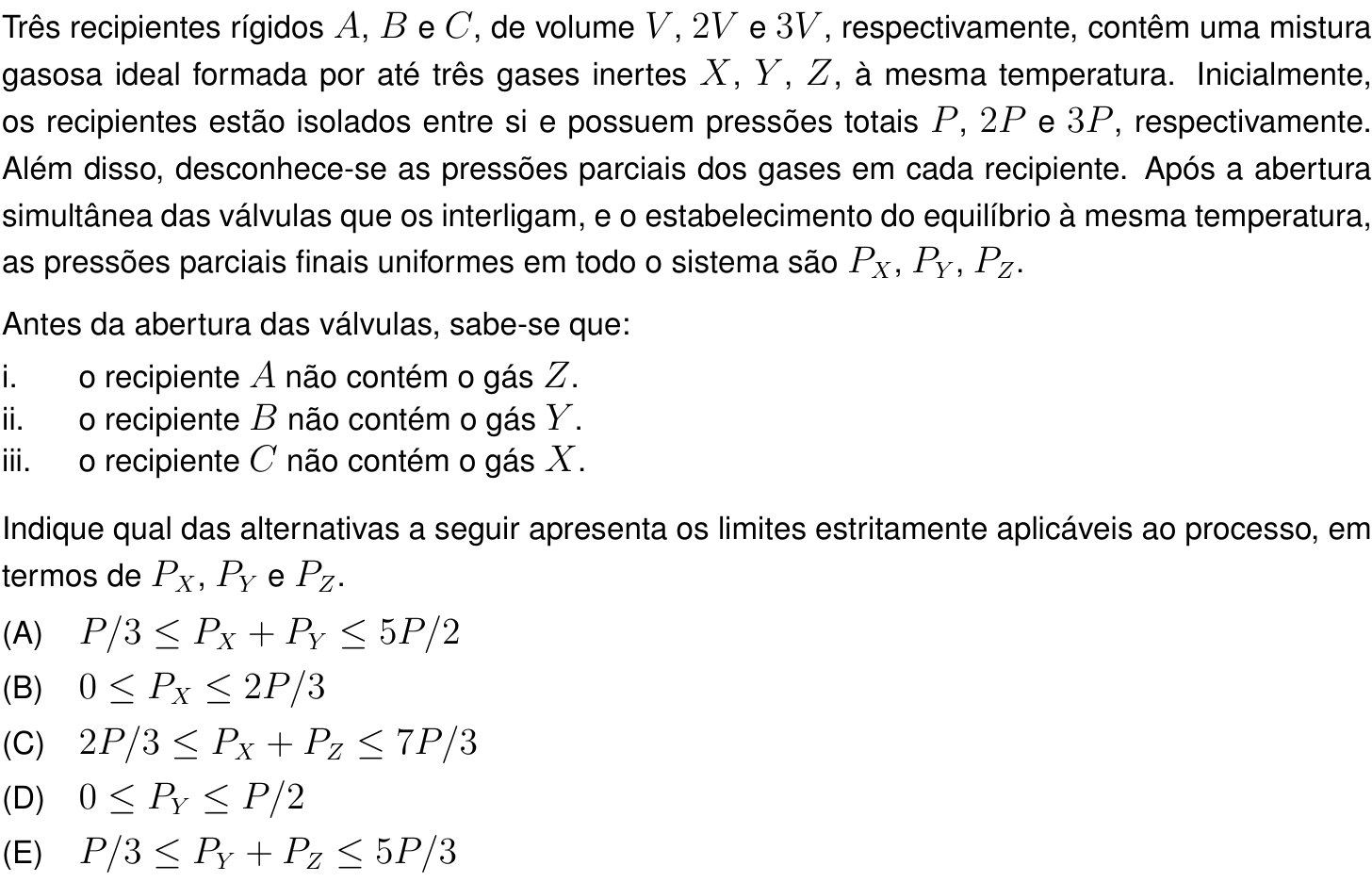
Three rigid recipients A, B, C volumes V, 2V, 3V, same T, contain ideal gas mixture up to three inert gases X,Y,Z. Initially isolated, total pressures P, 2P, 3P respectively. Partial pressures unknown. After simultaneous opening valves connecting them, equilibrium at same T, final uniform partial pressures in whole system are P_X, P_Y, P_Z.
Before opening, know:
i. A does not contain gas Z.
ii. B does not contain gas Y.
iii. C does not contain gas X.
Indicate which alternative presents strictly applicable limits to process, in terms of P_X,P_Y,P_Z.
Options:
(A) P/3 ≤ P_X + P_Y ≤ 5P/2
(B) 0 ≤ P_X ≤ 2P/3
(C) 2P/3 ≤ P_X + P_Z ≤ 7P/3
(D) 0 ≤ P_Y ≤ P/2
(E) P/3 ≤ P_Y + P_Z ≤ 5P/3
Need determine correct bounds. Need be careful with "limites estritamente aplicáveis" maybe means tightest possible bounds given constraints.
This is a mixing problem. Let's derive.
Let total moles n_A, n_B, n_C? Ideal gas: P V = n_A R T? For mixture, total pressure = sum partial pressures. Initially total pressures: A = P = sum partial pressures in A over gases present; B = 2P; C = 3P.
After mixing all volumes total V+2V+3V = 6V. Same T. Final partial pressure of each gas i (X,Y,Z) = total moles of that gas across all vessels * R T / (6V)? Actually final uniform partial pressure p_i = n_i_total R T / V_total. Initially in vessel j with volume V_j, if gas i present, its partial pressure p_i^{(j)} = n_i^{(j)} R T / V_j. So n_i^{(j)} = p_i^{(j)} V_j / (RT). Total n_i = (1/RT) sum_j p_i^{(j)} V_j. Final p_i = n_i_total RT / 6V = (1/6V) sum_j p_i^{(j)} V_j. Also total initial pressure contribution? Let's express using mole fractions maybe.
Let final partial pressures P_X, P_Y, P_Z. Since all gases inert and no reaction, total final pressure = P_X+P_Y+P_Z. We can relate to initial total pressures by conservation of total moles: total initial "PV" sum? For total moles, n_total = sum_j P_j V_j / RT = (P*V + 2P*2V + 3P*3V)/RT = (1 +4+9) PV/RT =14 PV/RT. Final total pressure = n_total RT /6V =14P/6 = 7P/3. So P_X + P_Y + P_Z = 7P/3. Check options maybe.
Need constraints due to each vessel missing certain gas and initial total pressures. We need possible range of final partial pressures given unknowns.
Let's define for each gas i and vessel j, partial pressure before opening, denote x_{i,j} ≥0, with condition: if gas i absent in vessel j then x_{i,j}=0. Also sum_i x_{i,j} = initial total pressure of vessel j: for A = P, B = 2P, C = 3P. And final P_i = (1/6)[V x_{i,A} + 2V x_{i,B} + 3V x_{i,C}] / V? Actually formula: P_i = (1/(6V)) [V x_{i,A} + 2V x_{i,B} + 3V x_{i,C}] = (1/6)(x_{i,A} + 2x_{i,B} + 3x_{i,C}). Good.
Conditions:
A: no Z => x_{Z,A}=0, but x_{X,A}+x_{Y,A}=P.
B: no Y => x_{Y,B}=0, x_{X,B}+x_{Z,B}=2P.
C: no X => x_{X,C}=0, x_{Y,C}+x_{Z,C}=3P.
All x ≥0.
We need possible ranges for linear combinations? Options maybe involve sums P_X+P_Y, P_X+P_Z, etc. Since total fixed 7P/3, some follow.
Let's compute P_X, P_Y, P_Z in terms of independent variables.
Let variables:
A: x_X,A = a, x_Y,A = P - a (since a between 0,P), x_Z,A=0.
B: x_X,B = b, x_Z,B = 2P - b (since b between 0,2P), x_Y,B=0.
C: x_Y,C = c, x_Z,C = 3P - c (c between 0,3P), x_X,C=0.
Then:
P_X = (1/6)[a + 2b + 3*0] = (a + 2b)/6.
P_Y = (1/6)[(P-a) + 0 + 3c] = (P - a + 3c)/6.
P_Z = (1/6)[0 + 2(2P - b) + 3(3P - c)? Wait C: z_C = 3P - c; B z_B=2P-b; A z_A=0. Coefficient 1,2,3 => (1/6)[0 + 2*(2P - b) + 3*(3P - c)] = (1/6)[4P - 2b + 9P - 3c] = (13P - 2b - 3c)/6. Sum: (a+2b + P-a+3c + 13P -2b -3c)/6 =14P/6 =7P/3 yes.
Variables: 0≤a≤P, 0≤b≤2P, 0≤c≤3P.
Then P_X = (a+2b)/6. P_Y = (P - a + 3c)/6. P_Z = (13P -2b -3c)/6.
Need identify correct bounds. Options:
A: P/3 ≤ P_X + P_Y ≤ 5P/2.
Compute P_X+P_Y = (a+2b + P-a+3c)/6 = (P + 2b +3c)/6 = P/6 + b/3 + c/2. Since b∈[0,2P], c∈[0,3P], min = P/6 +0+0 = P/6? Wait lower not P/3? Maybe option says P/3 ≤ P_X+P_Y ≤ 5P/2. Our min P/6 = 0.1667P < P/3=0.333P, so not strict lower? Maybe due other constraints? Let's check can b=c=0? Then a? Need A contains X/Y, no Z, a∈[0,P]; B contains X,Z only, b=0 means B all Z pressure 2P; C contains Y,Z only, c=0 means C all Z pressure 3P. Then P_X = a/6, P_Y = (P-a)/6. P_X+P_Y = P/6. So P/3 lower false. Option A maybe not.
Option C: 2P/3 ≤ P_X+P_Z ≤ 7P/3. Compute P_X+P_Z = (a+2b + 13P -2b -3c)/6 = (a +13P -3c)/6 = 13P/6 + a/6 - c/2. Since a∈[0,P], c∈[0,3P]. Min =13P/6 +0 - (3P)/2 =13P/6 -9P/6 =4P/6=2P/3. Max =13P/6 + P/6 -0 =14P/6=7P/3. So option C exactly lower 2P/3 ≤ ≤7P/3. This seems true. But we need check "estritamente aplicáveis" maybe means tight bounds attainable? Attainable: min at a=0,c=3P; max at a=P,c=0. So yes.
Option E: P/3 ≤ P_Y+P_Z ≤ 5P/3. Compute P_Y+P_Z = (P - a +3c +13P -2b -3c)/6 = (14P - a -2b)/6 = 7P/3 - (a+2b)/6 = 7P/3 - P_X. Since P_X ∈ [0,?]. What bounds P_X? Option B says 0 ≤ P_X ≤ 2P/3. Is that true? P_X=(a+2b)/6, a∈[0,P], b∈[0,2P], so max = (P+4P)/6=5P/6, not 2P/3. So option B false? Wait maybe due B cannot contain Y but total pressure 2P, yes b can be 2P, P_X max= (P+4P)/6=5P/6. Option B says ≤2P/3. Not tight. So E would then P_Y+P_Z = 7P/3 - P_X, with P_X max 5P/6 gives min = 7P/3 -5P/6 =14P/6 -5P/6=9P/6=3P/2=1.5P, not P/3. So E false.
Option D: 0 ≤ P_Y ≤ P/2. Compute P_Y=(P - a +3c)/6. Max when a=0,c=3P: (P+9P)/6=10P/6=5P/3 > P/2. Min when a=P,c=0:0. So D false.
But question: "Indique qual das alternativas a seguir apresenta os limites estritamente aplicáveis ao processo, em termos de P_X, P_Y e P_Z." Maybe there is only one correct? Let's verify all. Our derivation found C true. But need ensure no other hidden constraints? Let's investigate thoroughly. Because problem likely expects one answer. Let's analyze all possible constraints due to missing gases.
Maybe there is nuance: The initial total pressures P,2P,3P; "contêm uma mistura gasosa ideal formada por até três gases inertes X,Y,Z" So each vessel may contain subset of gases, with partial pressures possibly zero. Conditions specify absent certain gases, but not necessarily other gases present? They may contain "até três" but conditions say "não contém" one. It could contain the other two or one? But total pressure given; partial pressures nonnegative; if absent set zero. We included variables.
But perhaps question asks "limites estritamente aplicáveis" meaning inequalities that always hold for any possible initial distribution satisfying given absences. We found C. Need test if option A/B/D/E maybe also always hold? Let's test.
Option A: P/3 ≤ P_X+P_Y ≤ 5P/2. We saw min P/6 (if b=c=0,a=P gives P_X+P_Y=P/6? Wait if b=0,c=0,a=P => P_X=P/6, P_Y=0? Actually P_Y=(P-P+0)/6=0, sum P/6). So A lower fails. But maybe b=0,c=0,a=P impossible? Check B all Z pressure 2P, C all Z pressure 3P; A all X pressure P. Then final P_X=(P +0+0)/6=P/6, P_Z=(0+4P+9P?) Wait B Z=2P, C Z=3P => P_Z=(2*2P+3*3P)/6=13P/6. Total P_X+P_Y = P/6 < P/3. So A not.
Option B: 0 ≤ P_X ≤ 2P/3. We saw max 5P/6? Let's test possible distribution: A: P_X=P, P_Y=0,Z=0; B: P_X=2P (all X), P_Z=0; C: no X, all Z=3P. Then P_X=(P +2*2P +0)/6=5P/6? Wait B x_X=2P, yes a=P, b=2P => (P+4P)/6=5P/6. So B false.
Option D: 0 ≤ P_Y ≤ P/2. Max maybe? A all Y? Let's max P_Y: A a=0 (all Y=P), B b=0? B no Y, all Z=2P; C c=3P (all Y=3P, Z=0). Then P_Y=(P +9P)/6=10P/6=5P/3. So D false.
Option E: P/3 ≤ P_Y+P_Z ≤ 5P/3. Since P_Y+P_Z =7P/3 - P_X. Min when P_X max 5P/6 gives 7P/3 -5P/6 =14P/6 -5P/6=9P/6=3P/2=1.5P > P/3. So lower false. Max when P_X min 0? P_X can be 0, then P_Y+P_Z=7P/3 ≈2.333P >5P/3=1.667P. So upper false too. So only C.
But let's ensure "estritamente aplicáveis" maybe they want range for each final partial pressure? But options are inequalities. C seems correct. Need produce explanation.
Let's craft final answer in Portuguese with equations.
Need be mindful: The problem statement says "os limites estritamente aplicáveis ao processo" maybe "strictly applicable" means "válidos" (tight). Our derivation for C: 2P/3 ≤ P_X + P_Z ≤ 7P/3. We should show via variables and highlight min/max.
Let's produce final with notation:
Sejam a = p_{X,A}, b = p_{X,B}, c = p_{Y,C}. Then constraints:
A: p_{X,A}=a, p_{Y,A}=P-a, p_{Z,A}=0, 0≤a≤P.
B: p_{X,B}=b, p_{Z,B}=2P-b, p_{Y,B}=0, 0≤b≤2P.
C: p_{Y,C}=c, p_{Z,C}=3P-c, p_{X,C}=0, 0≤c≤3P.
Então:
P_X=(a+2b)/6
P_Y=(P-a+3c)/6
P_Z=(13P-2b-3c)/6
Daí:
P_X+P_Z = (a+2b +13P -2b -3c)/6 = (a +13P -3c)/6.
Como 0≤a≤P e 0≤c≤3P:
Mínimo: 13P/6 + 0 - 3*(3P)/6 = 13P/6 - 9P/6 =4P/6=2P/3.
Máximo: 13P/6 + P/6 - 0 =14P/6=7P/3.
Logo 2P/3 ≤ P_X+P_Z ≤7P/3.
Check if other options? Maybe not needed but mention "as demais não são estritamente aplicáveis". Final answer C.
Let's ensure no mistake in P_Z formula: A z=0; B z=2P-b; C z=3P-c. Weighted sum: 1*0 +2*(2P-b)+3*(3P-c)=4P-2b+9P-3c=13P -2b -3c. Yes.
Potential issue: "as pressões parciais finais uniformes em todo o sistema são P_X, P_Y, P_Z" after equilibrium. Conservation of total moles: final total pressure =? Initial total moles: for vessel i, n_i_total = P_i V_i/(RT). Total initial moles = (P*V +2P*2V+3P*3V)/(RT)=14PV/RT. Final volume=6V => total pressure=14P/6=7P/3. So P_X+P_Y+P_Z=7P/3. Option C not involving sum all? It involves P_X+P_Z. Good.
Let's finalize.
Need "Resposta: C" last line exactly. Include explanation.
Sejam
- a = p_{X,A}, com 0\le a\le P, pois A não contém Z e sua pressão total é P;
- b = p_{X,B}, com 0\le b\le 2P, pois B não contém Y e sua pressão total é 2P;
- c = p_{Y,C}, com 0\le c\le 3P, pois C não contém X e sua pressão total é 3P.
Assim:
p_{Y,A}=P-a,\quad p_{Z,A}=0,
p_{Z,B}=2P-b,\quad p_{Y,B}=0,
p_{Z,C}=3P-c,\quad p_{X,C}=0.
Após a mistura, o volume total é V+2V+3V=6V. Logo, para o gás X:
P_X=\frac{1\cdot a+2\cdot b+3\cdot 0}{6}=\frac{a+2b}{6}.
Para o gás Z:
P_Z=\frac{1\cdot 0+2(2P-b)+3(3P-c)}{6}
=\frac{4P-2b+9P-3c}{6}
=\frac{13P-2b-3c}{6}.
Portanto:
P_X+P_Z=\frac{a+2b+13P-2b-3c}{6}
=\frac{a+13P-3c}{6}.
Como 0\le a\le P e 0\le c\le 3P:
P_X+P_Z \ge \frac{0+13P-9P}{6}=\frac{4P}{6}=\frac{2P}{3};
P_X+P_Z \le \frac{P+13P}{6}=\frac{14P}{6}=\frac{7P}{3}.
Logo, os limites estritamente aplicáveis são:
\frac{2P}{3}\le P_X+P_Z\le \frac{7P}{3}.
Resposta: C