Respondeu
levou 15 s
Como pensou
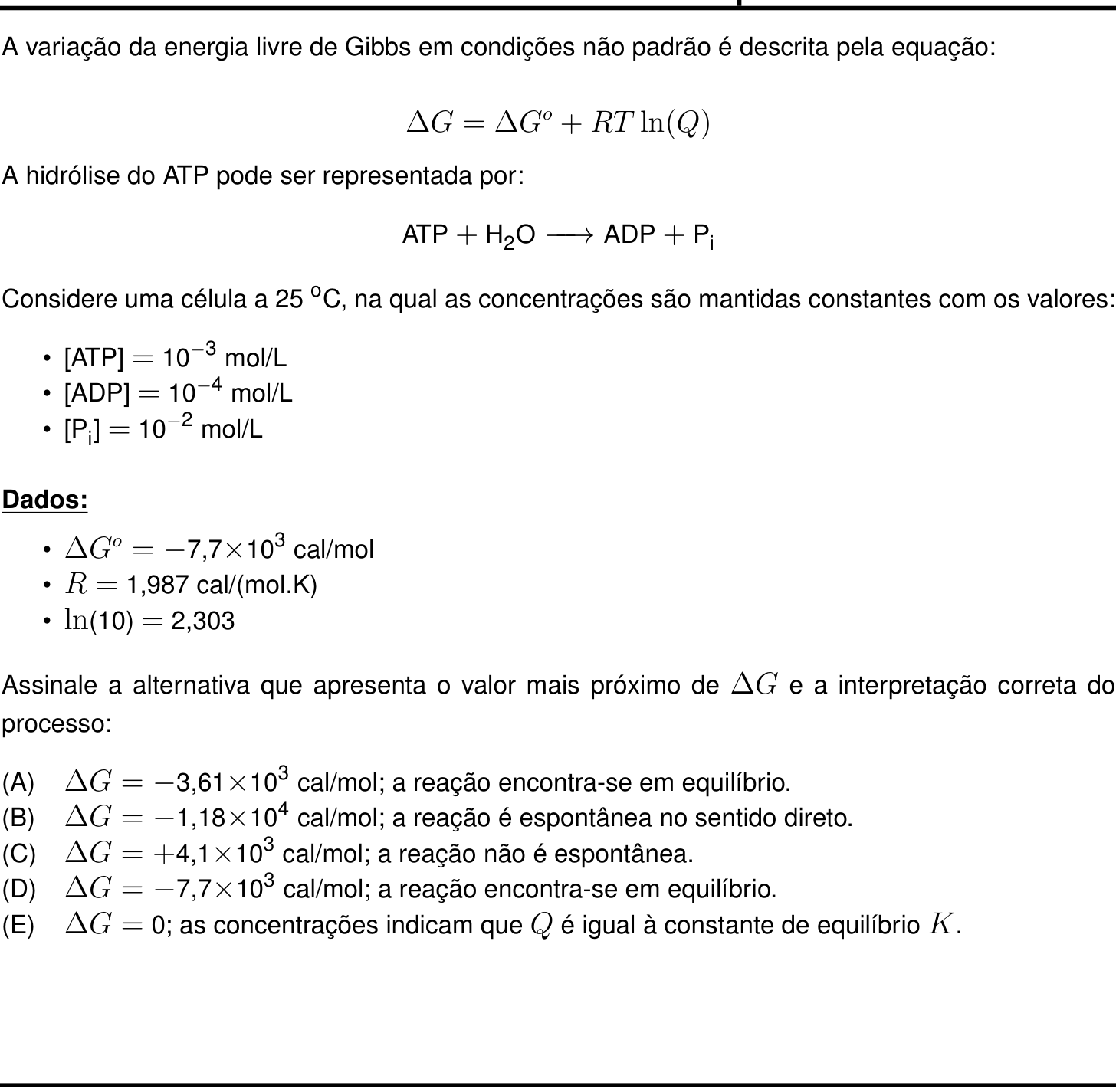
Para a hidrólise do ATP, a água é o solvente e sua atividade é aproximadamente 1. Assim, usando as concentrações fornecidas:
Q=\frac{[\mathrm{ADP}][\mathrm{P_i}]}{[\mathrm{ATP}]}
=\frac{10^{-4}\cdot10^{-2}}{10^{-3}}
=10^{-3}.
Logo,
\ln Q=-3\ln 10=-3(2{,}303)=-6{,}909.
Com T=25+273=298\ \mathrm{K}, temos:
\Delta G=\Delta G^\circ+RT\ln Q
=-7{,}7\times10^3+(1{,}987)(298)(-6{,}909).
Portanto,
\Delta G\approx-7700-4091
=-11791\ \mathrm{cal/mol}
\approx\boxed{-1{,}18\times10^4\ \mathrm{cal/mol}}.
Como \Delta G<0, a reação é espontânea no sentido direto, isto é, favorece a hidrólise do ATP em ADP e fosfato inorgânico. Concentrações mantidas constantes não implicam equilíbrio, que exigiria \Delta G=0.
Resposta: B
Respondeu
levou 10 s
Como pensou
**Calculating with explanation in Portuguese**
I need to do some calculations and explain them in Portuguese straightforwardly. I'm looking at a quantity of 1e-3 for water to omit, and I'll take the natural logarithm of -6.909. Then, I’ll multiply by the temperature factor, which is RT592.126, and continue with -6.909 and a total of -4090.99 to calculate -11790. I might mention the constant concentration, but not the equilibrium part. Let’s compose this clearly in a medium-short format with steps!
O quociente da reação de hidrólise do ATP é, considerando a atividade da água igual a 1:
Q=\frac{[\mathrm{ADP}][\mathrm{P_i}]}{[\mathrm{ATP}]}
=\frac{10^{-4}\cdot10^{-2}}{10^{-3}}
=10^{-3}.
Assim,
\ln Q=\ln(10^{-3})=-3\ln 10=-3(2{,}303)=-6{,}909.
Convertendo a temperatura para kelvin, T=25+273=298\ \mathrm{K}, e substituindo na equação:
\Delta G=\Delta G^\circ+RT\ln Q
=-7{,}7\times10^3+(1{,}987)(298)(-6{,}909).
Logo,
\Delta G\approx-7700-4091
=-11791\ \mathrm{cal/mol}
\approx-1{,}18\times10^4\ \mathrm{cal/mol}.
Como \Delta G<0, a reação é espontânea no sentido direto, isto é, no sentido da hidrólise do ATP. Concentrações mantidas constantes não implicam equilíbrio, que exigiria \Delta G=0.
Resposta: B
Respondeu
levou 4 s
Como pensou
Para a hidrólise do ATP, considerando a água como solvente, o quociente da reação é
Q=\frac{[\mathrm{ADP}][\mathrm{P_i}]}{[\mathrm{ATP}]}
=\frac{(10^{-4})(10^{-2})}{10^{-3}}=10^{-3}.
Assim, \ln Q=-3\ln(10)=-6{,}909. A 25^\circ\mathrm C, T=298\ \mathrm K, então
\Delta G=\Delta G^\circ+RT\ln Q
=-7700+(1{,}987)(298)(-6{,}909)
\approx -1{,}18\times10^4\ \mathrm{cal/mol}.
Como \Delta G<0, a reação é espontânea no sentido direto. Portanto, a alternativa correta é B.
Resposta: B
Respondeu
levou 6 s
Como pensou
Q = [ADP][Pi]/[ATP] = (10⁻⁴ · 10⁻²)/10⁻³ = 10⁻³
ln(Q) = −3 · ln(10) = −3 · 2,303 = −6,909
RT = 1,987 · 298 ≈ 592,1 cal/mol
RT ln(Q) ≈ 592,1 · (−6,909) ≈ −4,09×10³ cal/mol
ΔG = ΔG° + RT ln(Q) = −7,7×10³ − 4,09×10³ ≈ −1,18×10⁴ cal/mol
Como ΔG < 0, a hidrólise do ATP é espontânea no sentido direto nessas condições celulares (ainda mais favorável do que no estado padrão, pois a concentração de produtos é baixa em relação à de ATP).
Resposta: B
Respondeu
levou 7 s
Como pensou
Computing Q with these concentrations gives about 1e-3, so RT ln Q comes out to roughly -4093 J/mol. Adding that to the standard ΔG of -7700 gives about -1.18×10^4 J/mol, pointing to answer B.
Resposta: B. ΔG ≈ −1,18 × 10⁴ cal/mol, e a reação é espontânea no sentido direto.
1. Quociente de reação Q
A água é o solvente, portanto não entra em Q:
Q = \frac{[\text{ADP}][\text{P}_i]}{[\text{ATP}]} = \frac{10^{-4}\cdot 10^{-2}}{10^{-3}} = 10^{-3}
2. Termo RT ln Q
A temperatura é T = 25 °C = 298 K.
\ln Q = -3\cdot 2{,}303 = -6{,}909
RT\ln Q = 1{,}987 \cdot 298 \cdot (-6{,}909) \approx -4{,}09\times10^{3}\ \text{cal/mol}
3. Cálculo de ΔG
\Delta G = -7{,}7\times10^{3} - 4{,}09\times10^{3} \approx -1{,}18\times10^{4}\ \text{cal/mol}
4. Interpretação
Como ΔG < 0, a reação é espontânea no sentido direto. Ela não está em equilíbrio, pois ΔG ≠ 0. Isso descarta as alternativas A, D e E. A alternativa C também fica descartada, porque o sinal de ΔG é negativo.
Resposta: B
Respondeu
levou 4 s
Como pensou
Q = [ADP][Pi]/[ATP] = (10⁻⁴ · 10⁻²)/10⁻³ = 10⁻³ (a água não entra em Q).
ln Q = −3 · 2,303 = −6,909
T = 298 K, então RT = 1,987 · 298 = 592,1 cal/mol.
RT ln Q = 592,1 · (−6,909) ≈ −4,09 × 10³ cal/mol
ΔG = −7,7 × 10³ − 4,09 × 10³ ≈ −11,8 × 10³ cal/mol = −1,18 × 10⁴ cal/mol
Como ΔG < 0, a reação é espontânea no sentido direto.
Resposta: B
Respondeu
levou 20 s
Como pensou
The problem requires calculating the Gibbs free energy change for ATP hydrolysis under non-standard conditions.
The reaction quotient Q is 10⁻³. The standard free energy change is -7.7 × 10³ cal/mol at 298 K.
ln(Q) equals -6.909. RT is approximately 592 cal/mol. The product RT ln(Q) is roughly -4091 cal/mol.
The final ΔG is approximately -1.18 × 10⁴ cal/mol. This value is negative, confirming the reaction is spontaneous in the forward direction. The correct answer is option (B).
A reação de hidrólise do ATP é
\mathrm{ATP + H_2O \longrightarrow ADP + P_i}.
Como a água é o solvente, sua atividade é unitária e não entra no quociente reacional. Assim,
Q = \frac{[\mathrm{ADP}][\mathrm{P_i}]}{[\mathrm{ATP}]} = \frac{10^{-4}\times 10^{-2}}{10^{-3}} = 10^{-3}.
A temperatura da célula é T = 25+273 = 298\,\mathrm{K}. Substituindo os dados fornecidos,
\ln Q = \ln(10^{-3}) = -3\times 2{,}303 = -6{,}909,
RT = 1{,}987\times 298 \approx 592\,\mathrm{cal\,mol^{-1}},
RT\ln Q \approx 592\times(-6{,}909) \approx -4{,}09\times 10^3\,\mathrm{cal\,mol^{-1}}.
Portanto
\Delta G = \Delta G^\circ + RT\ln Q = -7{,}7\times 10^3 - 4{,}09\times 10^3 = -1{,}18\times 10^4\,\mathrm{cal\,mol^{-1}}.
O valor negativo de \Delta G mostra que a reação é espontânea no sentido direto nas condições celulares dadas.
Resposta: B
Respondeu
levou 21 s
Como pensou
We need answer solve. Need be careful. Need solve in Portuguese. Let's parse problem.
We have ΔG = ΔG° + RT ln Q.
Hydrolysis ATP + H2O -> ADP + Pi. Concentrations given: [ATP]=1e-3 mol/L, [ADP]=1e-4 mol/L, [Pi]=1e-2 mol/L. T=25 C = 298.15 K. ΔG° = -7.7e3 cal/mol. R=1.987 cal/(mol K). ln(10)=2.303.
Need Q expression. Reaction: ATP + H2O -> ADP + Pi. Water concentration? In biochemical standard, water is solvent, activity ~1, omitted from Q. For ATP hydrolysis, Q = ([ADP][Pi])/[ATP]? Usually yes, water not included. But let's verify with units and given values. Q = (10^-4 * 10^-2) / 10^-3 = 10^-6 / 10^-3 = 10^-3. If water included as 55.5 M, Q different, but not in choices? Let's calculate.
ΔG = -7700 + 1.987*298.15*ln(10^-3).
T=298 K maybe 25C. RT = 1.987*298.15 =? 1.987*298.15 = 1.987*298 + 1.987*0.15 ≈ 592.126 + 0.298 = 592.424 cal/mol ~ 592.4. Or using 298: 592.126. ln(10^-3) = -3 ln10 = -3*2.303 = -6.909. Product = -592.4*6.909 ≈ -4092? Let's calculate: 592.4*6.909 = 592.4*6 + 592.4*0.909 = 3554.4 + 538.5 = 4092.9. So ΔG = -7700 - 4093 = -11793 cal/mol ≈ -1.18e4. Matches B. Interpretation spontaneous direct. So B.
Need explain. But let's ensure no trick: Since ΔG negative, spontaneous forward. B has ΔG = -1.18×10^4 cal/mol and spontaneous. That matches.
Need produce final with explanation in Portuguese and final line "Resposta: B". Need maybe mention Q excludes water. Calculation.
Let's craft concise.
Potential issue: Temperature 25°C = 298 K; R = 1.987, ΔG° = -7.7e3. Q = (10^-4 * 10^-2)/10^-3 = 10^-3. Then RT ln Q = 1.987*298*ln(10^-3). ln(10^-3)= -3 ln10 = -6.909. Product approx -4092 cal/mol. ΔG = -7700 -4092 = -11792 cal/mol ≈ -1,18×10^4 cal/mol. Since ΔG <0, reaction spontaneous in direct sense (ATP hydrolysis). Alternative B.
Let's final with desired format.
A expressão para Q na hidrólise do ATP é:
Q=\frac{[\text{ADP}][\text{P}_i]}{[\text{ATP}]}
A água não entra na expressão, pois é o solvente e sua atividade é aproximadamente 1.
Substituindo as concentrações:
Q=\frac{(10^{-4})(10^{-2})}{10^{-3}}
= \frac{10^{-6}}{10^{-3}}
=10^{-3}
Agora calculamos:
\Delta G=\Delta G^\circ+RT\ln Q
\Delta G=-7,7\times10^3+(1,987)(298)\ln(10^{-3})
Como \ln(10^{-3})=-3\ln10=-3(2,303)=-6,909:
RT\ln Q \approx (1,987)(298)(-6,909)
\approx -4,09\times10^3\ \text{cal/mol}
Portanto:
\Delta G \approx -7,7\times10^3-4,09\times10^3
\approx -1,18\times10^4\ \text{cal/mol}
Como \Delta G<0, a reação é espontânea no sentido direto, ou seja, a hidrólise do ATP é favorecida.
Resposta: B
Respondeu
levou 24 s
Como pensou
**Analyzing Gibbs Free Energy**
I'm currently focused on the Gibbs Free Energy equation, specifically its application in non-standard conditions. I'm carefully examining how the change in free energy, denoted by ΔG, relates to the standard free energy change, ΔG°, the ideal gas constant R, the temperature T, and the reaction quotient Q. My attention is on the implications of each term, as I'm attempting to extract more information from this single equation.
**Calculating Free Energy Change**
Now, I'm working through a specific example: the hydrolysis of ATP in a cellular context. I'm using the given concentrations of ATP, ADP, and Pi at 25°C, along with the standard free energy change and the gas constant. My goal is to determine the actual free energy change, ΔG, under these non-standard conditions, and ultimately deduce the spontaneity and direction of the reaction. This requires the proper calculation of the reaction quotient Q, and substitution into the Gibbs Free Energy equation.
**Determining the Value of Q**
I've calculated the reaction quotient, Q, for the ATP hydrolysis example, using the given concentrations of ATP, ADP, and inorganic phosphate. Given the reaction quotient is $10^{-3}$, and following that, I calculated the natural logarithm of the reaction quotient, which gave me $-6.909$. I've also re-confirmed the values of RT and RTlnQ using the given data. Now, I'm ready to calculate the Gibbs Free Energy.
Para determinar a variação da energia livre de Gibbs (\Delta G) e a espontaneidade da reação, utilizamos a equação fornecida:
\Delta G = \Delta G^o + RT \ln(Q)
- Cálculo do quociente de reação (Q):
Como a água (\text{H}_2\text{O}) atua como solvente, sua atividade é considerada unitária (a_{\text{H}_2\text{O}} \approx 1). Assim:
Q = \frac{[\text{ADP}] \cdot [\text{P}_i]}{[\text{ATP}]}
Substituindo os valores das concentrações:
Q = \frac{10^{-4} \cdot 10^{-2}}{10^{-3}} = \frac{10^{-6}}{10^{-3}} = 10^{-3}
-
Cálculo de \ln(Q):
\ln(Q) = \ln(10^{-3}) = -3 \cdot \ln(10) = -3 \cdot 2,303 = -6,909
-
Cálculo do termo RT \ln(Q):
A temperatura absoluta é T = 25\ ^\circ\text{C} = 298\text{ K} (ou 298,15\text{ K}):
RT \ln(Q) = 1,987 \cdot 298,15 \cdot (-6,909) \approx 592,42 \cdot (-6,909) \approx -4,09 \times 10^3\text{ cal/mol}
-
Cálculo de \Delta G:
\Delta G = \Delta G^o + RT \ln(Q)
\Delta G = -7,7 \times 10^3 + (-4,09 \times 10^3) = -11,79 \times 10^3\text{ cal/mol} \approx -1,18 \times 10^4\text{ cal/mol}
-
Interpretação:
Como \Delta G < 0, o processo é termodinamicamente favorável, ou seja, a reação é espontânea no sentido direto.
Resposta: B