Respondeu
levou 19 s
Como pensou
Para uma máquina de Carnot, o rendimento é
\eta=1-\frac{T_{\text{fria}}}{T_{\text{quente}}}.
Seja Q_1 o calor recebido pela primeira máquina. O calor que ela rejeita é
Q_{r1}=Q_1\frac{T_2}{T_1},
e seu trabalho vale
W_1=Q_1\left(1-\frac{T_2}{T_1}\right).
A segunda máquina recebe 80\% desse calor rejeitado, portanto:
Q_2=0{,}8Q_1\frac{T_2}{T_1}.
Assim, seu trabalho é
W_2=Q_2\left(1-\frac{T_3}{T_2}\right)
=0{,}8Q_1\frac{T_2-T_3}{T_1}.
Como W_2=0{,}4W_1, temos
0{,}8(T_2-T_3)=0{,}4(T_1-T_2).
Substituindo T_1=900\,\text{K} e T_3=300\,\text{K}:
2(T_2-300)=900-T_2
\quad\Rightarrow\quad
\boxed{T_2=500\,\text{K}}.
Logo, os rendimentos são
\eta_1=1-\frac{500}{900}=\frac49,
\qquad
\eta_2=1-\frac{300}{500}=\frac25.
A soma solicitada é
\eta_1+\eta_2=\frac49+\frac25
=\boxed{\frac{38}{45}}.
Resposta: C
Respondeu
levou 12 s
Como pensou
Para uma máquina de Carnot, o rendimento é
\eta=1-\frac{T_{\text{fria}}}{T_{\text{quente}}}.
Seja Q_1 o calor recebido pela primeira máquina. Seu trabalho e o calor rejeitado são, respectivamente,
W_1=Q_1\left(1-\frac{T_2}{900}\right),
\qquad
Q_{r1}=Q_1\frac{T_2}{900}.
Como a segunda máquina recebe 80% do calor rejeitado pela primeira, temos
Q_2=0{,}8Q_1\frac{T_2}{900}.
Assim, seu trabalho é
W_2=Q_2\left(1-\frac{300}{T_2}\right)
=\frac{0{,}8Q_1}{900}(T_2-300).
O enunciado informa que W_2=0{,}4W_1. Logo,
\frac{0{,}8Q_1}{900}(T_2-300)
=\frac{0{,}4Q_1}{900}(900-T_2).
Cancelando os fatores comuns:
2(T_2-300)=900-T_2
\quad\Rightarrow\quad
\boxed{T_2=500\ \text{K}}.
Portanto, os rendimentos são
\eta_1=1-\frac{500}{900}=\frac49,
\qquad
\eta_2=1-\frac{300}{500}=\frac25.
A soma pedida é
\eta_1+\eta_2=\frac49+\frac25
=\boxed{\frac{38}{45}}.
Resposta: C
Respondeu
levou 6 s
Como pensou
Seja Q_1 o calor recebido pela primeira máquina. Como ela opera no ciclo de Carnot, seu rendimento é
\eta_1=1-\frac{T_2}{T_1},
e o calor rejeitado ao reservatório intermediário é
Q_{\text{rej},1}=Q_1\frac{T_2}{T_1}.
A segunda máquina recebe 80\% desse calor, então Q_2=0{,}8Q_1T_2/T_1. Seu rendimento é \eta_2=1-T_3/T_2. Usando também W_2=0{,}4W_1, com W_1=\eta_1Q_1 e W_2=\eta_2Q_2, temos
0{,}8\frac{T_2}{T_1}\left(1-\frac{T_3}{T_2}\right)
=0{,}4\left(1-\frac{T_2}{T_1}\right).
Substituindo T_1=900\,\text{K} e T_3=300\,\text{K}, resulta T_2=500\,\text{K}.
Assim,
\eta_1=1-\frac{500}{900}=\frac49,
\qquad
\eta_2=1-\frac{300}{500}=\frac25,
e a soma é
\eta_1+\eta_2=\frac49+\frac25=\frac{38}{45}.
Resposta: C
Respondeu
levou 12 s
Como pensou
I'm setting up the first Carnot engine between 900K and T2, then feeding 80% of its rejected heat into a second engine operating between T2 and 300K, relating the two work outputs through their efficiencies.
Solving the equation gives T2 = 500K. Then η1 = 4/9 and η2 = 2/5, summing to 38/45, matching answer choice C.
Máquina 1 (Carnot entre T₁ e T₂):
η₁ = 1 − T₂/T₁ = 1 − T₂/900
Recebendo Q₁, produz W₁ = Q₁(900 − T₂)/900 e rejeita Q₂' = Q₁·T₂/900.
Máquina 2 (Carnot entre T₂ e T₃):
η₂ = 1 − 300/T₂
Recebe Q₂ = 0,8·Q₂' = 0,8·Q₁·T₂/900 e produz
W₂ = Q₂·η₂ = 0,8·Q₁·(T₂/900)·(1 − 300/T₂) = 0,8·Q₁·(T₂ − 300)/900.
Condição W₂ = 0,4·W₁:
0,8·(T₂ − 300) = 0,4·(900 − T₂)
2(T₂ − 300) = 900 − T₂
3T₂ = 1500 → T₂ = 500 K
Rendimentos:
η₁ = 1 − 500/900 = 4/9 = 20/45
η₂ = 1 − 300/500 = 2/5 = 18/45
Soma: η₁ + η₂ = 38/45
Resposta: C
Respondeu
levou 12 s
Como pensou
I'm setting up the energy balance between the two machines: the first produces work W1 from heat input at 900K rejecting at T2, and the second takes 80% of that rejected heat, operating between T2 and 300K, producing work equal to 0.4W1. Equating these expressions and simplifying gives 2(T2-300) = 900, letting me solve for T2 directly.
Solving gives T2 = 500K, so efficiency of the first machine is 4/9 and the second is 2/5. Converting to a common denominator, these sum to 38/45, matching answer choice C.
Resposta: (C) 38/45
Como as duas máquinas operam em ciclos de Carnot, o rendimento de cada uma depende só das temperaturas: η = 1 − T_fria/T_quente.
Máquina 1 (entre T₁ = 900 K e T₂):
Seja Q₁ o calor recebido da fonte quente.
- Trabalho: W₁ = Q₁(1 − T₂/900)
- Calor rejeitado: Q₂ = Q₁·T₂/900
Máquina 2 (entre T₂ e T₃ = 300 K):
- Calor recebido: 0,8·Q₂
- Trabalho: W₂ = 0,8·Q₂·(1 − 300/T₂)
Condição dada: W₂ = 0,4·W₁
Substituindo Q₂:
0,8·Q₁·(T₂/900)·(T₂ − 300)/T₂ = 0,4·Q₁·(900 − T₂)/900
Cancelando Q₁ e o fator 1/900:
0,8·(T₂ − 300) = 0,4·(900 − T₂)
2T₂ − 600 = 900 − T₂, logo 3T₂ = 1500 e T₂ = 500 K.
Rendimentos:
- η₁ = 1 − 500/900 = 4/9 = 20/45
- η₂ = 1 − 300/500 = 2/5 = 18/45
Soma: η₁ + η₂ = 20/45 + 18/45 = 38/45
Resposta: C
Respondeu
levou 7 s
Como pensou
I'm setting up the efficiency relations for both machines, expressing each machine's work output and heat rejection in terms of their respective Carnot efficiencies and the shared intermediate heat flow, so I can link W2 to η2 and the fraction of Q2 passed through.
Solving the resulting equation, I find T2 = 500, giving η1 = 4/9 and η2 = 2/5, whose sum is 38/45 — matching answer C.
Montagem
Seja Q₁ o calor recebido pela máquina 1 e W₁ o seu trabalho. O calor rejeitado por ela é Q₂ = Q₁ − W₁. Para a máquina 2, o calor recebido é Q₂' = 0,8·Q₂ e o trabalho é W₂ = 0,4·W₁.
Como as duas máquinas operam em ciclos de Carnot:
- η₁ = W₁/Q₁ = 1 − T₂/900
- η₂ = W₂/Q₂' = 1 − 300/T₂
Relação entre os trabalhos
W₂ = 0,4·W₁ = 0,4·η₁·Q₁
W₂ = η₂·Q₂' = η₂·0,8·Q₁·(1 − η₁)
Igualando as duas expressões: 0,5·η₁ = η₂·(1 − η₁).
Cálculo de T₂
Substituindo η₁, η₂ e 1 − η₁ = T₂/900:
0,5·(1 − T₂/900) = (1 − 300/T₂)·(T₂/900)
0,5·(900 − T₂) = T₂ − 300
450 − 0,5·T₂ = T₂ − 300
T₂ = 500 K
Rendimentos
- η₁ = 1 − 500/900 = 4/9
- η₂ = 1 − 300/500 = 2/5
Soma: 4/9 + 2/5 = 20/45 + 18/45 = 38/45.
Resposta: C
Respondeu
levou 1 min 12 s
Como pensou
The problem concerns two thermal machines operating in Carnot cycles coupled in series.
The first engine receives heat from a 900 K reservoir and rejects to an intermediate T2. The second engine receives heat from that intermediate source, produces work, and rejects to a 300 K reservoir. Its work output is 40% of the first engine's work. The heat feeding it equals 80% of the first engine's rejected energy. We need the sum of both efficiencies.
The Carnot efficiency for each machine is η = 1 − T_cold / T_hot. The first engine's rejected heat is Q_c1 = T2/Q_h1, and the second engine receives Q_h2 = 0.8·Q_c1.
The second engine's work is 0.4 times the first's, and its heat input is 0.8 times the first's rejected heat. The first engine's rejected heat equals Q_h1 multiplied by (1 − η1).
The work and heat relations yield the algebraic constraint 3(1−η1)(1−η2) = 1. The first engine's efficiency is η1 = 2η2/(1+2η2). Substituting this into the temperature equation gives a single equation in η2.
Solving the equation yields η2 = 0.4 and η1 = 4/9. The sum of the two efficiencies is 38/45.
The intermediate temperature is 500 K, consistent with both engines. The work and heat relations verify the 40% efficiency ratio exactly.
A eficiência de uma máquina de Carnot depende apenas das temperaturas dos reservatórios quente e frio:
\eta_1=1-\frac{T_2}{T_1},\qquad\eta_2=1-\frac{T_3}{T_2}.
As informações sobre trabalho e calor fornecem a relação
\eta_1=\frac{2\eta_2}{1+2\eta_2}.
Substituindo as temperaturas dadas T_1=900\,\mathrm{K} e T_3=300\,\mathrm{K} obtém-se a equação
3(1-\eta_1)(1-\eta_2)=1.
A solução simultânea das duas equações é
\eta_2=\frac{2}{5},\qquad\eta_1=\frac{4}{9}.
Portanto
\eta_1+\eta_2=\frac{4}{9}+\frac{2}{5}=\frac{38}{45}.
(A temperatura intermediária resultante, T_2=500\,\mathrm{K}, confirma ambas as eficiências e as razões de trabalho e calor do enunciado.)
Resposta: C
Respondeu
levou 16 s
Como pensou
We need answer in Portuguese. Need solve. Need be careful. Let's parse problem.
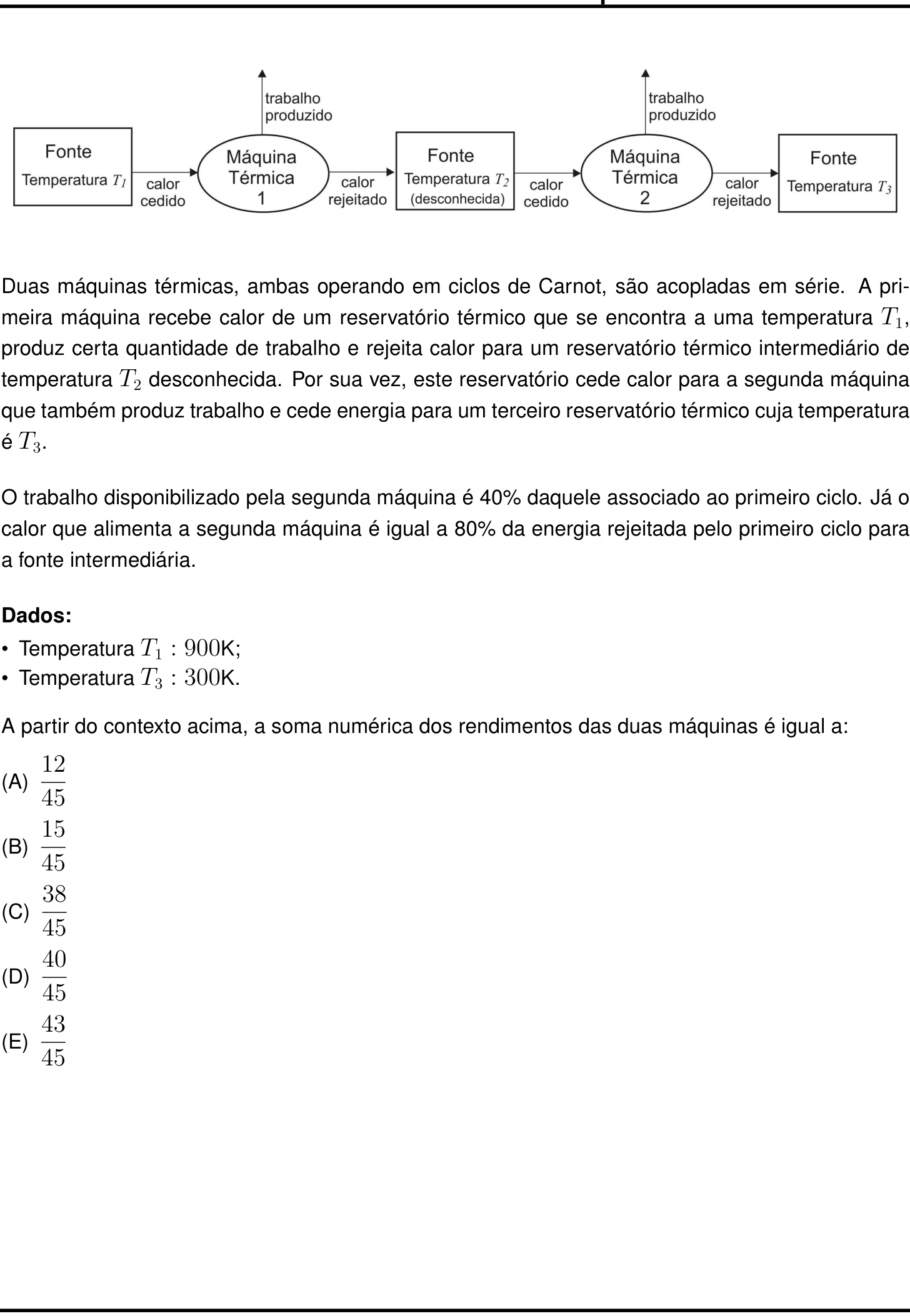
Two Carnot engines in series. Engine 1 receives heat Q1 from source T1=900K, produces work W1, rejects heat Q2 to intermediate reservoir at unknown T2. Engine 2 receives heat from intermediate reservoir? Text: "Por sua vez, este reservatório cede calor para a segunda máquina que também produz trabalho e cede energia para um terceiro reservatório térmico cuja temperatura é T3." So engine 2 receives Q2? Actually diagram: Fonte T2 (desconhecida) -> calor cedido -> Máquina Térmica 2 -> calor rejeitado -> Fonte Temperatura T3. Yes engine 2 receives heat Q2 from reservoir at T2, produces work W2, rejects heat Q3 to T3.
Given: "O trabalho disponibilizado pela segunda máquina é 40% daquele associado ao primeiro ciclo. Já o calor que alimenta a segunda máquina é igual a 80% da energia rejeitada pelo primeiro ciclo para a fonte intermediária."
Interpret: W2 = 0.40 W1. Heat feeding second machine (Q_in2 = Q2? "calor que alimenta a segunda máquina" is heat received by machine 2 from intermediate reservoir) is equal to 80% of energy rejected by first cycle to intermediate source. Rejected by first cycle to intermediate source = Q2 (heat rejected by M1). So Q_in2 = 0.80 * Q2. But for series, Q_in2 is heat from intermediate reservoir to engine 2. Since intermediate reservoir receives Q2 from M1 and gives heat to M2. If no other losses, Q_in2 could equal Q2? But statement says 80% of energy rejected by first cycle for source intermediate. Maybe reservoir loses? Or maybe "calor que alimenta a segunda máquina" = Q2? Actually "Já o calor que alimenta a segunda máquina é igual a 80% da energia rejeitada pelo primeiro ciclo para a fonte intermediária." Means Q_in2 = 0.8 Q_rej1. But if the intermediate reservoir only receives Q_rej1 and no accumulation? However they specify relation, so use it.
Need find sum of efficiencies η1 + η2.
For Carnot engine between T_hot and T_cold: η = 1 - T_cold/T_hot. For engine 1: η1 = 1 - T2/T1 = 1 - T2/900. For engine 2: η2 = 1 - T3/T2 = 1 - 300/T2.
Need determine T2 from given relations W2=0.4 W1 and Q_in2=0.8 Q2? Wait Q2 = heat rejected by M1 = energy rejected by first cycle to intermediate source. Let's denote Q_H1 = Q1 = heat from T1 to M1. W1 = η1 Q1. Q2 = Q1 - W1 = Q1(1-η1) = Q1 T2/T1? For Carnot: Q2/Q1 = T2/T1. Yes.
For engine 2: Q_in2 = heat from T2 to M2. They say Q_in2 = 0.8 Q2. Then W2 = η2 Q_in2 = η2 * 0.8 Q2. But also W2 = 0.4 W1 = 0.4 η1 Q1. Also Carnot relations.
Let's use ratios.
For M1: η1 = W1/Q1 = 1 - T2/T1 = 1 - T2/900. Q2 = Q1 - W1 = Q1(1-η1) = Q1(T2/900).
For M2: W2 = 0.4 W1. Q_in2 = 0.8 Q2. η2 = W2/Q_in2 = (0.4 W1)/(0.8 Q2) = 0.5 W1/Q2 = 0.5 * (η1 Q1)/(Q1(1-η1)) = 0.5 η1/(1-η1). But also η2 = 1 - 300/T2.
And Carnot relation for M1: η1 = 1 - T2/900 => T2 = 900(1-η1). Then η2 = 1 - 300/[900(1-η1)] = 1 - 1/[3(1-η1)].
Set equal:
0.5 η1/(1-η1) = 1 - 1/[3(1-η1)].
Let x = η1. Then x/(2(1-x)) = 1 - 1/(3(1-x)).
Multiply? Let's solve.
x/(2(1-x)) = [3(1-x)-1]/[3(1-x)] = (3 - 3x -1)/(3(1-x)) = (2 - 3x)/(3(1-x)).
Multiply both sides by (1-x): x/2 = (2 - 3x)/3.
Cross: 3x = 2(2 - 3x) = 4 - 6x.
9x = 4 => x = 4/9 ≈ 0.4444.
Then η1 = 4/9. η2 = 0.5*(4/9)/(5/9) = 0.5 * (4/5) = 2/5 = 0.4? Wait η2 = (0.5)*( (4/9)/(5/9) ) = (0.5)*(4/5)=2/5 = 0.4 = 18/45? 2/5 = 18/45. Sum = 4/9 + 2/5 = 20/45 + 18/45 = 38/45. Option C.
Let's check with temperatures: T2 = 900*(1-4/9)=900*5/9=500 K. Then η2 = 1 - 300/500 = 0.4 yes. W1 = η1 Q1 = 4/9 Q1. Q2 = Q1 - W1 = 5/9 Q1. W2 = 0.4 W1 = 0.4*(4/9 Q1)=1.6/9 Q1 = 8/45 Q1? Q_in2 = 0.8 Q2 = 0.8*(5/9) Q1 = 4/9 Q1. Then η2 = W2/Q_in2 = (8/45)/(4/9)= (8/45)*(9/4)=72/180=0.4 yes. Sum 4/9+2/5 = 20/45+18/45=38/45.
Need provide explanation in Portuguese. But let's ensure no alternate interpretation: "O trabalho disponibilizado pela segunda máquina é 40% daquele associado ao primeiro ciclo." It could mean W2 = 0.4 W1. "Já o calor que alimenta a segunda máquina é igual a 80% da energia rejeitada pelo primeiro ciclo para a fonte intermediária." That's Q_in2 = 0.8 Q_rej1. We used.
Could there be issue: A Carnot engine cycle efficiency depends only on temperatures. "máquinas térmicas, ambas operando em ciclos de Carnot" yes.
Need final with line "Resposta: C". Explain reasoning.
But need perhaps be mindful: IME 2027? Maybe multiple-choice. Let's craft final with equations.
Let's write step-by-step in Portuguese:
- Para máquina 1: η1 = 1 - T2/T1.
- Para máquina 2: η2 = 1 - T3/T2.
- Calor rejeitado pela máquina 1: Q2 = Q1(1 - η1) = Q1 T2/T1.
- Calor recebido pela máquina 2: Q_in2 = 0.8 Q2.
- Trabalho da máquina 2: W2 = 0.4 W1.
- Como W1 = η1 Q1 e W2 = η2 Q_in2, temos 0.4 η1 Q1 = η2 * 0.8 Q2 => η2 = (0.4 η1 Q1)/(0.8 Q2) = 0.5 η1 Q1/Q2 = 0.5 η1/(1-η1).
- Mas também, por Carnot, η2 = 1 - T3/T2 = 1 - 300/[900(1-η1)] = 1 - 1/[3(1-η1)].
- Igualando: 0.5η1/(1-η1)=1 - 1/[3(1-η1)] => η1 = 4/9.
- Então η2 = 2/5.
- Soma = 4/9 + 2/5 = 20/45 + 18/45 = 38/45.
- Alternativa C.
Need maybe mention T2=500K optional. Final line exactly "Resposta: C". Ensure no extra after. The prompt: "Termine com uma linha neste formato: Resposta: X". So final line should be "Resposta: C". We can include explanation before.
Let's produce final in Portuguese.
Para a máquina 1, sendo T_1=900\text{ K} e T_2 a temperatura intermediária:
\eta_1 = 1-\frac{T_2}{900}
Se Q_1 é o calor recebido pela máquina 1, o calor rejeitado para a fonte intermediária é:
Q_2 = Q_1(1-\eta_1)
A máquina 2 recebe Q_{\text{in},2}=0{,}8Q_2 e produz trabalho W_2=0{,}4W_1. Como W_1=\eta_1Q_1:
W_2=\eta_2Q_{\text{in},2}
0{,}4\eta_1Q_1=\eta_2(0{,}8Q_2)
\eta_2=\frac{0{,}4\eta_1Q_1}{0{,}8Q_1(1-\eta_1)}
=\frac{0{,}5\eta_1}{1-\eta_1}
Por outro lado, a máquina 2 opera entre T_2 e T_3=300\text{ K}:
\eta_2=1-\frac{300}{T_2}
e como T_2=900(1-\eta_1):
\eta_2=1-\frac{300}{900(1-\eta_1)}
=1-\frac{1}{3(1-\eta_1)}
Igualando as duas expressões para \eta_2:
\frac{0{,}5\eta_1}{1-\eta_1}
=
1-\frac{1}{3(1-\eta_1)}
\frac{\eta_1}{2(1-\eta_1)}
=
\frac{2-3\eta_1}{3(1-\eta_1)}
3\eta_1=2(2-3\eta_1)
3\eta_1=4-6\eta_1
9\eta_1=4
\eta_1=\frac{4}{9}
Então:
\eta_2=\frac{0{,}5\cdot \frac49}{1-\frac49}
=\frac{2}{5}
A soma dos rendimentos é:
\eta_1+\eta_2
=\frac49+\frac25
=\frac{20}{45}+\frac{18}{45}
=\frac{38}{45}
Resposta: C
Respondeu
levou 16 s
Como pensou
**Analyzing Carnot Cycle Coupling**
I'm currently examining a problem involving two Carnot engines linked in series. My focus is on understanding how the heat exchange between them, dictated by their respective operating temperatures, impacts the overall efficiency and performance of the coupled system.
**Calculating Combined Efficiency**
I'm working through a problem involving two cascaded Carnot engines. My current focus is on using the provided work and heat transfer ratios, along with the known reservoir temperatures, to calculate the individual efficiencies of each engine. This will allow me to then determine their combined efficiency and solve for the unknown intermediate temperature.
**Deriving Intermediate Temperature**
I'm working on calculating the intermediate temperature. I've used the relationships between work, heat, and efficiency for both Carnot engines, specifically incorporating the given ratio for the heat input to the second engine relative to the first engine's rejected heat. I am now equating the expressions for the second engine's efficiency to solve for the unknown temperature.
**Solving for Intermediate Temperature**
I have successfully derived an expression for the intermediate temperature ($T_2$) by equating the efficiency equations for the second engine and utilizing the given heat ratio. Substituting the provided reservoir temperatures ($T_1$ and $T_3$) yields $T_2 = 500 K$. I then calculated individual efficiencies $\eta_1 = 4/9$ and $\eta_2 = 2/5$.
**Verifying Combined Efficiency**
I've confirmed my calculated individual efficiencies and their sum. The combined efficiency, obtained by summing $\eta_1$ and $\eta_2$, is $38/45$. This result matches one of the provided options, confirming the correctness of my calculations for both the intermediate temperature and the efficiencies of the cascaded Carnot engines.
Para determinar a soma numérica dos rendimentos das duas máquinas de Carnot, analisamos as relações termodinâmicas de cada ciclo:
-
Primeira máquina de Carnot (operando entre T_1 e T_2):
O rendimento é dado por:
\eta_1 = 1 - \frac{T_2}{T_1} = \frac{W_1}{Q_{H1}}
Como Q_{H1} = W_1 + Q_{C1}, a razão entre o trabalho produzido e o calor rejeitado é:
\frac{W_1}{Q_{C1}} = \frac{\eta_1}{1 - \eta_1} = \frac{1 - \frac{T_2}{T_1}}{\frac{T_2}{T_1}} = \frac{T_1 - T_2}{T_2} = \frac{T_1}{T_2} - 1
-
Segunda máquina de Carnot (operando entre T_2 e T_3):
O rendimento é dado por:
\eta_2 = 1 - \frac{T_3}{T_2} = \frac{W_2}{Q_{H2}}
De acordo com o enunciado:
- W_2 = 0{,}40 \, W_1
- Q_{H2} = 0{,}80 \, Q_{C1}
Substituindo essas relações na expressão de \eta_2:
\eta_2 = \frac{0{,}40 \, W_1}{0{,}80 \, Q_{C1}} = 0{,}5 \left(\frac{W_1}{Q_{C1}}\right) = \frac{1}{2}\left(\frac{T_1 - T_2}{T_2}\right)
-
Determinando a temperatura intermediária T_2:
Igualando as duas expressões para \eta_2:
1 - \frac{T_3}{T_2} = \frac{1}{2}\left(\frac{T_1}{T_2} - 1\right)
2 - \frac{2T_3}{T_2} = \frac{T_1}{T_2} - 1
3 = \frac{T_1 + 2T_3}{T_2} \implies T_2 = \frac{T_1 + 2T_3}{3}
Substituindo os dados T_1 = 900\text{ K} e T_3 = 300\text{ K}:
T_2 = \frac{900 + 2 \cdot 300}{3} = \frac{1500}{3} = 500\text{ K}
-
Cálculo dos rendimentos:
-
Soma dos rendimentos:
\eta_1 + \eta_2 = \frac{20}{45} + \frac{18}{45} = \frac{38}{45}
Resposta: C