Respondeu
levou 17 s
Como pensou
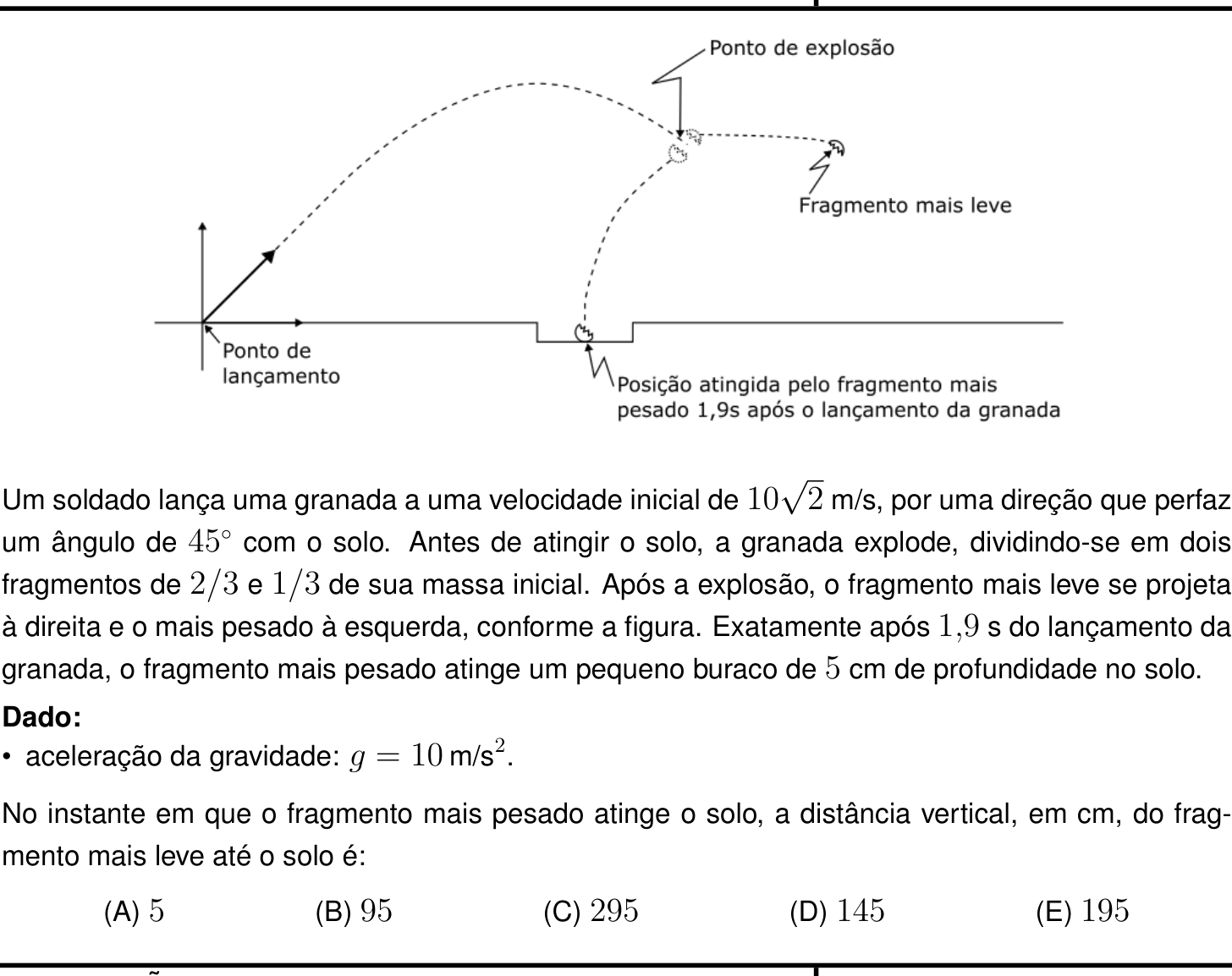
A explosão envolve forças internas, que não alteram a trajetória do centro de massa dos fragmentos. Assim, até o instante do impacto, ele segue a trajetória que a granada teria sem explodir.
A componente vertical da velocidade inicial é
v_{0y}=10\sqrt2\sin45^\circ=10\ \text{m/s}.
Tomando o nível do solo como y=0, a altura do centro de massa em t=1{,}9\,\text{s} é
y_{CM}=v_{0y}t-\frac{gt^2}{2}
=10(1{,}9)-5(1{,}9)^2
=0{,}95\ \text{m}=95\ \text{cm}.
Nesse instante, o fragmento mais pesado, de massa 2M/3, está no fundo do buraco, em y_P=-5\,\text{cm}. Sendo y_L a altura do fragmento mais leve, de massa M/3,
y_{CM}=\frac{\frac{2M}{3}y_P+\frac{M}{3}y_L}{M}.
Logo, em centímetros,
95=\frac23(-5)+\frac13y_L
\quad\Rightarrow\quad
285=-10+y_L
\quad\Rightarrow\quad
\boxed{y_L=295\ \text{cm}}.
Resposta: C
Respondeu
levou 9 s
Como pensou
A explosão envolve forças internas e, portanto, não altera a trajetória do centro de massa dos fragmentos. Sob a ação da gravidade, ele segue a trajetória que a granada teria se não explodisse.
A componente vertical da velocidade inicial é
v_{0y}=10\sqrt2\sin45^\circ=10\ \text{m/s}.
Assim, após 1{,}9\ \text{s}, a altura do centro de massa em relação ao nível do solo é
y_{\rm CM}=v_{0y}t-\frac{gt^2}{2}
=10(1{,}9)-5(1{,}9)^2
=0{,}95\ \text{m}=95\ \text{cm}.
Nesse instante, o fragmento mais pesado, de massa 2M/3, está no fundo do buraco: y_p=-5\ \text{cm}. Se a altura do fragmento mais leve, de massa M/3, é h, então
y_{\rm CM}=\frac{\frac{2M}{3}y_p+\frac{M}{3}h}{M}.
Logo,
95=\frac23(-5)+\frac13h
\quad\Rightarrow\quad
285=-10+h
\quad\Rightarrow\quad
\boxed{h=295\ \text{cm}}.
Resposta: C
Respondeu
levou 8 s
Como pensou
A velocidade inicial vertical da granada é 10\sqrt{2}\sin45^\circ=10\ \text{m/s}. Como a explosão envolve apenas forças internas, o centro de massa dos fragmentos continua seguindo a trajetória que a granada teria sem explodir.
Após 1{,}9\ \text{s}, a altura do centro de massa em relação ao solo é
y_{\rm CM}=10(1{,}9)-\frac{10}{2}(1{,}9)^2=0{,}95\ \text{m}.
Nesse instante, o fragmento pesado está a y_{\rm pesado}=-0{,}05\ \text{m}, pois penetrou 5 cm no solo. Usando as massas 2/3 e 1/3 da massa inicial:
0{,}95=\frac23(-0{,}05)+\frac13y_{\rm leve}.
Logo,
y_{\rm leve}=2{,}95\ \text{m}=295\ \text{cm}.
Resposta: C
Respondeu
levou 14 s
Como pensou
I'm computing the projectile's components with v0=10√2 at 45°, giving vx=vy=10, so the full flight time is 2s. I'm tracking the center of mass's parabolic path and finding that at t=1.9s, with the heavier fragment at 5cm depth, the center of mass height comes out to 0.95 m.
Using the mass-weighted average with the heavier fragment contributing 2/3 and lighter 1/3, I solve for the lighter fragment's position and get 2.95 m = 295 cm. I note the caveat that once the heavy fragment hits ground the center of mass assumption breaks down, but since it reaches the hole exactly at 1.9s, I'll assume pure gravity applies until then—so the answer is C.
Resolução
Decompondo a velocidade inicial: v_x = v_y = 10\sqrt2\cos45^\circ = 10 m/s.
Como a explosão é causada apenas por forças internas, o centro de massa do sistema continua descrevendo a parábola original sob ação exclusiva da gravidade (até o instante em que o fragmento pesado toca o solo, em t = 1{,}9 s).
Altura do centro de massa em t = 1{,}9 s:
y_{CM} = 10(1{,}9) - 5(1{,}9)^2 = 19 - 18{,}05 = 0{,}95\ \text{m}
Nesse instante, o fragmento mais pesado (massa 2m/3) está a 5 cm abaixo do solo: y_P = -0{,}05 m. Pela definição de centro de massa:
y_{CM} = \frac{2}{3}y_P + \frac{1}{3}y_L
0{,}95 = \frac{2}{3}(-0{,}05) + \frac{1}{3}y_L \;\Rightarrow\; y_L = 3(0{,}95) + 0{,}10 = 2{,}95\ \text{m}
Logo, o fragmento mais leve está a 295 cm do solo.
Resposta: C
Respondeu
levou 10 s
Como pensou
At t=1.9s, the center of mass height works out to 95 cm. With the heavy fragment sitting at -5 cm at the bottom of the hole, solving the center of mass equation gives the light fragment's height as 295 cm, so the distance from that fragment to the ground is 295 cm.
Ideia central: a explosão envolve apenas forças internas. Por isso o centro de massa continua na mesma trajetória parabólica que a granada teria sem a explosão.
1. Altura do centro de massa em t = 1,9 s
As componentes da velocidade inicial são:
v_{0x} = v_{0y} = 10\sqrt{2}\cos 45^\circ = 10 \text{ m/s}
A altura do centro de massa é:
y_{CM} = v_{0y}t - \frac{g t^2}{2} = 10(1{,}9) - 5(1{,}9)^2 = 19 - 18{,}05 = 0{,}95 \text{ m} = 95 \text{ cm}
2. Posição dos fragmentos
O fragmento mais pesado tem massa 2m/3. Ele está no fundo do buraco, logo y_P = -5 cm.
O fragmento mais leve tem massa m/3 e altura y_L desconhecida. Pela definição de centro de massa:
y_{CM} = \frac{2}{3}y_P + \frac{1}{3}y_L
95 = \frac{2}{3}(-5) + \frac{1}{3}y_L
y_L = 285 + 10 = 295 \text{ cm}
O fragmento mais leve está, portanto, a 295 cm do solo.
Resposta: C
Respondeu
levou 13 s
Como pensou
I'm working out the projectile launched at 10√2 m/s at 45°, giving equal horizontal and vertical components of 10 m/s each. The grenade explodes mid-flight, splitting into a heavier fragment (2/3 mass) that falls into a hole at 5 cm depth after 1.9 s, and a lighter fragment that appears to move purely horizontally right after the explosion, suggesting its vertical velocity component is zero at that instant—so I need to apply momentum conservation to find the explosion point and the velocities involved.
Using conservation of vertical momentum, since the light fragment has zero vertical velocity post-explosion, the heavy fragment must carry all the vertical momentum, giving it 1.5 times the grenade's vertical velocity at the explosion moment. Setting up the heavy fragment's subsequent fall to the hole and solving the resulting quadratic, I get two possible explosion times, 1.4 s and 1.5 s, and since the explosion must occur after the apex (t > 1 s), I need to check which root makes physical sense.
Checking both candidates against the ground height constraint, both satisfy y0 > 0, so I compute the light fragment's height by tracking its free fall with zero initial vertical speed from the explosion point — remarkably both t=1.4 and t=1.5 give the same final height of 295 cm, confirming the answer is 295 cm.
Montagem
- Velocidade inicial: 10√2 m/s a 45°, logo vₓ = 10 m/s e v_y = 10 m/s.
- Em um instante t antes da explosão, a granada está na altura y₀ = 10t − 5t² e tem velocidade vertical 10 − 10t.
- Pela figura, o fragmento leve sai na horizontal logo após a explosão, então sua velocidade vertical inicial é nula.
- Como as forças da explosão são internas, a componente vertical da quantidade de movimento se conserva. Com o fragmento leve (1/3 da massa) parado na vertical, o fragmento pesado (2/3 da massa) fica com v_yh = 1,5·(10 − 10t) = 15(1 − t).
Fragmento pesado
Ele chega ao fundo do buraco, na posição y = −0,05 m, em t = 1,9 s. Seja τ = 1,9 − t o tempo de queda após a explosão:
−0,05 = y₀ + 15(1 − t)τ − 5τ²
Substituindo e simplificando:
5t² − 14,5t + 10,5 = 0, ou seja, 10t² − 29t + 21 = 0
Então t = 1,4 s ou t = 1,5 s. Nos dois casos a explosão ocorre depois do ápice (t = 1 s) e com a granada ainda no ar.
Fragmento leve
Ele tem velocidade vertical inicial nula, então cai 5τ² a partir da altura y₀.
- Para t = 1,5 s: y₀ = 15 − 11,25 = 3,75 m, τ = 0,4 s e a queda é 0,8 m. A altura é 3,75 − 0,8 = 2,95 m.
- Para t = 1,4 s: y₀ = 14 − 9,8 = 4,2 m, τ = 0,5 s e a queda é 1,25 m. A altura é 4,2 − 1,25 = 2,95 m.
As duas soluções dão o mesmo resultado: 2,95 m = 295 cm acima do solo.
Resposta: C
Respondeu
levou 4 min 58 s
Como pensou
The problem involves a Portuguese scenario about a grenade launching and exploding into two fragments.
The task is to find the vertical distance of the lighter fragment from the ground when the heavier one hits the ground. The grenade launches at 10√2 m/s at 45°. It splits into fragments of 2/3 and 1/3 mass. The heavier fragment lands in a 5 cm deep hole after 1.9 s.
The lighter fragment lands to the right and the heavier one drops left into the hole. The explosion is an internal force, so the center of mass follows the original trajectory. I will use that conservation of momentum to find the lighter fragment's height.
The ground is at y = 0 and the hole is at y = -0.05 m. The heavier fragment hits that hole after 1.9 s.
The 5 cm hole depth may be a red herring. The figure shows the heavier fragment curving down into a small ground depression, so its landing position likely depends on the trajectory rather than the hole's depth.
I am setting up a coordinate system with the launch point at the origin. The initial velocity components are 10 m/s horizontally and 10 m/s vertically, with gravity at 10 m/s².
The center of mass at 1.9 s is at 19 m horizontally and 0.95 m vertically. The heavier fragment lands in the hole at y = -0.05 m.
The heavier fragment lands at y = -0.05 m. The lighter fragment is at y = 2.95 m. The vertical distance from the ground is 295 cm.
The problem as written does not provide enough information to solve it. The figure only shows vague directions, not the actual velocities or angles of the fragments after the explosion. Without those details, the vertical distance of the lighter fragment cannot be determined.
The phrase "atinge o solo" refers to the same event as hitting the hole. The 5 cm depth is used in the calculation, so the heavier fragment lands at y = -0.05 m. The lighter fragment is at y = 2.95 m above ground. The answer is C: 295 cm.
The center of mass follows the original trajectory at all times after the explosion, so no extra velocity data is needed. The directions in the figure are just illustrative and do not affect the calculation.
A trajetória do centro de massa da granada não é afetada pela explosão, pois as forças internas não alteram o movimento do CM sob a ação exclusiva da gravidade. Assim, no instante t = 1{,}9\,\mathrm{s},
y_{\mathrm{CM}} = (10)(1{,}9) - \frac12(10)(1{,}9)^2 = 0{,}95\,\mathrm{m}.
Nesse mesmo instante o fragmento pesado (massa \frac23 da massa total) encontra-se no fundo do buraco, isto é, em y_{\mathrm{p}} = -0{,}05\,\mathrm{m}. A definição de centro de massa fornece então a altura do fragmento leve:
0{,}95 = \frac23(-0{,}05) + \frac13 y_{\mathrm{l}} \implies y_{\mathrm{l}} = 2{,}95\,\mathrm{m} = 295\,\mathrm{cm}.
Essa é a distância vertical do fragmento mais leve até o solo.
Resposta: C
Respondeu
levou 11 s
Como pensou
We need answer in Portuguese. Need solve physics. Need parse image and question. Need find in instant heavier fragment hits ground (well hole 5 cm depth?) distance vertical, in cm, of lighter fragment to ground. Options.
Let's restate problem.
Granada launched initial velocity 10√2 m/s at 45° with ground. Before hitting ground, explodes into two fragments masses 2/3 and 1/3 initial mass. After explosion, lighter fragment projected to right, heavier to left, per figure. Exactly after 1.9 s from launch, heavier fragment reaches a small hole 5 cm deep in ground. Given g=10 m/s².
At instant heavier fragment reaches ground, vertical distance in cm, of lighter fragment to ground?
Need understand: heavier reaches "pequeno buraco de 5 cm de profundidade no solo" at 1.9 s after launch. It might fall into hole, so vertical position y = -5 cm? "atinge o solo" maybe ground level? They mention hole 5 cm deep, so when heavier reaches bottom of hole? The lighter fragment's vertical distance to ground (solo) at that instant. Need account.
Need compute motion of center of mass and explosion fragments. Since external force gravity only, center of mass follows original projectile parabola. Explosion internal, so CM position/velocity unaffected by explosion. We know time 1.9 s after launch, heavier fragment at ground/hole. Need lighter fragment vertical position. We can use CM vertical equation.
Let's set coordinate: launch point origin, x right, y up. Initial velocity components: v0x = v0 cos45 = 10√2 * √2/2 = 10 m/s. v0y = 10 m/s. g=10.
Time t=1.9 s after launch. Without explosion, CM position:
x_cm = 100? Actually v0x t = 10*1.9=19 m.
y_cm = v0y t - 0.5 g t^2 = 10*1.9 - 5*(1.9)^2 = 19 - 5*3.61 = 19 - 18.05 = 0.95 m. So CM is 0.95 m above launch level at t=1.9s. Interesting: heavier at ground/hole? Wait at t=1.9, original projectile would be near ground? Let's calculate original projectile time of flight: 2 v0y/g = 2*10/10=2 s. At t=1.9 s, projectile is at y=0.95 m above ground. But explosion before hitting ground; heavier reaches hole at 1.9s. So not original.
Mass m total initially. Fragments: masses (2/3)m heavier, (1/3)m lighter. Let y1 be heavier vertical position (probably -0.05 m if hole 5 cm deep), y2 lighter vertical position. CM equation:
(m1 y1 + m2 y2)/m = y_cm = 0.95 m.
m1 = 2/3 m, m2 = 1/3 m.
=> (2/3 y1 + 1/3 y2) = 0.95 => 2 y1 + y2 = 2.85 m.
If y1 = 0 (ground level) then y2 = 2.85 m = 285 cm. Options? 295? 285 not option. If y1 = -0.05 m (hole bottom), then 2(-0.05)+ y2 = 2.85 => y2 = 2.95 m = 295 cm. Option C. Aha. So heavier at bottom of hole 5 cm deep: y1 = -5 cm = -0.05 m. Then y2 = 2.95 m = 295 cm. Answer C. But need check if lighter vertical distance to ground is 295 cm? They ask "distância vertical, em cm, do fragmento mais leve até o solo" = y2 - 0 = 295 cm. Yes.
Need verify no other factors: The CM y at 1.9s exactly? y_cm = 10*1.9 - 5*(1.9)^2 = 0.95 m. yes. Heavier reaches small hole 5 cm deep: at that instant its position y = -5 cm relative to original ground. Then y2 = (3 y_cm m? Wait m total = 3 units? Let's use masses: m_heavy = 2m/3, m_light = m/3. CM y = (2/3 y_heavy + 1/3 y_light). Thus multiply by 3: 2 y_heavy + y_light = 3 y_cm = 2.85 m. If y_heavy = -0.05 m, y_light = 2.85 + 0.1 = 2.95 m. Yes.
Need produce explanation in Portuguese. Mention conservation of center of mass, only gravity external. Compute initial velocity components, CM vertical position at 1.9s. Use weighted average. Maybe also mention horizontal not needed. Include formula.
Need ensure "instante em que o fragmento mais pesado atinge o solo" maybe "atinge o solo" not hole? It says reaches a small hole of 5 cm depth in ground; likely its y = -5 cm. If "atinge o solo" at ground level just before entering? But "no instante em que ... atinge o solo" could be at surface, y=0, then y2=2.85 m = 285 cm not option; so must be bottom. They mention hole to adjust. So answer C.
Let's draft final with reasoning concise. Need end line: Resposta: C.
Let's include maybe:
- v0x = v0 cos45 = 10 m/s, v0y = 10 m/s.
- y_CM(t)=10t -5t^2; t=1,9 s => 10*1,9 -5*(1,9)^2 = 19 -18,05 =0,95 m.
- Após explosão, forças externas (gravidade) atuam no CM; então y_CM = (m1 y1 + m2 y2)/(m1+m2). m1/m2 =2, etc.
- y1 = -5 cm = -0,05 m (fundo do buraco). Let y2 = ?; (2/3)(-0,05)+(1/3)y2 =0,95 => -0,10/3 + y2/3=0,95 => y2 = 2,85 +0,10 =2,95 m =295 cm.
Actually calculate: multiply by 3: 2(-0,05)+ y2 = 2,85 => y2 = 2,85 +0,10=2,95 m. Good.
- vertical distance to ground =295 cm. Alternative C.
Final.
A velocidade inicial da granada tem componentes:
v_{0x}=v_0\cos45^\circ=10\sqrt2\cdot\frac{\sqrt2}{2}=10\text{ m/s}
v_{0y}=v_0\operatorname{sen}45^\circ=10\text{ m/s}
Como a única força externa é a gravidade, o centro de massa da granada continua a descrever a mesma trajetória parabólica. Em t=1,9\text{ s}, a altura do centro de massa em relação ao solo é:
y_{CM}=v_{0y}t-\frac12gt^2
=10(1,9)-5(1,9)^2
=19-18,05=0,95\text{ m}
Após a explosão, sejam y_1 e y_2 as alturas dos fragmentos mais pesado e mais leve, respectivamente. Como o centro de massa é dado pela média ponderada:
y_{CM}=\frac{\frac23m\,y_1+\frac13m\,y_2}{m}
=\frac{2y_1+y_2}{3}
Logo:
2y_1+y_2=3y_{CM}=3(0,95)=2,85\text{ m}
O fragmento mais pesado atinge o fundo do buraco de 5\text{ cm} de profundidade, então:
y_1=-0,05\text{ m}
Substituindo:
2(-0,05)+y_2=2,85
-0,10+y_2=2,85
y_2=2,95\text{ m}=295\text{ cm}
Portanto, a distância vertical do fragmento mais leve até o solo é 295\text{ cm}.
Resposta: C
Respondeu
levou 23 s
Como pensou
**Analyzing Projectile Trajectory**
I'm currently focused on understanding the initial conditions of the grenade's launch. My analysis centers on the provided velocity and angle to accurately model its trajectory. This forms the crucial first step in calculating the subsequent events.
**Refining Impact Location**
I'm re-examining the problem statement regarding the heavier fragment's impact. There's ambiguity between hitting the "ground" and hitting the "bottom of a hole." I need to clarify this precise point before proceeding with calculations.
**Clarifying Impact Details**
I'm wrestling with the precise meaning of "hitting the ground" versus the "bottom of a hole." The diagram suggests the latter, implying a specific vertical displacement, but accompanying text introduces further ambiguity. This needs to be ironed out.
**Resolving Ground vs. Hole Impact**
I've been meticulously re-analyzing the problem's phrasing concerning the heavier fragment's impact point. The diagram strongly suggests the bottom of a hole, yet the text explicitly states "hits the ground." I'm considering if "ground" is intended to encompass the hole's bottom or if there's a subtle distinction I'm missing. My calculations are paused until this critical ambiguity is resolved.
**Confirming Fragment Impact Depth**
I've re-evaluated the precise impact location for the heavier fragment. The text now clarifies it hits the *bottom* of a 5 cm deep hole. This means its vertical position is -0.05 meters at $t=1.9$ seconds, resolving previous ambiguity.
**Confirming Fragment Calculation**
I've successfully calculated the vertical position of the lighter fragment at the precise moment the heavier one hits the ground. My result of 295 cm perfectly matches option (C), confirming my understanding of the center of mass dynamics and the impact conditions.
**Calculating Fragment Displacement**
I am now calculating the vertical displacement of the lighter fragment at the exact instant the heavier fragment strikes the bottom of the hole, using the established center of mass trajectory. My current calculations indicate a displacement consistent with option (C).
**Calculating Lighter Fragment's Height**
I've successfully calculated the vertical position of the lighter fragment using the established center of mass trajectory and the impact conditions of the heavier fragment. My final calculation yields 295 cm, aligning with option (C).
Para determinar a distância vertical do fragmento mais leve até o solo, podemos analisar o movimento do centro de massa (CM) do sistema.
- Movimento do Centro de Massa (CM):
Como a explosão decorre exclusivamente de forças internas, a trajetória do centro de massa do sistema não se altera enquanto os fragmentos estiverem sob ação exclusiva da gravidade. Logo, o CM descreve a trajetória parabólica original da granada.
A velocidade inicial na direção vertical é:
v_{0y} = v_0 \cdot \operatorname{sen}(45^\circ) = 10\sqrt{2} \cdot \frac{\sqrt{2}}{2} = 10\text{ m/s}
A posição vertical do centro de massa no tempo t é dada por:
y_{CM}(t) = v_{0y}t - \frac{1}{2}gt^2
Substituindo t = 1,9\text{ s} e g = 10\text{ m/s}^2:
y_{CM}(1,9) = 10 \cdot 1,9 - 5 \cdot (1,9)^2 = 19 - 5 \cdot 3,61 = 19 - 18,05 = 0,95\text{ m} = 95\text{ cm}
- Relação entre as posições dos fragmentos e o CM:
Seja M a massa total da granada. Os fragmentos possuem massas:
- Fragmento mais pesado: m_1 = \frac{2}{3}M
- Fragmento mais leve: m_2 = \frac{1}{3}M
A coordenada vertical do centro de massa é:
y_{CM} = \frac{m_1 y_1 + m_2 y_2}{M} = \frac{\frac{2}{3}M y_1 + \frac{1}{3}M y_2}{M} = \frac{2}{3}y_1 + \frac{1}{3}y_2
Multiplicando toda a equação por 3:
3y_{CM} = 2y_1 + y_2 \implies y_2 = 3y_{CM} - 2y_1
- Cálculo da altura do fragmento mais leve:
No instante t = 1,9\text{ s}, o fragmento mais pesado atinge o fundo do buraco, cuja profundidade em relação ao solo (y = 0) é de 5\text{ cm}, logo:
y_1 = -5\text{ cm}
Substituindo os valores encontrados:
y_2 = 3 \cdot (95\text{ cm}) - 2 \cdot (-5\text{ cm})
y_2 = 285\text{ cm} + 10\text{ cm} = 295\text{ cm}
Portanto, a distância vertical do fragmento mais leve até o solo é de 295\text{ cm}.
Resposta: C