Respondeu
levou 13 s
Como pensou
**Calculating moments and forces**
I need to calculate a few positions: A0, P.9, B2.7, P3.3, and P3.9, while addressing moments and forces as well. The moments seem to add up to 67.5 plus 99 plus 117283.5 divided by 2.7, resulting in 105. I should also find the A30 ratio, which is 3.5. It's crucial to explain the sum of the moments and forces adequately, and I’ll make sure to use proper units, remembering to use commas in the Portuguese format for clarity.
Como a viga está em equilíbrio, a soma das forças verticais e a soma dos momentos devem ser nulas.
Tomando os momentos em relação ao apoio A, a reação F_A não contribui. As distâncias até B e até as forças de 30\,\text{kN} são, respectivamente, 2{,}7, 3{,}3 e 3{,}9\,\text{m}. Assim:
F_B\cdot 2{,}7=75\cdot 0{,}9+30\cdot 3{,}3+30\cdot 3{,}9
F_B=\frac{283{,}5}{2{,}7}=105\,\text{kN}.
Pelo equilíbrio das forças verticais:
F_A+F_B=75+30+30=135\,\text{kN},
logo,
F_A=135-105=30\,\text{kN}.
Portanto, a razão solicitada é
\frac{|F_B|}{|F_A|}=\frac{105}{30}=\boxed{3{,}50}.
Resposta: A
Respondeu
levou 9 s
Como pensou
**Calculating image distances**
I’m working on solving image distances with values like A 0, 75, B 2.7, and others. I think I need to sum the moments, like 67.5 + 99 + 117283.5, and then input B 105 alongside A 30. There’s also a ratio of 3.5 I need to consider for A. I might need to outline the steps in Portuguese too, to make it clearer for anyone who speaks that language. This could get interesting!
Para a viga estar em equilíbrio, a soma das forças verticais e a soma dos momentos devem ser nulas.
Equilíbrio das forças verticais:
F_A+F_B=75+30+30=135\ \text{kN}.
Equilíbrio dos momentos em relação ao apoio A: as distâncias de B e das três forças até A são, respectivamente, 2{,}7, 0{,}9, 3{,}3 e 3{,}9 metros. Assim,
F_B\cdot 2{,}7
=75\cdot 0{,}9+30\cdot 3{,}3+30\cdot 3{,}9.
F_B=\frac{283{,}5}{2{,}7}=105\ \text{kN}.
Logo,
F_A=135-105=30\ \text{kN}.
Portanto, a razão entre os módulos das reações é
\frac{F_B}{F_A}=\frac{105}{30}=\boxed{3{,}50}.
Resposta: A
Respondeu
levou 5 s
Como pensou
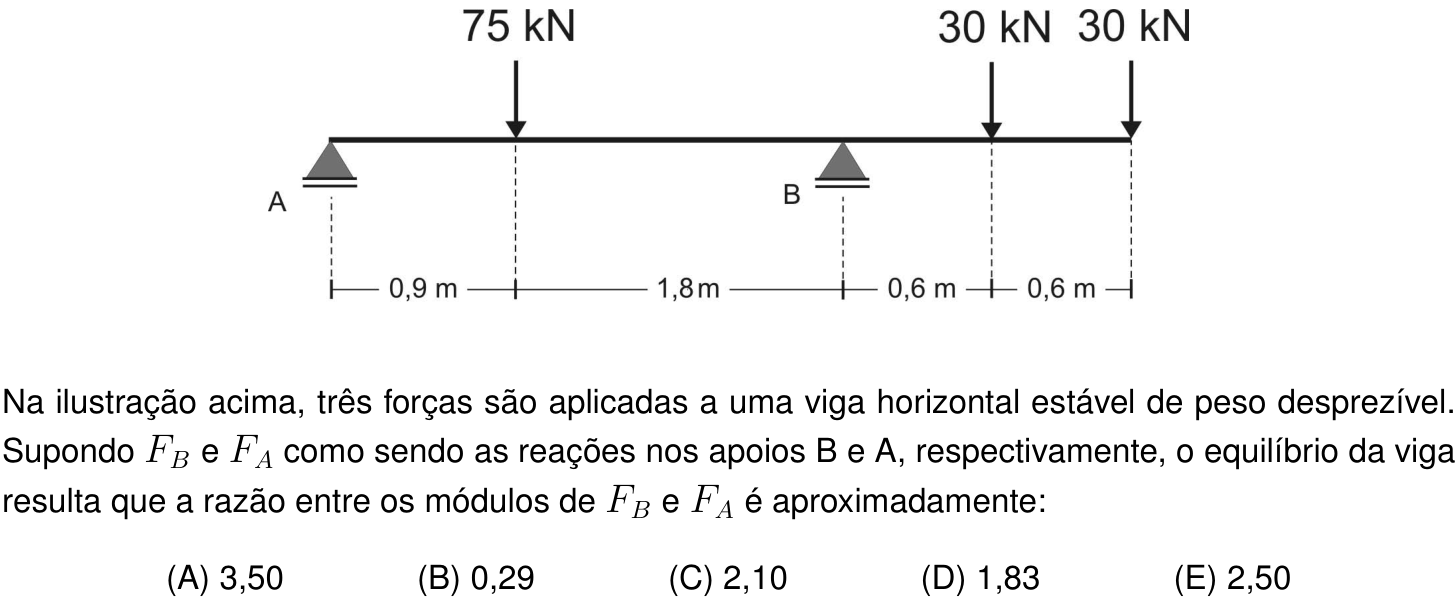
Tomando o apoio A como origem, o apoio B está a 0{,}9+1{,}8=2{,}7 m de A. As forças de 30 kN atuam, respectivamente, a 3,3 m e 3,9 m de A.
Pelo equilíbrio dos momentos em torno de A:
F_B(2{,}7)=75(0{,}9)+30(3{,}3)+30(3{,}9),
de onde F_B=105 kN. Pelo equilíbrio vertical,
F_A+F_B=75+30+30=135,
portanto F_A=30 kN. Assim,
\frac{|F_B|}{|F_A|}=\frac{105}{30}=3{,}50.
Resposta: A
Respondeu
levou 6 s
Como pensou
Vamos tomar o apoio A como origem e as posições das forças ao longo da viga:
- 75 kN em x = 0,9 m
- Apoio B em x = 0,9 + 1,8 = 2,7 m
- 30 kN em x = 2,7 + 0,6 = 3,3 m
- 30 kN em x = 3,3 + 0,6 = 3,9 m
Equilíbrio de forças (vertical):
F_A + F_B = 75 + 30 + 30 = 135 kN
Equilíbrio de momentos em relação a A:
F_B · 2,7 = 75 · 0,9 + 30 · 3,3 + 30 · 3,9
F_B · 2,7 = 67,5 + 99 + 117 = 283,5
F_B = 105 kN
Logo, F_A = 135 − 105 = 30 kN.
Razão:
F_B / F_A = 105 / 30 = 3,5
Resposta: A
Respondeu
levou 8 s
Como pensou
Taking moments about A with loads at 0.9, 3.3, and 3.9 to find FB: solving gives FB = 105, so FA = 30 by subtracting from the total load of 135. That gives a ratio of 3.5.
Resposta: (A) 3,50
Coloco a origem no apoio A. As posições ao longo da viga ficam assim:
- força de 75 kN em x = 0,9 m;
- apoio B em x = 0,9 + 1,8 = 2,7 m;
- primeira força de 30 kN em x = 2,7 + 0,6 = 3,3 m;
- segunda força de 30 kN em x = 3,3 + 0,6 = 3,9 m.
Momentos em relação a A (ΣM_A = 0):
F_B \cdot 2{,}7 = 75 \cdot 0{,}9 + 30 \cdot 3{,}3 + 30 \cdot 3{,}9
F_B \cdot 2{,}7 = 67{,}5 + 99 + 117 = 283{,}5
F_B = 105 \text{ kN}
Forças verticais (ΣF_y = 0):
F_A + F_B = 75 + 30 + 30 = 135
F_A = 135 - 105 = 30 \text{ kN}
Razão entre as reações:
\frac{F_B}{F_A} = \frac{105}{30} = 3{,}5
Resposta: A
Respondeu
levou 4 s
Como pensou
Posições medidas a partir de A (x = 0):
- Carga de 75 kN em x = 0,9 m
- Apoio B em x = 0,9 + 1,8 = 2,7 m
- Carga de 30 kN em x = 2,7 + 0,6 = 3,3 m
- Carga de 30 kN em x = 3,3 + 0,6 = 3,9 m
Equilíbrio de momentos em relação a A (considerando F_B para cima):
F_B · 2,7 = 75 · 0,9 + 30 · 3,3 + 30 · 3,9
F_B · 2,7 = 67,5 + 99 + 117 = 283,5
F_B = 105 kN
Equilíbrio de forças verticais:
F_A + F_B = 75 + 30 + 30 = 135
F_A = 135 − 105 = 30 kN
Razão:
F_B / F_A = 105 / 30 = 3,5
Resposta: A
Respondeu
levou 42 s
Como pensou
The problem is in Portuguese. It concerns a beam with forces and supports.
The beam has a pin support at A and another support at B. Three forces act on it: 75 kN, 30 kN, and 30 kN. Distances from A are 0.9 m, 1.8 m, 0.6 m, and 0.6 m. The beam extends beyond B to the right. Both supports appear to be simple supports. Vertical reactions FA and FB act upward.
I placed A at x=0 and mapped the forces to 0.9 m, 2.7 m, 3.3 m, and 3.9 m. The vertical equilibrium equation gives FA + FB = 135 kN. I am now setting up the moment equation about A.
I am assigning signs to the moment equation about A. Upward forces to the right of A create counterclockwise moments, while downward forces create clockwise moments.
The moment equation about A yields FB = 105 kN. Combined with the vertical equilibrium equation, FA = 30 kN. The ratio FB / FA is therefore 3.5. Both reactions are positive, confirming the sign convention. I am now verifying this result by taking moments about support B.
I am rechecking the moment equation about B. I noted that the 75 kN force is 1.8 m left of B, and the two 30 kN forces are 0.6 m and 1.2 m right of B. I am carefully assigning signs to the upward FA reaction to ensure the net moment sums to zero.
I am confirming the standard 2D rotation convention. Counterclockwise motion moves a point to the right of the center upward, and a point to the left downward.
I am applying the vector cross product to compute the moment about B. The upward FA reaction at A is located 2.7 m left of B, so its torque is τ = −2.7 FA. I am checking whether this sign correctly represents counterclockwise rotation.
I am summing the moments about B. The upward FA reaction contributes −81 kN·m. The 75 kN force contributes +135 kN·m. The two 30 kN forces contribute −18 kN·m and −36 kN·m. FB contributes zero. The total is 0.
A viga está em equilíbrio estático sob a ação das três cargas verticais e das reações verticais F_A e F_B (o peso próprio é desprezível e não há cargas horizontais).
O equilíbrio de forças verticais fornece
F_A + F_B = 135\,\text{kN}.
Tomando momentos em relação ao apoio A (com o sentido horário positivo) obtém-se
F_B\cdot 2{,}7 = 75\cdot 0{,}9 + 30\cdot 3{,}3 + 30\cdot 3{,}9 = 283{,}5,
donde
F_B = 105\,\text{kN}.
Substituindo na equação de forças,
F_A = 30\,\text{kN}.
Ambas as reações são positivas (dirigidas para cima). A razão pedida é portanto
\frac{|F_B|}{|F_A|} = \frac{105}{30} = 3{,}50.
(A verificação do equilíbrio de momentos em relação a B confirma que o momento resultante é nulo, validando os valores obtidos.)
Resposta: A
Respondeu
levou 22 s
Como pensou
We need answer in Portuguese. Need solve statics beam. Let's restate.
Beam horizontal stable weight negligible. Supports at A left, B interior? Diagram: A support at left end, B support at 1.8 m from first load? Let's parse.
Beam with support A at left end (triangle/pin? Actually symbol triangle on line maybe roller? A has triangle above line? B also). Forces: downward 75 kN at distance 0.9 m right of A. Then distance 1.8 m to B support. Then distance 0.6 m to first 30 kN downward, then distance 0.6 m to second 30 kN at right end. Total length = 0.9 + 1.8 + 0.6 + 0.6 = 3.9 m. Supports at A (x=0) and B (x=0.9+1.8=2.7 m). Loads: 75 kN at x=0.9; 30 kN at x=2.7+0.6=3.3; 30 kN at x=3.9. Need reactions F_A and F_B (vertical) ratio |F_B|/|F_A| approximately. Need consider signs? Equilibrium.
Let's solve. Let upward reactions A, B. Sum vertical: A + B = 75 + 30 + 30 = 135 kN (downward loads). Sum moments about A: B*(2.7) = 75*(0.9) + 30*(3.3) + 30*(3.9). Compute: 75*0.9 = 67.5. 30*3.3=99. 30*3.9=117. Total = 283.5 kN*m. B = 283.5 / 2.7 = 105 kN? 2.7*105=283.5 yes. Then A = 135 - 105 = 30 kN. Ratio B/A = 105/30 = 3.5. Alternative A.
Need ensure no issues: Support B at 2.7 m, load 30 at 3.3, another at 3.9. Yes. Ratio modules 3.5. Answer A.
Need explain. But perhaps check if F_B and F_A as reactions maybe one negative? No B positive 105, A positive 30. Ratio 3.50. Good.
Need final with line "Resposta: A". Include reasoning in Portuguese.
Para resolver, aplicamos as equações de equilíbrio da estática.
Dados:
- Carga de 75 kN a 0,9 m do apoio A.
- Apoio B a 0,9 + 1,8 = 2,7 m de A.
- Carga de 30 kN a 2,7 + 0,6 = 3,3 m de A.
- Carga de 30 kN a 3,3 + 0,6 = 3,9 m de A.
Sendo F_A e F_B as reações verticais para cima nos apoios A e B:
- Equilíbrio de forças verticais:
F_A + F_B = 75 + 30 + 30 = 135 \text{ kN}
- Equilíbrio de momentos em relação ao apoio A:
F_B \cdot 2,7 = 75 \cdot 0,9 + 30 \cdot 3,3 + 30 \cdot 3,9
F_B \cdot 2,7 = 67,5 + 99 + 117 = 283,5
F_B = \frac{283,5}{2,7} = 105 \text{ kN}
- Cálculo de F_A:
F_A = 135 - 105 = 30 \text{ kN}
- Razão entre os módulos:
\frac{F_B}{F_A} = \frac{105}{30} = 3,50
Resposta: A
Respondeu
levou 10 s
Como pensou
**Analyzing Beam Forces**
I'm currently focused on understanding the forces at play in the horizontal beam. My attention is specifically on the reactions at supports A and B, labeled $F_A$ and $F_B$, as described in the illustration.
**Calculating Support Reactions**
My focus has shifted to calculating the specific reactions at supports A and B, $F_A$ and $F_B$. I'm using the principles of static equilibrium to determine these values based on the applied loads and their positions along the beam.
**Solving for $F_B$**
I've successfully determined $F_B$ using the moment equilibrium equation about point A. The calculated value for $F_B$ is $105\text{ kN}$.
**Calculating $F_A$ and Verifying**
I've now calculated $F_A$ using the vertical force equilibrium equation, resulting in $30\text{ kN}$. I'm proceeding to verify these results by taking moments about point B.
Para determinar a razão entre os módulos das forças de reação nos apoios, aplicamos as condições de equilíbrio estático da viga.
- Equilíbrio de momentos em torno do apoio A (\sum M_A = 0):
Adotando o sentido horário como positivo:
\sum M_A = 75 \cdot 0{,}9 - F_B \cdot 2{,}7 + 30 \cdot (2{,}7 + 0{,}6) + 30 \cdot (2{,}7 + 0{,}6 + 0{,}6) = 0
Calculando cada termo:
75 \cdot 0{,}9 = 67{,}5\text{ kN}\cdot\text{m}
30 \cdot 3{,}3 = 99{,}0\text{ kN}\cdot\text{m}
30 \cdot 3{,}9 = 117{,}0\text{ kN}\cdot\text{m}
Substituindo na equação:
67{,}5 - 2{,}7 F_B + 99{,}0 + 117{,}0 = 0
2{,}7 F_B = 283{,}5
F_B = \frac{283{,}5}{2{,}7} = 105\text{ kN}
-
Equilíbrio de forças verticais (\sum F_y = 0):
F_A + F_B - 75 - 30 - 30 = 0
F_A + 105 = 135
F_A = 30\text{ kN}
-
Cálculo da razão entre os módulos de F_B e F_A:
\frac{F_B}{F_A} = \frac{105}{30} = 3{,}50
Resposta: A