Respondeu
levou 21 s
Como pensou
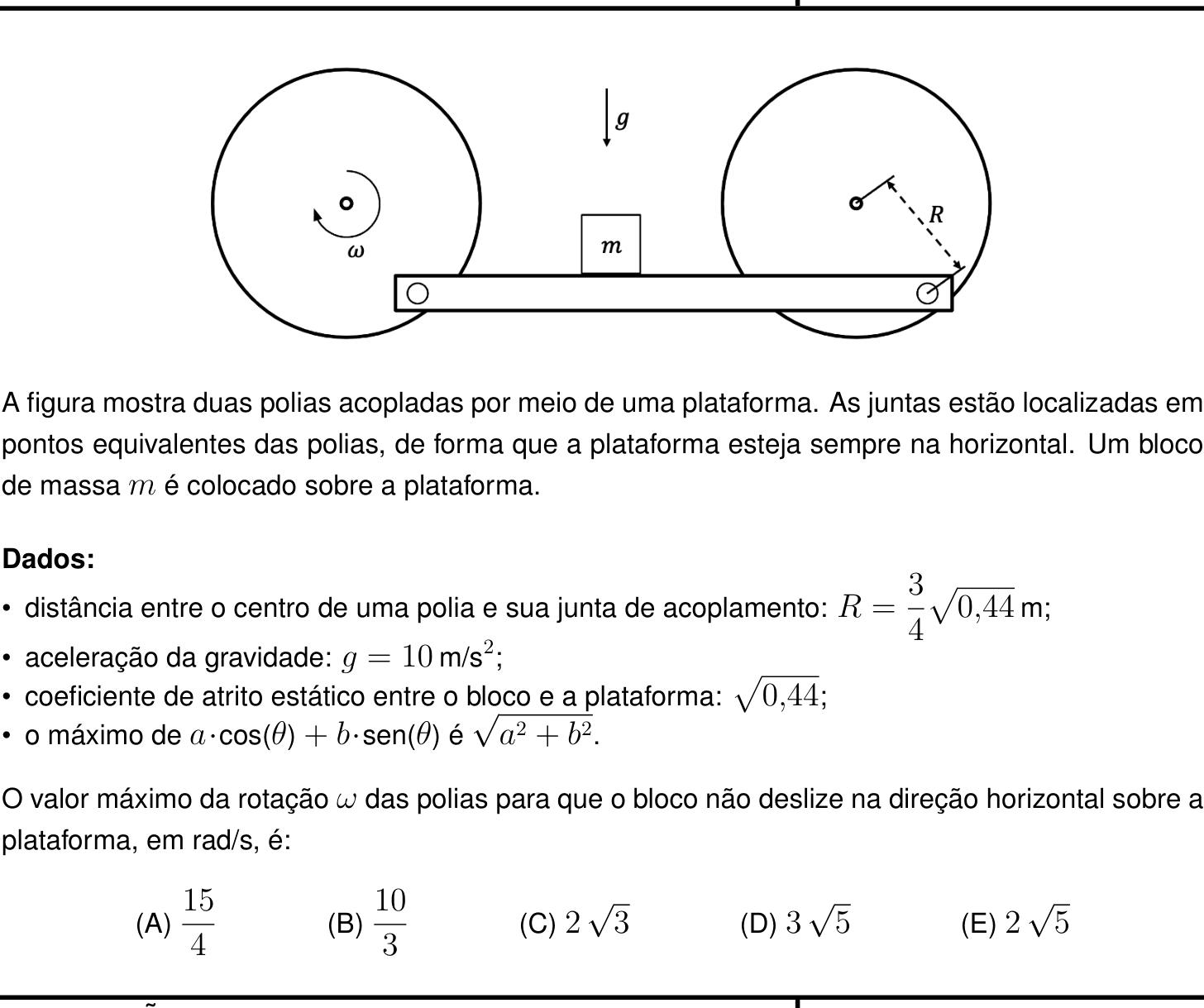
Como a plataforma permanece horizontal, ela realiza uma translação circular: todos os seus pontos têm a mesma aceleração das juntas. Para uma velocidade angular constante \omega, tomando \theta como o ângulo do raio da junta com a horizontal, temos
a_x=-R\omega^2\cos\theta,
\qquad
a_y=-R\omega^2\sen\theta.
Se o bloco não desliza, ele acompanha essa aceleração. Na horizontal, a força de atrito deve satisfazer
|F_{\text{at}}|=mR\omega^2|\cos\theta|.
Na vertical, a segunda lei de Newton fornece
N-mg=ma_y
\quad\Rightarrow\quad
N=m(g-R\omega^2\sen\theta).
Para que o atrito estático seja suficiente, é necessário que
|F_{\text{at}}|\leq \mu N.
Logo,
R\omega^2\bigl(|\cos\theta|+\mu\sen\theta\bigr)\leq \mu g.
Essa condição deve valer durante toda a volta. O máximo da expressão entre parênteses é \sqrt{1+\mu^2}, portanto
\omega_{\max}^2=\frac{\mu g}{R\sqrt{1+\mu^2}}.
Substituindo os dados,
\mu=\sqrt{0,44},
\qquad
R=\frac34\sqrt{0,44}\ \text{m},
\qquad
\sqrt{1+\mu^2}=\sqrt{1,44}=\frac65,
obtemos
\omega_{\max}^2
=\frac{10\sqrt{0,44}}
{\frac34\sqrt{0,44}\cdot\frac65}
=\frac{100}{9}.
Assim,
\boxed{\omega_{\max}=\frac{10}{3}\ \text{rad/s}}.
Nesse limite, R\omega_{\max}^2<g, de modo que a normal permanece positiva e o bloco não perde contato com a plataforma.
Resposta: B
Respondeu
levou 17 s
Como pensou
Como as juntas ocupam posições equivalentes nas polias, a plataforma permanece horizontal e realiza uma translação circular de raio R. Assim, se o bloco não desliza, sua aceleração é igual à da plataforma.
Seja \theta o ângulo do raio que liga o centro de uma polia à sua junta, medido em relação à horizontal. Para rotação constante \omega, as componentes da aceleração são
a_x=-R\omega^2\cos\theta,
\qquad
a_y=-R\omega^2\sen\theta.
Na vertical, a segunda lei de Newton fornece
N-mg=ma_y
\quad\Rightarrow\quad
N=m\bigl(g-R\omega^2\sen\theta\bigr).
Na horizontal, o atrito deve produzir a aceleração do bloco. Portanto, para não haver deslizamento,
mR\omega^2|\cos\theta|\leq \mu N.
Substituindo a normal e reorganizando:
R\omega^2\bigl(|\cos\theta|+\mu\sen\theta\bigr)\leq \mu g.
Essa condição deve valer durante toda a volta. O máximo da expressão entre parênteses é \sqrt{1+\mu^2}; logo,
\omega_{\max}^2=\frac{\mu g}{R\sqrt{1+\mu^2}}.
Com \mu=\sqrt{0,44}, R=\frac34\sqrt{0,44}\,\text{m} e g=10\,\text{m/s}^2,
\sqrt{1+\mu^2}=\sqrt{1,44}=\frac65,
\omega_{\max}^2
=\frac{10\sqrt{0,44}}
{\left(\frac34\sqrt{0,44}\right)\frac65}
=\frac{100}{9}.
Assim,
\boxed{\omega_{\max}=\frac{10}{3}\ \text{rad/s}}.
Nesse limite, R\omega_{\max}^2<g, de modo que o bloco também mantém contato com a plataforma.
Resposta: B
Respondeu
levou 17 s
Como pensou
Seja a=R\omega^2 o módulo da aceleração da plataforma. Como as juntas descrevem circunferências com a mesma fase, a plataforma tem acelerações horizontal e vertical que podem ser escritas como
a_x=a\cos\theta,\qquad a_y=a\sen\theta,
com \theta variando ao longo da rotação.
Para o bloco acompanhar a plataforma sem deslizar, a força de atrito necessária é m|a_x|. Na vertical, a normal vale N=m(g+a_y). Portanto, a condição de atrito estático é
|a_x|\leq \mu(g+a_y).
Para que isso valha em qualquer posição, o maior valor de |a_x|-\mu a_y não pode exceder \mu g. Usando a expressão de máximo fornecida,
a\sqrt{1+\mu^2}\leq \mu g.
Logo,
R\omega^2\leq \frac{\mu g}{\sqrt{1+\mu^2}}.
Com \mu=\sqrt{0,44}, R=\frac34\sqrt{0,44}\,\text{m} e g=10\,\text{m/s}^2:
\omega^2\leq
\frac{10\sqrt{0,44}}{\sqrt{1+0,44}}\,
\frac{1}{\frac34\sqrt{0,44}}
=\frac{100}{9}.
Assim, \omega_{\max}=\frac{10}{3}\,\text{rad/s}.
Resposta: B
Respondeu
levou 20 s
Como pensou
Since the platform translates in a circle without rotating, every point including the block undergoes the same centripetal acceleration ω²R toward the center, so I'm setting up the position angle θ to express the acceleration components as a_x = -ω²R cosθ and a_y = -ω²R sinθ.
From Newton's second law vertically I get N = m(g − ω²R sinθ), and horizontally f = −mω²R cosθ, so the no-slip condition becomes ω²R(|cosθ| + μ sinθ) ≤ μg for every θ. Maximizing the left side gives √(1+μ²), and plugging in μ²=0.44 and R=(3/4)√0.44 simplifies things nicely since √1.44=1.2, leading to ω² ≤ 100/9, so ω ≤ 10/3 — checking that N stays non-negative confirms this is valid, pointing to answer B.
Movimento do bloco
Como a plataforma permanece sempre horizontal e está presa a pontos equivalentes das duas polias, ela executa uma translação circular: todo ponto da plataforma (e, portanto, o bloco) descreve uma circunferência de raio R com velocidade angular \omega. A aceleração do bloco é centrípeta, de módulo \omega^2 R, apontando para o centro da sua trajetória.
Seja \theta o ângulo da posição do bloco (medido a partir da horizontal). Componentes da aceleração:
a_x = -\omega^2 R\cos\theta,\qquad a_y = -\omega^2 R\,\text{sen}\,\theta
Forças no bloco: peso mg (para baixo), normal N (para cima) e atrito estático f (horizontal).
- Vertical: N - mg = m a_y \Rightarrow N = m\left(g - \omega^2 R\,\text{sen}\,\theta\right)
- Horizontal: |f| = m\,\omega^2 R\,|\cos\theta|
Condição de não deslizamento: |f| \le \mu N
\omega^2 R\,|\cos\theta| \le \mu\left(g - \omega^2 R\,\text{sen}\,\theta\right)
\;\Longrightarrow\;
\omega^2 R\left(|\cos\theta| + \mu\,\text{sen}\,\theta\right) \le \mu g
Isso deve valer para todo \theta. Pelo dado da prova, o máximo de \cos\theta + \mu\,\text{sen}\,\theta é \sqrt{1+\mu^2}. Logo:
\omega^2 R\sqrt{1+\mu^2} \le \mu g
Substituindo os valores:
\mu = \sqrt{0{,}44} \Rightarrow \mu^2 = 0{,}44 \Rightarrow \sqrt{1+\mu^2} = \sqrt{1{,}44} = 1{,}2
R = \dfrac{3}{4}\sqrt{0{,}44}
\omega^2 \le \frac{\mu g}{R\sqrt{1+\mu^2}} = \frac{\sqrt{0{,}44}\cdot 10}{\dfrac{3}{4}\sqrt{0{,}44}\cdot 1{,}2} = \frac{10}{0{,}9} = \frac{100}{9}
\omega_{\max} = \frac{10}{3}\ \text{rad/s}
(Verifica-se ainda que N \ge 0: \omega^2 R \approx 5{,}5 < g, então o bloco não perde contato.)
Resposta: B
Respondeu
levou 11 s
Como pensou
I'm working out that the block's required centripetal acceleration ω²R decomposes into horizontal and vertical components depending on its angular position θ, which sets how normal force and friction must adjust: N = m(g + a_y), and the friction condition becomes |a_x| ≤ μ(g + a_y) with a_x = -ω²R cosθ and a_y = -ω²R sinθ.
Combining terms, the condition simplifies to ω²R(|cosθ| + μ sinθ) ≤ μg, and the worst case occurs when cosθ + μ sinθ reaches its maximum value √(1+μ²) = 1.2. Solving for ω² gives ω² = μg/(1.2R) = 100/9, so ω = 10/3, matching option B — and checking N > 0 confirms the normal force stays positive throughout.
Resposta: (B) ω = 10/3 rad/s
Movimento da plataforma. As juntas estão em pontos equivalentes das duas polias. Por isso a plataforma translada sem girar, e cada ponto dela, inclusive o bloco, descreve um círculo de raio R com velocidade angular ω. A aceleração do bloco tem módulo ω²R e aponta para o centro desse círculo.
Seja θ o ângulo da posição da junta. As componentes da aceleração são:
- horizontal: a_x = −ω²R cos θ
- vertical: a_y = −ω²R sen θ
Forças no bloco.
- Na vertical: N − mg = m·a_y, logo N = m(g − ω²R sen θ).
- Na horizontal, o atrito estático deve fornecer a aceleração: |f| = mω²R|cos θ|.
Condição de não deslizamento. É preciso |f| ≤ μN:
ω²R|cos θ| ≤ μ(g − ω²R sen θ)
Isolando:
ω²R(|cos θ| + μ sen θ) ≤ μg
O pior caso ocorre no máximo de |cos θ| + μ sen θ, que vale √(1 + μ²). Com μ² = 0,44:
√(1 + 0,44) = √1,44 = 1,2
Cálculo de ω.
ω² = μg / (1,2R) = (√0,44 · 10) / (1,2 · ¾√0,44) = 10 / 0,9 = 100/9
ω = 10/3 rad/s
Verificação. Nessa rotação, ω²R ≈ 5,5 m/s², menor que g. Portanto a normal permanece positiva e o bloco não perde contato com a plataforma.
Resposta: B
Respondeu
levou 9 s
Como pensou
I'm working out the platform's circular motion, getting centripetal acceleration components directed toward the pulley's center based on angle θ, then setting up Newton's second law equations for the block including normal force and friction.
Writing out the maximum friction condition using the angle φ, I find that the worst case reduces to requiring Rω²√(1+μ²) ≤ μg. Substituting μ²=0,44 and the given radius, I solve for ω, getting ω=10/3, then verify the normal force stays positive, confirming answer B.
Raciocínio
A plataforma permanece horizontal e as juntas estão em pontos equivalentes das polias. Por isso, ela faz uma translação circular de raio R, e todos os seus pontos têm a mesma aceleração: o módulo é a = Rω², dirigido da junta para o centro da polia.
Seja φ o ângulo da posição da junta em relação ao centro da polia. A aceleração da plataforma, e do bloco junto com ela, tem componentes:
- horizontal: |aₓ| = Rω²|cos φ|
- vertical: a_y = −Rω² sen φ
Equações do bloco
- Vertical: N − mg = m·a_y, logo N = m(g − Rω² sen φ).
- Horizontal: a força de atrito fornece a aceleração horizontal, f = m·Rω²|cos φ|.
Condição de não deslizamento
f ≤ μN:
Rω²|cos φ| ≤ μ(g − Rω² sen φ)
Rω²(|cos φ| + μ sen φ) ≤ μg
Essa condição deve valer para todo φ. Usando o máximo de a·cos θ + b·sen θ, que é √(a²+b²), o máximo do termo entre parênteses é √(1+μ²):
Rω²·√(1+μ²) ≤ μg
Valores numéricos
- μ² = 0,44, então √(1+μ²) = √1,44 = 1,2.
- R = (3/4)√0,44 e μ = √0,44.
ω² ≤ μg / (R·1,2) = 10 / ((3/4)·1,2) = 10/0,9 = 100/9
ω ≤ 10/3 rad/s
Verificação: com ω = 10/3, Rω² ≈ 5,5 m/s², menor que g. Portanto N > 0 para todo φ e o bloco não perde contato com a plataforma.
Resposta: B
Respondeu
levou 3 min 09 s
Como pensou
The problem is in Portuguese. It concerns two pulleys coupled by a platform with a block of mass m on it.
The goal is to find the maximum angular velocity ω so the block does not slide horizontally. The platform moves in a circle because it is attached to points on the rotating pulleys. Given data includes R = (3/4)√0.44 m, g = 10 m/s², and μ = √0.44. The maximum of a cosθ + b sinθ equals √(a² + b²).
Both pulleys rotate with the same angular velocity ω. The platform moves in a circle of radius R while remaining horizontal and not rotating.
The platform's center traces a circle of radius R with angular speed ω. Because the rotation is uniform, only centripetal acceleration acts on the block, with magnitude ω²R.
The pulley centers are fixed. The platform is attached at points distance R from each center. Because the platform stays horizontal, the attachment points share the same angular position on both pulleys. The block's centripetal acceleration must be resolved relative to the correct circular center.
The left and right joints trace circles of radius R around their respective pulley centers. Because the platform connects them, it translates as a rigid body. Every point on the platform shares the same acceleration, which is the centripetal acceleration ω²R toward its pulley center.
The centripetal acceleration ω²R points from each joint toward its pulley center and rotates with the platform. For the block to remain horizontal, friction must supply the horizontal component of this acceleration while the normal force balances gravity.
The block must remain in contact with the platform. I will set up coordinates to solve for the maximum angular velocity.
I will define θ as the angle between the joint radius and the vertical. The pulleys are side by side with the platform connecting their lower points. I need to determine whether the maximum angular velocity is limited by the worst-case position during the cycle or by the maximum value over the entire rotation.
The maximum angular velocity ω must be such that friction prevents horizontal sliding at every instant of the motion. Both pulleys rotate with constant angular velocity ω in the same direction and phase, so the platform translates rigidly.
The acceleration of the platform is identical at every point because the relative vector from each pulley center to its joint is the same. Both joints therefore share the same centripetal acceleration ω²R directed toward their respective centers.
I will use the identity that the maximum of a cosθ + b sinθ is √(a² + b²). The acceleration components are a_x = -ω² x and a_y = -ω² y, where (x, y) is the joint's position relative to its pulley center. I am now setting up the force equations for the block.
I set up the coordinate system with y vertical and x horizontal. The net force equations are f = m a_x and N - mg = m a_y, so N = m(g + a_y) and f = m a_x. For no sliding, |f| ≤ μ N, which gives |a_x| ≤ μ(g + a_y). This is the condition that limits the maximum angular velocity.
The acceleration components are a_x = -ω² R cosθ and a_y = -ω² R sinθ. The friction constraint becomes ω² R |cosθ| ≤ μ (g − ω² R sinθ). Contact is maintained only if g ≥ ω² R, which occurs when sinθ reaches its maximum of 1.
The pulleys rotate fully, so the joint traces a complete circle and sinθ reaches its maximum of 1. The platform stays horizontal throughout this motion. I am checking whether the pulleys interfere with each other at the top of the cycle.
The platform length equals the distance between pulley centers, so the two circles may overlap. The figure shows them as separate objects, but the coupling implies they rotate together.
The figure shows the platform attached to points that appear inside or on the pulley circles, not at the rim. This suggests the joint radius R may be smaller than the pulley radius, which would affect the geometry of the circular motion.
The exact geometry of the figure is irrelevant; the key fact is that each joint traces a circle of radius R. The block must satisfy the friction constraint at every angle θ, and it must not lose contact with the platform. If the normal force ever becomes negative, the block would leave the surface and the problem changes fundamentally. Therefore the maximum angular velocity is likely limited either by the block losing contact or by the friction force reaching its maximum value.
The maximum angular velocity is ω² = g/R. With R = (3/4)√0.44 and g = 10, this gives ω² ≈ 20, so ω ≈ 4.47 rad/s. This matches option 2√5 exactly.
The contact limit ω² = g/R may not be the true maximum. At that speed, friction is zero when sinθ = 1 and a_x = 0, so the friction constraint is trivially satisfied there. The actual maximum angular velocity might instead be limited by friction at some other angle θ, requiring a smaller value than g/R.
I substituted α = ω² R and rearranged the friction inequality into α(|cosθ| + μ sinθ) ≤ μ g. This form makes it clear that the maximum angular velocity is limited by the largest possible value of |cosθ| + μ sinθ over all angles θ.
The absolute value in |cosθ| complicates finding the maximum of f(θ) = |cosθ| + μ sinθ. The hint about the maximum of a cosθ + b sinθ suggests the expression might not actually contain an absolute value, or that the angle definition needs adjustment.
The maximum of |cosθ| + μ sinθ is √(1 + μ²). This occurs when cosθ = 1/√(1+μ²) and sinθ = μ/√(1+μ²), which satisfies the condition cosθ > 0 required for |cosθ| = cosθ. The same value is also achieved by the negative cosine case.
The maximum angular velocity is now derived from the friction limit. Because α = ω² R and R = (3/4) μ, the condition ω² ≤ [μ g / √(1+μ²)] / R simplifies to ω² = (4g / 3) / √(1+μ²). With μ = √0.44 and g = 10, this gives the exact expression for the maximum angular velocity.
With μ² = 0.44 and g = 10, the maximum angular velocity is exactly ω = 10/3 rad/s. This corresponds to option (B).
The maximum angular velocity satisfies α < g, so the normal force remains positive throughout the motion and contact is never lost. The friction constraint is therefore the true limiting factor.
The numerical verification confirms the maximum angular velocity is exactly ω = 10/3 rad/s. With μ = √0.44 and R = (3/4)√0.44, the critical angle gives α(|cosθ| + μ sinθ) = μ g, so friction reaches its limit precisely at that point. The horizontal acceleration there equals α |cosθ| ≈ 4.61, which matches the friction force required to keep the block in contact.
The contact-loss limit ω = √(g/R) does not match any option. With R = (3/4)√0.44 and g = 10, this gives approximately 2√5, which is option E, but the exact value of √0.44 differs from 2/3. The friction constraint remains the true limiting factor.
A plataforma permanece sempre horizontal e translada em movimento circular de raio R com velocidade angular constante \omega. Assim, a aceleração do bloco (enquanto não há deslizamento) tem componentes
a_x=-\omega^2 r_x,\qquad a_y=-\omega^2 r_y,
onde r_x^2+r_y^2=R^2.
As equações de movimento do bloco fornecem a força normal e a força de atrito necessárias:
N=m(g+a_y)=m(g-\omega^2 r_y),\qquad |f|=m|a_x|=m\omega^2|r_x|.
A condição de não deslizamento horizontal é |f|\le\mu N (com N\ge0) em todo instante, ou seja,
\omega^2 R\,|\cos\theta|\le\mu\bigl(g-\omega^2 R\sin\theta\bigr)
para todo \theta. Reescrevendo,
\alpha\bigl(|\cos\theta|+\mu\sin\theta\bigr)\le\mu g,\qquad\alpha:=\omega^2 R.
O máximo da expressão entre parênteses vale \sqrt{1+\mu^2} (consequência direta da identidade fornecida no enunciado aplicada às funções \cos\theta+\mu\sin\theta e -\cos\theta+\mu\sin\theta). Portanto o maior valor admissível de \alpha é
\alpha=\frac{\mu g}{\sqrt{1+\mu^2}}.
Substituindo os dados \mu=\sqrt{0{,}44}, R=\frac34\mu e g=10\,\mathrm{m/s^2} obtém-se
\omega^2=\frac{100}{9}\implies\omega=\frac{10}{3}.
(Nesse valor a normal permanece estritamente positiva, de modo que o limitante é de fato o atrito.)
Resposta: B
Respondeu
levou 32 s
Como pensou
Vamos analisar a questão. Temos duas polias acopladas por uma plataforma. As polias giram com velocidade angular ω. A plataforma se move? A plataforma está acoplada às polias em pontos equivalentes, de forma que a plataforma esteja sempre na horizontal. Isso lembra um mecanismo de movimento oscilatório? Ou movimento circular transformado em movimento horizontal?
A plataforma é acoplada nas polias por pinos (juntas). As polias giram, então a plataforma executa um movimento horizontal harmônico? As juntas estão em pontos equivalentes das polias. Pela figura, a plataforma está presa a um ponto na periferia de cada polia (ou a uma distância R do centro?). Na figura, a polia da direita tem um ponto marcado a uma distância R do centro, e a linha pontilhada mostra o raio R. A plataforma está fixada nesse ponto? As juntas de acoplamento estão a uma distância R do centro. Então, quando a polia gira, o ponto de acoplamento descreve um movimento circular de raio R. A plataforma é mantida horizontal, então apenas a componente horizontal do movimento circular é transmitida à plataforma? Ou a plataforma se move horizontalmente com aceleração variável.
A questão pede o valor máximo da rotação ω das polias para que o bloco de massa m não deslize na direção horizontal sobre a plataforma. O bloco está sobre a plataforma. A plataforma tem aceleração horizontal. O atrito estático entre o bloco e a plataforma fornece a força para o bloco acompanhar a plataforma. O bloco desliza se a força de atrito necessária exceder o máximo atrito estático.
Precisamos determinar a aceleração máxima da plataforma em função de ω e R. Como as polias giram com velocidade angular constante? Provavelmente sim, ω constante. O movimento da plataforma é dado pela componente horizontal do movimento circular de um ponto na periferia da polia. Se a junta está a uma distância R do centro, a posição horizontal da junta é x = R cos(θ) (ou seno), onde θ = ω t. A plataforma é rígida, e como as duas polias giram em sincronia? A figura mostra setas: a polia da esquerda tem uma seta circular indicando ω, e a polia da direita tem uma seta de raio R. Provavelmente as duas polias giram no mesmo sentido? A plataforma se move horizontalmente. Se as duas polias giram no mesmo sentido, os pontos de acoplamento se movem em fase? A plataforma é mantida horizontal, então as juntas devem ter o mesmo movimento vertical? Na verdade, para manter a plataforma horizontal, as juntas precisam estar na mesma altura? A figura mostra a plataforma na horizontal, com as juntas nos pontos mais baixos? Ou as juntas estão localizadas em pontos equivalentes, de forma que a plataforma esteja sempre na horizontal. Isso significa que as duas juntas têm a mesma coordenada vertical y. Como as polias são idênticas e giram com mesma ω, se os pontos de acoplamento estiverem defasados? Vamos supor que as duas polias giram de forma que as juntas estejam sempre na mesma altura. Para que a plataforma esteja sempre horizontal, as duas juntas devem ter a mesma coordenada y. Se as polias têm raio R e giram com mesmo ω, e os pontos de acoplamento estão em pontos equivalentes (mesmo ângulo), então as juntas terão a mesma altura y. A plataforma se move horizontalmente com x = R cos(ω t). A componente vertical y = R sen(ω t) varia, mas como as duas juntas têm o mesmo y, a plataforma se move verticalmente? Mas o problema diz que a plataforma está sempre na horizontal, não necessariamente que não se move verticalmente. Na figura, a plataforma está apoiada sobre as polias? Ou as polias estão acima e abaixo? A figura mostra a plataforma apoiada sobre as duas polias? Na verdade, a plataforma parece estar sobre as polias, mas as juntas são pinos? A plataforma tem furos? A descrição: "duas polias acopladas por meio de uma plataforma. As juntas estão localizadas em pontos equivalentes das polias, de forma que a plataforma esteja sempre na horizontal." Isso sugere que a plataforma é uma barra que conecta as duas polias através de pinos localizados a uma distância R do centro. Como as polias giram, a barra se move. Para que a barra permaneça horizontal, os pinos devem ter a mesma altura. Isso é possível se as polias girarem em sentidos opostos? Ou se os pinos estiverem em posições simétricas? A figura mostra as duas polias com setas: a da esquerda tem uma seta circular no sentido anti-horário? A da direita não tem seta? A figura pode ser simétrica. Vamos assumir que as polias giram em sentidos opostos? Se girarem em sentidos opostos, os pinos podem ter mesma altura se estiverem defasados. Mas a figura mostra uma seta ω na polia esquerda, e na direita tem uma linha pontilhada R. Pode ser que as duas polias girem no mesmo sentido, mas os pinos estão em lados opostos? A plataforma é mantida horizontal, então as juntas devem ter a mesma coordenada y. Se as polias giram no mesmo sentido com mesmo ω, e os pinos estão no mesmo ângulo, então y = R sen(ωt) para ambos. A plataforma se move verticalmente, mas permanece horizontal. A componente horizontal x = R cos(ωt) é a mesma para ambos, então a plataforma se move horizontalmente como um todo. A aceleração horizontal da plataforma é a derivada segunda de x = R cos(ωt): a_x = -R ω² cos(ωt). O máximo módulo é R ω². Então a aceleração máxima horizontal da plataforma é R ω².
O bloco sobre a plataforma sofre força de atrito estático para ter a mesma aceleração horizontal. A força de atrito máxima é μ N = μ m g. Para que o bloco não deslize, precisamos m a_max ≤ μ m g => a_max ≤ μ g. Como a_max = R ω², temos R ω² ≤ μ g => ω² ≤ μ g / R => ω ≤ sqrt( μ g / R ).
Vamos calcular com os dados: R = (3/4) sqrt(0,44) m. μ = sqrt(0,44). g = 10 m/s².
Então μ g / R = (sqrt(0,44) * 10) / ((3/4) sqrt(0,44)) = 10 / (3/4) = 10 * 4/3 = 40/3.
Então ω ≤ sqrt(40/3) = sqrt(40)/sqrt(3) = (2 sqrt(10))/sqrt(3) = 2 sqrt(10/3). Nenhuma das alternativas? Vamos ver as alternativas: (A) 15/4 = 3,75; (B) 10/3 ≈ 3,33; (C) 2√3 ≈ 3,46; (D) 3√5 ≈ 6,7; (E) 2√5 ≈ 4,47. sqrt(40/3) ≈ sqrt(13,33) ≈ 3,65. Não corresponde exatamente.
Vamos reavaliar. Talvez a aceleração da plataforma não seja simplesmente R ω². A plataforma pode ter movimento horizontal dado por x = R cos(ωt)? A junta está a uma distância R do centro. Se a polia gira com velocidade angular ω constante, o ponto de acoplamento descreve um círculo de raio R. A plataforma é mantida horizontal, então a coordenada y da junta é a mesma para as duas polias. A plataforma se move horizontalmente com x = R cos(ωt). A aceleração é -R ω² cos(ωt). O máximo módulo é R ω². Isso está correto.
Mas o problema pode ter uma sutileza: a força de atrito máxima é μ N, e N = m g? Sim, a plataforma é horizontal, então a normal é m g. Mas a plataforma pode ter aceleração vertical? A plataforma tem aceleração vertical? Se as juntas têm y = R sen(ωt), então a plataforma tem aceleração vertical a_y = -R ω² sen(ωt). Isso afeta a força normal? A força normal entre o bloco e a plataforma não é simplesmente m g se a plataforma tem aceleração vertical. A plataforma se move verticalmente, então o bloco também terá aceleração vertical (se não deslizar verticalmente). A força normal N satisfaz N - m g = m a_y (considerando para cima positivo). Então N = m(g + a_y). A força de atrito máxima é μ N = μ m (g + a_y). Como a_y varia, N varia. A condição para não deslizar horizontalmente é |m a_x| ≤ μ N = μ m (g + a_y). Dividindo por m: |a_x| ≤ μ (g + a_y). Precisamos analisar em que instante a combinação é mais crítica. a_x = -R ω² cos(ωt), a_y = -R ω² sen(ωt). Então |a_x| = R ω² |cos(ωt)|. N = m(g - R ω² sen(ωt)). A condição é R ω² |cos(ωt)| ≤ μ (g - R ω² sen(ωt)).
Queremos o máximo ω tal que para todo t a desigualdade seja satisfeita. Precisamos achar o máximo de ω que satisfaz R ω² |cos| + μ R ω² sen ≤ μ g? Vamos analisar.
A desigualdade é R ω² |cos θ| ≤ μ (g - R ω² sen θ), onde θ = ωt. Isso pode ser reescrito como R ω² (|cos θ| + μ sen θ) ≤ μ g. Queremos que isso valha para todo θ. O máximo do lado esquerdo em relação a θ deve ser ≤ μ g. Então precisamos maximizar f(θ) = |cos θ| + μ sen θ. Como μ = sqrt(0,44) ≈ 0,663. Vamos calcular o máximo dessa função.
Como |cos θ| é positivo, e sen θ pode ser positivo ou negativo. Para maximizar, provavelmente θ no primeiro quadrante, onde cos θ ≥ 0 e sen θ ≥ 0. Então f(θ) = cos θ + μ sen θ. O máximo dessa expressão é sqrt(1 + μ²). O dado do problema: "o máximo de a·cos(θ) + b·sen(θ) é sqrt(a² + b²)." Então o máximo de cos θ + μ sen θ é sqrt(1 + μ²). Portanto, a condição é R ω² sqrt(1 + μ²) ≤ μ g. Então ω² ≤ (μ g) / (R sqrt(1 + μ²)). Vamos calcular.
μ = sqrt(0,44). μ² = 0,44. 1 + μ² = 1,44. sqrt(1,44) = 1,2.
Então ω² ≤ (sqrt(0,44) * 10) / ( (3/4) sqrt(0,44) * 1,2 ) = 10 / ( (3/4) * 1,2 ) = 10 / (0,9) = 100/9 = 11,111... Então ω ≤ sqrt(100/9) = 10/3. Alternativa (B).
Vamos verificar: μ = sqrt(0,44) = sqrt(44/100) = sqrt(11/25) = sqrt(11)/5 ≈ 0,6633. μ² = 11/25 = 0,44. 1+μ² = 36/25 = 1,44. sqrt = 6/5 = 1,2. R = (3/4) sqrt(0,44) = (3/4)*(sqrt(11)/5) = 3 sqrt(11)/20. μ g / R = (sqrt(11)/5 * 10) / (3 sqrt(11)/20) = (2 sqrt(11)) / (3 sqrt(11)/20) = 2 * 20 / 3 = 40/3. Então ω² ≤ (40/3) / (6/5) = (40/3)*(5/6) = 200/18 = 100/9. ω ≤ 10/3. Correto.
Portanto, a alternativa correta é (B) 10/3.
Vamos resumir o raciocínio: A plataforma executa movimento circular? As juntas descrevem movimento circular de raio R. A plataforma se move horizontalmente com x = R cos(ωt) e verticalmente com y = R sen(ωt). A aceleração horizontal é a_x = -Rω² cos(ωt). A aceleração vertical é a_y = -Rω² sen(ωt). A força normal é N = m(g + a_y) = m(g - Rω² sen(ωt)). A força de atrito máxima é μN. Para não deslizar, |m a_x| ≤ μN => Rω² |cos| ≤ μ(g - Rω² sen). Rearranjando: Rω²(|cos| + μ sen) ≤ μg. O máximo de |cos| + μ sen é sqrt(1+μ²). Assim, Rω² sqrt(1+μ²) ≤ μg => ω ≤ sqrt( μg / (R sqrt(1+μ²)) ). Substituindo os valores, ω ≤ 10/3 rad/s.
Portanto, resposta B.
Vou escrever a explicação em português.
A plataforma está acoplada às polias por pinos que descrevem movimento circular de raio R. Como a plataforma permanece horizontal, as componentes vertical e horizontal do movimento dos pinos são transmitidas ao bloco. A posição horizontal da plataforma é x = R\cos(\omega t), de modo que sua aceleração horizontal é
a_x = -R\omega^2\cos(\omega t) \quad \Rightarrow \quad |a_x|_{\max} = R\omega^2.
A posição vertical é y = R\operatorname{sen}(\omega t), e a aceleração vertical correspondente é
a_y = -R\omega^2\operatorname{sen}(\omega t).
Assim, a força normal sobre o bloco não é simplesmente mg, mas
N = m(g + a_y) = m\bigl(g - R\omega^2\operatorname{sen}(\omega t)\bigr).
Para que o bloco não deslize horizontalmente, a força de atrito estático máxima deve ser suficiente para fornecer a aceleração horizontal:
m|a_x| \le \mu N
R\omega^2|\cos(\omega t)| \le \mu\bigl(g - R\omega^2\operatorname{sen}(\omega t)\bigr).
Rearranjando:
R\omega^2\bigl(|\cos(\omega t)| + \mu\operatorname{sen}(\omega t)\bigr) \le \mu g.
O máximo da expressão entre parênteses é \sqrt{1+\mu^2}. Portanto, a condição mais restritiva é
R\omega^2\sqrt{1+\mu^2} \le \mu g
\omega \le \sqrt{\frac{\mu g}{R\sqrt{1+\mu^2}}}.
Substituindo os dados:
\mu = \sqrt{0{,}44},\qquad R = \frac34\sqrt{0{,}44},\qquad g=10\ \text{m/s}^2.
Temos
\sqrt{1+\mu^2} = \sqrt{1+0{,}44} = \sqrt{1{,}44} = 1{,}2 = \frac65.
Assim,
\frac{\mu g}{R\sqrt{1+\mu^2}}
= \frac{\sqrt{0{,}44}\cdot 10}{\frac34\sqrt{0{,}44}\cdot \frac65}
= \frac{10}{\frac34\cdot \frac65}
= \frac{10}{\frac{18}{20}}
= \frac{10}{\frac{9}{10}}
= \frac{100}{9}.
Logo,
\omega \le \sqrt{\frac{100}{9}} = \frac{10}{3}\ \text{rad/s}.
Resposta: B
Respondeu
levou 33 s
Como pensou
**Calculating Maximum Rotation**
I'm currently focused on determining the maximum rotational velocity, ω, for the pulleys, ensuring the block doesn't slide horizontally. The problem gives us the question, but I'm still working through the implications, and looking for a specific value. I've been considering the dynamics involved, trying to deduce a formula or relationship based on the forces.
**Determining Maximum Angular Velocity**
I've been working through the details to find the maximum angular velocity, $\omega$, given the system's parameters. With the distance $R$, gravity $g$, and coefficient of static friction $\mu$ established, I'm focusing on the platform's circular motion. Analyzing the angular dependency, and the centripetal acceleration, I'm using the provided relationship to find the upper bound for $\omega$.
**Analyzing Block Dynamics**
I'm now focusing on the block's dynamics and the forces acting upon it. With the platform's position defined, I'm examining how the forces influence the block, specifically the normal force, weight, and static friction. I've broken down the acceleration into components and am formulating the equations using Newton's second law in both the vertical and horizontal directions. The goal is to determine the conditions under which the block remains stationary relative to the rotating platform.
**Evaluating Friction and Stability**
I'm now diving deep into the implications of the friction force, $f_{at}$, on the block's stability, and have found two ways to consider the relationship. I'm focusing on the condition where $N \ge 0$, and also the non-slipping constraint, to ensure no horizontal movement. Specifically, I'm considering the expression derived, and the worst-case scenario.
**Calculating Maximum Angular Velocity**
I've determined that the maximum value of the expression $\pm \cos\theta + \mu \sin\theta$ is $\sqrt{1 + \mu^2}$. This leads to the inequality $\omega^2 R \sqrt{1 + \mu^2} \le \mu g$. Simplifying, I've derived the maximum angular velocity, $\omega_{max} = \sqrt{\frac{\mu g}{R \sqrt{1 + \mu^2}}}$. Substituting the given values and noticing a perfect simplification with the $R$, I'm calculating the final $\omega_{max}$.
**Verifying the Solution**
I've plugged in the values to double-check my work. Substituting the calculated values for $\omega$ and $R$, I'm confirming that the normal force $N$ remains non-negative throughout the motion. Additionally, I've verified that the non-slipping constraint is satisfied, meaning the block maintains contact with the platform. I've double-checked that my earlier simplification is sound, and all is looking good. The solution appears valid.
Para determinar o valor máximo da rotação \omega das polias para que o bloco de massa m não deslize sobre a plataforma, analisamos o movimento da plataforma e as forças atuantes no bloco.
Como a plataforma permanece sempre na horizontal e é acoplada às polias em pontos equivalentes a uma distância R de seus centros, todos os seus pontos executam um movimento circular de raio R com velocidade angular constante \omega (translação circular).
Definindo um sistema de eixos com x na direção horizontal e y na direção vertical (apontando para cima), as componentes da aceleração da plataforma para um ângulo \theta = \omega t genérico são:
a_x = -\omega^2 R \cos(\theta)
a_y = -\omega^2 R \sen(\theta)
Aplicando a Segunda Lei de Newton ao bloco:
-
Na direção vertical:
N - mg = m a_y \implies N = m\big(g - \omega^2 R \sen(\theta)\big)
-
Na direção horizontal:
A força de atrito estático f_{\text{at}} é responsável pela aceleração horizontal do bloco:
|f_{\text{at}}| = m |a_x| = m \omega^2 R |\cos(\theta)|
Para que o bloco não deslize em nenhum instante, a força de atrito deve satisfazer a condição de não deslizamento:
|f_{\text{at}}| \le \mu N
m \omega^2 R |\cos(\theta)| \le \mu m \big(g - \omega^2 R \sen(\theta)\big)
\omega^2 R |\cos(\theta)| + \mu \omega^2 R \sen(\theta) \le \mu g
\omega^2 R \big(\pm \cos(\theta) + \mu \sen(\theta)\big) \le \mu g
Utilizando a propriedade dada no enunciado, o valor máximo da expressão \pm \cos(\theta) + \mu \sen(\theta) é:
\sqrt{(\pm 1)^2 + \mu^2} = \sqrt{1 + \mu^2}
Logo, a condição mais restritiva para todo \theta é:
\omega^2 R \sqrt{1 + \mu^2} \le \mu g \implies \omega^2 \le \frac{\mu g}{R \sqrt{1 + \mu^2}}
Substituindo os valores numéricos fornecidos:
- \mu = \sqrt{0,44} \implies \mu^2 = 0,44
- \sqrt{1 + \mu^2} = \sqrt{1 + 0,44} = \sqrt{1,44} = 1,2 = \frac{6}{5}
- R = \frac{3}{4}\sqrt{0,44} = \frac{3}{4}\mu \implies \frac{\mu}{R} = \frac{4}{3}\text{ m}^{-1}
- g = 10\text{ m/s}^2
Calculando \omega_{\text{máx}}^2:
\omega_{\text{máx}}^2 = \frac{g}{\sqrt{1 + \mu^2}} \cdot \frac{\mu}{R} = \frac{10}{1,2} \cdot \frac{4}{3} = \frac{50}{6} \cdot \frac{4}{3} = \frac{200}{18} = \frac{100}{9}\text{ rad}^2/\text{s}^2
Extraindo a raiz quadrada:
\omega_{\text{máx}} = \sqrt{\frac{100}{9}} = \frac{10}{3}\text{ rad/s}
Resposta: B