Respondeu
levou 18 s
Como pensou
**Considering Doppler Effect Explanation**
I need to provide a concise explanation regarding the Doppler effect and various factors like velocities and relative values. I'll clarify the steps and equations while ensuring I address the key concepts involved. It's essential to explain that the formulas relate to sources moving in the same direction or away from each other. While I should aim for about 250 words, 450 might work better. The equations will help illustrate the relationships clearly, and I might mention the graph curve for added clarity. The final response will include the essential details, using Resposta E to wrap it up.
Pelo efeito Doppler relativístico, o comprimento de onda observado depende da velocidade da nave em relação à fonte.
1. Velocidade da nave X
Como X se aproxima da fonte, há redução do comprimento de onda:
\frac{\lambda_X}{\lambda}
=\sqrt{\frac{1-v_X/c}{1+v_X/c}}.
Usando \lambda_X=\lambda/2 e elevando ao quadrado:
\frac14=\frac{1-v_X/c}{1+v_X/c}
\quad\Rightarrow\quad
1+\frac{v_X}{c}=4\left(1-\frac{v_X}{c}\right).
Logo,
v_X=0{,}6c.
2. Velocidade da nave Y
Como Y se afasta da fonte, há aumento do comprimento de onda:
\frac{\lambda_Y}{\lambda}
=\sqrt{\frac{1+v_Y/c}{1-v_Y/c}}.
Usando \lambda_Y=3\lambda:
9=\frac{1+v_Y/c}{1-v_Y/c}
\quad\Rightarrow\quad
9\left(1-\frac{v_Y}{c}\right)=1+\frac{v_Y}{c}.
Portanto,
v_Y=0{,}8c.
3. Velocidade relativa entre as naves
Embora uma se aproxime da fonte e a outra se afaste, elas viajam no mesmo sentido. Assim, pela transformação relativística de velocidades:
v_{\mathrm{rel}}
=\frac{v_Y-v_X}{1-\dfrac{v_Xv_Y}{c^2}}
=\frac{0{,}8c-0{,}6c}{1-0{,}6\cdot0{,}8}
=\frac{0{,}2c}{0{,}52}
\approx 0{,}385c.
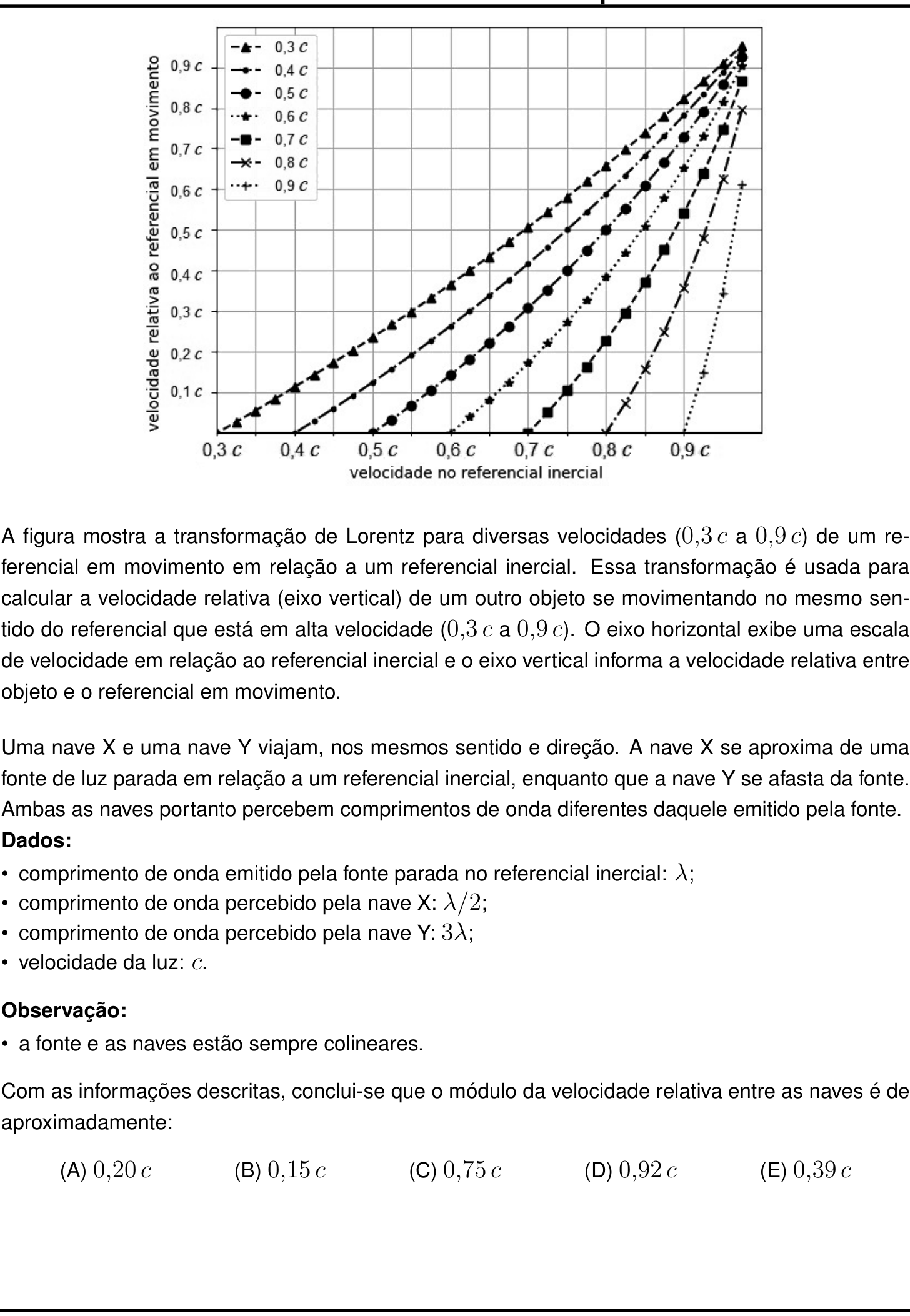
Esse valor corresponde aproximadamente a 0{,}39c, também indicado no gráfico pela curva de 0{,}6c quando a velocidade no eixo horizontal é 0{,}8c.
Resposta: E
Respondeu
levou 13 s
Como pensou
**Explaining Doppler Effects**
I need to address a straightforward Doppler situation where the rates are .6 and .8, respectively, with a ratio of .2/.52 and .3846 for energy. It’s important to clarify that the source appears in the same direction rather than opposite. To keep this concise, I’ll include relevant Doppler formulas and equations, around 450 words, along with a graph reference at .6 and .8. I’ll derive beta and explain the process clearly. Let’s finalize this!
Para determinar as velocidades das naves, usamos o efeito Doppler relativístico para a luz.
1. Nave X — aproximação da fonte
O comprimento de onda observado é
\lambda_X=\lambda\sqrt{\frac{1-\beta_X}{1+\beta_X}},
\qquad \beta_X=\frac{v_X}{c}.
Como \lambda_X=\lambda/2,
\frac14=\frac{1-\beta_X}{1+\beta_X}
\;\Rightarrow\;
1+\beta_X=4(1-\beta_X)
\;\Rightarrow\;
\beta_X=\frac35.
Logo, v_X=0{,}6c.
2. Nave Y — afastamento da fonte
Nesse caso,
\lambda_Y=\lambda\sqrt{\frac{1+\beta_Y}{1-\beta_Y}}.
Como \lambda_Y=3\lambda,
9=\frac{1+\beta_Y}{1-\beta_Y}
\;\Rightarrow\;
9(1-\beta_Y)=1+\beta_Y
\;\Rightarrow\;
\beta_Y=\frac45.
Assim, v_Y=0{,}8c.
3. Velocidade relativa entre as naves
Embora uma se aproxime da fonte e a outra se afaste, o enunciado informa que elas viajam no mesmo sentido. Portanto, aplicamos a subtração relativística de velocidades:
v_{\text{rel}}=
\frac{v_Y-v_X}{1-\dfrac{v_Xv_Y}{c^2}}
=
\frac{0{,}8c-0{,}6c}{1-0{,}6\cdot0{,}8}
=
\frac{0{,}2c}{0{,}52}
\approx 0{,}385c.
Esse resultado também pode ser lido no gráfico: na curva de 0{,}6c, para a velocidade horizontal 0{,}8c, a velocidade relativa é aproximadamente 0{,}39c.
Resposta: E
Respondeu
levou 15 s
Como pensou
**Analyzing velocities and Doppler effects**
I’m working on relative speeds of two objects where their velocities have opposite signs. If they're moving in the same direction, one dynamic affects the other's inertial frame. I should explore how their speeds impact wavelength observed using Doppler effects. The provided graph might help, especially in understanding the velocity transformations. I need to clarify the explicit Doppler derived formulas for a stationary source and a moving observer, reflecting ratios appropriately.**Clarifying velocity frames**
I’m considering the velocities of X and Y moving in the same direction, with Y at .8c and X at .6c in its inertial frame. The graph shows a relative speed of about .39c, which I need to verify using the correct formula. It's important to ensure I pay attention to the sign when working with these values, as that can impact the final analysis. Double-checking everything will help clarify the situation!**Verifying Doppler shifts**
I’m working with the equation for Doppler ratios where one observer is moving at different relativistic speeds. I calculated a negative value, which is unusual. The redshift and blueshift formulas look correct, and I need to ensure I’m understanding how the relative speeds affect each other. Also, it’s important to consider that if both are moving in the same direction, the subtraction may affect the outcome. Lastly, I need to translate my findings into Portuguese for clarity.
Para um observador que se aproxima da fonte, o comprimento de onda observado é
\lambda_{\text{obs}}=\lambda\sqrt{\frac{1-\beta}{1+\beta}},
em que \beta=v/c. Para a nave X, \lambda_{\text{obs}}=\lambda/2, então
\frac14=\frac{1-\beta_X}{1+\beta_X}
\quad\Rightarrow\quad \beta_X=0{,}6.
Para um observador que se afasta da fonte,
\lambda_{\text{obs}}=\lambda\sqrt{\frac{1+\beta}{1-\beta}}.
Como a nave Y percebe 3\lambda,
9=\frac{1+\beta_Y}{1-\beta_Y}
\quad\Rightarrow\quad \beta_Y=0{,}8.
As duas naves movem-se no mesmo sentido. Assim, o módulo da velocidade relativa, pela transformação relativística de velocidades, é
v_{\text{rel}}=\frac{0{,}8c-0{,}6c}{1-(0{,}8)(0{,}6)}
=\frac{0{,}2}{0{,}52}c\approx 0{,}39c.
Resposta: E
Respondeu
levou 13 s
Como pensou
Using the relativistic Doppler formula for an approaching source, I find Nave X has λ halved, giving β = 0.6c toward us. Now I'm setting up the same equation for Nave Y, whose wavelength is tripled, to find its recession velocity.
Solving gives β = 0.8c receding for Y. Both ships move in the same direction—X toward the source, Y away—so I apply the relativistic velocity addition formula to get their relative speed, which comes out to about 0.38-0.39c, matching answer E.
Efeito Doppler relativístico
Para uma fonte parada no referencial inercial e um observador com velocidade β (em unidades de c):
- Aproximando-se: λ_obs = λ·√[(1−β)/(1+β)]
- Afastando-se: λ_obs = λ·√[(1+β)/(1−β)]
Nave X (aproxima-se, percebe λ/2):
√[(1−β)/(1+β)] = 1/2 → (1−β)/(1+β) = 1/4 → 4 − 4β = 1 + β → β_X = 0,6
Nave Y (afasta-se, percebe 3λ):
√[(1+β)/(1−β)] = 3 → (1+β)/(1−β) = 9 → 1 + β = 9 − 9β → β_Y = 0,8
Velocidade relativa
Como as naves viajam no mesmo sentido (X atrás da fonte aproximando-se, Y à frente afastando-se), as velocidades no referencial inercial são 0,6c e 0,8c no mesmo sentido. Pela composição relativística de velocidades:
u' = (0,8c − 0,6c)/(1 − 0,8·0,6) = 0,2c/0,52 ≈ 0,385c ≈ 0,39c
Confirmação pelo gráfico: na curva do referencial a 0,6c, a abscissa 0,8c fornece ordenada ≈ 0,39c.
Resposta: E
Respondeu
levou 13 s
Como pensou
Using the relativistic Doppler formula, I work out ship X's approach speed: with observed wavelength halved, solving (1-β)/(1+β)=1/4 gives β=0.6. For ship Y receding with wavelength tripled, solving 9(1-β)=1+β gives β=0.8.
Since both ships move in the same sense relative to the source (X approaching, Y receding, source between them), I compute the relative velocity using the relativistic velocity addition formula: (0.8-0.6)/(1-0.48) ≈ 0.385c, which matches the graph curve for 0.6c at 0.8c. This points to answer E.
Resposta: (E) 0,39c. O raciocínio usa o efeito Doppler relativístico para obter a velocidade de cada nave e, em seguida, a composição relativística de velocidades.
1. Velocidade da nave X (aproximando-se da fonte)
Na aproximação, o comprimento de onda percebido é:
\lambda_X=\lambda\sqrt{\frac{1-\beta}{1+\beta}}
Com \lambda_X = \lambda/2:
\frac{1-\beta_X}{1+\beta_X}=\frac14 \;\Rightarrow\; 4-4\beta_X=1+\beta_X \;\Rightarrow\; \beta_X=0{,}6
Logo, v_X = 0{,}6\,c.
2. Velocidade da nave Y (afastando-se da fonte)
No afastamento, o comprimento de onda percebido é:
\lambda_Y=\lambda\sqrt{\frac{1+\beta}{1-\beta}}
Com \lambda_Y = 3\lambda:
\frac{1+\beta_Y}{1-\beta_Y}=9 \;\Rightarrow\; 1+\beta_Y=9-9\beta_Y \;\Rightarrow\; \beta_Y=0{,}8
Logo, v_Y = 0{,}8\,c.
3. Velocidade relativa entre as naves
As duas naves se movem na mesma direção e no mesmo sentido em relação ao referencial inercial. Pela transformação de Lorentz para velocidades:
v_{rel}=\frac{v_Y-v_X}{1-\dfrac{v_Xv_Y}{c^2}}=\frac{0{,}8c-0{,}6c}{1-0{,}48}=\frac{0{,}2c}{0{,}52}\approx 0{,}385\,c
4. Conferência pelo gráfico
Na curva do referencial de 0{,}6c, o ponto de abscissa 0{,}8c tem ordenada aproximadamente 0{,}38c–0{,}39c. Isso confirma o cálculo.
Resposta: E
Respondeu
levou 8 s
Como pensou
Using relativistic Doppler shift, I find that ship X approaching gives β=0.6, since the blueshift factor of 1/2 solves to (1-β)/(1+β)=1/4. For ship Y receding with a redshift factor of 3, solving (1+β)/(1-β)=9 gives β=0.8, so now I need to consider their directions relative to each other.
Since X moves toward the source and Y moves away in the same overall sense, they're effectively moving in the same direction with velocities 0.6c and 0.8c relative to the source. Applying relativistic velocity addition, (0.8-0.6)/(1-0.48)=0.2/0.52≈0.385c, matching answer E.
Efeito Doppler relativístico
Na nave X, a fonte se aproxima, então o comprimento de onda diminui:
λ/2 = λ·√[(1−β_X)/(1+β_X)]
(1−β_X)/(1+β_X) = 1/4, logo 4 − 4β_X = 1 + β_X e β_X = 0,6.
Na nave Y, a fonte se afasta, então o comprimento de onda aumenta:
3λ = λ·√[(1+β_Y)/(1−β_Y)]
(1+β_Y)/(1−β_Y) = 9, logo 1 + β_Y = 9 − 9β_Y e β_Y = 0,8.
Velocidade relativa
As naves viajam no mesmo sentido. X se aproxima da fonte e Y se afasta dela, então a fonte está entre as duas. No referencial da fonte, as velocidades têm o mesmo sinal: 0,6c e 0,8c.
Pela composição relativística de velocidades:
v_rel = (0,8c − 0,6c)/(1 − 0,6·0,8) = 0,2c/0,52 ≈ 0,385c ≈ 0,39c
Isso confere com o gráfico: para o referencial a 0,6c e o objeto a 0,8c, a velocidade relativa fica em torno de 0,38c.
Resposta: E
Respondeu
levou 5 min 56 s
Como pensou
The problem involves special relativity, specifically the relativistic Doppler effect and velocity addition.
Ships X and Y travel in the same direction. Ship X approaches a light source at rest. Ship Y moves away from it. The source emits wavelength λ. Ship X perceives λ/2. Ship Y perceives 3λ.
The source and ships remain collinear. The relativistic Doppler formula for a source at rest will be used to find the relative velocity between the ships.
Ship X's speed is 0.6c. The relativistic Doppler formula for approaching light gives λ/2 = λ·√((1−β)/(1+β)), which yields β_X = 3/5. Ship Y's redshifted wavelength 3λ will be used next to find its velocity.
Ship Y's velocity is 0.8c away from the source. The problem states both ships travel in the same direction, yet one approaches and the other recedes from the source. This seems contradictory.
The apparent contradiction is resolved by placing the ships on opposite sides of the source. Both travel in the same direction, but ship X approaches from the right while ship Y recedes to the left.
The relative velocity of ship Y with respect to ship X is being calculated using the relativistic velocity addition formula. Both ships move in the same direction, so their relative speed is negative. The difference in velocities is -0.2c, and the product of their speeds is 0.48c².
The relativistic relative velocity is approximately -0.385c, so the magnitude is about 0.39c. This matches option (E). The calculation assumes both ships move in the same direction.
The Doppler formulas were verified. For ship X, λ/2 = λ·√((1−β)/(1+β)) yields β = 0.6. For ship Y, the redshifted wavelength 3λ corresponds to the receding observer formula.
The graph shows how an object's velocity in an inertial frame transforms into relative velocity for a moving reference. The x-axis lists inertial speeds, and the y-axis lists relative speeds. Lines represent different moving-frame velocities from 0.3c to 0.9c. To find the relative speed between ships X and Y, one would use the moving reference at 0.6c and read the corresponding value on the curve for an object at 0.8c.
The graph is meant to provide a visual shortcut for students who may not recall the relativistic velocity addition formula. The legend is being decoded to identify which curve corresponds to the moving reference frame of 0.6c.
The exact relative velocity is 5/13 c, or about 0.3846 c. This rounds to 0.38 c rather than 0.39 c. The problem statement is being re-read to verify the ships' directions.
Classical relative velocity would yield 0.2 c, which matches option A. A simple addition of the two speeds gives roughly 0.95 c, close to option D. The problem explicitly states the ships travel in the same direction, so opposite motion is impossible.
A possible sign error in the velocity addition formula would yield roughly 0.15 c, matching option B.
The relativistic velocity addition formula is confirmed correct. For small relative speeds, the result approximates to the classical difference plus a positive second-order correction. This explains why the relativistic relative velocity is slightly larger than the simple subtraction of the two inertial speeds.
The exact value of 5/13 c is about 0.3846, which rounds to 0.38 rather than the listed 0.39. This discrepancy suggests the problem may be solvable directly from the graph without applying the velocity addition formula.
The exact value 5/13 c is approximately 0.3846 c. Rounding this to the nearest tenth yields 0.38 c, but the problem likely expects the nearest hundredth, which is 0.39 c. This explains why option E matches the calculated result.
The incorrect formula (0.8 − 0.6)/(1 + 0.48) yields roughly 0.135, which does not match any option. The correct relativistic result is approximately 0.39 c. The problem likely expects this rounded value, so the answer is E.
Opposite directions were tested. The relative velocity would be about 0.946 c, which does not match any option.
Standard rounding of 0.3846 to two decimal places yields 0.38, not 0.39. The exact value is closer to 0.385, and some may round that up to 0.39.
A razão entre os comprimentos de onda é dada pelo efeito Doppler relativístico. Para a nave X (que se aproxima da fonte) vale
\sqrt{\frac{1-\beta_X}{1+\beta_X}}=\frac12.
Resolvendo a equação obtém-se \beta_X=0{,}6, ou seja, v_X=0{,}6c.
Para a nave Y (que se afasta da fonte) vale
\sqrt{\frac{1+\beta_Y}{1-\beta_Y}}=3.
Resolvendo a equação obtém-se \beta_Y=0{,}8, ou seja, v_Y=0{,}8c.
Como as naves se deslocam no mesmo sentido, a velocidade relativa entre elas é fornecida pela transformação de Lorentz das velocidades (que também pode ser lida diretamente no gráfico, na curva correspondente a 0{,}6c, para a abscissa 0{,}8c):
v_\text{rel}=\frac{|0{,}8c-0{,}6c|}{1-0{,}6\cdot0{,}8}=\frac{0{,}2c}{0{,}52}\approx0{,}385c.
Esse valor é aproximadamente 0{,}39c.
Resposta: E
Respondeu
levou 24 s
Como pensou
We need answer in Portuguese, solve. Need parse problem. Need use image graph? Let's restate.
We have source at rest in inertial frame emits wavelength λ. Nave X approaches source? "A nave X se aproxima de uma fonte de luz parada em relação a um referencial inercial, enquanto que a nave Y se afasta da fonte." Both perceive different wavelengths due to Doppler relativistic. Dados:
- λ emitted by source at rest.
- wavelength perceived by X: λ/2 (blueshift, approaching)
- wavelength perceived by Y: 3λ (redshift, receding)
- speed of light c.
Need module of relative velocity between ships approximately. Options.
We need compute speeds of X and Y relative to source inertial frame? Then relative velocity between ships using relativistic velocity addition? They travel in same direction? Wording: "Uma nave X e uma nave Y viajam, nos mesmos sentido e direção. A nave X se aproxima de uma fonte de luz parada ... enquanto que a nave Y se afasta da fonte." So source at rest, X approaching source, Y receding from source. Since same direction? Wait "nos mesmos sentido e direção" maybe both travel in same direction? If X approaches source and Y pulls away from source, if source is between? Let's parse: "viajam, nos mesmos sentido e direção." Could mean X and Y move along same line/same direction. X approaching source, Y moving away from source. Hmm if both same direction, source? Let's set source at origin. If X is to the left approaching moving right, Y is to the right moving right away from source? Actually source at rest. Y moving away from source in same direction as X? If X is to left of source moving right toward source; Y is to right of source moving right away from source? Both velocities relative to source are +v (right), but X at x<0 approaching source (distance decreasing) and Y at x>0 receding (distance increasing). Both have same velocity vector relative to source. Yes possible: both moving same direction; X behind source approaching, Y ahead moving away. Then relative velocity between X and Y maybe non-relativistic subtraction? They same direction, speeds maybe different? Let's compute.
We need determine speed of X relative to source (inertial) from wavelength observed λ/2. Relativistic Doppler formula for source at rest, observer moving toward source: observed wavelength λ_obs = λ sqrt((1 - β)/(1 + β))? Let's derive.
For light, relativistic Doppler: If source and receiver recede with relative speed v, observed frequency f_obs = f_source sqrt((1 - β)/(1 + β)) for recession? Actually formula: f = f0 sqrt(1 - β)/sqrt(1 + β) for source and observer receding; for approaching, f = f0 sqrt(1 + β)/sqrt(1 - β). Wavelength λ = c/f, so λ_obs = λ0 sqrt((1 + β)/(1 - β)) for receding? Let's verify. If approaching, frequency higher, wavelength shorter: λ_obs = λ sqrt((1 - β)/(1 + β))? Since sqrt((1-β)/(1+β)) <1. Yes approaching: λ_obs = λ sqrt((1 - β)/(1 + β)). Receding: λ_obs = λ sqrt((1 + β)/(1 - β)). Need speeds relative to source.
Given X approaches: λ_X = λ/2 = λ sqrt((1 - β_X)/(1 + β_X)).
So sqrt((1 - β)/(1 + β)) = 1/2 => (1 - β)/(1 + β) = 1/4 => 4 - 4β = 1 + β => 3 = 5β => β_X = 0.6. So v_X = 0.6 c toward source.
Y recedes: λ_Y = 3λ = λ sqrt((1 + β_Y)/(1 - β_Y)).
=> (1+β)/(1-β)=9 => 1+β =9 -9β => 10β=8 => β_Y = 0.8. So v_Y = 0.8 c away from source.
Relative velocity between X and Y? They are moving in same direction? X velocity +0.6c relative source; Y velocity? If both same direction, Y velocity +0.8c relative source. Then relative velocity X as observed from Y or Y from X = (0.8c - 0.6c)/(1 - 0.6*0.8) = 0.2c/(1 - 0.48)=0.2c/0.52 ≈0.3846c ~0.39c. Option E.
But check wording: "A nave X se aproxima de uma fonte ... enquanto que a nave Y se afasta da fonte. ... viajam, nos mesmos sentido e direção." If X is approaching source and Y is moving away from source, maybe their velocities relative to source are opposite signs? Let's examine: If both travel same direction, but source is between them, then one approaching and other receding could be same velocity direction but opposite sides. So source stationary, X left moving right toward source (v=+0.6c), Y right moving right away (v=+0.8c). Relative speed = difference (same direction) = 0.2c? Wait if both velocities +0.6 and +0.8, relative velocity from Y to X = (0.6 - 0.8)/(1 - 0.48) = -0.3846c, magnitude 0.3846. Yes E.
But need be cautious: Could be X approaching source (left? v=+0.6c) and Y receding source (left? Actually if both same direction but source maybe at same side? Let's draw. Source at x=0. Nave X se aproxima da fonte: if X is to left of source, velocity positive toward source. Nave Y se afasta da fonte: if Y is to left? But if Y also moving same direction as X? If both moving right, source at x=0, X left of source moving right approaches; Y could also be left of source but faster moving right? Then Y may be moving away from source? If Y left of source but farther left? If both right, distance to source decreases for both, so both approach source. If Y is to right of source moving right, recedes, same velocity direction as X. So yes. Could X and Y have velocities opposite? "mesmos sentido e direção" no.
But wait, maybe the relative velocity between ships could be obtained by Doppler formula directly? If X approaches source and perceives λ/2, Y recedes perceives 3λ. Need relative velocity between X and Y; yes via relativistic addition.
Let's verify options: (A) 0.20 c, (B) 0.15 c, (C) 0.75 c, (D) 0.92 c, (E) 0.39 c. We got 0.3846 ~0.39. So E.
Need produce explanation in Portuguese. Need perhaps use graph? Graph shows transformation Lorentz for various velocities: horizontal is velocity in inertial frame, vertical is relative velocity to moving frame? Maybe could solve using graph maybe? But no need. Let's see if there is any trap: The graph might be for Lorentz transformation: vertical = velocity relative to moving referential? It might indicate addition of velocities. If X speed 0.6c, Y speed 0.8c; relative speed between them maybe graph? For v=0.6c and u=0.8c? Actually graph: x-axis velocity in inertial referential (source frame), y-axis velocity relative to moving reference frame (velocity of object in moving frame). It plots transformation from velocity in inertial frame to velocity in moving frame, for various relative velocities of frames (0.3c to 0.9c). The equation: u' = (u - v)/(1 - uv/c²)? Something. Given object speed in inertial frame =? We know X speed maybe 0.6c relative source, Y speed 0.8c. Need relative speed between X and Y: In frame of X, the source moves at -0.6c? Actually if X frame has velocity +0.6c relative source, then in X frame source velocity = -0.6c. Y velocity in source frame = +0.8c. Transform Y velocity to X frame: u' = (u - v)/(1 - uv/c²) = (0.8c - 0.6c)/(1 - 0.8*0.6) = 0.2c/(1-0.48)=0.3846c. So yes.
Could there be a different assumed direction: X approaching means velocity toward source maybe v_X = -0.6c relative source if source at origin and X to right? Let's define positive away from source. X approaching source means if source at origin, X velocity toward origin. If both same direction with Y receding from source, then X and Y might not be same sign? Let's see: Source at origin. If positive direction away from source, Y away => +0.8c. X approaching source means from right side moving left toward origin, so velocity -0.6c? But then X and Y have opposite directions ("sentido" = direction along line; "direção" = line). The phrase "nos mesmos sentido e direção" in Portuguese: "viajam, nos mesmos sentido e direção." Usually "mesmo sentido e direção" means same direction and same orientation (same vector direction). If X approaching and Y receding from a stationary source, can they have same vector direction? As above, if X on left moving right (toward source) and Y on right moving right (away) yes both vector direction right. So okay. But if source is at origin, X from left moving right (+0.6c), Y from right moving right (+0.8c); both same direction. Relative velocity = (0.8 - 0.6)/(1 - 0.48) =0.3846c. If instead X from right moving left toward source, Y from right moving right away? They'd have opposite directions, not same. So our assumption is consistent.
Let's consider alternative: Maybe both X and Y are on same side of source? "A nave X se aproxima de uma fonte ... enquanto que a nave Y se afasta da fonte." If same side, one cannot be approaching while other receding if both same direction? Suppose source at right, both left of source and moving left: X moves right (toward source) and Y moves left (away from source) => opposite directions, not same. Or source at origin, both right of source? X approaching source (moving left) and Y receding from source (moving right) opposite. So indeed same direction requires source between them (or one behind? Wait if source at x=0, X at x<0 moving right toward source (approaching); Y at x>0 moving right away from source (receding). Same direction. Great.
Let's formulate final response.
Need include:
- Use relativistic Doppler formula: λ_obs = λ sqrt((1 ± β)/(1 ∓ β))? Let's present carefully.
- For X approaching: λ_X = λ/2. Thus 1/2 = sqrt((1 - β_X)/(1 + β_X)). Solve β_X = 0.6.
- For Y receding: λ_Y = 3λ. Thus 3 = sqrt((1 + β_Y)/(1 - β_Y)). Solve β_Y = 0.8.
- Both same direction? "mesmo sentido e direção" implies velocities in same direction; relative speed via relativistic composition: v_rel = (v_Y - v_X)/(1 - v_X v_Y / c²) = (0.8c - 0.6c)/(1 - 0.8*0.6) = 0.2c/0.52 = (5/13)c ≈ 0.3846c ≈ 0.39c.
- Therefore alternative E.
Need check formula signs: Let's derive Doppler formula to avoid sign errors in explanation.
Relativistic Doppler formula: For source at rest, observer moving toward source with speed v: observed frequency f = f0 sqrt((1+β)/(1-β))? Wait let's settle definitively.
Let's derive: Source emits light with frequency f0 in source frame S. Observer moves with velocity v in S (toward source? Let's set source at origin, observer at x negative? Simplify: source at origin, observer moving in +x direction toward source? Actually if observer is at negative x and moving +x, direction toward source. Let source at x=0; observer at x=-L moving +v. The light from source travels in -x direction to observer. In observer frame, frequency observed? Use 4-vector: source 4-momentum photon? Easier known formula: If source and receiver are approaching each other, observed frequency is higher: f_obs = f_s sqrt((1+β)/(1-β)). Yes because if β positive (approaching relative motion? Actually if source and receiver relative velocity v along line, with v positive for approaching? Then f_obs = f_s sqrt((1+β)/(1-β)) > f_s). Thus wavelength λ_obs = c/f_obs = λ_s sqrt((1-β)/(1+β)) < λ_s. That matches λ/2. Good. So formula.
For receding: f_obs = f_s sqrt((1-β)/(1+β)) < f_s, so λ_obs = λ_s sqrt((1+β)/(1-β)) > λ_s. Matches 3λ. Good.
Let's solve:
X:
λ/2 = λ sqrt((1 - β)/(1 + β))
=> 1/2 = sqrt((1 - β)/(1 + β))
=> 1/4 = (1 - β)/(1 + β)
=> 1 + β = 4(1 - β) = 4 - 4β
=> 5β = 3 => β = 0.6.
Y:
3λ = λ sqrt((1 + β)/(1 - β))
=> 3 = sqrt((1 + β)/(1 - β))
=> 9 = (1 + β)/(1 - β)
=> 9(1 - β) = 1 + β => 9 - 9β = 1 + β => 10β = 8 => β = 0.8.
Relative velocity:
v_rel = (v_Y - v_X)/(1 - v_X v_Y / c²) = (0.8c - 0.6c)/(1 - 0.8*0.6) = 0.2c/(1 - 0.48) = 0.2c/0.52 = (20/100)/(52/100) =20/52=5/13 c ≈0.3846 c ≈0.39 c. Option E.
Need maybe mention graph? The graph maybe could be used to verify: For inertial velocity 0.8c and moving frame 0.6c, transform to moving frame yields ~0.38c. But not needed. The problem statement includes graph maybe for general context; can mention "a figura ilustra a composição relativística de velocidades, mas podemos calcular diretamente." Maybe final not too long.
Need ensure final answer with "Resposta: E".
Let's produce final explanation in Portuguese. Keep formal.
Potential nuance: "A nave X se aproxima de uma fonte ... enquanto que a nave Y se afasta da fonte. Ambas as naves portanto percebem comprimentos de onda diferentes daquele emitido pela fonte." The source emits wavelength λ in inertial frame. "comprimento de onda percebido pela nave X: λ/2" "percebido pela nave Y: 3λ". We assume ships' speeds relative to source. Yes.
Let's maybe include the formula for relativistic Doppler:
- Aproximação: λ_obs = λ sqrt((1−β)/(1+β))
- Afastamento: λ_obs = λ sqrt((1+β)/(1−β))
Then solve.
Could there be an issue: If X approaching source, its velocity relative to source is 0.6c; Y receding source, velocity relative to source is 0.8c. If both same direction, "relative velocity between ships" might be simply |0.8c - 0.6c| = 0.2c? But relativistic addition gives 0.3846c. The problem likely expects relativistic velocity composition, and options include 0.20c as distractor. Since they provide graph of Lorentz transformation, definitely use relativistic addition. We choose E.
Let's craft final response.
Need final line exactly "Resposta: E" maybe no period after? Format: "Resposta: X" with X letter. We'll do.
Usando o efeito Doppler relativístico para a luz:
\lambda_{\text{obs}}=\lambda\sqrt{\frac{1-\beta}{1+\beta}} \quad \text{(aproximação)}
\lambda_{\text{obs}}=\lambda\sqrt{\frac{1+\beta}{1-\beta}} \quad \text{(afastamento)}
Para a nave X, que se aproxima da fonte:
\frac{\lambda}{2}=\lambda\sqrt{\frac{1-\beta_X}{1+\beta_X}}
\frac14=\frac{1-\beta_X}{1+\beta_X}
1+\beta_X=4-4\beta_X
5\beta_X=3 \Rightarrow \beta_X=0,6
Para a nave Y, que se afasta da fonte:
3\lambda=\lambda\sqrt{\frac{1+\beta_Y}{1-\beta_Y}}
9=\frac{1+\beta_Y}{1-\beta_Y}
9-9\beta_Y=1+\beta_Y
10\beta_Y=8 \Rightarrow \beta_Y=0,8
Como as naves viajam no mesmo sentido e direção, a velocidade relativa entre elas é obtida pela composição relativística de velocidades:
v_{\text{rel}}=\frac{v_Y-v_X}{1-\frac{v_Xv_Y}{c^2}}
v_{\text{rel}}=\frac{0,8c-0,6c}{1-(0,8)(0,6)}
v_{\text{rel}}=\frac{0,2c}{1-0,48}
=\frac{0,2c}{0,52}
\approx 0,3846c
v_{\text{rel}}\approx 0,39c
Resposta: E
Respondeu
levou 31 s
Como pensou
**Analyzing Relative Velocity Graphs**
I'm currently focused on a graph presenting relative velocity versus inertial reference frame velocity, considering reference frame speeds from 0.3c to 0.9c. The text preceding this indicates the figure serves as a visual representation, although a formal examination of the data has yet to occur.
**Calculating Lorentz Transformations**
I've been working on applying the Lorentz transformation for a range of velocities ($0.3c$ to $0.9c$) of a moving reference frame relative to an inertial frame. My focus is on calculating the relative velocity (vertical axis) of another object moving in the same direction as the high-speed reference frame. The horizontal axis represents the velocity relative to the inertial frame, while the vertical axis represents the relative velocity between the object and the moving frame. I'm now integrating information about two spacecraft, X and Y, to refine the calculations.
**Deriving Doppler Shift Equations**
I'm now delving into the relativistic Doppler effect for light, aiming to derive the relevant formulas. Considering the scenario where a spacecraft (X) approaches a source, I'm working through the wavelength shift. I'm using the formula $\lambda' = \lambda \sqrt{\frac{1 - \beta}{1 + \beta}}$ and applying it to the given context, leading to calculations involving $\beta$ and the spacecraft's relative velocity.
**Reconciling Relative Motion**
I'm now grappling with the scenario's wording concerning spacecraft X and Y. My calculations indicate X approaches the light source while Y recedes, all in the same direction. I am puzzling over the source's position relative to both spacecraft. I've concluded the source is between the spacecraft, or perhaps the spacecraft are on opposite sides of the source and moving in the same direction. I'm now setting up a simple coordinate system to visualize the positions more clearly.
**Calculating Relative Velocity**
I've clarified the scenario: both spacecraft X and Y travel in the positive x-direction. X is at $x < 0$, approaching the source at $x=0$ with $v_X = +0.6c$, while Y is at $x > 0$, receding from the source with $v_Y = +0.8c$. Now I've confirmed they are colinear. I'm calculating the relative velocity between the spacecraft. Analytically, $u = 0.3846c \approx 0.39c$, which agrees with option (E). I'll also verify this result using the graph.
**Interpreting Graph Data**
I'm now focusing on the graph's legend to accurately associate each marker with its corresponding velocity. I've correctly matched the symbols (triangle, diamond, circle, cross, etc.) with their respective velocities from 0.3c to 0.9c. I'm taking the graph and velocities into the interpretation to correlate the data effectively.
Para determinar o módulo da velocidade relativa entre as duas naves, utilizamos o efeito Doppler relativístico para a luz e a composição relativística de velocidades (ou a leitura do gráfico fornecido).
1. Determinação da velocidade da nave X (v_X)
Como a nave X se aproxima da fonte de luz, ocorre um desvio para o azul (blueshift). A relação entre o comprimento de onda percebido (\lambda_X) e o emitido (\lambda) é:
\lambda_X = \lambda \sqrt{\frac{1 - \beta_X}{1 + \beta_X}}
Dado que \lambda_X = \frac{\lambda}{2}:
\sqrt{\frac{1 - \beta_X}{1 + \beta_X}} = \frac{1}{2} \implies \frac{1 - \beta_X}{1 + \beta_X} = \frac{1}{4}
4(1 - \beta_X) = 1 + \beta_X \implies 5\beta_X = 3 \implies \beta_X = 0,6
Portanto, a velocidade da nave X é v_X = 0,6\,c.
2. Determinação da velocidade da nave Y (v_Y)
Como a nave Y se afasta da fonte de luz, ocorre um desvio para o vermelho (redshift). A relação é:
\lambda_Y = \lambda \sqrt{\frac{1 + \beta_Y}{1 - \beta_Y}}
Dado que \lambda_Y = 3\lambda:
\sqrt{\frac{1 + \beta_Y}{1 - \beta_Y}} = 3 \implies \frac{1 + \beta_Y}{1 - \beta_Y} = 9
1 + \beta_Y = 9(1 - \beta_Y) \implies 10\beta_Y = 8 \implies \beta_Y = 0,8
Portanto, a velocidade da nave Y é v_Y = 0,8\,c.
3. Velocidade relativa entre as naves
Como ambas as naves se movem na mesma direção e no mesmo sentido (uma se aproxima da fonte antes de cruzar por ela, e a outra se afasta após cruzá-la), calculamos a velocidade relativa u' usando a transformação relativística de velocidades:
u' = \frac{|v_Y - v_X|}{1 - \dfrac{v_Y v_X}{c^2}} = \frac{0,8\,c - 0,6\,c}{1 - (0,8)(0,6)} = \frac{0,2\,c}{1 - 0,48} = \frac{0,2\,c}{0,52} = \frac{5}{13}\,c \approx 0,385\,c \approx 0,39\,c
(Observação: esse valor também pode ser obtido diretamente no gráfico ao localizar a curva referente ao referencial de 0,6\,c e observar a ordenada correspondente à velocidade inercial de 0,8\,c, que se situa logo abaixo de 0,4\,c, em aproximadamente 0,39\,c.)
Resposta: E