Respondeu
levou 18 s
Como pensou
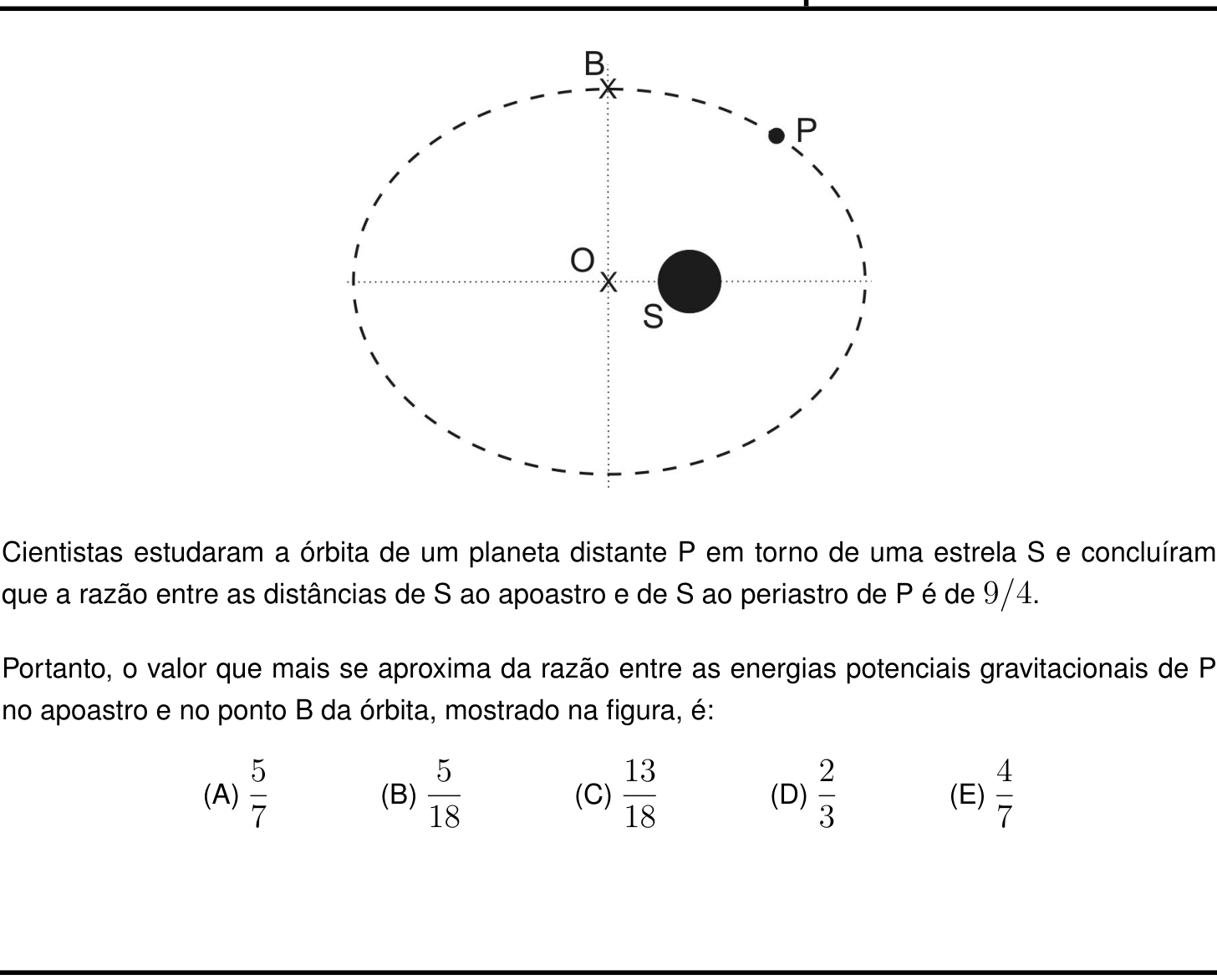
A estrela S ocupa um dos focos da órbita elíptica. Se a é o semieixo maior e c=OS, as distâncias no apoastro e no periastro são
r_{\text{apo}}=a+c,\qquad r_{\text{peri}}=a-c.
Assim,
\frac{a+c}{a-c}=\frac94
\;\Rightarrow\;
4a+4c=9a-9c
\;\Rightarrow\;
c=\frac{5a}{13}.
Logo,
r_{\text{apo}}=a+c=\frac{18a}{13}.
O ponto B é uma extremidade do eixo menor. Como, na elipse, b^2+c^2=a^2, o triângulo retângulo SOB fornece
SB=\sqrt{b^2+c^2}=a.
A energia potencial gravitacional é U=-GMm/r. Portanto, a razão solicitada é
\frac{U_{\text{apo}}}{U_B}
=\frac{-GMm/r_{\text{apo}}}{-GMm/SB}
=\frac{SB}{r_{\text{apo}}}
=\frac{a}{18a/13}
=\boxed{\frac{13}{18}}.
Resposta: C
Respondeu
levou 9 s
Como pensou
A órbita é uma elipse, com a estrela S em um de seus focos. Sejam a o semieixo maior, b o semieixo menor e c=OS a distância do centro ao foco.
As distâncias da estrela ao apoastro e ao periastro são, respectivamente, a+c e a-c. Assim,
\frac{a+c}{a-c}=\frac94
\quad\Rightarrow\quad
4a+4c=9a-9c
\quad\Rightarrow\quad
c=\frac{5a}{13}.
O ponto B é uma extremidade do eixo menor. Como b^2=a^2-c^2, temos
SB=\sqrt{b^2+c^2}=a.
A energia potencial gravitacional é
U=-\frac{GMm}{r}.
Logo, a razão solicitada é
\frac{U_{\text{apoastro}}}{U_B}
=\frac{SB}{a+c}
=\frac{a}{a+\frac{5a}{13}}
=\boxed{\frac{13}{18}}.
Resposta: C
Respondeu
levou 10 s
Como pensou
**Analyzing gravitational potential energies**
I'm tackling a problem related to geometry and orbits, specifically regarding an ellipse centered at O, with focus S. There's a focus diagram to consider, and we need to find the ratio between gravitational potential energies at specific points. Given the distance ratios from the focus and the apoastro to the periastro is 9/4, I need to derive the eccentricity and potential energy ratios using the gravitational potential formula. After going through the math, I've concluded the energy ratio to be 13/18 for point B and the apoastro.**Explaining ellipse parameters**
I'm working on an explanation based on an ellipse with center O and a horizontal semi-major axis. I need to accurately describe point B at the top of the ellipse and focus S. The goal is to derive the energy ratios between the apoastro and point B. The ratio of distances is given as 9/4, which leads me to find relationships between distances. After calculations, I conclude that the eccentricity is e=5/13, and the distance at point B is a, while the apo distance reaches 18a/13.**Evaluating potential energy factors**
I'm working through a calculation involving apoastro and the coordinates given. So, I have my variable a as 13/18, and it looks like the answer is C. I think I need to use P, which is stated to be at apoastro, but the diagram seems a bit misleading. It shows P in the upper right instead of at the furthest point on an ellipse—where it should be. However, I’ll interpret P as it relates to the apoastro. I’m also considering potential energy, keeping the ratio positive.
Sejam a o semieixo maior da órbita e c a distância do centro O ao foco S. As distâncias do foco ao apoastro e ao periastro são a+c e a-c, respectivamente. Logo,
\frac{a+c}{a-c}=\frac94
\quad\Longrightarrow\quad
\frac ca=\frac5{13}.
No ponto B, que está sobre o eixo menor, a distância até S é a: se b é o semieixo menor, então SB=\sqrt{c^2+b^2}=a, pois b^2=a^2-c^2.
Como a energia potencial gravitacional é U=-GMm/r, a razão pedida é
\frac{U_{\text{apoastro}}}{U_B}
=\frac{SB}{S\text{-apoastro}}
=\frac{a}{a+c}
=\frac{1}{1+5/13}
=\frac{13}{18}.
Resposta: C
Respondeu
levou 10 s
Como pensou
Solving the ratio of apoastron to periastron distances, I get 9/4 = (1+e)/(1-e), which gives e = 5/13. Then I note that point B at the end of the minor axis is distance a from focus S, while the apoastron distance works out to 18a/13.
Taking the ratio of potential energy at apoastron versus at B, the masses cancel and I'm left with a/r_a = 13/18, so the answer is C.
Geometria da órbita
Seja a o semieixo maior e e a excentricidade da elipse. As distâncias da estrela S (foco) ao apoastro e ao periastro são:
r_{apo} = a(1+e), \qquad r_{peri} = a(1-e)
Pela razão dada:
\frac{1+e}{1-e} = \frac{9}{4} \;\Rightarrow\; 4 + 4e = 9 - 9e \;\Rightarrow\; e = \frac{5}{13}
Logo, r_{apo} = a\left(1 + \frac{5}{13}\right) = \frac{18a}{13}.
Distância de S ao ponto B
O ponto B é a extremidade do eixo menor. Pela propriedade da elipse, a distância de um foco a essa extremidade é igual ao semieixo maior:
r_B = \sqrt{b^2 + c^2} = a
Razão das energias potenciais
A energia potencial gravitacional é U = -\dfrac{GMm}{r}, portanto:
\frac{U_{apo}}{U_B} = \frac{-GMm/r_{apo}}{-GMm/r_B} = \frac{r_B}{r_{apo}} = \frac{a}{18a/13} = \frac{13}{18}
Resposta: C
Respondeu
levou 7 s
Como pensou
Setting apoapsis plus periapsis as 9k and their difference as 4k gives a=6.5k and c=2.5k, so the distance from the focus to point B at the minor axis end equals a, or 6.5k. Since potential energy is inversely proportional to distance, the ratio of U at apoapsis to U at B is r_B/r_apo = 6.5/9 = 13/18, pointing to answer C.
Resposta: (C) 13/18
1. Semieixo maior e distância focal
Seja a o semieixo maior e c a distância do centro O à estrela S (foco da elipse).
- A distância de S ao apoastro é a + c.
- A distância de S ao periastro é a - c.
Pela razão dada:
\frac{a+c}{a-c} = \frac{9}{4}
Tomando a + c = 9k e a - c = 4k, obtemos a = 6{,}5k e c = 2{,}5k.
2. Distância de S ao ponto B
O ponto B é extremidade do eixo menor. Numa elipse, a distância de qualquer foco a uma extremidade do eixo menor é igual ao semieixo maior. Logo:
r_B = a = 6{,}5k
3. Razão entre as energias potenciais
A energia potencial gravitacional é U = -\dfrac{GMm}{r}, ou seja, inversamente proporcional à distância. Portanto:
\frac{U_{apo}}{U_B} = \frac{r_B}{r_{apo}} = \frac{6{,}5k}{9k} = \frac{13}{18}
Resposta: C
Respondeu
levou 4 s
Como pensou
Seja a o semieixo maior da elipse, e a distância focal c = OS.
Apoastro e periastro
- Apoastro: r_a = a + c
- Periastro: r_p = a − c
Como r_a/r_p = 9/4, temos 4(a + c) = 9(a − c), logo 13c = 5a e c = 5a/13.
Distância de S ao ponto B
B é uma extremidade do eixo menor. Por isso, a distância de B a cada foco é igual a a (propriedade da elipse: a soma das distâncias aos focos é 2a, e B é equidistante dos dois focos). Então SB = a.
Isso também pode ser verificado por Pitágoras: SB² = b² + c² = a².
Razão entre as energias potenciais
A energia potencial gravitacional é U = −GMm/r. Logo:
U_apoastro / U_B = r_B / r_a = a / (a + c) = 1 / (1 + 5/13) = 13/18
Resposta: C
Respondeu
levou 4 min 47 s
Como pensou
The problem involves a planet orbiting a star.
The ratio of distances from the star to apoapsis and periapsis is 9/4. I need to find the closest approximation for the ratio of gravitational potential energies at the apoapsis and point B.
The eccentricity is 5/13. Point B is at the end of the minor axis.
The ellipse is horizontal. Point B is the top endpoint of the vertical axis through the center.
The ratio of potential energies equals the ratio of distances from the star. The apoapsis is on the left and periapsis on the right, with the star near the right focus. Point B is the top endpoint of the minor axis.
The distance from the star to point B equals the semi-major axis a. The ratio of potential energies is therefore 1/(1+e). With e = 5/13, this gives 13/18, which corresponds to option C.
The wording "most closely approximates" is puzzling if the ratio is exactly 13/18. I am reconsidering whether point B is truly the end of the minor axis, since the figure also shows a planet P near the upper right.
The ratio 13/18 is about 0.722, which matches option C exactly. I am now reconsidering whether point B might actually be the apoapsis rather than the end of the minor axis.
Point B is confirmed as the top endpoint of the minor axis. The distance from the star to B equals the semi-major axis a exactly, so the ratio of potential energies is 13/18. The wording "most closely approximates" is likely just standard phrasing for an exact answer.
I am now considering whether point B is actually the end of the latus rectum rather than the minor axis. The vertical dotted line in the figure appears to pass through the star S, the center O, and the bottom of the ellipse.
The figure appears to be from an IME exam. The vertical dotted line crosses the horizontal axis at point O, which is labeled at that intersection.
The text distinguishes apoastro from point B, so B is not the apoapsis. I am now examining the figure more carefully to verify the exact position of point B.
The phrase "most closely approximates" suggests the exact ratio is not among the options, so point B might be a different point than the top of the minor axis. The figure shows a vertical dotted line from the top mark down to the bottom of the ellipse, intersecting the horizontal axis at O, with the star S to the right.
I am now checking whether point B might be the end of the latus rectum instead of the minor axis. If so, the distance from the star to B would equal the semi-latus rectum rather than the semi-major axis.
If point B is the end of the latus rectum, its distance from the star is a(1−e²). The ratio of potential energies would then be 1−e. With e = 5/13, this equals 8/13, which is approximately 0.615. None of the answer choices match this value exactly.
The vertical line passes through the center O, not through the focus S. This confirms point B is the top endpoint of the minor axis and the distance from the star to B equals the semi-major axis a. The ratio of potential energies is therefore exactly 13/18.
A órbita elíptica tem a estrela S em um dos focos. Sendo a o semieixo maior e e a excentricidade, as distâncias de S ao periastro e ao apoastro são, respectivamente,
r_p=a(1-e),\qquad r_a=a(1+e).
A razão dada no enunciado fornece
\frac{1+e}{1-e}=\frac{9}{4}\implies e=\frac{5}{13}.
O ponto B indicado na figura é uma extremidade do semieixo menor. A distância de qualquer foco a esse ponto é exatamente o semieixo maior, isto é, r_B=a.
A energia potencial gravitacional é U=-GMm/r. Portanto a razão pedida vale
\frac{U_a}{U_B}=\frac{r_B}{r_a}=\frac{1}{1+e}=\frac{13}{18}.
Esse valor coincide com a alternativa (C).
Resposta: C
Respondeu
levou 8 s
Como pensou
Preciso resolver a questão. A imagem mostra uma órbita elíptica? Na verdade a figura pode representar uma elipse com centro O, foco S? Preciso interpretar. A estrela S está dentro da órbita, deslocada do centro O. A órbita aparentemente é uma elipse (linha tracejada), com O centro? O ponto B está no topo, acima de S? Vejamos: A elipse tem centro O? A distância de S ao apoastro e ao periastro é dada razão 9/4. Preciso encontrar razão entre energias potenciais gravitacionais de P no apoastro e no ponto B da órbita. A energia potencial gravitacional U = -GMm/r, onde r é distância de P a S. Então razão U_apoastro / U_B = ( -GMm/r_apo ) / ( -GMm/r_B ) = r_B / r_apo. Preciso de r_B / r_apo.
Preciso determinar r_B em função dos parâmetros da elipse. A figura: elipse com centro O, eixo maior horizontal? S está sobre o eixo maior? Parece que S está deslocado para a direita de O? Na figura, O é centro, S é uma massa escura à direita de O, P está no primeiro quadrante. B está no topo, acima de O? Há uma linha vertical pontilhada passando por O e B, então B está no ponto mais alto da elipse? Mas a órbita é uma elipse com centro O; B é uma extremidade do eixo menor? A figura: O centro; a linha pontilhada vertical de O até B; B marcado como x no topo. Sim, B é o ponto da órbita no semi-eixo menor (topo). Então a distância de B a S? Preciso calcular.
Dados: apoastro A (distância máxima de S) e periastro P (distância mínima de S). Razão R_A / R_P = 9/4. Para uma elipse, se o centro é O, foco S, semi-eixo maior a, excentricidade e, então distância do centro ao foco c = a e. Aapoastro = a + c = a(1+e); periastro = a - c = a(1-e). Razão (1+e)/(1-e) = 9/4. Resolvendo: 4(1+e)=9(1-e) => 4+4e = 9 -9e => 13e =5 => e=5/13. Então c = a e = (5/13)a. A semi-eixo menor b = a sqrt(1-e^2) = a sqrt(1 -25/169)= a sqrt(144/169)= (12/13)a.
Agora o ponto B: no semi-eixo menor, então coordenadas em relação ao centro O: (0, b) se eixo maior horizontal, S no foco (c,0) (ou (-c,0)). A figura mostra S à direita de O? Sim, S está à direita de O (seta? o círculo escuro S está à direita). Então foco S em (c,0). A distância r_B do ponto B=(0,b) a S=(c,0): r_B = sqrt(c^2 + b^2). c^2 + b^2 = a^2 e^2 + a^2(1-e^2)=a^2. Então r_B = a. Interessante: distância do foco ao topo do semi-eixo menor é igual ao semi-eixo maior a. Isso é propriedade da elipse: a soma das distâncias do foco a qualquer ponto? O ponto B está na elipse; distâncias aos focos somam 2a. Como um foco? Na verdade r_B = a? Vamos ver: para elipse, distância do foco (c,0) ao ponto (0,b): sqrt(c^2 + b^2) = sqrt(c^2 + a^2 - c^2)=a. Sim.
O apoastro: distância r_apo = a + c = a(1+e) = a(1+5/13)= (18/13)a = 18a/13. Ou também 9/4 do periastro? Periastro a(1-e)= a(8/13)=8a/13, razão 18/8=9/4 ok.
Assim razão pedida = r_B / r_apo = a / [a(1+e)] = 1/(1+e) = 1/(1+5/13)=1/(18/13)=13/18. Alternativa C.
Mas atenção: A pergunta: "razão entre as energias potenciais gravitacionais de P no apoastro e no ponto B da órbita". Energia potencial é negativa. A razão U_apo / U_B = ( -GMm/r_apo ) / ( -GMm/r_B ) = r_B / r_apo. Se interpretarmos "razão entre as energias potenciais" como U_apo/U_B, sim. Mas algumas bancas podem pedir módulo? A questão fala "razão entre as energias potenciais gravitacionais de P no apoastro e no ponto B". Como energia potencial é negativa, a razão pode ser 13/18 positiva (ambas negativas). Se fosse energia potencial no apoastro dividida pela no ponto B: ( -GMm/r_apo ) / ( -GMm/r_B ) = r_B/r_apo = 13/18. Alternativa C.
Verifique se B é realmente o semi-eixo menor. A figura: O centro; ponto B no topo; linha vertical pontilhada de O a B; S está à direita de O sobre o eixo horizontal. Então B é (0,b). Sim. A distância SB é a. Portanto razão 13/18.
Resposta: C.
Vou elaborar explicação em português, passo a passo, e finalizar com "Resposta: C".
A órbita é uma elipse com centro O e a estrela S em um dos focos. Sejam a o semieixo maior e e a excentricidade. As distâncias de S ao apoastro e ao periastro são, respectivamente,
r_a=a(1+e),\qquad r_p=a(1-e).
A razão dada é
\frac{r_a}{r_p}=\frac{9}{4}
\frac{a(1+e)}{a(1-e)}=\frac{9}{4}
4(1+e)=9(1-e)
4+4e=9-9e
13e=5
e=\frac{5}{13}.
Assim, a distância ao apoastro é
r_a=a(1+e)=a\left(1+\frac{5}{13}\right)=\frac{18a}{13}.
Na figura, B é o ponto superior da elipse, sobre o semieixo menor. A distância de B ao foco S é igual ao semieixo maior a, pois, para uma elipse,
r_B=\sqrt{b^2+c^2}=\sqrt{a^2(1-e^2)+a^2e^2}=a.
A energia potencial gravitacional é
U=-\frac{GMm}{r}.
Logo, a razão pedida entre as energias potenciais no apoastro e em B é
\frac{U_a}{U_B}
=
\frac{-GMm/r_a}{-GMm/r_B}
=
\frac{r_B}{r_a}
=
\frac{a}{18a/13}
=
\frac{13}{18}.
Resposta: C
Respondeu
levou 15 s
Como pensou
**Analyzing Orbital Mechanics**
I'm currently processing the provided information about planet P's orbit around star S. The core of the problem lies in understanding the 9/4 ratio between apoastron and periastron distances, which I'll use to determine orbital parameters.
**Calculating Potential Energy Ratio**
I'm now focusing on the specific calculation involving the ratio of gravitational potential energies. I've identified point B as an extremity of the minor axis and am proceeding with calculating the distances from the star S to the apoastron and this point B.
**Determining Orbital Eccentricity**
I've successfully derived the orbital eccentricity from the apoastron to periastron ratio. This has led me to confirm that the distance from the star's focus to a point on the minor axis extremity is equal to the semi-major axis, 'a'.
**Calculating Potential Energy Ratio**
I've successfully calculated the ratio of gravitational potential energies between apoastro and point B. It turns out to be a straightforward application of the inverse relationship between potential energy and distance, yielding a value of 13/18, which matches one of the provided alternatives.
Para determinar a razão entre as energias potenciais gravitacionais do planeta P no apoastro e no ponto B, analisamos as características geométricas da órbita elíptica:
-
Relação das distâncias dos apsides:
Seja a o semi-eixo maior da elipse e e a sua excentricidade. As distâncias do foco (onde está a estrela S) ao apoastro (r_a) e ao periastro (r_p) são dadas por:
r_a = a(1 + e)
r_p = a(1 - e)
O enunciado informa que:
\frac{r_a}{r_p} = \frac{9}{4} \implies \frac{a(1 + e)}{a(1 - e)} = \frac{9}{4}
4(1 + e) = 9(1 - e) \implies 4 + 4e = 9 - 9e \implies 13e = 5 \implies e = \frac{5}{13}
Assim, a distância ao apoastro em função de a é:
r_a = a\left(1 + \frac{5}{13}\right) = \frac{18}{13}a
-
Distância ao ponto B:
O ponto B está situado na extremidade do semi-eixo menor da elipse. Pela definição geométrica da elipse, a soma das distâncias de qualquer ponto aos dois focos é constante e igual a 2a. Por simetria, a distância da extremidade do eixo menor a qualquer um dos focos é igual ao semi-eixo maior:
r_B = a
-
Razão entre as energias potenciais gravitacionais:
A energia potencial gravitacional a uma distância r da estrela de massa M é expressa por:
U(r) = -\frac{GMm}{r}
Portanto, a razão entre as energias potenciais gravitacionais no apoastro e no ponto B é dada por:
\frac{U_a}{U_B} = \frac{-\frac{GMm}{r_a}}{-\frac{GMm}{r_B}} = \frac{r_B}{r_a} = \frac{a}{\frac{18}{13}a} = \frac{13}{18}
Resposta: C