Correção UNICAMP 2027Confira as respostas e a resolução de cada questão da 1ª faseVer a correção
IA ao vivo / IME 2027 · Prova objetiva

COMPARE OS RACIOCÍNIOS

Questão 11

Gabarito oficial: A. ← 10 12 →

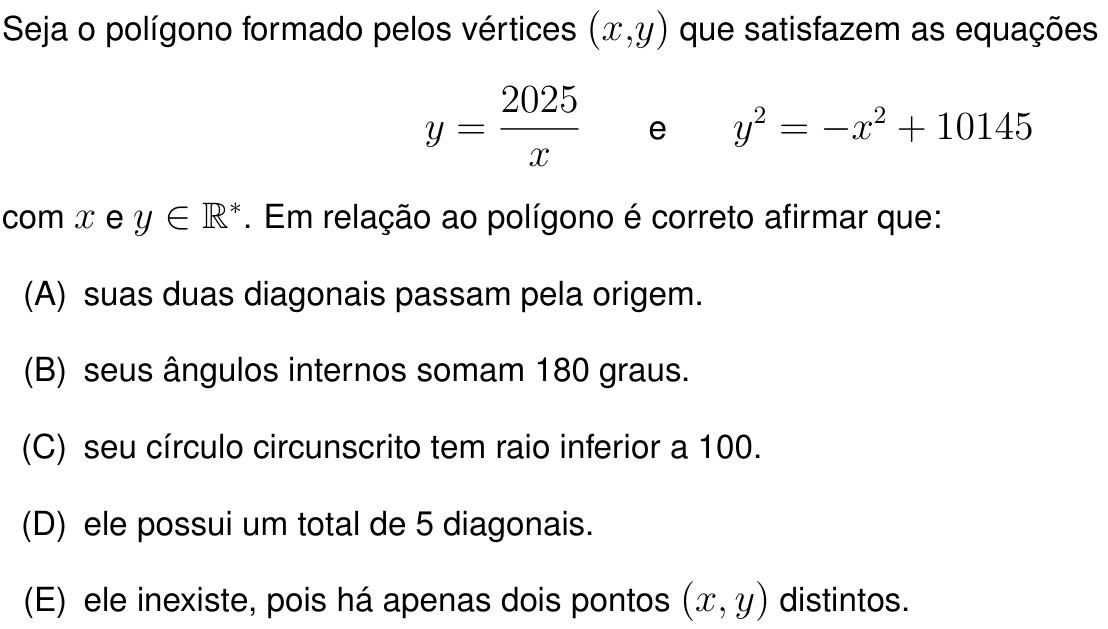
A questão

Questão 11

Respostas das IAs

GPT-6 Astra

A

Respondeu

levou 31 s

Como pensou
**Exploring geometric relationships** I’m working with the equations (x+y)²=14195 and (x-y)²=6095. Using u and v, I find four distinct points because both square roots are non-zero. This means there’s symmetry related to the origin and the diagonals form a rectangle. I’ll calculate u and v to identify the diagonals by their opposite signs. It’s clear that the four vertices form a rectangle inscribed in the circle, with symmetrical properties. I’ll conclude with a final line in Portuguese, reflecting on this symmetry in the context of algebra.

As equações dadas equivalem a

xy=2025 \quad\text{e}\quad x^2+y^2=10145.

Logo,

(x+y)^2=10145+2\cdot2025=14195,
(x-y)^2=10145-2\cdot2025=6095.

Assim,

x+y=\pm\sqrt{14195},\qquad x-y=\pm\sqrt{6095}.

As quatro combinações de sinais determinam quatro pontos distintos, pois

x=\frac{(x+y)+(x-y)}2,\qquad y=\frac{(x+y)-(x-y)}2.

Portanto, o polígono é um quadrilátero.

Todos os vértices pertencem ao círculo

x^2+y^2=10145,

centrado na origem. Além disso, se (x,y) é uma solução, (-x,-y) também é. Dessa forma, os vértices aparecem em dois pares diametralmente opostos, e as duas diagonais passam pela origem.

As demais alternativas são falsas: o quadrilátero tem soma dos ângulos internos igual a 360^\circ, possui apenas duas diagonais e seu círculo circunscrito tem raio \sqrt{10145}>100.

Resposta: A

GPT-6.1 Sol

A

Respondeu

levou 17 s

Como pensou
**Explaining geometric concepts** I’m thinking about how to express ordered points using a formula with a and b. While it feels a bit overly explicit, it’s clear in intention. I need to derive 4 through sums and ensure that for a quadrilateral inscribed in a circle, diagonals maintain symmetry. I'll list points P and -P, Q and -Q, and define a and b using radicals. I’m aiming for about 250 words, though maybe 180 would suffice.

As equações equivalem a

xy=2025,\qquad x^2+y^2=10145.

Logo,

(x+y)^2=10145+2\cdot2025=14195,
(x-y)^2=10145-2\cdot2025=6095.

Assim, podemos escolher independentemente os sinais de

x+y=\pm\sqrt{14195},\qquad x-y=\pm\sqrt{6095},

obtendo quatro pontos distintos. Definindo

a=\frac{\sqrt{14195}+\sqrt{6095}}2,\qquad b=\frac{\sqrt{14195}-\sqrt{6095}}2,

com a>b>0, os vértices, em ordem ao redor do círculo, são

P=(a,b),\quad Q=(b,a),\quad R=(-a,-b),\quad S=(-b,-a).

As diagonais são PR e QS. Como R=-P e S=-Q, ambas têm a origem como ponto médio, portanto passam por ela.

As demais alternativas são falsas: o quadrilátero tem soma dos ângulos internos igual a 360^\circ e apenas duas diagonais; seu círculo circunscrito tem raio \sqrt{10145}>100.

Resposta: A

GPT-6 Luna

A

Respondeu

levou 12 s

Como pensou
**Solving intersections of hyperbola and circle** I need to solve the intersection between the hyperbola xy=2025 and the circle x²+y²=10145. I’ll look for the points of intersection, using substitutions like y²=-x²+10145. I’m considering the quadratic equation formed and its discriminant. I should calculate 10,145² to begin with. I’m also estimating the roots and factoring to find out if there are four points of intersection, which would indicate a quadrilateral. I'll keep track of the calculations!**Identifying quadrilateral intersection points** I'm working with the circle x²+y²=10145, which has a radius of about 100.72. The quadrilateral formed here has two diagonals, and I need to confirm the existence of four distinct points that create this shape. I need to check for degeneracy by ensuring a ≠ b. The discriminant must be positive to find roots, and using substitutions like u=x² and v=y² might simplify things. Each pair of roots gives us four points, which I’ll carefully outline!**Verifying a calculation** I’m working through the calculation for 10,145 squared. First, I establish that 10,000 squared is 100,000,000, then I calculate 2 times 10,000 times 145, which gives me 2,900,000. Next, I find that 145 squared equals 21,025. Adding these values together gives me a total of 102,921,025. I confirm this is positive, and I'm considering the relationship between the equations implied here. It seems to link x and y values for a circular relation.

Das equações dadas, obtemos

xy=2025 \quad\text{e}\quad x^2+y^2=10145.

Definindo u=x^2 e v=y^2, temos

u+v=10145,\qquad uv=2025^2.

Esses valores são as raízes de uma equação quadrática cujo discriminante é

10145^2-4\cdot2025^2=86\,518\,525>0.

Logo, u e v são distintos e positivos. Há quatro pontos de interseção: para cada escolha entre u e v como x^2, há dois pontos com xy>0, relacionados pela troca simultânea dos sinais.

Assim, os quatro vértices formam pares de pontos opostos: se (x,y) é um vértice, (-x,-y) também é. As diagonais ligam esses pares e, portanto, passam pela origem.

Resposta: A

Claude Fable 5.1

A

Respondeu

levou 17 s

Como pensou
Using xy=2025 and x²+y²=10145, I'm trying (x+y)² and (x-y)² but neither gives a perfect square, so I'm setting up x² and y² as roots of a quadratic with sum 10145 and product 2025² to find another way in. The discriminant doesn't come out as a perfect square either, but that doesn't matter since it's positive, confirming four real solutions exist with both roots positive. These form four points (a,b), (b,a), (-a,-b), (-b,-a) symmetric about the origin, making a rectangle with diagonals through the center and circumradius sqrt(10145) ≈ 100.72 — just over 100, so I can rule out the circle-radius-100 claim and confirm the rectangle has two diagonals and angle sum 360, making answer A correct.

Montando o sistema:

xy = 2025 e x^2 + y^2 = 10145.

Fazendo u = x^2 e v = y^2: u + v = 10145 e uv = 2025^2. A equação t^2 - 10145t + 2025^2 = 0 tem discriminante 10145^2 - 4\cdot 2025^2 = (10145-4050)(10145+4050) = 6095\cdot 14195 > 0, e as duas raízes são positivas (soma e produto positivos) e distintas. Logo existem valores a > 0 e b > 0, com a \neq b, tais que x^2 \in \{a^2, b^2\}.

Como xy = 2025 > 0, x e y têm o mesmo sinal, resultando em 4 pontos:

(a,b),\ (b,a),\ (-a,-b),\ (-b,-a).

Natureza do polígono:

  • Todos os pontos estão no círculo x^2+y^2 = 10145, de raio \sqrt{10145} \approx 100{,}7 > 100.
  • Os pontos vêm em pares simétricos em relação à origem: (a,b) e (-a,-b); (b,a) e (-b,-a). Assim, as duas diagonais do quadrilátero são diâmetros do círculo e passam pela origem — o polígono é um retângulo (inscrito, com diagonais iguais que se cortam ao meio).

Analisando as alternativas:

  • (A) Verdadeira: ambas as diagonais passam pela origem (centro do círculo).
  • (B) Falsa: é um quadrilátero, soma dos ângulos internos = 360°.
  • (C) Falsa: raio \approx 100{,}7 > 100.
  • (D) Falsa: um quadrilátero tem 2 diagonais.
  • (E) Falsa: há 4 pontos distintos.

Resposta: A

Claude Opus 5.5

A

Respondeu

levou 10 s

Como pensou
With xy=2025 and x²+y²=10145, I can find (x+y)² and (x-y)², both positive, giving four intersection points forming a rectangle. The diagonals of this rectangle pass through the origin, confirming the center claim, while the radius exceeding 100 rules out the smaller-radius option.

Resposta: (A). Os vértices formam um retângulo inscrito na circunferência centrada na origem, cujas diagonais são diâmetros.

Encontrando os vértices. As condições são xy = 2025 e x² + y² = 10145. Combinando-as:

  • (x + y)² = 10145 + 2·2025 = 14195, logo x + y = ±√14195.
  • (x − y)² = 10145 − 2·2025 = 6095, logo x − y = ±√6095.

As duas expressões são positivas, então há 4 combinações de sinais. Isso dá 4 pontos distintos, da forma (a, b), (b, a), (−a, −b) e (−b, −a).

Natureza do polígono. Os quatro pontos estão na circunferência x² + y² = 10145, centrada na origem. Eles são simétricos em relação à origem e à reta y = x. Portanto formam um retângulo inscrito nessa circunferência.

Análise das alternativas:

  • (A) As diagonais ligam (a, b) a (−a, −b) e (b, a) a (−b, −a). Ambas são diâmetros da circunferência e passam pela origem. Verdadeira.
  • (B) A soma dos ângulos internos de um quadrilátero é 360°, não 180°. Falsa.
  • (C) O raio do círculo circunscrito é √10145 ≈ 100,7, que é maior que 100. Falsa.
  • (D) Um quadrilátero tem 4·1/2 = 2 diagonais, não 5. Falsa.
  • (E) Há 4 pontos distintos, então o polígono existe. Falsa.

Resposta: A

Claude Sonnet 5.5

A

Respondeu

levou 6 s

Como pensou
Given xy=2025 and x²+y²=10145, I compute (x+y)²=14195 and (x−y)²=6095, giving four solutions that form a symmetric configuration about the origin — points (a,b), (b,a), (−a,−b), (−b,−a), related by reflection across y=x and point symmetry through the origin. These form a parallelogram whose diagonals both pass through the origin and have equal length (since all points lie on a circle of radius √10145), making it a rectangle — so statement A is true. The radius is about 100.72, just over 100, so C is false; there are only 2 diagonals, so D is false; B is also false. The answer is A.

Os vértices são as soluções reais de xy = 2025 e x² + y² = 10145.

Encontrando os pontos.

  • (x + y)² = 10145 + 2·2025 = 14195, logo x + y = ±√14195.
  • (x − y)² = 10145 − 2·2025 = 6095, logo x − y = ±√6095.

Isso dá 4 pontos distintos, todos com x e y de mesmo sinal, porque xy > 0. Se (a, b) é solução, então (b, a), (−a, −b) e (−b, −a) também são.

Forma do polígono. Os 4 pontos estão na circunferência x² + y² = 10145, centrada na origem. Eles são simétricos em relação à origem: (a, b) ↔ (−a, −b) e (b, a) ↔ (−b, −a). Os segmentos que ligam esses pares são diâmetros da circunferência, portanto são diagonais que passam pela origem e têm o mesmo comprimento. Um quadrilátero cujas diagonais se bisseccionam e são iguais é um retângulo.

Alternativas.

  • (A) Verdadeira: as duas diagonais são diâmetros e passam pela origem.
  • (B) Falsa: a soma dos ângulos internos de um quadrilátero é 360°.
  • (C) Falsa: o raio é √10145 ≈ 100,7, que é maior que 100.
  • (D) Falsa: um quadrilátero tem 2 diagonais.
  • (E) Falsa: existem 4 pontos distintos.

Resposta: A

Grok 4.7

A

Respondeu

levou 1 min 47 s

Como pensou
The problem is in Portuguese. I will translate it. The problem asks which statement is correct about a polygon formed by the intersection of two curves with non-zero real coordinates. The options are: both diagonals pass through the origin; internal angles sum to 180 degrees; the circumscribed circle has radius less than 100; it has five diagonals; or it does not exist because only two distinct points satisfy both equations. I substituted the hyperbola equation into the circle equation to find the intersection points. This yields a quartic equation in x, which I reduced to a quadratic in z = x². I then calculated the discriminant using the difference of squares formula. The discriminant evaluates to 6095 times 14195. I then noticed the system x² + y² = 10145 and xy = 2025 can be solved more directly. I derived (x+y)² = 14195 and (x−y)² = 6095. The hyperbola xy = 2025 has branches only in the first and third quadrants. I am now checking how many intersection points exist. The discriminant is positive, so the quadratic in z has two distinct positive roots. Each root gives two values of x, and y = 2025/x fixes the corresponding y. Thus there are four intersection points. I am factoring 6095 and 14195 to simplify the square roots. I found that 6095 equals 5 times 23 times 53. I am now checking whether 14195 is divisible by 17. I confirmed that 14195 equals 5 times 17 times 167, so the discriminant is not a perfect square. The four intersection points will not have simple coordinates. I am now checking the sign combinations for x and y to verify the exact number of solutions. I verified that all four sign combinations of s and d satisfy xy = 2025. The product (s² − d²)/4 equals exactly 2025 for every combination, confirming the four intersection points. I verified that x² + y² = 10145 holds for every sign combination. I am now estimating the approximate coordinates of one intersection point to confirm its position. The four intersection points are approximately (98.6, 20.5), (20.5, 98.6), (-20.5, -98.6), and (-98.6, -20.5). These form a quadrilateral in the first and third quadrants. The circle radius is approximately 100.72, so the circumscribed circle has radius greater than 100. I am now ordering the four intersection points by their angular positions in the first quadrant to determine the polygon's vertices. The third quadrant points are at roughly 191.7 and 258.3 degrees. The quadrilateral vertices are ordered by angle. The angular order of the four intersection points is approximately 11.7°, 78.3°, 191.7°, and 258.3°. Because all points lie on the same circle centered at the origin, this angular sequence determines the convex polygon's vertices. I checked the options. A quadrilateral has internal angles summing to 360°, not 180°, so option (B) is incorrect. Option (D) is impossible because a quadrilateral has only two diagonals. Option (E) is false since four intersection points exist. Option (C) is also wrong because the radius exceeds 100. The only remaining candidate is option (A). The diagonals of the quadrilateral are P_a to P_c and P_b to P_d. The point P_c is exactly the negative of P_a, so the diagonal connecting them passes through the origin. This confirms that option (A) is correct. The side vectors of the quadrilateral are (q−p)(1, −1) and (p+q)(1, 1). Opposite sides are parallel. The polygon is a parallelogram. The diagonals bisect each other, confirming the quadrilateral is a parallelogram. The diagonals are not perpendicular, so it is not a rhombus. The side lengths differ: two sides have length |q−p|√2 and the other two have length (p+q)√2. The sides are perpendicular because the direction vectors (1, −1) and (1, 1) have a dot product of zero. The polygon is therefore a rectangle with unequal adjacent sides.

A interseção das curvas é dada pelo sistema

xy=2025,\qquad x^2+y^2=10145,

com x,y\neq 0. As soluções são exatamente os quatro pontos distintos

(p,q),\quad(q,p),\quad(-p,-q),\quad(-q,-p),

onde p>q>0. Esses pontos são os vértices de um retângulo (lados adjacentes ortogonais e diagonais que se bissectam). As diagonais unem (p,q) a (-p,-q) e (q,p) a (-q,-p), logo ambas passam pela origem.

As demais alternativas são falsas: a soma dos ângulos internos de um quadrilátero é 360^\circ; o circunraio é \sqrt{10145}>100; um quadrilátero possui apenas duas diagonais; e existem quatro pontos, não dois.

Resposta: A

DeepSeek V4.1 Flash

A

Respondeu

levou 57 s

Como pensou
We need answer in Portuguese. Need solve. Let's restate problem. "Seja o polígono formado pelos vértices (x,y) que satisfazem as equações y = 2025/x e y^2 = -x^2 + 10145, com x e y ∈ R*. Em relação ao polígono é correto afirmar que:" We need determine points (x,y) satisfying both equations? Let's solve. Equations: 1) y = 2025 / x 2) y^2 = -x^2 + 10145 => x^2 + y^2 = 10145. Substitute y=2025/x into second: 2025^2 / x^2 = -x^2 + 10145 => multiply x^2: 2025^2 = -x^4 + 10145 x^2 => x^4 - 10145 x^2 + 2025^2 = 0. Let t = x^2 >0. t^2 - 10145 t + 2025^2 = 0. Compute discriminant: D = 10145^2 - 4*(2025)^2. 10145? 2025? Let's compute. 10145 = 5*2029? 2029? 2025=45^2? 2025=81*25=9^2*5^2? 2025=45^2=2025 yes. 10145? 10145/5=2029, 2029 prime? 2029? 45^2=2025, so 10145=5*2029. Not special? Maybe D = ? 10145^2 - 4*2025^2 = (10145-2*2025)(10145+2*2025)? Wait difference squares? Since (a-b)(a+b) if same? 10145^2 - (2*2025)^2 = (10145 - 4050)(10145 + 4050) = 6095 * 14195. Yes D = 6095*14195. Compute: 6095*14195. 14195*6000=85,170,000; 14195*95=1,348,525; total 86,518,525. sqrt? Maybe 930? 930^2=864900, 9300^2=86,490,000? Wait 9300^2=86,490,000; 9301^2=86,508,601; 9302^2=86,527,204. So sqrt ~9301.4. Not integer? Let's verify D maybe. 10145^2? 10145^2 = (10000+145)^2=100,000,000+2,900,000+21,025=102,921,025. 2025^2=4,100,625; *4=16,402,500; difference=86,518,525. sqrt not integer? 9301^2 = 86,508,601; difference 9916. Not square. So t = (10145 ± sqrt(86518525))/2. Irrational. Thus x = ± sqrt(t1), ± sqrt(t2), four possible x; each gives y=2025/x, so four points? But x nonzero. Also y = ±? Since y=2025/x, sign of x determines y sign. Four points. But option E says "ele inexiste, pois há apenas dois pontos (x,y) distintos." Is that true? Let's examine: For each t positive, x = ±sqrt(t). But y = 2025/x, so for x positive y positive; x negative y negative. Since t1,t2 positive? Sum =10145 >0, product =2025^2 >0, so both t positive. Thus 4 points: (sqrt(t1), 2025/sqrt(t1)), (-sqrt(t1), -2025/sqrt(t1)), (sqrt(t2), 2025/sqrt(t2)), (-sqrt(t2), -2025/sqrt(t2)). So 4 points, not 2. E false. But "polígono formado pelos vértices que satisfazem" means polygon with vertices these points? The four points? Need determine property among options A-D. Let's analyze. Points are intersections of hyperbola y=2025/x and circle x^2+y^2=10145 centered origin radius sqrt(10145). Circle radius sqrt(10145). 100^2=10000, 101^2=10201, so radius ≈100.72, >100? Actually sqrt(10145) ≈100.722? So >100. Option C says "seu círculo circunscrito tem raio inferior a 100." But all points lie on circle radius sqrt(10145) ≈100.72 >100. Wait if polygon formed by these four points? Circumscribed circle of polygon? Since all four points lie on circle x^2+y^2=10145, that circle passes through all vertices. But "seu círculo circunscrito" (circumcircle) of polygon could be smaller? A polygon's circumscribed circle is unique through all vertices if concyclic. All four points lie on circle centered origin radius sqrt(10145), so the circumcircle has radius sqrt(10145) ≈100.72 >100, assuming polygon has no three collinear? But if four points concyclic, circumcircle is that circle. However is there a smaller circle through all four? No, unique if non-collinear? Actually infinitely many circles through two points, but three non-collinear determine unique circle. Are these four points concyclic on that circle. Since at least three non-collinear? Need check. Points are on hyperbola and circle. They likely are not all on a line. So circumcircle radius = sqrt(10145) >100, C false if "inferior a 100". Let's verify 10145 >10000 yes. So C false. Option A: "suas duas diagonais passam pela origem." A quadrilateral has two diagonals. Do both pass through origin? Need check. Points are symmetric with respect to origin: if (x,y) is solution, (-x,-y) is also solution (since equations odd/even? y=2025/x: (-x,-y) gives -y = 2025/(-x) => -y = -2025/x => y=2025/x yes. y^2 same. So pairs are opposite. Thus polygon is a parallelogram? Four points: P1=(a,b), P2=(c,d), P3=(-a,-b), P4=(-c,-d) where a=sqrt(t1), b=2025/a; c=sqrt(t2), d=2025/c. The quadrilateral vertices in order? Need order. Points: (a,b), (c,d), (-a,-b), (-c,-d). Diagonals connect opposite vertices: P1-P3 passes through origin, P2-P4 passes through origin. So both diagonals pass through origin. A true? Wait "polígono formado pelos vértices" maybe just set of vertices, polygon is quadrilateral with those vertices? Usually "polígono formado pelos vértices" means polygon whose vertices are these points, likely convex hull. The four points are two pairs of opposite points, so they form a parallelogram? Actually any four points with two pairs opposite through origin: the quadrilateral with vertices in cyclic order will have diagonals connecting opposite vertices, both lines through origin. But need ensure the order: The four points lie on circle centered origin, so they form a cyclic quadrilateral, but not necessarily convex? Let's examine positions. t1,t2 are roots of t^2 - 10145 t + 2025^2=0. Let t1 < t2. Then x values: sqrt(t1) < sqrt(t2). y=2025/x so y1 > y2 >0? Since x1 < x2, y1 > y2. Points in first quadrant: P1=(a,b) with a=sqrt(t1), b=2025/a; P2=(c,d) with c=sqrt(t2), d=2025/c, with a<c, b>d. Both positive. Opposite in third quadrant: P3=(-a,-b), P4=(-c,-d). So vertices alternate around circle? Let's see first quadrant: P1 near y-axis? a small -> b large; P2 near x-axis? c large -> d small. So P1 upper left, P2 lower right in first quadrant. The circle centered origin: P1 and P2 are on circle. The order around circle starting from positive x-axis: P2 (angle small? c large, d small), then P1? Since c > a, b > d? Actually P1 angle arctan(b/a) = arctan(2025/a^2)= arctan(2025/t1). P2 angle arctan(2025/t2). Since t1<t2, 2025/t1 > 2025/t2 => angle P1 > angle P2. So in first quadrant, P2 at smaller angle (closer x-axis), P1 at larger angle (closer y-axis). Opposite points: P4 opposite P2 in third quadrant, P3 opposite P1. Cyclic order around circle: P2 (angle θ2), P1 (θ1), P3 (θ1+π), P4 (θ2+π) if θ1<π/2, θ2<θ1? Actually θ2 < θ1 < π/2. Then after P4? Let's list: angles: θ2 (P2), θ1 (P1), π+θ2 (P4), π+θ1 (P3) then back to θ2+2π? Wait P1 angle θ1, P3 θ1+π; P2 θ2, P4 θ2+π. Since θ2 < θ1 < π/2, order around circle: θ2 (P2), θ1 (P1), π+θ2 (P4), π+θ1 (P3), then θ2+2π (P2). So vertices in order: P2, P1, P4, P3 (convex quadrilateral). Diagonals are P2-P3 and P1-P4. P2-P3: P2=(c,d), P3=(-a,-b) not opposite? Wait opposite pairs are P1-P3 and P2-P4. Our order P2-P1-P4-P3 means sides are P2-P1, P1-P4, P4-P3, P3-P2. Diagonals are P2-P4 (opposite through origin? P2 and P4 are opposite: P2=(c,d), P4=(-c,-d), yes line through origin) and P1-P3 (opposite: P1=(a,b), P3=(-a,-b), line through origin). So yes both diagonals pass through origin. A true? But wait "suas duas diagonais passam pela origem" for a quadrilateral, diagonals are segments connecting nonadjacent vertices. Since our vertices include opposite pairs, yes. Option B: "seus ângulos internos somam 180 graus." Any quadrilateral's internal angles sum 360°, not 180. Triangle sum 180. So false if polygon is quadrilateral. But maybe polygon could be degenerate? It has four points, so quadrilateral, sum 360. B false. Option D: "ele possui um total de 5 diagonais." Quadrilateral has 2 diagonals, not 5. A pentagon has 5 diagonals. So false. But maybe polygon has more vertices? No four points. So D false. Option E false as noted. So answer A? But let's be cautious: The problem statement: "Seja o polígono formado pelos vértices (x,y) que satisfazem as equações... com x e y ∈ R*." Could "polígono formado pelos vértices" mean the polygon whose vertices are all points satisfying equations? Yes. We found 4 points. Are they distinct? t1≠t2? Discriminant >0. t1,t2 positive and distinct? t1 < t2 because discriminant >0. Yes. So quadrilateral. A true. But wait need consider if the four points form a polygon? They could be collinear? Let's verify magnitude: Points on circle radius sqrt(10145), so not collinear (unless opposite pairs? Two opposite pairs define two diameters; four points not all collinear). Convex quadrilateral cyclic. Diagonals are diameters passing through origin. Yes. However, there is subtlety: The equations y = 2025/x and y^2 = -x^2 + 10145. The first is hyperbola, second circle. Intersection could include points with y=0? But y = 2025/x, x ∈ R*, y≠0. Circle radius sqrt(10145) >0, so yes. But let's solve fully. Substitute: y=2025/x => x^2 + (2025/x)^2 = 10145 => x^4 - 10145x^2 + 2025^2=0. Let u=x^2. u^2 - 10145u + 2025^2=0. Compute product = 2025^2 = 4,100,625. Sum = 10145. The roots are positive because discriminant positive and sum positive product positive. So two positive u values. Thus four x values ±sqrt(u1), ±sqrt(u2). For each x, y=2025/x. So four points. Need check if two points maybe same? x distinct? u1≠u2? Discriminant = 10145^2 -4*2025^2 = let's compute maybe 10145^2=102,921,025; 4*4,100,625=16,402,500; diff=86,518,525 >0, so distinct. So four distinct points. Now check options: A true: The quadrilateral vertices are (a,b), (c,d), (-a,-b), (-c,-d) with a=√u1, b=2025/a, c=√u2, d=2025/c. The diagonals connect (a,b)-(-a,-b) and (c,d)-(-c,-d), both lines through origin. So both diagonals pass through origin. Good. B false: Quadrilateral interior angle sum = 360°. C: Circumcircle radius? All four points lie on x^2+y^2=10145, so the circle centered origin radius √10145 passes through all. Is this the circumscribed circle? Any circle through three non-collinear points is unique. The four points are concyclic. Since polygon cyclic? Yes. The circumcircle is that circle, radius √10145 ≈100.72 >100. So C says "inferior a 100" false. But wait maybe "círculo circunscrito" could have radius less than 100 if one considers largest circle contained in polygon? In Portuguese "círculo circunscrito" usually circumscribed circle around polygon (passes through vertices). "Círculo inscrito" is inscribed. So C false. But let's double-check radius: 100^2=10000; 10145 >10000 => radius >100. So C false. D: Total diagonals = 5? For n vertices, diagonals = n(n-3)/2. For n=4 =>2. For n=5 =>5. Since 4 vertices, false. Maybe if polygon has more than 4 vertices due to complex? No. E: "inexiste, pois há apenas dois pontos distintos" false, four points. Thus answer A. But wait there is potential issue: The polygon formed by vertices might not be the convex hull? Could the four points be considered as vertices of a self-intersecting polygon? Usually "polígono formado pelos vértices" means polygon with those vertices in some order (maybe convex). But if they are concyclic, the natural polygon is convex quadrilateral with vertices in circular order. Diagonals pass through origin. So A. Let's ensure no hidden trap: The equations: y = 2025/x and y^2 = -x^2 + 10145. The first equation is y = 2025/x. The second: y^2 = -x^2 + 10145 => x^2 + y^2 = 10145. Since y=2025/x, x and y same sign? Actually y=2025/x, sign(y)=sign(x). Circle radius squared 10145. Intersections in first and third quadrants only? Yes. The four points are symmetric wrt origin. The quadrilateral is a parallelogram? Let's verify sides: P1-P2, P2-P4? Actually order P2, P1, P4, P3. Sides: P2P1, P1P4, P4P3, P3P2. Are opposite sides parallel? P2P1 vector = (a-c, b-d). P4P3 vector = (a-c? P4=(-c,-d), P3=(-a,-b) => P3-P4 = (c-a, d-b)= -(a-c, b-d)? Actually P4->P3 = (-a+c? Wait P4=(-c,-d), P3=(-a,-b), vector P4->P3 = (-a - (-c), -b - (-d)) = (c-a, d-b) = -(a-c, b-d). So P2P1 = (a-c, b-d), P3P4 = (a-c? P3->P4 = (-c+a, -d+b) = (a-c, b-d). So P2P1 parallel/equal to P3P4, yes parallelogram? Also P1P4 = (-c-a, -d-b), P3P2 = (c+a, d+b) = -( -c-a, -d-b)? Actually P3->P2 = (c - (-a), d - (-b)) = (a+c, b+d) = -( -c-a, -d-b)? Yes P1P4 = (-c-a, -d-b) = -(a+c, b+d). So opposite sides parallel. So quadrilateral is parallelogram. Diagonals bisect each other at origin? For parallelogram, diagonals bisect each other. Since opposite vertices are negatives, midpoint of P1 and P3 is origin; midpoint of P2 and P4 is origin. So diagonals intersect at origin, hence both pass through origin. Yes. So A definitely true. But wait question asks "Em relação ao polígono é correto afirmar que:" maybe there is only one correct. Answer A. Let's craft final explanation in Portuguese. Include solving equations, intersecting circle/hyperbola, four points symmetric, quadrilateral parallelogram, diagonals pass through origin. Mention other alternatives false. Final line "Resposta: A". Need follow format exactly. The user asked: "Resolva a questão e explique o seu raciocínio em português. Termine com uma linha neste formato: Resposta: X". So final answer should have explanation and end with Resposta: A. Use desired oververbosity 5.
Substituindo y=\frac{2025}{x} na segunda equação:

y^2=-x^2+10145 \implies x^2+y^2=10145
x^2+\left(\frac{2025}{x}\right)^2=10145
x^4-10145x^2+2025^2=0

Fazendo t=x^2, temos:

t^2-10145t+2025^2=0

Como o discriminante é positivo e as raízes são positivas, existem dois valores distintos para t, logo quatro valores distintos para x:

x=\pm\sqrt{t_1},\quad x=\pm\sqrt{t_2}

Para cada x, obtemos y=\frac{2025}{x}, totalizando 4 pontos distintos.

Esses quatro pontos são simétricos em relação à origem: se (x,y) é solução, então (-x,-y) também é. Assim, o polígono é um quadrilátero cujos vértices ocorrem em pares opostos. Logo, suas duas diagonais ligam pontos opostos e ambas passam pela origem.

As demais alternativas são falsas:

  • (B) a soma dos ângulos internos de um quadrilátero é 360^\circ, não 180^\circ;
  • (C) o círculo circunscrito tem raio \sqrt{10145}>100, pois 10145>10000;
  • (D) um quadrilátero possui apenas 2 diagonais;
  • (E) existem 4 pontos distintos, não apenas 2.

Resposta: A

Gemini 3.8 Flash

A

Respondeu

levou 28 s

Como pensou
**Analyzing the System** I'm currently focused on analyzing the system defined by the equations $y = \frac{2025}{x}$ and $y^2 = -x^2 + 10145$. Specifically, I'm trying to figure out how these equations define a polygon in the real plane, given that $x$ and $y$ are non-zero real numbers. **Determining Real Solutions** I've determined there are precisely four distinct real solutions to the system. The approach involved manipulating the equations to derive expressions for $(x+y)^2$ and $(x-y)^2$. Since both are positive, the equations yield four combinations for $(x+y)$ and $(x-y)$, resulting in four real solutions. I confirmed none of these solutions have zero values for x or y. Finally, I noticed that if (x0, y0) is a solution, (-x0, -y0) is also a solution, confirming symmetry. **Defining the Polygon's Vertices** I've rigorously established the four vertices of the polygon, labeled A, B, C, and D. I've considered the symmetrical nature of the equations and confirmed that if (x0, y0) is a solution, (-x0, -y0) is also a solution, thus yielding A, B, C and D vertices. I'm now carefully mapping these points on the Cartesian plane, considering their quadrants and relative positions with respect to the line y=x, so that I will be able to establish the angles. **Confirming Vertex Order** I've determined the angular order of the vertices to be A, B, C, and D. I'm noting the angles: Theta A is approximately 20 degrees, Theta B is approximately 70 degrees, Theta C is approximately 200 degrees, and Theta D is approximately 250 degrees. Based on this, I've confirmed the polygon has vertices in cyclical order as A, B, C, D. Consequently, the sides of the polygon are AB, BC, CD, and DA, and the diagonals are AC and BD. Since C = -A and D = -B, both diagonals AC and BD pass through the origin. This confirms that alternative (A) is correct: "its two diagonals pass through the origin."

Para resolver a questão, analisamos o sistema de equações formado pelas condições dadas:

  1. y = \dfrac{2025}{x} \iff x \cdot y = 2025
  2. y^2 = -x^2 + 10145 \iff x^2 + y^2 = 10145

com x, y \in \mathbb{R}^*.

Podemos determinar as somas e diferenças das variáveis:

(x + y)^2 = x^2 + y^2 + 2xy = 10145 + 2(2025) = 10145 + 4050 = 14195 > 0

(x - y)^2 = x^2 + y^2 - 2xy = 10145 - 2(2025) = 10145 - 4050 = 6095 > 0

Como ambas as quantidades são estritamente positivas e diferentes entre si, temos:

x + y = \pm \sqrt{14195}

x - y = \pm \sqrt{6095}

Isso gera 2 \times 2 = 4 soluções reais distintas (x, y), nenhuma das quais possui coordenadas nulas. Denotando uma solução no primeiro quadrante com x_1 > y_1 > 0 por A = (x_1, y_1), pela simetria das equações, os outros três vértices são:

  • B = (y_1, x_1) (também no 1º quadrante)
  • C = (-x_1, -y_1) = -A (no 3º quadrante)
  • D = (-y_1, -x_1) = -B (no 3º quadrante)

Como os vértices dispostos em ordem angular cíclica formam o quadrilátero ABCD:

  • As diagonais desse quadrilátero são os segmentos AC e BD.
  • O ponto médio de AC é \dfrac{A + C}{2} = \dfrac{A + (-A)}{2} = (0, 0).
  • O ponto médio de BD é \dfrac{B + D}{2} = \dfrac{B + (-B)}{2} = (0, 0).

Portanto, ambas as diagonais passam pela origem (0,0).

Além disso, analisando as demais alternativas:

  • (B) Incorreta, pois a soma dos ângulos internos de um quadrilátero é 360^\circ.
  • (C) Incorreta, pois todos os vértices estão sobre a circunferência x^2 + y^2 = 10145, cujo raio é R = \sqrt{10145} > \sqrt{10000} = 100.
  • (D) Incorreta, pois um quadrilátero possui apenas 2 diagonais.
  • (E) Incorreta, pois existem 4 pontos distintos.

Resposta: A