Respondeu
levou 12 s
Como pensou
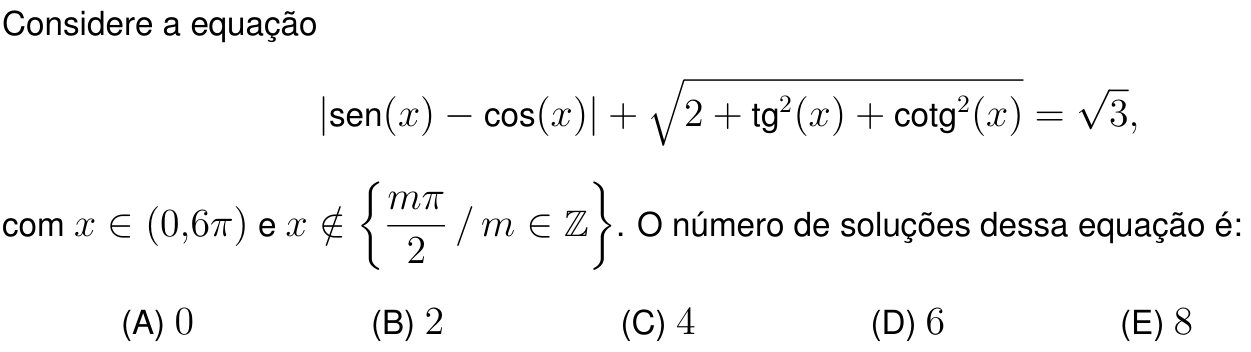
Como \tg x\cdot\cotg x=1 no domínio dado, temos
\tg^2x+\cotg^2x\ge 2|\tg x\cdot\cotg x|=2.
Portanto,
\sqrt{2+\tg^2x+\cotg^2x}\ge \sqrt4=2.
Além disso, |\sen x-\cos x|\ge0. Assim, o lado esquerdo da equação é sempre maior ou igual a 2, enquanto o lado direito é \sqrt3<2.
Logo, a equação não possui soluções.
Resposta: A
Respondeu
levou 7 s
Como pensou
Como \operatorname{tg}x\cdot\operatorname{cotg}x=1 no domínio dado, temos
\operatorname{tg}^2x+\operatorname{cotg}^2x
\ge 2\left|\operatorname{tg}x\cdot\operatorname{cotg}x\right|=2.
Logo,
|\sen x-\cos x|+\sqrt{2+\operatorname{tg}^2x+\operatorname{cotg}^2x}
\ge 0+\sqrt{4}=2>\sqrt3.
Portanto, a equação não possui soluções.
Resposta: A
Respondeu
levou 8 s
Como pensou
**Solving a trigonometric equation**
I'm tackling the equation |sin - cos| + sqrt(2 + tan² + cot²) = sqrt(3) over the domain x ∈ (0, 6π), excluding mπ/2 where tan and cot are undefined. First, I'm analyzing the sqrt term's minimum. I realize tan² + cot² ≥ 2, making the term inside sqrt at least 4, so that part becomes ≥ 2. The right-hand side is approximately 1.732, which seems impossible. I need to double-check if the radical covers the full expression, leading me to conclude there might not be a solution after all.**Inspecting the equation**
I’m examining the equation where the radical starts after the plus sign, with the cotg² approximating around 989. This leads me to consider if the expression could be |sin - cos| + sqrt(2 + tan²(x)) + cotg²(x) = sqrt(3). The radical indeed covers cotg², suggesting there's possibly a misconception here. The tan and cot functions are reciprocals, ensuring they’re non-zero in their domain. Setting t = tan(x) ≠ 0 leads me to conclude that the left-hand side is always greater than sqrt(3), meaning there’s no solution. I need to explain this clearly in Portuguese as well.
Como x\notin\{m\pi/2:m\in\mathbb Z\}, temos \tan x\neq 0 e \cot x=1/\tan x. Pela desigualdade u+1/u\ge 2, para u=\tan^2 x>0,
\tan^2 x+\cot^2 x\ge 2.
Assim, o radicando é pelo menos 4, e portanto a raiz quadrada é pelo menos 2. Como |\sen x-\cos x|\ge 0, o lado esquerdo da equação é no mínimo 2, que é maior que \sqrt3. Logo, não há soluções.
Resposta: A
Respondeu
levou 10 s
Como pensou
I'm simplifying the equation by recognizing that 2 + tan²x + cot²x equals (tan x + cot x)², so the square root term reduces to 2/|sin 2x|. Setting t = |sin x − cos x| with t² = 1 − sin 2x, I can rewrite everything in terms of sin 2x to solve for it.
Since |1 − t²| never exceeds 1 for t² in [0,2], the term 2/|1−t²| is always at least 2, which exceeds √3 on its own—so the full left side always surpasses √3, meaning there are no solutions. The answer is A.
Simplificando o radical:
2+\operatorname{tg}^2x+\operatorname{cotg}^2x=(\operatorname{tg}x+\operatorname{cotg}x)^2=\left(\frac{\operatorname{sen}^2x+\cos^2x}{\operatorname{sen}x\cos x}\right)^2=\frac{1}{\operatorname{sen}^2x\cos^2x}
Logo
\sqrt{2+\operatorname{tg}^2x+\operatorname{cotg}^2x}=\frac{1}{|\operatorname{sen}x\cos x|}=\frac{2}{|\operatorname{sen}(2x)|}.
Como 0<|\operatorname{sen}(2x)|\le 1 (a condição x\neq \frac{m\pi}{2} garante que \operatorname{sen}(2x)\neq 0), temos
\frac{2}{|\operatorname{sen}(2x)|}\ \ge\ 2.
Analisando o lado esquerdo:
|\operatorname{sen}x-\cos x|+\sqrt{2+\operatorname{tg}^2x+\operatorname{cotg}^2x}\ \ge\ 0+2=2>\sqrt{3}.
Portanto, o lado esquerdo é sempre estritamente maior que \sqrt3 para todo x no domínio, e a equação não possui nenhuma solução no intervalo (0,6\pi).
Resposta: A
Respondeu
levou 8 s
Como pensou
I simplify 2+tan²+cot² to (tan+cot)², which gives sqrt equal to 2/|sin2x|. Since this term alone is at least 2, which exceeds √3, I set t = sinx cosx and try to bound |sinx−cosx| + 2/|sin2x| to see if the equation can ever reach √3.
Since |t| ≤ 1/2 always forces 1/|t| ≥ 2, the sum is always at least 2, which is already greater than √3, so there are no solutions regardless of the interval. The answer is 0.
Resposta: (A) 0
Simplificando a raiz. Como \operatorname{tg}x\cdot\operatorname{cotg}x = 1, vale
2 + \operatorname{tg}^2 x + \operatorname{cotg}^2 x = (\operatorname{tg} x + \operatorname{cotg} x)^2 .
Daí,
\sqrt{2+\operatorname{tg}^2x+\operatorname{cotg}^2x} = |\operatorname{tg}x+\operatorname{cotg}x| = \left|\frac{\operatorname{sen}^2x+\cos^2x}{\operatorname{sen}x\cos x}\right| = \frac{2}{|\operatorname{sen}(2x)|}.
Limitando o primeiro membro. Como |\operatorname{sen}(2x)| \le 1, a raiz é sempre maior ou igual a 2. Além disso, |\operatorname{sen}x-\cos x| \ge 0. Portanto:
|\operatorname{sen}x-\cos x| + \frac{2}{|\operatorname{sen}2x|} \ge 2 > \sqrt{3}.
O primeiro membro nunca chega a \sqrt{3}, para nenhum x do domínio. Isso vale qualquer que seja a leitura do intervalo, (0;\,6\pi) ou (0{,}6\pi). A equação não tem solução.
Resposta: A
Respondeu
levou 7 s
Como pensou
I recognize that the sum of squares of tangent and cotangent simplifies to 1 over sin x cos x squared. Setting s = sin x - cos x with |s| = a, I express sin x cos x in terms of a² and reduce the equation to a + 2/|1-a²| = √3, restricting a to (0, √2] while excluding a=1. Now I'm working through the cases this absolute value splits into.
For a<1, the fraction term alone exceeds √3, so no solutions arise. For a>1 up to √2, the bound on a²-1 keeps the fraction term at least 2, pushing the left side well above √3 again, so this case also fails — meaning there are no valid solutions overall, confirming answer A.
Simplificando o radical. Como tg²x + cotg²x + 2 = (tg x + cotg x)² e tg x + cotg x = 1/(sen x · cos x), temos
√(2 + tg²x + cotg²x) = 1/|sen x · cos x|.
As condições x ≠ mπ/2 garantem que sen x · cos x ≠ 0.
Mudança de variável. Seja a = |sen x − cos x|. Então a² = 1 − 2·sen x·cos x, ou seja, sen x · cos x = (1 − a²)/2. Além disso, 0 ≤ a ≤ √2, e a ≠ 1, pois a = 1 daria sen x · cos x = 0, o que está excluído.
A equação fica
a + 2/|1 − a²| = √3.
Análise dos casos.
- Se 0 ≤ a < 1, então 0 < 1 − a² ≤ 1, logo 2/(1 − a²) ≥ 2. Assim o lado esquerdo é maior que 2 > √3, e não há solução.
- Se 1 < a ≤ √2, então 0 < a² − 1 ≤ 1, logo 2/(a² − 1) ≥ 2. Assim o lado esquerdo é maior que 1 + 2 = 3 > √3, e também não há solução.
Portanto a equação não tem soluções no intervalo dado.
Resposta: A
Respondeu
levou 53 s
Como pensou
This is an IME 2027 problem. I need to solve the equation.
I'm simplifying the expression under the square root. I found that \(\tan^2(x) + \cot^2(x) = \frac{1}{\sin^2 x \cos^2 x} - 2\).
The square root simplifies to \(\frac{2}{|\sin 2x|}\). The equation becomes \(\sqrt{2}|\sin(x - \pi/4)| + \frac{2}{|\sin 2x|} = \sqrt{3}\).
I verified that \(\sqrt{1 - \sin 2x}\) equals the absolute value of \(\sin x - \cos x\). This gives another way to write the equation.
I confirmed the identity by substituting \(\sin(x - \pi/4)\). I am now setting the substitution t = sin 2x, noting that t is in [-1, 1] and cannot be zero.
I substituted t = sin 2x into the equation. The second term is always at least 2 because |t| ≤ 1. The first term is non-negative. Their sum is therefore at least 2, which exceeds √3 ≈ 1.732. This suggests there are no solutions.
I am double-checking the algebraic simplification of tan² + cot².
I checked specific values at x = π/4 and x = π/6. Both give left-hand sides above √3. The inequality holds numerically too.
A expressão sob o radical simplifica-se da seguinte forma:
\operatorname{tg}^2 x + \operatorname{cotg}^2 x = \frac{1}{\operatorname{sen}^2 x\cos^2 x}-2,
donde
2+\operatorname{tg}^2 x+\operatorname{cotg}^2 x=\frac{1}{\operatorname{sen}^2 x\cos^2 x}.
Assim,
\sqrt{2+\operatorname{tg}^2 x+\operatorname{cotg}^2 x}=\frac{1}{|\operatorname{sen} x\cos x|}=\frac{2}{|\operatorname{sen} 2x|}.
Como |\operatorname{sen} 2x|\le 1, segue que
\frac{2}{|\operatorname{sen} 2x|}\ge 2,
com igualdade se e somente se |\operatorname{sen} 2x|=1. O primeiro termo da equação original é não negativo, logo o lado esquerdo é sempre maior ou igual a 2. Porém 2>\sqrt{3}, de modo que a igualdade jamais ocorre (em particular, ela não ocorre em nenhum ponto do intervalo (0,6\pi) em que a expressão está definida).
Resposta: A
Respondeu
levou 14 s
Como pensou
We need answer in Portuguese, solve. Need be careful. Equation:
|sen x - cos x| + sqrt(2 + tg^2 x + cotg^2 x) = sqrt(3)
Domain x in (0,6π) excluding mπ/2? notation mπ/2 / m∈Z? Actually { mπ/2 / m ∈ Z } means multiples of π/2, where tan/cot undefined. Domain excludes all mπ/2.
Need find number of solutions.
Let's solve. Let t = tan x maybe. Since expression includes tan and cot, domain excludes π/2 multiples. Also |sin - cos| can express.
Equation: |sin x - cos x| + sqrt(2 + tan^2 x + cot^2 x) = √3.
Observe tan^2 + cot^2 >= 2? By AM-GM tan^2+cot^2 ≥ 2, equality when tan^2=1 => tan=±1 => x = π/4 + kπ/2? Wait tan^2=1 => x=π/4 + kπ/2, but exclude? Those are multiples π/4 not multiples π/2 except? π/4 + kπ/2 never multiple π/2? If k even gives π/4 mod π? Actually multiples of π/2: 0, π/2, π... π/4+ kπ/2 not multiple π/2. Good.
Then sqrt(2 + tan^2 + cot^2) ≥ sqrt(2+2)=2. First term |sin - cos| ≥ 0. Sum ≥ 2. RHS = √3 ≈1.732 <2. Therefore impossible. So no solutions? Wait check: sqrt(2 + tan^2 + cot^2) >= 2 indeed. LHS >=2 > √3. So zero solutions. But options include 0. But maybe domain? Let's verify no nuance: tan^2+cot^2 >=2, yes. Then sqrt >=2. RHS √3 <2. So no solutions. Answer A 0.
But wait maybe if first term negative? absolute nonnegative. So sum >=2. So 0.
Need provide explanation. But ensure no trick: Could tan^2 + cot^2 be less than 2 if complex? Real no. Since tan^2, cot^2 nonnegative; product? AM-GM tan^2 + cot^2 ≥ 2|tan cot| = 2, because tan*cot=1? Actually tan x * cot x =1 for defined, yes. Good.
Then LHS ≥ sqrt(4)=2. √3<2. No solution. Thus number 0.
Need final with answer line.
A equação é
|\sen x-\cos x|+\sqrt{2+\tg^2x+\cotg^2x}=\sqrt3.
Para todo x do domínio, \tg x e \cotg x são reais e não nulos. Temos, pela desigualdade das médias,
\tg^2x+\cotg^2x \ge 2\sqrt{\tg^2x\cdot \cotg^2x}=2.
Logo,
\sqrt{2+\tg^2x+\cotg^2x}\ge \sqrt{2+2}=2.
Como |\sen x-\cos x|\ge 0, o lado esquerdo é sempre maior ou igual a 2. Porém,
\sqrt3 \approx 1{,}732 < 2.
Assim, a igualdade é impossível para qualquer x\in(0,6\pi) com \tg x e \cotg x definidos. Portanto, não há soluções.
Resposta: A
Respondeu
levou 16 s
Como pensou
**Analyzing Trigonometric Solutions**
I'm currently focused on determining the number of solutions for a complex trigonometric equation within the specified interval. The core task involves simplifying the equation by manipulating the absolute value, square root, and trigonometric functions, while carefully considering the domain restrictions. The goal is to identify all valid $x$ values.
**Simplifying Equation Terms**
I've established that the term under the square root simplifies nicely. Specifically, $2 + \tan^2(x) + \cot^2(x)$ equals $(\tan(x) + \cot(x))^2$, meaning the square root becomes the absolute value of $\tan(x) + \cot(x)$, which in turn is $2/|\sin(2x)|$. This means the expression is always greater than or equal to 2.
**Proving No Solutions**
I've realized the left side of the equation is always greater than or equal to 2, while the right side is $\sqrt{3}$, which is less than 2. This fundamental inequality means there are no real solutions.
**Confirming No Solutions**
My analysis confirms the initial finding: the left side of the equation is always greater than or equal to 2, while the right side is $\sqrt{3}$, which is less than 2. This fundamental inequality definitively proves there are no real solutions to the equation within the given domain.
Para determinar o número de soluções da equação, vamos analisar o valor mínimo que o lado esquerdo da igualdade pode assumir.
Temos a equação:
|\sen(x) - \cos(x)| + \sqrt{2 + \tg^2(x) + \cotg^2(x)} = \sqrt{3}
-
Análise do termo dentro da raiz:
Como \tg(x) \cdot \cotg(x) = 1, podemos reescrever o radicando como um quadrado perfeito:
2 + \tg^2(x) + \cotg^2(x) = \tg^2(x) + 2\tg(x)\cotg(x) + \cotg^2(x) = (\tg(x) + \cotg(x))^2
Portanto:
\sqrt{2 + \tg^2(x) + \cotg^2(x)} = |\tg(x) + \cotg(x)|
Pela Desigualdade das Médias (MA \ge MG) aplicada aos números reais estritamente positivos \tg^2(x) e \cotg^2(x):
\tg^2(x) + \cotg^2(x) \ge 2\sqrt{\tg^2(x)\cotg^2(x)} = 2
Logo:
2 + \tg^2(x) + \cotg^2(x) \ge 2 + 2 = 4
\implies \sqrt{2 + \tg^2(x) + \cotg^2(x)} \ge \sqrt{4} = 2
-
Análise do termo modular:
O módulo de qualquer número real é sempre não-negativo:
|\sen(x) - \cos(x)| \ge 0
-
Análise do lado esquerdo completo:
Somando as duas desigualdades, obtemos para todo x no domínio da equação:
|\sen(x) - \cos(x)| + \sqrt{2 + \tg^2(x) + \cotg^2(x)} \ge 0 + 2 = 2
Como o lado direito da equação é \sqrt{3} e sabemos que \sqrt{3} \approx 1,732 < 2, o lado esquerdo é estritamente maior que o lado direito para qualquer valor de x:
|\sen(x) - \cos(x)| + \sqrt{2 + \tg^2(x) + \cotg^2(x)} \ge 2 > \sqrt{3}
Portanto, a equação não possui soluções no domínio dado. O número de soluções é 0.
Resposta: A