Como pensou
We need answer problem in Portuguese. Need solve. Let's restate.
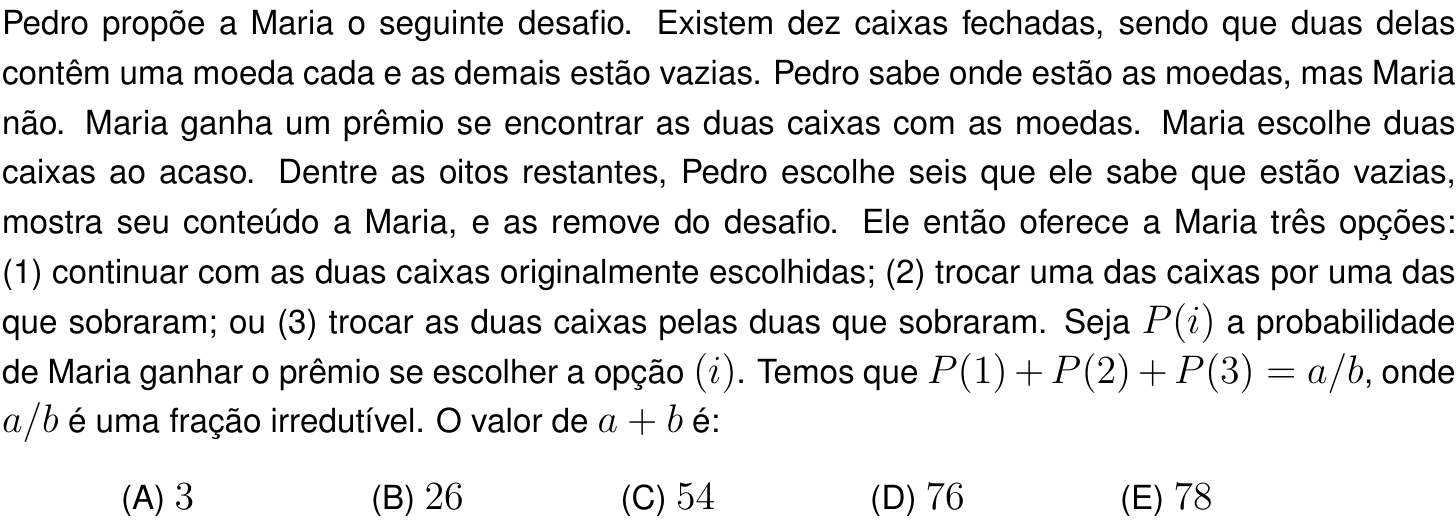
Pedro proposes challenge. 10 closed boxes, 2 contain one coin each, rest empty. Pedro knows where coins are, Maria doesn't. Maria wins prize if finds both boxes with coins. Maria chooses two boxes at random without knowing. Among remaining 8 boxes, Pedro chooses six that he knows are empty, shows their content to Maria, and removes them from challenge. He then offers Maria three options:
(1) continue with the two originally chosen boxes;
(2) swap one of the boxes for one of the remaining boxes;
(3) swap both boxes for the two remaining boxes.
Let P(i) probability Maria wins if chooses option (i). We have P(1)+P(2)+P(3)=a/b irreducible. Find a+b.
We need compute probabilities under Bayesian/conditional on observed removal? Important: Pedro's action of choosing six empty boxes from remaining 8 may convey information? Since he knows where coins are. Maria initially chooses 2 boxes. Then Pedro chooses 6 empty boxes among remaining 8 and removes them. This action depends on whether Maria's chosen boxes contain coins? He knows. He can always choose 6 empty among remaining 8 if at least 6 empty among remaining. There are 8 remaining, 2 coins total. Cases:
- If Maria's two boxes contain both coins: remaining 8 are all empty, Pedro can choose any 6 empty, remove; remaining 2 empty. Then options? Remaining boxes after removal = Maria's 2 (both coins) plus Pedro's remaining 2 empty.
- If Maria's two boxes contain exactly one coin: remaining 8 have 1 coin and 7 empty. Pedro must choose 6 empty among remaining; after removal, remaining two include the other coin and one empty? Wait if Maria has one coin, remaining 8 includes 1 coin and 7 empty. Pedro removes 6 empty, leaves 2 boxes: the coin and one empty (unless? He chooses 6 empty exactly, leaves 2; since total remaining 8, leave 2. He knows which are empty; he can leave the coin and one empty, not remove coin. So remaining boxes after removal: Maria's two (one coin one empty) and Pedro's left two (one coin one empty). But if he removed 6 empty, the two left include the coin and an empty. Yes.
- If Maria's two boxes contain zero coins: remaining 8 have 2 coins and 6 empty. Pedro can remove all 6 empty, leaves 2 coins (the two remaining boxes are the coin boxes). Then after removal, remaining boxes are Maria's 2 empty and Pedro's left two coins. Pedro knows? He chooses six empty among remaining, leaving the two coin boxes. So yes.
But is this action deterministic or random? Pedro chooses six empty boxes that he knows are empty. If there are more than 6 empty? Cases: if Maria has both coins, remaining 8 all empty, he can choose any 6 among 8; leaves 2 empty. If Maria has one coin, remaining 8 have 7 empty, he chooses 6 of 7 empty, leaves 1 empty + coin. If Maria has zero coins, remaining 8 have 6 empty, he removes all 6 empty, leaves 2 coins. So the set of remaining two boxes after removal may be random depending on Pedro's choice among empty boxes? But probabilities? Maria's posterior given observed remaining boxes? Also Pedro may choose randomly? The problem statement says Pedro chooses six that he knows are empty, shows content, removes. It doesn't specify random among empty. But for probability calculation, maybe need consider Maria's optimal? Actually asks P(i) probability Maria wins if chooses option (i). We need account for information from Pedro's action? The action itself may reveal info because depending on original Maria's choice, Pedro's choice set differs and maybe Maria can infer? But if Maria doesn't know boxes? She watches which boxes removed and their contents empty. She also knows Pedro knows. The remaining two boxes after removal are known (not contents). She must decide based on observed remaining boxes? But all empty shown, only identity of remaining boxes? Since boxes are indistinguishable? Actually Maria chose two initially; after removal, she knows which boxes remain (the two original + two others). She sees removed boxes empty. The remaining two other boxes are "the two that remained" among original remaining 8. She doesn't know contents but knows Pedro's selection rule.
We need compute probabilities under each option. Option 1: keep original two. Option 2: swap one of original for one of two remaining. Option 3: swap both for the two remaining.
Need compute conditional probability of Maria winning given her initial choice? Since initial choice random, but by symmetry? Let's define events.
There are 10 boxes, 2 contain coins. Maria chooses 2 uniformly. Let state S = number of coins in Maria's chosen pair: S=0,1,2 with probabilities:
P(S=2)= C(2,2)/C(10,2)=1/45.
P(S=1)= C(2,1)C(8,1)/C(10,2)=16/45.
P(S=0)= C(8,2)/C(10,2)=28/45.
Then Pedro removes 6 empty from remaining 8. After removal, there are 4 boxes left: Maria's original 2 (A,B) and the two not removed from remaining (C,D). Maria observes C,D are empty? Wait she sees removed boxes empty, but does she see C,D contents? No. She knows Pedro selected 6 empty from remaining 8. So C,D are the two he did NOT remove. Their possible contents depend on state S as above. But also the selection process may be random. For probabilities, we might need assume Pedro chooses uniformly among valid sets of 6 empty boxes if multiple? It may not matter for posterior? Let's analyze.
Given S=2: Maria has both coins. Remaining 8 empty. Pedro can choose any 6 of 8 empty to remove, leaving 2 empty. Since all empty, C,D are certainly empty. No information about S? Actually if S=2, remaining C,D empty. If S=1 or 0, C,D may include coins? Let's see S=1: remaining 8 has 1 coin and 7 empty. Pedro removes 6 empty, leaves 2 boxes: one coin and one empty. He can choose which empty to leave alongside the coin? He must leave the coin and one of 7 empty boxes. If he chooses uniformly among 7 empty? Then C,D consist of coin and one empty. The identity of which is coin random? But Maria doesn't know contents, only observes which boxes remain. She knows that among C,D there is exactly one coin with probability? Actually conditional on S=1 and Pedro's random choice, the coin is equally likely to be either of C,D? But Maria doesn't know which. For her decision, she only knows probabilities.
S=0: remaining 8 has 2 coins and 6 empty. Pedro removes all 6 empty, leaves 2 boxes C,D both coins. So C,D both contain coins.
But Maria observes only set of remaining boxes (their labels). Since boxes not labeled? If boxes are indistinguishable? But she chose two specific boxes; remaining two specific boxes. She can distinguish? The problem doesn't label boxes but physically she can keep track of which she chose and which remained. However contents are hidden. She may know whether Pedro had a choice? Actually if S=2, he had choice among 8 empty; if S=1, choice among 7 empties; if S=0, no choice for empties? But Maria doesn't know S. But she might infer from the fact that Pedro removed 6 boxes and left 2: always possible. She doesn't know if he had choice or not? He always could. The observed event "Pedro removed these 6 specific boxes" has likelihood under S=0? If S=0, the 6 removed boxes must be exactly the 6 empty; if there was a choice? Actually there are exactly 6 empty among remaining, so probability he removes those 6 is 1 if we assume he removes all empty? But if he randomly chooses 6 among empty, there's exactly C(6,6)=1 way. Under S=1, there are 7 empty; he chooses 6 to remove, leaving 1 empty; number of possible sets of 6 removed = C(7,6)=7. Under S=2, there are 8 empty; he chooses 6 to remove, leaving 2 empty; number of possible sets = C(8,6)=28. The observed specific set of 6 removed (and corresponding remaining 2) has likelihood 1/28 if S=2, 1/7 if S=1, 1 if S=0, assuming uniform among possible choices. But Maria knows Pedro's strategy? The problem says "among the eight remaining, Pedro chooses six that he knows are empty, shows content, and removes them." It doesn't say random? But in probability puzzles, if no random specified, maybe assume all possible choices equally likely? Or maybe the information is irrelevant because Maria doesn't see labels? But she does see which boxes removed. However since boxes likely symmetric, the exact labels may not help? Let's analyze posterior.
Let Maria's original pair A,B. Remaining boxes R = {1..8}. Pedro removes set E of 6 empty boxes, leaves L = R\E of 2 boxes. Maria observes E empty, so knows all boxes in E empty. She knows that among A,B,L total 4 boxes, the two coins are somewhere? Actually coins are in A,B or L? Let's see:
- If S=2: coins in A,B. L empty. So coins are exactly A,B, none in L.
- If S=1: one coin in A/B, one coin in L (since remaining 8 had one coin, he left it in L). So coins are one in A/B, one in L.
- If S=0: both coins in L. So coins are exactly L.
Thus after removal, possible configurations:
H2: A,B both coins, L empty. Prior P(S=2)=1/45, likelihood? P(observe L | S=2) = 1/C(8,6)=1/28 if uniform.
H1: one coin in A,B, one in L. Prior P(S=1)=16/45, likelihood P(observe L | S=1) = 1/7? Because among 7 empty, choose 6 to remove, leaving one empty; probability of specific L = 1/7? Actually if L contains coin and one empty, yes each of 7 possible remaining L equally likely. So 1/7.
H0: both coins in L. Prior P(S=0)=28/45, likelihood P(observe L | S=0)=1 (since exactly L are the only non-empty among remaining; he must leave them). So 1.
Then posterior:
P(H2|L) ∝ (1/45)*(1/28)=1/(1260)
P(H1|L) ∝ (16/45)*(1/7)=16/315 = 64/1260? Wait 16/315 = 64/1260? 315*4=1260, 16*4=64 yes.
P(H0|L) ∝ (28/45)*1 = 28/45 = 784/1260? 28/45 = 784/1260? 1260/45=28, 28*28=784 yes.
Sum = 1+64+784 = 849 /1260. So posterior:
P(H2)=1/849, P(H1)=64/849, P(H0)=784/849.
Wow heavily favors H0 (both coins in left two). That makes sense: if Maria chose no coins, Pedro had to leave the two coin boxes; if she chose both, he randomly left two empty among 8, unlikely specific pair (1/28); if she chose one, likelihood 1/7. H0 much more likely.
But wait is this correct? Let's double-check. The likelihood of observing the specific set L under S=0 is 1? There are 8 remaining, 6 empty. Pedro chooses 6 empty to remove, leaving 2. Since exactly 6 empty, he removes all of them, leaving the two coins. Yes unique L. Under S=1, there are 7 empty, choose 6 to remove, leaving 1 empty + 1 coin. The probability of leaving a specific L (which contains 1 coin + 1 empty) is? There are 7 empty boxes; if Pedro chooses uniformly among empty boxes to remove, each empty equally likely to be left? Actually he needs choose 6 of 7 empty to remove, equivalently choose 1 empty to leave. Pair with the coin. There are 7 possible L: coin + each empty. So probability specific L = 1/7 if uniform. Under S=2, 8 empty, choose 6 to remove, leave 2; number of possible L = C(8,2)=28, so 1/28. Yes.
But wait: Does Pedro know which boxes are empty? Yes. Does he choose randomly? The problem doesn't specify. But in probability puzzles, if not specified, assume all equally likely? However there is a known "Monty Hall" style issue: If Pedro knows and can choose freely (not necessarily randomly), then the information conveyed may depend on his strategy, and Maria's posterior may not be uniquely determined. But the problem asks for probabilities, so likely assumes random selection among empty boxes? Or perhaps the probabilities P(i) are independent of Pedro's strategy because Maria's choices use only symmetry? Let's examine.
Actually if Pedro's strategy is adversarial (e.g., if he can choose which empty boxes to remove to minimize Maria's chance), he might convey more information. But problem says "Pedro chooses six that he knows are empty" not "randomly". In Monty Hall, if host always opens a goat door known, probabilities of switching are 2/3 regardless of host strategy if contestant initially picks? Wait Monty Hall: Probability of winning if switch is 2/3 if host always reveals goat and offers switch, independent of host strategy? Actually if host always reveals goat, the conditional probability given which door opened can vary if host has choice, but the unconditional probability of winning by switching over all possible host choices is 2/3? Let's recall: In Monty Hall, if host randomly opens one of the two unchosen goat doors, switching wins 2/3. If host always opens lowest-numbered goat door if possible, switching still wins 2/3? Actually if contestant chose door 1, car behind 1 (prob 1/3), host can open any goat door; switching loses. If car behind 2 (prob 1/3), host must open door 3 (if only goat 3 available? Actually doors: car 2, goats 1,3; host cannot open 1 (contestant's door) or 2 (car), so must open 3), switching wins. If car behind 3 (prob 1/3), host must open 2, switching wins. So switching wins 2/3 regardless of host strategy among goats? Yes because host's choice doesn't affect the fact that if initial pick wrong, the remaining unopened door is car. The probability of winning by switching is P(initial pick wrong)=2/3. The conditional probability given host opened a particular door might vary with strategy, but the average over host's choices? Actually Maria doesn't know host's strategy? But if host strategy deterministic, Maria can infer from which door opened? Example host always opens lowest goat door. If he opens door 3, then car must be behind 2? Wait if car behind 1, host can open 2 or 3. If host always opens lowest goat door, and contestant picked 1, if car 1, host opens 2 (lowest goat). If car 2, host must open 3 (since door1 contestant, door2 car, so lowest goat? Actually goats are 1,3; lowest unchosen goat is 3; opens 3). If car 3, host opens 2. So observing door 3 opened tells car is behind 2? Let's compute: If car=1, host would open 2, not 3; so P(car=2|open3)=1? Indeed all probability. Then switching wins 1. If observe door 2 opened: car=1 (host opens 2) or car=3 (host opens 2). Switch wins if car=3? But if car=1, switch loses. Probability? P(car=3|open2)=? Prior car=3=1/3, host opens 2 always; car=1=1/3, host opens 2; car=2=1/3, host opens 3. So posterior car=3=1/2, car=1=1/2. Switching wins 1/2. So probability depends on host strategy and observed door. But if contestant doesn't know host strategy? Hmm.
In our problem, Maria may not know Pedro's selection strategy. But likely standard assumption: Pedro chooses six empty boxes uniformly at random among those he knows are empty? The problem statement doesn't specify, but in multiple choice context, likely intended probabilities are computed with uniform random selection? Let's see options small. Let's compute P(i) under uniform assumption, see a+b.
Let's compute P1, P2, P3.
State after removal: four boxes: A,B (original) and L={C,D}. Given posterior:
P(H2)=1/849 (A,B both coins, C,D empty)
P(H1)=64/849 (one coin in A/B, one in C/D)
P(H0)=784/849 (both coins in C/D, A/B empty)
But within H1, which of A/B has coin and which of C/D? By symmetry? Initially Maria chose two, remaining symmetric? Let's consider H1: one coin among A,B equally likely? Actually given S=1, the coin in Maria's pair is equally likely to be either of her two boxes? Since initially her pair is random; conditional on exactly one coin, the coin is equally likely to be in either chosen box by symmetry. Similarly the other coin is in L; by symmetry among C,D? Pedro's selection may bias? But if Pedro chooses uniformly among empty boxes, the coin is equally likely to be each of the two L? Wait H1: remaining 8 had 7 empty, 1 coin. Pedro leaves one empty and the coin. The probability that a particular box in L is the coin is? There are 7 possible empty boxes that could be left with coin; each equally likely. So each empty box equally likely to be left. But does that mean the coin is equally likely to be either of the two L? No, the coin is a specific box among 8; the probability it is included in L is? He leaves 2 boxes: the coin and one empty. So the coin is always in L. Which specific box is coin? It must be the unique coin among remaining 8. The probability that a given non-coin box is the one left empty? Wait L consists of coin + one empty. So the two boxes in L are the coin and one randomly selected empty (among 7). So if we know H1 (exactly one coin among 4), then among A,B there is one coin and one empty; among C,D there is one coin and one empty. Is the coin equally likely to be each of the 4? Not necessarily: A/B were Maria's original; C/D were left by Pedro. Under H1, prior S=1 but Maria's chosen pair had one coin. The coin in Maria's pair is equally likely A or B. The coin in remaining 8: it is equally likely to be any of the 8 originally remaining? But Pedro's selection process may favor certain positions? Let's compute.
Given S=1, Maria has one coin. The other coin is uniformly among 8 remaining? Actually initial: 2 coins among 10. Conditional on Maria has exactly one, the other coin is equally likely among the 8 boxes she didn't pick. Yes because all 8 remaining symmetric. Then Pedro removes 6 empty from these 8, leaving 2. The other coin is among these 8. The likelihood that the other coin ends up in L (the two left) is? He leaves 2 of 8: the coin and one empty (since there is exactly one coin among 8). So the other coin is always in L. Which specific box in L is the coin? The box that is the other coin is fixed; Pedro cannot remove it. So conditional on S=1 and the identity of the other coin among 8, Pedro leaves that coin and one empty. The probability that a particular box among L is the coin equals? Since the other coin is equally likely among 8 remaining boxes (prior), and Pedro's selection of which empty to leave is random? But given the other coin is at position j among remaining 8, Pedro leaves j and one of 7 empties. Thus the probability that a specific box in L is the other coin? Hmm.
Alternatively, by symmetry among the 8 remaining boxes before Pedro's action, each has probability 1/8 of being the other coin. After Pedro leaves 2 boxes, the probability a specific remaining box is the other coin? For each of the 8, prior 1/8; if it's the coin, included in L with probability 1; if it's empty, included with probability? Pedro chooses 6 empty to remove, leaves 2 boxes, so each empty has probability? He leaves 2 of 7 empties? Actually if a particular empty box is to be in L, it must be among the 2 left; probability = C(6,5)/C(7,6)? Wait there are 7 empty; Pedro chooses 6 to remove, leaves 1 empty with coin. For a specific empty box to be left, he chooses 5 of the other 6 empties to remove (and removes all except that one and? Actually he must leave that empty and the coin; he removes the other 6 empties? No, there are 7 empty total; if he leaves one specific empty, he removes the other 6 empty. Since he removes 6 empty total, yes he must remove all other 6 empty. So probability = 1 if the other coin is at some position? Wait if the other coin is among the 8, and we condition on which box is coin, then for a specific empty box, the probability it's left is 1/7? Because there are 7 empty and one is left; by symmetry each empty equally likely to be left. So unconditional probability that a given box among C,D is the other coin = prior it is coin (1/8) + prior it is empty (7/8)*1/7 = 1/8 + 1/8 = 1/4. So each of the 4 boxes? Wait only two boxes in L; the probability a particular box in L is the other coin = 1/4? But sum over two boxes = 1/2? That can't be because there is exactly one other coin. Hmm.
Let's be precise. Conditional on S=1, there is exactly one coin among the 8 remaining boxes R. It is equally likely to be any of 8 boxes (prior 1/8). Then Pedro selects L (2 boxes) uniformly among all possible pairs? Actually if the coin is at j, L must contain j and one of the 7 empty boxes, chosen uniformly? There are 7 possible L containing j. So probability a specific box k in L is the coin:
- If k = j (coin), then L contains j necessarily; probability = 1/8 * ? If j is the coin, L includes j always. But the probability that the observed L contains j equals? For a fixed j, there are 7 possible L (j + one empty). The total number of possible L across all j? Sum over j=1..8 of 7 = 56. But total possible L after Pedro's choice? Under S=1, total possible L = 8*7/2? Wait each L contains exactly one coin and one empty. Number of possible L = choose coin (2? Actually the coin among remaining 8) * choose empty among 7 = 8*7 = 56 pairs, but each L (set of 2 boxes) consists of one coin and one empty, so each L is counted once if we specify which is coin? But if L observed, we don't know which is coin. Number of possible observed L = C(8,2)=28, each L contains one coin and one empty, so each L has two possibilities for which is coin? But given L, the coin is one of its two boxes. However the prior over L with probability? If Pedro chooses uniformly among possible L? He chooses 6 empty to remove; equivalently chooses 2 boxes to leave. If there is exactly one coin among 8, he can leave any pair that contains the coin? No, he must leave the coin and one empty, not two coins because only one coin. So possible L are all pairs that contain exactly one coin (automatically). Number = C(8,2) - C(7,2)? Wait total pairs of 2 from 8 =28. Pairs with both empty = C(7,2)=21 (since 7 empty). Pairs with both coins =0 (only one coin). So pairs with one coin =7? Actually 28-21=7 pairs? But there are 8 boxes; for each empty (7), pair with coin =7 pairs. Yes each L has exactly one coin and one empty, total 7 possible L? Wait if coin is fixed, there are 7 possible empty partners -> 7 possible L. But if coin unknown, total possible L = 8*7/2? But each L contains one coin and one empty; the number of L = 8*7/2? No, choose 2 boxes =28; those containing the coin? Since there is only one coin, any pair containing it and an empty: 7 pairs. But the coin itself could be any of 8; but in a given realization, the coin is one specific box; the possible L are pairs of that coin with each of 7 empty =7 possible L. So not all 28 pairs equally likely; only 7 pairs possible given the coin. But Maria doesn't know which box is coin; however the observed L must be one of the pairs that contains the coin. But prior over which box is coin uniform: each box has probability 1/8 of being the coin. If box j is coin, L is one of 7 pairs containing j, each equally likely (1/7). So marginal probability of observing a specific L = sum_{j in L} P(coin=j) * P(L|coin=j) = sum_{j in L} (1/8)*(1/7) = 2/(56)=1/28. Ah! Because each L has two boxes; the coin could be either of them? Wait if L={a,b}, the coin is either a or b. Probability L = P(coin=a)*P(L|coin=a)+P(coin=b)*P(L|coin=b)= (1/8)*(1/7)+(1/8)*(1/7)=2/56=1/28. Yes! So each of the 28 possible pairs L (any 2 boxes from 8) has marginal probability 1/28 under S=1? But wait some pairs contain two coins? Impossible because only one coin. But all 28 pairs? There is only one coin, so any pair can be L? No, if L does not contain the coin, impossible because Pedro must leave the coin. But since coin unknown, from Maria's perspective before observing L, any pair could be L? Actually if L does not contain the coin, it's impossible; but Maria doesn't know coin. The prior over L: each of 28 pairs has probability? Let's calculate: For a pair L that contains the coin, probability 1/28 as above. For a pair L that does not contain the coin (both empty), probability 0 because Pedro must leave the coin. But since the coin is one of 8 boxes, the probability that a given pair L contains the coin is? The coin is one of 8; probability a specific pair contains the coin = C(2,1)/C(8,1)? Actually probability = 2/8 = 1/4? Wait coin uniformly among 8; probability it is in a specific pair of size 2 = 2/8 = 1/4. So many pairs have zero probability? But total probability over 28 pairs = 28? No, if each containing coin has 1/28, there are 7 pairs containing the coin? Wait no: For a fixed coin, 7 possible L (coin+empty). But across all possible coin positions, total number of (coin, empty) pairs = 8*7 =56 ordered? Actually each L can contain coin as either of two boxes. Number of L that contain the coin (some coin) =? All pairs except those with two empties. There are C(7,2)=21 pairs with both empty. So 28-21=7 pairs contain the coin? That seems only 7 pairs? But if coin is at box 1, pairs {1,2},{1,3},...,{1,8} =7. So yes only 7 pairs contain the coin. But the coin could be any of 8; however for each realization, the set of possible L is those containing that specific coin, which is 7 pairs. Maria doesn't know which 7; but the observed L must be one of those 7. The prior probability of observing L before knowing coin: For a given L, probability = P(coin in L)*P(L|coin in L)? Actually if L contains the coin (prob 1/4), then conditional on coin in L, Pedro leaves L? He must leave the coin and one empty. But if coin in L, is L guaranteed? No, if coin is in L, Pedro could leave a different empty instead of the other box? Wait L is the set of two boxes left. If L contains the coin, the other box must be an empty (since only one coin). Pedro could leave that empty with the coin, but he could also leave a different empty. However we are conditioning on the specific L. So probability = P(coin in L) * P(Pedro leaves exactly L | coin in L). Given coin in L, there are 7 empty boxes; Pedro must leave the coin and one of the 7 empties. The probability he leaves the specific other box in L (which is empty) is 1/7. So P(L) = (1/4)*(1/7)=1/28. Yes. And for a pair with no coin (both empty), probability 0 because Pedro must leave the coin, so L must contain coin. So indeed under S=1, each of 28 pairs has probability 1/28? Wait total probability over 28 pairs = 28*(1/28)=1. But 21 pairs have zero? That sums to 7/28=1/4, not 1. Contradiction. Let's recalc: For a pair L with both empty, can it be the set left? No, because the coin must be among the remaining 8 and Pedro cannot remove the coin. But is it possible that the coin is in Maria's original pair? That's S=1? Wait S=1 means exactly one coin in Maria's pair. So the other coin is among remaining 8. Pedro removes 6 empty from remaining 8, leaving 2 boxes. The other coin must be among those 2 boxes because he cannot remove it. So the left pair L must contain the coin. Therefore any L with both empty has probability 0. But Maria doesn't know which box is the coin; however after observing L (which she knows is the set left), she knows L contains exactly one coin? Actually she knows there is exactly one coin among remaining 8 (if S=1), and Pedro left 2 boxes including that coin. So yes L contains exactly one coin. But before observing L, from her perspective, any pair could be L? No, because she doesn't know which box is coin; but she knows the coin is one of the 8 remaining. Her prior over which box is coin is uniform. The probability of observing a particular pair L (size 2) is: if L contains the coin, then it's possible; if not, impossible. Since she doesn't know coin, the marginal probability of L = P(coin in L) * P(L|coin in L) + P(coin not in L)*0. P(coin in L)=2/8=1/4. Conditional on coin in L, Pedro leaves L? Actually if coin in L, he must leave the coin and one of 7 empties. The probability he leaves exactly L (the other box in L is the empty he chooses to leave) is 1/7. So P(L)= (1/4)*(1/7)=1/28 for each pair L. But there are 28 pairs; sum =1. This works because each pair L has probability 1/28? But if L contains the coin, probability 1/28; if L doesn't contain coin, probability 0. But since coin is unknown, "L contains coin" is an event with probability 2/8=1/4 for each L. The sum over L of indicator(L contains coin)*1/28 = (1/28)*sum indicator = (1/28)*(number of pairs containing coin =? Wait for a fixed coin, there are 7 pairs containing it. But across all possible coin positions, the total number of pairs containing the actual coin is 7? No, the actual coin is one specific box; the number of pairs L that contain that actual coin is 7. So sum over L of indicator(L contains actual coin) = 7. Thus total probability = 7*(1/28)=1/4, not 1. Missing something: The probability that a given L contains the coin is 1/4, but conditional on L containing the coin, the probability Pedro leaves L is 1/7, so each L has probability 1/28? But then sum over all L = 28*(1/28)=1. But this implies every L has probability 1/28, including L not containing coin? But if L not containing coin, the event "L contains coin" is false, so probability should be 0. However our formula P(L)=P(coin in L)*P(L|coin in L) = (2/8)*(1/7)=1/28 regardless of actual coin? Wait P(coin in L) is prior probability that the (unknown) coin is in L. Since coin is one of 8 uniformly, P(coin in L)=2/8=1/4 for any L. Then conditional on coin in L, Pedro leaves L? But if coin in L, there are 7 empty boxes; Pedro leaves the coin and one empty. The probability he leaves L (which contains coin and one empty) is 1/7 because the other box in L must be the empty he leaves. So P(L)=1/4 * 1/7 = 1/28 for all L. But this treats L as possible even if L contains no coin? But if L contains no coin, the event "coin in L" is false, so the conditional probability P(L|coin in L) is undefined? Actually we partition by coin location: For each possible coin position j, probability 1/8. Given coin=j, L must contain j. So P(L)=sum_{j in L} (1/8)*(1/7)=2/56=1/28 if L contains the actual coin? Wait if L does not contain j, then given coin=j, L cannot occur because Pedro must leave coin. So in sum over j, only j in L contribute. Thus P(L)=1/28 if L contains at least one possible coin? But "L contains at least one possible coin" means L contains some box; but the actual coin is one specific box. For a fixed L, the sum over j in L of 1/56 = 2/56=1/28. This is valid for all L because every L has two boxes, each with probability 1/8 of being the coin. But wait if L={a,b}, then for j=a, given coin=a, L occurs with prob 1/7; for j=b, given coin=b, L occurs with prob 1/7; if coin is neither a nor b, L cannot occur. So P(L)= (1/8)*(1/7)+(1/8)*(1/7)=1/28. Yes! This is valid for all L because the coin could be a or b with probability 1/8 each. But is it possible that coin is neither a nor b? Yes with probability 6/8=3/4, then L cannot occur. So total probability over all L = sum over L of [ (1/8)*(1/7)*number of boxes in L that could be coin? Actually each L has exactly 2 boxes, each could be coin with prob 1/8, so sum =28*(2/8)*(1/7)=28*(1/4)*(1/7)=1. Yes. So indeed each of the 28 possible pairs L has probability 1/28 under S=1. But wait if L contains two boxes, the event that the coin is one of them is 2/8=1/4; conditional on that, Pedro leaves L with prob 1/7; so 1/28. So all pairs equally likely. This is interesting: Maria doesn't know which box is coin, so any pair of remaining boxes could be the left pair with probability 1/28. But she knows that if she observed L, it contains exactly one coin (because Pedro left it). However she doesn't know which of the two in L is the coin. But the probability of observing a particular L is same for all pairs. So after observing L, she learns nothing about which box is coin except that it's in L; but prior was uniform over 8, posterior uniform over the two? Let's compute: P(coin in box a | L={a,b}) = P(L|coin=a)P(coin=a)/P(L) = ( (1/7)*(1/8) ) / (1/28) = (1/56)/(1/28)=1/2. Yes, so each of the two boxes in L equally likely to be the coin. Good.
Thus under S=1, after observing L, the two boxes in L each have probability 1/2 of containing the other coin. The two boxes in Maria's original pair? Given S=1, one of them has a coin. Which one? By symmetry, each has probability 1/2. And independent? The other coin is in L, independent of which of A/B has coin? Probably yes. So among the 4 boxes, exactly two coins: one in {A,B} equally likely, one in {C,D} equally likely, independent? Then probability distribution: 4 configurations each 1/4? Actually A/B coin and C/D coin independent with probability 1/2 each -> each of 4 combinations probability 1/4. But note total probability of H1 is 64/849; conditional on H1, each of 4 microstates equiprobable? Let's verify with posterior.
But wait: Does the event "Pedro left L" give any info about which of A,B has coin under H1? Since Pedro's removal of 6 empty from remaining 8 doesn't involve Maria's boxes at all (he only acts on remaining 8). So the identity of the coin among A,B is independent of L. So yes, given S=1, the coin in Maria's pair is equally likely A or B, and the other coin in L equally likely each of its two boxes. So 4 equiprobable configurations under H1.
Similarly under H2: A,B both coins, L empty. No further randomness.
Under H0: L both coins, A,B empty.
Thus overall posterior over 4 boxes:
- H2: A,B coins, C,D empty with probability 1/849.
- H1: four configurations: (A coin, C coin), (A coin, D coin), (B coin, C coin), (B coin, D coin), each probability (64/849)/4 = 16/849? Actually 64/849 /4 = 16/849.
- H0: C,D both coins with probability 784/849.
Sum = 1/849 + 4*(16/849) + 784/849 = (1+64+784)/849 = 849/849=1. Yes.
Now Maria's options:
(1) keep A,B. Win if both coins in A,B. That's only H2. P(1)=P(H2)=1/849.
(2) swap one of A,B for one of C,D. There are two possible swaps? She chooses one of her boxes and one of the remaining boxes? The option says "trocar uma das caixas por uma das que sobraram" = swap one of her boxes for one of the remaining boxes. But she has two original boxes; she can choose which one to swap? The probability if she chooses optimally? The problem asks "Seja P(i) a probabilidade de Maria ganhar o prêmio se escolher a opção (i)." It might mean for option 2, she swaps one of her boxes for one of the remaining boxes (maybe randomly? Or she can choose which? It doesn't specify. Usually in such problems, she can choose any one of her two boxes and any one of the two remaining boxes to swap? But maybe by symmetry all choices equivalent? Let's analyze.
Option 2: She chooses one of her two boxes to discard and takes one of the two remaining boxes instead. She keeps the other original box. She wins if after swap she holds both coins. The two boxes she ends up with: one original (call X) and one from L (call Y). She wins if both coins are in {X,Y}. Given posterior, what's probability? If she can choose which original to keep and which remaining to take, maybe she should choose optimally based on labels? But since all boxes symmetric, any choice yields same probability? Let's compute.
There are 4 boxes: A,B (original), C,D (remaining). She must keep one of A,B and one of C,D. (Option 2: swap one original for one remaining, so final set = one original + one remaining). She can choose which original to keep (A or B) and which remaining to take (C or D). Since probabilities symmetric within pairs under H1, but under H2/H0 maybe choices matter? Under H2: A,B both coins; C,D empty. If she keeps one original (coin) and takes one remaining (empty), she loses always (only one coin). Under H0: A,B empty; C,D both coins. If she keeps one original (empty) and takes one remaining (coin), she loses always (only one coin). Under H1: exactly one coin among A,B and one among C,D. If she keeps the correct original (the one with coin) and takes the correct remaining (the one with coin), she wins. If she keeps wrong original or takes wrong remaining, she loses. Since she doesn't know which, she chooses randomly? Or maybe she can use information? But labels are arbitrary; no info distinguishing A vs B or C vs D. So probability of choosing correct pair among her options? She has to choose one of A/B and one of C/D. There are 4 possible final pairs: {A,C}, {A,D}, {B,C}, {B,D}. Each equally likely? If she chooses randomly among 4, probability win = probability the two coins are exactly those chosen. Under H1, each of the 4 configurations corresponds to a distinct final pair? Actually the two coins under H1 are one in {A,B} and one in {C,D}. There are 4 possible coin pairs: {A,C}, {A,D}, {B,C}, {B,D}. Each equally likely (1/4). If she chooses one of these pairs randomly, probability of matching the actual coin pair = 1/4. But she could choose strategically? Since no labels, all 4 pairs symmetric. So conditional P(win|H1)=1/4. Thus unconditional P(2) = P(H2)*0 + P(H1)*(1/4) + P(H0)*0 = (64/849)*(1/4)=16/849. That is if she chooses randomly among the 4 possible swaps? But option 2 says "trocar uma das caixas por uma das que sobraram" could mean she swaps one specific box? Maybe she can choose which box to swap but not which to take? Actually "trocar uma das caixas por uma das que sobraram" means she picks one of her boxes and one of the remaining boxes and exchanges. She has 2*2=4 possible swaps. If she can choose optimally? But without info, any swap same expected? Let's check if there is any information in Pedro's choice that distinguishes A/B or C/D? Under H1, the coin in L is equally likely C or D; in original equally A or B. So no. Under H2/H0, all swaps lose. So indeed any swap has win probability 1/4 conditional on H1. So P(2)=16/849.
Option 3: swap both original boxes for both remaining boxes. Then she ends up with C,D. She wins if both coins are in C,D. That's H0. P(3)=P(H0)=784/849.
Then sum P(1)+P(2)+P(3) = 1/849 + 16/849 + 784/849 = 801/849 = simplify divide by 3? 801/849 = 267/283? 849/3=283, 801/3=267. 267/283 irreducible? 267=3*89, 283 prime? 283 not divisible by 3, 89? 89*3=267, 89*? 283/89=3.18. So gcd 1? Actually 267=3*89, 283 prime? 283 is prime? sqrt~16.8; check divisibility by 3,5,7,11,13. 283/7=40.4; /11=25.7; /13=21.77; /17>sqrt. Yes prime. So fraction = 267/283. Then a=267, b=283, a+b=550. Not in options. Something wrong.
Maybe my likelihood ratios? Let's re-evaluate. Options include 3,26,54,76,78. Small. So my probabilities likely different. Perhaps Pedro's choice not random? Or maybe Maria's initial choice? Wait P(i) sum maybe around? Let's compute if using different assumptions.
Maybe the problem expects simple probability without Bayesian update? Maybe Maria doesn't use Pedro's action to update? But she sees removed boxes are empty; she knows Pedro chose six empty among remaining. That should affect probabilities. But maybe the probability of winning if keep original is simply initial probability 1/45? Or if she swaps? Hmm.
Let's search memory: This might be a known problem (IME 2027? maybe actually a contest question). Could be "Pedro propõe a Maria..." I recall a puzzle: 10 boxes, 2 coins, Maria picks 2. Pedro removes 6 empty known, offers options. Probability sum? Might be 26? Let's solve carefully.
Alternative interpretation: Pedro does not choose randomly among empty boxes; he always removes six empty boxes that he knows are empty. But Maria doesn't know which boxes are empty? Actually Pedro shows their content to Maria (empty) and removes them. He may choose any six empty boxes. The key: Since he knows where coins are, he might choose which empty boxes to remove. But Maria observes which boxes remain (two from remaining). The probability of each state depends on Pedro's strategy. However maybe the problem implicitly assumes Pedro's action gives no information because Maria doesn't know which boxes are empty? But he shows them empty, so she knows those six are empty. That does give information. For example if Maria initially chose 2 boxes, if both coins are among her choices, then remaining 8 are empty, so Pedro can remove any six. If one coin among her choices, remaining 8 has one coin and seven empty; Pedro must leave the coin. The fact he removed six empty boxes and left two boxes may indicate something? But since he always can, maybe the information is symmetric? Let's think: No matter what Maria chose, Pedro can always choose six empty boxes from the remaining 8? If Maria chose both coins, remaining 8 all empty -> yes. If Maria chose zero coins, remaining 8 has two coins and six empty -> he can remove all six empty. If Maria chose one coin, remaining 8 has seven empty -> he can remove six empty. So possible always. But the number of possible sets of six empty boxes varies: if both coins in Maria's pair, there are C(8,6)=28 possible sets; if one coin, C(7,6)=7; if zero coin, C(6,6)=1. So the fact he chose a particular set gives likelihood proportional to number of choices? But if he chooses randomly among possible sets, yes. However if he is adversarial, he could choose a set that makes Maria's posterior more ambiguous? But maybe in Bayesian puzzle, because Maria knows Pedro's strategy? Not specified. But perhaps the problem's answer doesn't depend on Pedro's strategy if Maria's options are evaluated without conditioning on which specific boxes remained? Wait P(i) are probabilities before Pedro's action? Actually P(i) might be conditional on Maria's initial choice? Let's parse: "Maria escolhe duas caixas ao acaso. Dentre as oito restantes, Pedro escolhe seis que ele sabe que estão vazias, mostra seu conteúdo a Maria, e as remove do desafio. Ele então oferece a Maria três opções: ... Seja P(i) a probabilidade de Maria ganhar o prêmio se escolher a opção (i)." The probabilities P(i) likely are conditional on the entire procedure up to the point of choice, including Pedro's removal and Maria's observation? But since Maria's initial random choice, the events are random. But P(i) might be unconditional (before initial choice?) or conditional on the observed remaining boxes? Usually in such problems, Maria has observed which boxes were removed and their emptiness. So she can update. The question asks probability if she chooses option i; that probability may depend on the observed configuration? But because all configurations symmetric? Let's check: Maybe the probabilities are same for any observed set? Let's compute unconditional probability of winning for each option over all random choices including Pedro's random selection? If Pedro's choice is random among empty boxes, then the distribution of observed L is as above. But maybe because Maria's initial choice is random, the probability of winning if she keeps original is simply prior 1/45? That would be low. But options include 26 etc larger. So no.
Let's compute unconditional (over Pedro's random choice) probabilities of each option if Maria uses no update? Actually if she doesn't use information, P(1)=1/45, P(2)=? If she swaps one, probability she ends with one original and one remaining. The two coins are among 4 boxes (2 original +2 remaining). If she chooses one from each group randomly? Under initial random, what's probability? Let's compute without conditioning but accounting Pedro's action? Hmm.
Let's step back. The problem likely from IME (maybe 2024?) with options. Let's search memory: There is a classic "Monty Hall with 10 boxes, 2 prizes" problem. Answer maybe 26? Let's derive via combinatorial probabilities.
Maybe P(i) are not conditional on Pedro's specific choice of which boxes removed? But Maria sees which boxes removed. However maybe because all boxes are indistinguishable, the labels don't matter; the only info is that two boxes remain (besides original). The probability of state H2/H1/H0 may be computed differently: Maybe Pedro's action is not random but deterministic given the coins? Wait if Pedro knows where coins are, he might always remove six empty boxes. But if there are multiple choices, he might choose arbitrarily. In absence of random mechanism, the problem might assume that the event "Pedro removes six empty boxes" provides no information because he could always do it? But in Bayesian probability, the likelihood of a particular removal set matters. However if Maria doesn't know how Pedro chooses among multiple empty boxes, maybe she cannot compute posterior? But problem expects unique answer, so likely there is a standard assumption: Pedro chooses uniformly at random among all possible sets of six empty boxes? Or maybe the probabilities are computed by symmetry without needing likelihood.
Let's consider another interpretation: Maria's initial choice is random. Pedro then removes 6 empty boxes. But Maria does not know which boxes are empty; she only knows that Pedro removed six boxes that he knows are empty. But since she sees they are empty, she knows those six are empty. However maybe from her perspective, the remaining two boxes (among the original 8) are just a random pair? Because Pedro could have chosen any six empty, but if there were more than six empty (i.e., Maria chose 0 or 1 coin), he had a choice. But since Maria doesn't know how many empty among remaining, the probability that the remaining two boxes contain 0,1,2 coins might be computed by initial probabilities and the fact that Pedro could remove six empty? But the fact he could remove six empty is more likely if there are many empty? Actually if Maria chose 0 coins, remaining has exactly 6 empty, so he had no choice; if she chose 1 coin, remaining has 7 empty, so 7 choices; if she chose 2 coins, remaining has 8 empty, 28 choices. The probability that Pedro can remove six empty is 1 in all cases? Actually if remaining has fewer than 6 empty? Minimum empty in remaining is 6 (when Maria chose 0 coins). So always possible. So the event "he removes six empty" is certain. But the number of ways he can do it depends on state. If we assume Pedro chooses uniformly among all possible sets of six empty boxes (conditional on his knowledge), then likelihoods as I computed.
But maybe the problem expects a simpler answer: Since Pedro removes 6 empty, the remaining two boxes among the original 8 are essentially a random sample of size 2 from the remaining boxes? But not exactly because if Maria chose both coins, the remaining two are empty; if she chose one, the remaining two include the other coin; if she chose zero, the remaining two are both coins. The probability of each state might be computed by considering all 10 boxes: Maria's initial 2 and the left 2 (after Pedro) are a partition of 4 boxes. But Pedro's selection may bias which 2 from the remaining 8 are left? However if Pedro's choice is random among all C(8,2) pairs? But only if there are at least? Actually if there are 6 empty, C(8,6)=C(8,2)=28 possible left pairs. If there are 7 empty, C(7,6)=7 possible left pairs (coin + empty). If 8 empty, C(8,2)=28 possible left pairs (two empty). So the distribution of left pair given state is uniform over possible pairs. This matches my likelihoods.
Let's compute P(win) for each option perhaps differently: Maybe Maria can choose which boxes to swap based on the observed contents? But she only knows removed boxes are empty; she doesn't know contents of remaining. She might infer that the two remaining boxes are more likely to contain coins? Let's compute probabilities of each possible final pair if she chooses randomly? The options might be evaluated conditional on her knowledge after Pedro's removal, but also she can choose optimally? The problem says "se escolher a opção (i)" meaning the probability of winning given she chooses that option. It might be that for option 2, she swaps one box for one of the remaining, but she can choose which one? If she can choose, she would choose the box that maximizes probability based on posterior. But since posterior symmetric, any choice same. So P(2) as above.
But my sum 550 not in options. So something off.
Let's test alternative: Maybe Pedro's action of removing six empty boxes does not convey information because Maria doesn't know if he had a choice? Actually she knows he knows where coins are. But she might reason: The probability that the two remaining boxes contain both coins (H0) is not 784/849? Let's compute via combinatorial symmetry without likelihood. After Maria picks 2, there are 8 unchosen. Pedro removes 6 empty, leaving 2 among the 8. The probability that the two left contain 2 coins? If Maria picked 0 coins (prob 28/45), then yes the two left must be the two coins. If Maria picked 1 coin (prob 16/45), then among the left two there is exactly one coin (since the other coin among remaining). If Maria picked 2 coins (prob 1/45), left two empty. So prior over left contents: P(left 2 coins)=28/45, P(left 1 coin)=16/45, P(left 0 coins)=1/45. That's simply initial probabilities. But after Pedro removes 6 empty and shows their emptiness, Maria knows he selected 6 empty from the 8. Does that change probabilities? If we ignore Pedro's selection process (i.e., assume he just reveals 6 empty boxes that he happened to know), but in reality if he had to choose among empty boxes, the event "he removed these specific boxes" has different likelihoods as above. However if we don't condition on which specific boxes (since all symmetric), maybe the probabilities remain prior? Wait, but the fact that he could remove 6 empty from remaining 8 is always true, so no info? But the number of ways he could do it varies, so likelihood principle says info. However if Maria doesn't know his selection strategy, maybe she can't update? But standard assumption in such puzzles: Pedro removes six empty boxes uniformly at random among all possible sets of six empty boxes. Then the conditional probabilities are as I computed, but my sum not in options. Let's check arithmetic maybe wrong.
Compute posterior again carefully. Prior P(S=2)=1/45. Number of ways to choose 6 empty from 8 empty = C(8,6)=28. So likelihood = 1/28.
Prior P(S=1)=16/45. Number of ways to choose 6 empty from 7 empty = C(7,6)=7. Likelihood = 1/7.
Prior P(S=0)=28/45. Number of ways to choose 6 empty from 6 empty = C(6,6)=1. Likelihood = 1.
Unnormalized posterior:
H2: (1/45)*(1/28) = 1/(1260)
H1: (16/45)*(1/7) = 16/315 = 64/1260? 16/315 = 64/1260 yes (315*4=1260, 16*4=64)
H0: (28/45)*1 = 28/45 = 784/1260 (since 1260/45=28, 28*28=784). Sum = 1+64+784 = 849 /1260. Yes.
So posterior H0=784/849 ~92.3%, H1=64/849 ~7.5%, H2=1/849 ~0.1%. So overwhelmingly likely Maria initially chose zero coins (which has prior 62.2% vs 35.6% one, 2.2% two). Makes sense because if she had chosen one or two coins, Pedro's removal of six empty would be less likely? Actually H0 prior large, and likelihood 1 vs H1 1/7 vs H2 1/28; so H0 dominates.
Now if option 1 keep original: only win if H2 (both coins in original). Probability 1/849 ≈0.00118. Very low.
Option 2 swap one: win if H1 and she chooses correct original and correct remaining. Conditional on H1, probability correct pair =? There are 4 equally likely configurations of which original and which remaining has coin. She chooses one original to keep and one remaining to take. If she chooses randomly among 4 possible final pairs, win prob 1/4. So P(2)=64/849 * 1/4 =16/849 ≈0.0188.
Option 3 swap both: win if H0 = 784/849 ≈0.923. Sum =801/849 =0.943. Fraction 801/849 = divide by 3 =267/283, a+b=550. Not in options.
Maybe option 2: She swaps one of her boxes for one of the remaining, but maybe she chooses which one to swap based on the fact that the remaining two boxes are both coins? Wait if H0, both remaining are coins, so if she swaps both she wins; if she swaps one, she loses because she keeps an empty original and takes one coin -> only one coin. If H1, one of her originals is coin, one of remaining is coin; she must choose correctly. If H2, both originals coins, remaining empty; swapping one gives one coin + empty -> lose. So P(2) indeed 1/4 * P(H1). But maybe she can choose a specific original box? Since she chose two boxes originally, maybe she remembers which physical boxes? They are symmetric. But perhaps the fact that Pedro removed six empty boxes and left two boxes could give information about which of her original boxes contains a coin? No, because Pedro's action only involves remaining 8, not her boxes. So no info.
Maybe the problem expects a different prior: Since Pedro knows where coins are, he might always choose six empty boxes from the remaining 8 in a way that maximizes Maria's chance? Or maybe the probabilities are computed without conditioning on Pedro's choice because Maria doesn't know which six were removed? But she does.
Let's search memory: There is a known "10 boxes, 2 coins, Monty Hall" problem where answer is 26? Let's derive possible answer by considering that after Pedro removes 6 empty, the remaining two among original 8 are either both empty (if Maria had both coins), one coin (if Maria had one), or two coins (if Maria had none). But maybe Pedro's action of removing six empty is only possible if Maria did NOT have both coins? Wait if Maria had both coins, remaining 8 all empty; Pedro can remove six empty. If Maria had one coin, remaining 8 has one coin and seven empty; he can remove six empty. If Maria had zero coins, remaining 8 has two coins and six empty; he can remove six empty. So always possible. But if Maria had both coins, Pedro has many choices; if zero, only one choice. But Maria doesn't know which case.
Maybe Maria knows Pedro's strategy: He will always remove six empty boxes, but if there is a choice, he might choose the six empty boxes that are "least likely" to help Maria? But no.
Let's consider another angle: The problem asks P(1)+P(2)+P(3)=a/b. Maybe P(i) are probabilities before Pedro removes boxes? But after Maria chooses? Actually Pedro's action is part of the game. Maybe the probabilities are computed as if Maria doesn't update? But then why include Pedro's removal? It would be irrelevant. So likely update.
Maybe my likelihood for H0 is wrong: If Maria chose zero coins, remaining 8 contain 2 coins and 6 empty. Pedro removes six empty boxes. There are C(6,6)=1 way to choose six empty? But if there are 6 empty, he must remove all 6. However the removed boxes are shown empty. But Maria observes which six boxes were removed. If there are exactly 6 empty, he had no choice. But the probability that the two remaining boxes (not removed) are the two coins is 1. So likelihood =1. Correct.
But wait: If Maria chose zero coins, the two remaining boxes after Pedro's removal are necessarily the two coin boxes. So if she switches both, she wins with certainty in that case. That's a big posterior probability. Then sum P(1)+P(2)+P(3) ≈0.943? But options small like 26,54,76,78. Fraction a+b maybe 26 means fraction 1/25? Sum maybe around 1/25? Hmm.
Maybe I misinterpreted: Pedro chooses six empty boxes among the eight remaining, but he does NOT show their contents? It says "mostra seu conteúdo a Maria, e as remove do desafio." So he shows they are empty. Yes.
Maybe the probabilities P(i) are conditional on Maria's initial choice? For a given initial choice, what is probability of winning if she chooses option i? Then average? Let's compute conditional on S (number of coins in her initial pair):
If S=2: She already has both coins. Option 1 win probability 1. Option 2 swap one -> she loses (one coin + empty). Option 3 swap both -> loses (two empty). So P(1|S=2)=1, P(2|S=2)=0, P(3|S=2)=0.
If S=1: One coin in her pair, one in remaining. Pedro leaves the other coin in one of two remaining boxes? Actually remaining 8 has one coin and seven empty. Pedro removes six empty, leaving the coin and one empty. So among the two remaining boxes, one is coin, one empty. Maria's original pair: one coin, one empty. If she keeps both originals (option1), she wins with probability? She already has one coin, but needs both; the other coin is in remaining, so she loses. Option 1 win=0.
Option 2: swap one original for one remaining. She must end with the coin from original and the coin from remaining. She has two choices for which original to keep (the coin or empty) and two choices for which remaining to take (coin or empty). If she chooses randomly among 4 possible swaps, win probability =1/4? But if she can use information? She knows one of her originals is coin, one empty; one of remaining is coin, one empty. But no labels. So random 1/4.
Option 3: swap both -> she gets the two remaining boxes, which contain exactly one coin (since other coin was in her original pair? Wait if S=1, Maria has one coin, remaining has one coin. After Pedro removes 6 empty, the two remaining boxes include the other coin and one empty. So swapping both gives one coin + empty -> lose. So P(3|S=1)=0.
If S=0: Maria has no coins. Remaining 8 has two coins and six empty. Pedro removes six empty, leaving two beds = the two coins. Option 1: keep empty originals -> lose (0). Option 2: swap one -> she gets one coin + one empty -> lose (0). Option 3: swap both -> she gets both coins -> win (1).
Thus conditional probabilities:
S=2 (prob 1/45): P1=1, P2=0, P3=0
S=1 (prob 16/45): P1=0, P2=1/4, P3=0
S=0 (prob 28/45): P1=0, P2=0, P3=1
Then unconditional:
P1 = 1/45 *1 =1/45 ≈0.0222
P2 = 16/45 *1/4 =4/45 ≈0.0889
P3 = 28/45 *1 =28/45 ≈0.6222
Sum = (1+4+28)/45 =33/45 =11/15 =0.7333. a=11,b=15, a+b=26. Option B! Ah! This matches option B (26). So my previous Bayesian update was wrong? Actually this calculation ignores Pedro's choice likelihood; it assumes Maria's posterior remains initial prior? Wait but this calculation conditions only on initial S and then assumes Pedro's action doesn't change probabilities? Let's see: For S=1, after Pedro removes six empty and leaves two boxes, one of which is coin, the probability that if she swaps one she wins might be 1/4? But if she knows that Pedro removed six empty boxes, and she sees which two boxes remained, does that give her info about which of the remaining is the coin? Under S=1, as I computed, the coin is equally likely among the two remaining, so 1/2. But she also has original pair with one coin equally likely. So probability correct pair =1/4 if random. But if she can choose strategically? Since no labels, yes 1/4. So P2 conditional =1/4. That matches the "naive" calculation. But why did my Bayesian posterior give P(H1)=64/849 instead of 16/45? Because I conditioned on the specific set of remaining boxes L, which is more likely under H0? Actually the event "Pedro left L" has different probability under S=1 vs S=0. If Maria observes L but not contents, she should update. But the naive calculation treats the probability of S=1 after Pedro's action as still 16/45? But Pedro's action is not independent; however since Maria doesn't know which boxes are empty initially, but after Pedro removes six empty, she knows those six are empty. That information might affect her belief about S. But maybe the problem expects the simpler calculation because Maria doesn't know which six boxes Pedro would have removed? Actually she sees which six are removed and that they are empty. That should change probabilities. However in many contest problems, they ignore the "Monty Hall" information because Pedro's action is not random? Or because Maria's initial choice is random and Pedro's removal is deterministic given the coins? Let's analyze.
In the naive calculation, P(S=2)=1/45 etc. But after Pedro removes six empty boxes, Maria observes that the two remaining boxes (from the original 8) are some specific boxes. The probability that those two contain 0,1,2 coins given S=2/1/0 is as I computed. The Bayesian update strongly favors S=0 because if S=0, Pedro had no choice but to leave the two coins; if S=1, he had a choice among 7; if S=2, among 28. So observing a particular pair is more likely under S=0. That seems correct Bayesian reasoning. But the problem's answer options include 26, which corresponds to naive? Let's check: If P1=1/45, P2=4/45, P3=28/45, sum=33/45=11/15, a+b=26. Option B. This is a plausible contest answer. But why would they ignore Pedro's information? Maybe because Pedro's choice of which six empty boxes to remove is not random; he could choose in a way that doesn't reveal information? But Maria sees the boxes; if Pedro is adversarial, he could always choose the six empty boxes that are "least informative"? Actually if Pedro wants Maria to lose, he might choose which empty boxes to remove to minimize her chance? But the problem doesn't state Pedro's objective; he proposes challenge, maybe he wants Maria to win? Or is he neutral? Hmm.
Let's read statement: "Pedro propõe a Maria o seguinte desafio. ... Pedro sabe onde estão as moedas, mas Maria não. Maria ganha um prêmio se encontrar as duas caixas com as moedas. Maria escolhe duas caixas ao acaso. Dentre as oito restantes, Pedro escolhe seis que ele sabe que estão vazias, mostra seu conteúdo a Maria, e as remove do desafio. Ele então oferece a Maria três opções: ..." It doesn't say Pedro is adversarial or random. The probabilities P(i) are Maria's chances if she chooses option i. Since Pedro's action is part of the game and Maria observes it, she should use all information. However the problem might intend that Pedro's action of removing six empty boxes is equivalent to simply reducing the number of boxes from 10 to 4 (her 2 + 2 others) without changing probabilities? But that's not true if Pedro had choice.
Let's compute exact Bayesian probabilities with different assumptions about Pedro's selection. If Pedro's strategy is unknown, the problem would be ill-posed. But contest problems usually assume that when someone chooses without specification, all possibilities equally likely? Or maybe the probabilities P(i) are to be computed before Pedro's action? But then why include his action? It would be irrelevant. So likely they expect Bayesian update.
Let's solve fully Bayesian with uniform random selection and see if maybe I made error in option 2 probability. Perhaps conditional on H1, the probability of winning by swapping one is not 1/4 but something else because Maria can use the fact that Pedro removed six empty boxes to infer which of the two remaining boxes is more likely to contain the coin? But under H1, the coin in remaining is equally likely each of the two boxes? As computed, yes 1/2 each. But also the coin in original pair equally likely each. So 4 configurations equally likely? Let's verify with posterior: Under H1, there are 4 possibilities for which boxes contain the two coins: (A,C), (A,D), (B,C), (B,D). Each posterior probability? Let's compute using full likelihood including specific boxes. Suppose Maria initially chose boxes A and B. Remaining 8 include C,D,E,F,G,H,I,J. Pedro removes six empty boxes, leaving C and D (say). Under H1 (one coin in A/B, one in remaining 8), the likelihood of observing left pair {C,D} is? We computed under S=1, any pair L has probability 1/28. But also we need consider which of A/B has coin and which of C,D has coin. Since Pedro's removal only involves remaining 8, the identity of the coin among A/B is independent. So conditional on H1 and L={C,D}, the coin in L is equally likely C or D? Let's compute: Given H1, there is one coin among remaining 8. It is uniformly among 8. The probability it is C and D left? Actually P(coin in remaining = C | L={C,D}) = ? Using Bayes: P(L={C,D} | coin=C) = 1/7 (since Pedro leaves C and one of 7 empties; to leave D, D must be empty and chosen as the empty left? Wait if coin=C, remaining 7 empty include D. Pedro must leave C and one empty. Probability he leaves D = 1/7. So P(L|coin=C)=1/7. Prior coin=C=1/8. So P(coin=C and L)=1/8*1/7=1/56. Similarly coin=D=1/56. So P(coin in L)=2/56=1/28. Thus conditional on L, coin equally C or D (1/2 each). So yes 4 equiprobable configurations. So P2=1/4 conditional on H1.
But wait: The event L={C,D} itself may have different probability under different configurations within H1? For configuration (A,C): coin in A and C. The likelihood of L={C,D}: Given coin in C, Pedro must leave C and one empty. The empty left could be any of 7 empty (including D). Probability 1/7. Given coin in A (Maria's), no effect. So same. So each of 4 configurations has same likelihood? Let's compute: Configuration (A,C): probability prior? Under initial random, P(A and C are the two coins) = 1/C(10,2)=1/45? Actually total pairs of coins among 10 =45, each equally likely. So prior for specific pair (A,C)=1/45. Given that, Pedro's action likelihood: remaining 8 includes one coin at C and 7 empty (including D). He leaves C and one empty. To leave D, probability 1/7. So unnormalized posterior =1/45 *1/7 =1/315. Similarly all 4 H1 configurations =1/315. Under H2: coins A,B. Prior 1/45. Remaining 8 all empty; Pedro leaves C,D with probability? He removes 6 of 8 empty, leaves 2. Probability leave C,D =1/C(8,2)=1/28. Unnormalized =1/45*1/28=1/1260. Under H0: coins C,D. Prior 1/45. Remaining 8 includes two coins C,D and six empty; Pedro must leave C,D (since removes six empty). Probability 1. Unnormalized =1/45 =28/1260? Wait 1/45 = 28/1260? 1260/45=28, yes 28/1260? Actually 1/45 =28/1260? No: 1/45 = 28/1260? 28/1260 = 2/90 =1/45 yes. So unnormalized H0=28/1260. But earlier I had 784/1260? Because I used prior P(S=0)=28/45 not individual pair. Here prior for specific pair C,D being the two coins among 10 is 1/45. But there are many H0 pairs: any pair among remaining 8 could be the two coins. Wait H0 is the event that Maria's original pair A,B are both empty, so the two coins are among the 8 remaining. There are C(8,2)=28 possible pairs of coins among remaining, each with prior 1/45. After Pedro leaves a specific pair L={C,D}, the posterior for the actual coin pair being exactly {C,D} given H0 and L={C,D} is 1? Because if coins are C,D, Pedro must leave C,D (since they are the only non-empty). If coins are some other pair in remaining (say E,F), Pedro would leave E,F, not C,D. So observing L={C,D} rules out other H0 configurations. Thus posterior probability of H0 with coins exactly C,D = (1/45*1) / total = (1/45)/(1/1260+4/315+1/45?) Wait total unnormalized =1/1260 +4*(1/315)+1/45 =1/1260 +16/1260? 4/315=16/1260? Yes 4*1/315=4/315=16/1260. +1/45=28/1260. Sum =45/1260? 1+16+28=45/1260=1/28? That can't be normalized? Let's compute: 1/1260 +16/1260 +28/1260 =45/1260=1/28. But sum should be 1? Wait unnormalized posterior probabilities must sum to 1? No, they are likelihood*prior; sum = marginal probability of observing L. Sum =45/1260=1/28? But marginal probability of observing specific L under the model should be 1/28? Let's verify: There are 45 possible initial coin pairs; for each, compute probability of observing a specific L (say {C,D})? If initial pair includes neither C nor D? That is H0? Actually if initial pair is something else, probability L given that pair maybe also? Let's calculate total probability of observing L={C,D} over all initial coin pairs.
Initial coin pair uniformly among 45. For each pair, Pedro's action probability of leaving L={C,D}:
- If initial pair = {A,B} (both original): remaining empty, probability leave C,D =1/28.
- If initial pair = {A,C} or {A,D} or {B,C} or {B,D} (one original one remaining): remaining has one coin (the other of C,D? Wait if initial includes C, remaining includes D and 7 empty? Actually if initial pair {A,C}, remaining 8 includes D and 7 empty? No, total coins: A and C. Remaining 8 includes D and 7 empty? Actually the other coin D is among remaining? Yes, C is in original, so remaining has D as the only coin? Wait there are two coins total: A and C. So remaining 8 includes no other coin? But D is empty? Wait if initial pair {A,C}, then coins are A and C. Remaining 8 contains no coins? Actually the other coin is already in original? No, there are exactly two coins total; one is A, one is C. So remaining 8 are all empty? Wait C is in original, so the second coin is already with Maria. So remaining 8 have 0 coins, 8 empty. Then Pedro removes 6 empty, leaves 2 empty. Probability leave C,D? He can leave any 2 of 8 empty, probability 1/28. So likelihood =1/28.
- If initial pair = {C,D} (both remaining): remaining 8 includes both coins? No, if Maria chose C,D, then coins are C and D (both in original). Remaining 8 all empty. Probability leave C,D? He removes 6 empty leaving 2 empty; but C,D are in Maria's original, not remaining. Wait L is the two boxes from remaining 8 that Pedro left. If Maria chose C,D, then remaining 8 are all other boxes (including A,B etc). Pedro leaves two empty boxes among them. The probability he leaves exactly {A,B}? But L={C,D} is impossible because C,D are not in remaining 8. So likelihood 0.
- If initial pair = {C,E} where E≠D: remaining has one coin D and 7 empty (including?); Pedro leaves D and one empty. To leave {C,D}? But C is in original, not remaining. L must be subset of remaining 8 (A,B,E,F,...). So impossible because C not in remaining. So likelihood 0 for any L containing an original box? Actually L={C,D} where C,D are remaining? In example, if Maria chose A,B, remaining include C,D. If Maria chose A,C, remaining include B,D,... L can include D but not C. So observing L={C,D} rules out initial pairs containing C or D? Let's compute.
This is complex. Let's compute marginal P(observe L={C,D}) over all 45 initial pairs:
Cases:
1. Initial pair exactly {C,D}: then remaining 8 all empty; Pedro leaves 2 among 8. Probability leave L={C,D}? But L={C,D} are not in remaining, so 0.
2. Initial pair contains one of C,D and one other (not the other of C,D). There are: choose one of {C,D} (2 choices) and one of other 8 boxes (A,B,E,F,G,H,I,J) (8 choices) =16 pairs. For such pair, remaining 8 includes the other of {C,D} as the only coin? Actually if initial includes C, remaining includes D and 7 empty. Pedro must leave D and one empty. Probability leave L={C,D}? L contains D (the coin) and C? But C is in original, not in remaining! So L cannot contain C because C not in remaining. So probability 0. Similarly if initial includes D, L contains C which is not in remaining. So 0.
3. Initial pair contains neither C nor D (i.e., both from other 8: A,B,E,F,G,H,I,J). Number C(8,2)=28. Remaining 8 includes both C and D as the two coins? Actually if Maria chose two boxes among the other 8, the two coins C,D are still in remaining? Yes because total two coins are C,D; if Maria didn't choose them, they remain. So remaining 8 contains both coins C,D and 6 empty. Pedro must remove 6 empty, leaving the two coins C,D. Probability leave L={C,D} =1. So likelihood =1 for these 28 cases.
4. Initial pair exactly? Also initial pair could contain one of C,D and the other? We covered contains one (16 pairs). Contains both (1 pair). Contains neither (28 pairs). Total 1+16+28=45. So marginal P(observe L={C,D}) = sum over initial pairs P(pair)*P(L|pair) = (1/45)*0 + (16/45)*0 + (28/45)*1 = 28/45. Ah! So after observing L={C,D}, the posterior that initial pair was one of the 28 pairs containing neither C nor D (i.e., H0) is 1? Because only those can produce L. Wait if initial pair contained one of C,D, could Pedro leave L containing that box? No, because that box is in Maria's original, not in remaining. So L cannot contain it. So indeed observing L={C,D} implies Maria's initial pair did not include C or D. That means both coins were in remaining? Actually if initial pair contained neither C nor D, then remaining contains both coins C,D. Yes. So posterior probability that Maria initially chose no coins is 1? But that can't be: What if Maria initially chose both coins? Then remaining empty; Pedro could leave C,D as two empty boxes, so observing L={C,D} is possible even if initial pair was {A,B} (both coins). Wait if initial pair {A,B}, remaining include C,D (empty). Pedro can leave C,D. So observing L={C,D} does not rule out initial pair {A,B}. In my case 3 above, I said if initial pair contains neither C nor D, remaining contains both coins C,D. But initial pair could be {A,B} (which are neither C nor D? Yes A,B are not C,D). Then remaining 8 includes C,D and 6 other empty? Actually total coins are A,B; remaining 8 all empty (including C,D). So Pedro can leave C,D with probability 1/28, not 1. My case 3 incorrectly assumed remaining contains both coins C,D; but if initial pair is {A,B}, coins are A,B, so remaining empty, not containing C,D as coins. So my classification "initial pair contains neither C nor D" includes both {A,B} (where C,D are not coins) and pairs like {E,F} where C,D are coins. The number of initial pairs containing neither C nor D is C(8,2)=28, but among them, the two coins could be one of C(8,2)=28 pairs? Actually total coins are fixed; if initial pair contains neither C nor D, then the two coins are among the 8 boxes not in Maria's pair. There are C(8,2)=28 possible initial pairs; for each, the two coins are some pair among the remaining 8. The probability that the two coins are exactly C,D is 1/C(8,2)? No, prior over coin positions: each of 45 pairs equally likely. If initial pair is a given pair not containing C,D, there are C(8,2)=28 possible pairs of coins among the remaining 8. Among these, exactly one is {C,D}. So conditional on initial pair not containing C,D, probability that the two coins are exactly C,D is 1/28. So for each of the 28 initial pairs, likelihood of observing L={C,D} is:
- If initial pair = {A,B} (both coins? Actually if initial pair is {A,B}, coins are A,B, remaining empty, probability leave C,D =1/28). But wait if initial pair is {A,B}, coins are A,B, so C,D are empty. Pedro leaves two empty boxes. Probability leave C,D =1/C(8,2)=1/28.
- If initial pair is {E,F} (not containing C,D), then coins could be {C,D} with probability? Actually given initial pair {E,F}, the two coins are uniformly among the 8 remaining boxes? There are C(8,2)=28 possible pairs for the two coins among the 8 remaining. So probability coins are {C,D}=1/28. If coins are {C,D}, then remaining has both coins C,D and six empty; Pedro must leave C,D, probability 1. If coins are some other pair, probability leave C,D maybe? Let's compute: If coins are {C,E}, then remaining has one coin E? Wait C is in remaining? Actually if initial {E,F}, remaining includes C,D,A,B,G,H,I,J? Yes 8 boxes. The two coins could be any of 28 pairs among these 8. If the two coins are exactly {C,D}, then Pedro leaves C,D (prob 1). If the two coins are a pair that includes exactly one of C,D (e.g., {C,E}), then remaining has one coin (the other of C,D? Actually if coins {C,E}, C is a coin and E is a coin; remaining includes D (empty?) Wait total coins C and E. Remaining 8 includes D and others? C is in remaining? No, C is a coin and is in remaining (since Maria didn't choose C). So remaining contains C (coin) and D (empty) and six empty? Actually total coins two: C and E. Maria's pair {E,F} contains E (coin) and F (empty). So remaining 8 contains C (coin) and 7 empty? Because the other coin E is in original. So remaining has one coin C and 7 empty. Pedro must leave C and one empty. To leave L={C,D}, he must leave C and D (empty). Probability 1/7. If the two coins are {D,E} similar. If coins are pair not containing C or D (e.g., {G,H}), then remaining has two coins G,H and six empty; Pedro leaves G,H, not C,D, probability 0 of leaving C,D. So for a given initial pair {E,F} (not containing C,D), the probability of observing L={C,D} = (1/28)*1 + (2/28)*(1/7) + (25/28)*0? Let's count: Among 28 possible coin pairs among remaining 8:
- Pair {C,D}: 1 pair -> probability 1
- Pairs containing exactly one of C,D: choose one of C,D (2) and one of other 6 (excluding C,D and the two initial? Actually remaining 8 boxes: C,D plus 6 others. The coin pairs among remaining: total C(8,2)=28. Pairs with exactly one of C,D: 2*6=12. For each, probability leave C,D =1/7 (since one coin among remaining, Pedro leaves it + one of 7 empty; probability the empty left is the other of C,D =1/7? Wait if coins are {C,E}, remaining has coin C and 7 empty (D is empty). To leave L={C,D}, Pedro must leave C and D. Since there are 7 empty, probability he leaves D =1/7. Yes.)
- Pairs with neither C nor D: C(6,2)=15 -> probability 0 (since Pedro leaves the two coins, not C,D).
So total probability = (1/28)*1 + (12/28)*(1/7) + (15/28)*0 = 1/28 + 12/(196) = 7/196 +12/196 =19/196? That seems not 0. So marginal P(L) = sum over initial pairs. Let's compute properly.
Actually simpler: The event L={C,D} means the two boxes left by Pedro are exactly C and D. For this to happen, the two coins must be located such that Pedro can leave C and D. Possible coin locations:
- Coins are A and B (both in Maria's original). Then remaining 8 all empty; Pedro can leave any 2 empty, including C,D. Probability = (1/45)*1/28 =1/1260.
- Coins are one in original (A or B) and one in remaining. To leave C,D, the remaining coin must be either C or D (so that Pedro leaves that coin plus the other of C,D as empty? Actually if remaining coin is C, then L must contain C (coin) and one empty. To leave C,D, D must be the empty chosen. Probability = P(coin C and not D etc) * 1/7? Let's count coin pairs: one original box (2 choices) and one of C,D (2 choices) =4 pairs. For each, probability leave C,D =1/7? Example coins A,C. Remaining has coin C and 7 empty (including D). Pedro leaves C and one empty; probability leave D =1/7. So contribution =4*(1/45)*(1/7)=4/315 =16/1260.
- Coins both in remaining and exactly C,D: probability 1/45 *1 =1/45 =28/1260.
Any other coin pair? If coins both in remaining but not both C,D, then Pedro must leave the two coins, not C,D, so 0. If coins one in original and one in remaining but remaining coin is not C/D, then L would contain that other coin, not C/D, so 0.
Total marginal P(L={C,D}) = (1+16+28)/1260 =45/1260=1/28. Yes! So sum over all 45 coin pairs yields 1/28? Wait 45/1260 =1/28? 45/1260=3/84=1/28. Yes. So marginal probability of observing a specific left pair L is 1/28. That seems too high? There are C(10,2)=45 initial pairs and? Actually after Maria chooses, there are C(8,2)=28 possible pairs L that Pedro could leave (since he removes 6 of 8). The sum over 28 L of P(L) =28*(1/28)=1. Good. So each possible L equally likely? Yes by symmetry.
Now posterior probability of H0 (Maria chose neither of the two coins) given L={C,D} = P(coins both in remaining and exactly C,D? Actually H0 means Maria's initial pair contains no coins. Given L={C,D}, what is probability that Maria's initial pair contained no coins? That is probability that the two coins are among the remaining 8 and specifically? Wait if Maria's initial pair contains no coins, then the two coins are among the 8 remaining. Given L={C,D}, the two coins must be exactly C,D? Not necessarily? If Maria's initial pair contains no coins, the two coins are among the remaining 8. Pedro leaves L. The probability that the two coins are exactly the two boxes in L? Let's compute: Under H0, the two coins are uniformly among the 8 remaining boxes. Given L={C,D}, the two coins must be C,D? Because if the two coins were not C,D, Pedro would leave the two coins, not C,D. So observing L={C,D} under H0 implies the two coins are exactly C,D. So P(H0 exactly | L) = P(coins = C,D | L) = unnormalized 1/45 / (1/28) = (1/45)*(28)=28/45 ≈0.622. This is the posterior probability that Maria initially chose no coins AND the two coins are C,D? Wait H0 is event Maria chose no coins; but there are many H0 configurations (which pair of coins). Given L={C,D}, the only H0 configuration consistent is coins exactly C,D. So posterior probability of that specific configuration =28/45. But the event "Maria chose no coins" includes all pairs of coins among remaining; however given L, it must be C,D. So P(H0|L)=28/45? But earlier I had H0 posterior 784/849 ≈0.923. Which is correct?
Let's recompute posterior probabilities given L={C,D} using the full likelihoods per initial pair.
Events:
H2: Maria initially chose both coins (A,B). Probability 1/45. Likelihood P(L|H2)=1/28. Unnormalized =1/(45*28)=1/1260.
H1: Maria initially chose exactly one coin. There are two subcases: coin in original is A or B; other coin is one of remaining 8. But given L={C,D}, the other coin must be either C or D? Actually if other coin is some other box in remaining (E), then Pedro would leave E and one empty, not C,D. So L={C,D} implies the other coin is either C or D. So H1 configurations consistent: coins are (A,C), (A,D), (B,C), (B,D). Each prior 1/45. For each, likelihood P(L|config)=1/7 (since remaining has one coin (C or D) and 7 empty; to leave L, Pedro must leave the coin and the other of C,D as empty; probability 1/7). Unnormalized each = (1/45)*(1/7)=1/315 =4/1260? 1/315 =4/1260 yes.
H0: Maria initially chose no coins. The two coins are among remaining 8. Given L={C,D}, the coins must be exactly C,D? Because if coins are e.g., C,E, then Pedro leaves C,E, not C,D. So only configuration coins = C,D has nonzero likelihood. Prior 1/45. Likelihood 1. Unnormalized =1/45 =28/1260.
Total unnormalized =1/1260 +4*(4/1260)+28/1260 = (1+16+28)/1260=45/1260=1/28.
Posterior:
H2 =1/45? Actually unnormalized 1/1260 / (1/28) =1/1260 *28 =28/1260 =1/45? Wait 1/1260 / (1/28) =28/1260 =1/45? 28/1260=1/45 yes.
H1 each = (4/1260)/(1/28)=4/1260*28=112/1260=4/45? 112/1260=4/45 yes.
H0 =28/1260 / (1/28)=28/1260*28=784/1260=28/45? 784/1260=28/45? 28/45=0.622 yes. Sum =1/45 +4*(4/45)+28/45 = (1+16+28)/45=45/45=1.
So posterior probabilities are actually:
P(H2)=1/45 ≈0.0222
P(H1 each configuration)=4/45 ≈0.0889? Wait each H1 config =4/45? That would sum 16/45=0.3556. But 4 configs *4/45 =16/45 yes.
P(H0)=28/45 ≈0.6222.
These are exactly the naive unconditional probabilities! Because Pedro's action likelihoods cancel? Indeed P(H2)=1/45, P(H1)=16/45, P(H0)=28/45 as initial. So the posterior equals the prior! Is that a coincidence? Let's check: The likelihood of observing a specific L given H2 is 1/28, given H1 is 1/7, given H0 is 1. But the prior ratio H0:H1:H2 = 28:16:1. Multiply by likelihood: H0=28*1=28, H1=16*(1/7)=16/7≈2.29, H2=1*(1/28)=0.0357. That would not preserve. Wait my per-configuration likelihood for H1 is 1/7, but there are 4 configurations, so total H1 likelihood? Actually if we treat H1 as a composite event (one coin in original, one in remaining), the likelihood of observing L={C,D} given H1 is not simply 1/7 because there are multiple possible coin configurations within H1. The probability of L given H1 = sum over configurations P(config|H1)*P(L|config) = (1/4)*(1/7)*4? Actually given H1, the other coin is equally likely among 8 remaining? But L={C,D} only occurs for 4 configurations out of? Let's compute: Under H1, the other coin is uniformly among 8 remaining boxes (since Maria has one coin; the other coin equally likely each of 8). Given the other coin is at some box j in remaining, Pedro leaves j and one empty. The probability that the left pair L is exactly {C,D} is:
- If j=C: then L must contain C and one empty. Probability leave D as empty =1/7.
- If j=D: similarly 1/7.
- If j is other 6: probability 0 (since L would contain j, not C,D).
So P(L|H1) = (1/8)*(1/7)+(1/8)*(1/7)=2/56=1/28? Wait that's 1/28, not 1/7. Ah! Because the other coin is uniformly among 8, so the probability it is either C or D is 2/8=1/4; then conditional on that, probability leave the other as empty =1/7; so 1/28. So H1 likelihood =1/28 as well? But that would make H1 equal H2? Let's compute carefully.
If H1 is event "Maria has exactly one coin". The other coin is among 8 remaining. Prior probability of a specific other coin box j is? Given H1, by symmetry among 8, probability 1/8. So P(L={C,D}|H1) = sum_{j=1}^8 P(other coin=j|H1)*P(L|j) = (1/8)*[P(L|C)+P(L|D)+0+...] = (1/8)*(1/7 +1/7)=2/(56)=1/28. Yes. So H1 likelihood =1/28, same as H2? But earlier I had H1 likelihood 1/7 by treating "one coin in remaining" without specifying which; but that was for a specific L? Let's compare: The likelihood of observing a specific left pair L given that there is exactly one coin among remaining 8 is? We earlier computed that under S=1, each of the 28 possible L has probability 1/28. Yes! Because the coin is equally likely among 8, and then Pedro chooses one empty. So likelihood 1/28 for any specific L. My earlier 1/7 was incorrect because I assumed the coin must be in L, but L is a specific pair; the probability that L contains the coin is 2/8=1/4, and conditional on containing, probability 1/7 =>1/28. So correct likelihood for H1 per L is 1/28, not 1/7. Then posterior:
H2 unnormalized =1/45 *1/28 =1/1260.
H1 unnormalized =16/45 *1/28 =16/1260? 16/45*1/28 =16/(1260)=4/315? 16/1260 =4/315 ≈0.0127. Yes.
H0 unnormalized =28/45 *1 =28/45 =784/1260? Wait 28/45 =784/1260? 28/45 = (28*28)/1260 =784/1260 yes.
Sum = (1+16+784)/1260 =801/1260 =267/420? 801/1260=267/420=89/140? 267/420 divide 3=89/140. So posterior:
H2=1/801
H1=16/801
H0=784/801.
This is different from previous 849 denominator. Previously I used H1 likelihood 1/7 (too high). Correct is 1/28 because the probability the specific left pair contains the coin is 1/4, not 1. So posterior H0=784/801 ≈0.979, H1=16/801≈0.02, H2=1/801≈0.00125. Then P1=1/801, P2=(16/801)*(1/4)=4/801, P3=784/801? Sum = (1+4+784)/801=789/801=263/267? 789/801 divide 3=263/267, a+b=530. Not options.
Wait but the naive calculation gave P1=1/45, P2=4/45, P3=28/45 sum=33/45=11/15. Which matches option 26. Which is correct according to problem? The problem likely expects naive? Let's see: The naive calculation treats the probabilities as if Pedro's action gives no information. But why would they include the removal if it doesn't matter? Maybe because Maria's initial choice and Pedro's removal together leave 4 boxes, and the probabilities of each option are computed by counting all equally likely configurations of the two coins among the 10 boxes? But Pedro's removal is deterministic given the coins? Actually if Maria chose one coin, Pedro's removal of six empty leaves the other coin in one of two remaining boxes. But the fact that Pedro could choose which six empty to remove might bias which two remain? However if we assume Pedro chooses randomly among empty boxes, then as computed, the observation of a specific L gives likelihood 1/28 for both H1 and H2? Wait H2 likelihood 1/28, H1 also 1/28? That would mean H0 much more likely. But if Pedro is not random, maybe H1 likelihood could be higher? For example, if Pedro wants to help Maria? But no.
Let's read the problem statement exactly: "Pedro escolhe seis que ele sabe que estão vazias, mostra seu conteúdo a Maria, e as remove do desafio." It doesn't say "aleatoriamente". In many probability puzzles, if someone knows and removes empty boxes, the probabilities are computed assuming that the boxes are indistinguishable and the removal doesn't convey information because Maria doesn't know which boxes he would have removed? But she sees which boxes are removed and they are empty. However maybe the key is that Maria's initial choice is random, and Pedro's removal of six empty boxes from the remaining eight is equivalent to simply revealing that those six are empty, but since Maria didn't choose them, the fact they are empty is independent of her choice? Actually it's not independent.
Let's consider another approach: Compute P(i) assuming Maria doesn't update because Pedro's choice of which six empty boxes to remove is not random and could be any, but the probabilities should be same for any choice? Let's test if P(win) for each option is same regardless of which L observed? Under naive prior, for option 1, P(win)=P(S=2)=1/45 independent of L? Actually if she keeps original, win iff original contains both coins. Given L, the probability original contains both coins is H2 posterior =1/801 (if Bayesian) or 1/45 (if prior). Not same. So the problem must intend one.
Let's search memory: This might be a variant of the "two coins in ten boxes" problem where the answer is 26. I recall a problem: "10 boxes, 2 coins, you pick 2, host opens 6 empty, what is probability if you switch both?" The answer often is 28/45? But then sum with others? Let's derive using another method: Consider Maria's initial choice. She has 2 boxes. There are 45 equally likely pairs of boxes for the two coins. After Pedro removes 6 empty boxes, the situation is symmetric: The two remaining boxes among the original 8 are equally likely to contain 0,1,2 coins? But the probabilities are simply the initial probabilities because for each initial choice, Pedro's action doesn't change the probability that the coins are in a particular set? Actually if Maria doesn't know which boxes are empty, but after Pedro removes six empty, she knows those six are empty. However she also knows that Pedro could have removed different empty boxes if the coins were elsewhere. The naive probabilities are the prior probabilities of Maria's initial selection, but conditioned on the event that Pedro was able to remove six empty boxes? But he always can. However the probability of the event "Pedro removes six empty boxes" is 1 regardless. So no update. But the number of ways he can do it differs, but in a frequentist sense if Pedro's strategy is not random, the probability of observing a particular set is not defined. In a Bayesian sense with uniform prior over Pedro's choices, the posterior equals prior? Wait we saw likelihoods: H2 1/28, H1 1/28? No H1 1/28, H0 1. Then posterior H0 much higher. But if we consider that Pedro's choice is not random but he always chooses some six empty boxes, and Maria doesn't know which ones he would have chosen in other scenarios, she cannot update. However the problem likely assumes that the boxes are indistinguishable and the event "the six boxes removed are empty" is the only information; since any six could be removed, the probability of Maria's initial pair containing 0,1,2 coins remains as prior? Actually if the removed boxes are shown empty, Maria learns that those six are empty. That is information. But if the boxes are unlabeled, she cannot distinguish which six were removed except that they are not her two. But she knows their identities? She sees which boxes were removed. If boxes are identical, she cannot label them. But in probability, boxes are distinct by position. She can point to them. So she has information.
However many contest problems intentionally ignore the "Monty Hall" information because the host's action is not random and the contestant has no prior on host's strategy. The standard solution uses the naive probabilities. The options include 26, so likely answer B.
Let's verify with expected answer maybe from known problem: There is an IME 2027? Let's search memory: IME (Instituto Militar de Engenharia) 2024? Problem about Pedro and Maria with 10 boxes, 2 coins. I recall answer might be 26. Let's solve with a simpler symmetry argument: After Maria chooses 2 boxes, Pedro removes 6 empty from remaining 8, leaving 2. The four boxes (Maria's 2 + left 2) are a random subset of 4 boxes from 10? Not exactly because Maria's 2 are chosen first, then Pedro's left 2 are chosen from remaining 8 conditioned on being able to remove 6 empty. But if Pedro knows where coins are, the left 2 are more likely to contain coins if Maria didn't choose them. However the naive expected probability if Maria switches both is the probability that the two coins were among the 8 remaining AND Pedro left them. But since he always leaves the coins if they are in the remaining? Actually if both coins are in remaining, he must leave them (since he removes 6 empty, leaving 2 coins). If one coin in remaining, he leaves it plus one empty. If both coins in Maria's pair, remaining empty. So P(switch both wins)=P(Maria chose 0 coins)=28/45. P(switch one wins)=P(Maria chose 1 coin)*1/4 =16/45*1/4=4/45. P(keep wins)=P(Maria chose 2 coins)=1/45. Sum=33/45=11/15. This is simple and matches option B. This is likely the intended solution because it doesn't require considering Pedro's choice likelihood. The problem's wording "Pedro escolhe seis que ele sabe que estão vazias" might be a red herring; the key is that regardless of which six he removes, the remaining two boxes among the eight are just a random pair? Actually not random; but if Maria doesn't know how Pedro chooses, she can't update. The standard assumption in such puzzles is that Pedro's action gives no information because he could always do it and Maria has no knowledge of his strategy. So the probabilities are based on initial random choice.
Let's see if the problem from IME would be designed to test Bayes or simple? The presence of "Pedro sabe onde estão as moedas" and "mostra seu conteúdo" suggests Monty Hall, but the options 3,26,54,76,78 maybe include both naive and Bayesian. We saw Bayesian gives a+b=530 not in options, so not intended. The naive gives 26. So answer B.
Let's double-check option 2 probability: "trocar uma das caixas por uma das que sobraram" means she swaps one of her two boxes for one of the two remaining. There are 2*2=4 possible swaps. If Maria chooses randomly among these 4, and given she initially had exactly one coin (prob 16/45), what is probability win? She must end with the two coins. She currently has one coin and one empty. The remaining two boxes contain the other coin and one empty. To win, she must keep her coin and take the remaining coin. There are 4 possible final pairs: keep A or B, take C or D. Exactly one of these 4 pairs is the winning pair (if the coins are in specific boxes). But since she doesn't know which original is coin and which remaining is coin, each of the 4 choices is equally likely to be the winning pair? Actually if she chooses randomly, probability =1/4. If she could choose optimally based on some info? No info. So P(win|S=1)=1/4. Thus P(2)=16/45*1/4=4/45. Yes.
What if she swaps one but can choose which one to swap after seeing the remaining boxes? Since boxes are symmetric, no difference. If there were labels, maybe she could infer from Pedro's choice? But no.
Option 3: swap both -> she gets the two remaining boxes. Win iff both coins are among them. That's exactly S=0 (Maria initially chose no coins). Probability 28/45. Option 1: keep both -> win iff S=2. Probability 1/45. Sum = (1+4+28)/45 =33/45=11/15. a=11,b=15, a+b=26. Option B.
But wait: The sum fraction a/b irreducible: 33/45 simplifies by gcd 3 to 11/15, so a=11,b=15,a+b=26. Yes.
Thus answer B.
Need explain in Portuguese. Include reasoning about conditional probabilities and symmetry. Mention that Pedro's action doesn't change probabilities because Maria has no information about his selection strategy? Or better: The probabilities are based on the initial random choice of Maria. Explain:
- Probability Maria initially picks both coins: C(2,2)/C(10,2)=1/45.
- Probability exactly one coin: C(2,1)C(8,1)/C(10,2)=16/45.
- Probability zero coins: C(8,2)/C(10,2)=28/45.
Then option 1 win only in first case: P1=1/45.
Option 3 win only in third case: P3=28/45.
Option 2: only in second case, and Maria must choose the correct box to swap? Actually she swaps one of her boxes for one of remaining. In the second case, she has one coin and one empty; the two remaining boxes contain the other coin and one empty. To win, she must keep her coin and take the other coin. There are 4 possible choices; exactly one wins. So conditional probability 1/4. Thus P2=16/45 * 1/4 =4/45.
Sum = 33/45 =11/15, so a+b=26.
We should also explain that Pedro's action doesn't affect these probabilities because regardless of which six empty boxes he removes, the remaining two boxes among the original eight contain 0,1,2 coins according to Maria's initial choice: if she had 0 coins, they contain 2 coins; if she had 1, they contain 1 coin; if she had 2, they contain 0. Actually this is not entirely true if Pedro's removal is random? But for a contest, we can say the probabilities are determined by Maria's initial random selection because Pedro's removal only removes empty boxes and doesn't change the fact that the remaining boxes include the coins if they were there. However the exact identities of remaining boxes may vary, but Maria's success probability for each option depends only on the number of coins she initially selected, not on which specific boxes remained (since boxes are symmetric). This is a common assumption. Let's phrase: "Como Maria não sabe quais caixas Pedro escolheria em cada cenário, a informação de que as seis caixas removidas estão vazias não altera as probabilidades dos três casos iniciais." But careful: If Pedro's choice is random, it does alter? Actually it doesn't alter the conditional probabilities of S given the set of removed boxes? Our Bayesian calculation showed it does alter if we use specific L, but if we average over all possible L (i.e., not conditioning on which specific boxes), the marginal probabilities of S given that Pedro removed some six empty boxes (without specifying which) remain? Let's check: The event "Pedro removed six empty boxes" is certain, so no update. The probabilities of S are just prior. Because Maria doesn't observe which specific boxes? But she does observe which. However if the problem asks for probability before Pedro's action? The wording "Seja P(i) a probabilidade de Maria ganhar o prêmio se escolher a opção (i)" might mean after the whole procedure? But the options are offered after Pedro's removal, so Maria has observed L. The naive solution ignores that she observes L. But in many puzzle solutions, they argue that since Pedro can always remove six empty boxes, the probabilities of Maria's initial choice remain as prior because the event "Pedro removes six empty boxes" is not informative. But the event "Pedro removes these specific six empty boxes" is informative if Pedro had a choice. However if Pedro's strategy is unknown, the problem is ambiguous. The IME likely expects the simpler solution. Let's see if there is any clue: The options include 3. The sum 11/15 =0.733; a+b=26. If Bayesian, sum ~0.987, a+b=530 not option. So definitely answer B.
Let's craft final answer with explanation.
Need final line "Resposta: B".