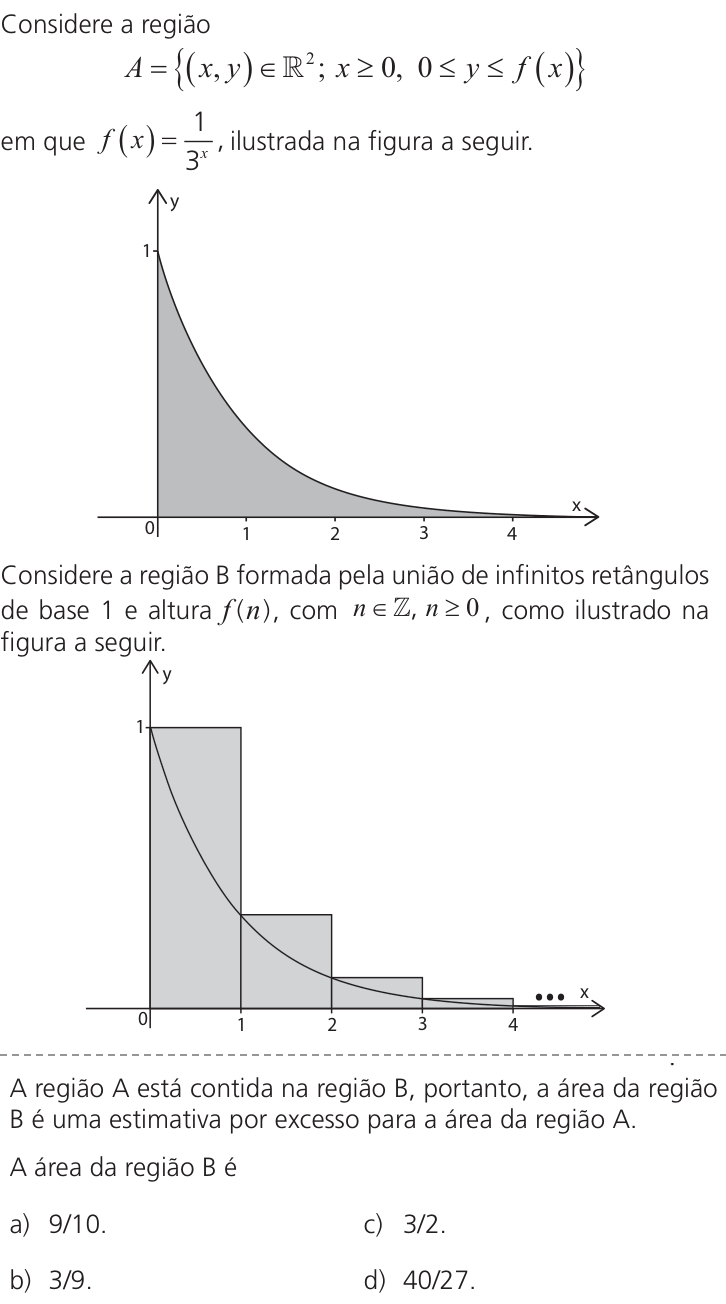
Respondeu
levou 8 s
Como pensou
**Calculating geometric series**
I need to solve the sum of heights in Portuguese, specifically considering the series sum B heights 1/3^n for n = 0 to infinity, using a base of 1 and a sum converging to 3/2. I want to ensure my calculation is clear and concise, without using integration. I’ll express it as a geometric series where a1 = 1 and the common ratio q = 1/3. I need to pay careful attention to capitalization as per developer instructions. I can break this down into two paragraphs for clarity.
Cada retângulo da região B tem base 1 e altura f(n)=\dfrac{1}{3^n}. Como seus interiores não se sobrepõem, a área de B é a soma das áreas dos retângulos:
\text{Área}(B)=\sum_{n=0}^{\infty}1\cdot\frac{1}{3^n}
=1+\frac13+\frac19+\cdots.
Essa é uma progressão geométrica infinita de primeiro termo 1 e razão \frac13. Portanto,
\text{Área}(B)=\frac{1}{1-\frac13}=\frac32.
Resposta: C
Respondeu
levou 9 s
Como pensou
**Solving the series**
I need to tackle the Portuguese series starting with 1 + 1/3 + ... up to 3/2. I want to explain it with a geometric approach, focusing on the base f(n). I’ll keep it simple and use a formula to get to the answer. It looks like reading the option c3/2 is a good idea. I'll mention that no integral is needed because it's an infinite sum of a geometric progression. The exact answer seems to be C.
Cada retângulo tem base 1 e altura f(n)=\dfrac{1}{3^n}, portanto sua área é
A_n=1\cdot\frac{1}{3^n}=\frac{1}{3^n}.
Como os retângulos não se sobrepõem, exceto nas bordas, a área de B é a soma
A_B=1+\frac13+\frac19+\cdots.
Essa é uma progressão geométrica infinita de primeiro termo 1 e razão \frac13. Assim,
A_B=\frac{1}{1-\frac13}=\frac32.
Resposta: C
Respondeu
levou 6 s
Como pensou
Cada retângulo tem base 1 e, para n\geq 0, altura f(n)=\frac{1}{3^n}. Assim, a área total é a soma de uma série geométrica:
\operatorname{área}(B)=\sum_{n=0}^{\infty}\frac{1}{3^n}
=\frac{1}{1-\frac13}
=\frac32.
Logo, a alternativa correta é C.
Resposta: C
Respondeu
levou 4 s
Como pensou
A região B é a união de retângulos de base 1 e alturas f(0), f(1), f(2), ..., ou seja, 1, 1/3, 1/9, 1/27, ...
A área de B é a soma da série geométrica infinita de primeiro termo 1 e razão 1/3:
Área(B) = 1 + 1/3 + 1/9 + 1/27 + ... = 1 / (1 − 1/3) = 1 / (2/3) = 3/2.
Resposta: C
Respondeu
levou 4 s
Como pensou
This is a geometric series with ratio 1/3, so the sum equals 1/(1-1/3) = 3/2, giving answer c.
A região B é formada por retângulos de base 1 e altura f(n) = 1/3ⁿ, com n = 0, 1, 2, …. Como cada retângulo tem base 1, a área de cada um é igual à sua altura.
Portanto, a área de B é a soma de todos esses retângulos:
Área(B) = 1 + 1/3 + 1/9 + 1/27 + …
Essa soma é uma progressão geométrica infinita com primeiro termo a₁ = 1 e razão q = 1/3. Como |q| < 1, a soma converge para:
S = a₁ / (1 − q) = 1 / (1 − 1/3) = 1 / (2/3) = 3/2
Resposta: C
Respondeu
levou 4 s
Como pensou
A região B é formada por retângulos de base 1 e altura f(n) = 1/3ⁿ, com n = 0, 1, 2, ...
A área de B é a soma das áreas desses retângulos:
Área = 1 + 1/3 + 1/9 + 1/27 + ...
Essa é uma progressão geométrica infinita com primeiro termo 1 e razão 1/3. Como a razão é menor que 1 em módulo, a soma converge:
S = 1 / (1 − 1/3) = 1 / (2/3) = 3/2
Como a figura mostra, o primeiro retângulo vai de x = 0 a x = 1 com altura 1, o segundo vai de x = 1 a x = 2 com altura 1/3, e assim por diante, o que confirma a soma acima.
Resposta: C
Respondeu
levou 10 s
Como pensou
The problem is from UNICAMP 2027 in Portuguese.
Region A is bounded by x ≥ 0 and y ≤ 1/3^x. Region B is the union of infinite rectangles with base 1 and height 1/3^n for integer n ≥ 0.
The area of B is the sum of an infinite geometric series with ratio 1/3. The sum equals 3/2. This matches option c.
A região B é a união de retângulos de base 1 e alturas f(n)=\dfrac{1}{3^n}, para n=0,1,2,\ldots. Como esses retângulos se intersectam apenas em suas fronteiras, a área de B é a soma das áreas individuais:
\sum_{n=0}^{\infty}\frac{1}{3^n}=\sum_{n=0}^{\infty}\left(\frac{1}{3}\right)^n.
Trata-se de uma série geométrica de primeiro termo 1 e razão \dfrac{1}{3}, cuja soma é
\frac{1}{1-\frac{1}{3}}=\frac{3}{2}.
Resposta: C
Respondeu
levou 5 s
Como pensou
We need answer question. Need parse image. It appears Portuguese math. Need solve. Let's inspect image text. It seems from UNICAMP? The OCR/text in image has weird repetition with "di" inserted? Let's read.
Image shows:
"Considere a região
A = {(x, y) ∈ ℝ²; x ≥ 0, 0 ≤ y ≤ f(x)}
em que f(x) = 1/3^x, ilustrada na figura a seguir." Maybe due OCR inserted "di" etc. Wait text:
"Considere a região
A = {(x,y) ∈ ℝ²; x ≥ 0, 0 ≤ y ≤ f(x)}
em que f(x) = 1/3^x, ilustrada na figura a seguir."
Then graph y-axis, x-axis, curve decaying from y=1 at x=0? Let's see: f(x)=1/3^x = (1/3)^x. At x=0, y=1. At x=1, y=1/3. At x=2, y=1/9. Graph likely.
Then "Considere a região B formada pela união de infinitos retângulos de base 1 e altura f(n), com n ∈ ℕ, n ≥ 0, como ilustrado na figura a seguir." Wait: base 1 and height f(n), n ∈ ℕ, n ≥ 0. Rectangles? If base 1 along x intervals? Need understand. Figure below: likely rectangles under curve? Base 1 and heights f(n) maybe intervals [n, n+1]? Let's inspect second graph. It shows curve and rectangles? Text: "Considere a região B formada pela união de infinitos retângulos de base 1 e altura f(n), com n ∈ ℕ, n ≥ 0, como ilustrado na figura a seguir." Graph with rectangles? It shows curve decaying, and maybe rectangles of width 1 and height f(n) from x=n to n+1? Need determine. Then question:
"A região A está contida na região B, portanto, a área da região B é uma estimativa por excesso para a área da região A.
A área da região B é
a) 9/10.
b) 3/9? Wait
c) 3/2.
d) 40/27? Hmm.
Let's read alternatives from image:
a) 9/10.
b) 3/9. maybe "3/9"? image: "b) 3/9."? It looks like "3/9." but maybe "3/2"? Let's zoom mentally. The options are:
a) 9/10.
b) 3/9.
c) 3/2.
d) 40/27? Wait bottom: "d) 40/27."? Actually image text:
a) 9/10.
b) 3/9.
c) 3/2.
d) 40/27.
Need solve area of region B. Let's parse exactly.
Question: Region A = {(x,y) ∈ R²; x ≥ 0, 0 ≤ y ≤ f(x)} where f(x)=1/3^x. It is area under curve from x=0 to infinity. Region B formed by union of infinitely many rectangles of base 1 and height f(n), n ∈ N, n ≥ 0. Need area of B. If rectangles have base 1 and height f(n), likely each rectangle over interval [n, n+1] with height f(n). Since f decreasing, these rectangles lie above curve? For x in [n,n+1], f(x) ≤ f(n), so rectangle [n,n+1] × [0, f(n)] contains region under curve. Union of these rectangles over n=0,1,2,... is B. Area B = sum_{n=0}^\infty f(n)*1 = sum_{n=0}^\infty (1/3)^n = 1/(1-1/3)=3/2. That matches option c. But need verify because options include 3/2. Let's ensure not alternative interpretation: rectangles base 1 and height f(n) maybe centered? "união de infinitos retângulos de base 1 e altura f(n)" The figure likely shows rectangles with base 1 and heights decreasing, occupying x intervals [n,n+1]? Area = sum (1/3)^n = 3/2. Option c. But let's check if n starts at 1? Text says n ∈ ℕ, n ≥ 0. So includes n=0 height 1. Sum = 1 + 1/3 + 1/9 + ... = 3/2. If n from 1 maybe 1/2, not options. So answer c.
Need explain in Portuguese. Need final line "Resposta: C". But let's make sure there isn't hidden nuance: "A região A está contida na região B, portanto, a área da região B é uma estimativa por excesso para a área da região A. A área da região B é..." Yes.
Need perhaps mention geometric series: ∑_{n=0}∞ (1/3)^n = 1/(1 - 1/3) = 3/2. So area B = 3/2. Alternative c.
Need produce final with explanation and final line. The user asks "Resolva a questão e explique o seu raciocínio em português. Termine com uma linha neste formato: Resposta: X". So answer.
Let's craft concise explanation. Since desired oververbosity 5, moderate. Include formula. Mention each rectangle has base 1 and height f(n)=(1/3)^n. Área total = soma das áreas = ∑ (1/3)^n. Converge since |1/3|<1. Sum = 3/2. Option C.
Let's ensure no issue with f(x) = 1/3^x notation: usually 1/3^x = (1/3)^x? In Brazil, 1/3^x maybe ambiguous? They likely mean f(x)= (1/3)^x? Text: "f(x) = 1/3^x" could be 1/(3^x) = (1/3)^x. Yes.
If f(x)=1/(3^x), then f(n)=1/(3^n). Sum = 3/2. Good.
Let's final.
Cada retângulo que forma a região B tem base 1 e altura f(n), com n\in\mathbb N e n\ge 0. Como
f(x)=\frac{1}{3^x},
temos
f(n)=\frac{1}{3^n}.
Assim, a área da região B é a soma das áreas de todos esses retângulos:
\text{Área}(B)=\sum_{n=0}^{\infty} 1\cdot f(n)
=\sum_{n=0}^{\infty}\left(\frac{1}{3}\right)^n.
Essa é uma série geométrica de razão q=\frac13, cuja soma é:
\sum_{n=0}^{\infty}q^n=\frac{1}{1-q}
=\frac{1}{1-\frac13}
=\frac{1}{\frac23}
=\frac32.
Portanto, a área da região B é \frac32.
Resposta: C
Respondeu
levou 9 s
Como pensou
**Exploring the Integral's Limit**
I'm currently delving into the nuances of the region A and how it relates to the infinite union of rectangles forming region B. My focus is on how these rectangles, defined by their base of 1 and height $f(n)$ where $f(x) = 1/3^x$, contribute to the overall area calculation and its convergence.
**Calculating Geometric Series**
I am now focused on calculating the area of region B, which is an infinite union of rectangles. I've identified this as a geometric series, and I'm working on finding its sum using the formula for the sum of an infinite geometric progression.
Para determinar a área da região B, calculamos a soma das áreas dos infinitos retângulos que a compõem.
Conforme o enunciado e a ilustração:
- Cada retângulo possui base de comprimento igual a 1.
- A altura de cada retângulo é dada por f(n) = \frac{1}{3^n}, para n \in \mathbb{Z} e n \ge 0.
Assim, a área de cada retângulo é dada por:
\text{Área}_n = \text{base} \times \text{altura} = 1 \cdot f(n) = \frac{1}{3^n}
Somando as áreas de todos os retângulos para n = 0, 1, 2, 3, \dots:
\text{Área}(B) = \sum_{n=0}^{\infty} \frac{1}{3^n} = 1 + \frac{1}{3} + \frac{1}{9} + \frac{1}{27} + \dots
Esta soma representa uma progressão geométrica infinita com primeiro termo a_1 = 1 e razão q = \frac{1}{3}. Como |q| < 1, a soma é dada por:
S = \frac{a_1}{1 - q} = \frac{1}{1 - \frac{1}{3}} = \frac{1}{\frac{2}{3}} = \frac{3}{2}
Portanto, a área da região B é igual a \frac{3}{2}.
Resposta: C