Respondeu
levou 7 s
Como pensou
**Seeking clarity in equations**
I’m tackling a straightforward equation involving a, r, and determinants. It looks like I need to find a solution for the expression involving negative values, and I want to ensure my steps are clear, possibly in Portuguese. I’m contemplating how to organize my thoughts: do I aim for around 200 words or is 120 enough? Laying out these equations methodically will help. Let’s clarify this as best as possible!
Como a,b,c,d formam, nessa ordem, uma PA de razão r<0, temos
b=a+r,\qquad c=a+2r,\qquad d=a+3r.
Usando o determinante:
\det M=ad-bc=a(a+3r)-(a+r)(a+2r)=-2r^2.
Como \det M=-8, segue que
-2r^2=-8\;\Rightarrow\;r^2=4.
A razão é negativa, portanto r=-2.
O traço da matriz é a+d=-4. Assim,
a+(a+3r)=-4
\;\Rightarrow\;
2a-6=-4
\;\Rightarrow\;
\boxed{a=1}.
Resposta: A
Respondeu
levou 10 s
Como pensou
**Solving equations concisely**
I need to work on solving for "r" in the equation -2r² = -8, which gives r = -2. Then, there's another equation: 2a + 3r = -4, leading to a = 1. I should accurately expand the expression a(a + 3r) - (a + r)(a + 2r) = -2r². I’ll focus on making sure the equation breakdown is clear in the final output, emphasizing the necessary accuracy in the process.
Como a,b,c,d formam, nessa ordem, uma PA de razão r<0, temos
b=a+r,\qquad c=a+2r,\qquad d=a+3r.
O determinante da matriz é
\det M=ad-bc=a(a+3r)-(a+r)(a+2r)=-2r^2.
Como \det M=-8, segue que r^2=4. A razão é negativa, portanto r=-2.
Usando o traço a+d=-4:
a+(a+3r)=-4
\;\Rightarrow\;
2a-6=-4
\;\Rightarrow\;
\boxed{a=1}.
Resposta: A
Respondeu
levou 6 s
Como pensou
Como a,b,c,d, nessa ordem, formam uma PA de razão r<0, podemos escrever
b=a+r,\qquad c=a+2r,\qquad d=a+3r.
Pelo determinante,
ad-bc=a(a+3r)-(a+r)(a+2r)=-2r^2=-8,
portanto r^2=4. Como a razão é negativa, r=-2.
Usando o traço:
a+d=a+(a+3r)=2a+3r=-4.
Substituindo r=-2, obtemos 2a-6=-4, logo a=1.
Resposta: A
Respondeu
levou 5 s
Como pensou
Seja a PA com razão r < 0: a, b = a + r, c = a + 2r, d = a + 3r.
Traço: a + d = 2a + 3r = −4.
Determinante: ad − bc = a(a+3r) − (a+r)(a+2r) = a² + 3ar − (a² + 3ar + 2r²) = −2r².
Como det M = −8, temos −2r² = −8, logo r² = 4. Sendo a razão negativa, r = −2.
Substituindo no traço: 2a + 3(−2) = −4 ⇒ 2a = 2 ⇒ a = 1.
Verificação: a = 1, b = −1, c = −3, d = −5. Traço: 1 + (−5) = −4 ✓. Determinante: (1)(−5) − (−1)(−3) = −5 − 3 = −8 ✓.
Resposta: A
Respondeu
levou 6 s
Como pensou
Computing the determinant gives -2r² = -8, so r = -2. Then using the trace condition 2a+3r = -4, I solve for a = 1.
Montando a PA: com razão r, temos
a,\quad b = a + r,\quad c = a + 2r,\quad d = a + 3r.
Determinante:
\det M = ad - bc = a(a+3r) - (a+r)(a+2r)
= a^2 + 3ar - (a^2 + 3ar + 2r^2) = -2r^2.
Como \det M = -8, temos -2r^2 = -8, logo r^2 = 4. A razão é negativa, então r = -2.
Traço:
a + d = a + (a + 3r) = 2a + 3r = -4.
Substituindo r = -2: 2a - 6 = -4, logo a = 1.
Verificação: a PA é 1, -1, -3, -5. O determinante é 1\cdot(-5) - (-1)(-3) = -5 - 3 = -8 e o traço é 1 + (-5) = -4. As duas condições são satisfeitas.
Resposta: A
Respondeu
levou 4 s
Como pensou
Sejam a, b = a + r, c = a + 2r e d = a + 3r, com r < 0.
Traço: a + d = 2a + 3r = −4, logo a = (−4 − 3r)/2.
Determinante: ad − bc = a(a + 3r) − (a + r)(a + 2r) = a² + 3ar − (a² + 3ar + 2r²) = −2r².
Como o determinante vale −8, temos −2r² = −8, ou seja, r² = 4. Sendo r negativa, r = −2.
Valor de a: a = (−4 + 6)/2 = 1.
Verificação: a PA é 1, −1, −3, −5. O traço é 1 + (−5) = −4 e o determinante é 1·(−5) − (−1)(−3) = −5 − 3 = −8. Os dois dados conferem.
Resposta: A
Respondeu
levou 10 s
Como pensou
The problem is in Portuguese. I will translate it.
I'm solving a Portuguese linear algebra problem. The matrix entries form an arithmetic progression with negative common difference. I've set up the trace and determinant equations to find the value of a.
A sequência a,b,c,d forma uma progressão aritmética de razão r<0, de modo que
b=a+r,\qquad c=a+2r,\qquad d=a+3r.
O traço fornece a relação
a+d=-4\implies 2a+3r=-4.
O determinante fornece
ad-bc=-8.
Substituindo as expressões em termos de a e r e simplificando, obtém-se
-2r^2=-8\implies r^2=4.
Como a razão é negativa, r=-2. Substituindo na equação do traço,
2a+3(-2)=-4\implies a=1.
(A verificação direta com a=1, b=-1, c=-3 e d=-5 confirma tanto o traço quanto o determinante.)
Resposta: A
Respondeu
levou 1 s
Como pensou
We need answer. Need solve. Need parse image. The text appears maybe corrupted? Let's inspect. Image contains Portuguese math problem. It says:
"Considere a matriz
M = ( a b
c d )
em que as entradas a,b,c,d formam, nessa ordem, uma PA de razão negativa. Sabendo que o determinante de M é -8 e o traço de M, ou seja, a soma dos elementos da diagonal principal de M, vale -4, o valor de a é
a) 1.
b) -1.
c) 5.
d) -5."
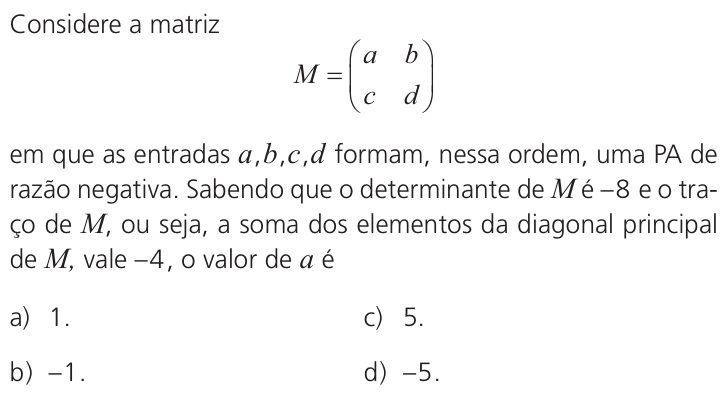
Need solve. Let's transcribe carefully. Image text: "Considere a matriz M = ((a b)(c d)) em que as entradas a,b,c,d formam, nessa ordem, uma PA de razão negativa. Sabendo que o determinante de M é -8 e o traço de M, ou seja, a soma dos elementos da diagonal principal de M, vale -4, o valor de a é". Alternatives a) 1 b)-1 c)5 d)-5.
Need find a. Let entries form arithmetic progression in order a,b,c,d with negative common difference r<0. So b=a+r, c=a+2r, d=a+3r. Determinant = ad - bc = a(a+3r) - (a+r)(a+2r) =? Compute: a^2+3ar - (a^2+3ar+2r^2) = -2r^2. Nice independent. Determinan = -8 => -2r^2=-8 => r^2=4 => r= -2 (negative). Trace = a+d = a + a+3r = 2a+3r = -4. Substitute r=-2: 2a -6 = -4 => 2a =2 => a=1. Answer A.
Need provide explanation in Portuguese. Final with Resposta: A. Ensure final line exactly format. Could include explanation.
As entradas a,b,c,d formam, nessa ordem, uma PA de razão negativa r. Assim:
b=a+r,\quad c=a+2r,\quad d=a+3r
O determinante da matriz M é:
\det M = ad-bc
Substituindo:
\det M = a(a+3r)-(a+r)(a+2r)
= a^2+3ar-(a^2+3ar+2r^2)=-2r^2
Como \det M=-8:
-2r^2=-8 \Rightarrow r^2=4
Como a razão é negativa:
r=-2
O traço de M é a+d=-4. Logo:
a+(a+3r)=-4
2a+3r=-4
Substituindo r=-2:
2a-6=-4
2a=2
a=1
Portanto, o valor de a é 1.
Resposta: A
Respondeu
levou 7 s
Como pensou
**Exploring Matrix Properties**
I'm currently analyzing a matrix where the elements form a negative-reason arithmetic progression. My focus is on understanding how this specific structure influences the matrix's determinant, and I'm working through the implications of this constraint.
**Calculating Matrix Value**
I've determined the common difference of the arithmetic progression to be -2. My current focus is on substituting this value back into the trace equation to solve for 'a'.
Para resolver a questão, vamos utilizar as propriedades dadas no enunciado:
-
As entradas a, b, c, d formam, nessa ordem, uma progressão aritmética (PA) de razão r < 0. Podemos escrevê-las como:
a = a
b = a + r
c = a + 2r
d = a + 3r
-
O traço da matriz M é a soma dos elementos da diagonal principal:
\text{tr}(M) = a + d = -4
Substituindo d = a + 3r:
a + (a + 3r) = -4 \implies 2a + 3r = -4 \quad \text{(I)}
-
O determinante da matriz M é dado por:
\det(M) = ad - bc = -8
Substituindo os termos em função de a e r:
\det(M) = a(a + 3r) - (a + r)(a + 2r)
\det(M) = (a^2 + 3ar) - (a^2 + 3ar + 2r^2) = -2r^2
Como \det(M) = -8:
-2r^2 = -8 \implies r^2 = 4 \implies r = \pm 2
Como o enunciado afirma que a razão da PA é negativa (r < 0), temos:
r = -2
-
Substituindo r = -2 na equação (I):
2a + 3(-2) = -4
2a - 6 = -4
2a = 2
a = 1
Portanto, o valor de a é 1.
Resposta: A