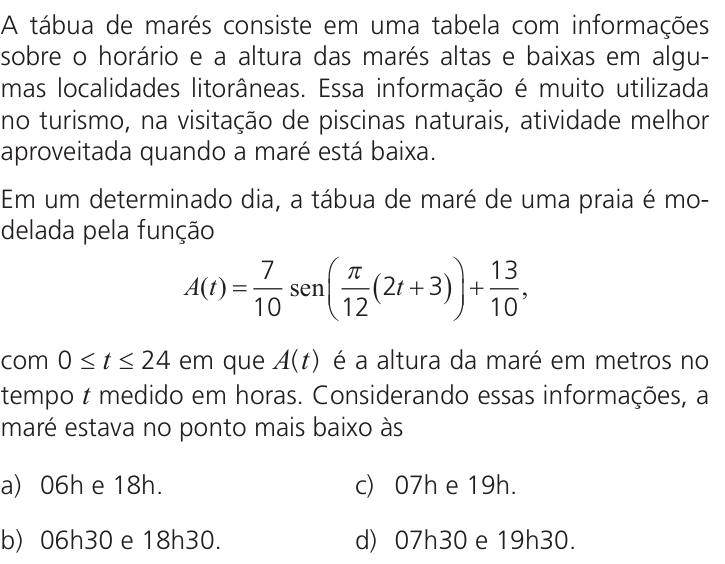
Respondeu
levou 8 s
Como pensou
**Calculating angles in sine**
I need to solve a straightforward sine equation related to the minimum angle of 3pi/2 + 2k pi. It leads to (2t + 3)/12 = 3/2 + 2k, which simplifies down to t = 7.5 + 12k. This gives angles like 7:30 and 19:30. I want to ensure clarity in my explanation without overcomplicating things for Portuguese readers. Citing coefficients for positive minimum value of sine is essential to finalize my answer with math details.
A altura da maré é mínima quando o seno vale -1, pois seu coeficiente, \frac{7}{10}, é positivo. Portanto,
\frac{\pi}{12}(2t+3)=\frac{3\pi}{2}+2k\pi,\qquad k\in\mathbb Z.
Multiplicando por \frac{12}{\pi}:
2t+3=18+24k
\quad\Rightarrow\quad
t=7{,}5+12k.
No intervalo 0\le t\le24, temos t=7{,}5 e t=19{,}5, que correspondem a 07h30 e 19h30.
Resposta: D
Respondeu
levou 9 s
Como pensou
**Solving the sine equation**
I need to solve the equation for sine: π/12(2t + 3) must equal 3π/2 + 2kπ. This simplifies to 2t + 3 = 18 + 24k, which gives t as 7.5 + 12k. So, t could be 7:30 or 19:30 depending on k. I'm focusing on concise reasoning with positive coefficients in the equation. I’ll finalize my response while ensuring everything is clearly presented in Portuguese for better understanding.
Como o coeficiente de seno é positivo, a altura A(t) é mínima quando o seno vale -1. Portanto,
\frac{\pi}{12}(2t+3)=\frac{3\pi}{2}+2k\pi,\qquad k\in\mathbb Z.
Simplificando,
2t+3=18+24k
\quad\Rightarrow\quad
t=7{,}5+12k.
No intervalo 0\le t\le24, temos t=7{,}5 e t=19{,}5, correspondentes a 07h30 e 19h30.
Resposta: D
Respondeu
levou 6 s
Como pensou
**Explaining the function**
I need to explain this in Portuguese. The function is A=0.7 sin(pi/12 (2t+3)) +1.3, and it reaches its minimum when the sine equals -1. The original argument would be 3pi/2 + 2πk. By solving π/12(2t+3)=3π/2 +2πk, I find that t equals 7.5 + 12k, leading to possible values of 7.5 and 19.5 within the range of 0 to 24. So, that translates to 07h30 and 19h30, which would be option D.
A maré atinge seu ponto mais baixo quando o seno vale -1. Assim,
\frac{\pi}{12}(2t+3)=\frac{3\pi}{2}+2\pi k,
em que k é um inteiro. Resolvendo,
2t+3=18+24k \quad\Rightarrow\quad t=7{,}5+12k.
No intervalo de 0 a 24 horas, isso ocorre em t=7{,}5 e t=19{,}5, ou seja, às 07h30 e às 19h30.
Resposta: D
Respondeu
levou 5 s
Como pensou
A maré está no ponto mais baixo quando o seno vale −1, pois A(t) = (7/10)·sen(...) + 13/10 é mínima nesse caso (A = 13/10 − 7/10 = 0,6 m).
O seno vale −1 quando seu argumento é 3π/2 + 2kπ:
π/12 · (2t + 3) = 3π/2 + 2kπ
⟹ 2t + 3 = 18 + 24k
⟹ 2t = 15 + 24k
⟹ t = 7,5 + 12k.
Para 0 ≤ t ≤ 24:
- k = 0: t = 7,5 h → 07h30
- k = 1: t = 19,5 h → 19h30
Logo, a maré estava no ponto mais baixo às 07h30 e às 19h30.
Resposta: D
Respondeu
levou 6 s
Como pensou
For the minimum, I set sine equal to -1, solving π/12(2t+3) = 3π/2 + 2kπ, which gives t = 7.5 + 12k, so t = 7.5 or 19.5, matching answer D.
Condição de mínimo
O termo 7/10 é positivo. Por isso, A(t) é mínima quando o seno vale −1:
\frac{\pi}{12}(2t+3) = \frac{3\pi}{2} + 2k\pi
Resolvendo a equação
Multiplicando ambos os lados por 12/π:
2t + 3 = 18 + 24k \;\Rightarrow\; 2t = 15 + 24k \;\Rightarrow\; t = 7{,}5 + 12k
Valores no intervalo 0 ≤ t ≤ 24
- k = 0: t = 7,5, ou seja, 07h30.
- k = 1: t = 19,5, ou seja, 19h30.
Nesses horários, a altura é A = 1,3 − 0,7 = 0,6 m, que é o ponto mais baixo da maré.
Resposta: D
Respondeu
levou 4 s
Como pensou
A maré está no ponto mais baixo quando o seno vale −1, ou seja, quando
(π/12)(2t + 3) = 3π/2 + 2kπ
Dividindo por π e multiplicando por 12:
2t + 3 = 18 + 24k
2t = 15 + 24k
t = 7,5 + 12k
Com 0 ≤ t ≤ 24, os valores possíveis são t = 7,5 (k = 0) e t = 19,5 (k = 1). Para k = 2 temos t = 31,5, fora do intervalo.
Ou seja, a maré estava mais baixa às 7h30 e às 19h30. Nesses instantes, A = −0,7 + 1,3 = 0,6 m, que é a altura mínima.
Resposta: D
Respondeu
levou 15 s
Como pensou
The problem involves tides modeled by a function.
The minimum tide height is 0.6 meters. This occurs when the sine term equals -1.
The minimum occurs at 7.5 and 19.5 hours. The correct answer is option d.
A maré atinge o ponto mais baixo quando a função seno vale -1, pois esse é o valor mínimo da função seno e, portanto, de A(t).
Isso ocorre quando o argumento da função seno satisfaz
\frac{\pi}{12}(2t+3)=\frac{3\pi}{2}+2k\pi,\qquad k\in\mathbb{Z}.
Simplificando, obtém-se
t=7{,}5+12k.
No intervalo 0\leq t\leq 24, os únicos valores são t=7{,}5 e t=19{,}5, isto é, 07\mathrm{h}30 e 19\mathrm{h}30.
(A periodicidade de 12 horas da função confirma que esses dois instantes são os únicos mínimos no intervalo considerado.)
Resposta: D
Respondeu
levou 6 s
Como pensou
We need answer question. Need parse image. The image appears weird: text in Portuguese? It seems possibly the image is corrupted? Let's inspect. The text is likely a math problem in Portuguese, but the OCR? Let me read the image text as provided in prompt? It shows Portuguese-like but nonsensical? Actually it might be a "táboa de marés" (tide table) and formula. The text: "A tábua de marés consiste em uma tabela com informações sobre o horário e a altura das marés altas e baixas em algumas localidades litorâneas. Essa informação é muito utilizada no turismo, na visitação de piscinas naturais, pelo mergulhador quando a maré está baixa. Em um determinado dia, a tábua de maré de uma praia é modelada pela função A(t)=7/10 sen(π/12(2t+3)) + 13/10, com 0 ≤ t ≤ 24 em que A(t) é a altura da maré em metros no tempo t medido em horas. Considerando essas informações, a maré estará no ponto mais baixo às..." Options: a) 06h e 18h; b) 06h30 e 18h30; c) 07h e 19h; d) 07h30 e 19h30. This seems like a sinusoidal tide model. Need find times of minimum height. A(t)=0.7 sin(π/12(2t+3)) +1.3. Minimum when sine = -1. Solve π/12(2t+3) = 3π/2 + 2kπ? Wait for min of sin = -1 at angle = 3π/2 + 2kπ. Let x = π/12(2t+3). Need x = 3π/2 + 2kπ. Then 2t+3 = (12/π)*(3π/2 + 2kπ)=18 + 24k. So 2t = 15 +24k => t = 7.5 +12k. In [0,24], k=0 gives t=7.5 (07:30), k=1 gives t=19.5 (19:30). So answer d) 07h30 e 19h30. Need ensure no issue. But let's verify: Function A(t) = 7/10 sen(π/12(2t+3)) + 13/10. Minimum amplitude when sine = -1. Yes t=7.5 and 19.5. Options: d) 07h30 e 19h30. So answer D.
Need provide explanation in Portuguese. End with "Resposta: D". We need be careful: maybe "maré mais baixa" = minimum. We solve.
Let's craft response. The prompt asks: "Você está fazendo a prova UNICAMP 2027. A mensagem traz a imagem de uma questão de múltipla escolha, recortada do caderno de prova, e, quando a questão depende de um texto de apoio, a imagem desse texto antes dela. Ler a imagem faz parte da tarefa. Resolva a questão e explique o seu raciocínio em português. Termine com uma linha neste formato: Resposta: X"
We need solve. The image contains text as above. We should transcribe maybe. But final with explanation.
Let's ensure formula: A(t)=7/10 sen(π/12(2t+3)) +13/10. Wait could there be formatting: "A(t)= 7/10 sen(π/12(2t + 3)) + 13/10" yes. The period: argument coefficient: π/12*2 = π/6, period = 2π/(π/6)=12 hours. Minima separated by 12h. The phase: minimum at t where argument = 3π/2 + 2kπ. Solving yields 7.5 +12k, so 07:30 and 19:30. Yes.
Potential nuance: The options include "d) 07h30 e 19h30." So D.
Need perhaps mention "maré baixa" = ponto mais baixo. Function height min when sine minimum. Since 7/10 positive, min of A when sin = -1.
Let's craft final. Maybe include steps:
1. A(t)=0.7 sen(π/12(2t+3)) + 1.3.
2. Para mínimo, sen = -1.
3. sen θ = -1 => θ = 3π/2 + 2kπ.
4. θ = π/12(2t+3) = 3π/2 + 2kπ -> 2t+3 = 18 + 24k -> 2t = 15 +24k -> t = 7.5 +12k.
5. Para 0 ≤ t ≤ 24: k=0 t=7.5 h = 7h30; k=1 t=19.5 h = 19h30. k=2 >24.
6. Alternativa D.
Final with "Resposta: D". Ensure no extra after.
A função que modela a altura da maré é
A(t)=\frac{7}{10}\operatorname{sen}\left(\frac{\pi}{12}(2t+3)\right)+\frac{13}{10},\quad 0\le t\le 24.
Queremos o ponto mais baixo, ou seja, a altura mínima. Como \frac{7}{10}>0, o valor mínimo de A(t) ocorre quando o seno é mínimo, isto é, quando
\operatorname{sen}\left(\frac{\pi}{12}(2t+3)\right)=-1.
Sabemos que \operatorname{sen}\theta=-1 quando
\theta=\frac{3\pi}{2}+2k\pi,\quad k\in\mathbb Z.
Assim:
\frac{\pi}{12}(2t+3)=\frac{3\pi}{2}+2k\pi.
Multiplicando por \frac{12}{\pi}:
2t+3=18+24k.
2t=15+24k
t=7{,}5+12k.
Como 0\le t\le 24, temos:
- k=0 \Rightarrow t=7{,}5 h =7\text{h}30;
- k=1 \Rightarrow t=19{,}5 h =19\text{h}30;
- k=2 \Rightarrow t=31{,}5 h, fora do intervalo.
Portanto, a maré estará no ponto mais baixo às 7\text{h}30 e às 19\text{h}30.
Resposta: D
Respondeu
levou 7 s
Como pensou
**Analyzing Tide Table**
I am currently processing the user's request to address the image content, which appears to be related to a tide table and its practical applications. I'm focusing on understanding the nuances of the question and the information provided in the text excerpt.
**Calculating Tide Extremes**
I'm working through the provided tide table data. My current focus is on determining the times when the tide reaches its lowest points, using the given sinusoidal function to model the tide's height.
Para encontrar o momento em que a maré está no ponto mais baixo, devemos determinar quando a função A(t) atinge o seu valor mínimo no intervalo 0 \le t \le 24.
A função dada é:
A(t) = \frac{7}{10} \operatorname{sen}\left(\frac{\pi}{12}(2t + 3)\right) + \frac{13}{10}
Como o coeficiente que multiplica o seno é positivo (\frac{7}{10} > 0), a função A(t) atinge o seu mínimo quando o seno atinge seu valor mínimo possível, que é -1:
\operatorname{sen}\left(\frac{\pi}{12}(2t + 3)\right) = -1
Para que o seno seja igual a -1, seu argumento deve ser da forma:
\frac{\pi}{12}(2t + 3) = \frac{3\pi}{2} + 2k\pi, \quad \text{com } k \in \mathbb{Z}
Dividindo ambos os lados por \pi:
\frac{2t + 3}{12} = \frac{3}{2} + 2k
Multiplicando a equação inteira por 12:
2t + 3 = 18 + 24k
2t = 15 + 24k
t = 7,5 + 12k
Considerando o intervalo 0 \le t \le 24:
-
Para k = 0:
t = 7,5\text{ h} = 7\text{h e } 30\text{min}
-
Para k = 1:
t = 7,5 + 12 = 19,5\text{ h} = 19\text{h e } 30\text{min}
Portanto, a maré estava no ponto mais baixo às 07h30 e 19h30.
Resposta: D