Respondeu
levou 11 s
Como pensou
**Solving cubic roots**
I need to find all integer roots of a cubic equation where the product is -8 and the sum of the roots has a maximum of 10. The roots could be combinations like -8, 1, 1 or all negatives like -4, -2, -2. It seems like the possible combinations are important, as well as Vieta's relations. I want to present three possible modular triples and ensure the explanation remains clear and concise, aiming for around 140 words in the final output.
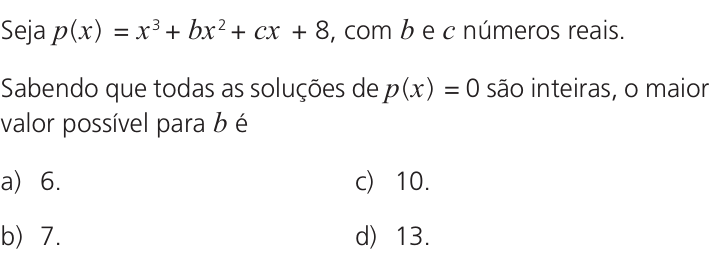
Sejam r_1,r_2,r_3 as raízes inteiras, contando suas multiplicidades. Pelas relações de Viète,
r_1+r_2+r_3=-b
\quad\text{e}\quad
r_1r_2r_3=-8.
Assim, os módulos das raízes são inteiros positivos cujo produto é 8. Sem considerar a ordem, as únicas possibilidades são
(1,1,8),\qquad (1,2,4),\qquad (2,2,2).
As somas desses módulos são, respectivamente, 10, 7 e 6. Logo,
b=-(r_1+r_2+r_3)\le |r_1|+|r_2|+|r_3|\le 10.
O valor b=10 é atingido com as raízes -1,-1,-8, pois
p(x)=(x+1)^2(x+8)=x^3+10x^2+17x+8.
Portanto, o maior valor possível de b é 10.
Resposta: C
Respondeu
levou 17 s
Como pensou
Sejam r_1,r_2,r_3 as raízes inteiras de p(x), contando as multiplicidades. Pelas relações de Viète,
r_1+r_2+r_3=-b
\quad\text{e}\quad
r_1r_2r_3=-8.
Como |r_1r_2r_3|=8, os únicos trios possíveis de valores absolutos, sem considerar a ordem, são
(1,1,8),\qquad (1,2,4),\qquad (2,2,2).
Logo,
b=-(r_1+r_2+r_3)
\le |r_1|+|r_2|+|r_3|
\le 10.
Esse limite é atingido pelas raízes -1,-1,-8, pois
p(x)=(x+1)^2(x+8)=x^3+10x^2+17x+8.
Portanto, o maior valor possível de b é 10.
Resposta: C
Respondeu
levou 10 s
Como pensou
**Analyzing negative factors**
I'm working on minimizing sums while considering factors that produce a product of -8. I found various triplets like (1,1,8), (1,2,4), and (2,2,2), with corresponding negative sums that give us different values for b. I’m also contemplating whether there could be a mix of one negative and two positives. However, it looks like b equals 10 is the minimal result. I’ll consider root integers and factorization to clarify the bounds.**Evaluating positive and negative combinations**
I'm examining the scenario where there's one negative and two positive numbers. The equation shows that the sum could be -a + b + c. I'm trying to figure out if this can be less than -10. Since a has to divide 8, and bc equals 8/a, it seems like a has to be at most 8. The minimum sum I can get here is -6, which means we can't actually go lower than that.**Explaining polynomial roots**
I’m working through the factorization problem, aiming for three negatives or one negative. For the positive product of 8, I find combinations like 1,1,8 (sum 10), 1,2,4 (sum 7), and 2,2,2 (sum 6). The minimum root sum I calculate is -10, and I confirm the given parameters for b, which gives a maximum of 10. Now to check the polynomial roots, I find them to be -1, -1, and -8. This leads to the polynomial p = (x+1)²(x+8). I conclude that the answer is C.
Pelas relações de Viète, se as raízes inteiras são r,s,t, então
rst=-8 \quad\text{e}\quad b=-(r+s+t).
Para maximizar b, queremos minimizar a soma das raízes.
Se as três raízes forem negativas, seus valores absolutos são inteiros positivos com produto 8. As possibilidades, a menos de ordem, são (1,1,8), (1,2,4) e (2,2,2). A menor soma das raízes ocorre com (-1,-1,-8), cuja soma é -10, dando b=10.
Se houver apenas uma raiz negativa, a soma não pode ser menor que -10, pois o valor absoluto dessa raiz é no máximo 8, e as outras duas são positivas.
De fato, as raízes -1,-1,-8 produzem p(x)=(x+1)^2(x+8), com b=10.
Resposta: C
Respondeu
levou 10 s
Como pensou
I need the three integer roots to multiply to -8, and since b is the negative of their sum, I want to minimize that sum to maximize b. I'm checking factor combinations like (-1,-1,-8), (-1,-2,-4), (-2,-2,-2), and (1,1,-8) to compare their sums.
Checking more combinations, (-1,-1,-8) gives the smallest sum of -10, yielding b=10, and no other factorization gets lower. So the answer is 10.
Raciocínio:
Se as raízes de p(x)=x^3+bx^2+cx+8 são os inteiros r_1, r_2, r_3, pelas relações de Girard:
- r_1 + r_2 + r_3 = -b
- r_1 r_2 r_3 = -8
Para maximizar b, precisamos minimizar a soma r_1+r_2+r_3. As raízes são inteiras e seu produto é -8, então elas são divisores de 8 (em módulo: 1, 2, 4 ou 8), com um número ímpar de raízes negativas.
Listando as possibilidades (a menos de ordem):
- (-1,-1,-8): soma = -10 \Rightarrow b = 10
- (-1,-2,-4): soma = -7 \Rightarrow b = 7
- (-2,-2,-2): soma = -6 \Rightarrow b = 6
- (1,1,-8): soma = -6 \Rightarrow b = 6
- (1,2,-4): soma = -1 \Rightarrow b = 1
- (2,2,-2): soma = 2 \Rightarrow b = -2
- (1,4,-2), (1,-1,8), etc.: somas maiores ainda.
A menor soma possível é -10, obtida com as raízes -1, -1, -8, o que dá b = 10 (e c = 1 + 8 + 8 = 17). De fato, (x+1)^2(x+8) = x^3 + 10x^2 + 17x + 8.
Um valor como b = 13 exigiria soma -13, impossível com divisores de 8 cujo produto seja -8.
Resposta: C
Respondeu
levou 7 s
Como pensou
I need to find integer triples whose product is -8 and minimize their sum to maximize b. Checking combinations like (-8,1,1), (-1,-1,-8), (-1,-2,-4), and (-2,-2,-2) to compare their sums.
The best option turns out to be (-8,-1,-1), giving sum -10 and thus b=10. Since the problem states all roots must be integers, this confirms the answer is 10.
Resposta: 10 (alternativa C)
Como p(x) é de grau 3 e todas as soluções de p(x) = 0 são inteiras, podemos chamar as raízes (contando multiplicidade) de r₁, r₂ e r₃, todas inteiras.
Relações de Girard:
- r₁ · r₂ · r₃ = −8
- r₁ + r₂ + r₃ = −b, ou seja, b = −(r₁ + r₂ + r₃)
Para obter o maior valor de b, precisamos da menor soma possível das raízes.
Ternas de inteiros com produto −8:
| Terna |
Soma |
b |
| (−1, −1, −8) |
−10 |
10 |
| (−1, −2, −4) |
−7 |
7 |
| (−2, −2, −2) |
−6 |
6 |
| (1, 1, −8) |
−6 |
6 |
| (1, −1, 8), (1, 2, −4), etc. |
maiores |
menores |
A menor soma é −10, dada pelas raízes −1, −1 e −8. Logo b = 10.
Verificação: (x + 1)²(x + 8) = x³ + 10x² + 17x + 8. O termo independente é 8, como exigido, e b = 10.
Resposta: C
Respondeu
levou 7 s
Como pensou
Sejam r, s, t as raízes inteiras de p(x) = x³ + bx² + cx + 8.
Pelas relações de Girard:
- r·s·t = −8
- r + s + t = −b
Para maximizar b, precisamos minimizar a soma r + s + t, com produto −8.
Triplas de inteiros com produto −8 (a menos da ordem):
- (1, 1, −8): soma −6, então b = 6
- (1, −1, 8): soma 8, então b = −8
- (1, 2, −4): soma −1, então b = 1
- (1, −2, 4): soma 3, então b = −3
- (−1, −2, −4): soma −7, então b = 7
- (−1, 2, 4): soma 5, então b = −5
- (−1, −1, −8): produto −8, soma −10, então b = 10
- (2, 2, −2): produto −8, soma 2, então b = −2
- (−2, −2, −2): produto −8, soma −6, então b = 6
- (−1, 1, 8): produto −8, soma 8, então b = −8
- (2, −1, 4): produto −8, soma 5, então b = −5
- (−2, −1, 4): produto 8, não serve
- (1, −1, 8): já considerada
Conferindo (−1, −1, −8): o produto é (−1)(−1)(−8) = −8, correto. Soma = −10, logo b = 10.
Há outras possibilidades? Para uma soma ainda menor, seria preciso um valor como −8 combinado com fatores de produto 1 em módulo e sinais negativos. Com (−8, −1, −1) já temos o caso. Com (−8, 1, 1), a soma é −6. Com (−4, −2, −1), o produto é −8 e a soma é −7, e b = 7. Com (−4, 2, 1), a soma é −1. Com (−2, −2, −2), o produto é −8 e a soma é −6. Com (−2, 2, 2), a soma é 2. Com (−2, −4, −1), é o mesmo caso de b = 7. Com (−8, −1, −1), b = 10 é o maior.
Existem então c correspondentes: as raízes −1, −1, −8 dão c = 1 + 8 + 8 = 17, inteiro real, o que é válido.
O maior valor possível é b = 10.
Resposta: C
Respondeu
levou 4 min 01 s
Como pensou
The problem is in Portuguese. I will translate it.
The problem asks for the largest possible value of b when all roots of p(x) = x³ + bx² + cx + 8 are integers. Using the rational root theorem, the possible integer roots are ±1, ±2, ±4, and ±8.
Comparing coefficients gives b = -(r+s+t) and r·s·t = -8. To maximize b, the sum of the roots must be minimized.
Since the product of the roots is negative, either one root is negative and two are positive, or all three roots are negative. The goal is to find the triple that minimizes the sum.
If all three roots are negative, the sum is -(a+b+c) where a·b·c = 8. To minimize the sum, we must maximize a+b+c. The positive integers whose product is 8 are 1, 2, and 4, so the maximum sum of those factors is 7.
The maximum sum of three positive integers whose product is 8 is 10, achieved by the triple (1,1,8). This gives a root sum of -10 and therefore b = 10.
The case with one negative root and two positive roots is now being checked. The sum becomes b + c − 8/(bc), which may yield a smaller value than the all-negative case.
I am now listing all integer triples whose product is −8 to find the smallest possible sum. I am also checking whether roots can be larger than 8 in absolute value, such as −16, paired with smaller integers to keep the product exactly −8.
I realized that if one root is not a divisor of 8, the remaining two roots cannot both be integers. Therefore every integer root must be a divisor of 8.
The triple (-8, 1, 1) gives a sum of -6 and b = 6. This is smaller than the all-negative case of (-1, -1, -8), which yielded b = 10. The next step is to check whether any other combination of roots can produce an even smaller sum.
I am now systematically listing every unordered triple of integers from {±1, ±2, ±4, ±8} whose product is −8. Repeated roots are allowed. I will compute the sum for each combination and find the smallest sum to determine the largest possible value of b.
The systematic search of all integer triples with product −8 is underway. The three-negative case is now fully checked: the triple (−1, −1, −8) yields the smallest sum of −10, and no other combination of three negative roots produces a smaller sum.
The one-negative-two-positive case is now fully checked. The smallest sum is −6, achieved by the triple (−8, 1, 1). All other combinations in this category yield sums between −1 and 8. A case with three positive roots is impossible because their product would be positive.
The case with two negative roots and one positive is impossible because the product would be positive. Only one or three negative roots are allowed. The smallest sum of −10 from the triple (−1, −1, −8) remains the minimum. I am now verifying whether any other integer roots could satisfy the product constraint.
I am reconsidering the constant term. The polynomial is x³ + bx² + cx + 8, so the product of the roots should be −8. I need to verify whether this sign is correct.
The minimum sum of the roots is −10, achieved by the triple (−1, −1, −8). Therefore the largest possible value of b is 10. This corresponds to option c).
I am reconsidering whether the integer roots are truly limited to ±1, ±2, ±4, and ±8. If larger divisors exist, a smaller sum could yield a larger b. I am checking whether 8 has additional integer divisors.
I am re-reading the problem carefully. The condition that all solutions are integers might mean only the real roots are integers, not necessarily complex roots. A cubic can have one real root and two complex conjugate roots. I need to verify whether complex roots are allowed.
The phrase "todas as soluções" confirms that every root is real and integer. This rules out complex roots, so the earlier calculation of b = 10 is correct.
<summary goes here>
The polynomial x³ + 10x² + 17x + 8 has roots −1, −1, and −8. This confirms b = 10 is achievable. Values above 10 are impossible.
I am now checking whether the problem allows complex roots. If only one real root is required to be integer, the remaining two roots could be complex conjugates. Their sum would be twice the real part of those complex roots, so b could potentially be larger than 10.
Complex roots are not integers, so they cannot be solutions. The answer is C (10), and option D (13) is impossible.
Option D (13) appears to be a trap. A common mistake would be taking roots like −8, −4, and −1, which sum to −13 but have product −32 instead of −8. Another error might involve setting the product equal to 8 rather than −8.
O polinômio dado é mônico, de modo que, se r, s e t são suas raízes, as relações de Girard fornecem
r+s+t=-b,\qquad rst=-8.
Logo b=-(r+s+t). Maximizar b equivale a minimizar a soma de três inteiros cujo produto seja -8.
Todo inteiro que aparece como raiz deve ser um divisor de -8, portanto as únicas possibilidades são \pm1,\pm2,\pm4,\pm8. Examinando todas as triplas formadas por esses valores cujo produto é exatamente -8, a menor soma obtida é -10, realizada pelas raízes -8,-1,-1. O valor correspondente de b é
b=-(-10)=10.
O polinômio
(x+8)(x+1)^2=x^3+10x^2+17x+8
confirma que esse valor é atingido e que todas as raízes são inteiras.
Nenhuma outra tripla de inteiros produz soma menor que -10 (em particular a soma -13 exigiria o produto -32, incompatível com o termo constante 8). Assim o maior valor possível de b é 10.
Resposta: C
Respondeu
levou 4 s
Como pensou
We need answer in Portuguese. Need solve. Let's restate. Polynomial p(x)= x^3 + b x^2 + c x + 8, b,c real. If all roots of p(x)=0 are integers, what is largest possible value for b? Options 6,7,10,13.
We need solve. Cubic monic with integer roots? "todas as soluções de p(x)=0 são inteiras" means all roots are integers. Since coefficients b,c real? But polynomial x^3 + b x^2 + c x + 8. If roots all integers, then because monic, roots r,s,t integers and product = -8? Wait for monic cubic x^3 + b x^2 + c x + 8 = (x - r)(x - s)(x - t). Constant = -rst = 8 => rst = -8. b = -(r+s+t)? Let's expand: (x-r)(x-s)(x-t) = x^3 - (r+s+t)x^2 + (rs+rt+st)x - rst. Constant = -rst = 8 => rst = -8. b = -(r+s+t). c = rs+rt+st.
Need maximize b = -(sum roots) subject to integer roots r,s,t with product -8. Since product negative, either one negative and two positive, or three negative? Product -8: possibilities signs: one negative two positive (product negative), or three negative? Three negatives product negative yes. But sum? To maximize b, minimize sum r+s+t (because b = -sum). Need roots integers product -8. Factor 8=2^3. Integer triples product -8: include ±1, ±2, ±4, ±8. Let's enumerate all unordered triples integers with product -8 and find sum minimal (most negative). Since b largest = -min sum.
Triples product -8:
- Three negative: (-1,-1,-8) product -8? (-1*-1=1; *-8=-8). Sum -10 -> b=10.
(-1,-2,-4): product -8? (-1*-2=2; *-4=-8). Sum -7 -> b=7.
(-2,-2,-2): product -8. Sum -6 -> b=6.
One negative two positive:
(-1,1,8): product -8. Sum 8 -> b=-8.
(-1,2,4): product -8. Sum 5 -> b=-5.
(-2,1,4): product -8. Sum 3 -> b=-3.
(-2,2,2): product -8? -2*2*2=-8. Sum 2 -> b=-2.
(-4,1,2): sum -1? Wait -4+1+2=-1 -> b=1.
(-8,1,1): sum -6 -> b=6.
Also permutations. Need largest b = 10 for roots -1,-1,-8. Check polynomial p(x)= (x+1)^2(x+8)? Let's compute roots -1,-1,-8. Sum = -10, b = 10. c = rs+... r=-1,s=-1,t=-8: rs=1, rt=8, st=8 sum=17. Polynomial x^3 +10x^2+17x+8? Constant -rst = -((-1)(-1)(-8))? r*s*t = (-1)*(-1)*(-8)=-8. -rst = 8 yes. Works. Largest b 10 option c.
Need provide explanation. Check if any subtle: "maior valor possível para b" all roots integers. Yes.
Need final line Resposta: C. But let's ensure no other constraints: b,c real, all solutions are integers. Since coefficients can be real, but if all roots integers, b,c determined by roots and are integers actually. Max b = 10. Good.
Need explain perhaps via Viète. Let's craft in Portuguese. Include roots r,s,t integers, product = -8. b = -(r+s+t), maximize b => minimize sum. Enumerate factor triples. Need mention all possible triples? Could use AM-GM? Let's do concise.
Need maybe use integer factor triples of -8. List negative sum possibilities? Since to minimize sum, likely all negative? But one negative two positive could also negative sum if negative large, e.g. (-8,1,1) sum -6, b=6; (-4,1,2) sum -1. Actually the most negative sum among all is -10 from (-1,-1,-8). Need show no lower than -10. Could enumerate triples.
Let's produce final answer with reasoning.
Potential issue: Portuguese wording "soluções de p(x)=0 são inteiras" means roots are integers. "maior valor possível para b". yes.
Let's final.
Seja
p(x)=x^3+bx^2+cx+8.
Se todas as raízes são inteiras, podemos escrever
p(x)=(x-r)(x-s)(x-t),
com r,s,t\in\mathbb Z. Pela relação de Girard/Viète:
rst=-8,\qquad b=-(r+s+t).
Como b=-(r+s+t), para maximizar b devemos minimizar r+s+t.
Os inteiros cujo produto é -8 formam trios como:
(-1,-1,-8),\quad (-1,-2,-4),\quad (-2,-2,-2),
além dos casos com um negativo e dois positivos.
Calculando as somas:
(-1)+(-1)+(-8)=-10 \implies b=10,
(-1)+(-2)+(-4)=-7 \implies b=7,
(-2)+(-2)+(-2)=-6 \implies b=6.
Os demais trios dão valores menores para b. Portanto, o maior valor possível é
b=10.
Resposta: C
Respondeu
levou 13 s
Como pensou
**Exploring Polynomial Roots**
I'm currently analyzing a cubic polynomial where all roots are integers. The goal is to find the maximum possible value for the coefficient 'b'. I'm focusing on how the integer roots relate to the constant term and the coefficients.
**Maximizing Coefficients**
I am focused on finding the maximum value of 'b' in a cubic polynomial with integer roots and a constant term of 8. My current analysis explores how the product of roots equaling -8, along with the desire to minimize their sum, impacts this coefficient. I am considering scenarios with three negative roots.
**Refining Root Combinations**
I've explored negative root combinations for a product of -8, finding maximal 'b' at 10 with roots (-1, -1, -8). Now, I'm investigating scenarios with one negative and two positive integer roots, considering how their sum influences 'b'.
**Finding Maximum Root Sum**
I've confirmed that with integer roots and a product of -8, the minimum sum is -10, leading to a 'b' coefficient of 10. I'm now exploring if a 'b' of 13 is achievable with the integer root constraint.
Para resolver a questão, consideramos o polinômio:
p(x) = x^3 + bx^2 + cx + 8
Sejam r_1, r_2 e r_3 as raízes inteiras da equação p(x) = 0. Pelas relações de Girard, temos:
- r_1 + r_2 + r_3 = -b \implies b = -(r_1 + r_2 + r_3)
- r_1 \cdot r_2 \cdot r_3 = -8
Para que b tenha o maior valor possível, a soma das raízes (r_1 + r_2 + r_3) deve ser o menor valor possível (o mais negativa possível).
Como r_1, r_2, r_3 \in \mathbb{Z} e o produto das três raízes é -8, podemos ter as seguintes combinações para os valores absolutos \{|r_1|, |r_2|, |r_3|\}:
-
\{1, 1, 8\}:
- Com três raízes negativas: (-1) \cdot (-1) \cdot (-8) = -8.
A soma é (-1) + (-1) + (-8) = -10 \implies b = -(-10) = 10.
- Com uma raiz negativa: (-8) + 1 + 1 = -6 \implies b = 6.
-
\{1, 2, 4\}:
- Com três raízes negativas: (-1) + (-2) + (-4) = -7 \implies b = 7.
- Com uma raiz negativa: (-4) + 1 + 2 = -1 \implies b = 1.
-
\{2, 2, 2\}:
- Com três raízes negativas: (-2) + (-2) + (-2) = -6 \implies b = 6.
- Com uma raiz negativa: (-2) + 2 + 2 = 2 \implies b = -2.
Comparando todos os valores possíveis para b, o maior valor é 10.
Resposta: C