Respondeu
levou 12 s
Como pensou
**Calculating volume and area**
I need to find a concise way to solve for a volume of 0.0005 cm³ with a specific area of 2463 cm². It looks like I’ll need to calculate the orientation of monolayer thickness and relate it to the volume and area. The conversion to 2.03e-7 cm sounds significant, and it seems like I should express this in terms of 20.3 angstroms (A) for clarity. I'll aim to outline this in about 200 words with clear steps.
Como as moléculas formam uma monocamada e ficam perpendiculares à superfície da água, seu comprimento corresponde à espessura do filme:
L=\frac{V}{A}.
O volume da substância anfifílica é apenas 1% do volume da gota:
V=0{,}01\cdot 0{,}05=5{,}0\times10^{-4}\ \text{mL}
=5{,}0\times10^{-4}\ \text{cm}^3.
A mancha circular tem diâmetro de 56\ \text{cm}, portanto sua área é:
A=\pi r^2=\pi\cdot28^2\approx2{,}46\times10^3\ \text{cm}^2.
Assim,
L=\frac{5{,}0\times10^{-4}}{2{,}46\times10^3}
\approx2{,}03\times10^{-7}\ \text{cm}.
Como 1\ \text{Å}=10^{-8}\ \text{cm}, obtemos:
L\approx20{,}3\ \text{Å}\approx20\ \text{Å}.
Resposta: B
Respondeu
levou 8 s
Como pensou
**Calculating a volume**
I need to calculate a simple volume: 0.05ml times 0.01, which gives me 0.0005cm³. Then I multiply that by π (approximately 3.14) times 784, resulting in 2463 cm². For some reason, I'm also mentioning t2.03e-7cm, which becomes 20.3 A. I should also explain this in concise steps in Portuguese, and I’m considering the typical wording length for a film. Oh, and I need to remember that 1 cm is equal to 1e8 A.
Como as moléculas estão orientadas perpendicularmente à superfície da água e formam uma monocamada, seu comprimento corresponde à espessura do filme:
L=\frac{V}{A}.
A substância anfifílica representa 1\% do volume da gota. Assim, o volume que permanece na superfície é
V=0{,}01\cdot 0{,}05=5{,}0\times10^{-4}\ \text{mL}
=5{,}0\times10^{-4}\ \text{cm}^3.
A mancha tem raio de 28\ \text{cm}, portanto sua área é
A=\pi r^2=\pi(28)^2\approx 2{,}46\times10^3\ \text{cm}^2.
Logo,
L=\frac{5{,}0\times10^{-4}}{2{,}46\times10^3}
\approx 2{,}03\times10^{-7}\ \text{cm}.
Como 1\ \text{Å}=10^{-8}\ \text{cm},
L\approx 20{,}3\ \text{Å}\approx 20\ \text{Å}.
Resposta: B
Respondeu
levou 8 s
Como pensou
**Calculating solution thickness**
I need to solve some calculations related to a Portuguese task. I have a circular film with a diameter of 56 cm and radius of 28 cm, leading to an area of about 2463 cm². I've got a drop of 0.05 mL of a 1% solution, which translates to 0.0005 mL or 0.0005 cm³ of solute.
To find the thickness, I'll use the formula thickness = volume/area, giving me 2.03e-7 cm or about 20.3 Å. I’ll need to ensure my statements and calculations are valid, especially regarding solvent interactions.**Calculating solution details**
I need to find the thickness of a solution drop with a volume of 0.05 mL, where the solute is 1%, which equals 5e-4 mL or 5e-4 cm³. The diameter of the circular film is 56 cm, giving a radius of 28 cm, and an area of about 2463 cm².
After calculating, the thickness comes out to be 2.03e-7 cm, or around 20.3 Å when converted. I also need to keep in mind any conditions related to the statements, especially while using Portuguese reasoning.
O volume da substância anfifílica corresponde a 1% do volume da gota:
V=0{,}01\times 0{,}05\ \text{mL}=5\times10^{-4}\ \text{cm}^3.
A mancha tem raio de 28\ \text{cm}, então sua área é
A=\pi(28)^2=784\pi\ \text{cm}^2.
Como o filme é uma monocamada, sua espessura — equivalente ao comprimento da molécula — é
\ell=\frac{V}{A}
=\frac{5\times10^{-4}}{784\pi}\ \text{cm}
\approx 2{,}0\times10^{-7}\ \text{cm}.
Usando 1\ \text{cm}=10^8\ \text{Å}, obtemos \ell\approx20\ \text{Å}.
Resposta: B
Respondeu
levou 8 s
Como pensou
Volume de substância anfifílica na gota: 1% de 0,05 mL = 5×10⁻⁴ mL = 5×10⁻⁴ cm³.
Área da mancha (círculo de diâmetro 56 cm, raio 28 cm):
A = π·r² ≈ 3,14 × 784 ≈ 2,46×10³ cm²
Espessura da monocamada = comprimento da molécula:
h = V/A = 5×10⁻⁴ / 2,46×10³ ≈ 2,0×10⁻⁷ cm = 2,0×10⁻⁹ m = 20 Å
(1 Å = 10⁻¹⁰ m, logo 2,0×10⁻⁹ m = 20 Å.)
Resposta: B
Respondeu
levou 8 s
Como pensou
Taking the volume of oil used and dividing by the film's area on the water surface gives a thickness of about 2×10⁻⁷ cm, roughly 20 Å — consistent with a monolayer estimate.
Resposta: B (≈ 20 Å). A gota se espalha numa monocamada. Logo, a espessura do filme é o volume da substância anfifílica dividido pela área da mancha.
1. Volume da substância anfifílica
A gota tem 0,05 mL e a substância representa 1% em volume. O solvente se dissolve na água (informação II), então só a substância forma o filme:
V = 0,05 mL × 0,01 = 5 × 10⁻⁴ mL = 5 × 10⁻⁴ cm³
2. Área da mancha
O diâmetro é 56 cm, portanto o raio é 28 cm:
A = π r² = π × (28 cm)² ≈ 3,14 × 784 ≈ 2,46 × 10³ cm²
3. Espessura do filme
As moléculas ficam verticais em relação à superfície (informação I). Assim, a espessura do filme corresponde ao comprimento de uma molécula:
h = V / A = (5 × 10⁻⁴ cm³) / (2,46 × 10³ cm²) ≈ 2,0 × 10⁻⁷ cm
4. Conversão para ångströms
Como 1 Å = 10⁻⁸ cm:
h = 2,0 × 10⁻⁷ cm ÷ 10⁻⁸ cm/Å ≈ 20 Å
Resposta: B
Respondeu
levou 5 s
Como pensou
Volume da substância anfifílica: 1% de 0,05 mL = 5 × 10⁻⁴ mL = 5 × 10⁻⁴ cm³.
Área da mancha circular, com diâmetro de 56 cm (raio de 28 cm):
A = πr² = 3,14 × 784 ≈ 2,46 × 10³ cm²
Espessura da monocamada, que equivale ao comprimento da molécula:
h = V/A = 5 × 10⁻⁴ / 2,46 × 10³ ≈ 2,0 × 10⁻⁷ cm
Conversão para ångström (1 Å = 10⁻⁸ cm):
h ≈ 2,0 × 10⁻⁷ cm = 20 Å
Resposta: B
Respondeu
levou 14 s
Como pensou
The problem is in Portuguese about determining the size of an amphiphilic molecule.
A drop of 0.05 mL containing the substance at 1% by volume was placed on water. The solvent dissolves quickly, leaving a monolayer film with a diameter of 56 cm. The molecules are less dense than water and align parallel to each other and vertical to the surface.
The volume of the amphiphilic substance is 0.0005 cm³. It forms a circular film with radius 28 cm. The thickness equals volume divided by area.
The area of the circular film is approximately 2464 cm². The thickness of the monolayer is about 2 × 10⁻⁷ cm, or 20 Å. This value corresponds to option B.
O volume da substância anfifílica corresponde a 1\% do volume da gota:
V = 0{,}05\,\mathrm{mL} \times 0{,}01 = 5 \times 10^{-4}\,\mathrm{cm}^3.
Esse volume se espalha como uma monocamada de área igual à da mancha circular de diâmetro 56\,\mathrm{cm} (raio 28\,\mathrm{cm}):
A = \pi \times 28^2 \approx 2{,}46 \times 10^3\,\mathrm{cm}^2.
A espessura da monocamada (comprimento da molécula) é, portanto,
h = \frac{V}{A} \approx 2{,}0 \times 10^{-7}\,\mathrm{cm} = 20\,\text{Å}.
Resposta: B
Respondeu
levou 14 s
Como pensou
We need answer in Portuguese, with reasoning, final "Resposta: X". Need solve. Need parse images. There is constants table and question. Need determine length of amphiphilic molecule from experiment.
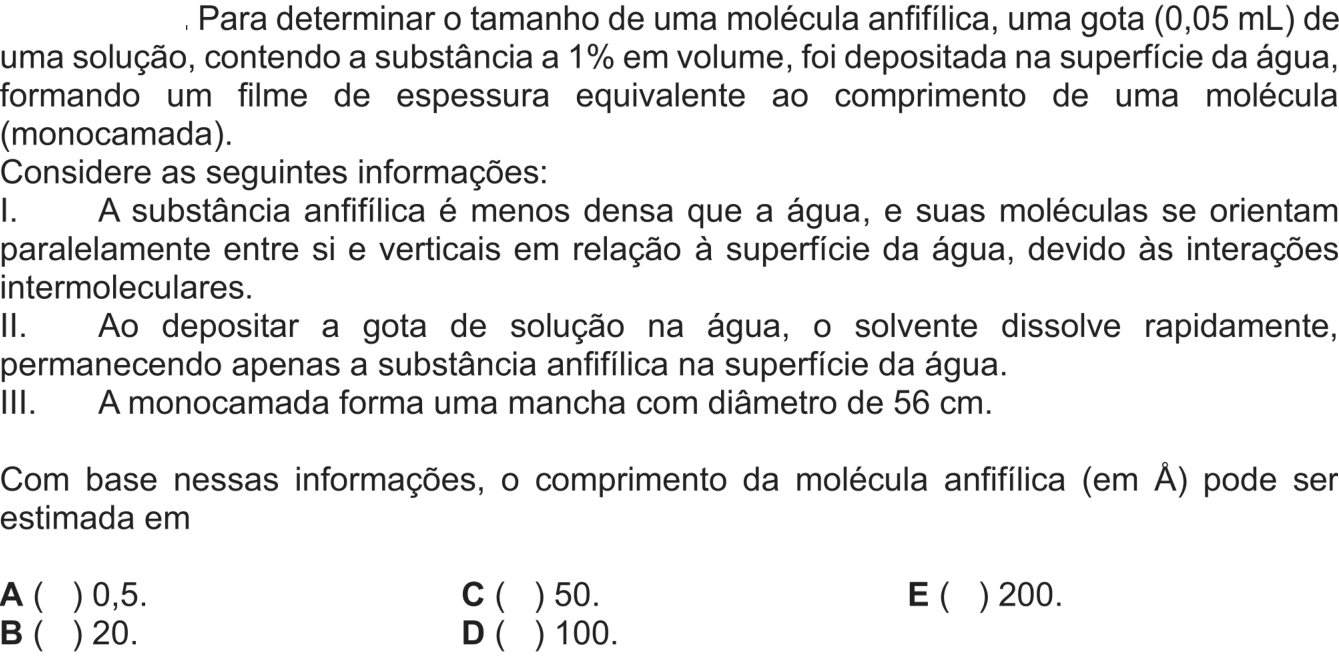
Let's restate problem. To determine size of amphiphilic molecule, a drop (0,05 mL) of a solution, containing substance at 1% by volume, was deposited on water surface, forming film thickness equal to length of one molecule (monolayer). Given:
I. Amphiphilic substance less dense than water, molecules orient parallel to each other and vertical relative to water surface due to intermolecular interactions.
II. When drop solution deposited on water, solvent dissolves rapidly, remaining only amphiphilic substance on water surface.
III. Monolayer forms a spot with diameter 56 cm.
With info, length of amphiphilic molecule (in Å) can be estimated.
Choices: A 0.5; B 20; C 50; D 100; E 200.
Need compute thickness = volume of amphiphilic substance spread on surface / area of spot. Need volume of amphiphilic substance in drop. Drop volume 0.05 mL solution, 1% by volume substance. So volume substance = 0.01 * 0.05 mL = 0.0005 mL = 5e-4 mL? Let's compute carefully.
0.05 mL = 0.05 cm^3? 1 mL = 1 cm^3. So 0.05 mL = 0.05 cm^3 = 5e-2 cm^3. 1% v/v means 1 mL substance per 100 mL solution. So substance volume = 0.01 * 0.05 mL = 0.0005 mL = 5e-4 mL = 5e-4 cm^3? Wait 1 mL = 1 cm^3, so 0.0005 mL = 0.0005 cm^3 = 5e-4 cm^3. Yes.
Area of spot: diameter 56 cm => radius 28 cm. Area = π r^2 = π * 28^2 = π * 784 cm^2 ≈ 2463 cm^2 (using π ~3.14? Let's see choices. If area ~ 2.46e3 cm^2. Thickness h = V/A = 5e-4 cm^3 / (π * 28^2 cm^2) ≈ 2.03e-7 cm. Convert to Å: 1 cm = 1e8 Å? 1 cm = 10^8 Å? Let's verify: 1 Å = 1e-10 m = 1e-8 cm? Since 1 cm = 0.01 m, 1 Å = 1e-10 m = 1e-10 / 0.01 cm = 1e-8 cm? Actually 1e-10 m = 1e-8 cm? 1e-8 cm = 1e-10 m yes because 1 cm = 1e-2 m, so 1e-8 cm = 1e-10 m. Yes 1 cm = 10^8 Å. So 2.03e-7 cm * 1e8 Å/cm = 20.3 Å. Choice B 20. Good.
But need consider density? Maybe amphiphilic substance less dense than water, but volume from solution percentage? The solution is 1% by volume, so volume of substance is 1% of solution volume. However, maybe "1% em volume" means 1 mL of substance in 100 mL solution? Yes. But if amphiphilic substance is less dense than water and maybe solvent dissolves rapidly; volume after solvent evaporation? The drop volume 0,05mL of solution containing substance 1% by volume. The volume of substance = 0.0005 mL. It spreads as monolayer. Need area = π(56/2)^2 cm^2 = 2463 cm^2. Thickness = 0.0005 cm^3 / 2463 cm^2 = 2.03e-7 cm = 20.3 Å. Choice B.
Need ensure not confounded by "substância anfifílica é menos densa que a água" maybe if density needed? Not unless mass? But volume percentage no density needed. The film thickness = volume molecule / area per molecule? Actually all molecules at surface, total volume = N * area per molecule * length? Area = N * area per molecule. Thickness = total volume / area. Yes.
Need produce explanation in Portuguese, concise. Final with Resposta: B. They ask "Resolva a questão e explique seu raciocínio em português. Termine com linha neste formato: Resposta: X". Need maybe mention calculations. Let's craft.
Potential issue: area using diameter 56 cm. Some might treat 1% v/v and drop volume: 0.05 mL = 0.05 cm³. 1% = 0.01, so volume = 0.0005 cm³. Area = π(28 cm)² = 784π cm² ≈ 2463 cm². Espessura = 0.0005 / (784π) cm = 2.03×10^-7 cm. Convert: 1 cm = 10^8 Å, so ≈20.3 Å ≈20 Å. Alternative B.
Need maybe mention π approximated? Use π ≈ 3.14; 784π ≈2463; 0.0005/2463 = 2.03e-7 cm. If use π=3, area=2352, thickness=2.13e-7 cm=21.3 Å, still around 20. So B.
Need maybe check if there is a trap: "conteúdo a substância a 1% em volume" maybe solution contains 1% surfactant, and solvent dissolves rapidly, remaining only substance at surface. If the amphiphilic molecule is less dense than water, maybe only a fraction? No. "filme de espessura equivalente ao comprimento de uma molécula (monocamada)" means thickness equals length. It forms mancha diameter 56 cm. Good.
Let's formulate final with steps. Could include "Como as moléculas se orientam verticalmente, a espessura do filme corresponde ao comprimento da molécula." Use volume conservation.
Let's write in Portuguese:
"Volume da substância na gota: V = 1% de 0,05 mL = 0,01 × 0,05 mL = 5×10^-4 mL = 5×10^-4 cm³.
Área da mancha: A = π(d/2)^2 = π(56/2)^2 = π×28² cm² ≈ 2,46×10^3 cm².
Comprimento ℓ = V/A = 5×10^-4 cm³ / (784π cm²) ≈ 2,03×10^-7 cm.
Como 1 cm = 10^8 Å, ℓ ≈ 20,3 Å, que corresponde a aproximadamente 20 Å.
Alternativa B."
Final line exactly "Resposta: B". Good.
Need maybe no extra line? The user wants end with line. We'll comply.
O volume de substância anfifílica presente na gota é 1% do volume da solução:
V = 0{,}01 \times 0{,}05\ \text{mL} = 5\times 10^{-4}\ \text{mL} = 5\times 10^{-4}\ \text{cm}^3
A mancha formada tem diâmetro 56\ \text{cm}, então sua área é:
A = \pi r^2 = \pi (28\ \text{cm})^2 = 784\pi\ \text{cm}^2
Como as moléculas formam uma monocamada, a espessura do filme é o comprimento da molécula:
\text{espessura} = \frac{V}{A} = \frac{5\times 10^{-4}\ \text{cm}^3}{784\pi\ \text{cm}^2}
\text{espessura} \approx 2{,}03\times 10^{-7}\ \text{cm}
Convertendo para ångströms:
1\ \text{cm} = 10^8\ \text{Å}
2{,}03\times 10^{-7}\ \text{cm} \approx 20{,}3\ \text{Å}
Portanto, o comprimento estimado da molécula anfifílica é aproximadamente 20\ \text{Å}.
Resposta: B
Respondeu
levou 12 s
Como pensou
**Estimating molecule length**
I'm currently working on estimating the amphiphilic molecule's length in Angstroms. The approach involves calculating the volume of the solution drop and then using the given concentration to determine the volume of the amphiphilic substance itself. This volume will be key in proceeding with the length estimation.
**Calculating amphiphile volume**
My focus has shifted to determining the precise volume of the amphiphilic substance. I've calculated this based on the initial solution drop volume and its concentration. This will then be used with the spread area to derive the molecular length.
**Calculating molecular thickness**
I have completed the calculation for the monolayer thickness, converting the volume and area into consistent units. This yielded a thickness of approximately 20.3 Ångströms, which aligns perfectly with one of the provided options, suggesting the estimations are accurate.
Para determinar o comprimento da molécula anfifílica, podemos relacionar o volume da substância que forma a monocamada com a área superficial por ela ocupada:
-
Volume da substância anfifílica na gota:
O volume da gota é V_{\text{gota}} = 0{,}05\text{ mL} = 0{,}05\text{ cm}^3.
Como a solução contém 1\% em volume da substância:
V = 1\% \times V_{\text{gota}} = 0{,}01 \times 0{,}05\text{ cm}^3 = 5 \times 10^{-4}\text{ cm}^3
-
Área da monocamada formada:
O diâmetro da mancha circular é D = 56\text{ cm}, logo o raio é r = 28\text{ cm}.
Utilizando a aproximação \pi \approx \frac{22}{7}:
A = \pi r^2 = \frac{22}{7} \times 28^2 = 22 \times 4 \times 28 = 2464\text{ cm}^2
-
Espessura da monocamada (h):
Como o filme tem a espessura de uma única molécula:
V = A \times h \implies h = \frac{V}{A} = \frac{5 \times 10^{-4}\text{ cm}^3}{2464\text{ cm}^2} \approx 2{,}03 \times 10^{-7}\text{ cm}
-
Conversão para Ångströms (\text{Å}):
Lembrando que 1\text{ \AA} = 10^{-10}\text{ m} = 10^{-8}\text{ cm}:
h = \frac{2{,}03 \times 10^{-7}\text{ cm}}{10^{-8}\text{ cm/\AA}} \approx 20\text{ \AA}
Resposta: B