Como pensou
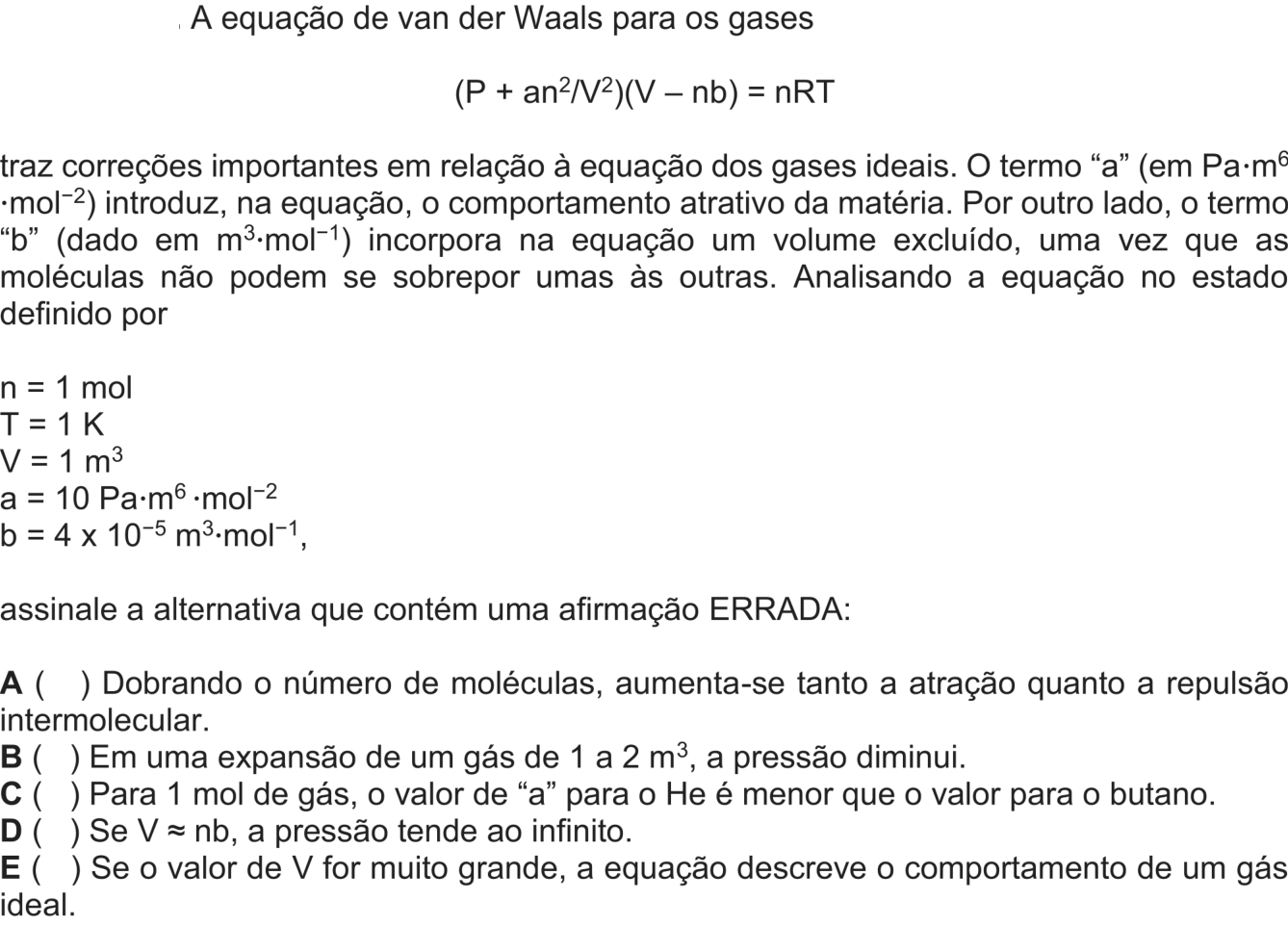
We need answer question. Need solve. Let's restate. Image1 constants. Image2 question. It asks: "A equação de van der Waals para os gases ... traz correções importantes em relação à equação dos gases ideais. O termo 'a' (em Pa·m^6·mol^-2) introduz, na equação, o comportamento atrativo da matéria. Por outro lado, o termo 'b' (dado em m^3·mol^-1) incorpora na equação um volume excluído, uma vez que as moléculas não podem se sobrepor umas às outras. Analisando a equação no estado definido por n = 1 mol, T = 1 K, V = 1 m^3, a = 10 Pa·m^6·mol^-2, b = 4 x 10^-5 m^3·mol^-1, assinale a alternativa que contém uma afirmação ERRADA:"
Options:
A ( ) Dobrando o número de moléculas, aumenta-se tanto a atração quanto a repulsão intermolecular.
B ( ) Em uma expansão de um gás de 1 a 2 m^3, a pressão diminui.
C ( ) Para 1 mol de gás, o valor de "a" para o He é menor que o valor para o butano.
D ( ) Se V ≈ nb, a pressão tende ao infinito.
E ( ) Se o valor de V for muito grande, a equação descreve o comportamento de um gás ideal.
Need identify wrong statement. Let's analyze van der Waals equation: (P + a n^2/V^2)(V - n b) = n R T. State n=1, T=1 K, V=1 m^3, a=10 Pa m^6 mol^-2, b=4e-5 m^3/mol. b tiny. Need evaluate options.
Option A: "Dobrando o número de moléculas, aumenta-se tanto a atração quanto a repulsão intermolecular." Doubling number of molecules n: term a n^2/V^2 increases (attractive correction? In equation P = nRT/(V-nb) - a n^2/V^2, pressure reduced by attraction; correction magnitude increases). Repulsion term b n? Volume excluded nb increases, so (V - nb) smaller, P larger if same V? Actually for fixed V and T, increasing n: attractive term subtracts more (a n^2/V^2) decreases P; repulsive term (V - nb) in denominator decreases (since nb larger) increases P. So both corrections increase? "aumenta-se tanto a atração quanto a repulsão intermolecular" - likely true.
Option B: expansion from 1 to 2 m^3, pressure decreases. Normally for gas expansion, P decreases. But could van der Waals have weird? With n=1, T=1, a=10, b=4e-5. At V=1, P + 10 = R*1/(1 - 4e-5)? R=8.31? Wait R = 8.31 J K^-1 mol^-1 = 8.31 Pa m^3 K^-1 mol^-1. So P = R T/(V - b) - a/V^2. At V=1: P = 8.31*1/(0.99996) - 10 ≈ 8.3103 - 10 = -1.69 Pa negative. At V=2: P = 8.31/(2 - 0.00004) - 10/4 = 4.155 - 2.5 = 1.655 Pa positive. So pressure increases, not decreases! But option says "Em uma expansão de um gás de 1 a 2 m^3, a pressão diminui." Is that false? Wait expansion usually volume increases, pressure should decrease for ideal gas. But with attractive forces, at small volumes pressure can be negative due to attraction, then expansion may increase pressure? Let's examine. At V=1, P negative (unphysical maybe) due to strong attraction? At V=2, P positive. So expansion from 1 to 2 m^3 increases pressure. Therefore statement B is false? But maybe they mean "em uma expansão" generally pressure decreases, but this particular state? The question asks about "Analisando a equação no estado definido por..." maybe options refer to general behavior? Need parse.
Option C: For 1 mol of gas, value of "a" for He is smaller than value for butane. True: helium weak intermolecular forces, a small; butane larger a.
Option D: If V ≈ nb, pressure tends to infinity. As V approaches nb, denominator (V - nb) tends to 0, so P tends to infinity (if numerator positive). True.
Option E: If V very large, equation describes ideal gas behavior. True: V large, a/V^2 negligible, V-nb ≈ V, so P V ≈ n R T.
Thus wrong likely B. But let's double-check: The question asks "assinale a alternativa que contém uma afirmação ERRADA". Among options, B seems wrong in the defined state. But is B generally considered false? In vdW, isothermal expansion can have pressure increase if in region where attractive forces dominate? Let's recall vdW isotherms: below critical temperature, there are loops; pressure may not monotonically decrease with volume. Here T=1 K very low, likely below critical for most gases? At V=1, P negative? Let's compute with R=8.31, a=10, b=4e-5, n=1, T=1. P = nRT/(V-nb) - a n^2/V^2 = 8.31/(0.99996) - 10 = 8.3103 - 10 = -1.6897 Pa. Negative pressure means not physically stable? Actually vdW can predict negative pressure for stretched liquid? For gas? At T=1K, maybe below critical, condensation? But as ideal gas equation, negative pressure maybe unphysical; but in vdW, at low T, pressure can be negative in metastable region? Hmm.
Option B says "Em uma expansão de um gás de 1 a 2 m^3, a pressão diminui." In this case, pressure increases from -1.69 to 1.655. So B is false. However, if the problem intended ideal gas assumption? But it's about vdW equation; they gave specific values to test. So B is likely wrong.
But let's examine if any other option could be considered wrong? Option A: "Dobrando o número de moléculas, aumenta-se tanto a atração quanto a repulsão intermolecular." At n=2, equation: (P + a (2)^2/V^2)(V - 2b) = 2 R T. Attractive term a n^2/V^2 = 4a/V^2 (increases); repulsive term volume excluded nb = 2b (increases). So both increase. True.
Option C: "Para 1 mol de gás, o valor de 'a' para o He é menor que o valor para o butano." True.
Option D: "Se V ≈ nb, a pressão tende ao infinito." Let's solve: P = nRT/(V - nb) - a n^2/V^2. As V → nb+, first term → +∞, second term finite, so P → +∞. True.
Option E: "Se o valor de V for muito grande, a equação descreve o comportamento de um gás ideal." True.
Thus B is the only false statement.
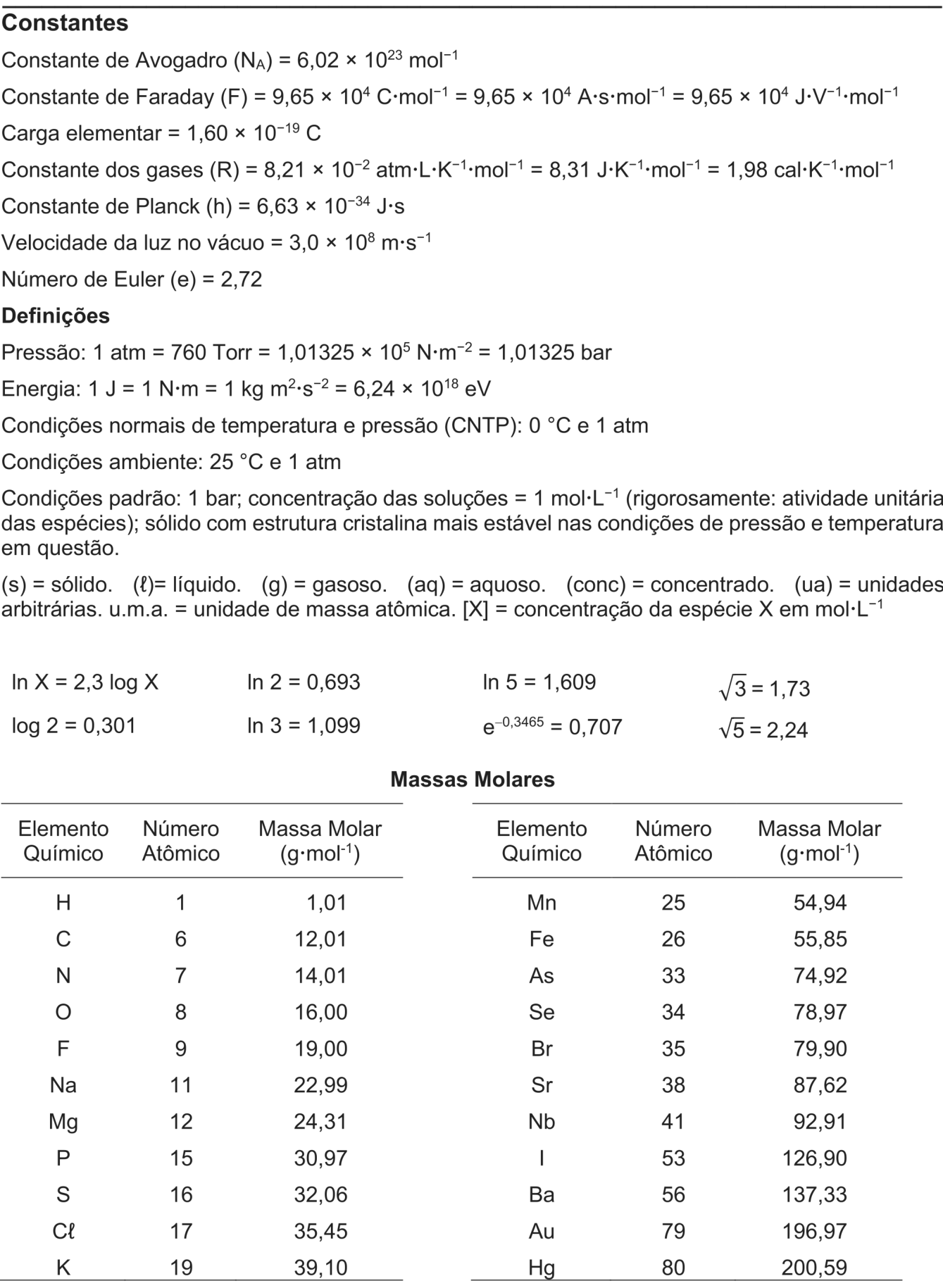
But let's be careful: Is B maybe generally true "Em uma expansão de um gás de 1 a 2 m^3, a pressão diminui" as a statement about normal gases? The question says "Analisando a equação no estado definido por ...". So yes, they expect compute P at V=1 and V=2 maybe. Let's compute R value? They gave R = 8,21×10^-2 atm L K^-1 mol^-1 = 8,31 J K^-1 mol^-1. Since a in Pa m^6 mol^-2, b in m^3 mol^-1, V in m^3, T=1K. Use SI: R=8.31 J K^-1 mol^-1 = 8.31 Pa m^3 K^-1 mol^-1 (since J = Pa m^3). So P = nRT/(V-nb) - a n^2/V^2. n=1, T=1, a=10, b=4e-5.
At V=1: P = 8.31/(1 - 4e-5) - 10 = 8.310332 - 10 = -1.689668 Pa.
At V=2: P = 8.31/(2 - 4e-5) - 10/4 = 4.155083 - 2.5 = 1.655083 Pa.
So pressure increases. Therefore B false.
But maybe they consider "expansão" as increasing volume, and for ideal gas pressure decreases. Since vdW at this state predicts increase, so B is false.
Let's see if any nuance: Alternative D: "Se V ≈ nb, a pressão tende ao infinito." If V ≈ nb exactly, denominator zero, pressure infinite. But in reality, vdW equation not valid near excluded volume? But mathematically true. However, perhaps if V < nb, physical volume cannot be less than excluded volume. But "V ≈ nb" means close, pressure large. True.
Alternative A: "Dobrando o número de moléculas, aumenta-se tanto a atração quanto a repulsão intermolecular." If n doubles, the term a n^2/V^2 increases, but also b n increases. So yes. But one might argue "repulsão intermolecular" is represented by b n, which increases. "atração" represented by a n^2/V^2, increases. True.
Alternative C: "Para 1 mol de gás, o valor de 'a' para o He é menor que o valor para o butano." True: He has weak dispersion forces, butane larger polarizability, a larger.
Alternative E: "Se o valor de V for muito grande, a equação descreve o comportamento de um gás ideal." True, because correction terms vanish.
Thus answer B.
Need provide explanation in Portuguese. Final line "Resposta: B". Ensure format.
Let's produce final with reasoning concise.
A afirmação errada é a B.
Pela equação de van der Waals:
\left(P+\frac{an^2}{V^2}\right)(V-nb)=nRT
ou
P=\frac{nRT}{V-nb}-\frac{an^2}{V^2}
Para n=1\ \text{mol}, T=1\ \text{K}, a=10\ \text{Pa·m}^6\text{mol}^{-2}, b=4\times10^{-5}\ \text{m}^3\text{mol}^{-1} e R=8,31\ \text{J·K}^{-1}\text{mol}^{-1}=8,31\ \text{Pa·m}^3\text{K}^{-1}\text{mol}^{-1}:
P=\frac{8,31}{1-4\times10^{-5}}-10 \approx 8,31-10=-1,69\ \text{Pa}
P=\frac{8,31}{2-4\times10^{-5}}-\frac{10}{4}
\approx 4,155-2,5=1,655\ \text{Pa}
Portanto, ao expandir de 1\ \text{m}^3 para 2\ \text{m}^3, a pressão aumenta de aproximadamente -1,69\ \text{Pa} para 1,655\ \text{Pa}. Logo, a alternativa B, que diz que a pressão diminui, está errada.
As demais alternativas estão corretas:
- A: ao dobrar n, tanto o termo atrativo \frac{an^2}{V^2} quanto o termo repulsivo nb aumentam.
- C: o hélio tem forças intermoleculares muito mais fracas que o butano, logo seu valor de a é menor.
- D: se V \to nb, o denominador V-nb tende a zero, fazendo P \to \infty.
- E: para V muito grande, \frac{an^2}{V^2}\to0 e V-nb\approx V, recuperando a equação dos gases ideais.
Resposta: B