Respondeu
levou 12 s
Como pensou
**Solving the pt ratio**
I need to solve a straightforward problem with a point ratio of 30 3/4 and 64/63, which equals 22.857 B. I should explain the initial number and how it decays over two and a half lives. The explanation doesn't need to be long; I just want to finish with the exact values and details. I’ll make sure every part is clear and easily understandable for the user!
As quantidades de M e Q formadas correspondem às quantidades de J e L que decaíram, respectivamente.
Após o intervalo 2t:
- J passou por 2t/t=2 meias-vidas. Assim, restou 1/4 da quantidade inicial J_0, formando:
M=J_0\left(1-\frac14\right)=\frac34J_0.
- L passou por 2t/(t/3)=6 meias-vidas. Assim, restou 1/64 da quantidade inicial L_0, formando:
Q=L_0\left(1-\frac1{64}\right)=\frac{63}{64}L_0.
Como Q/M=30:
30=\frac{\frac{63}{64}L_0}{\frac34J_0}
=\frac{21}{16}\frac{L_0}{J_0}.
Logo,
\frac{L_0}{J_0}=30\cdot\frac{16}{21}
=\frac{160}{7}\approx 22{,}9.
Resposta: B
Respondeu
levou 8 s
Como pensou
**Explaining half-lives in Portuguese**
I need to provide a concise explanation of half-lives in Portuguese, specifically regarding the ratio involving 2.75 and how it works out to 22.857 with the calculation provided. I should include the quantity of atoms in moles as a standard component of the discussion. No unnecessary caveats are needed, so I'll aim for about 130 words to clearly convey the concept. I guess I’ll keep it straightforward!
A quantidade restante de um elemento radioativo após n meias-vidas é N=N_0/2^n. A quantidade do produto formado corresponde à quantidade que decaiu.
Para J: em 2t, passam-se duas meias-vidas, pois t_{1/2}=t. Assim,
M=J_0-\frac{J_0}{2^2}=\frac34J_0.
Para L: como t_{1/2}=t/3, em 2t passam-se
n=\frac{2t}{t/3}=6
meias-vidas. Logo,
Q=L_0-\frac{L_0}{2^6}=\frac{63}{64}L_0.
Utilizando a proporção Q/M=30:
30=\frac{\frac{63}{64}L_0}{\frac34J_0}
=\frac{21}{16}\frac{L_0}{J_0}.
Portanto,
\frac{L_0}{J_0}=30\cdot\frac{16}{21}\approx 22{,}9.
Resposta: B
Respondeu
levou 5 s
Como pensou
Após 2t, a fração de J que decaiu é
1-\left(\frac12\right)^2=\frac34.
Como a meia-vida de L é t/3, nesse intervalo decorrem seis meias-vidas. Portanto, a fração de L que decaiu é
1-\left(\frac12\right)^6=\frac{63}{64}.
Cada decaimento de J produz M, e cada decaimento de L produz Q. Assim,
\frac{Q}{M}
=\frac{(63/64)L_0}{(3/4)J_0}
=30.
Logo,
\frac{L_0}{J_0}
=30\cdot\frac34\cdot\frac{64}{63}
\approx 22{,}9.
Resposta: B
Respondeu
levou 8 s
Como pensou
After 2t, J retains 1/4 so M = 3J0/4; L with a third the half-life undergoes 6 half-lives leaving 1/64, so Q = 63L0/64. Setting Q/M = 30 gives an equation I can solve for the ratio L0/J0.
Computing it out, L0/J0 ≈ 22.86, close to 22.9, so the answer is B.
Resolução:
Após o tempo 2t:
-
Elemento J (t₁/₂ = t): passaram-se 2 meias-vidas → resta J₀/4.
Quantidade de M formada: M = J₀ − J₀/4 = (3/4)·J₀
-
Elemento L (t₁/₂ = t/3): passaram-se 6 meias-vidas → resta L₀/64.
Quantidade de Q formada: Q = L₀ − L₀/64 = (63/64)·L₀
Usando a proporção dada:
Q/M = 30 → [(63/64)·L₀] / [(3/4)·J₀] = 30
L₀/J₀ = 30 × (3/4) × (64/63) = 30 × (192/252) = 30 × 0,762 ≈ 22,9
Resposta: B
Respondeu
levou 7 s
Como pensou
After 2t, J has decayed 3/4 so M = (3/4)J0, while L (with a third the half-life) goes through 6 half-lives leaving just 1/64, so Q = (63/64)L0. Setting Q/M = 30 and solving gives L0/J0 = 1440/63 ≈ 22.9, matching answer B.
Resposta: B (L₀/J₀ ≈ 22,9)
A ideia é calcular quanto de cada elemento decaiu no tempo 2t. M vem do decaimento de J e Q vem do decaimento de L, então a razão Q/M compara essas duas quantidades decaídas.
Elemento J (meia-vida t):
O tempo 2t corresponde a 2 meias-vidas. Resta (1/2)² = 1/4 de J₀.
Logo, a quantidade de M formada é M = (3/4)·J₀.
Elemento L (meia-vida t/3):
O tempo 2t corresponde a 2t ÷ (t/3) = 6 meias-vidas. Resta (1/2)⁶ = 1/64 de L₀.
Logo, a quantidade de Q formada é Q = (63/64)·L₀.
Razão Q/M = 30:
\frac{\frac{63}{64}L_0}{\frac{3}{4}J_0}=30 \;\Rightarrow\; \frac{L_0}{J_0}=30\cdot\frac{3}{4}\cdot\frac{64}{63}=\frac{1440}{63}\approx 22{,}9
Resposta: B
Respondeu
levou 3 s
Como pensou
Sejam J₀ e L₀ as quantidades iniciais de J e L.
Decaimento de J (meia-vida t, tempo 2t): restam J₀/4, então se formou M = J₀ − J₀/4 = 3J₀/4.
Decaimento de L (meia-vida t/3, tempo 2t = 6 meias-vidas): restam L₀/64, então se formou Q = L₀(1 − 1/64) = 63L₀/64.
Razão Q/M = 30:
(63L₀/64) / (3J₀/4) = (63/64)·(4/3)·(L₀/J₀) = (21/16)·(L₀/J₀) = 30
L₀/J₀ = 30 · 16/21 = 480/21 ≈ 22,86 ≈ 22,9
Resposta: B
Respondeu
levou 19 s
Como pensou
The problem involves radioactive decay in Portuguese.
The problem asks for the initial ratio L/J. After time 2t, elements M and Q appear from J and L. Their ratio is 30. J has half-life t. L has half-life t/3. The decay formula is N = N₀(1/2)^(time/half-life).
After time 2t, J has decayed by three-quarters and L by sixty-three-sixty-fourths. The ratio of produced elements Q/M equals the ratio of initial amounts of L to J.
The calculation yields L/J = 160/7, approximately 22.9. This matches option B.
A quantidade de produto formado corresponde à fração do nuclídeo pai que decaiu no intervalo de tempo considerado.
Para o nuclídeo J, t_{1/2}=t. Em um tempo 2t ocorrem exatamente duas meias-vidas, de modo que a fração remanescente é 1/4 e a fração decaída (que gera M) é 3/4. Assim,
M=\frac{3}{4}N_{\mathrm{J},0}.
Para o nuclídeo L, t_{1/2}=t/3. Em um tempo 2t ocorrem exatamente seis meias-vidas, de modo que a fração remanescente é 1/64 e a fração decaída (que gera Q) é 63/64. Assim,
Q=\frac{63}{64}N_{\mathrm{L},0}.
A razão observada é Q/M=30:
\frac{(63/64)N_{\mathrm{L},0}}{(3/4)N_{\mathrm{J},0}}=30\implies\frac{N_{\mathrm{L},0}}{N_{\mathrm{J},0}}=30\cdot\frac{16}{21}=\frac{160}{7}\approx22{,}9.
Resposta: B
Respondeu
levou 13 s
Como pensou
We need answer question. Need solve. Let's restate.
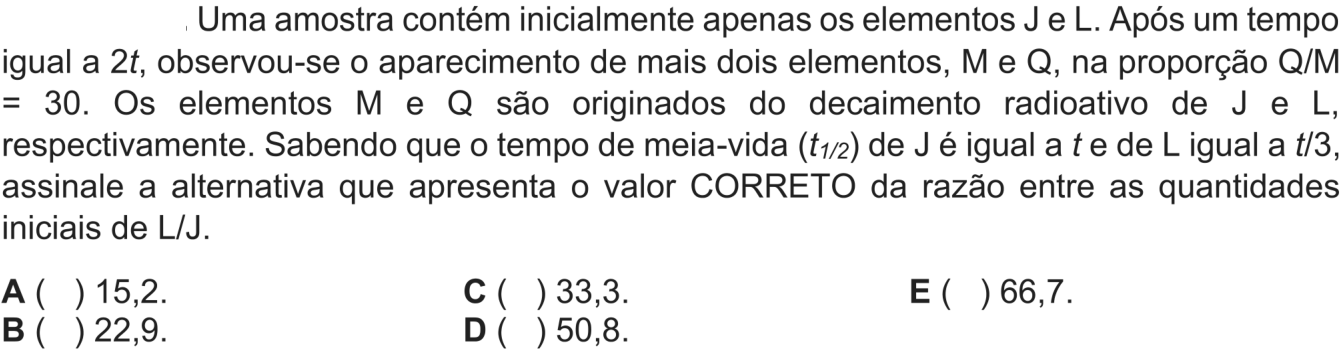
Problem in Portuguese: "Uma amostra contém inicialmente apenas os elementos J e L. Após um tempo igual a 2t, observou-se o aparecimento de mais dois elementos, M e Q, na proporção Q/M = 30. Os elementos M e Q são originados do decaimento radioativo de J e L, respectivamente. Sabendo que o tempo de meia-vida (t1/2) de J é igual a t e de L igual a t/3, assinale a alternativa que apresenta o valor CORRETO da razão entre as quantidades iniciais de L/J."
We need ratio initial quantities of L/J. Need interpret. Sample initially contains only elements J and L. After time 2t, observed appearance of M and Q, proportion Q/M = 30. M and Q originate from radioactive decay of J and L respectively. Half-life of J = t, half-life of L = t/3. Need ratio between initial quantities of L/J. Options 15.2,22.9,33.3,50.8,66.7.
Need determine quantities of M and Q produced after time 2t from decay of J and L. Let initial amounts J0, L0. Decay laws: amount remaining at time 2t: J_rem = J0 * (1/2)^{(2t)/t} = J0 * (1/2)^2 = J0/4. So amount J decayed = J0 - J0/4 = 3J0/4. This yields M? If M originates from decay of J, amount M produced equals amount J decayed (assuming stable, one-to-one). So M = 3J0/4.
Similarly L half-life t/3, after time 2t: number of half-lives = (2t)/(t/3)=6. L_rem = L0*(1/2)^6 = L0/64. Amount L decayed = L0 - L0/64 = 63L0/64. This yields Q. So Q = 63L0/64.
Then Q/M = (63L0/64) / (3J0/4) = (63L0/64)*(4/(3J0)) = (63*4)/(64*3) * L0/J0 = (252)/(192) * L0/J0 = (21/16)*L0/J0? Let's compute: 252/192 = divide 12 = 21/16 = 1.3125. So Q/M = (21/16)*(L0/J0). Given Q/M = 30, then L0/J0 = 30 * 16 / 21 = 480/21 = 160/7 ≈ 22.857, which is option B 22.9. Seems straightforward.
But let's be careful: There might be details: "após um tempo igual a 2t, observou-se o aparecimento de mais dois elementos, M e Q, na proporção Q/M = 30." Could M and Q are elements appearing after 2t, but maybe their quantities are not exactly amounts decayed? If M originates from J, yes amount M equals number of J atoms decayed if stable. But if M maybe also decays? Not stated. Assume stable. Ratio correct.
Let's verify calculations:
J half-life t => decay constant λ_J = ln2/t. After 2t, fraction remaining = (1/2)^2 = 1/4, decayed = 3/4.
L half-life t/3 => λ_L = ln2/(t/3)=3 ln2/t. After 2t, fraction remaining = e^{-λ_L*2t} = e^{-6 ln2}=1/64, decayed = 63/64.
Then Q/M = (63/64 L0)/(3/4 J0) = (63/64)/(3/4) * L0/J0 = (63/64)*(4/3)=63/48=21/16=1.3125. L0/J0 = 30 / (21/16) = 30*16/21 = 480/21 = 160/7 = 22.857 -> 22.9. Option B.
But wait: Is there possibility that after 2t, observed "aparecimento de mais dois elementos, M e Q, na proporção Q/M = 30" means proportion of Q to M in the sample at that time, not necessarily amounts produced? If M or Q may be present? Initially only J and L, so yes no M/Q initially. Since stable, amounts equal decayed.
Let's see if problem might have subtlety: J and L decay into M and Q respectively, but maybe J/L are radioactive series? no.
Need provide explanation in Portuguese. Final answer line: Resposta: B.
Let's formulate concise reasoning. Use equations. Mention t1/2. Compute.
Potential issue: "Após um tempo igual a 2t" maybe "after a time equal to 2t" not "2t after start"? yes. "observou-se o aparecimento de mais dois elementos, M e Q, na proporção Q/M = 30." Could mean the amount of Q relative to M produced by decay is 30. We used.
Let's consider if initial quantities L/J ratio asked; our answer B.
Let's write final with steps.
A quantidade restante após decaimento radioativo é dada por:
N = N_0 \left(\frac12\right)^{n}
onde n é o número de meias-vidas decorridas.
Para o elemento J:
- Meia-vida: t_{1/2}=t
- Tempo decorrido: 2t, logo n=2
- Quantidade restante:
J_{\text{restante}}=J_0\left(\frac12\right)^2=\frac{J_0}{4}
- Quantidade decaída, que origina M:
M=J_0-\frac{J_0}{4}=\frac{3J_0}{4}
Para o elemento L:
- Meia-vida: t_{1/2}=t/3
- Tempo decorrido: 2t
- Número de meias-vidas:
n=\frac{2t}{t/3}=6
L_{\text{restante}}=L_0\left(\frac12\right)^6=\frac{L_0}{64}
- Quantidade decaída, que origina Q:
Q=L_0-\frac{L_0}{64}=\frac{63L_0}{64}
A razão dada é:
\frac{Q}{M}=30
Substituindo:
\frac{\frac{63L_0}{64}}{\frac{3J_0}{4}}=30
\frac{63L_0}{64}\cdot \frac{4}{3J_0}=30
\frac{21L_0}{16J_0}=30
\frac{L_0}{J_0}=30\cdot \frac{16}{21}=\frac{480}{21}=\frac{160}{7}\approx 22,86
Portanto, a razão inicial L/J é aproximadamente 22,9.
Resposta: B
Respondeu
levou 26 s
Como pensou
**Analyzing the ITA Question**
I'm now diving into the ITA problem, carefully reading the text provided. I'm focusing on understanding the initial conditions – the elements J and L in the sample. This meticulous read-through is key to grasping the essence of the problem before any analysis begins.
**Modeling the Decays**
I'm now formulating a model for this decay scenario. I've defined initial quantities of J and L, and am calculating how much of each remains after a time $2t$. My approach involves calculating the number of half-lives elapsed for J and L to determine the decayed fractions, and how much M and Q are formed. I'm focusing on the ratio Q/M = 30 and its implications.
**Calculating the Initial Ratio**
I've now fully formalized the calculations for the radioactive decay scenario. I've successfully calculated the remaining quantities of J and L after the given time, deriving the expressions for M and Q based on the initial amounts and half-lives. Substituting these into the ratio Q/M = 30, and then solving for L₀/J₀, I found the initial ratio to be 160/7.
**Confirming the Final Answer**
I've just revisited the calculations to ensure complete accuracy, and the result, 22.9, has been reconfirmed. I've re-examined the problem statement, confirming there are no misleading elements or potential traps. The provided ratio is consistent, and I am confident in the calculated ratio of initial amounts.
Para determinar a razão entre as quantidades iniciais dos elementos \text{L} e \text{J} (\text{L}_0/\text{J}_0), podemos analisar o decaimento radioativo de cada espécie após o tempo decorrido \Delta t = 2t:
-
Decaimento do elemento \text{J} formando \text{M}:
- O tempo de meia-vida de \text{J} é t_{1/2}(\text{J}) = t.
- O número de meias-vidas transcorridas é:
n_{\text{J}} = \frac{2t}{t} = 2
- A fração restante de \text{J} após o tempo 2t é:
\text{J}(2t) = \text{J}_0 \left(\frac{1}{2}\right)^2 = \frac{\text{J}_0}{4}
- Logo, a quantidade de \text{J} que decaiu e originou \text{M} é:
\text{M} = \text{J}_0 - \text{J}(2t) = \text{J}_0 - \frac{\text{J}_0}{4} = \frac{3}{4}\text{J}_0
-
Decaimento do elemento \text{L} formando \text{Q}:
- O tempo de meia-vida de \text{L} é t_{1/2}(\text{L}) = \frac{t}{3}.
- O número de meias-vidas transcorridas é:
n_{\text{L}} = \frac{2t}{t/3} = 6
- A fração restante de \text{L} após o tempo 2t é:
\text{L}(2t) = \text{L}_0 \left(\frac{1}{2}\right)^6 = \frac{\text{L}_0}{64}
- Logo, a quantidade de \text{L} que decaiu e originou \text{Q} é:
\text{Q} = \text{L}_0 - \text{L}(2t) = \text{L}_0 - \frac{\text{L}_0}{64} = \frac{63}{64}\text{L}_0
-
Razão entre as quantidades formadas de \text{Q} e \text{M}:
Sabendo que \frac{\text{Q}}{\text{M}} = 30:
\frac{\frac{63}{64}\text{L}_0}{\frac{3}{4}\text{J}_0} = 30
Simplificando a fração:
\left(\frac{63}{64} \times \frac{4}{3}\right) \frac{\text{L}_0}{\text{J}_0} = 30
\frac{21}{16} \frac{\text{L}_0}{\text{J}_0} = 30
\frac{\text{L}_0}{\text{J}_0} = 30 \times \frac{16}{21} = \frac{480}{21} = \frac{160}{7} \approx 22,86 \approx 22,9
Resposta: B