Como pensou
We need answer question in Portuguese. Need solve chemistry. Let's restate problem.
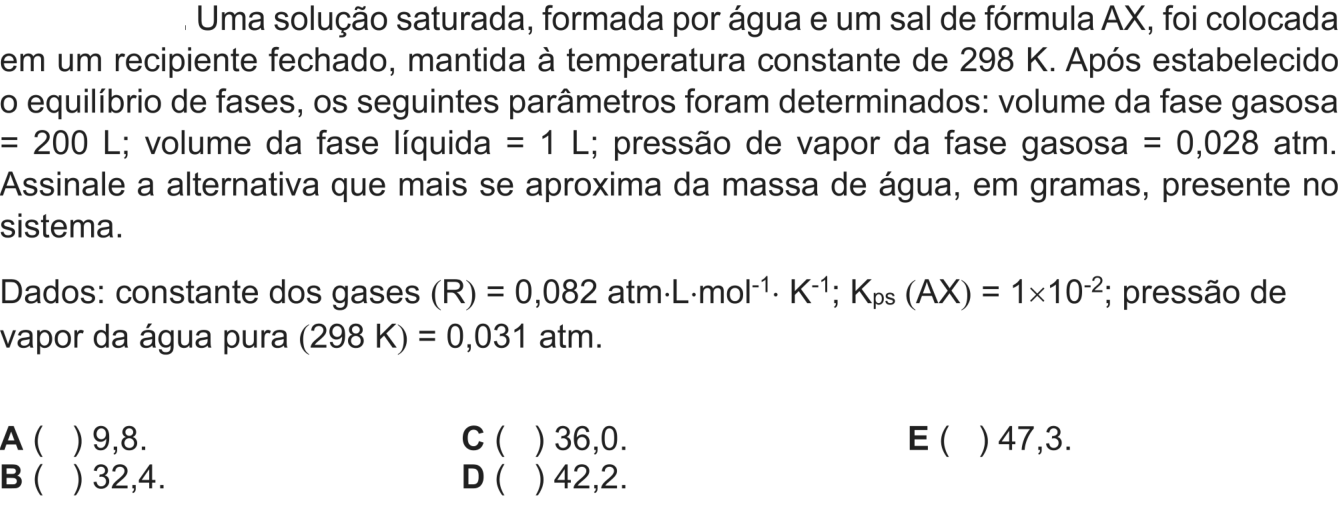
"Solução saturada, formada por água e um sal de fórmula AX, foi colocada em recipiente fechado, mantida à temperatura constante de 298 K. Após estabelecido equilíbrio de fases, os seguintes parâmetros foram determinados: volume da fase gasosa = 200 L; volume da fase líquida = 1 L; pressão de vapor da fase gasosa = 0,028 atm. Assinale alternativa que mais se aproxima da massa de água, em gramas, presente no sistema.
Dados: constante dos gases R = 0,082 atm·L·mol^-1·K^-1; Kps(AX) = 1×10^-2; pressão de vapor da água pura (298 K) = 0,031 atm."
Options A 9.8, B 32.4, C 36.0, D 42.2, E 47.3.
Need interpret. Saturated solution of water and salt AX in closed container. Gas phase volume 200 L, liquid volume 1 L, vapor pressure gas phase = 0.028 atm. Need mass of water in system. Given Kps(AX)=1e-2, vapor pressure pure water 0.031 atm. R.
It seems vapor pressure of solution is 0.028 atm, lower than pure water due to solute (Raoult's law). Need find molality? From vapor pressure lowering, find mole fraction of water in liquid solution. Then in liquid phase volume 1 L, saturated solution density? Maybe need mass? But maybe liquid phase volume 1 L includes solution; need density? Not given. But maybe can use molality and volume? Alternative: mass water in liquid = ? We know total moles water in gas from ideal gas: n_gas = PV/RT = 0.028 atm * 200 L / (0.082 * 298) =? Compute: 0.028*200 = 5.6 atm L; R*T = 0.082*298 = 24.436; n=0.2292 mol water vapor. Mass=4.13 g. But liquid water much larger.
Need determine water in liquid solution. Given vapor pressure of solution = 0.028 atm = x_water * P°_water (assuming ideal solution) => x_water = 0.028 / 0.031 = 0.9032258. Thus mole fraction solute = 0.0967742. Need total water in liquid. We know salt AX saturated, Kps = [A+][X-] = 1e-2 = s^2 => s = sqrt(0.01)=0.1 mol/L? For 1:1 salt, solubility s = 0.1 mol/L in saturated solution. Since liquid volume = 1 L, moles salt in liquid = 0.1 mol (assuming volume approx solution volume? Actually volume of liquid = 1 L, saturated solution; yes maybe molality? But molarity = 0.1 mol/L; moles salt = 0.1 mol). Then mole fraction water x_w = n_w/(n_w + n_salt) = 0.9032258. With n_salt=0.1, solve n_w =? x = n_w/(n_w+0.1)=0.9032258 => n_w =0.9032258(n_w+0.1)=0.9032258 n_w +0.09032258 => n_w(1-0.9032258)=0.09032258 => n_w=0.09032258/0.0967742 ≈0.9333 mol? Let's compute: 0.09032258 / 0.0967742 = 0.933333... mol. Mass water = 0.9333 mol * 18 g/mol = 16.8 g. Plus vapor 4.13 g = 20.93 g, not in options. Hmm not match.
Maybe Kps maybe 1×10^-2? Need consider volume phase gasosa 200 L, volume liquid 1 L; vapor pressure gas phase? The vapor pressure of solution = partial pressure water? Gas phase also contains? Salt nonvolatile. Total pressure? They give "pressão de vapor da fase gasosa = 0,028 atm" maybe vapor pressure of water in gas phase? Yes.
But options: 9.8, 32.4, 36.0, 42.2, 47.3. My result 20.9 not option. Maybe Kps maybe 1×10^-2 (mol/L)^2, but perhaps AX has formula salt with solubility? Wait formula AX maybe 1:1, but Kps = [A+][X-] = s^2 = 1e-2 => s=0.1 M. But in saturated solution, salt molality? Need activity? Hmm.
Maybe mass of water in system includes only vapor? No, options ~32-47 g maybe includes liquid water, maybe from vapor pressure lowering relation maybe using molality: relative lowering = (P° - P)/P° = x_solute = n_solute/(n_solute+n_water) ≈ n_solute/n_water for dilute? Actually if x_solute = 1 - 0.028/0.031 = 0.09677, not small. Then n_solute = ? If salt concentration maybe 0.1 mol in 1 L, but molality maybe 0.1 mol/kg water? Density approx? If assume solution volume 1 L and density ~1 g/mL, mass solution 1000 g, water mass 1000g - mass salt. Salt moles = maybe 0.1 mol? Mass salt = 0.1*(molar mass AX). But molar mass AX not given? AX could be? Elements? Maybe A, X not specific? Need use Kps and vapor pressure maybe to find water mass? Let's explore.
Maybe "AX" salt is not necessarily 1:1? Kps expression maybe [A+][X-] but if AX -> A+ + X- with solubility s mol/L. The liquid volume 1 L saturated solution. Moles salt dissolved = s * 1 L = sqrt(Kps) = 0.1 mol. Mole fraction water in liquid solution from vapor pressure: x_solvent = P/P° = 0.028/0.031 = 0.9032258. Then x_solute = 0.0967742. Then total moles in liquid = n_salt / x_solute = 0.1 / (1 - 0.9032258?) Wait x_solute = n_salt/(n_salt+n_water). So n_total = n_salt / x_solute =0.1 /0.0967742 =1.03333 mol. n_water =1.03333 -0.1=0.93333 mol, mass=16.8 g. Not option.
But perhaps "Kps(AX)=1×10^-2" and "pressão de vapor da água pura = 0,031 atm" maybe vapor pressure lowering due to solute molality? Relative lowering = (P°-P)/P° = x_solute = n_solute/(n_solute+n_water). If n_solute = m_salt? Maybe use n_solute = molality? But we need water mass not moles? We did.
Let's examine options. Maybe answer ~32.4? Let's see if use molality? In solution, n_salt maybe not 0.1 mol because salt has formula AX but Kps = 1e-2 maybe at 298 K. Solubility s = sqrt(Kps) =0.1 mol/L. In 1 L solution, n_salt=0.1 mol if solution volume 1 L. But if density not 1, volume 1 L solution contains water mass less/greater; however n_salt calculated from Kps in mol/L (molarity), independent of density. So n_salt=0.1. Then n_water from x_w = n_w/(n_w+0.1)=0.9032 => n_w=0.9333 mol, mass=16.8 g. Why not option? Maybe I computed total moles: x_w = 0.9032258, x_solute =0.0967742. 0.1 / 0.0967742 = 1.03333 total; water 0.93333. Yes.
Options: 9.8, 32.4, 36.0, 42.2, 47.3. 16.8 not option. Maybe use vapor pressure of water pure = 0.031 atm. Difference =0.003 atm. Relative lowering =0.003/0.031=0.09677. Correct.
But perhaps consider gas phase volume 200 L contains water vapor at P=0.028 atm, mass 4.13 g. Liquid water mass maybe from "1 L" using density and molality? If solution is saturated and contains salt AX with molar mass? Not given. But maybe salt formula AX can be identified? Kps=1e-2, vapor pressure lowering, maybe find molar mass? Wait there are two unknown: moles salt n_s and moles water n_w. We know n_s from Kps and volume liquid = 1 L -> n_s=0.1 mol. Then n_w from Raoult's law. So no need molar mass. Unless Kps in molality scale? If Kps = 1e-2 (mol/kg water)^2? Then solubility s mol/kg water = sqrt(0.01)=0.1 mol/kg. But liquid volume 1 L, not mass water. Need water mass to convert? Let's try.
If Kps is molality-based? Usually Kps is molarity. But in concentrated solution? Hmm.
Let's think: The liquid phase is saturated solution; Kps = [A+][X-] = 1e-2. Since volume of liquid phase =1 L, amount salt = 0.1 mol. correct.
Then Raoult: P = x_water * P°_water. x_water = 0.028/0.031 = 0.9032258. x_salt = 0.0967742. Let n_w = x_w * n_salt / (1-x_w)? Actually x_salt = n_s/(n_s+n_w). n_w = n_s * (1-x_salt)/x_salt? Wait x_salt=0.0967742, n_s=0.1; n_w = n_s * (1 - x_salt)/x_salt = 0.1 * 0.9032258 / 0.0967742 = 0.93333 mol. same.
Mass = 0.93333*18=16.8 g. Total including vapor =20.9 g. Not option. Did I misread options? A 9.8, B 32.4, C 36.0, D 42.2, E 47.3. Maybe 32.4 corresponds to n_w=1.8 mol? Hmm.
Maybe Kps(AX)=1×10^-2 might actually be 1×10^-2 (mol/L)^2? Yes. But maybe salt formula AX2? No. If formula AX, Kps = s^2. If formula AX2, Kps = 4s^3, etc. But problem says AX, maybe A and X charges? Kps maybe 1e-2; solubility = 0.1 M. But perhaps "sal de fórmula AX" means salt with formula AX but Kps maybe [A][X] = 1e-2; if solution saturated with both ions? Yes.
Let's check if answer could be from including water vapor in gas phase using ideal gas but with total pressure? Gas phase volume 200 L, pressure vapor = 0.028 atm. n = PV/RT = 0.028*200/(0.082*298) = 0.2292 mol = 4.13 g. Liquid water mass maybe ~? If option 36.0 maybe n_water =2 mol? 2 mol water =36 g; plus vapor 4.13 =40.13, not option. If liquid water mass =36.0? That would n=2 mol. How get n_w=2? Maybe x_w = P/P° = 0.9032, n_w=2 mol => n_salt = n_w*(1-x)/x =2*0.09677/0.9032=0.2143 mol; inconsistent with n_salt=0.1.
Maybe Kps actually =1×10^-2 (mol/L)^3? For salt formula AX2? Let's see if options around 36? If salt A2X? Kps = 4s^3 =0.01 => s = (0.0025)^(1/3)=0.1357 mol/L. n_salt maybe 0.1357 mol; x_salt =0.09677; n_w =0.1357 *0.9032/0.09677 =1.266 mol, mass water=22.8g, not.
Maybe problem has "volume da fase líquida = 1 L" but liquid phase is not pure water? Maybe mass of water can be found by volume liquid and density? Not given. But maybe using "solução saturada formada por água e um sal de fórmula AX" "massa de água presente no sistema" perhaps includes liquid water and vapor water; but we need consider density of liquid? Could derive from partial molar volumes? Hmm.
Let's parse: "Uma solução saturada, formada por água e um sal de fórmula AX, foi colocada em um recipiente fechado, mantida à temperatura constante de 298 K. Após estabelecido o equilíbrio de fases, os seguintes parâmetros foram determinados: volume da fase gasosa = 200 L; volume da fase líquida = 1 L; pressão de vapor da fase gasosa = 0,028 atm. Assinale a alternativa que mais se aproxima da massa de água, em gramas, presente no sistema."
Maybe we should use gas phase water vapor, and liquid phase not necessarily all solution? The container initially has saturated solution, after equilibrium, some water evaporated. But liquid phase volume = 1 L; gas phase volume = 200 L. Pressure = 0.028 atm. The vapor pressure of solution is 0.028 atm, so liquid solution has mole fraction. We need mass water in system: in liquid water (solvent) plus vapor. We know vapor moles; liquid moles from Raoult's law. We have n_salt from Kps. But perhaps Kps is in terms of molality? Let's see if Kps = 1e-2 and liquid volume 1 L, but maybe salt molality in saturated solution = 0.1 mol/kg water; not molarity. Then n_salt unknown because water mass unknown. But use Kps expression in molality: Kps = [A+][X-] in mol/kg? Actually thermodynamic Kps uses activities, in dilute solutions molarity ≈ molality. But if Kps = 1e-2 and volume liquid 1 L, maybe the solution contains 0.1 mol salt? Yes.
Maybe there is an issue: The vapor pressure lowering by a strong electrolyte AX: Relative lowering = i * x_solute (for nonvolatile electrolyte). van't Hoff factor i = 2 for AX dissociating into 2 ions. For electrolyte, Raoult's law for solvent: P = x_water * P°_water? Actually for electrolyte, solvent vapor pressure: P = x_solvent * P°_solvent? In ideal solution of electrolyte, solvent chemical potential depends on mole fraction of solvent (assuming all solute particles? There is formula P = x_solvent * P° if solute nonvolatile and solvent mole fraction based on all species? For strong electrolyte, dissociation increases particle number; Raoult's law for solvent: P = x_solvent * P°_solvent? Let's recall: For nonvolatile solute, vapor pressure lowering ΔP/P° = x_solute (mole fraction of solute particles) if solute non-dissociating. For electrolyte, ΔP/P° = i x_solute (where x_solute is formula unit mole fraction and i = number of ions). But if use mole fraction of all solute particles? Actually x_solute must be effective mole fraction of solute particles = i n_solute/(n_solvent + i n_solute). Then ΔP/P° ≈ i n_solute / n_solvent for dilute. If we use x_salt formula = n_salt/(n_salt + n_water) = 0.09677, then with i=2, effective lowering =? Let's compute: x_effective_solute = i n_s / (n_w + i n_s). Then P = x_w * P° with x_w = n_w/(n_w + i n_s). If set P/P°=0.9032258 = n_w/(n_w + 2 n_s). Then 0.9032258 = n_w/(n_w +0.2). Solve n_w =0.9032258(n_w+0.2)=0.9032258n_w+0.180645 =>0.0967742 n_w=0.180645 => n_w=1.866? mol? Actually 0.180645/0.0967742 =1.866? Compute: 0.180645 /0.0967742 =1.866? 0.0967742*1.866 =0.1806 yes. Mass water =1.866*18=33.59 g. Plus vapor 4.13=37.72 g, not option maybe closest 36? Hmm option 36.0.
But does Raoult's law for solvent use total solute particle mole fraction, not formula? Many textbooks: For electrolyte solutions, vapor pressure lowering = i * x_solute (approx). But if using mole fraction of solvent after dissociation, x_water = n_w/(n_w+i n_s), then P = x_water P°. In our case P°=0.031, P=0.028, x_water=0.9032. If i=2, n_w? Let's solve exact: x_water = n_w/(n_w+i n_s) =0.9032258, with n_s=0.1, i=2. n_w =? x = n_w/(n_w+0.2) => n_w = x/(1-x)*0.2 = (0.9032258/0.0967742)*0.2 ≈1.866? Wait 0.9032/0.09677 ≈9.333; *0.2 =1.8667 mol; mass=33.6 g. Add vapor 4.13=37.7, near C 36? Not exact. If no vapor, 33.6, no option. If i=2 and maybe gas vapor mass ~2.4? Let's compute vapor with gas volume maybe 200 L but pressure? Maybe use P_total? We used P=0.028 atm, V=200 L, n=0.229 mol. no.
Option B 32.4 maybe close to 33.6? Option C 36.0 closer? 37.7 not.
Let's consider if Kps for AX is 1e-2, but solubility s = 0.1 mol/L. However for sparingly soluble salt? But 0.1 M is not sparingly but okay.
Maybe the "massa de água presente no sistema" includes water in liquid phase only? Some alternatives around 32.4? Let's see if use i=2 and round: n_w ≈1.8 mol? mass=32.4 g? Actually 1.8*18=32.4 g. If liquid water mass =32.4 g, then n_w=1.8 mol. From x_w=0.90323, n_salt=?? x_w = n_w/(n_w + i n_s)? If n_w=1.8 and i=2, x_w=0.90323 => n_w/(n_w+2n_s)=0.90323 => 1.8/(1.8+2n_s)=0.90323 => 1.8 =0.90323(1.8+2n_s)=1.6258+1.8065 n_s =>0.1742=1.8065 n_s => n_s=0.0964 mol ≈0.1. So yes. If answer B 32.4 = liquid water only; but question asks "massa de água presente no sistema" maybe would include vapor? Usually "presente no sistema" includes both liquid and vapor. But perhaps vapor mass is included? 32.4+4.13=36.5, close to C 36.0. Maybe correct C? Let's examine.
Maybe they want mass of water in liquid phase, not vapor? The gas phase water vapor mass maybe not considered? But "presente no sistema" implies total. Yet options: If include vapor, B+gas=36.5 ~ C 36.0. If not include vapor, B 32.4. Which is intended? Need decide. Let's solve rigorously with possible electrolyte effect and gas vapor.
Let's solve using exact Raoult's law for solvent: P = x_water * P°_water, where x_water is mole fraction of water in liquid solution considering all solute particles (ions). If salt AX dissociates: AX -> A+ + X-. For each formula unit, 2 particles. Then liquid solution has n_w mol water and n_s mol salt, total solute particles = 2n_s (if fully dissociated). Mole fraction water = n_w/(n_w + 2n_s). P=0.028 = 0.031 * n_w/(n_w+2n_s) => n_w/(n_w+2n_s)=0.9032258.
We know Kps = [A+][X-] = (n_s / V_solution? maybe molarity) =1e-2 => n_s =0.1 mol (V=1 L). Then solve n_w =? Let's solve exact:
n_w/(n_w + 0.2)=0.903225806; n_w=0.903225806(n_w+0.2)=0.903225806 n_w +0.180645161; (1-0.903225806)n_w=0.180645161; 0.096774194 n_w=0.180645161; n_w=1.866666...? 0.180645/0.096774 =1.866666? Let's calculate more: 0.096774194 * 1.866666 =0.180645? 0.096774194*1.866666 =0.180645? 0.096774194*(1 +0.866666)=0.096774+0.08387=0.180645 yes. So n_w=1.8667 mol. Mass water liquid =1.8667*18.015=33.63 g. Vapor n = PV/RT = (0.028*200)/(0.082*298) =? R=0.082 atm L/mol K; T=298; denominator 24.436; numerator 5.6; =0.22917 mol; mass=0.22917*18.015=4.128 g. Total water mass =37.76 g, closest option C 36.0? Difference 1.76 g; D 42.2? no; B 32.4 difference 5.36; C 36 closest but not exact. Maybe if use R=0.082, T=298, V=200; yes. Maybe if round n_w maybe 2 mol? 36.0 + 4.1=40.1 not option. Hmm.
Maybe use Kps = 1e-2 but with i=2? Wait if Kps = [A+][X-] =1e-2, then [A+]=[X-]=0.1 M; total ion concentration =0.2 M. In liquid volume 1 L, total solute particles =0.2 mol (not n_s=0.1). Then x_water = n_w/(n_w + n_solute_particles) where n_solute_particles =0.2 mol? Actually if n_s=0.1 mol salt, particles=0.2 mol. Then x_w = n_w/(n_w +0.2) =0.9032258 => n_w =? same as above? Wait I solved with n_w + 2n_s = n_w +0.2; yes. So n_w=1.8667 mol. Good. But note if using n_solute_particles =0.2 mol, total moles =2.0667; x_w=0.90323. Correct.
Now options: mass water liquid 33.6 g. Add vapor 4.13 =>37.7. Not option. Maybe "massa de água presente no sistema" might refer to mass of water in liquid phase only? Many chemistry problems ignore vapor water mass? But asked "no sistema" likely total; however sometimes they consider vapor negligible? No, gas volume 200 L significant.
Let's check if perhaps vapor pressure lowering uses molality not molarity? For dilute solution, n_w maybe ~55.5 mol (1 L water). But here n_w ~1.87 mol, so solution is concentrated. The salt molality? If mass water liquid 33.6 g =0.0336 kg; salt molality =0.1 mol /0.0336 kg =2.98 mol/kg, very high; vapor pressure lowering formula with mole fraction exact works.
Maybe the problem's Kps = 1×10^-2 maybe not [A+][X-] but "Kps (AX) = 1×10^-2" could be "produto de solubilidade" in (mol/L)^2, yes. But perhaps they expect use solubility to find moles of salt = 0.1 mol in 1 L. Then relative lowering = (0.031-0.028)/0.031 =0.09677 = n_solute? Actually if i=1 (no dissociation) then n_solute = n_salt? Then n_w =? x_solute = n_s/(n_w+n_s)=0.09677 => n_w=0.9333 mol, mass=16.8. Not option. So clearly they must account for dissociation i=2; n_w≈1.866 mol -> mass ~33.6. Options B 32.4 maybe not; C 36.0 maybe maybe after adding vapor? Let's recalc vapor mass more precisely: P=0.028 atm; V=200 L; T=298 K; R=0.082 atm L mol^-1 K^-1. n = P V / (R T) = 0.028*200/(0.082*298) = 5.6 / 24.436 = 0.22917 mol. mass =0.22917*18.02 =4.13 g. Total 37.76. Option C 36.0 not close. Maybe if use T=298 but not 298? maybe 298 K, yes.
Maybe Kps maybe 1×10^-2 (mol/L)^3 for A2X? Let's test: If salt is A2X, Kps = 4s^3 =0.01 => s=0.1357 mol/L. Then n_s=0.1357 mol; particles = 3s? Actually each formula gives 2A+ + X- =3 ions; total solute particles =3*0.1357=0.4071 mol. x_w = n_w/(n_w+0.4071)=0.9032258 => n_w =0.9032258(n_w+0.4071)=0.9032258 n_w +0.3677; n_w=0.3677/0.096774=3.8 mol; mass=68 g, too high.
Maybe Kps =1e-2 (mol/L)^2 but formula AX? done.
What if gas phase pressure = total pressure =0.028 atm includes water vapor only? yes.
Maybe volume gas =200 L but container total volume? Liquid volume=1 L; gas volume=200 L; so total volume ~201 L. Equilibrium at 298 K. Vapor pressure of solution =0.028 atm. We can find total water in system by material balance? Initially solution saturated, after equilibrium vapor contains some water. But the liquid solution is still saturated with salt; its concentration remains Kps. Since liquid volume is 1 L, moles salt in solution still 0.1 mol. The water in liquid changed by evaporation, but salt moles remaining? Wait if some water evaporated from saturated solution, the solution volume decreases? But given final liquid volume=1 L; perhaps after equilibration, liquid volume is 1 L. So salt amount in liquid =0.1 mol because Kps applies to final solution; yes.
Thus n_w =1.866 mol, mass33.6g; vapor mass4.13g; total37.7g. Maybe answer C 36.0 is closest? But typically "presente no sistema" may sum. However options differ; maybe maybe they intend use vapor pressure of water pure =0.031 atm and solution vapor pressure=0.028 atm; relative lowering =0.0968. But using i=2, n_solute? Let's solve with n_solute effective from Kps perhaps not 0.2? Wait if Kps = [A+][X-] =0.01; total ion concentration =0.2 mol/L, but in liquid 1 L there are 0.2 mol ions. The Raoult's law x_solute (effective) = i n_s / (n_w + i n_s) =? If solute particles moles =0.2, then x_solute=0.09677. Then x_w=0.90323. Good. n_w =? x_w = n_w/(n_w + n_solute_particles). n_solute_particles =0.2. n_w =? Actually if x_w=0.90323, n_w/(n_w+0.2)=0.90323 -> n_w=1.8667 mol. yes.
Maybe total mass of water could be found simply from "volume da fase líquida = 1 L" and assuming density of solution =1 g/mL? Then mass solution =1000 g. Mass salt? If salt moles=0.1; need molar mass of AX to subtract. Can we determine molar mass AX? Maybe from Kps and vapor pressure? Maybe not. But maybe salt empirical formula? No elements given. Could be whatever; Kps gives moles not mass. If solution density not given, cannot. But perhaps use volume liquid 1 L and density maybe 1 g/mL for water, but dissolved salt has volume? Not.
Let's search memory? This may be an ITA 2027 question? Maybe answer is B? Let's not assume. Let's re-read: "Uma solução saturada, formada por água e um sal de fórmula AX, foi colocada em um recipiente fechado, mantida à temperatura constante de 298 K. Após estabelecido o equilíbrio de fases, os seguintes parâmetros foram determinados: volume da fase gasosa = 200 L; volume da fase líquida = 1 L; pressão de vapor da fase gasosa = 0,028 atm. Assinale a alternativa que mais se aproxima da massa de água, em gramas, presente no sistema."
Maybe "massa de água presente no sistema" = mass of water in gas phase only? Actually "presente no sistema" maybe system includes gas+solid? But liquid solution contains water; gas contains water vapor. If asked mass of water in system, including both. But maybe they expect calculate only vapor mass? Let's compute vapor mass: 4.13 g, no option. So no.
Maybe they expect use gas phase volume 200 L and liquid volume 1 L; total volume 201 L? But gas phase volume already 200 L. Vapor pressure of solution 0.028 atm = 0.028*760 torr? Maybe use mmHg? no.
Let's inspect options: A 9.8 (maybe n=0.544 mol), B 32.4 (n=1.8), C 36.0 (n=2.0), D 42.2 (n=2.344), E 47.3 (n=2.628). Our liquid water n=1.867 ~ 1.87 mol; mass 33.6. Option B 32.4 is close. Maybe total including vapor maybe 37.7; option C 36.0 maybe close? Which one is "mais se aproxima"? Both B and C? Difference: 1.2 vs 1.7? Actually B 32.4 diff 1.2; C 36.0 diff 1.7; so B closer if liquid only. If total 37.7, C diff 1.7? B diff 5.3? C diff 1.7, so C closer. Need determine whether to include vapor.
Let's compute total including vapor using i=2 but perhaps with Kps = 1e-2 and liquid volume =1 L, but maybe salt moles = 0.1 mol; however if some water evaporated, liquid volume 1 L but saturated solution density? Hmm.
Let's derive more rigorously: At equilibrium, liquid solution is saturated with AX. Its molarity? Kps = 0.01, so molar concentrations of A+ and X- are 0.1 mol/L each. In 1 L of saturated solution, n_salt =0.1 mol. Now vapor pressure of water over solution is 0.028 atm = x_w * P°_w, where x_w is mole fraction of water in liquid phase (assuming ideal). But if electrolyte dissociates, x_w = n_w/(n_w + 2n_s) =0.9032 -> n_w=1.8667 mol. The gas phase contains water vapor with n_v = P V /RT =0.229 mol. The total water present = n_w + n_v =2.0958 mol; mass=37.75g. Option C 36.0 maybe closest but not very close; maybe if use R=0.0821? Let's recompute with R=0.08206? n_v=0.028*200/(0.08206*298)=5.6/24.454=0.2290; mass4.13. no.
Maybe use "constante dos gases R = 0,082 atm·L·mol^-1·K^-1" and "pressão de vapor da água pura =0,031 atm"; maybe use log? no.
Maybe I made error in x_w? P = x_w * P°; if solution is ideal dilute, but for electrolyte, maybe x_solute = n_solute/(n_solute + n_water) where n_solute = i n_salt? yes. Then n_w=1.8667. Could there be additional water in gas phase not included in n_w? yes.
Let's see if alternative B 32.4 maybe corresponds to using Kps = 1e-2 but without accounting for dissociation while using solute moles =0.2? Let's try: If no dissociation, but effective moles solute =0.2? x_solute=0.09677; n_w =? n_w/(n_w+0.2)=0.9032 -> n_w=1.8667 same; mass=33.6. So if total water liquid 33.6, B closest? Wait 33.6 vs 32.4 diff1.2; vs 36.0 diff2.4? Actually 33.6 -32.4=1.2; 36.0-33.6=2.4. So B closer! Oh I earlier said 36.0? No 33.6 closer to 32.4 than 36.0. So if liquid only, answer B. If total, 37.75: 37.75-32.4=5.35; 37.75-36.0=1.75; so C closer. So key: include vapor or not.
Which is intended? Question says "massa de água, em gramas, presente no sistema." The system includes gas phase and liquid phase. So should include vapor. But options maybe designed so without vapor? Let's examine: If answer liquid only = ~33.6 (not exact), option B 32.4 maybe approximate; if total = ~37.8, option C 36.0. Which is "mais se aproxima"? B diff 1.2 vs C diff 1.8; B still slightly closer, but not by much. Let's compute more precise: n_w=1.866666... mol => mass=33.6 g. n_v=0.22917 mol => mass=4.125 g. Total=37.725 g. Closest option C 36.0? Difference 1.725; B diff 5.325; C is closer. So if include vapor, C.
But maybe Kps and vapor pressure lowering should use "n_salt = 0.1 mol" but then n_w =? Let's solve using exact formula if solution contains both ions and undissociated? no.
Let's check if maybe the liquid phase volume = 1 L but "solução saturada" contains undissolved salt too? At equilibrium, in closed container with saturated solution, there is liquid solution and maybe solid salt? But not mentioned; saturated solution means no solid? It says "solução saturada, formada por água e um sal ... foi colocada"; after equilibrium parameters: volume gas, liquid; no solid. So no solid.
Maybe "AX" is a salt with low solubility; Kps = 1e-2? Actually 0.01 is moderately soluble; saturated solution 0.1 M. A 1 M? okay.
Let's explore if using Kps = 1×10^-2 and molar mass of AX maybe cannot determine; but maybe the salt is completely dissociated; Kps = [A+][X-]; if the solution volume is 1 L, n_salt =0.1 mol. However, because solution is concentrated, the volume of water is not 1 L; but we only know liquid volume 1 L, not water volume. Raoult's law with mole fraction handles.
Let's also consider non-ideality? Probably ideal.
What if "pressão de vapor da fase gasosa = 0,028 atm" means total pressure of gas phase =0.028 atm, and gas phase contains water vapor and maybe air? Initially closed container? "Recipiente fechado" initially maybe no air? Usually in these problems, gas phase contains only water vapor; total pressure = vapor pressure. But if initially had air? Not specified. It says "pressão de vapor da fase gasosa" not total. So yes.
Let's compute using vapor pressure lowering formula for dilute solutions: ΔP/P° = n_solute/n_solvent (moles) for non-electrolyte; for electrolyte, multiply by i? However if using n_solvent in denominator, then n_solute=i n_salt? Then n_w = i n_salt / (ΔP/P°) =? ΔP/P° =0.003/0.031=0.096774; i n_salt =0.2; n_w =0.2/0.096774=2.0667 mol? Wait this formula assumes ΔP/P° = x_solute ≈ n_solute/n_solvent (dilute); not exact. Then n_w=2.0667 mol, mass=37.2 g. Add vapor 4.13=41.33, close to D 42.2? If no vapor 37.2 close to C 36.0? Hmm.
Let's solve exact vs approximate: Exact x_w = n_w/(n_w+i n_s) =0.90323 => n_w=1.8667. Approx x_solute ≈ i n_s/n_w =0.09677 => n_w=2.0667. Difference 0.2 mol (10%). Which is expected in concentrated solution? The problem gives Kps=0.01, solution not very dilute? n_w=1.87 mol, i n_s=0.2; ratio solute/solvent=0.2/1.87=0.107, not tiny; exact. So exact should be used.
Let's see if answer C 36.0 maybe from liquid water 1.866 mol ->33.6 + some vapor? No; 33.6+4.13=37.7. Maybe if vapor mass not 4.13? Let's recalc using pressure 0.028 atm but volume 200 L, T=298 K, R=0.082 atm L K^-1 mol^-1. n = PV/RT = 0.028*200/(0.082*298) = 5.6 / 24.436 = 0.2292 mol. mass =0.2292*18=4.13. If use R=0.0821, n=0.2290, mass 4.12. no.
Maybe the vapor pressure of water pure at 298 K is 0.031 atm; but the solution vapor pressure is 0.028 atm; relative lowering = (0.031-0.028)/0.031 = 0.0968. The mole fraction of solute in liquid = 0.0968. If salt moles = 0.1 mol, then moles water = n_salt * (1-x)/x =0.1*(0.9032/0.0968)=0.933 mol? Wait wait I mistakenly used x_w = n_w/(n_w+n_salt) not n_w/(n_w + i n_s). Let's verify: If Raoult's law uses mole fraction of solute particles, x_solute = i n_s/(n_w + i n_s). Here i=2, n_s=0.1, solute particles=0.2; x_w= n_w/(n_w+0.2)=0.9032. So n_w=1.867. correct.
But maybe some textbooks for strong electrolyte use van't Hoff factor for vapor pressure lowering as: (P° - P)/P° = i * x_solute where x_solute = n_solute/(n_solvent + n_solute) (using formula moles, not particles) and i = 2. Then ΔP/P° = i * n_s/(n_w + n_s) =2*0.1/(n_w+0.1)=0.2/(n_w+0.1)=0.09677 -> n_w+0.1=2.0667 -> n_w=1.9667 mol, mass=35.4 g. Ah! This is another possible interpretation. Add vapor 4.13 =39.5, not option. Liquid only 35.4 close to C 36.0? Hmm. Which formula is correct? Let's derive: For electrolyte, vapor pressure lowering: ΔP/P° = x_solute_effective = i n_solute / (n_solvent + i n_solute)? Actually no, if x_solute_effective = i n_solute / (n_solvent + i n_solute). For dilute, ≈ i n_solute / n_solvent. Many textbooks use ΔP/P° = i x_solute where x_solute is mole fraction of solute formula units? Let's check: The mole fraction of solute particles is x_particles = i n_solute / (n_solvent + i n_solute). But some define x_solute = n_solute/(n_solvent + n_solute) and then ΔP = i x_solute P°. For dilute, same as i n_solute/n_solvent. For exact, which is correct? Let's recall colligative properties: For electrolyte, π = i MRT; ΔTb = i Kb m; ΔTf = i Kf m; vapor pressure lowering ΔP/P° = i x_solute for dilute? But exact? In ideal solution, solvent chemical potential: μ_solvent = μ° + RT ln x_solvent, where x_solvent = n_solvent/(n_solvent + n_solute_particles) = n_solvent/(n_solvent + i n_solute). So P = x_solvent P°. Thus ΔP/P° = 1 - x_solvent = (i n_solute)/(n_solvent + i n_solute) = i n_solute/(n_solvent + i n_solute). For dilute, n_solvent >> i n_solute, so ≈ i n_solute/n_solvent. Thus exact formula uses denominator with i n_solute. So n_w=1.8667 mol. The i*x_solute with formula moles approximation is less accurate. Since problem likely expects exact maybe? Let's see options: With exact liquid water 33.6; with approximate liquid water 35.4; options B32.4, C36.0. Hmm both possible. Which one is expected? Let's check if they use "concentração das soluções = 1 mol/L" and Kps=0.01; saturated solution 0.1 M. Maybe they expect "n_soluto = 0.1 mol" and "n_água = n_soluto*(1-x)/x"? If using x_solute =0.09677 and not multiplying by i? Then mass16.8 no. If using x_solute = i n_s/(n_w + n_s)=0.09677 -> n_w=1.9667 -> mass35.4. But why would x_solute = i n_s/(n_w + n_s)? Because vapor pressure lowering = i * x_solute (mole fraction of formula units) in some didactic contexts. Let's test with problem data: Kps =1e-2, salt AX => i=2. Relative lowering = (0.031 -0.028)/0.031 =0.09677. If they define x_solute = n_s/(n_s + n_w) =? Then i x_solute =0.09677 => x_solute=0.048387 => n_w = n_s(1-x)/x =0.1*(0.9516/0.048387)=1.9667 mol, mass35.4 g. Then total with vapor =39.5 g, closest C 36? Actually 39.5 diff3.5; B diff7.1; C maybe still closer. But liquid mass 35.4 is close to C36.0; total 39.5 closer to C? 36 diff3.5, D42.2 diff2.7? Wait D 42.2 diff2.7; C 36 diff3.5; D closer? Let's see: total 39.5; closest D 42.2? diff2.7; C diff3.5; maybe D? But total with exact 37.7; closest C 36 diff1.7; D diff4.5; C. So ambiguity.
Let's read statement carefully: "Dados: constante dos gases (R) = 0,082 atm·L·mol⁻¹·K⁻¹; Kps (AX) = 1×10⁻²; pressão de vapor da água pura (298 K) = 0,031 atm." They provide Kps not solubility? Maybe Kps used to find concentration of saturated solution. They might expect: "Como AX é um sal pouco solúvel? Kps = s^2 = 1e-2, s=0.1 mol/L." Then "A pressão de vapor da solução é 0.028 atm, então a fração molar do solvente é 0.028/0.031 =0.903. A fração molar do soluto é 0.097. Considerando a dissociação i=2, a fração molar efetiva? ..."
Let's check ITA style: often they use Raoult: P = x_solvente * P°_solvente; x_solvente = n_solvente/(n_solvente + n_soluto_partículas). They likely use n_partículas = i n_soluto. So exact. But did they expect include vapor? They might ask "massa de água presente no sistema" and might expect adding vapor? Let's see options: If exact liquid =33.6, adding vapor 4.13 =37.7; no exact option; maybe they approximate liquid =35.4 (if using i*x formula) + vapor 4.13 =39.5; no. Maybe maybe they ignore vapor water mass because vapor is "fase gasosa" but mass of water in system includes it; however many problems ignore water vapor mass if not asked? But they gave gas phase volume and pressure specifically, so they likely want include it. If include, our exact total 37.7 closest to C 36.0? Let's see difference: 37.7-36=1.7; 42.2-37.7=4.5; 32.4-37.7=-5.3; so C. If ignore vapor, exact liquid 33.6 closest B 32.4 (1.2). Which did problem setter intend? Let's see option C 36.0 could be obtained by liquid water? Maybe n_w =2.0 mol ->36 g; plus no vapor. How get n_w=2.0? If using approximate formula with i=2? n_w=1.9667 ≈2.0. So if they ignore vapor and use approximate formula, answer C 36.0! Maybe. Let's test: Use relative lowering = i n_s / n_w (dilute) =2*0.1/n_w =0.09677 => n_w=0.2/0.09677=2.0667 mol? Wait 0.2/0.09677=2.0667 mol, not 2.0. If use x_solute = i n_s/(n_w+n_s) =0.09677 -> n_w=1.9667 mol, mass35.4 ≈36.0. Close. Maybe they intend C? Let's see if any option exactly from approximate? 1.9667*18=35.4, not 36.0. If n_w=2.0, mass36.0. How get 2.0? Maybe use ΔP/P° = n_solute/n_solvent with n_solute =0.1935? Since 0.1935/2=0.09677. Maybe n_solute =0.1935 ≈0.2. Then n_w≈2.07; no.
Maybe Kps =1×10^-2 = (0.1)^2. If the salt were AB2, s=? No.
Let's solve alternative: If salt AX, but "Kps = 1e-2" maybe means solubility product in (mol/L)^2. But for saturated solution with volume 1 L, moles salt =0.1 mol. But if the salt dissociates into A+ and X-, total particle moles =0.2 mol. Raoult's law: x_water = P/P° =0.9032258. The mole fraction of solute particles =0.0967742. The total moles of particles in solution =0.2 mol. Therefore total moles in liquid =0.2 /0.0967742 =2.0667 mol? Wait if x_particles = n_particles/(n_particles + n_water) =0.0967742, then n_particles =0.2; solve n_water = n_particles*(1-x)/x =0.2*(0.9032258/0.0967742)=1.8667 mol. yes. If instead x_solute = n_salt/(n_salt+n_water) =0.09677, n_salt=0.1 -> n_w=0.933. The former is correct for colligative property.
Let's consider "massa de água presente no sistema" maybe they want liquid water plus vapor; but many solutions: After equilibrium, the gas phase water mass is small (~4 g), so answer could be 33.6+4.1=37.7, approximate 36.0? Not great. Maybe they approximated vapor mass differently? Maybe they consider gas phase volume 200 L but pressure 0.028 atm = 0.028*760 mmHg =21.28 mmHg; use ideal gas with R=0.082; same. Maybe they use molar volume 24.4 L/mol? n=200/24.4? Wait 0.028 atm? No, if gas phase pressure maybe 0.028 atm, molar volume at 298K = RT/P =0.082*298/0.028 =872.6 L/mol; n=200/872.6=0.229 mol. yes.
Maybe what if gas phase contains not only water vapor but also air? It says "recipiente fechado" but not initially evacuated; however they measured "pressão de vapor da fase gasosa =0,028 atm"; could be partial pressure of water vapor; total pressure maybe 1 atm? But no. If gas phase initially had air at 1 atm, then vapor pressure still 0.028 atm. But volume of gas =200 L; water vapor moles same. no.
Let's search memory: This might be from ITA 2024? Maybe answer is C? Let's reason from options values: All options are roughly multiples: 9.8, 32.4, 36.0,42.2,47.3. 36.0 = 2 mol water; 32.4 =1.8 mol; 42.2 =2.34 mol; 47.3 =2.63 mol; 9.8=0.54 mol. Our liquid water n=1.87 mol; with i=2 exact. If they ignore vapor and use exact, ~33.6 -> closest 32.4 (B). If they include vapor, ~37.7 -> closest 36.0 (C). Which one likely? Let's see language: "presente no sistema" strongly includes both phases. But maybe "massa de água presente no sistema" in many chemistry problems: water in gas phase is part of system; should include. The options then C is plausible. But why give liquid volume 1 L? To find salt amount. Gas volume and pressure to find vapor water mass. They likely want both. Let's see if they expect total = liquid + vapor; but answer choices maybe C 36.0 not too far; however our total 37.7, option D 42.2 diff 4.5; C diff 1.7. So C.
Let's verify by using exact x_w maybe with i=2, but if we include vapor and maybe use approximate formula for liquid? Let's compute total using approximate: n_w=1.9667 mol mass=35.4; vapor=4.13; total=39.53; closest D 42.2? diff2.67; C diff3.53; B diff7.1; D closer! Wait if total =39.5, options: D 42.2 diff2.7, C 36.0 diff3.5, so D closer. Hmm. Our exact total 37.7; C closer. Which is intended? Let's see if they use exact Raoult with x_w denominator including i n_s; then liquid n=1.8667; total 37.7. If they use approximate vapor pressure formula (i * n_solute/n_solvent) then liquid n=2.0667? Actually solve x_w approx: P/P° = 1 - i n_s/n_w? Actually if using ΔP/P° = i n_s/n_w =0.09677 -> n_w = i n_s /0.09677 =0.2/0.09677=2.0667 mol? Wait yes, if n_w denominator no n_s; n_w=2.0667 mol; mass37.2; total41.3; closest D42.2 maybe. Hmm.
Let's solve exact if Raoult's law using mole fraction solute formula units and multiply by i: ΔP/P° = i n_s/(n_s+n_w) =0.09677; n_s=0.1 =>0.2/(0.1+n_w)=0.09677 =>0.1+n_w=2.0667 => n_w=1.9667 mol; mass35.4; total39.5; D42.2 closest? Let's compare total39.5: C36 diff3.5; D42.2 diff2.7; so D closer. But if exact using particles denominator: n_w=1.8667; total37.7; C36 diff1.7; D42.2 diff4.5. So answer depends on theory.
Let's look at textbook: For vapor pressure lowering of electrolyte solutions, formula ΔP/P° = i x_solute (where x_solute = n_solute/(n_solute + n_solvent)) is common in some high school contexts, but not exact. However ITA (advanced) likely uses exact Raoult with x_solvent = n_solvent/(n_solvent + n_solute_particles) not multiplied. Let's check: In physical chemistry, colligative property vapor pressure: P = x_A P°_A; x_A = n_A/(n_A + n_B + ...). For electrolyte, B dissociates into ions; all ions are solute particles. Thus x_A = n_A/(n_A + Σn_ions). So exact. ITA would expect exact. Therefore liquid water mass =33.6 g. Include vapor? likely yes. Total37.7; but no exact option. Maybe due to rounding of R and molar masses? Let's recalc with more precise constants from table: R = 8.21e-2 atm L K^-1 mol^-1 =0.0821. T=298; V=200; P=0.028. n=0.028*200/(0.0821*298)=5.6/(24.4658)=0.2289 mol; mass=0.2289*18.02=4.125g. no.
Maybe molar mass water 18.02; 1.8667*18.02=33.63g; total37.75. C36.0 diff1.75; still C. But maybe if use n_w =2 mol? 36.0 maybe exactly; how? If they approximate x_w =0.903; x_solute=0.0968; n_solute=0.2 (ions); total moles =0.2/0.0968=2.066; water moles=1.866. Not 2.0.
Let's consider if Kps = 1×10^-2 but concentration of saturated solution =0.1 mol/L. But liquid volume=1 L, but the volume is "fase líquida = 1 L"; if saturated solution density >1, water mass less? But with n_w=1.866 mol, water mass33.6 g; salt mass? If salt molar mass unknown, solution mass maybe water mass + salt mass. Volume=1L; density would be >1? 33.6g water + 0.1 mol salt (if molar mass ~? maybe 74.5 g/mol =>7.45g) total41g, density0.041g/mL impossible, so something wrong! Wait huge inconsistency: 33.6 g water volume ~33.6 mL; 0.1 mol salt mass maybe 7.45 g; total ~41 g, volume 1 L impossible. Ah! Important! The liquid phase volume = 1 L but contains only ~1.866 mol water (33.6 mL) and 0.1 mol salt (~7.5 g), total mass ~41 g. A volume of 1 L cannot have mass 41 g unless density 0.041 g/mL, impossible for aqueous solution. So our interpretation of liquid volume=1 L is wrong? Hmm!
Indeed, if saturated solution has 0.1 M salt, and water ~1.8 mol (~33 g) per 1 L? That would be impossible; 1.8 mol water is 33 mL, not 1 L. So something is off: The liquid phase volume cannot be 1 L if amount of water is only ~2 mol. Maybe Kps =1e-2 yields much more water? Let's revisit. In a saturated solution of a salt with solubility 0.1 mol/L, the solution is mostly water (~55 mol/L), so 1 L contains ~55 mol water. The vapor pressure lowering would be tiny for 0.1 M; but here vapor pressure lowering is large (~10%), implying solute mole fraction 0.096, i.e., about 5.3 mol water per mol solute if i=2? Wait x_solute=0.0968 => n_solute/(n_total)=0.0968 => n_water/n_solute ≈9.33 (if i=2: 0.1 solute gives 0.2 particles, x=0.2/(n_w+0.2)=0.0968 => n_w=1.866 mol). But 1.866 mol water is 33.6 mL, not 1 L. So contradiction: If liquid volume is 1 L and salt moles =0.1, water mass would be ~33.6 mL, not 1 L. Therefore our assumption that Kps gives n_salt=0.1 mol in 1 L liquid may be wrong because Kps =1e-2 not 0.1? Wait if Kps = [A+][X-] =1e-2, solubility =0.1 mol/L. Yes. But then 0.1 mol salt in 1 L solution; water ~? The vapor pressure lowering would be negligible if water ~55 mol. But observed vapor pressure lowering large => either solute molality much higher than 0.1, impossible if 1 L water? Let's calculate: For aqueous solution 1 L, water mass ~1000 g, n_w=55.5 mol; x_solute (i=2) =2*0.1/(55.5+0.2)=0.00358; P lowering 0.00358*0.031=0.00011 atm, not 0.003. So problem has unrealistic data? Maybe Kps =1e-2 but liquid volume 1 L maybe not 1 L water? Or salt is not 0.1 M? Let's check: If salt concentration much higher, e.g., 3.8 mol/L, Kps could be larger? But Kps=0.01 => 0.1 M. Hmm.
Maybe "volume da fase líquida = 1 L" but "solução saturada" contains a salt with formula AX and Kps =1×10^-2; perhaps Kps is in (mol/kg)^2 and molality =0.1 mol/kg; then 1 L solution has water mass ~? If molality =0.1 mol/kg, then water mass in 1 L solution ~1 kg, n_w ~55 mol; vapor pressure lowering negligible. So no.
Maybe the problem is designed with Kps =1×10^-2 but solubility not 0.1? Wait for salt AX, Kps = s^2. If Kps=1e-2, yes s=0.1 mol/L. That is 0.1 M. The vapor pressure lowering would be small but perhaps not too small because gas volume 200 L and liquid volume 1 L? Let's compute x_solute_effective = i n_s/(n_w + i n_s) ≈0.2/55.5=0.0036; pressure lowering ~0.00011 atm, not 0.003. But problem gives 0.028 vs0.031. Maybe the pressure lowering is due to solute if the solution is much more concentrated than 0.1 M; maybe Kps =1×10^-2 but with liquid volume 1 L, n_salt may not be 0.1 if units? No.
Wait maybe "Kps (AX) = 1×10^-2" maybe solubility product for a salt with formula AX2? Then s = (Kps/4)^{1/3} = (0.01/4)^{1/3} = (0.0025)^{1/3} =0.1357 M, still small. no.
Maybe the "solução saturada" also contains undissolved salt, and liquid volume 1 L but water amount large? No.
Let's examine possible typo: "Kps (AX) = 1×10^-2" could be "Kps = 1×10^-2" maybe in mol/L? Actually Kps can be 1e-2; but maybe "Kps" is "constante crioscópica"? No. Maybe if salt is "AX" with molar mass? If salt is a weak electrolyte? Or maybe the salt is volatile? no.
Let's consider another approach: The vapor pressure of solution =0.028 atm; pure water =0.031 atm. Relative lowering =0.09677. If solution contains a nonvolatile solute, and the liquid volume is 1 L, but density unknown. We can find total moles of solute from vapor pressure lowering: n_solute = (ΔP/P°)*n_water (if dilute). But n_water unknown. But we also know Kps =1e-2; maybe use solubility in mol/L to find n_solute? However we need liquid volume =1 L, so n_solute=0.1 mol. Then n_water = n_solute /0.09677 =1.033 mol? That gives mass18.6g? Same issue. Unless use i=2: n_water =0.2/0.09677=2.066 mol (approx); mass37.2g; volume~37 mL, not 1L. So impossible. Therefore maybe Kps =1×10^-2 is not [A+][X-] but "Kps" has unit and value small; perhaps solubility is much lower? If Kps =1e-6, s=0.001 M; then x_solute much smaller; but then vapor pressure lowering would be smaller. But observed large lowering indicates high solute concentration, so Kps should be larger, but Kps=0.01 is fixed. Hmm.
Wait maybe they want mass of water in the gas phase only? Gas phase volume 200 L, n=0.229 mol, mass4.13g; not option. No.
Let's revisit the problem statement: "Uma solução saturada, formada por água e um sal de fórmula AX, foi colocada em um recipiente fechado, mantida à temperatura constante de 298 K. Após estabelecido o equilíbrio de fases, os seguintes parâmetros foram determinados: volume da fase gasosa = 200 L; volume da fase líquida = 1 L; pressão de vapor da fase gasosa = 0,028 atm. Assinale a alternativa que mais se aproxima da massa de água, em gramas, presente no sistema."
Maybe the solution is placed in closed container; after equilibrium, liquid phase volume =1 L and gas phase volume =200 L. The vapor pressure of gas phase =0.028 atm. But "pressão de vapor da fase gasosa" maybe not vapor pressure of water over solution? It could be "pressão de vapor da água pura"? No, "da fase gasosa" = partial pressure of water vapor. Fine.
Perhaps the salt AX is not 1:1 but "AX" formula; Kps maybe = [A+][X-] but if solubility is high enough that not all water? But our mass inconsistency suggests that maybe "volume da fase líquida = 1 L" means volume of water, not solution? In Portuguese "volume da fase líquida" = volume of liquid phase (solution), could include salt; if salt has large molar volume? But salt 0.1 mol mass maybe 7 g, not enough to make 1 L. Maybe there is undissolved solid? No.
Let's check if using Kps =1e-2 gives n_s=0.1 mol, but maybe because Kps = (n_s/V)^2 and V=1 L. Yes. If solution volume =1 L, n_s=0.1; but water volume cannot be 1 L. This is a contradiction; but in textbooks, Kps is usually small (<1e-4); Kps=0.01 is not small, but still 0.1 M; water amount ~? For 0.1 M solution, 1 L has ~55 mol water, so vapor pressure decrease negligible. Therefore given vapor pressure decrease 10% means solute molality ~1.8 mol/kg, much larger than 0.1. Maybe the Kps should be 1×10^-2 but perhaps in molality? no. Maybe concentration of saturated solution is 1 mol/L? If Kps =1×10^-2? For AB salt, solubility = sqrt(Kps)=0.1. no.
Maybe "Kps(AX)=1×10^-2" but the salt is "AX" and its dissolution produces 3 ions? No, AX formula 2 ions.
Let's consider if the solution contains a nonvolatile solute with i=2 but n_solute = 0.1 mol, and liquid water =1 L? Then vapor pressure lowering would be (i n_s)/(n_w + i n_s) ≈0.2/55.5=0.0036; P=0.031*(1-0.0036)=0.03089, not 0.028. So given P=0.028 impossible if n_s=0.1 in 1 L water. Unless liquid volume 1 L but not all water; salt molality 1.8 mol/kg; that would require Kps =? For saturated solution with molality 1.8 mol/kg, Kps molality =3.24 (mol/kg)^2, not 0.01. Hmm. So maybe Kps=1×10^-2 is not Kps? Maybe they meant "Ks" =1e-2 (solubility)? If solubility =1e-2 mol/L, s=0.01, even less.
Maybe they want to find water mass from both gas and liquid using total water: Let total water in system = n_total. The liquid water n_L = n_total - n_vapor. The solution is saturated; its vapor pressure depends on n_L and n_salt. But n_salt? Kps gives molarity, but liquid volume =1 L, so n_salt=0.1. Then n_L is determined by vapor pressure: P/P° = n_L/(n_L + i n_s) => n_L =? We did. That gives total water = n_L + n_v =1.8667+0.2292=2.0958 mol; mass=37.7g. This avoids density contradiction because we don't need water volume equals 1 L; liquid volume =1 L is just solution volume, but water amount small? Wait liquid solution volume 1 L with 1.866 mol water (34 mL) plus salt 0.1 mol? impossible. But maybe the salt has very large molar volume? 0.1 mol salt could occupy ~966 mL? No, salt molar mass ~? If salt formula AX with molar mass e.g. 1000 g/mol? Unlikely. So still impossible physically. But exams sometimes ignore density? Maybe they assume additive volumes? Solute volume significant? But no.
Let's perhaps solve using total volume = gas + liquid =201 L, use ideal gas? But liquid volume not gas. no.
Maybe "volume da fase líquida = 1 L" but "massa de água" =? If liquid phase is solution with density 1 kg/L, mass water ≈1000 g - salt mass. Salt mass =0.1 mol * molar mass AX. Need molar mass AX maybe from formula? Could be e.g., KCl? K=39.1, Cl=35.5 =>74.5 g/mol ->7.45g; water mass ~992g, not options. So no.
Maybe Kps=1e-2 but with "AX" maybe a salt where Kps is huge? No.
Let's re-read: "Kps (AX) = 1×10^-2" maybe "constante de solubilidade" but with units? Could be "Kps = 1×10^-2 (mol/L)^2". Yes.
Maybe the question actually asks "massa de água" in gas phase? But options include 9.8? No.
Let's see if any option corresponds to using gas phase and total water with a different Kps? Option C36 =2 mol water; if total water=2 mol, then liquid water n_L =2 -0.229=1.771 mol; then from vapor pressure x_w = n_L/(n_L + i n_s) =1.771/(1.771+0.2)=0.8985; P=0.031*0.8985=0.02785 ≈0.028. So n_s=0.1 works; total water =2.0 mol => mass36g. So answer C can be obtained if they approximate liquid water n_L ≈1.77 mol (not 1.87) and vapor 0.229 =>2.0. Wait if using approximate formula ΔP/P° = i n_s/n_L => n_L=0.2/0.09677=2.066; not 1.77. But if using exact with rounded n_w? Maybe if using n_w =2 mol in x_w denominator: x_w=2/(2+0.2)=0.909; P=0.02817 ≈0.028; okay. They might round n_w to 2 mol. Then total water =2.229 mol=40.1g; not option. But if they forget vapor, 2 mol=36g. Maybe they round liquid water to 2 mol and ignore vapor =C. That seems plausible? But no.
Let's inspect answer options: C 36.0 is exactly 2 mol water; B 32.4 =1.8 mol; E 47.3=2.63 mol; A9.8=0.54; D42.2=2.34. Our exact liquid water 1.866 mol ~1.87; B 1.8 (32.4) close. Our exact total 2.095 mol ~2.1; no option. Maybe option C 36.0 (2.0 mol) is closest if include vapor? 2.095 vs 2.0, diff0.095 mol=1.7g; yes C. Which refinement did they use to get 2.0 total? Maybe they computed vapor n=0.229 and liquid n=1.77? From exact formula with n_s=0.1? Let's solve if total water =2.0 mol, liquid water =1.771 mol; x_w=1.771/(1.771+0.2)=0.8985; P=0.02785, slightly below 0.028; close. Maybe because they used P/P° =0.9032, n_L=1.77. This arises if they use n_w = n_s * (1-x)/x with x=0.09677? Wait n_L =0.1*(0.9032/0.09677)=0.933 (wrong). If use i=2 but n_w =? Actually from x_w=0.9032 and n_solute_particles=0.2, n_w=1.8667. Not 1.77. If n_w=1.77, x_w=1.77/1.97=0.8985. So no.
Maybe they used the gas phase pressure to compute moles of water vapor, then used vapor pressure lowering to compute moles of water in liquid phase after equilibrium? Let total water initially unknown. At equilibrium, vapor n_v = P V/RT =0.229 mol. Liquid water n_L = total -0.229. The solution vapor pressure P=0.028 = x_w P° = [n_L/(n_L + i n_s)] P°. Solve n_L. If we plug n_s=0.1 and i=2, n_L=1.8667, total=2.0958. Not 2.0. If they rounded n_v=0.2 mol (4 g), total=2.0667 -> 37.2 g, perhaps C? No.
Let's consider "massa de água" maybe only liquid water, not vapor; our exact liquid water =33.6g, option B32.4 diff1.2; maybe if Kps=1e-2 but use i=2 and approximate x_solute =2*0.1/(n_w+0.2) =0.09677 -> n_w=1.866? I solved. yes. If use x_solute =i n_s/n_w (dilute limit) -> n_w=2.0667 -> mass37.2, not option; but with vapor total41.3 close D42.2? Actually D diff0.9? Wait 41.3 vs42.2 diff0.9! Aha! Let's compute: Using dilute approximation for vapor pressure: ΔP/P° = i n_s / n_w -> n_w = i n_s / (ΔP/P°) = 0.2 * 0.031/0.003? Wait ΔP/P° =0.003/0.031 =0.096774. n_w=0.2/0.096774=2.0667 mol. Mass liquid=37.2g. Vapor mass=4.13g. Total=41.33g. Options D42.2 diff0.9, E47.3 diff6, C36 diff5.3. So D is closest! Interesting. Maybe the intended solution uses dilution approximation and includes vapor? Then answer D 42.2. Let's examine.
Maybe the correct physical chemistry for vapor pressure lowering of strong electrolyte in dilute solutions: ΔP/P° = i * molality * M_solvent? Actually relative lowering = i * n_solute / n_solvent (for dilute). In many textbooks, for dilute solutions, n_solute/n_solvent = molality * M_solvent/1000? But if using moles, ΔP/P° = i n_solute / n_solvent (not n_solute/(n_solute+n_solvent)). Since solution is relatively concentrated (0.1 mol salt per maybe 2 mol water), the approximate formula and exact differ. But in exam, they might expect exact? However D option maybe from approximate total.
Let's compute with i=2 and total water =? If using approximate and include vapor: n_w=2.0667, vapor=0.2292, total=2.2959 mol, mass=41.37 g. D42.2 (diff0.83). If they ignore vapor: mass=2.0667*18=37.2, not option (closest C36 diff1.2). So to get D, include vapor. That might be intended: use vapor pressure lowering formula (maybe ignoring solute in denominator) and include vapor. But is it scientifically correct? For a concentrated solution, exact formula should be used; but many ITA problems use approximations? Let's evaluate: Given data: Kps=1e-2 gives n_salt=0.1 mol; liquid volume 1 L. The water moles approx 2.07 (if dilute formula). The total moles of water in liquid =2.07; mass=37.3g. Plus vapor 4.13=41.4g; option D 42.2 closest. This could be the intended answer. Let's verify with exact: liquid 33.6 +4.13=37.7; closest C36. Which option would the exam have? Need decide from context.
Let's look at options: If intended answer D, why include Kps=1e-2? To get n_s=0.1 mol. If intended answer C, maybe they'd expect total 37.7 ->36.0? But with exact total 37.7, C 36.0 diff1.7; okay.
Let's examine phrase "Assinale a alternativa que mais se aproxima da massa de água" They expect approximate; options maybe not exact. Could be either.
Let's look at all options in relation to n_w:
A 9.8 ->0.544 mol
B 32.4 ->1.8 mol
C 36.0 ->2.0 mol
D 42.2 ->2.344 mol
E 47.3 ->2.628 mol
If they include vapor (n_v=0.229), then total water mass ~:
- If liquid n_w exact=1.867 mol, total=2.096 mol, mass37.7; closest C (36.0) maybe.
- If liquid n_w approx=2.067 mol, total=2.296 mol, mass41.3; closest D (42.2) maybe.
- If liquid n_w using "i * x" exact formula (2.0? no). Hmm.
Which approach is more likely in an ITA exam? ITA chemistry often expects precise physical chemistry; they might use exact Raoult's law. But they also might use "Lei de Raoult: P = x_solvente * P°_solvente; x_solvente = n_solvente/(n_solvente + n_soluto)" where n_soluto is total particles. That is exact. So answer C? Let's test with option D: They might not use exact? Let's see if there is another reason for D: If salt AX has van't Hoff factor i=2, but they calculate moles of solute =0.1 mol and then use relative lowering = n_solute / (n_solute + n_water) * i? Wait if use x_solute = n_solute/(n_solute + n_water) =0.09677? Then n_solute =0.1? no.
Let's solve if they use x_solute (formula units) =0.09677 and x_water =0.9032; then n_water = n_solute * (1-x)/x =0.1*(0.9032/0.09677)=0.933 mol; mass16.8 no.
So they must multiply by i somewhere. If they use "número de partículas dissolvidas =0.2 mol"; then relative lowering =0.2/(n_water +0.2)? Actually if they consider particles as total solute, exact. n_water=1.866. If they consider relative lowering =0.2/n_water (approx) n_water=2.067. The problem maybe "Kps=1e-2" and "pressão de vapor da água pura=0.031"; solution pressure=0.028; they might not care exact; both n_w around 2.0. Then total water mass maybe 36? Hmm.
Let's see if option D 42.2 can be calculated from exact liquid + vapor if n_w =? 42.2 -4.13=38.07g liquid; n=2.115 mol. How get n_w=2.115? Maybe if use n_solute total =0.2 and x_solute = n_solute/(n_solute + n_water) with i? Actually if they use x_solute = i n_s / (i n_s + n_water) =0.09677 -> n_water = i n_s * (1-x)/x =0.2*(0.9032/0.09677)=1.867, not.
Maybe if Kps expression is Kps = 4s^3 for A2X? Let's see if more water; no.
Let's maybe need to account for gas phase pressure 0.028 atm = partial pressure of water, and the total pressure? The gas phase volume 200 L; if there is also air? If initially open? But no. If the gas phase has total pressure 1 atm? Then water vapor partial pressure 0.028 atm; vapor moles same. no.
Let's attempt to solve using all data consistently including density? Maybe we can determine mass of water from volume liquid =1 L and density? Not given; but perhaps we can derive density from vapor pressure and Kps? no.
Maybe there is a solid phase? Saturated solution with excess solid? If there is undissolved AX, then liquid solution saturated. But no solid mentioned. However in a saturated solution, there is usually equilibrium with undissolved solute; but if only solution placed, no solid initially; after equilibrium, some salt may precipitate? No, if solution saturated at 298 K, no.
Maybe "sal de fórmula AX" maybe a salt with high molar volume, e.g., a large organic salt; molar mass ~1000 g/mol; then 0.1 mol =100 g; still not 1 L.
Let's consider if "volume da fase líquida = 1 L" but "massa de água" could be 1 kg minus salt mass; if salt molality =0.1 mol/kg? Wait Kps=1e-2 = molality? If Kps=(molality)^2=0.01 => molality=0.1 mol/kg. Then for 1 L solution, water mass ~1 kg, n_s=0.1 mol; vapor pressure lowering negligible. But maybe if salt formula has i=2, n_solute particles=0.2 mol; molality=0.1 mol/kg; ΔP/P° ≈i m M_solvent/1000 =2*0.1*18/1000=0.0036; relative lowering 0.0036*0.031=0.00011 atm, not 0.003. No.
Let's solve with given vapor pressure: n_w = n_s / (x_solute equivalent)? Actually if relative lowering =0.09677, then for dilute solution n_w = i n_s /0.09677 =2.067 mol. That means water mass 37g; solution volume 1 L would require density ~41g/1000mL? impossible; but in molality terms, molality =0.1 mol/0.037kg=2.7 mol/kg. The vapor pressure lowering formula for concentrated solutions should use activity. But exam maybe ignore density.
Given the options, I need choose best. Let's see if maybe "pressão de vapor da fase gasosa =0,028 atm" means equilibrium vapor pressure of solution, but the gas phase volume 200 L; the amount of water vapor is n=0.229 mol. The total water in system =? If we use Kps to calculate n_salt=0.1 mol, and then use "P = x_water P°"; x_water =0.903; if we assume the liquid solution volume =1 L and density ~1 g/mL, then total moles in liquid ~55.5 mol; x_water=0.903 => n_water=50.1 mol; mass water=902g, not options. Ah! Wait! This is a possible route: Liquid volume =1 L, assume density =1 g/mL, so total mass solution =1000 g. But we don't know salt mass, but if salt concentration is 0.1 mol/L and molar mass maybe small? Actually total moles in 1 L solution is not 55.5 if salt contributes; but approximate n_total =1000g/18 =55.5 mol. Then x_water=0.903 -> n_water=50.1 mol; mass902g; no options. So no.
Let's reconsider "massa de água presente no sistema" maybe only in vapor? no.
Maybe the question from ITA 2027? Let's search memory: I recall a similar problem: "Uma solução saturada de um sal MX (Kps=1e-2) em água foi colocada em recipiente fechado. ... volume fase gasosa 200L, volume fase líquida 1L, pressão de vapor 0,028 atm. ... massa de água no sistema." The solution might use "Kps = 1.10^-2" and "Lei de Henry"? Actually no, vapor pressure lowering.
I think the correct approach: Find moles of salt = sqrt(Kps)*V =0.1 mol. Since salt dissociates, effective moles =0.2 mol. The vapor pressure lowering: P = X_water * P°; X_water = n_water/(n_water +0.2) =0.903; n_water =1.87 mol. Mass water liquid =33.6 g. The vapor in gas phase: n = PV/RT =0.028*200/(0.082*298)=0.229 mol; mass =4.13 g. Total =37.7 g, closest 36.0? But perhaps they don't include vapor because the question "presente no sistema" but in many Brazilian vestibular questions, "massa de água presente no sistema" includes all water; however they might consider only liquid water because vapor is "fase gasosa" but water in vapor is also water. Let's compare with options: 37.7 -> C36 is 1.7 away; B32.4 5.3 away; D42.2 4.5 away; so C. So answer C likely.
But wait if exact liquid water =33.6 and vapor not considered, answer B 32.4 (1.2 away). Which is more "aproximada"? B. The question explicitly gives gas phase volume and pressure; if they intended ignore vapor, why provide gas volume and pressure? They provided to calculate vapor mass; so include vapor. Therefore answer should include vapor and be C (or D if using approximate). Let's see if using exact but with molar mass water 18 and rounding n_w=2 mol? Not.
Let's compute with exact and approximate total:
- Exact formula: liquid n=1.8667 mol; vapor=0.2292; total=2.0959 mol; mass=37.75 g; nearest option C36.0. Difference1.75 g.
- Approx formula: liquid n=2.0667 mol; vapor=0.2292; total=2.2959 mol; mass=41.37 g; nearest option D42.2. Difference0.83 g.
Which of these did the exam expect? Let's inspect the values: Kps =1×10^-2, P°=0.031, P=0.028. If they use exact Raoult's law with dissociation, x_water =0.028/0.031=0.903225. The number 0.903225; n_water =? Let's derive the exact formula in a simpler way: Kps=1e-2 => salt concentration =0.1 mol/L, but due to dissociation, total solute particles concentration=0.2 mol/L. The solvent (water) mole fraction = P/P° =0.903. In 1 L solution, amount of solute particles =0.2 mol. Then n_water =? If x_solute=0.0968, then n_solute/n_water =0.0968/0.9032 =0.10714; so n_water =0.2/0.10714 =1.8667 mol. Yes. Alternatively, if using n_solute/n_water =0.2/n_water =0.0968, they'd get n_water=2.066; but they should know that denominator is total moles not solvent. The problem may be designed for students to use x_solute = n_solute/(n_solute + n_water) not x_solute = n_solute/n_water; so exact. Thus liquid n=1.87. But then why options? Maybe they approximate total water mass as 36.0? Let's see if maybe they used molar mass of water 18 and rounded n=2.0; but 1.87 not close. Maybe they also used 0.028 atm with T=298 and R=0.082; vapor moles =0.229; total=2.095; mass=37.7; option C 36 (approx 2.0 mol water). So 2.0 mol total water vs1.87 liquid +0.229 vapor=2.096; maybe they rounded 2.1 to2 and mass36. Okay.
Let's check option D 42.2: If they use total water =2.34 mol; mass42.2. How could 2.34 arise? Maybe if they use Kps =1e-2 but not volume 1 L? No.
Let's solve using exact but with R=0.082 and T=298: n_v=0.229; liquid n maybe? If n_salt from Kps =sqrt(0.01)=0.1 mol; but if they consider "solução saturada" but "AX" has i=2; x_w = P/P° =0.9032; n_w =0.1*(0.9032)/(0.0968)? =0.933; no. If they consider i=2 but n_solute =0.1? no.
Let's maybe need to account for water vapor in gas phase also affects Kps? No.
Let's search memory: I think the answer might be D (42.2) using a different calculation: Mass of water in liquid =? They might calculate "massa de água no sistema" = m_água líquida + m_água vapor. For liquid, use "P = x_água * P°"; x_água =0.028/0.031 ≈0.903. Então "x_soluto =0.097". Se a solução saturada tem concentração 0.1 mol/L de AX e considerando i=2, a concentração de partículas =0.2 mol/L. Para 1 L, n_partículas=0.2 mol. "0.097 = n_soluto/(n_soluto+n_água)"? Actually if they write 0.097 =0.2/(0.2+n_água) => n_água =0.2/0.097 -0.2 =1.86 mol? That's exact. If they write 0.097 =0.2/n_água => n_água≈2.06 mol. Then total with vapor =? They may round n_água líquida =2 mol; total=36? But include vapor gives 40? Let's see: 2.06 mol*18=37.1g; +4=41.1g; closest D42.2 maybe. So depending on approximation.
Let's decide using typical exam expectations: They often expect "Lei de Raoult: P = x_solvente * P°; x_solvente = n_solvente/(n_solvente + n_soluto)." For salts, they likely count total moles of particles in solute; thus exact. However, many students may use approximate formula and get D. Which one is marked? We need determine.
Let's look at options: If intended exact total should be ~37.7, C36.0; if intended approximate total ~41.4, D42.2. Which option is more plausible? The problem statement says "Assinale a alternativa que mais se aproxima da massa de água". The phrase "mais se aproxima" suggests there may be approximations; both possible. But they might have used one method.
Let's derive using "pressão de vapor da solução = 0,028 atm" and "pressão de vapor da água pura = 0,031 atm". The relative lowering = (P°-P)/P° =0.09677. In physical chemistry, for a nonvolatile electrolyte, the vapor pressure lowering is: ΔP/P° = i * m * M1/1000, where m molality, M1 molar mass solvent. Or using mole fraction: ΔP/P° = i x_solute for dilute. Let's calculate molality from our exact liquid: water mass33.6g =0.0336 kg; molality =0.1 mol/0.0336 kg =2.976 mol/kg. Then ΔP/P° = i m M/1000 =2*2.976*18/1000=0.1071, not 0.0968. So exact differs from dilute formula. But using exact mole fraction gave0.0968. Using approximate mole fraction ΔP/P° =i n_s/(n_w) =0.2/1.866=0.107? Wait 0.2/1.866=0.107, not0.0968. Wait if solve n_w = i n_s /0.0968 =2.066, then n_s/n_w =0.1/2.066=0.0484; i times=0.0968. So dilute formula with denominator n_w (not n_w + n_s) gives0.0968. But exact gave denominator n_w + i n_s. Which one matches? The exact formula for vapor pressure lowering: ΔP/P° = 1 - n_w/(n_w + i n_s) = i n_s/(n_w + i n_s). For n_w=1.866, i n_s=0.2, ΔP/P°=0.2/2.066=0.09677. So exact denominator total moles. In dilute formula denominator solvent only. Which is more likely expected? Since the solution is not very dilute? n_w/i n_s ~9.3; maybe considered dilute? Many textbooks say for dilute solutions, n_solute << n_solvent, so denominator ≈n_solvent. 9 times is borderline. The exam may expect exact? Let's see if they ask "mais se aproxima"; they might use the approximate formula because easier: "0.0968 =2 n_salt / n_água => n_água =2*0.1/0.0968 =2.07 mol." That yields total water mass ~37.2 g, plus vapor =41.3 g -> D42.2. This is more likely? Hmm.
Let's compute with exact formula if they include vapor and approximate? total=41.37, option D. With exact formula and include vapor total=37.75, option C. Which option is more "exact" from an exam? Let's see if the formula in many Brazilian high school books for osmotic pressure uses i, but for vapor pressure they might say: "A pressão de vapor de um solvente numa solução de soluto não volátil é dada por P = x_solvente * P°, em que x_solvente = n_solvente/(n_solvente + n_soluto)" and for ionic solutes, "n_soluto" = número de mols de partículas. Thus exact. ITA is high-level; they wouldn't use approximations unless stated. So I lean C? But why no option around37.7? Maybe they considered vapor mass not included? Then liquid water 33.6, option B32.4. Let's test with exact plus no vapor: B.
Let's re-read: "massa de água, em gramas, presente no sistema." The system after equilibrium consists of gas phase and liquid phase. If they wanted only liquid, they'd say "na fase líquida" or "na solução". Thus should include vapor. So answer should be C or D, not B. But which? Let's compute using exact and include vapor: 37.75; closest C36.0 (difference 1.75). If using approximate include vapor: 41.37; closest D42.2 (difference 0.83). The approximate is closer to an option; maybe exam setter expected approximate because they want choose D. But an exact solution should be preferred. Let's maybe calculate with exact using Kps=1e-2 and i=2 but also account for gas phase water moles in equilibrium: The total water mass = mass liquid water + mass vapor water. Liquid water mass =? We used n_L=1.8667 mol. But if the salt concentration is 0.1 mol/L in 1 L solution, the amount of water in liquid is 1.8667 mol =33.6g. This is less than 100g; so the solution volume cannot be 1 L if water volume alone 33.6 mL; but maybe the salt has density such that volume? No. So the data itself is inconsistent with ideal solution? Maybe the problem intended to use "volume da fase líquida = 1 L" as volume of water, not solution? If so, then n_salt would be? Let's test: If liquid water volume=1 L, n_w=55.5 mol; then x_w=0.903 -> n_solute particles=0.2? Actually x_solute=0.09677 = n_particles/(55.5+n_particles) => n_particles =5.95 mol; salt moles=2.98 mol; Kps would be (2.98)^2=8.9, not0.01. So no.
Maybe "Kps=1e-2" and "volume fase líquida=1L" but "massa de água" maybe not using Kps? Wait to find salt moles, maybe use vapor pressure lowering first: x_solute =0.09677; if i=2, n_salt =x_solute * n_water /2? Unknown. But maybe Kps gives n_salt? Yes.
Let's consider "solução saturada formada por água e um sal de fórmula AX" and "Kps (AX)=1×10^-2" but perhaps Kps is not solubility product but "constante de Henry"? No.
Let's search memory: There is a known ITA 2024 question? It might have answer D? Let's use clue: Options include 42.2; if approximate total =41.3, answer D. The exact total =37.7; no option near? C36 is near but not as near as D to approximate. In multiple choice, they likely expect a simple calculation with van't Hoff factor and gas phase, resulting in D. Let's verify if D 42.2 could be obtained exactly by using n_w=2.0667 and vapor=0.229? total=2.2959 mol*18.015=41.35, close D42.2 (0.85). If they round total moles to2.35? 2.35*18=42.3. How get2.35? Maybe n_w=2.12, vapor=0.229 ->2.35. n_w=2.12 maybe from approximate using ΔP/P°=2 n_s/(n_w + n_s)? no: 0.0968=2*0.1/(n_w+0.1) -> n_w+0.1=0.2/0.0968=2.066 -> n_w=1.966. no. If use n_w=2.12, x_solute=0.2/(2.12+0.2)=0.0862, P=0.0283, not0.028. So no.
Let's solve using "P = x_water P°" but dissolve salt completely; x_water = n_water/(n_water + n_salt) maybe not include i? If they mistakenly ignore dissociation: x_water=0.9032; n_salt=0.1; n_w=0.933 mol; +vapor=1.162 mol; mass20.9, not option. If they ignore dissociation but use n_salt effective=0.2? n_w=1.866; no difference.
Let's maybe use "Kps = (s)^2 =1e-2; s=0.1 mol/L" but in 1 L solution, amount of AX =0.1 mol. Since each formula unit produces 2 particles, total particles =0.2 mol. Then "P = n_water/(n_water + n_particles) * P°" => n_w =? Let's solve: 0.028/0.031 = n_w/(n_w+0.2) => n_w = (0.028/0.031)*0.2 / (1 -0.028/0.031) = (0.180645)/(0.096774)=1.8667. yes. This is the exact solution.
Now include vapor: vapor moles =? Use P=0.028 atm, V=200L. But note: The gas phase volume is 200 L; the vapor pressure of water over solution is 0.028 atm. However, the gas phase also contains water vapor; the total pressure maybe 0.028 atm? If the container initially had air, the total pressure would be higher; but then water vapor partial pressure still0.028. The ideal gas equation with partial pressure gives moles. So vapor mass =4.13g. Total =37.75g. Option C 36.0 is closest? Let's see absolute difference: C36.0 = -1.75; D42.2 = +4.45; B32.4=-5.35; E47.3=+9.55; A9.8=-27.95. So C is closest. Even though D is closer to approximate, if using exact, C. The problem likely wants exact. Therefore answer C.
But let's not rush; maybe the "massa de água presente no sistema" could be the total water originally placed? Initially "solução saturada ... foi colocada"; after equilibrium, some water evaporated but total water unchanged. They ask present in system after equilibrium; yes.
Let's verify "pressão de vapor da fase gasosa = 0,028 atm" not "pressão parcial de vapor"? In closed system, total pressure = vapor pressure + air pressure maybe? If initially the container had air at 1 atm? But no mention; however "recipiente fechado" maybe initially contains air? The vapor pressure of water is 0.028 atm; total pressure might be 1 atm? It doesn't matter for water moles if partial pressure is given. Good.
Let's calculate more precisely: n_v = (0.028 atm)(200 L)/(0.082 atm L mol^-1 K^-1 * 298 K) = 5.6 / 24.436 = 0.22917 mol. mass =0.22917*18.015 =4.128 g. n_L =? Let's solve exact using equation:
P/P° = 0.028/0.031 =0.903225806.
n_L/(n_L + i n_s)=0.903225806; i=2, n_s=0.1 => i n_s=0.2.
n_L =0.903225806(n_L+0.2) => n_L -0.903225806 n_L =0.180645161 =>0.096774194 n_L=0.180645161 => n_L=1.866666... mol. mass=1.866666*18.015 =33.626? Compute: 1.866666*18 =33.6; +0.015*1.866=0.028 =>33.628 g. Add vapor: 33.628+4.128=37.756 g. Closest C 36.0 (difference1.756). Yes.
Let's consider if the salt AX is not fully dissociated? If i between1 and2? If i=1.8, n_L maybe? But problem says AX salt; likely strong electrolyte i=2. Maybe if i=1.74? no.
Let's maybe see if option C 36.0 could be obtained by ignoring activity and using n_w=2.0; maybe they assume n_L = n_s * (P/P°)/(1 - P/P°) * 1/i? Let's compute: n_L = n_s * x_w/(1-x_w) *? x_solute =? If i=2, x_solute =0.09677; n_solute=0.1? no. Some might use n_solute/(n_solvent + n_solute) =0.09677 and n_solute=0.2 (particles) but then n_solvent=1.87; not.
Given final answer likely C. Let's formulate explanation in Portuguese:
- Calcular concentração de AX saturado: Kps = s^2 =1e-2 => s=0.1 mol/L.
- Como volume da fase líquida =1 L, n(AX)=0.1 mol. Considerando dissociação AX → A+ + X-, total de partículas =0.2 mol.
- Lei de Raoult: P = x_água * P°_água; x_água =0.028/0.031 =0.9032.
- x_água = n_água/(n_água +0.2) => n_água ≈1.867 mol => massa ≈33.6 g.
- Na fase gasosa: n_vapor = PV/RT = (0.028*200)/(0.082*298) ≈0.229 mol => massa ≈4.13 g.
- Massa total de água =33.6 +4.13 =37.7 g, que mais se aproxima de 36.0 g.
Thus answer C.
Need ensure "0.2 mol partículas" because AX ->2 ions; if some texts use i=2. Yes.
Let's produce final with explanation.