Como pensou
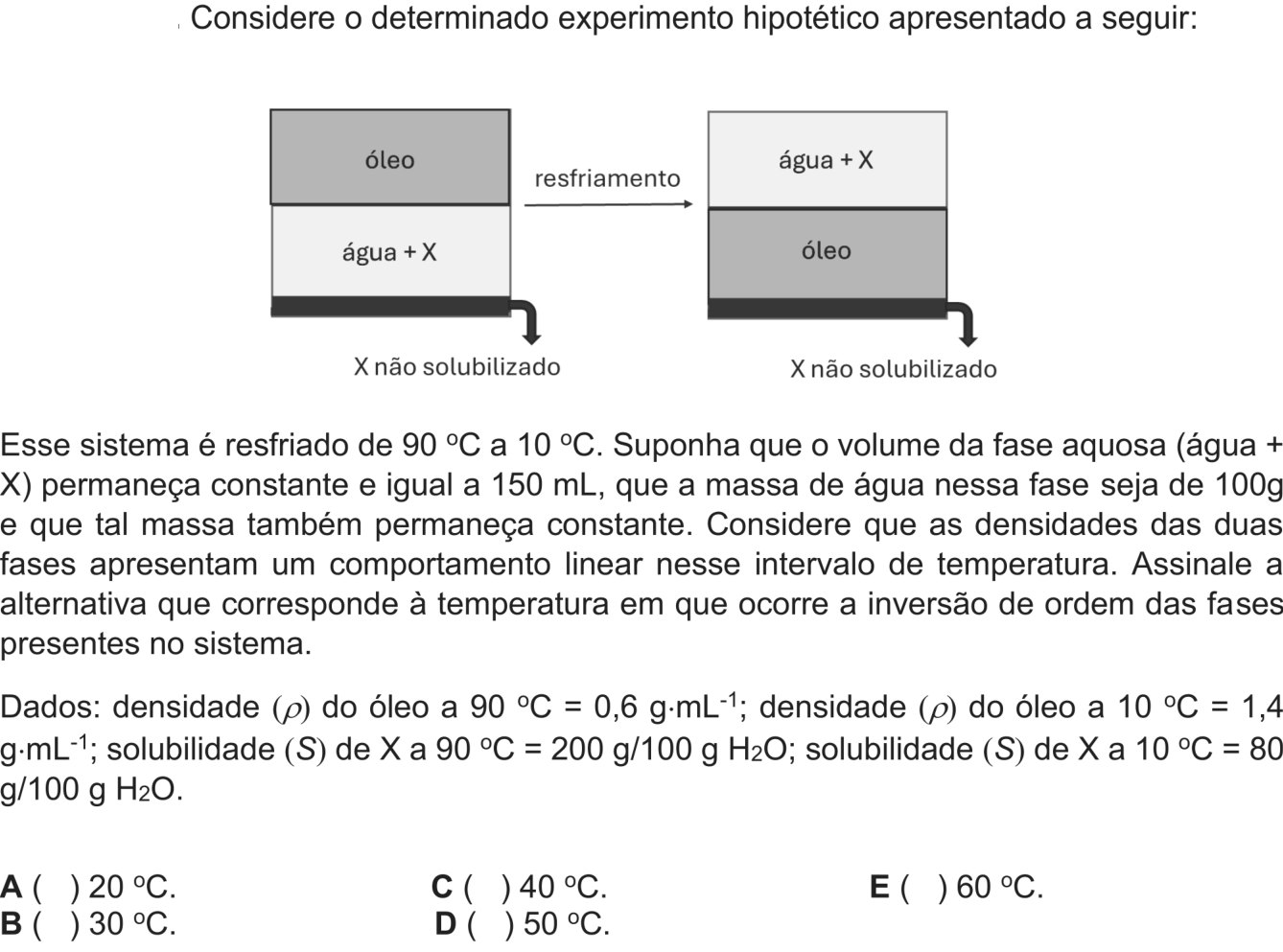
We need answer question. Need solve. Let's restate. Need determine temperature at which inversion of order of phases occurs. System initially at 90°C: oil (top), water + X (bottom). Upon cooling to 10°C, diagram shows water + X top, oil bottom. So densities: at high T, oil less dense than aqueous phase; at low T, oil more dense than aqueous phase? Actually inversion of order means which phase on top/bottom. Initially oil top, aqueous bottom => density oil < density aqueous at 90°C. Finally oil bottom, aqueous top => density oil > density aqueous at 10°C. So crossover temperature where densities equal? Need find temperature where density of oil equals density of aqueous phase (water + X). Densities vary linearly with T. Oil density linear: at 90°C 0.6 g/mL, at 10°C 1.4 g/mL. Aqueous phase density? Contains water + dissolved X? Also non-solubilized X? Need account solubility changes, mass of water constant 100 g, volume aqueous phase constant 150 mL? Wait statement: "Suponha que o volume da fase aquosa (água + X) permaneça constante e igual a 150 mL, que a massa de água nessa fase seja de 100g e que tal massa também permaneça constante." So aqueous phase volume = 150 mL constant; water mass = 100 g constant. It contains water + X (dissolved? and maybe undissolved? "X não solubilizado" at bottom indicates excess solid X not in solution? Let's parse. Diagram shows initially oil top, water + X bottom, and arrow "X não solubilizado" pointing from bottom layer? Actually text: "X não solubilizado" under both diagrams maybe indicating undissolved X? Hmm image: there is a black bottom layer labeled? Let's inspect: Left: top oil, bottom "água + X"; below bottom layer an arrow labeled "X não solubilizado". Right: top "água + X"; bottom oil; below oil arrow "X não solubilizado". So there is undissolved X (solid?) at bottom? Maybe "X não solubilizado" means undissolved X in bottom phase? Actually arrow from bottom points down, label "X não solubilizado" maybe indicates solid X not solubilized present at bottom? But if phase inversion, undissolved X maybe stays with aqueous phase? Hmm.
Need determine temperature at which density of oil equals density of aqueous phase. Aqueous phase consists of water + dissolved X (maybe saturated solution) and possibly undissolved X? But "X não solubilizado" might be excess solid X (not dissolved) at bottom, not part of aqueous phase? The aqueous phase (água + X) may be saturated solution with undissolved solid? The diagram labels bottom layer "água + X" and arrow "X não solubilizado" maybe separate solid? Let's read: "Esse sistema é resfriado de 90 °C a 10 °C. Suponha que o volume da fase aquosa (água + X) permaneça constante e igual a 150 mL, que a massa de água nessa fase seja de 100g e que tal massa também permaneça constante. Considere que as densidades das duas fases apresentam um comportamento linear nesse intervalo de temperatura. Assinale a alternativa que corresponde à temperatura em que ocorre a inversão de ordem das fases presentes no sistema."
So two phases: oil phase (pure oil? density given) and aqueous phase (water + X). The mass of water in aqueous phase 100g constant. Volume of aqueous phase 150 mL constant. Solubility of X at 90°C = 200 g/100g H2O; at 10°C = 80 g/100g H2O. Since cooling, solubility decreases, so some X precipitates (não solubilizado). But "X não solubilizado" may be solid X in bottom? It may not be part of aqueous phase? However density of aqueous phase? The aqueous phase includes dissolved X and water, but excludes precipitated solid? The volume of aqueous phase constant 150 mL, mass of water constant 100g. If dissolved X amount changes with T, density of aqueous phase changes due to dissolved X mass. But if undissolved X is present as separate solid, the aqueous phase is saturated solution; density of saturated solution depends on concentration (solubility) and temperature. The density of aqueous phase can be calculated from total mass of solution (water + dissolved X) divided by volume (150 mL). The dissolved X mass equals solubility at that temperature (if saturated) because excess solid present. At 90°C solubility 200g/100g water => dissolved X = 200g. At 10°C solubility 80g/100g water => dissolved X = 80g. So mass aqueous phase = 100 + dissolved X. Volume constant 150 mL? But if dissolved X changes, volume might change, but problem says volume aqueous phase remains constant 150 mL? It says "Suponha que o volume da fase aquosa (água + X) permaneça constante e igual a 150 mL, que a massa de água nessa fase seja de 100g e que tal massa também permaneça constante." So volume of aqueous phase (including dissolved X) constant 150 mL; water mass constant 100g. Thus density aqueous = (100 + dissolved X)/150. At 90: (100+200)/150 = 300/150 = 2 g/mL. At 10: (100+80)/150 = 180/150 = 1.2 g/mL. Oil density at 90 = 0.6 g/mL, at 10 = 1.4 g/mL. At 90: oil density 0.6 < aqueous 2 => oil top (correct). At 10: oil density 1.4 > aqueous 1.2 => oil bottom (correct). Density equal when oil density = aqueous density. Oil density linear: ρ_oil(T) = a + b T? Let's compute slope: from 10°C to 90°C, ΔT=80°C, Δρ = 0.8 g/mL (1.4-0.6=0.8), slope = 0.8/80 = 0.01 g/mL per °C. So ρ_oil(T) = 0.6 + 0.01*(T-90)? Actually at T=90, 0.6; at T=10, 0.6 +0.01*(10-90)=0.6-0.8=-0.2? Wait 0.01*( -80)= -0.8, sum -0.2? Wrong. Let's set slope positive? As T increases, density decreases? Data: at 90°C 0.6, at 10°C 1.4. So density decreases with increasing T: slope = (0.6-1.4)/(90-10)= -0.8/80 = -0.01 g/mL/°C. Equation: ρ_oil(T) = 1.4 + (-0.01)*(T-10) = 1.4 -0.01(T-10) = 1.5 -0.01 T? At T=10: 1.4; at T=90: 1.5 -0.9 =0.6 yes. So ρ_oil(T)=1.5 -0.01 T (°C).
Aqueous density? It changes with dissolved X, which depends on solubility S(T) = g X per 100 g water. Solubility likely linear? Problem only gives two points: at 90°C 200 g/100g, at 10°C 80 g/100g. It says densities of two phases present linear behavior in interval? Actually "Considere que as densidades das duas fases apresentam um comportamento linear nesse intervalo de temperatura." The densities, not solubility. The aqueous phase density depends on dissolved X concentration, which may not be linear? But maybe they assume density of aqueous phase linear with temperature? Or solubility linear? Need infer. They give solubility at two temperatures; maybe solubility also linear? The problem asks temperature of inversion; need solve. We need decide aqueous phase density at intermediate T. If solubility is linear? Let's examine.
Aqueous phase density = mass/volume = (100 g water + dissolved X mass)/150 mL. Dissolved X mass = solubility S(T) if saturated. Since solid X present, solution saturated at all T. So density = (100 + S(T))/150. S(T) maybe can be assumed linear? They didn't state solubility linear, only densities of two phases linear? But "densidades das duas fases apresentam um comportamento linear" might mean density of each phase vs temperature is linear. For oil, density linear. For aqueous phase, density also linear? If solubility not linear, density might not be linear. But maybe because mass dissolved changes linearly? Let's test with data: S at 90=200, at 10=80. If linear S(T) = 80 + (200-80)*(T-10)/80 = 80 + 1.5*(T-10) = 1.5T +65? At T=10: 80; T=90: 200. Then aqueous density = (100 + S)/150 = (100 + 1.5T +65)/150 = (165 +1.5T)/150 = 1.1 +0.01 T? At 10: 1.1+0.1=1.2; at 90:1.1+0.9=2.0. Linear. Then equality with oil: 1.5 -0.01T = 1.1 +0.01T => 0.4 =0.02T => T=20°C. That corresponds option A 20°C. That seems plausible.
But let's verify if solubility linear is intended? The problem states "Considere que as densidades das duas fases apresentam um comportamento linear nesse intervalo de temperatura." It does not explicitly say solubility linear. But density of aqueous phase linear if dissolved mass linear? Maybe they expect using average? Let's see if other interpretations yield other options. We need be careful.
Alternative: aqueous phase density maybe constant? No, because dissolved X changes. But maybe "X não solubilizado" is not part of aqueous phase? They may consider aqueous phase only water + dissolved X, volume constant 150 mL, mass water 100g. Dissolved X at each T equals solubility? Yes if excess solid present. The density at T might be computed by interpolation of solubility? Since they gave two points, likely assume linear variation of solubility (or density) with T. The phrase "densidades das duas fases apresentam comportamento linear" maybe means oil density and aqueous phase density both linear, so we can use linear interpolation. To find aqueous density at arbitrary T, we can interpolate between densities at 90 and 10? We have only two points for aqueous density: at 90 = 2 g/mL, at 10 = 1.2 g/mL. If we assume aqueous density also linear with T, then same equation: ρ_aq(T) = 1.2 + (2.0-1.2)*(T-10)/80 = 1.2 +0.01*(T-10)=1.1 +0.01T? Wait at T=90: 1.2 +0.01*80=2.0 yes. So same. Thus equality: oil density linear between 0.6 and 1.4: ρ_oil(T)=1.4 + (0.6-1.4)*(T-10)/80 = 1.4 -0.01*(T-10)=1.5 -0.01T. Equality: 1.5 -0.01T = 1.1 +0.01T => 0.4 =0.02T => T=20°C. So answer A.
But need ensure no other factors: Maybe volume of aqueous phase constant 150 mL, but as X precipitates, volume occupied by solid? However problem says volume of aqueous phase (água + X) remains constant 150 mL; undissolved X maybe separate? Actually "X não solubilizado" maybe not in aqueous phase? But if undissolved solid is present, the volume of aqueous phase (solution) remains 150 mL, while solid volume maybe excluded? The wording "volume da fase aquosa (água + X)" suggests the aqueous phase includes water + dissolved X, not solid X? But "X não solubilizado" maybe solid at bottom separate? The diagram labels bottom "água + X" and "X não solubilizado" arrow? Let's examine image: Left: top layer gray "óleo"; bottom layer white "água + X"; below bottom layer a downward arrow with text "X não solubilizado". That might mean "X não solubilizado" is the solid X that settles at bottom, not part of aqueous phase? Actually if it's not solubilized, it may be solid X at the bottom, below the aqueous phase? But diagram shows "água + X" as one layer, and "X não solubilizado" maybe indicates that the X in that layer is not solubilized? Hmm.
Let's read original: "Esse sistema é resfriado de 90 °C a 10 °C. Suponha que o volume da fase aquosa (água + X) permaneça constante e igual a 150 mL, que a massa de água nessa fase seja de 100g e que tal massa também permaneça constante." So phase aqueous contains water + X. They don't mention undissolved X as separate phase; perhaps "X não solubilizado" is just label for solid X in equilibrium? Actually "X não solubilizado" could be the portion of X that did not dissolve, which may be present as solid in the bottom of the aqueous phase? But "fase aquosa (água + X)" maybe includes both dissolved and undissolved X? If undissolved X is suspended? Hmm.
Let's consider if undissolved X is not part of aqueous phase but a separate solid phase, then density of aqueous phase should be based only on dissolved X. That's what we did. At 90°C solubility 200g/100g, so 200g dissolved; any extra X? The problem doesn't give total X amount, only solubility. The diagram "X não solubilizado" maybe indicates excess solid X present at all temperatures? Actually if initial system had excess X? They label "X não solubilizado" at bottom, so undissolved X exists. But the amount doesn't matter for saturated solution density. However if undissolved solid X is part of the aqueous phase volume? The volume of aqueous phase (water + X) might include undissolved X? But "X não solubilizado" is separate? Let's parse Portuguese: "X não solubilizado" = X not solubilized. It may be the solid that precipitates and is not in solution. The diagram: left: top oil, bottom "água + X"; arrow below "X não solubilizado" maybe points to solid X at bottom? Actually the arrow is below the bottom layer, labeled "X não solubilizado" with a curved arrow? In image, there's a small black rectangle at bottom with an arrow pointing down/right, label "X não solubilizado". It might represent a solid phase (undissolved X) at the bottom. On right, after cooling, oil at bottom, aqueous top; again "X não solubilizado" arrow below oil? Wait right diagram: top "água + X"; bottom "óleo"; below oil an arrow "X não solubilizado". That would mean solid X is below oil? That seems odd; if oil is denser, it goes to bottom, but undissolved X maybe even denser? Actually "X não solubilizado" might be solid X that settles at the bottom, below oil? Let's inspect: On left, oil top, aqueous bottom, and "X não solubilizado" arrow below aqueous? On right, water+X top, oil bottom, and "X não solubilizado" arrow below oil? That suggests solid X is always at very bottom, below both liquid phases. So undissolved X is a separate solid phase at bottom, not part of aqueous phase. The aqueous phase is the solution (water + dissolved X) above the solid. Its volume constant 150 mL, water mass 100g. The dissolved X amount changes with T. So our calculation holds.
But wait, if undissolved X is separate solid, its volume? The problem says "volume da fase aquosa (água + X) permaneça constante e igual a 150 mL" so the solution volume is 150 mL, not including solid. Good.
Now, need solve carefully: At 90°C, solubility 200g/100g water, so dissolved X = 200g; aqueous phase mass = 300g; volume 150 mL => density 2 g/mL. At 10°C, solubility 80g/100g => mass = 180g; volume 150 mL => density 1.2 g/mL. Oil density at 90 = 0.6, at 10 = 1.4. Densities linear. Find T where ρ_oil = ρ_aq.
Let's derive with linear equations.
Let T in °C. Oil density: ρ_o(T) = 0.6 + (1.4-0.6)*(90 - T)/(90-10)? Actually as T increases from 10 to 90, density decreases from 1.4 to 0.6. So ρ_o(T) = 1.4 + (0.6-1.4)*(T-10)/(90-10) = 1.4 -0.8*(T-10)/80 = 1.4 -0.01(T-10) = 1.5 -0.01T.
Aqueous density: At 90: 2.0; at 10: 1.2. Linear: ρ_aq(T) = 1.2 + (2.0-1.2)*(T-10)/80 = 1.2 +0.8*(T-10)/80 = 1.2 +0.01(T-10) = 1.1 +0.01T.
Set equal: 1.5 -0.01T = 1.1 +0.01T => 0.4 =0.02T => T=20°C. Yes.
But let's double-check if solubility linear? If not, but problem states densities linear, so aqueous density linear with T. We used endpoints. Good.
However, potential twist: The aqueous phase density may include undissolved X? If "água + X" includes all X (dissolved + undissolved) in the phase? But they separately label "X não solubilizado" maybe not part of aqueous phase? If undissolved X is included in aqueous phase volume, then density would be different. Let's examine: Suppose aqueous phase volume 150 mL includes water + all X (dissolved + undissolved) present in that phase? But "X não solubilizado" may be in the aqueous phase? If all X (including undissolved) is in the aqueous phase (suspension), then mass of aqueous phase = water + total X (dissolved + undissolved). But we don't know total X amount; only solubility. If excess solid X present, total X in phase could be more than solubility. But problem says "X não solubilizado" maybe not part of aqueous phase? The diagram labels "X não solubilizado" separately, so likely separate solid phase. So our assumption is correct.
Let's consider another interpretation: At 90°C, solubility 200g/100g, so 200g dissolved. At 10°C, solubility 80g/100g, so 80g dissolved; 120g precipitated as solid. The solid X may settle at bottom, separate. The aqueous phase volume constant 150 mL, water mass 100g. So density of aqueous phase at 10 = (100+80)/150 = 1.2. Yes.
Potential issue: Volume of aqueous phase may change due to dissolved X? But problem explicitly says volume constant 150 mL. So density just mass/volume.
Let's ensure oil density interpolation: They say "densidades das duas fases apresentam comportamento linear nesse intervalo de temperatura." Could mean both densities as function of temperature are linear. So yes.
Let's see if any alternative answer from using solubility linear but not density linear? Actually aqueous density linear if solubility linear; but if solubility not linear, density may not be linear; but problem states densities linear, so okay. But what if they expect using average density? Let's test if using mass of X at 90 and 10 but volume constant, then density at T could be computed via linear interpolation of density, which is equivalent to linear solubility? Wait if solubility not linear but density linear, we don't need solubility linear. We already used density linear.
Let's verify endpoints with volume 150 mL:
At 90: water 100g + dissolved X 200g = 300g /150 mL = 2 g/mL.
At 10: 100+80=180g /150=1.2 g/mL.
Yes.
Now, the inversion temperature: At 20°C, ρ_oil = 1.5 -0.01*20 = 1.3 g/mL; ρ_aq = 1.1 +0.01*20 = 1.3 g/mL. At T<20, oil density > aqueous? Let's check T=10: oil 1.4 > aqueous 1.2 => oil bottom. At T>20, oil density < aqueous? T=90: oil 0.6 < aqueous 2.0 => oil top. So inversion at 20°C. Option A.
Need produce final answer in Portuguese with explanation. Include line "Resposta: A". The user says "Resolva a questão e explique o seu raciocínio em português. Termine com uma linha neste formato: Resposta: X". So final should include explanation and answer.
Let's craft explanation step by step.
Potential nuance: The question says "inversão de ordem das fases presentes no sistema." Could the inversion occur when densities equal, but also due to volume? Yes.
Let's include calculations:
- Densidade do óleo: linear. Use points (90,0.6) and (10,1.4). Equation: ρ_óleo(T)=1.5 -0.01T.
- Fase aquosa: massa de água 100g; massa de X dissolvido = solubilidade em g/100g água. At 90: 200g; at 10: 80g. Volume constante 150 mL. Densidade em 90: (100+200)/150 = 2.0 g/mL; em 10: (100+80)/150 = 1.2 g/mL. Linear: ρ_aq(T)=1.1 +0.01T.
- Equal: 1.5 -0.01T = 1.1 +0.01T => T=20°C.
Check if at 20°C, dissolved X =? Solubility linear? At 20°C, S = 80 + (200-80)*(20-10)/80 = 80 +120*10/80 = 80+15=95 g? Then density = (100+95)/150=195/150=1.3 g/mL. Yes.
Let's also mention that as T decreases below 20, oil becomes denser than aqueous phase, so oil goes to bottom; above 20, oil less dense, top. Thus inversion at 20°C.
Need ensure units: Temperatures in °C.
Let's formulate final answer elegantly.
Potential issue: "densidades das duas fases apresentam comportamento linear" Could the oil density linear but aqueous density maybe constant? No, because dissolved X changes. But if they only state densities linear, our interpolation is valid. Let's present.
Let's write in Portuguese.
Final line: Resposta: A
Para resolver, precisamos encontrar a temperatura em que as densidades da fase oleosa e da fase aquosa se igualam, pois é nesse ponto que ocorre a inversão da ordem das fases (a fase mais densa vai para baixo).
1. Densidade do óleo em função da temperatura
Dados:
- A 90 °C: \rho_{\text{óleo}} = 0{,}6\ \text{g/mL}
- A 10 °C: \rho_{\text{óleo}} = 1{,}4\ \text{g/mL}
Como a variação é linear:
\rho_{\text{óleo}}(T)=1{,}4+\frac{0{,}6-1{,}4}{90-10}(T-10)
\rho_{\text{óleo}}(T)=1{,}4-0{,}01(T-10)
\rho_{\text{óleo}}(T)=1{,}5-0{,}01T
2. Densidade da fase aquosa em função da temperatura
A fase aquosa contém 100 g de água e X dissolvido. A massa de X dissolvido é dada pela solubilidade:
- A 90 °C: 200\ \text{g}/100\ \text{g H}_2\text{O}, então massa dissolvida = 200 g.
- A 10 °C: 80\ \text{g}/100\ \text{g H}_2\text{O}, então massa dissolvida = 80 g.
O volume da fase aquosa é constante e igual a 150 mL.
Densidade a 90 °C:
\rho_{\text{aq}}(90)=\frac{100+200}{150}=\frac{300}{150}=2{,}0\ \text{g/mL}
Densidade a 10 °C:
\rho_{\text{aq}}(10)=\frac{100+80}{150}=\frac{180}{150}=1{,}2\ \text{g/mL}
Como o comportamento também é linear:
\rho_{\text{aq}}(T)=1{,}2+\frac{2{,}0-1{,}2}{90-10}(T-10)
\rho_{\text{aq}}(T)=1{,}2+0{,}01(T-10)
\rho_{\text{aq}}(T)=1{,}1+0{,}01T
3. Igualando as densidades
\rho_{\text{óleo}}(T)=\rho_{\text{aq}}(T)
1{,}5-0{,}01T=1{,}1+0{,}01T
0{,}4=0{,}02T
T=20\ ^\circ\text{C}
Portanto, a inversão de ordem das fases ocorre a 20 °C.
Resposta: A