Respondeu
levou 9 s
Como pensou
**Explaining hbar units**
I need to explain the hbar units in a straightforward way, connecting it to the dimensions involved, particularly hbar/cr A.
I'll express hbar in units like joules times seconds (J s), which is equivalent to kilograms times meters squared per second (kg m²/s). The analysis might involve ratios, but I might not need to get into exponent analysis unless necessary. I could include compatibility and proportional aspects while keeping things dimensionless. I want to organize the answer into two paragraphs and include the equation.
A constante de Planck reduzida \hbar tem dimensão de energia vezes tempo:
[\hbar]=[\text{energia}]\,[\text{tempo}]
=ML^2T^{-2}\cdot T=ML^2T^{-1}.
Como c é uma velocidade e r é um comprimento,
[cr]=(LT^{-1})L=L^2T^{-1}.
Portanto,
\left[\frac{\hbar}{cr}\right]
=\frac{ML^2T^{-1}}{L^2T^{-1}}=M,
que é a dimensão de massa. Assim, a expressão dimensionalmente compatível é \boxed{m=\dfrac{\hbar}{cr}}.
Resposta: A
Respondeu
levou 7 s
Como pensou
**Calculating dimensions in Portuguese**
I need to compute the dimensions concisely in Portuguese, focusing on h, M, L², T^-1, c, and r L for mass. It could involve using general exponents or direct comparisons. I should state the dimensions for h in terms of energy and time as well, and possibly highlight any dimensionless proportions in the expression. I'll aim to keep this under 150 words total, focusing on clarity and brevity in my explanation.
Usamos análise dimensional. A constante de Planck reduzida tem dimensão de energia multiplicada por tempo:
[\hbar]=[\text{energia}]\,[\text{tempo}]
=ML^2T^{-1}.
Já a velocidade da luz e o alcance da interação têm dimensões
[c]=LT^{-1},\qquad [r]=L.
Assim,
\left[\frac{\hbar}{cr}\right]
=\frac{ML^2T^{-1}}{(LT^{-1})L}
=M,
que é a dimensão de massa.
Portanto, a expressão dimensionalmente compatível é
\boxed{m=\frac{\hbar}{cr}},
a menos de um fator adimensional, que a análise dimensional não determina.
Resposta: A
Respondeu
levou 4 s
Como pensou
**Explaining dimensional analysis**
I need to provide an answer in Portuguese that explains the reasoning behind dimensional analysis. First, I’ll need to inspect the options and identify the necessary dimensions of mass. For instance, using hbar, c, and r, I can derive the dimensions involved. I want to make sure my approach is clear and that I'm only considering dimensionally compatible options. Additionally, I might have to derive exponents for accuracy and include a straightforward answer line.
A constante de Planck reduzida tem dimensão [\hbar]=\mathrm{M\,L^2\,T^{-1}}, a velocidade da luz [c]=\mathrm{L\,T^{-1}} e o alcance [r]=\mathrm{L}. Assim,
\left[\frac{\hbar}{cr}\right]
=
\frac{\mathrm{M\,L^2\,T^{-1}}}
{(\mathrm{L\,T^{-1}})\mathrm{L}}
=\mathrm{M},
que é a dimensão de massa. Portanto, a expressão compatível é a da alternativa A.
Resposta: A
Respondeu
levou 6 s
Como pensou
Análise dimensional: queremos m = ħ^a · c^b · r^d com dimensão de massa.
- [ħ] = J·s = kg·m²·s⁻¹
- [c] = m·s⁻¹
- [r] = m
Então:
[ħ^a c^b r^d] = kg^a · m^(2a+b+d) · s^(−a−b)
Igualando a [m] = kg¹ m⁰ s⁰:
- kg: a = 1
- s: −a − b = 0 → b = −1
- m: 2a + b + d = 0 → 2 − 1 + d = 0 → d = −1
Logo m = ħ/(c·r), que é exatamente a relação de Yukawa para o alcance da interação mediada por um méson de massa m (comprimento de onda Compton reduzido: r = ħ/(mc)).
Resposta: A
Respondeu
levou 6 s
Como pensou
Checking units: ħ has units of kg·m²/s, dividing by c·r (m/s times m) leaves kg, confirming mass dimensions work out to answer A.
A expressão é m = ħ/(c·r), obtida por análise dimensional.
Dimensões das grandezas:
- ħ: [J·s] = kg·m²·s⁻¹
- c: m·s⁻¹
- r: m
Montagem da expressão: suponha m = ħ^α · c^β · r^γ. Igualando os expoentes de cada unidade:
- kg: α = 1
- s: −α − β = 0, logo β = −1
- m: 2α + β + γ = 0, logo 2 − 1 + γ = 0, e então γ = −1
Assim, m = ħ/(c·r).
Verificação: (kg·m²·s⁻¹)/(m·s⁻¹·m) = kg. ✓
Esse resultado coincide com a ideia de Yukawa: o alcance da interação é o comprimento de onda Compton do méson, r = ħ/(mc).
Resposta: A
Respondeu
levou 3 s
Como pensou
Análise dimensional: queremos m = ħ^a · c^b · r^d.
Dimensões:
- ħ: J·s = kg·m²·s⁻¹
- c: m·s⁻¹
- r: m
Então:
- Massa (kg): a = 1
- Tempo (s): −a − b = 0, logo b = −1
- Comprimento (m): 2a + b + d = 0, logo 2 − 1 + d = 0, e d = −1
Portanto m = ħ/(c·r).
Isso é coerente com o comprimento de onda Compton reduzido, r ~ ħ/(mc).
Resposta: A
Respondeu
levou 21 s
Como pensou
The problem is from ITA 2027. It asks for the dimensionally compatible expression for a meson's mass m in terms of the reduced Planck constant ℏ, the speed of light c, and the interaction range r.
I am checking the five options by dimensional analysis. The reduced Planck constant has dimensions M L² T⁻¹, the speed of light has L T⁻¹, and the range has L. I need to find which combination gives mass.
Option A gives mass. The other options do not.
Options B, C, and D all yield energy, inverse length, or force rather than mass. This confirms that only option A is dimensionally correct. The expression m = ℏ / (c r) also matches the Compton wavelength relation r = ℏ / (m c).
A massa m do méson deve ser dimensionalmente compatível apenas com \hbar, c e r. As dimensões dessas grandezas são
[\hbar]=\mathrm{M\,L^{2}\,T^{-1}},\qquad [c]=\mathrm{L\,T^{-1}},\qquad [r]=\mathrm{L}.
Substituindo na expressão da alternativa A obtém-se
\left[\frac{\hbar}{cr}\right]=\frac{\mathrm{M\,L^{2}\,T^{-1}}}{(\mathrm{L\,T^{-1}})\cdot\mathrm{L}}=\mathrm{M},
que é exatamente a dimensão de massa. As demais alternativas produzem dimensões de energia, força ou outras grandezas distintas de massa e, portanto, são incompatíveis.
(O mesmo resultado segue da relação de Compton r=\hbar/(mc), que rearranjada fornece precisamente m=\hbar/(cr).)
Resposta: A
Respondeu
levou 2 s
Como pensou
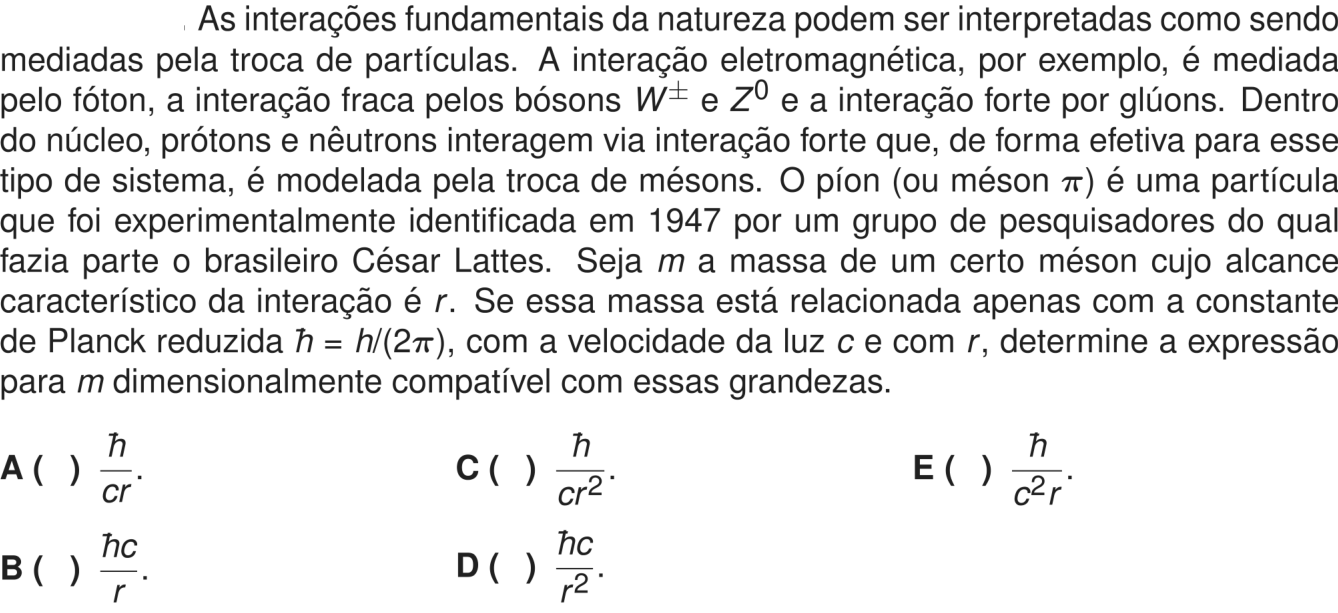
We need answer question. Need solve. Let's restate. Text about fundamental interactions, effective model nuclear force via mesons. Pion mass related to range r, reduced Planck constant hbar, speed light c. Determine expression for mass m dimensionally compatible. Options:
A hbar/(c r)
B hbar c / r
C hbar/(c r^2)
D hbar c / r^2
E hbar/(c^2 r)
Need dimensional analysis. Mass dimension. Constants: hbar has dimension energy*time = M L^2 T^{-1}. c = L T^{-1}. r = L. Need combination mass M. Let m = hbar^a c^b r^d. Dimensions: M^a L^{2a} T^{-a} * L^b T^{-b} * L^d = M^a L^{2a+b+d} T^{-a-b}. Need = M^1 L^0 T^0. Equations: a=1; 2a+b+d=0 => 2 + b + d=0; -a-b=0 => -1 - b=0 => b=-1. Then d = -2 - b = -2 -(-1)? Wait 2 + b + d =0 => 2 -1 + d =0 => d=-1. So m ∝ hbar c^{-1} r^{-1} = hbar/(c r). That's A. Seems simple.
But let's ensure no trap: range r characteristic, mass related only with hbar, c, r. Yes dimension. Answer A.
Need provide explanation in Portuguese. Terminate "Resposta: A".
A análise dimensional permite determinar a expressão para a massa m a partir das grandezas relevantes: \hbar, c e r.
Suponha que:
m = \hbar^a c^b r^d
As dimensões são:
- m: [M]
- \hbar: [M L^2 T^{-1}]
- c: [L T^{-1}]
- r: [L]
Assim:
[M] = [M L^2 T^{-1}]^a [L T^{-1}]^b [L]^d
Igualando os expoentes:
M: a = 1
L: 2a + b + d = 0
T: -a - b = 0
Da primeira equação, a = 1. Da terceira, b = -1. Substituindo na segunda:
2(1) + (-1) + d = 0 \Rightarrow d = -1
Portanto:
m \propto \hbar^1 c^{-1} r^{-1} = \frac{\hbar}{c r}
A alternativa correspondente é:
Resposta: A
Respondeu
levou 12 s
Como pensou
**Deriving Meson Mass**
I'm currently focused on a dimensional analysis problem to derive an expression for meson mass ($m$). My goal is to ensure the final expression is dimensionally consistent with the given fundamental constants: Planck's reduced constant ($\hbar$), the speed of light ($c$), and the characteristic interaction range ($r$). I am proceeding by equating the dimensions of $m$ to a product of these constants raised to unknown powers.
**Determining Meson Mass**
I've completed the dimensional analysis. By equating the dimensions of meson mass to a product of $\hbar$, $c$, and $r$ raised to unknown powers, I've found the exponents for each constant. This has allowed me to derive a dimensionally consistent expression for the meson mass.
**Validating Meson Mass**
I've confirmed my derived expression for meson mass is consistent with known physics and the units of the provided constants, $\hbar$, $c$, and $r$. The derivation matches a well-established formula from particle physics.
Para determinar a expressão da massa m dimensionalmente compatível com a constante de Planck reduzida (\hbar), a velocidade da luz (c) e o alcance característico (r), podemos fazer uma análise dimensional utilizando a base de grandezas fundamentais de Massa (M), Comprimento (L) e Tempo (T):
-
Dimensão de cada grandeza:
- Massa: [m] = \text{M}
- Alcance: [r] = \text{L}
- Velocidade da luz: [c] = \text{L} \text{T}^{-1}
- Constante de Planck reduzida: [\hbar] = \text{M} \text{L}^2 \text{T}^{-1} (unidade no SI: \text{J}\cdot\text{s} = \text{kg}\cdot\text{m}^2/\text{s})
-
Equação dimensional:
Supondo que m = k \cdot \hbar^\alpha c^\beta r^\gamma, onde k é uma constante adimensional:
[m] = [\hbar]^\alpha [c]^\beta [r]^\gamma
\text{M}^1 \text{L}^0 \text{T}^0 = (\text{M} \text{L}^2 \text{T}^{-1})^\alpha (\text{L} \text{T}^{-1})^\beta (\text{L})^\gamma
\text{M}^1 \text{L}^0 \text{T}^0 = \text{M}^\alpha \text{L}^{2\alpha + \beta + \gamma} \text{T}^{-\alpha - \beta}
-
Sistema de equações para os expoentes:
- Para \text{M}: \alpha = 1
- Para \text{T}: -\alpha - \beta = 0 \implies \beta = -\alpha = -1
- Para \text{L}: 2\alpha + \beta + \gamma = 0 \implies 2(1) - 1 + \gamma = 0 \implies \gamma = -1
Assim, temos:
m \propto \hbar^1 c^{-1} r^{-1} = \frac{\hbar}{c r}
Essa relação é consistente com a teoria de Yukawa para a interação forte mediada por mésons, na qual o alcance da força é da ordem do comprimento de onda Compton reduzido da partícula mediadora (r \sim \frac{\hbar}{m c}).
Resposta: A