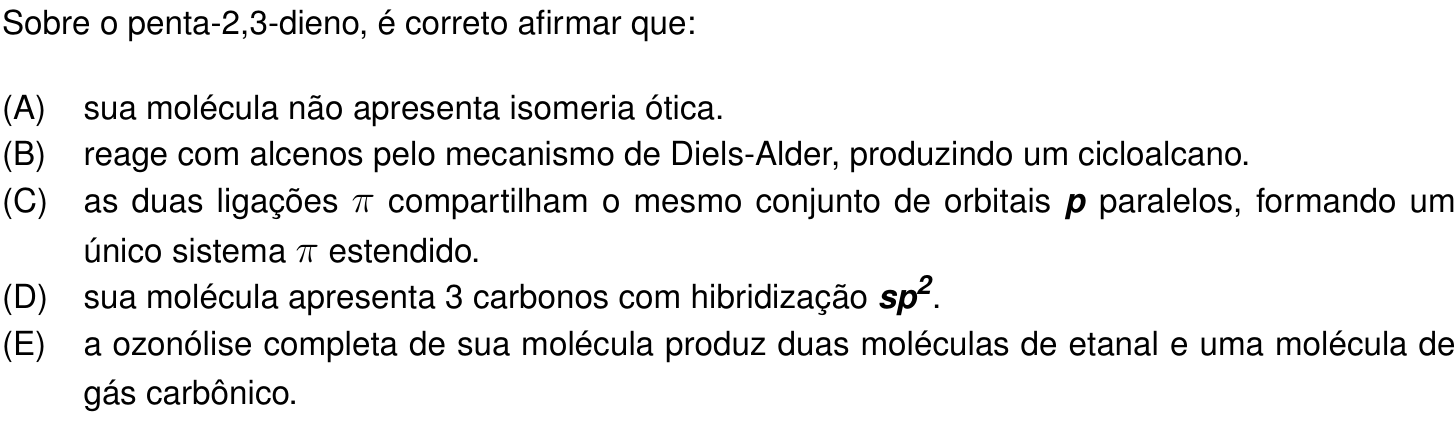
Como pensou
We need answer in Portuguese, explain. Need solve question. Let's restate. "Sobre o penta-2,3-dieno, é correto afirmar que:" Options. Need identify correct statement about penta-2,3-diene. Let's analyze thoroughly.
Penta-2,3-diene: CH3-CH=C=CH-CH3? Wait penta-2,3-dieno: parent pentane with double bonds at positions 2 and 3. Structure: C1-C2=C3=C4-C5? Let's name: CH3-CH=C=CH-CH3? Actually penta-2,3-diene is an allene? Positions 2 and 3 double bonds: C2=C3 and C3=C4? Wait diene with cumulative double bonds: "penta-2,3-diene" means five carbons, double bonds between C2-C3 and C3-C4? Let's check IUPAC. Penta-2,3-diene: CH2? Let's draw: C1-C2=C3=C4-C5? If double bonds at 2 and 3, C2=C3 and C3=C4. Then central carbon C3 has double bonds to C2 and C4, so it's an allene: C1-C2=C3=C4-C5? But C2 would have double bond to C3 and single to C1, with H? C3 double bonds to C2 and C4, no H. C4 double bond to C3 and single to C5. Yes penta-2,3-diene = CH3-CH=C=CH-CH3? Let's assign: C1: CH3, C2: CH, C3: C, C4: CH, C5: CH3? Wait valence: C2 has double to C3, single to C1, single to H: CH. C3 has double to C2, double to C4: no H. C4 has double to C3, single to C5, single to H: CH. C5: CH3. So CH3-CH=C=CH-CH3. Yes allene with terminal methyls.
Option A: "sua molécula não apresenta isomeria ótica." Need determine if penta-2,3-diene has optical isomers. Allene with different substituents at each terminal carbon can be chiral if substituents on each end are different. General allene R1R2C=C=CR3R4 is chiral if R1≠R2 and R3≠R4. Here penta-2,3-diene: CH3-CH=C=CH-CH3. Each terminal carbon (C2 and C4) has substituents: C2 has H, CH3, and double bond to C3; C4 has H, CH3, and double bond to C3. Because terminal carbons each have H and CH3, they are different (H ≠ CH3) on both ends. Also the two CH3 groups? Wait allene axial chirality: if each end has two different substituents, molecule is chiral. So it should present optical isomerism (enantiomers). Option A says não apresenta isomeria ótica = false.
Option B: "reage com alcenos pelo mecanismo de Diels-Alder, produzindo um cicloalcano." Diels-Alder is reaction between a conjugated diene (4π) and a dienophile (alkene/alkyne). Penta-2,3-diene is a cumulated diene, not conjugated; it cannot act as diene in Diels-Alder? Actually allenes can undergo [2+2] or other cycloadditions, but not Diels-Alder as 4π diene. Also produces cycloalkene, not cycloalkane. False.
Option C: "as duas ligações π compartilham o mesmo conjunto de orbitais p paralelos, formando um único sistema π estendido." For allene, the two π bonds are orthogonal (perpendicular), not parallel; central carbon sp hybridized, p orbitals not parallel; no extended π system. False.
Option D: "sua molécula apresenta 3 carbonos com hibridização sp2." In allene CH3-CH=C=CH-CH3: central carbon C3 is sp hybridized; terminal double-bonded carbons C2 and C4 are sp2; the two methyl carbons C1 and C5 are sp3. So number of sp2 carbons = 2, not 3. False.
Option E: "a ozonólise completa de sua molécula produz duas moléculas de etanal e uma molécula de gás carbônico." Need check ozonolysis of allene. Ozonolysis of alkenes cleaves C=C; for allene C=C=C, ozonolysis can yield carbonyl compounds and CO2 depending. Let's analyze penta-2,3-diene: CH3-CH=C=CH-CH3. Ozonolysis oxidative/reductive? "ozonólise completa" maybe with water? General allene ozonolysis: allene R2C=C=CR2? Each double bond cleaved; central carbon becomes CO2? Let's derive.
Ozonolysis of alkenes: C=C -> two carbonyls. For allene with two cumulated double bonds: R2C=C=CR2? Actually penta-2,3-diene: CH3-CH=C=CH-CH3. Cleavage at both double bonds? "complete ozonolysis" breaks all double bonds. Products: Let's assign. Structure: CH3-CH=C=CH-CH3.
Allene has C2=C3=C4. Ozonolysis can cleave C2=C3 and C3=C4? The central carbon C3 is bonded to C2 and C4 by double bonds. Upon complete ozonolysis, each double bond cleaves, C2 gives carbonyl (aldehyde/ketone) depending substituents, C4 gives carbonyl, and central C3 gives CO2? Let's verify.
Take allene CH2=C=CH2 (propadiene): ozonolysis yields formaldehyde + CO2? Let's recall: ozonolysis of allene yields ketones/aldehydes and carbon dioxide. Example: allene CH2=C=CH2 -> 2 HCHO + CO2? Actually balance: C3H4 + O3 -> 2 CH2O + CO2? Let's check atoms: reactants C3H4; products 2 CH2O = C2H4O2 + CO2 = C3H4O4? Wait oxygen from ozone adds; not balanced. Ozonolysis incorporates oxygen: allene + O3 -> maybe glyoxal? Let's derive: Allene ozonolysis can yield carboxylic acids? Let's search memory: Ozonolysis of allene: R2C=C=CR2 + O3 -> R2CO + CO2 + R2CO? So central carbon CO2, terminal carbons ketones/aldehydes. For propadiene: CH2=C=CH2 -> 2 HCHO + CO2. Yes.
Our allene: CH3-CH=C=CH-CH3. Terminal C2 has H and CH3, so cleavage gives acetaldehyde (etanal) CH3CHO. Terminal C4 has H and CH3, gives acetaldehyde. Central carbon C3 gives CO2. So products: 2 etanal + CO2. Option E says exactly: duas moléculas de etanal e uma molécula de gás carbônico. So E correct.
Need ensure "ozonólise completa" maybe not allene? Yes. So answer E.
Need provide explanation in Portuguese. Include reasoning and final line "Resposta: E". Need maybe mention allene geometry, sp, etc. Let's craft concise but enough.
Let's verify all options thoroughly to avoid mistakes. Penta-2,3-diene has chiral allene? Let's confirm: It is CH3-CH=C=CH-CH3. The central carbon sp, terminal carbons sp2. The molecule is not planar; terminal substituents lie in perpendicular planes. It has axial chirality because each terminal carbon has two different substituents (H and CH3). It exists as two enantiomers. So A incorrect. Option D says 3 sp2 carbons: Actually C2 and C4 are sp2; central C3 is sp; C1 and C5 sp3. So 2 sp2 carbons. Incorrect. Option B Diels-Alder: penta-2,3-diene is cumulated, not conjugated; no Diels-Alder. Could it react as dienophile? It is an alkene? But "reage com alcenos pelo mecanismo de Diels-Alder" no. Producing cicloalcano? Diels-Alder produces cyclohexene, not cycloalkane. Incorrect. Option C: π bonds orthogonal, not parallel; not extended. Incorrect.
Final answer in Portuguese. Need include final line. Use "Resposta: E". Let's formulate.
Potential issue: Ozonolysis of allene complete: Does it produce "duas moléculas de etanal e uma molécula de gás carbônico"? Let's verify oxidative workup vs reductive. Reductive ozonolysis of allene maybe gives carbonyls and carbon dioxide? For alkenes, reductive ozonolysis gives aldehydes/ketones; oxidative gives acids. For allene, central carbon may become CO2 in both? Let's check. Ozonolysis of allene: First double bond cleavage maybe gives a carbonyl oxide and a carbonyl? The remaining carbonyl oxide? Let's derive. But common: allene ozonolysis: R2C=C=CR2 -> R2CO + CO2 + R2CO. Yes.
Let's ensure penta-2,3-diene structure has C2 and C4 each with H and CH3, so each terminal yields CH3CHO (etanal), central CO2. Yes.
Let's write explanation: "A estrutura é CH3–CH=C=CH–CH3. A ozonólise completa cliva as duas ligações duplas cumuladas: cada carbono terminal (CH) origina etanal, e o carbono central origina CO2." Good.
Need maybe mention why not A: Alleno com substituintes diferentes em cada carbono terminal é quiral. But since terminal carbons each have H and CH3, it has enantiomerism. Actually if terminal carbon has two identical substituents, not chiral; here they are different, so yes.
Let's craft final with reasoning.
A estrutura do penta-2,3-dieno é:
\mathrm{CH_3-CH=C=CH-CH_3}
Trata-se de um alceno cumulado (alleno), com carbono central \mathrm{sp} e carbonos das extremidades duplas \mathrm{sp^2}.
Analisando as alternativas:
- (A) Falsa. Como cada carbono terminal da ligação dupla cumulada possui dois substituintes diferentes (H e CH₃), a molécula apresenta isomeria ótica (quiralidade axial).
- (B) Falsa. O penta-2,3-dieno é um dieno cumulado, não conjugado; não sofre Diels-Alder como dieno típico. Além disso, Diels-Alder produz cicloalcenos, não cicloalcanos.
- (C) Falsa. Em allenos, as duas ligações \pi são perpendiculares entre si, não paralelas, portanto não formam um sistema \pi estendido.
- (D) Falsa. A molécula possui apenas 2 carbonos com hibridização \mathrm{sp^2}, não 3.
- (E) Verdadeira. A ozonólise completa cliva as duas ligações duplas cumuladas. Cada extremidade \mathrm{CH_3-CH=} produz etanal (\mathrm{CH_3CHO}), e o carbono central produz \mathrm{CO_2}. Assim, formam-se duas moléculas de etanal e uma molécula de gás carbônico.
Resposta: E