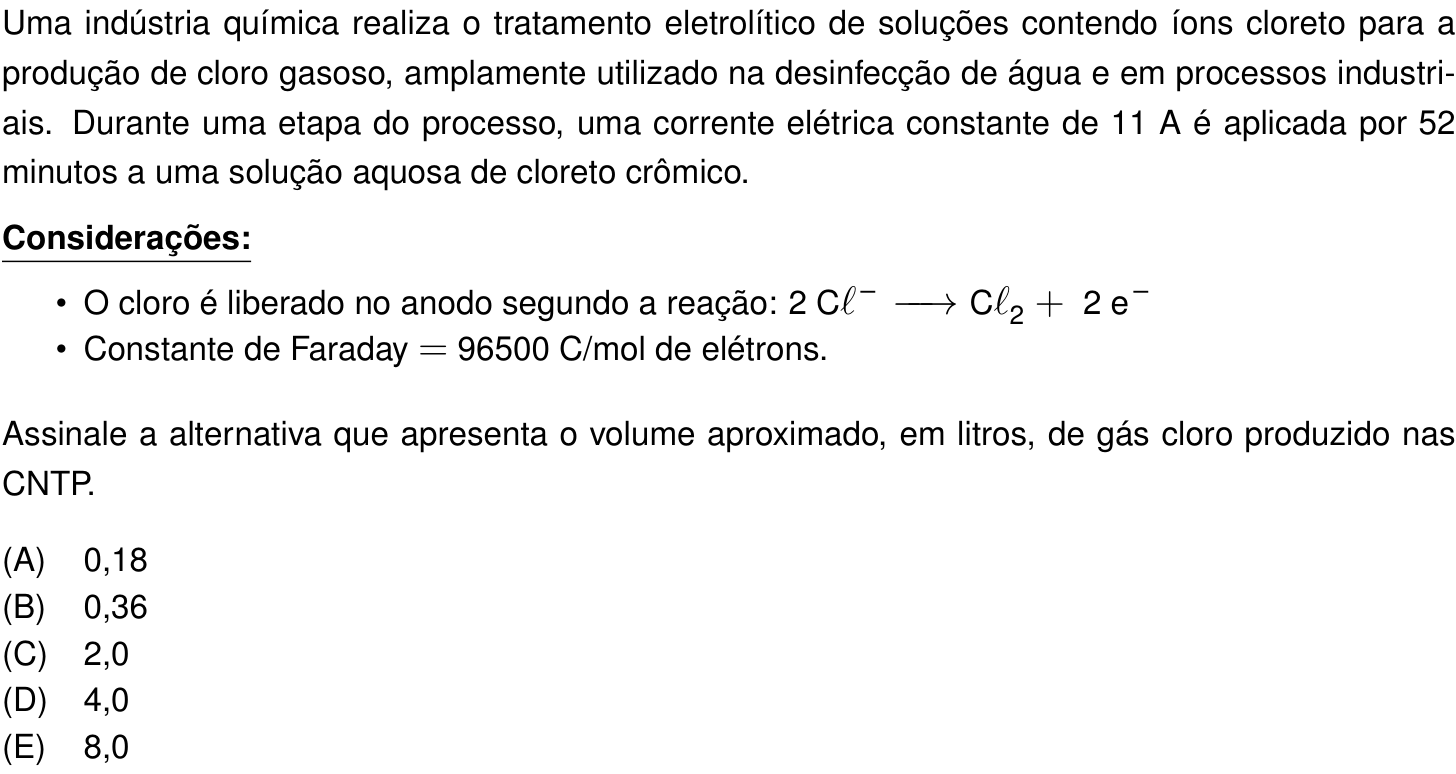
Respondeu
levou 11 s
Como pensou
A carga elétrica que atravessa a solução é:
Q=It=11\cdot(52\cdot60)=34320\ \text{C}.
Pela constante de Faraday, a quantidade de elétrons transferidos é:
n_{e^-}=\frac{Q}{F}=\frac{34320}{96500}\approx0{,}356\ \text{mol}.
Na reação do anodo,
2\,\mathrm{Cl^-}\longrightarrow\mathrm{Cl_2}+2e^-,
cada mol de \mathrm{Cl_2} produzido corresponde à transferência de 2 mol de elétrons. Assim:
n_{\mathrm{Cl_2}}=\frac{0{,}356}{2}\approx0{,}178\ \text{mol}.
Nas CNTP, o volume molar dos gases é aproximadamente 22{,}4\ \text{L/mol}. Logo:
V=0{,}178\cdot22{,}4\approx\boxed{4{,}0\ \text{L}}.
Resposta: D
Respondeu
levou 8 s
Como pensou
**Calculating electron and chlorine quantities**
I’m starting with a straightforward calculation: 11 times 3120 equals 34320. Then, I have 0.35565 electrons and for chlorine, I’m using 0.17782 multiplied by 22.4, which gives me approximately 3.9832 D.
Now, I need to explain the steps in Portuguese clearly and concisely. I want to make sure that my explanations are easy to follow!
A carga elétrica total aplicada é:
Q=I\,t=11\cdot(52\cdot60)=34320\ \text{C}.
Pela constante de Faraday, a quantidade de elétrons transferidos é:
n(e^-)=\frac{Q}{F}=\frac{34320}{96500}\approx0{,}356\ \text{mol}.
A reação 2Cl^-\rightarrow Cl_2+2e^- indica que 2 mol de elétrons correspondem à produção de 1 mol de Cl_2. Assim:
n(Cl_2)=\frac{0{,}356}{2}\approx0{,}178\ \text{mol}.
Nas CNTP, o volume molar é 22{,}4\ \text{L/mol}. Logo:
V=0{,}178\cdot22{,}4\approx4{,}0\ \text{L}.
Resposta: D
Respondeu
levou 4 s
Como pensou
**Solving the chemistry problem**
I need to solve a problem about chlorine in a solution. The current is at 11A for 52 minutes, which gives me Q=11*3120=34320 C. This calculates to 0.1778 moles of Cl2. At standard conditions, that would be about 3.98 L. I should also clarify the reaction for the anode and explain its context, particularly regarding "solução aquosa cloreto crômico." I'll format the answer to make it clear.
A carga elétrica total aplicada é
Q=I\,t=11\ \text{A}\times(52\times60)\ \text{s}=34\,320\ \text{C}.
Assim, a quantidade de elétrons transferida é
n(e^-)=\frac{Q}{F}=\frac{34\,320}{96\,500}\approx 0{,}356\ \text{mol}.
Pela reação 2\mathrm{Cl^-}\rightarrow\mathrm{Cl_2}+2e^-, cada mol de \mathrm{Cl_2} corresponde a 2 mol de elétrons. Logo,
n(\mathrm{Cl_2})\approx\frac{0{,}356}{2}=0{,}178\ \text{mol}.
Na CNTP, considerando o volume molar de 22{,}4\ \text{L/mol},
V\approx0{,}178\times22{,}4\approx4{,}0\ \text{L}.
Resposta: D
Respondeu
levou 7 s
Como pensou
Carga total: Q = i·t = 11 A × 52 min × 60 s/min = 34 320 C.
Mols de elétrons: n(e⁻) = 34 320 / 96 500 ≈ 0,3557 mol.
Pela semirreação 2 Cl⁻ → Cl₂ + 2 e⁻, cada mol de Cl₂ requer 2 mol de elétrons:
n(Cl₂) = 0,3557 / 2 ≈ 0,178 mol.
Volume nas CNTP (22,4 L/mol):
V = 0,178 × 22,4 ≈ 3,98 L ≈ 4,0 L.
Resposta: D
Respondeu
levou 6 s
Como pensou
Charge is 11×52×60 = 34320 C, giving 0.3556 mol electrons, so 0.1778 mol Cl2. At standard conditions that's about 3.98 L, roughly 4.0 L — matching answer D.
O volume de Cl₂ nas CNTP é de aproximadamente 4,0 L.
1. Carga elétrica que passou pela solução
Q = i \cdot t = 11\ \text{A} \times (52 \times 60)\ \text{s} = 11 \times 3120 = 34\,320\ \text{C}
2. Mols de elétrons
n_{e^-} = \frac{34\,320}{96\,500} \approx 0{,}356\ \text{mol}
3. Mols de Cl₂ formados no anodo
Pela semirreação 2 Cℓ⁻ → Cℓ₂ + 2 e⁻, são necessários 2 mol de elétrons para cada 1 mol de Cℓ₂:
n_{Cl_2} = \frac{0{,}356}{2} \approx 0{,}178\ \text{mol}
4. Volume nas CNTP
O volume molar nas CNTP é 22,4 L/mol:
V = 0{,}178 \times 22{,}4 \approx 3{,}98\ \text{L} \approx 4{,}0\ \text{L}
Resposta: D
Respondeu
levou 3 s
Como pensou
Cálculo da carga: Q = i·t = 11 A × (52 × 60 s) = 11 × 3120 = 34320 C.
Mols de elétrons: n(e⁻) = 34320 / 96500 ≈ 0,3557 mol.
Pela semirreação 2 Cl⁻ → Cl₂ + 2 e⁻, cada mol de Cl₂ corresponde a 2 mol de elétrons:
n(Cl₂) = 0,3557 / 2 ≈ 0,1778 mol.
Volume nas CNTP (22,4 L/mol, convenção usual no Brasil):
V = 0,1778 × 22,4 ≈ 3,98 L ≈ 4,0 L.
Observação: o cloreto crômico (CrCl₃) não altera o cálculo, pois o cloro liberado no anodo depende apenas da carga que passa pelo circuito.
Resposta: D
Respondeu
levou 19 s
Como pensou
The problem concerns the electrolysis of a solution containing chloride ions to produce chlorine gas.
The process uses 11 A for 52 minutes. Faraday's constant is 96500 C/mol. The molar volume at CNTP is 22.4 L/mol.
The charge passed is 34320 C. This yields about 0.356 mol of electrons. The reaction produces roughly 0.178 mol of Cl₂. At CNTP, this corresponds to a volume near 4.0 L.
The volume is approximately 4.0 L, matching option D. The chromium salt does not affect the chlorine production at the anode.
A carga elétrica total que atravessa a solução é dada por
Q = I \cdot t = 11\,\mathrm{A} \times (52 \times 60)\,\mathrm{s} = 34320\,\mathrm{C}.
O número de mols de elétrons correspondente é
n(\mathrm{e}^-) = \frac{34320}{96500} \approx 0,356\,\mathrm{mol}.
Pela semi-reação anódica fornecida, cada mol de \mathrm{Cl}_2 exige 2 mol de elétrons, de modo que
n(\mathrm{Cl}_2) = \frac{0,356}{2} \approx 0,178\,\mathrm{mol}.
Nas CNTP o volume molar é 22,4\,\mathrm{L\,mol}^{-1}, logo
V(\mathrm{Cl}_2) \approx 0,178 \times 22,4 \approx 4,0\,\mathrm{L}.
(O cátion cromo não interfere no cálculo, pois a questão pede apenas o cloro liberado no ânodo.)
Resposta: D
Respondeu
levou 17 s
Como pensou
We need answer in Portuguese with reasoning, final line "Resposta: X". Need solve. Let's parse.
Question: indústria química tratamento eletrolítico de soluções contendo íons cloreto para produção de cloro gasoso. During step, current constant 11 A applied for 52 minutes to aqueous solution of "cloreto crômico" maybe chromic chloride? Need volume approx liters of chlorine gas produced at CNTP. Given anode reaction: 2 Cl^- -> Cl2 + 2 e^-; Faraday = 96500 C/mol electrons. Alternatives: 0.18, 0.36, 2.0, 4.0, 8.0.
We need calculate moles electrons Q = I*t. t=52 min = 3120 s. Q = 11 A * 3120 s = 34320 C. Moles e- = 34320 / 96500 = ? Let's compute. 96500*0.355? 96500*0.355 = 34257.5. So ~0.35565 mol e-. Reaction: 2 mol e- produce 1 mol Cl2. Moles Cl2 = 0.1778 mol. At CNTP, molar volume = 22.4 L/mol (standard). Volume = 0.1778*22.4 = 3.982 L ≈ 4.0 L. Alternative D.
Need ensure CNTP maybe 22.4 L. If 25°C 24.5? But CNTP in Brazil often 0°C 1 atm = 22.4 L. Answer 4.0. Let's produce explanation.
Need mention Faraday constant, charge, moles electrons, stoichiometry, volume. Final line exactly "Resposta: D" maybe. Ensure no extra. Use Portuguese.
A carga elétrica total aplicada é:
Q = i \cdot t = 11 \text{ A} \cdot (52 \cdot 60 \text{ s}) = 11 \cdot 3120 = 34320 \text{ C}
O número de mols de elétrons é:
n_{e^-} = \frac{34320}{96500} \approx 0,3556 \text{ mol}
Pela reação anódica:
2Cl^- \rightarrow Cl_2 + 2e^-
2 mols de elétrons produzem 1 mol de Cl_2. Logo:
n_{Cl_2} = \frac{0,3556}{2} \approx 0,1778 \text{ mol}
Nas CNTP, o volume molar é 22,4 \text{ L/mol}. Assim:
V = 0,1778 \cdot 22,4 \approx 3,98 \text{ L} \approx 4,0 \text{ L}
Resposta: D
Respondeu
levou 11 s
Como pensou
**Calculating Chlorine Volume**
I'm currently focused on determining the approximate volume of chlorine gas, in liters, produced at STP. My calculations are progressing, utilizing the provided constant electric current of 11 A and a time of 52 minutes (3120 seconds).
**Quantifying Chlorine Gas**
My calculations are complete. I've used Faraday's constant and the stoichiometry of the anode reaction to determine the moles of chlorine gas produced from the given current and time. This yielded an approximate volume of 4.0 L at STP, aligning with one of the options.
Para determinar o volume de gás cloro (\text{Cl}_2) produzido nas CNTP, seguimos os seguintes passos:
-
Cálculo da carga elétrica total (Q):
A corrente elétrica é i = 11\text{ A} e o tempo é t = 52\text{ minutos} = 52 \times 60\text{ s} = 3120\text{ s}.
Q = i \cdot t = 11\text{ A} \times 3120\text{ s} = 34320\text{ C}
-
Cálculo da quantidade de matéria de elétrons (n_{e^-}):
Utilizando a constante de Faraday (F = 96500\text{ C/mol}):
n_{e^-} = \frac{Q}{F} = \frac{34320\text{ C}}{96500\text{ C/mol}} \approx 0,356\text{ mol de } e^-
-
Cálculo da quantidade de matéria de \text{Cl}_2 produzida (n_{\text{Cl}_2}):
Pela semirreação no anodo:
2\text{ Cl}^- \longrightarrow \text{Cl}_2 + 2\text{ e}^-
A proporção estequiométrica mostra que são necessários 2\text{ mol} de elétrons para formar 1\text{ mol} de \text{Cl}_2:
n_{\text{Cl}_2} = \frac{n_{e^-}}{2} = \frac{0,356}{2} \approx 0,178\text{ mol}
-
Cálculo do volume de gás cloro nas CNTP:
Sabendo que o volume molar de um gás ideal nas CNTP é de 22,4\text{ L/mol}:
V = n_{\text{Cl}_2} \times 22,4\text{ L/mol} \approx 0,178\text{ mol} \times 22,4\text{ L/mol} \approx 3,98\text{ L} \approx 4,0\text{ L}
Resposta: D