Correção UNICAMP 2027Confira as respostas e a resolução de cada questão da 1ª faseVer a correção
IA ao vivo / IME 2027 · Prova objetiva

COMPARE OS RACIOCÍNIOS

Questão 29

Gabarito oficial: D. ← 28 30 →

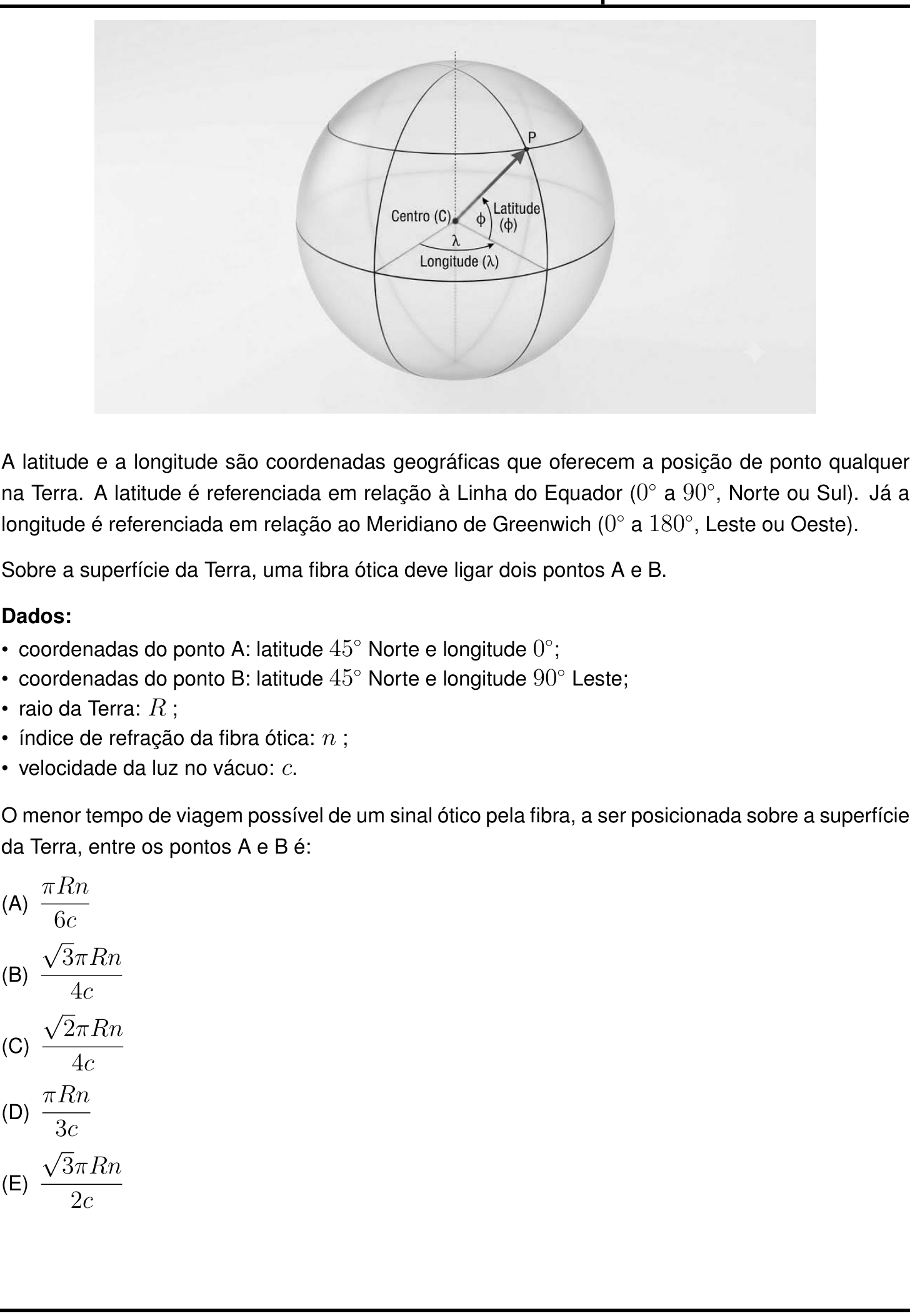
A questão

Questão 29

Respostas das IAs

GPT-6 Astra

D

Respondeu

levou 15 s

Como pensou
**Exploring spherical law in Portuguese** I need to provide a concise explanation of the central spherical law, particularly focusing on the formula relating to the great circle. I'll read through the consistent indices carefully. The formula involves several components, including terms like cos theta and sin for specific angles. I only need to ensure that the explanations and equations are clear. It seems I should hit around 250 words, instead of 150, for a thorough explanation.

O menor caminho entre dois pontos sobre uma esfera é o arco menor de um círculo máximo, e não necessariamente o arco do paralelo que passa por eles.

Seja \theta o ângulo entre os raios que ligam o centro da Terra aos pontos A e B. Em função das latitudes \phi_A,\phi_B e da diferença de longitude \Delta\lambda, temos:

\cos\theta=\sin\phi_A\sin\phi_B+\cos\phi_A\cos\phi_B\cos(\Delta\lambda).

Como ambos os pontos têm latitude 45^\circ Norte e suas longitudes diferem em 90^\circ:

\cos\theta=\sin^2 45^\circ+\cos^2 45^\circ\cos90^\circ =\frac12.

Logo, \theta=60^\circ=\pi/3 rad, e o comprimento mínimo da fibra é

L_{\min}=R\theta=\frac{\pi R}{3}.

A velocidade da luz na fibra é v=c/n. Portanto,

t_{\min}=\frac{L_{\min}}{v} =\frac{\pi R/3}{c/n} =\boxed{\frac{\pi Rn}{3c}}.

Resposta: D

GPT-6.1 Sol

D

Respondeu

levou 10 s

Como pensou
**Explaining great circle angles** I need to solve for the shortest great circle angle using the formula related to a circle of radius \(60 \frac{\pi}{3}\). I think I should explain how to use the dot product and the cosine relation with latitude, ideally breaking it into three paragraphs for clarity. It's important to avoid any confusion with the notation, particularly for the center and angle. I can use specific coordinate vectors and emphasize the spherical cosine formula along the way. Keeping the explanation around 260 characters should help maintain clarity.

Como a velocidade da luz na fibra é constante, v=c/n, o menor tempo corresponde ao menor caminho sobre a superfície terrestre: o arco de círculo máximo que liga A a B, e não o arco do paralelo de latitude 45^\circ.

Seja \theta o ângulo entre os raios que chegam a A e B. Para latitudes \phi_A,\phi_B e diferença de longitude \Delta\lambda,

\cos\theta=\sin\phi_A\sin\phi_B+ \cos\phi_A\cos\phi_B\cos(\Delta\lambda).

Substituindo \phi_A=\phi_B=45^\circ e \Delta\lambda=90^\circ:

\cos\theta =\sin^2 45^\circ+\cos^2 45^\circ\cos90^\circ =\frac12.

Logo,

\theta=60^\circ=\frac{\pi}{3}.

Assim, o comprimento mínimo da fibra é

L=R\theta=\frac{\pi R}{3},

e o tempo mínimo de propagação vale

t_{\min}=\frac{L}{v} =\frac{\pi R/3}{c/n} =\boxed{\frac{\pi Rn}{3c}}.

Resposta: D

GPT-6 Luna

D

Respondeu

levou 6 s

Como pensou
**Explaining geodesics in Portuguese** I need to explain how to recognize the shortest path, or geodesic, on a sphere, given specific coordinates: both at 45°N latitude and a longitude difference of 90°. To find the dot product and central angle, I can use the formula involving sine and cosine, which leads me to a central angle of π/3. The surface distance would be Rπ/3, and to find the signal speed, there's a formula involving the distance divided by speed, ensuring the shortest great circle route on the surface.

A menor trajetória sobre a superfície da Terra é um arco de círculo máximo. O ângulo central \theta entre A e B satisfaz

\cos\theta=\sin\phi_A\sin\phi_B+\cos\phi_A\cos\phi_B\cos(\Delta\lambda).

Com \phi_A=\phi_B=45^\circ e \Delta\lambda=90^\circ,

\cos\theta=\sin^2 45^\circ+\cos^2 45^\circ\cos90^\circ=\frac12,

logo \theta=\pi/3. Assim, o comprimento mínimo da fibra é R\theta=\pi R/3.

A velocidade da luz na fibra é c/n. Portanto,

t=\frac{\pi R/3}{c/n}=\frac{\pi Rn}{3c}.

Resposta: D

Claude Fable 5.1

D

Respondeu

levou 13 s

Como pensou
Converting both points to position vectors on the sphere, I find their dot product gives cos θ = 1/2, so the angle between them is 60° or π/3 radians. That makes the great circle distance Rπ/3. Travel time at speed n with speed of light c gives n·Rπ/(3c), matching answer D.

Resolução

O menor caminho sobre a superfície da Terra entre dois pontos é o arco de círculo máximo (geodésica). Precisamos do ângulo central θ entre A e B.

Escrevendo os vetores posição (com eixo z pelo polo Norte, eixo x no meridiano de Greenwich):

  • A (lat 45°N, lon 0°): \vec A = R\left(\cos 45^\circ,\ 0,\ \sin 45^\circ\right) = R\left(\tfrac{\sqrt2}{2},\ 0,\ \tfrac{\sqrt2}{2}\right)
  • B (lat 45°N, lon 90°E): \vec B = R\left(0,\ \cos 45^\circ,\ \sin 45^\circ\right) = R\left(0,\ \tfrac{\sqrt2}{2},\ \tfrac{\sqrt2}{2}\right)

Produto escalar:

\vec A\cdot\vec B = R^2\left(0 + 0 + \tfrac{1}{2}\right) = \frac{R^2}{2}

Logo \cos\theta = \dfrac{1}{2} \Rightarrow \theta = 60^\circ = \dfrac{\pi}{3}.

Comprimento do arco de círculo máximo:

L = R\theta = \frac{\pi R}{3}

A velocidade da luz na fibra é v = c/n, então o menor tempo é:

t = \frac{L}{v} = \frac{\pi R}{3}\cdot\frac{n}{c} = \frac{\pi R n}{3c}

Resposta: D

Claude Opus 5.5

D

Respondeu

levou 10 s

Como pensou
Computing points A and B on the circle of radius R, their dot product gives a 60° angle between them, so the arc length is πR/3 and the travel time is nπR/(3c) — matching answer D.

Ideia: o caminho mais curto entre dois pontos sobre a superfície de uma esfera é o arco de círculo máximo que os une.

1. Posição dos pontos. Use um sistema com origem no centro da Terra, o eixo z apontando para o polo Norte e o eixo x no meridiano de Greenwich. Um ponto de latitude \phi e longitude \lambda fica em \vec r = R(\cos\phi\cos\lambda,\ \cos\phi\,\text{sen}\lambda,\ \text{sen}\phi).

  • Ponto A (\phi = 45^\circ, \lambda = 0^\circ): \vec A = R\left(\tfrac{\sqrt2}{2},\ 0,\ \tfrac{\sqrt2}{2}\right)
  • Ponto B (\phi = 45^\circ, \lambda = 90^\circ L): \vec B = R\left(0,\ \tfrac{\sqrt2}{2},\ \tfrac{\sqrt2}{2}\right)

2. Ângulo central entre A e B.

\cos\theta = \frac{\vec A\cdot\vec B}{R^2} = 0 + 0 + \frac{1}{2} = \frac12 \;\Rightarrow\; \theta = 60^\circ = \frac{\pi}{3}

Outra forma de ver: a corda AB mede R\sqrt{\tfrac12+\tfrac12} = R. Assim, o triângulo formado por C, A e B é equilátero e o ângulo central é 60^\circ.

3. Comprimento mínimo da fibra.

L = R\,\theta = \frac{\pi R}{3}

4. Tempo de viagem. A velocidade da luz na fibra é v = \dfrac{c}{n}. Logo:

t = \frac{L}{v} = \frac{\pi R n}{3c}

Resposta: D

Claude Sonnet 5.5

D

Respondeu

levou 6 s

Como pensou

Como a fibra deve ficar sobre a superfície da Terra, o menor caminho entre A e B é o arco de círculo máximo (geodésica) que os une.

Vetores posição (com raio R):

  • A: latitude 45°, longitude 0° → R(cos45°, 0, sen45°) = R(√2/2, 0, √2/2)
  • B: latitude 45°, longitude 90° → R(0, cos45°, sen45°) = R(0, √2/2, √2/2)

Ângulo central θ entre A e B:

cos θ = (√2/2)(0) + (0)(√2/2) + (√2/2)(√2/2) = 1/2

Logo θ = 60° = π/3.

Comprimento do arco:

d = Rθ = πR/3

Tempo de viagem:

A velocidade da luz na fibra é v = c/n, então

t = d/v = (πR/3)·(n/c) = πRn/(3c)

Observação: o arco ao longo do paralelo de 45° seria mais longo, pois o paralelo tem raio R·cos45° e o arco de 90° mede (π/2)(R√2/2) = √2πR/4 ≈ 1,11R, contra πR/3 ≈ 1,05R do círculo máximo. Isso confirma que o círculo máximo é o menor caminho.

Resposta: D

Grok 4.7

D

Respondeu

levou 32 s

Como pensou
The problem involves latitude and longitude. It concerns connecting two points on the Earth's surface with a fiber optic cable. Point A is at 45°N, 0° and point B at 45°N, 90°E. The fiber path follows the Earth's surface. I will calculate the central angle between these points using spherical coordinates. I am setting up the position vectors on a unit sphere. Both points have colatitude 45°, with point A at longitude 0° and point B at 90°. The dot product of the unit vectors gives cos α = 1/2, so the central angle is 60°. The great circle distance is Rπ/3. The travel time through the fiber is (πRn)/(3c), which matches option D. I checked the other options. Option C equals the arc length along the 45° parallel, but that path is longer than the great circle. The correct answer remains D.

A menor distância sobre a superfície da Terra entre os pontos A e B é o comprimento do arco de círculo máximo (geodésica) que os une. Para determiná-lo, calculam-se os vetores posição (em coordenadas esféricas com origem no centro da Terra):

\vec{A}=R\bigl(\cos 45^\circ,\ 0,\ \sin 45^\circ\bigr),\qquad \vec{B}=R\bigl(0,\ \cos 45^\circ,\ \sin 45^\circ\bigr).

O produto escalar unitário vale 1/2, de modo que o ângulo central entre os pontos é \alpha=\pi/3. O comprimento do arco é portanto

L=R\alpha=\frac{\pi R}{3}.

No interior da fibra a velocidade da luz é c/n, logo o tempo mínimo de percurso é

t=\frac{L}{c/n}=\frac{\pi Rn}{3c}.

(A trajetória ao longo do paralelo de latitude 45^\circ é mais longa e não corresponde ao mínimo.)

Resposta: D

DeepSeek V4.1 Flash

D

Respondeu

levou 30 s

Como pensou
We need answer question in Portuguese. Need solve. Need likely IME 2027? Let's parse problem. "Sobre a superfície da Terra, uma fibra óptica deve ligar dois pontos A e B. Dados: coordenadas A: latitude 45° Norte e longitude 0°; B: latitude 45° Norte e longitude 90° Leste; raio R; índice refração fibra n; velocidade luz vácuo c. O menor tempo de viagem possível de um sinal óptico pela fibra, a ser posicionada sobre a superfície da Terra, entre pontos A e B é: options." We need find shortest path along surface of sphere between two points on same latitude 45°N, longitudes differ 90°. Need "menor tempo de viagem" = minimum optical path length in fiber divided by speed? The fiber positioned on surface. Optical signal travels along fiber at speed v = c/n? Actually refractive index n, speed in fiber v = c/n. Time = length / v = n * length / c. Need shortest path along surface (geodesic on sphere) between A and B. Then time = n * geodesic distance / c. Options include R n / c times angular measures. Need determine central angle between A and B on great circle? Points both latitude 45°N, longitudes 0 and 90E. Need spherical distance. Let's compute. Coordinates: latitude φ = 45° (north), longitude difference Δλ = 90°. Use spherical law: central angle θ between points satisfies cos θ = sin φ1 sin φ2 + cos φ1 cos φ2 cos Δλ. φ1=φ2=45°, sin^2 45 = 1/2, cos^2 45 = 1/2. cos θ = (1/2) + (1/2)*cos 90° = 1/2 + 0 = 1/2. Thus θ = 60° = π/3 radians. Then arc length = R θ = R π/3. Time = n * distance / c = n R π / (3c). That matches option D: π R n / 3c. Good. But question might have nuance? "O menor tempo de viagem possível de um sinal óptico pela fibra, a ser posicionada sobre a superfície da Terra, entre os pontos A e B é:" If fiber on surface maybe short path is great-circle arc. But there might be issue: "a ser posicionada sobre a superfície da Terra" maybe fiber can be placed along surface; smallest time path along surface may be not necessarily great circle? On a sphere, geodesic shortest path between two points is minor great-circle arc, unless antipodal. Here central angle 60° <180, so yes. Need provide explanation in Portuguese. Include spherical geometry formula. Need final "Resposta: D". Let's craft answer maybe with details. Need ensure no mistake due to optical fiber path maybe can go through interior? "Sobre a superfície da Terra" means on surface, not through Earth. So geodesic. If straight tunnel inside Earth would be shorter but not allowed. Options include? If through chord length? Let's check: chord length = 2R sin(θ/2) = 2R sin30 = R. Time = nR/c, not options. So surface. Need mention coordinates: latitude 45°, longitude difference 90°, central angle formula. Let's solve. Maybe some alternative: The shortest route between two points at same latitude is not along parallel; it's great circle. Need "menor tempo" because light travels at constant speed in fiber; minimum time = minimum length; great circle arc. Let's formulate final answer: - Speed in fiber v = c/n. - Distance d along Earth's surface between A and B = R θ, where θ central angle. - Use spherical law of cosines: cos θ = sin φ_A sin φ_B + cos φ_A cos φ_B cos Δλ = (√2/2)(√2/2) + (√2/2)(√2/2) cos90 = 1/2 + 0 = 1/2 => θ=60°=π/3 rad. - d = Rπ/3. - t = d/v = nRπ/(3c). - Alternativa D. Need maybe not include "π/3" in final? yes. Let's produce final with desired format.

Para a fibra óptica, a luz se propaga com velocidade

v=\frac{c}{n}.

Assim, o menor tempo corresponde ao menor caminho sobre a superfície esférica da Terra, que é o arco de grande círculo entre os pontos A e B.

Dados:

  • Latitude de A e B: 45^\circ
  • Diferença de longitude: 90^\circ

Usando a lei dos cossenos esférica:

\cos\theta=\sin\phi_A\sin\phi_B+\cos\phi_A\cos\phi_B\cos\Delta\lambda
\cos\theta=\left(\frac{\sqrt2}{2}\right)^2+\left(\frac{\sqrt2}{2}\right)^2\cos90^\circ
\cos\theta=\frac12+0=\frac12
\theta=60^\circ=\frac{\pi}{3}\text{ rad}

Distância ao longo da superfície:

d=R\theta=\frac{\pi R}{3}

Tempo mínimo:

t=\frac{d}{v}=\frac{\pi R/3}{c/n} =\frac{\pi Rn}{3c}

Resposta: D

Gemini 3.8 Flash

D

Respondeu

levou 14 s

Como pensou
**Calculating Optimal Travel Time** I'm currently focused on determining the minimum travel time for an optical signal between two points on Earth's surface, A and B. My initial work involves understanding the geodesic path and accounting for the Earth's curvature, as the signal will travel *over* its surface, not through it. **Defining Point Coordinates** I'm now defining the precise spherical coordinates for point B, specifically $45^\circ\text{ N}$ latitude and $90^\circ\text{ E}$ longitude. My current focus is on translating these geographic coordinates into Cartesian $(x,y,z)$ values relative to Earth's center, with the $z$-axis aligned with the North-South pole and the $x,y$ plane at the equator. This is crucial for calculating the great-circle distance. **Calculating Central Angle** I have successfully determined the central angle subtended by the great-circle arc connecting points A and B. This crucial step involved converting their geographic coordinates to Cartesian vectors and then applying the dot product to solve for the angle, yielding a result of $\pi/3$ radians or $60^\circ$. **Deriving Travel Time** I've now calculated the minimum travel time by dividing the great-circle distance by the speed of light in the fiber. My derivation matches alternative (D) perfectly. I'm cross-checking if a path along the parallel at 45° latitude is indeed longer than the great-circle route.

Para determinar o menor tempo de viagem do sinal óptico entre os pontos A e B, devemos encontrar a menor distância sobre a superfície esférica da Terra (geodésica), que corresponde ao arco de círculo máximo (grande círculo) que une os dois pontos.

1. Vetores posição dos pontos A e B:
Adotando um sistema de coordenadas cartesianas com origem no centro da Terra:

  • O eixo z aponta para o Polo Norte.
  • O eixo x aponta para o Meridiano de Greenwich (longitude 0^\circ) sobre o equador.
  • O eixo y aponta para a longitude 90^\circ\text{ L} sobre o equador.

As coordenadas esféricas são dadas por:

x = R \cos\phi \cos\lambda

y = R \cos\phi \sin\lambda

z = R \sin\phi

Para o ponto A (\phi_A = 45^\circ\text{ N}, \lambda_A = 0^\circ):

\vec{r}_A = R\left(\cos 45^\circ \cos 0^\circ, \, \cos 45^\circ \sin 0^\circ, \, \sin 45^\circ\right) = R\left(\frac{\sqrt{2}}{2}, \, 0, \, \frac{\sqrt{2}}{2}\right)

Para o ponto B (\phi_B = 45^\circ\text{ N}, \lambda_B = 90^\circ\text{ L}):

\vec{r}_B = R\left(\cos 45^\circ \cos 90^\circ, \, \cos 45^\circ \sin 90^\circ, \, \sin 45^\circ\right) = R\left(0, \, \frac{\sqrt{2}}{2}, \, \frac{\sqrt{2}}{2}\right)

2. Ângulo central entre A e B:
O ângulo central \theta entre os vetores \vec{r}_A e \vec{r}_B é obtido pelo produto escalar:

\vec{r}_A \cdot \vec{r}_B = |\vec{r}_A| |\vec{r}_B| \cos\theta

R^2 \left(\frac{\sqrt{2}}{2} \cdot 0 + 0 \cdot \frac{\sqrt{2}}{2} + \frac{\sqrt{2}}{2} \cdot \frac{\sqrt{2}}{2}\right) = R^2 \cos\theta
R^2 \left(\frac{2}{4}\right) = R^2 \cos\theta \implies \cos\theta = \frac{1}{2}

Logo, o ângulo central é:

\theta = \frac{\pi}{3}\text{ rad} \quad (60^\circ)

3. Menor distância sobre a superfície da Terra:
O comprimento do menor arco de círculo máximo entre os pontos A e B é:

d = R \cdot \theta = \frac{\pi R}{3}

4. Menor tempo de propagação:
A velocidade v da luz no interior da fibra óptica de índice de refração n é:

v = \frac{c}{n}

Assim, o menor tempo de viagem t é:

t = \frac{d}{v} = \frac{\frac{\pi R}{3}}{\frac{c}{n}} = \frac{\pi R n}{3c}

Resposta: D