Como pensou
We need answer question in Portuguese. Need solve physics. Need be careful. Let's parse problem.
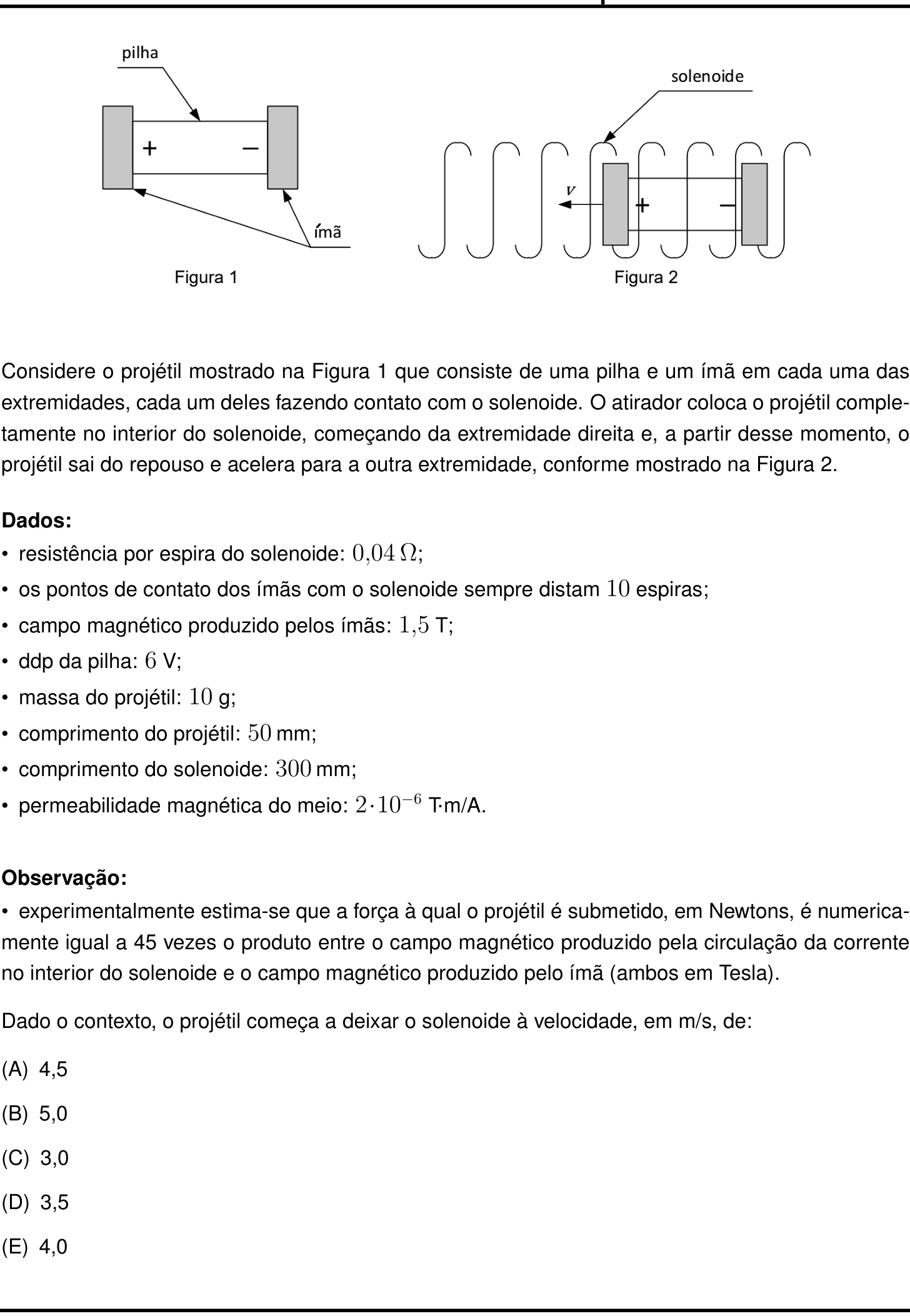
We have projectile shown Fig1 consists of battery (pilha) and magnet at each end, each making contact with solenoid. The shooter places projectile completely inside solenoid, starting from right extremity, and from that moment projectile leaves rest and accelerates toward other extremity, as Fig2.
Dados:
- resistance per turn of solenoid: 0.04 Ω;
- contact points of magnets with solenoid always 10 turns apart; (os pontos de contato dos ímãs com o solenoide sempre distam 10 espiras) meaning distance between contact points? Maybe when projectile moves, battery connects to solenoid through magnets at two points separated by 10 turns? Need understand.
- magnetic field produced by magnets: 1.5 T;
- battery voltage: 6 V;
- projectile mass: 10 g;
- projectile length: 50 mm;
- solenoid length: 300 mm;
- magnetic permeability medium: 2e-6 T·m/A.
Observação: experimentally estimates force on projectile, in Newtons, numerically equal to 45 times product between magnetic field produced by current circulation inside solenoid and magnetic field produced by magnet (both in Tesla). So F = 45 * B_solenoid * B_magnet? Numerically maybe units? Need.
Question: Given context, projectile begins to leave solenoid at velocity, in m/s, of:
(A) 4.5
(B) 5.0
(C) 3.0
(D) 3.5
(E) 4.0
Need solve. This is a railgun/coilgun? Projectile comprises battery and magnets; when inside solenoid, current flows through portion of solenoid between contacts, creating magnetic field inside solenoid. Magnets produce field; force accelerates projectile. Need compute acceleration and final velocity when leaving solenoid? Need account changing number of turns in circuit? As projectile moves, contacts change, but "always distam 10 espiras" maybe contacts distance fixed 10 turns, so length of solenoid wire in circuit is always 10 turns? But wait projectile length 50 mm, solenoid length 300 mm. Battery/magnets contacts are at ends? Distance between contacts? If projectile length 50mm, points of contact with solenoid maybe at magnet ends, and distance between contacts equals projectile length? But "sempre distam 10 espiras" means the two contact points are always separated by 10 turns? Hmm.
Let's understand geometry: Solenoid is a coil of wire. Projectile has two conducting ends (magnets?) that brush against solenoid turns. Battery is inside projectile, connected to left and right magnets, so current enters solenoid at one contact (e.g., right magnet) and exits at other contact (left magnet), completing circuit through segment of solenoid between the two contacts. The segment likely has 10 turns? They say "os pontos de contato dos ímãs com o solenoide sempre distam 10 espiras" = contact points of magnets with solenoid always are 10 turns apart. Since projectile length 50mm, the contacts are separated along solenoid by 50mm. If the solenoid has N total turns over length 300mm, then turns per mm = N/300. Distance 50mm corresponds to N*50/300 = N/6 turns, not necessarily 10 unless N=60. Maybe N=60? Let's see total turns from data? Resistance per turn 0.04 Ω, voltage 6V, need current maybe determined by 10 turns resistance? If contacts separated 10 turns, circuit resistance = 10*0.04=0.4Ω, current = V/R = 6/0.4=15 A. That seems plausible. They explicitly give "pontos de contato ... sempre distam 10 espiras" to define number of turns in circuit = 10. So current through 10-turn segment; resistance = 0.4Ω.
Need compute magnetic field inside solenoid due to current in 10 turns? Solenoid length? Magnetic field inside long solenoid formula B = μ n I, where n = number of turns per unit length. If 10 turns over length 50mm? Wait the 10 turns spanning between contacts along solenoid length of 50 mm? Since contacts distance = projectile length = 50mm, and they say 10 turns apart, so there are 10 turns in 50mm. Thus n = 10 / 0.05 m = 200 turns/m? Or maybe solenoid's total length 300mm, total turns N =? If 10 turns in 50mm, then total over 300mm = 60 turns. Resistance total = 60*0.04=2.4Ω, but circuit only 10 turns, so R=0.4Ω.
Magnetic field inside solenoid: B = μ n I, where n = N/L = 10 / 0.05 = 200 m^-1, I = V/R = 6/(10*0.04)=15 A. μ = 2e-6 T·m/A. Then B_sol = 2e-6 * 200 * 15 = 2e-6 * 3000 = 0.006 T = 6e-3 T. Then force F = 45 * B_sol * B_magnet? Both in Tesla. B_magnet=1.5 T. F = 45 * 0.006 * 1.5 = 45 * 0.009 = 0.405 N. Mass=0.010 kg => acceleration a = F/m = 0.405/0.010 = 40.5 m/s². That seems huge. Over what distance? Projectile length? It starts completely inside solenoid from right extremity; then accelerates to other extremity? The projectile length 50mm; to leave solenoid? It starts completely inside; it accelerates for distance? From initial position "completely inside, starting from right extremity" maybe its left end at right end? Hmm.
Need identify distance over which force acts. Projectile completely inside solenoid, starting from right extremity: perhaps projectile's right end is flush with solenoid's right end; it starts at rest, accelerates toward left; it leaves solenoid when its right end exits left end? The projectile length Lp=50 mm, solenoid length Ls=300 mm. It traverses distance Ls - Lp = 250 mm? Or maybe from right extremity to left extremity, distance = Ls = 300mm? "o atirador coloca o projétil completamente no interior do solenoide, começando da extremidade direita e, a partir desse momento, o projétil sai do repouso e acelera para a outra extremidade" Hmm "coloca o projétil completamente no interior do solenoide, começando da extremidade direita" Could mean initially projectile is placed inside solenoid with its right end aligned with right end (so entirely inside except? completely inside). Then it accelerates toward left and leaves solenoid when it exits at left extremity. The distance traveled until it completely leaves? Need decide. Dados: comprimento do projétil: 50 mm; comprimento do solenoide: 300 mm. The projectile leaves solenoid when its center? Typically "começa a deixar o solenoide" after it travels until its right end reaches left end? Let's parse Portuguese: "o projétil começa a deixar o solenoide à velocidade ..." = "the projectile begins to leave the solenoid at velocity". That means velocity at the moment it starts to exit? "começa a deixar" maybe when front edge reaches end? Need compute velocity when it leaves? Let's examine.
"O atirador coloca o projétil completamente no interior do solenoide, começando da extremidade direita e, a partir desse momento, o projétil sai do repouso e acelera para a outra extremidade, conforme mostrado na Figura 2." In Fig2, projectile is inside solenoid, moving left. It starts from right extremity (maybe right end of solenoid) and accelerates to the other extremity. It leaves solenoid after moving? If projectile length 50 mm, solenoid length 300 mm; if initially completely inside starting from right extremity, then its left end is at distance 50 mm from right end; its right end at right end. The distance to the left extremity until it begins to leave? The projectile begins to leave the solenoid when its right end reaches the left end of solenoid? At that moment, entire projectile? Let's simulate: Solenoid from x=0 left to x=300 right. Initially projectile completely inside from right extremity: maybe its right end at x=300, left end at x=250. It accelerates left. Its left end reaches x=0 after moving 250 mm. Then it begins to protrude; "begins to leave" when its left end exits, i.e., after moving 250 mm. But "sai do repouso e acelera para a outra extremidade" maybe until its right end reaches left extremity? Then "começa a deixar o solenoide" maybe when its right end reaches left end? Actually "o projétil começa a deixar o solenoide à velocidade" probably when it completely leaves? Let's see.
Alternative: The force may act continuously while projectile is inside? The magnetic field inside solenoid is present where current flows through solenoid segment between contacts. The projectile carries battery and contacts; the circuit segment includes turns between contacts, which move along with projectile? Since contacts are on magnets, separated by projectile length; the segment of solenoid between them is 10 turns, always adjacent to projectile? Does the magnetic field act on the magnets? The force might be constant while projectile is inside? As it moves, the contacts move along solenoid, but the current segment also moves? Actually the solenoid is fixed. The projectile contacts slide along solenoid. The current enters through one contact and exits through another contact; the current flows through the portion of solenoid between the two contacts (10 turns). That portion is underneath the projectile? Since contacts are at projectile ends, the current-carrying segment is between them, length 50mm. The magnetic field in that segment acts on the magnets? The force on each magnet due to magnetic field? The observation says force is 45 times product of magnetic fields; perhaps force is constant independent of position. Acceleration constant. Then distance traveled until leaving? Need know distance over which force acts: likely while projectile is inside solenoid, from right end to left end, maybe distance = solenoid length - projectile length? Let's think.
If projectile length = 50 mm, and it starts completely inside from right extremity. It will leave solenoid when its right end exits left end? That would occur when the rear of projectile reaches left end, i.e., it travels 300 mm? But if projectile starts completely inside at right extremity, its right end is at 300. To leave at left, the projectile must travel until its right end reaches 0? That would mean whole projectile exits: distance = 300 mm? Wait if right end at x=300, to have right end at x=0 requires travel 300 mm; then projectile is completely outside (left of solenoid). But "começa a deixar o solenoide" (begins to leave) would be when its left end reaches 0 after traveling 250 mm; at that moment part still inside; it begins to exit. If force continues while any part in solenoid? It may act until completely exits (right end reaches 0), distance 300 mm. But magnetic interaction may only between magnets and solenoid? The force likely acts on magnets while they are inside solenoid? As long as contacts are within solenoid? Since contacts at ends; if projectile length 50mm and solenoid 300mm, contacts remain inside until rear contact exits? The current flows while both contacts touch the solenoid. It will continue until one contact leaves the solenoid (the front one reaches end after 250 mm? or rear reaches end after 300 mm?).
Let's determine: Contacts are at magnets at projectile ends. The current path through solenoid between the two contacts. At initial position: right contact at right end (x=300), left contact at x=250. Circuit includes turns between x=250 and x=300 (10 turns). As projectile moves left, contacts move left. Right contact moves from 300 to 250? Wait no, projectile moves left; both contacts move left. Until left contact reaches x=0? At that point left contact exits left end; but right contact is at x=50. The circuit between contacts would include turns from x=0? Actually left contact at x=0, right at x=50? The current path through solenoid might be between them; but left contact at end maybe cannot contact turns beyond? It may continue until left contact exits; after left contact leaves, no contact? But battery still? Maybe magnets contact the solenoid at ends; when a magnet leaves, contact is lost, so current stops. So force acts while both contacts are within solenoid, i.e., until left (front) contact reaches left extremity? But the projectile still inside; after front exits, the rear contact at x=50 (if length 50) still on solenoid; but circuit open because front contact no longer on solenoid? Actually front contact just at edge; as soon as it passes beyond edge, it may lose contact with coil; current stops. So force may act until the front magnet reaches the end, distance = Ls - Lp = 300 - 50 = 250 mm. But maybe if contacts separated by 10 turns along solenoid, when front reaches end, there is no more coil beyond; circuit open. Thus distance = 250 mm. But question asks velocity when "começa a deixar o solenoide", i.e., when it begins to leave, which is exactly when front reaches end / left extremity. So distance 250 mm. Let's see options: If acceleration 40.5 m/s² over 0.25 m, v = sqrt(2*40.5*0.25)=sqrt(20.25)=4.5 m/s. Option A 4.5. That matches one of alternatives exactly. If distance 0.3 m, v=sqrt(2*40.5*0.3)=sqrt(24.3)=4.93 ~5.0 (option B). If distance 0.05? no. Need decide.
The question: "o projétil começa a deixar o solenoide à velocidade, em m/s, de:" Means "the projectile begins to leave the solenoid at velocity ...". So exactly at moment it starts to leave, which in our model is after moving 250 mm (front reaches end). So speed = sqrt(2*a*0.25) = 4.5 m/s. Option A. This likely is intended. But let's verify all physics.
Need check if force formula: Observação says "experimentalmente estima-se que a força à qual o projétil é submetido, em Newtons, é numericamente igual a 45 vezes o produto entre o campo magnético produzido pela circulação da corrente no interior do solenoide e o campo magnético produzido pelo ímã (ambos em Tesla)." So F = 45 * B_corrente * B_ímã. We used. No 1/2 or something? It says product, numerical equal 45 times product. So yes.
Need check B_solenoid formula maybe B = μ * N/L * I? With N/L? We used n=10/0.05=200. But if solenoid total length 300mm and total turns maybe 60, but the current only through a segment 10 turns of length? The magnetic field produced by the current circulation inside the solenoid: Could be B = μ * (N/L) * I? If the entire solenoid has 60 turns over 0.3m, n=200 turns/m, same. Actually if 10 turns in 50mm -> n=200; and if total 60 turns over 300mm -> n=200; consistent. So n=200. Voltage = 6V, resistance for 10 turns = 0.04*10=0.4Ω, current=15A. B=μ n I = 2e-6 * 200 * 15 = 0.006 T. Force=45*0.006*1.5=0.405 N. mass=0.01 kg => a=40.5 m/s². Distance =? If from right extremity to left extremity? Let's revisit "completamente no interior do solenoide, começando da extremidade direita". If projectile length 50mm and solenoid length 300mm; "completamente no interior" yes. It starts from right extremity; "a partir desse momento, o projétil sai do repouso e acelera para a outra extremidade, conforme mostrado na Figura 2." The figure shows projectile inside near right side, with arrow v pointing left. The projectile will travel until it leaves solenoid. It might leave when it has moved its own length? If "coloca o projétil completamente no interior do solenoide, começando da extremidade direita" Could mean the projectile is initially entirely inside, with its front end at the right extremity? Wait, "começando da extremidade direita" = starting from the right extremity. If placed from the right extremity, maybe the projectile's front end is at the right extremity and the rest extends inside? But "completamente no interior" contradictory? Let's parse: "O atirador coloca o projétil completamente no interior do solenoide, começando da extremidade direita" = The shooter places the projectile completely inside the solenoid, starting from the right end. Maybe meaning initially the projectile is entirely inside with its right end at the right extremity. Figure 2 shows projectile inside with left side at right? Hmm, the labels "v" arrow points left, and projectile (with battery and magnets) is inside solenoid near right side? It shows two magnets, one left one right; there is a gap? Let's inspect Fig2: Solenoid coil extends horizontally; projectile inside; two gray rectangles (magnets) at ends, with a line/battery between them; arrow v points left. The projectile is centered? It might be near right end? The right magnet maybe at right end? Actually the solenoid coil ends beyond both magnets; there is some coil to right of right magnet and left of left magnet? The drawing shows coil loops across; the projectile is located between some loops, not necessarily at end. Since it says starting from right extremity; maybe in Fig2 it's midway? Hmm.
Let's examine if force acts over entire solenoid length? The projectile length 50 mm; solenoid 300 mm. If it starts from right extremity and accelerates to the other extremity, maybe distance traveled is (solenoid length - projectile length)/2? No.
Let's derive more rigorously from energy/work: Force is constant? The current segment always 10 turns; yes B constant; force constant. The distance over which force acts may be from initial position to when it completely leaves? Need determine final velocity "begins to leave" maybe when it leaves the solenoid? Let's consider possible distances and resulting velocities:
- If distance = 0.25 m (Ls - Lp): v=4.5 (A)
- If distance = 0.30 m: v=sqrt(2*40.5*0.3)=4.93 ~5.0 (B)
- If distance = 0.20 m? v=sqrt(16.2)=4.02 (E)
- If distance = 0.30 + 0.05? no.
- If distance = 0.35? v=sqrt(28.35)=5.32 no.
Options: 4.5,5.0,3.0,3.5,4.0. Our 4.5 fits A. Need ensure no factor 2 missing.
Could force formula maybe F = 45 * B_sol * B_magnet? Yes. But maybe B_sol = μ * N^2 * A / l * I? No, inside solenoid B=μ n I. The observation says "campo magnético produzido pela circulação da corrente no interior do solenoide" could be magnetic field inside due to current. We used.
Need check resistance: "resistência por espira do solenoide: 0,04 Ω" and "os pontos de contato dos ímãs com o solenoide sempre distam 10 espiras" => current path has 10 espiras? But maybe two contact points separated by 10 espiras, but current flows through all turns between them? Yes 10 turns in series. However if the projectile has battery connected to two magnets, the current enters one magnet, through the solenoid turns between contacts, and returns to other magnet. So resistance = 10 * 0.04 = 0.4 Ω. Current = 6/0.4 = 15 A. Correct.
Magnetic field of solenoid with 10 turns over length 50 mm: B = μ N I / L = (2e-6)*(10)*(15)/(0.05) = (2e-6*150)/0.05? Wait compute: μ N I / L = 2e-6 * 10 * 15 / 0.05 = 2e-6 * 150 / 0.05 = 2e-6 * 3000 = 6e-3 T. Yes.
Force = 45 * 0.006 * 1.5 = 0.405 N. Mass=10g=0.01 kg -> a=40.5 m/s².
Distance? Let's verify from text: "coloca o projétil completamente no interior do solenoide, começando da extremidade direita e, a partir desse momento, o projétil sai do repouso e acelera para a outra extremidade". If projectile length 50 mm, solenoid length 300 mm. Starting at right extremity means its right end is at right end. It accelerates left until "começa a deixar o solenoide". It begins to leave when its left end reaches the left end? Actually if projectile is in interior, "deixar o solenoide" means its front part exits. The moment it begins to leave is when its left end reaches left extremity. Distance traveled = 300 - 50 = 250 mm. Yes. The other extremity is left end; if projectile were point, distance 300mm. But projectile has length. They included projectile length to subtract. So answer 4.5.
Let's also consider if force might act until projectile's center? Suppose magnetic force acts on both magnets; the net force maybe constant until one magnet leaves. After front magnet exits, rear magnet still inside, force maybe changes sign? No. But "começa a deixar" at front exit. OK.
Let's craft final answer in Portuguese explaining reasoning.
Need maybe mention formula for solenoid: B = μ N I / L. Compute current. Compute acceleration via F=ma. Compute velocity via Torricelli: v² = v0² + 2aΔs, v0=0, Δs=0.25m. v=sqrt(2*40.5*0.25)=4.5 m/s. Conclude A.
Need be mindful: "permeabilidade magnética do meio: 2·10^-6 T·m/A" Maybe they expect B = μ * n * I, n = 10/0.05=200 espiras/m. I = 6/(0.04*10)=15A. B=2e-6*200*15=6e-3 T.
Could there be a factor due to the magnetic field produced by the current "no interior do solenoide" not "no trecho de 10 espiras"? But n = total turns / total length. Since total turns 60, length 0.3m, n=200. Same as 10/0.05. OK.
Let's produce final with concise explanation. The final line: Resposta: A.
Need ensure final answer includes exactly "Resposta: A" at end. Good.
Let's produce in Portuguese.
Need final only? The prompt says "Resolva a questão e explique o seu raciocínio em português. Termine com uma linha neste formato: Resposta: X". We can include explanation then final line. OK.
Let's draft:
- Cálculo da corrente: contato entre 10 espiras, resistência equivalente R = 10 * 0.04 = 0.4 Ω. I = U/R = 6/0.4 = 15 A.
- Campo magnético do solenoide: B_s = μ n I, com n = 10/0,05 = 200 espiras/m. B_s = 2e-6 * 200 * 15 = 6e-3 T.
- Força: F = 45 * B_s * B_imã = 45 * 6e-3 * 1.5 = 0.405 N.
- Massa m = 10g = 0.01 kg; aceleração a = F/m = 0.405/0.01 = 40.5 m/s².
- Distância até começar a sair: o projétil tem 50 mm, o solenoide 300 mm; ele percorre 300 - 50 = 250 mm = 0.25 m.
- Torricelli: v² = 2 a Δs = 2*40.5*0.25 = 20.25; v = 4.5 m/s.
- Alternativa A.
Final.
Cálculo da corrente no trecho do solenoide:
- Como os contatos estão sempre separados por 10 espiras, a resistência do trecho é:
R=10\cdot 0{,}04=0{,}4\ \Omega
I=\frac{U}{R}=\frac{6}{0{,}4}=15\ \text{A}
Campo magnético produzido pelo solenoide nesse trecho:
- O trecho tem 10 espiras em 50 mm = 0,05 m, então:
n=\frac{10}{0{,}05}=200\ \text{espiras/m}
- Campo no interior do solenoide:
B_s=\mu n I = 2\cdot10^{-6}\cdot200\cdot15=6\cdot10^{-3}\ \text{T}
Força sobre o projétil:
F=45\,B_s\,B_{\text{ímã}}
=45\cdot6\cdot10^{-3}\cdot1{,}5
=0{,}405\ \text{N}
Aceleração:
m=10\ \text{g}=0{,}01\ \text{kg}
a=\frac{F}{m}=\frac{0{,}405}{0{,}01}=40{,}5\ \text{m/s}^2
Distância percorrida até o projétil começar a sair do solenoide:
\Delta s = 300\ \text{mm}-50\ \text{mm}=250\ \text{mm}=0{,}25\ \text{m}
Velocidade final por Torricelli:
v^2 = v_0^2 + 2a\Delta s
=0+2\cdot40{,}5\cdot0{,}25
=20{,}25
v=4{,}5\ \text{m/s}
Resposta: A