Como pensou
We need answer in Portuguese. Need solve geometry. Let's restate.
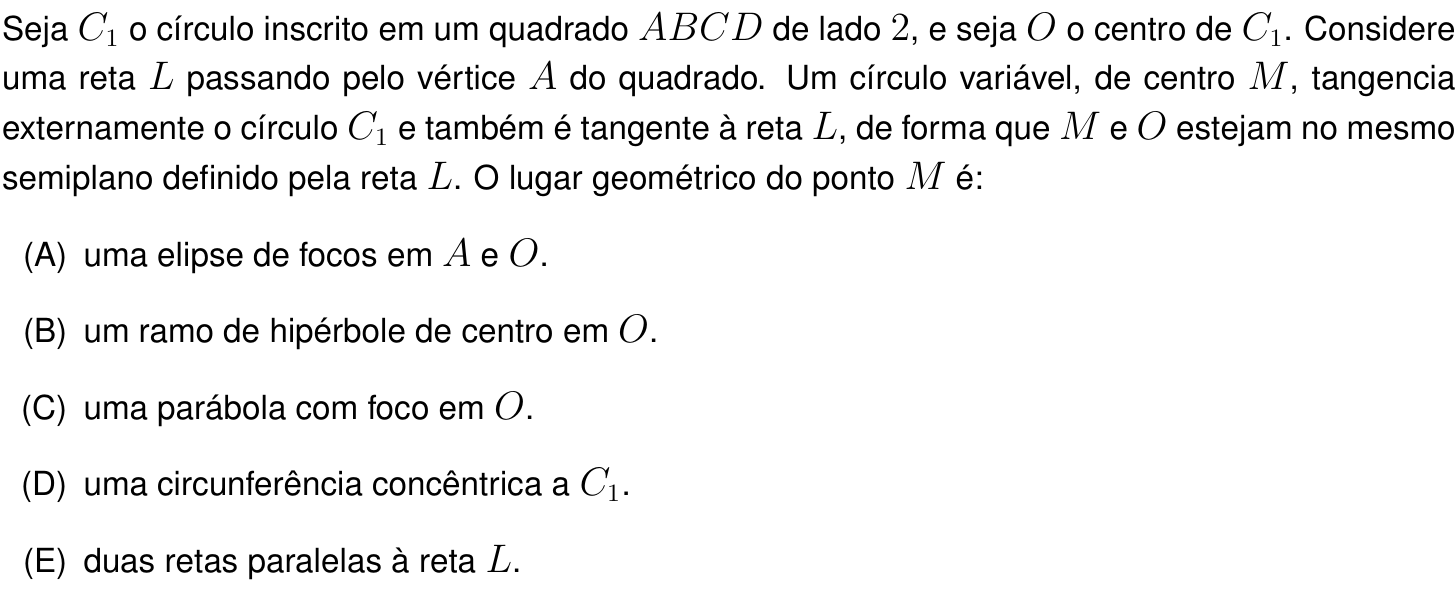
Square ABCD side 2. Circle C1 inscribed in square, center O. So C1 radius 1, center at square center. Let A be a vertex of square. A line L through vertex A. A variable circle with center M tangent externally to C1 and also tangent to line L, with M and O on same side of L. Locus of M? Options.
We need analyze. We can set coordinates. Need be careful: L arbitrary? The statement: "Considere uma reta L passando pelo vértice A do quadrado. Um círculo variável, de centro M, tangencia externamente o círculo C1 e também é tangente à reta L, de forma que M e O estejam no mesmo semiplano definido pela reta L. O lugar geométrico do ponto M é:"
So L is a fixed arbitrary line through A? The variable circle varies for a fixed L? The locus of M as circle varies (probably for a fixed L) maybe is a conic. Options include ellipse, hyperbola, parabola, circle, parallel lines. Need identify. Since L arbitrary through A? Wait if L is fixed, locus is conic depending on distance from O to L? Let's derive.
Let coordinate system convenient: Square side 2. Let A=(0,0)? Need O coordinates. Circle inscribed in square center O. Let's choose square vertices perhaps A=(0,0), B=(2,0), C=(2,2), D=(0,2). Then inscribed circle center O=(1,1), radius r=1. Line L through A=(0,0), arbitrary direction. Let L be line y = m x or angle. Since M and O same side of L.
Circle with center M tangent to L, so distance from M to L equals radius ρ of variable circle. It is externally tangent to C1: distance MO = ρ + 1 (since external tangent). Since C1 radius 1, M outside C1. Also M and O same side of L.
So for a point M, the circle centered at M tangent to L has radius d(M,L). Condition d(M,L) >0 and distance MO = d(M,L)+1. Equivalently MO - d(M,L) = 1. That's a conic? Let F=O, directrix L. Distance to focus O minus distance to line L constant 1? Actually MF = distance to directrix + 1. If distance to directrix = d, MF = d + 1. This is not standard conic (difference of distances) maybe parabola? Let's see: MF - d = 1. For a point, distance to focus minus distance to directrix constant. Set with focus O, directrix L. This defines a conic? Standard conic is distance to focus = e * distance to directrix. Here distance to focus = distance to directrix + 1, not linear. Not a conic? Wait maybe because C1 center and radius? Actually C1 is circle, variable circle tangent externally to C1 and tangent to line L. If instead consider homothety? Hmm condition MO = ρ + 1, where ρ = d(M,L). So MO - d = 1. This is a branch of hyperbola? Let's test.
Take coordinate with L as x-axis, A origin, and focus O at some point (a,b) with b>0. For points M=(x,y) on same side y>0? Actually L y=0, O has b>0. Distance to L: d=y (assuming y>0). Condition sqrt((x-a)^2+(y-b)^2) = y + 1. Square:
(x-a)^2 + (y-b)^2 = y^2 + 2y +1
=> (x-a)^2 + y^2 -2by + b^2 = y^2 + 2y +1
=> (x-a)^2 -2by + b^2 -2y -1 =0
=> (x-a)^2 -2(b+1)y + (b^2 -1)=0.
So y = [(x-a)^2 + b^2 -1]/[2(b+1)]. This is a parabola! Because quadratic in x, linear in y. So locus is a parabola with vertical axis? Wait x^2 term. It is a parabola with focus? Let's compare standard: (x-a)^2 = 2(b+1)(y - c), where c=(b^2-1)/(2(b+1)) = (b-1)/2. Vertex at (a, (b-1)/2). Focus? Standard parabola (x-h)^2 = 4p(y-k), so 4p=2(b+1), p=(b+1)/2. Focus at (h, k+p) = (a, (b-1)/2 + (b+1)/2) = (a,b) = O. Directrix y = k - p = (b-1)/2 - (b+1)/2 = -1. So focus is O, directrix is line parallel to L at distance 1 on opposite side? Wait L is y=0, directrix y=-1. So parabola with focus O and directrix parallel to L? But options say "uma parábola com foco em O" (parabola with focus at O). That matches. But need ensure line L is directrix? Our derivation says directrix is line parallel to L at distance 1 from L? Actually directrix y=-1, not L. But option C says parabola with focus in O. Is it exactly? Let's parse: "uma parábola com foco em O." Yes.
But need check special cases: If L passes through O? Then b=0? O=(1,1), A=(0,0), line through A could pass through O if A,O line? A=(0,0), O=(1,1), line y=x passes through O. Then L contains O. But M and O same side? If L contains O, O on L, no side? Maybe excluded? Let's analyze. If b=0, O on L. Then distance from M to L = d, MO = d+1. Since O on L, distance MO >= d? Actually distance from M to line = component perpendicular, while MO is full distance. Condition MO = d+1. Could be a ray? Let's see. If O on L, then for M not on L, MO > d (unless M perpendicular above O). Condition MO - d =1. This is like branch of hyperbola? Let's derive with L x-axis, O=(0,0) maybe. Condition sqrt(x^2+y^2)=|y|+1. Square: x^2+y^2 = y^2+2|y|+1 => x^2 = 2|y|+1. For y>0: x^2 = 2y+1 => y=(x^2-1)/2 (parabola). For y<0: x^2 = -2y+1 => y=(1-x^2)/2 (parabola). But M and O same side? O on line, no side. Maybe not considered? If b=0, the locus is union of two parabolas? But options maybe still parabola? Hmm.
But line L arbitrary through A; O is at distance? In square, center O at distance sqrt(1^2+1^2)=sqrt2 from A? Wait A=(0,0), O=(1,1), distance AO=√2. If line L passes through A and O, then b=0 (distance from O to L =0) because O lies on L. But "M e O estejam no mesmo semiplano definido pela reta L" if O on L, any side? The same semiplano is not defined if O on boundary. Maybe L not through O? The problem maybe assumes general position? But "reta L passando pelo vértice A" can be any line, including AO. If L passes through O, then condition "M and O same side" impossible because O on line? It might mean if O on L, then M same side? Usually semiplano defined by L containing O? If O on L, all points? No. Maybe L is not through O? Hmm.
Need consider maybe L is not arbitrary but fixed? The locus for fixed L. Options include parabola with focus O. Our derived equation for b>0 is parabola with focus O and directrix line parallel to L at distance 1 from L? Wait directrix y=-1, which is the line parallel to L at distance 1 on the side opposite O? Since O y=b>0, directrix y=-1. The distance from O to directrix = b+1. The focus is O. So yes parabola. But why directrix distance 1? Because C1 radius 1. If b=0, focus on directrix? Then parabola degenerates? Actually if focus O on L, our equation x^2 = 2|y|+1? That's two parabolas with focus O? Let's check standard parabola with focus O=(0,0), directrix y=-1? Equation x^2 = 4p(y+1/2)? For focus (0,0), directrix y=-1: p=1/2, equation x^2 = 2(y+1/2) = 2y+1. Yes for y≥? That matches x^2=2y+1. So upper branch is parabola with focus O and directrix y=-1. Lower branch? If y<0, condition sqrt(x^2+y^2)= -y +1 (since |y|=-y) => x^2+y^2 = y^2 -2y +1 => x^2 = -2y +1 => x^2 = 2(-y)+1? Wait y negative; equation x^2 = 1 - 2y. This is parabola with focus O? Standard parabola with focus (0,0), directrix y=1? For y<0, directrix y=1? Equation x^2 = -4p(y - k)? Let's solve: focus (0,0), directrix y=1 => distance to focus sqrt(x^2+y^2), distance to line = |y-1| = 1-y for y<1. Condition sqrt = 1-y? Square x^2+y^2 = (1-y)^2 =1 -2y + y^2 => x^2 =1 -2y. Yes. So lower branch is another parabola with focus O and directrix y=1 (opposite side). So if O on L, locus is two parabolas (not a single parabola) or maybe one parabola? But M and O same side? If O on L, "same side" undefined. If we require M in same open half-plane as O, but O not in open half-plane. So maybe exclude b=0. So likely L not through O. Options include "uma parábola" not two. So under general position (L not through O), locus is a parabola.
But wait: Is M allowed anywhere? Condition distance MO = d(M,L)+1. Since d(M,L) is distance to line L. For any M on same side of L as O, d>0. We got a parabola. Let's verify with another method: The variable circle tangent externally to C1. If center M, radius ρ = MO -1. It is tangent to line L, so distance from M to L = ρ = MO -1 => MO - d =1. Yes.
This equation indeed defines a parabola? Let's check geometric definition: A parabola is set of points equidistant from focus and directrix. Here MO = d + 1. If we shift directrix? Let L' be line parallel to L at distance 1 from L in the direction away from O? Wait O same side as M, so L is below? Let's visualize: O above L? Suppose O at distance b>0 above L. For M above L, d=y. Condition MO = y+1. This means distance from M to O equals distance from M to line L'? Define L' as line parallel to L obtained by translating L by 1 unit away from O? If O above L (b>0), then translating L downward (opposite O) by 1 gives y=-1. Distance from M to L' = y+1 = d+1. So condition MO = distance(M,L'). Yes. Thus M lies on parabola with focus O and directrix L' (parallel to L, on opposite side of L from O, distance 1 from L). So option C says parabola with focus O. Correct.
But need ensure not other conic? Let's test with coordinates if L not arbitrary? Suppose L through A but not necessarily any line? The problem's wording: "Considere uma reta L passando pelo vértice A do quadrado." Maybe L is fixed and arbitrary. The locus of M as the circle varies maybe depends on L. Options include parabola. So answer C.
But let's be thorough, because there might be trick: The circle C1 is inscribed in square ABCD side 2. A is a vertex. O center. Line L through A. Variable circle tangent externally to C1 and tangent to L, with M and O same side of L. Locus of M. We found parabola with focus O and directrix parallel to L at distance 1 from L. But option C says "uma parábola com foco em O." But is it always a parabola? Yes for fixed L, as M varies. However, "lugar geométrico do ponto M" maybe for all possible L? Wait the problem says "Considere uma reta L passando pelo vértice A ... Um círculo variável ... tangencia ... O lugar geométrico de M é:" It likely asks for given L, find locus. If L varies, the union of loci? But options singular. Since L arbitrary, but locus for each fixed L might be conic. The answer should be independent of L? But if L changes, the parabola's directrix changes, but it's still a parabola with focus O. So option C.
But let's check if there is a possibility of an ellipse or hyperbola due to distance to O minus distance to L = 1? Wait distance to point minus distance to line constant is not a conic? We derived a parabola because distance to line is linear. But let's double-check by transforming.
Set coordinates with L as x-axis. Let O=(p,q) with q>0. Condition sqrt((x-p)^2+(y-q)^2) = y+1. Square gave (x-p)^2 = 2(q+1)y + (1 - q^2)? Let's recompute carefully.
(x-p)^2 + (y-q)^2 = (y+1)^2 = y^2 +2y +1
=> (x-p)^2 + y^2 -2qy + q^2 = y^2 +2y +1
=> (x-p)^2 = 2(q+1)y + 1 - q^2
=> y = [(x-p)^2 + q^2 -1]/[2(q+1)].
This is a parabola opening upward if q+1>0 (q>0 yes). Vertex at (p, (q^2 -1)/(2(q+1))) = (p, (q-1)/2). Standard form: (x-p)^2 = 4p_param (y - k), with 4p_param = 2(q+1), p_param=(q+1)/2 >0. Focus at (p, k + p_param) = (p, (q-1)/2 + (q+1)/2) = (p,q) = O. Directrix y = k - p_param = (q-1)/2 - (q+1)/2 = -1. So indeed focus O, directrix y=-1. This is independent of q? Directrix is line parallel to L at distance 1 from L on opposite side from O? Since O at y=q>0, L y=0, directrix y=-1. Yes distance from L to directrix =1, on opposite side of O. So correct.
But wait: The circle C1 radius 1. The distance from L to directrix is exactly radius. This is because external tangency: MO = ρ + 1, ρ = d(M,L). So MO = d(M,L)+1. The directrix is L shifted by 1 away from O. So yes.
What if L is below O? By same side condition, O and M same side, but O may be below L? We can always orient. If O distance b from L, b>0 (since O not on L? If O on L, b=0). For b>0, directrix is on side opposite O at distance 1. So parabola.
Now, maybe the problem expects a "parábola" but with focus at O and directrix as a line parallel to L at distance 1? Option C says "uma parábola com foco em O", not mentioning directrix. So yes.
Let's verify with a sample: Square A=(0,0), B=(2,0), C=(2,2), D=(0,2), O=(1,1). Take L = x-axis (y=0), line AB through A? Actually AB is side from A to B, line y=0 through A. Then O is at distance 1 from L, same side y>0. Condition MO = y+1. Equation (x-1)^2 + (y-1)^2 = (y+1)^2 => (x-1)^2 + y^2 -2y +1 = y^2 +2y +1 => (x-1)^2 = 4y. So parabola y = (x-1)^2/4, focus (1,1)=O, directrix y=-1. That works. Circle C1 radius 1 centered (1,1) tangent to L y=0 at (1,0). Variable circle tangent externally to C1 and to L: its radius = y, distance to O = y+1. For a point M=(x,y) on parabola, circle tangent to L at vertical? Yes.
Take L=line y=x through A. Then O=(1,1) lies on L, so b=0. Our formula would have q=0? Not valid because O on L. Condition M and O same side? undefined. Maybe the problem implicitly assumes L does not pass through O? It doesn't say. But if L=diagonal AO, then the locus might be two parabolas? Let's check if in that case the "same side" condition can be interpreted as M in the same half-plane as O? But O on line, there is no half-plane containing O? Usually a line divides plane into two open half-planes, neither contains O. So condition impossible if O lies on L. Thus such L excluded by "M e O estejam no mesmo semiplano definido pela reta L" because O on boundary, not in a semiplano. So L not through O. So b>0.
Thus answer C.
But need provide explanation in Portuguese. The final answer should have reasoning and final line "Resposta: C". Need ensure not too verbose. But let's continue to ensure no other options.
Could it be a hyperbola? Let's test if condition were MO + d = constant? No. Our condition is difference. For ellipse: sum distances to two foci constant. Hyperbola: difference distances to two foci constant. Parabola: distance to focus equals distance to directrix. Our condition distance to focus equals distance to line + constant. If directrix is shifted, it's parabola. So yes.
Let's produce final explanation. But before final, maybe there is another interpretation: The variable circle tangent externally to C1 and tangent to line L. The center M must be such that the circle is also externally tangent? The condition "tangencia externamente o círculo C1" means the variable circle is outside C1, so distance between centers = sum of radii = R+1. "tangente à reta L" means distance from M to L = R. So R = distance(M,L) = MO -1. So MO - distance(M,L) = 1. Since M and O same side of L, choose signed distance? The locus is a parabola with focus O and directrix the line parallel to L at distance 1 from L on the side opposite to O. Because for any M on same side as O, distance to directrix = distance to L + 1. Thus MO = distance to directrix. Hence parabola.
We can write in final: Seja d a distância de M a L. Como o círculo de centro M é tangente a L, seu raio é d. A tangência externa com C1 (raio 1) dá MO = d + 1. Logo MO = distância de M à reta L' paralela a L, situada a 1 unidade de L no lado oposto a O. Portanto, pela definição, M descreve uma parábola com foco O e diretriz L'. Alternativa C.
Need mention if O on L, condition impossible, so assume not. Fine.
Final line: Resposta: C.
Let's produce final in Portuguese.