Respondeu
levou 8 s
Como pensou
**Analyzing Portuguese Image Question**
I need to tackle the Portuguese image question with a clear explanation identifying past participles like "stripped," "erased," and more. Acknowledging past and present perfect forms may be helpful, but I should keep it concise. The crown symbolizes dignity and justice rather than suffering. I think we should write 2-3 paragraphs focusing on resilience, emphasizing ongoing violence and roots. The final response could illustrate the persistence through terms like "breathes" and "rises," highlighting ancestral connections without excessive detail.
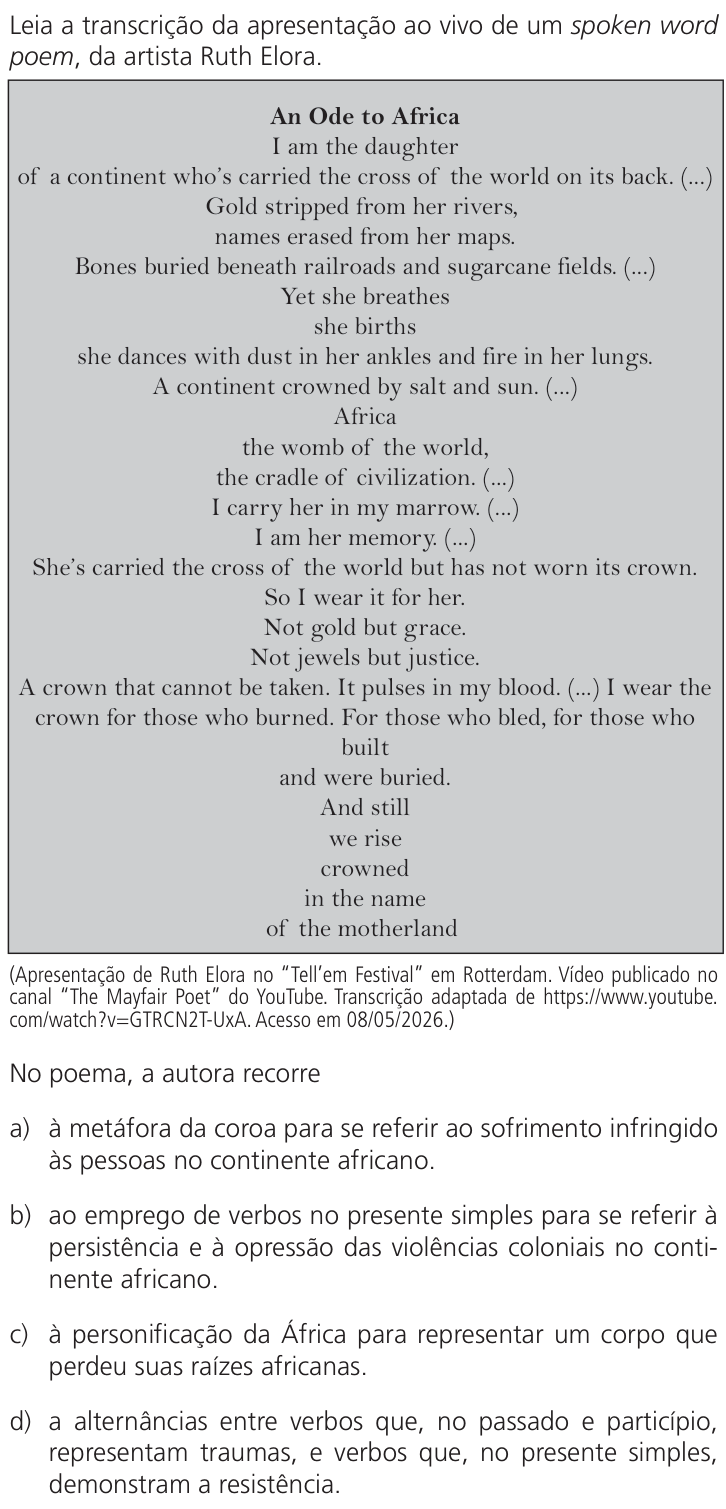
A alternativa correta é D. O poema alterna formas verbais no passado e no particípio, como “stripped” (retirado), “erased” (apagados) e “buried” (enterrados), que remetem à exploração e aos traumas históricos da África, com verbos no presente simples, como “breathes” (respira), “births” (dá à luz), “dances” (dança) e “rise” (nos erguemos), que expressam vitalidade e resistência.
A coroa simboliza dignidade e justiça, não o sofrimento, associado à imagem da cruz. Além disso, a personificação da África e as referências ao sangue e à memória reforçam os vínculos ancestrais, em vez de indicar perda de raízes.
Resposta: D
Respondeu
levou 8 s
Como pensou
**Explaining Portuguese Temporal Forms**
I need to provide examples of Portuguese temporal forms, contrasting past oppression with present vitality. I should note that phrases like "stripped," "erased," "buried," "burned," and "bled" illustrate past experiences, while "she breathes," "she dances," and "we rise" signify current strength. My response will consist of two paragraphs exploring these contrasts without overdoing it. I'll ensure to include the phrase "She's carried" in the present perfect, while referencing past participles as needed in my final answer.
A alternativa correta é a D. O poema contrapõe as marcas da violência histórica à resistência e à vitalidade africanas.
Os verbos no passado e no particípio, como “stripped”, “erased” e “buried”, remetem à exploração das riquezas, ao apagamento de identidades e às mortes. Já formas no presente simples, como “she breathes”, “she dances” e “we rise”, afirmam a continuidade da vida e a resistência diante desses traumas.
A coroa, por sua vez, simboliza dignidade e justiça, não sofrimento; e a personificação da África reforça o vínculo com as raízes africanas, em vez de indicar sua perda.
Resposta: D
Respondeu
levou 4 s
Como pensou
A autora contrapõe imagens de violência colonial — como “gold stripped”, “names erased” e “bones buried” — a verbos no presente, como “breathes”, “births”, “dances” e “we rise”. Os particípios e formas do passado evocam os traumas sofridos; o presente destaca a continuidade e a resistência dos povos africanos.
Resposta: D
Respondeu
levou 6 s
Como pensou
Analisando o poema de Ruth Elora:
- A coroa ("crown") não representa sofrimento, mas sim dignidade, "grace", "justice" e resistência ("we rise crowned") — isso elimina a alternativa A.
- Os verbos no presente simples ("she breathes", "she births", "she dances", "we rise") expressam vida e resistência, e não a opressão das violências coloniais — elimina a B.
- A personificação da África a apresenta como mãe ("motherland", "womb of the world", "cradle of civilization"), uma figura que, apesar do sofrimento, respira e dança; não é um corpo que perdeu suas raízes — elimina a C.
- O poema alterna claramente dois registros verbais: particípios e passado que marcam os traumas ("stripped", "erased", "buried", "has carried the cross", "burned", "bled", "built and were buried") e verbos no presente simples que marcam a resistência ("she breathes", "she births", "she dances", "I wear", "it pulses", "we rise"). A conjunção "Yet" e a expressão "And still" reforçam exatamente esse contraste entre trauma e resistência.
Resposta: D
Respondeu
levou 7 s
Como pensou
I'm noticing the poem uses past/participle verbs like "carried," "stripped," "erased," "buried," and "burned" for trauma, while shifting to present simple verbs like "breathes," "births," "dances," and "rise" for resistance—pointing me toward D. The crown metaphor in A signals dignity rather than suffering, and B's present tense actually marks resistance rather than oppression, so I'm ruling those out while weighing whether C's personification of Africa fits better.
Análise das alternativas
-
Traumas no passado/particípio. O sofrimento colonial aparece com verbos no passado ou particípio:
- "has carried the cross"
- "Gold stripped from her rivers"
- "names erased"
- "Bones buried"
- "those who burned", "who bled", "who built and were buried"
-
Resistência no presente simples. A sobrevivência e a resistência aparecem com verbos no presente:
- "Yet she breathes / she births / she dances"
- "I carry her in my marrow"
- "I wear it for her"
- "It pulses in my blood"
- "And still we rise"
Essa alternância de tempos verbais corresponde exatamente ao que a alternativa D descreve.
-
Por que as outras alternativas estão erradas:
- a) A metáfora do sofrimento é a cruz ("carried the cross"). A coroa representa dignidade, graça e justiça ("Not gold but grace. Not jewels but justice"), algo que "não pode ser tirado".
- b) O presente simples não expressa a opressão. As violências coloniais estão no passado; o presente expressa a resistência.
- c) A África é de fato personificada, mas como mãe, útero e berço da civilização, que segue viva. Não aparece como um corpo que perdeu suas raízes. A autora, ao contrário, afirma carregá-la "na medula" e ser sua memória.
Resposta: D
Respondeu
levou 4 s
Como pensou
Análise das alternativas, a partir do poema:
- A) Incorreta. No poema, a cruz representa o sofrimento ("carried the cross of the world on its back"). A coroa representa dignidade, justiça e resistência ("Not gold but grace. Not jewels but justice").
- B) Incorreta. O presente simples ("she breathes", "she births", "she dances") expressa resistência e vida, não a opressão colonial. A opressão aparece em particípios e no passado: "stripped", "erased", "buried".
- C) Incorreta. A África é de fato personificada ("she breathes", "womb", "I carry her in my marrow"), mas ela não aparece como um corpo que perdeu as raízes. Ao contrário, a memória e a ancestralidade seguem vivas, carregadas pela autora.
- D) Correta. O poema alterna dois tipos de verbo. Os particípios e o passado ("stripped", "erased", "buried", "carried", "burned", "bled", "built") representam traumas, como a exploração, o apagamento e a morte. Já o presente simples ("breathes", "births", "dances", "we rise", "I wear") mostra resistência e continuidade.
Resposta: D
Respondeu
levou 17 s
Como pensou
The question is in Portuguese about the spoken word poem "An Ode to Africa" by Ruth Elora.
The question asks what the author resorts to in the poem. The options are a metaphor of the crown for African suffering, or present-tense verbs to express colonial oppression.
The remaining options are personifying Africa as a body that lost its roots, and alternating between past and present-tense verbs to represent trauma and resistance.
The poem describes Africa as a continent burdened by the world's cross, stripped of gold and names, and buried beneath railroads and sugarcane. Yet it breathes, gives birth, and dances with dust and fire. The crown is salt and sun. Africa is the womb of the world.
The crown is not a metaphor for African suffering. It is a symbol of grace and justice, worn by the speaker for those who were burned, bled, and buried. The author claims it pulses in her blood and crowns her as she rises for the motherland.
Option b is incorrect. The simple present verbs describe life and resistance. The past participles describe the violence. The present tense does not refer to colonial oppression.
Option c is incorrect. The poem personifies Africa as a living body, but it does not describe a body that lost its roots. The speaker carries Africa in her marrow and is her memory. The idea of lost roots contradicts the text.
Option d is correct. The poem alternates past participles and past verbs to represent colonial traumas, such as gold stripped, names erased, and bones buried. Present simple verbs like breathes, births, and dances express resistance and life. The speaker rises in the present tense for those who burned, bled, built, and were buried.
A coroa, no poema, não simboliza o sofrimento (esse papel cabe à cruz carregada), e os verbos no presente simples não descrevem a opressão colonial, mas a vida e a resistência; tampouco a personificação da África aponta para a perda de raízes. O que o texto faz é alternar formas verbais de passado e particípio (“stripped”, “erased”, “buried”, “burned”, “bled”, “built”) — que evocam os traumas da exploração — com verbos no presente simples (“breathes”, “births”, “dances”, “wear”, “rise”) — que afirmam a persistência e a resistência.
Resposta: D
Respondeu
levou 4 s
Como pensou
We need answer question based on image. Need parse. This appears to be a Portuguese language / literature question? Image contains text "Leia a transcrição da apresentação ao vivo de um spoken word poem, da artista Ruth Elora." Then poem text. Then question alternatives. Need solve. Let's inspect image carefully.
Image text (transcribed roughly):
Top: "Leia a transcrição da apresentação ao vivo de um spoken word poem, da artista Ruth Elora."
Then poem:
"An Ode to Africa
I am the daughter
of a continent who's carried the cross of the world on its back. (...)
Gold stripped from her rivers,
names erased from her maps.
Bones buried beneath railroads and sugarcane fields. (...)
Yet she breathes
she births
she dances with dust in her ankles and fire in her lungs.
A continent crowned by salt and sun. (...)
Africa
the womb of the world,
the cradle of civilization. (...)
I carry her in my marrow. (...)
I am her memory. (...)
She's carried the cross of the world but has not worn its crown.
So I wear it for her.
Not gold but grace.
Not jewels but justice.
A crown that cannot be taken. It pulses in my blood. (...) I wear the crown for those who burned. For those who bled, for those who built
and were buried.
And still
we rise
crowned
in the name
of the motherland
(Apresentação de Ruth Elora no "Tell'em Festival" em Maputo. Vídeo publicado no canal "The Mayfair Poet" do YouTube. Transcrição adaptada de https://www.youtube.com/watch?v=GTRCN2t-UxA. Acesso em 08/05/2026.)
Then question:
"No poema, a autora recorre"
Alternatives:
a) à metáfora da coroa para se referir ao sofrimento infringido às pessoas no continente africano.
b) ao emprego de verbos no presente simples para se referir à persistência e à opressão das violências coloniais no continente africano.
c) à personificação da África para representar um corpo que perdeu suas raízes africanas.
d) a alternâncias entre verbos que, no passado e no presente, representam traumas e verbos que, no presente simples, demonstram a resistência.
Need determine correct. Let's analyze poem.
The question: "No poema, a autora recorre" (In the poem, the author uses)
a) "à metáfora da coroa para se referir ao sofrimento infringido às pessoas no continente africano." She uses crown metaphor? Actually crown used as something not worn by Africa, but she wears it for her; crown of grace/justice, not suffering. So a likely incorrect: crown not suffering, but resistance/justice.
b) "ao emprego de verbos no presente simples para se referir à persistência e à opressão das violências coloniais no continente africano." Present simple verbs? The poem has present simple ("breathes, births, dances, carry, wear, pulses, rise") to refer to persistence/resistance? Also past participles for colonial violence ("stripped, erased, buried, carried, burned, bled, built, buried"). So present simple not for oppression? It's for resilience. b says present simple to refer to persistence and oppression of colonial violence? Maybe wrong: present simple conveys persistence/resistance, not oppression.
c) "à personificação da África para representar um corpo que perdeu suas raízes africanas." Personification of Africa? It is personified? "she breathes, she births, she dances" yes. But represents a body that lost its African roots? In poem, author says I carry her in my marrow, I am her memory; maybe not lost roots, but connection. So likely incorrect.
d) "a alternâncias entre verbos que, no passado e no presente, representam traumas e verbos que, no presente simples, demonstram a resistência." This seems accurate: alternation between past/present verbs representing traumas (stripped, erased, buried) and present simple verbs demonstrating resistance (breathes, births, dances, rise, wear). The poem explicitly uses past for colonial trauma and present simple for resistance.
Need ensure answer d. Let's examine options in Portuguese. d) "a alternâncias entre verbos que, no passado e no presente, representam traumas e verbos que, no presente simples, demonstram a resistência." There is grammar issue: "a alternâncias" should be "à alternância" but okay. It says alternation between verbs that, in past and present, represent traumas and verbs that, in simple present, demonstrate resistance. Wait "verbos que, no passado e no presente, representam traumas" maybe "verbs in past and present represent traumas"? Actually past tense represents traumas; present simple represents resistance. But option d says "verbos que, no passado e no presente, representam traumas e verbos que, no presente simples, demonstram a resistência." Could be read as some verbs in past and present represent traumas, and verbs in simple present demonstrate resistance. The poem has present simple for enduring resistance; past for trauma. Yes.
Let's double-check all alternatives. a: crown metaphor refers to suffering? The crown is not suffering; it's dignity/justice. b: present simple verbs for persistence and oppression of colonial violence? Wrong; present simple for resistance. c: personification of Africa to represent a body that lost roots? Actually personification of Africa to represent continent's resilience and connection; not lost roots. d: correct.
Need provide explanation in Portuguese. End with "Resposta: D". Ensure final line exactly.
Need maybe mention "spoken word poem". We can explain.
Let's craft final answer: The poem contrasts historical violence (gold stripped, names erased, bones buried) expressed with past participles/past, with present simple verbs (breathes, births, dances, rise, wear) indicating resistance, continuity and reparation. The crown metaphor is not suffering but dignity/justice. Therefore d.
Final line: Resposta: D.
O poema contrasta dois campos semânticos e temporais:
- De um lado, aparecem verbos e expressões ligadas ao passado e a traumas coloniais: “Gold stripped”, “names erased”, “Bones buried”, “those who burned”, “those who bled”, “those who built / and were buried”.
- De outro, há verbos no presente simples que expressam resistência, permanência e renascimento: “she breathes”, “she births”, “she dances”, “we rise”, “I wear it for her”, “It pulses in my blood”.
A metáfora da coroa, portanto, não remete diretamente ao sofrimento, mas à dignidade, à justiça e à resistência. A personificação da África também não indica perda de raízes, mas continuidade e memória. Assim, a alternativa que melhor descreve o recurso poético é a que aponta para a alternância entre verbos de trauma, no passado/presente, e verbos de resistência, no presente simples.
Resposta: D
Respondeu
levou 11 s
Como pensou
**Analyzing Unicamp's English/Portuguese Question**
I am currently processing an image containing a comprehension question from the Unicamp entrance exam. My focus is on dissecting the provided English/Portuguese text, "An Ode to Africa," and its associated multiple-choice options to fully grasp the question's nuances.
**Interpreting Poem's Imagery**
I'm analyzing the poem's powerful imagery, particularly the recurring "crown" metaphor. My current focus is understanding how it represents both suffering inflicted upon Africa and the resilience and justice the speaker embodies for the continent.
**Evaluating Poem's Thematic Nuances**
I'm dissecting the poem's thematic elements, specifically the contrast between past trauma and present resilience. My current task involves meticulously examining verb tenses to understand how they convey Africa's suffering and its enduring spirit, directly addressing the options presented.
Com base na leitura do poema An Ode to Africa, de Ruth Elora, podemos analisar as alternativas:
- a) Incorreta: A "cruz" é associada ao peso e ao sofrimento (carried the cross of the world on its back), enquanto a "coroa" é uma metáfora para a dignidade, justiça, graça e soberania (Not gold but grace. / Not jewels but justice.).
- b) Incorreta: As violências e opressões coloniais são expressas predominantemente por particípios e verbos no passado (stripped, erased, buried, burned, bled), enquanto o presente simples expressa a continuidade da vida e a resistência (breathes, births, dances, rise).
- c) Incorreta: A personificação da África enfatiza sua força como matriz geradora (womb of the world, cradle of civilization) e sua conexão profunda com os descendentes (I carry her in my marrow), e não uma perda de raízes.
- d) Correta: Há uma clara alternância temporal e estrutural: formas no particípio/passado denotam as marcas da exploração e os traumas históricos (stripped, erased, buried, burned, bled), enquanto os verbos no presente simples marcam a resiliência, a vitalidade e a resistência (breathes, births, dances, rise).
Resposta: D