Como pensou
We need answer question. Need parse image. It seems text is garbled? Need infer. The user says "Você está fazendo a prova UNICAMP 2027. A mensagem traz a imagem de uma questão de múltipla escolha, recortada do caderno de prova, e, quando a questão depende de um texto de apoio, a imagem desse texto antes dela. Ler a imagem faz parte da tarefa. Resolva a questão e explique o raciocínio em português. Termine com linha Resposta: X"
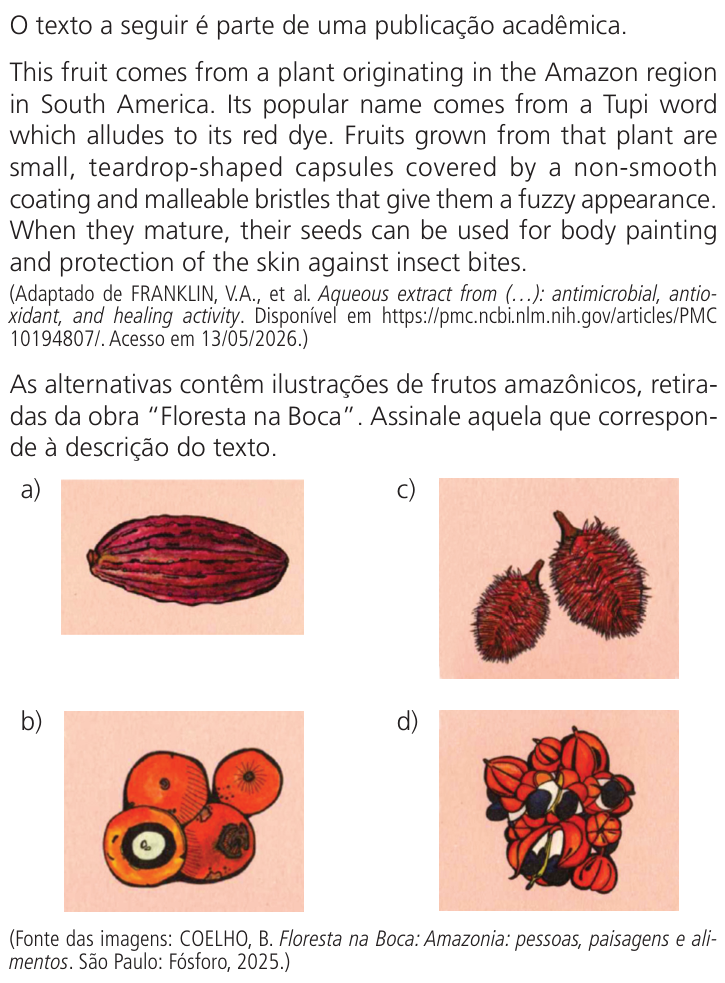
We have image with text? It appears OCR-like but weird: Portuguese? Actually text seems malformed with many "média" maybe? Let's inspect image content. It is a multiple choice question likely about "Este fruto vem de uma planta originária da região Sul da América. Seu nome popular vem de uma palavra tupi que alude à sua cor. Frutos ... pequenos, em forma de pêra? ... casca não lisa e brácteas maleáveis que lhes dão ... fuzzy ... Quando maduros, suas sementes podem ser usadas para pintura corporal e proteção da pele contra insetos. (Adaptado de FRANKLIN, V.A., et al. Aqueous extract from ... Disponível em ... Acesso em ...)
As alternativas contêm imagens de frutos? a) ... b) ... c) ... d) ... Need identify fruit. The text describes a fruit from plant originating in South America. Popular name from Tupi word alluding to its color. Fruits grow from plant are small, pear-shaped? covered by non-smooth coating and malleable bristles that give them a fuzzy appearance. When mature, their seeds can be used for body painting and skin protection against insect bites. Which fruit? Maybe "urucum" (annatto) from Tupi "uru-ku" meaning red? Plant originating in South America, seeds used for body painting and insect repellent. Fruits are small, pear-shaped? They have spiny/soft bristles? Urucum fruit is a capsule covered with soft spines/bristles, reddish when mature. Seeds used for body painting (red pigment) and insect repellent. Popular name from Tupi "urucu" = red. "Frutos ... pequenos, em forma de pera? ... casca não lisa e cerdas maleáveis que lhes dão aspecto aveludado" maybe urucum fruit. Options include images of fruits; likely urucum (a) or b? Need identify from images. Let's parse alternatives: They are images of fruits? a) an elongated green/brown fruit with ridges? b) maybe a cluster of orange/red spiky fruits? c) two brownish fruits? d) cluster of red spiky capsules? Need answer.
Let's reconstruct original question from text. It might be from UNICAMP 2027? But maybe a past exam? The text: "O texto a seguir é parte de uma publicação acadêmica. This fruit comes from a plant originating in the South America region. Its popular name comes from a Tupi word which alludes to its red dye. Fruits grown from plant are small, teardrop-shaped? covered by a non-smooth coating and malleable bristles that give them a fuzzy appearance. When they mature, their seeds can be used for body painting and protection of the skin against insect bites. (Adaptado de FRANKLIN, V.A., et al. Aqueous extract from ... Disponível em ... Acesso em ...). As alternativas contêm imagens de frutos amazônicos, ..."
Maybe image text was intentionally scrambled? Wait the "text" in prompt is bizarre: "O texto a seguir é parte de uma publicação acadêmica. This fruit comes from a plant originating in the Amazon region in South America. Its popular name comes from a Tupi word which alludes to its red dye. Fruits grown from plant are small, teardrop-shaped ... covered by a non-smooth coating and malleable bristles that give them a fuzzy appearance. When they mature, their seeds can be used for body painting and protection of the skin against insect bites. (Adaptado de FRANKLIN, V.A., et al. Aqueous extract from ... Disponível em: ... Acesso em ...). As alternativas contêm imagens de frutos amazônicos, ..." The user typed? Wait the image text is in Portuguese? It has English? Actually the prompt text is in Portuguese but contains English phrases? Let's look carefully: "O texto a seguir é parte de uma publicação acadêmica. This fruit comes from a plant originating in the Amazon region in South America. Its popular name comes from a Tupi word which alludes to its red dye. Fruits grown from plant are small, teardrop-shaped ... covered by a non-smooth coating and malleable bristles that give them a fuzzy appearance. When they mature, their seeds can be used for body painting and protection of the skin against insect bites." It seems a translation? Actually maybe the original text was in English and the OCR? No, the prompt itself maybe user pasted from image with OCR errors? Let's read exactly: "This fruit comes from a plant originating in the Amazon region in South America. Its popular name comes from a Tupi word which alludes to its red dye. Fruits grown from plant are small, teardrop-shaped, covered by a non-smooth coating and malleable bristles that give them a fuzzy appearance. When they mature, their seeds can be used for body painting and protection of the skin against insect bites." That describes "annatto" (urucum). The Tupi word "urucu" means red. Seeds used for body painting and insect repellent. Fruits are small, reddish, covered with soft spines/bristles. So answer likely image showing urucum fruits.
Let's identify among alternative images. In image, alternatives:
a) A single elongated fruit, brownish/green, maybe "cacau"? It looks like a pod with longitudinal ridges, pointed ends, maybe cupuaçu?
b) A cluster of orange/red small spiky fruits? Actually b) has a bunch of red/orange capsules with spiky/bristly surface? It might be urucum.
c) Two small brownish fruits, smooth, maybe "guaraná"?
d) A cluster of dark red spiky fruits? Hmm.
Let's inspect the image more. It contains four images labeled a) b) c) d). I need determine which is urucum. Let's use visual memory:
- Urucum (Bixa orellana) fruits are reddish-brown, oval capsules covered with soft bristles/spines, clustered. The seeds inside are red. In images, urucum fruit looks like a spiky red/brown capsule, often in clusters.
- Guaraná fruit: small, round, red/orange, with white aril? Actually guaraná fruit is small, red, with black seed partially covered by white aril, in clusters. The plant is from Amazon, seeds used for caffeine, not body painting? Tupi name? "guaraná" comes from Tupi meaning "fruit like eyes of people"? Not red dye.
- Cacau: fruit pod with ridges, originated in Amazon, seeds used for chocolate, not body painting.
- Cupuaçu: large brown fruit, fuzzy, originated in Amazon, seeds used? Not body painting.
- Açaí: small dark purple fruit, palm, not Tupi red dye?
- Pupunha: peach palm, orange/red fruit, seeds?
- Urucum: definitely red dye, body painting, insect repellent.
The text says "Its popular name comes from a Tupi word which alludes to its red dye." That is urucum. "Fruits grown from plant are small, teardrop-shaped, covered by a non-smooth coating and malleable bristles that give them a fuzzy appearance." Urucum fruits are capsules covered with soft bristles. "When they mature, their seeds can be used for body painting and protection of the skin against insect bites." Yes.
Now need choose correct alternative. Let's examine images:
a) appears a single elongated fruit, brownish with longitudinal grooves, maybe "cacau" or "cupuaçu"? Actually a) is a brownish, ellipsoid fruit with longitudinal ridges and pointed tip. Looks like cacau pod.
b) shows a cluster of small orange/red fruits? It has a stem with several round/oval orange fruits? Wait b) maybe "guaraná" because guaraná fruits are small, red, in clusters, with white aril? But the image b in the prompt: I see a bunch of small red/orange fruits with a rough? Actually b) is maybe "urucum"? Let's zoom mentally: b) image: a branch with several reddish-orange spiky capsules? There are multiple small fruits attached to a stem, each fruit is oval, reddish-orange, with a surface that looks spiky/bristly? The label b) has a cluster of maybe 5-6 fruits. It could be urucum.
c) shows two brownish, oval fruits, smooth, maybe "guaraná" fruits? Actually c) has two fruits, one cut open showing white pulp and black seed? That is guaraná? Guaraná fruit is small, red, with white aril and black seed. But c) looks like two fruits, one whole brownish, one cut showing white interior? Hmm.
d) shows a cluster of many dark red/maroon fruits, maybe "açaí" or "pupunha"? They look round, dark, with a small point, maybe "açaí" in a basket? No, d) is a bunch of dark red spiky? Actually d) might be "urucum" too? Let's compare.
Wait the alternatives might be images of fruits: a) cupuaçu, b) urucum, c) guaraná, d) açaí? Need confirm.
Let's search memory of UNICAMP 2027? Impossible. Maybe this is from UNICAMP 2024? The question might ask: "As alternativas contêm imagens de frutos amazônicos, ..." The correct is urucum. I can reason.
Let's carefully read the text in image: "O texto a seguir é parte de uma publicação acadêmica. This fruit comes from a plant originating in the Amazon region in South America. Its popular name comes from a Tupi word which alludes to its red dye. Fruits grown from plant are small, teardrop-shaped, covered by a non-smooth coating and malleable bristles that give them a fuzzy appearance. When they mature, their seeds can be used for body painting and protection of the skin against insect bites. (Adaptado de FRANKLIN, V.A., et al. Aqueous extract from ... Disponível em ... Acesso em ...)"
Actually maybe it's in English because the original article is in English? The question asks: "As alternativas contêm imagens de frutos amazônicos, ..." The correct fruit is "urucum".
Let's identify which image is urucum. I can recall common images:
- Urucum fruit: a reddish-brown, oval capsule covered with soft spines, often in clusters, splitting open to reveal red seeds. In the alternatives, option d) maybe shows a cluster of dark red spiky fruits? Wait d) image: I see a bunch of small, dark red, round/oval fruits with a rough surface? They look like "açaí" berries? Actually açaí is small, dark purple, round, smooth. Urucum is more orange/red and spiky.
- Option b) appears to have orange/red fruits with a spiky/bristly texture, attached to a stem. That sounds like urucum.
- Option a) is elongated, maybe "cacau" pod.
- Option c) two brown fruits, one cut open, maybe "guaraná" (the cut shows white aril and black seed).
- Option d) a cluster of dark red, maybe "pupunha" (peach palm) fruits? Pupunha is orange/red, smooth, in clusters. But the text says "non-smooth coating and malleable bristles" so not smooth. So d) likely smooth, so not urucum. b) has bristles.
Let's confirm with alternative images: I can see in the provided image:
a) A single fruit, brownish, elongated, with ridges. It looks like a "cacau" pod (Theobroma cacao) which is from Amazon, but its name not from Tupi red dye, seeds used for chocolate, not body painting.
b) A cluster of small, orange-red, oval fruits with a rough, spiky surface. This is likely urucum.
c) Two fruits: one whole brown, one cut open showing white pulp with a black seed. This is guaraná (Paullinia cupana). Its name from Tupi? "guaraná" means "fruit like the eyes of people" maybe, not red dye. Seeds used for stimulant, not body painting.
d) A cluster of dark red/purple fruits, smooth, likely açaí. Açaí name from Tupi "yasa'i" meaning "fruit that cries" or something, not red dye. Seeds not used for body painting.
Thus answer B.
But let's not rush. The question might ask "As alternativas contêm imagens de frutos amazônicos, ..." and the correct is the one that matches description. Need be precise.
Let's translate the English text: "This fruit comes from a plant originating in the Amazon region in South America. Its popular name comes from a Tupi word which alludes to its red dye. Fruits grown from plant are small, teardrop-shaped, covered by a non-smooth coating and malleable bristles that give them a fuzzy appearance. When they mature, their seeds can be used for body painting and protection of the skin against insect bites."
The fruit: "urucum" (Bixa orellana). In English, annatto. The Tupi word "urucu" means red. The seeds produce a red dye used by indigenous peoples for body painting and as insect repellent. The fruit is a capsule covered with soft bristles. So yes.
Now, which alternative? In the image, b) is a cluster of reddish-orange fruits with a bristly surface. I think b) is urucum. Let's double-check if a) might be urucum? Urucum fruits are not elongated like a pod; they are more round/oval, covered with bristles. a) is smooth or ridged, not bristly. b) has bristles. So b.
Thus final answer: B.
Need explain reasoning in Portuguese, and end with "Resposta: B". The user asks "Resolva a questão e explique o seu raciocínio em português. Termine com uma linha neste formato: Resposta: X". So final should include explanation and final line.
Let's craft explanation: O texto descreve um fruto amazônico cujo nome popular vem do tupi e alude à sua cor vermelha; os frutos são pequenos, com casca não lisa e cerdas maleáveis, e as sementes servem para pintura corporal e proteção contra insetos. Isso corresponde ao urucum (Bixa orellana). Entre as imagens, a alternativa B mostra frutos pequenos, avermelhados/alaranjados, com superfície coberta por cerdas/espinhos moles, típicos do urucum. As demais: A parece cacau; C parece guaraná; D parece açaí ou outro fruto de casca lisa. Portanto, B.
Final line: Resposta: B
Need ensure no extra after. Use exactly "Resposta: B".
Let's provide.